REVIEW 3 major objections 5 minor 39 references
Beamforming and Resource Allocation for Delay Minimization in RIS-Assisted OFDM Systems
T0 review · 3 major / 5 minor · reviewed 2026-08-07 · deepseek-v4-flash
Pith's one-line read This paper claims that a hybrid deep reinforcement learning controller, jointly learning RIS phase shifts and subcarrier assignments from queue lengths, minimizes average packet delay in RIS-assisted OFDM downlinks.
desk verdict Competent hybrid-PPO delay-minimization paper with a real reward-objective mismatch under unequal arrival rates; the equal-arrival results stand but the robustness claim needs work. read the letter →
The pith
A machine-rendered reading of the paper's core claim, the machinery that carries it, and where it could break.
The reading
What carries the argument
The load-bearing mechanism is a hybrid proximal-policy-optimization controller split by action type. PPO-$\Theta$ is a continuous-action actor-critic that maps a state containing direct and cascaded CSI, buffer lengths $q_k[t]$, and packet arrivals $\ell_k[t]$ to the RIS phase vector $\theta[t]$, using a convolutional feature extractor for the channel tensors. PPO-$N$ is a multi-agent discrete-action version in which each subcarrier has its own actor choosing one of $K$ users, while a centralized critic evaluates the global state; the two modules share the reward $r_t=-\sum_k q_k[t]$. The active beamforming at the base station is computed, not learned, by maximum-ratio transmission followed by water-filling over the allocated subcarriers. The design work that carries the argument is the decomposition of the mixed action space and the inclusion of backlog and arrivals in the state, which makes the policy react to delay pressure rather than only to instantaneous rate.
What would settle it
On a small system ($K=3$, $N=8$, $M=36$) with unequal Poisson arrival rates, train the proposed method once with $r_t=-\sum_k q_k[t]$ and once with $r_t=-\sum_k \lambda_k q_k[t]$; if the $\lambda_k$-weighted reward does not lower average or per-user delay, the reward-proxy equivalence is the point of failure. On a fixed channel snapshot, exhaustively search all $K^N$ subcarrier assignments with MRT-water-filling beamforming and compare the best achievable delay against the learned policy; if exhaustive search does not outperform the policy, the simulation evidence would not demonstrate that the learning is near-optimal.
Extended reading notes
Core claim
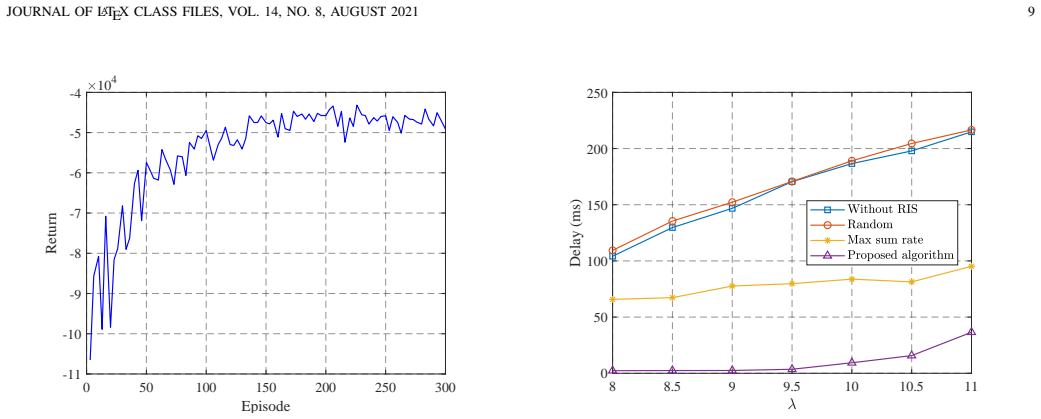
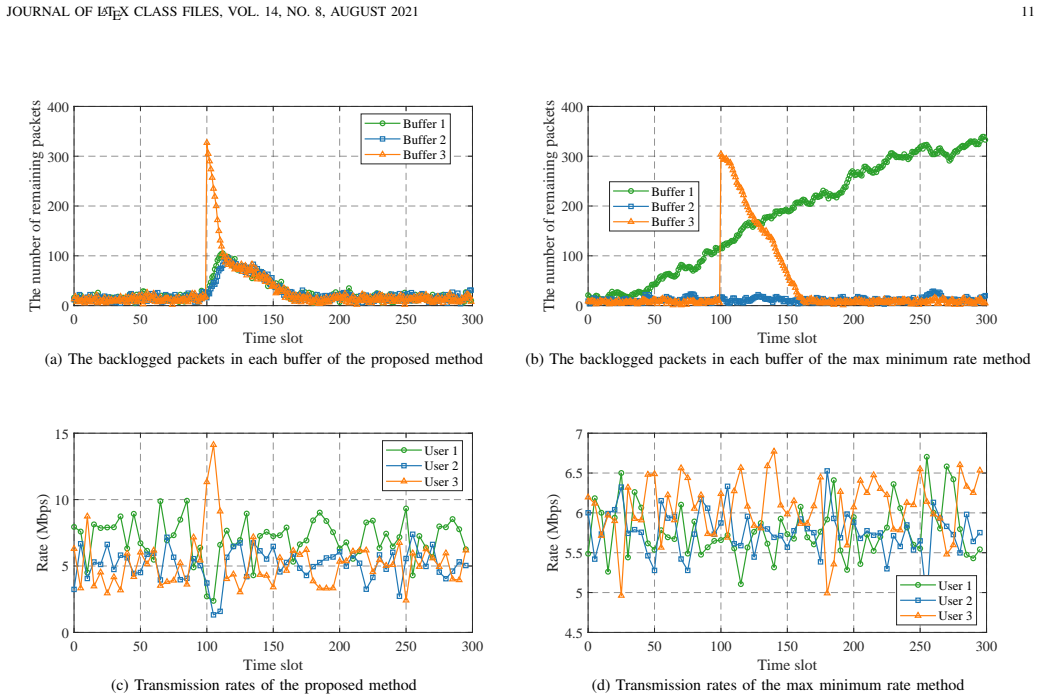
The central claim is that average packet delay in a RIS-assisted OFDM system can be minimized by a queue-aware learned policy over the hybrid action space, and that this beats conventional throughput-oriented or rate-fair baselines. The paper formulates slot-by-slot decisions as an MDP and trains two proximal-policy-optimization modules on the shared reward $r_t=-\sum_k q_k[t]$: PPO-$\Theta$ outputs continuous RIS phase shifts, and PPO-$N$ uses one agent per subcarrier to output discrete user assignments, thereby reducing the subcarrier action space from $K^N$ to $N$ parallel choices of size $K$. Active beamforming is not learned: after the two PPO modules fix phases and subcarrier-user pairings, the base station uses maximum-ratio transmission with water-filling power allocation. The evidence is simulation-based; across arrival rates, burst injections, unequal traffic flows, and three robustness scenarios, the proposed method keeps the lowest average delay and jitter, clears buffer bursts by shifting rate to heavily backlogged users, and maintains balanced backlogs. No theoretical guarantee is claimed for the learned policy, and the comparison rests on the simulated scenarios defined in the paper.
Load-bearing premise
The reward $r_t=-\sum_k q_k[t]$ is treated as a faithful proxy for average delay, but that equivalence is exact only when user arrival rates are equal; the unequal-arrival experiments keep the unweighted reward, so the policy may not be directly optimizing the stated delay objective in that regime.
Editorial extensions
If this is right
- The hybrid split removes the need to alternate between phase optimization and subcarrier assignment in each time slot, since both decisions come from one trained controller.
- The multi-agent subcarrier decomposition cuts the discrete action space from $K^N$ to $N$ agents each choosing among $K$ users, making the method applicable to systems with many subcarriers.
- State features tied to delay—buffer backlog and current arrivals—let the policy prioritize heavily loaded users during bursts, which the paper shows clears backlog faster than a rate-maximizing or max-min-rate policy.
- Pre-training the phase network on a max-min-rate reward and then switching to the backlog reward accelerates convergence, with the return stabilizing around 150 episodes in the reported setting.
- The simulation comparisons imply that RIS assistance is necessary for low delay in this system: the no-RIS baseline has the highest average delay across the tested arrival rates.
Reading between the lines
- A direct extension the paper does not explore is reweighting the reward by arrival rate; a natural test is $r_t=-\sum_k \lambda_k q_k[t]$ under unequal traffic, since the backlog sum is only an exact delay proxy for equal arrival rates.
- The two-module PPO decomposition is not tied to OFDM subcarriers and could be transferred to other mixed-action wireless scheduling problems, such as joint power and resource-block allocation or RIS phase design with user pairing.
- The reported scale is three users; the claimed scalability of the multi-agent subcarrier design would need tests at larger $N$ and $K$, since the centralized critic still observes global state and its training cost is the likely bottleneck.
Editorial analysis
A structured set of objections, weighed in public.
Referee Report
Summary. The manuscript considers a downlink RIS-assisted MISO-OFDM system with stochastic packet arrivals and queueing at the BS. The authors formulate a joint optimization of RIS phase shifts, subcarrier allocation, and active beamforming to minimize the average delay per user. They propose a hybrid DRL algorithm: PPO-Θ for the continuous RIS phases, a multi-agent PPO-N for the discrete subcarrier allocation, and MRT with water-filling for the active beamforming. The state space includes CSI, queue lengths, and current packet arrivals, and a transfer-learning pretraining stage (max-min rate) is used to accelerate convergence. Simulations compare the proposed method against max-sum-rate, max-min-rate, random, and without-RIS baselines across arrival rates, bursty traffic, varying numbers of RIS elements, unequal per-user arrival rates, jitter, and several robustness scenarios.
Significance. The paper addresses an important and timely problem, and the proposed framework is technically sound in its nominal equal-arrival-rate setting. The description of the DRL components is detailed, and the simulation study is fairly extensive, covering bursty arrivals, varying RIS sizes, unequal traffic, jitter, and robustness checks. The paper does not provide theoretical guarantees for the learned policy, but for a simulation-driven systems paper this is acceptable. The main weakness is a reward-objective mismatch under unequal arrival rates, which undermines the robustness and fairness claims for that scenario. If the reward is reweighted and the experiments re-run (or the claims narrowed), the paper would be a solid contribution to delay-aware RIS-assisted resource allocation.
major comments (3)
- [Section III-C, Eq. (21)] The reward r_t = -Σ_k q_k[t] is claimed to be equivalent to the average-delay objective (11). The packet-level argument that cumulative queue lengths reflect aggregate delay is valid only when all users have equal arrival rates. With unequal rates, as in Section IV-G (λ1=λ+gap, λ2=λ, λ3=λ-gap), Little's law gives per-user average delay as E[q_k]/λ_k, so the correct per-slot proxy for the equally weighted per-user average in (11) is -Σ_k q_k[t]/λ_k (up to constants). The unweighted sum overweights users with high arrival rates. Consequently, the results in Fig. 9 and Fig. 11 do not demonstrate that the learned policy minimizes the stated objective; they show queue-balancing behavior under a mismatched reward. The abstract's claim of 'superior system robustness and fairness' is therefore not supported by a reward aligned with the objective in the unequal-rate setting. Please either reweight the reward by 1/λ_k and re-run the unequal-rate experiments, or explicitly reframe the Section IV-G results as empirical queue-balancing rather than delay-minimization under the stated objective.
- [Section III-C, Eq. (21)] The PPO-N critic loss in Eq. (21) is written as E[(r_t + V(s_{t+1}) - V(s_t))^2], omitting the discount factor γ that appears both in the TD error (20) and in the corresponding PPO-Θ critic loss (16). This is internally inconsistent; the TD target should be r_t + γ V(s_{t+1}). Please correct Eq. (21).
- [Section IV-A, footnote 1] The main text states that user positions are fixed throughout each episode, but footnote 1 says 'user positions are randomly generated at each step within an episode during the training process.' These statements are contradictory and directly affect the interpretation of the simulation results. Please clarify whether user positions change per time step, per episode, or only across episodes, and align the footnote with the main text.
minor comments (5)
- [Section I-B] There are several typos in the introduction and throughout: 'propoosed' should be 'proposed', 'trainning' should be 'training', 'indicaters' in Section II-C should be 'indicators', 'brustiness' in Section IV-E should be 'burstiness', 'influcence' in Section III-B should be 'influence', 'necessiates' in Section I should be 'necessitates', 'illstrated' in Section III-B should be 'illustrated', and 'assised' in Section V should be 'assisted'.
- [Section III-B, actor network design] In the paragraph describing the actor network input, 'the transmission power level ℓ_k[t]' should read 'the packet arrival level ℓ_k[t]', since ℓ_k[t] denotes the number of arriving packets, not a power level.
- [Section IV-I and Table III] The notation 'L3' appears in the 'Delay taps' column of Table III and in the text of Section IV-I, but the system model only defines L0, L1, and L2. This is presumably a typo for 'L2'. Please correct the notation for consistency.
- [Section IV-B] For the 'Max sum rate' baseline, the text says 'The algorithm proposed in [37] and [38] is respectively employed for subcarrier allocation and RIS reflection shift optimization.' Please specify which reference corresponds to which subproblem, as both references are IRS-enhanced OFDM papers and the division of labor is unclear.
- [Section III-B, Eq. (12)] The reward in Eq. (12) penalizes only queueing delay, while the objective (11) explicitly includes both queueing and transmission delay. Even in the equal-arrival case, the reward is an indirect proxy that ignores the service-time component. This is acceptable for the simulation study if transmission delays are small relative to queueing delays, but the paper should state this approximation explicitly when motivating the reward.
Circularity Check
No significant circularity: the paper's delay reductions are measured from simulated packet-level delays, not derived from the reward definition by construction.
full rationale
The paper's central claim is an empirical one: the proposed hybrid DRL policy reduces average delay relative to baselines. That claim is supported by simulating the queueing system in Section IV and measuring packet-level delays T_D^(k)(g), as in the problem formulation (11) and the simulation studies in Figs. 6, 7, 10, 11 and Table III. The reward in Eq. (12), r_t = -Σ_k q_k[t], is a design proxy justified via Little's law and citation [36]; it is not identical to the measured delay objective, and the delay numbers are not read off from the reward. There is no fitted parameter renamed as a prediction: the PPO agents are trained on the reward, and the delay results are independently evaluated outcomes of the simulated system. Self-citations in the paper appear in background and component-design contexts (e.g., [1], [3]–[6], [14], [15], [28]–[32]) and do not carry the delay-minimization claim. The legitimate weakness noted for Section IV-G is that the unweighted reward (12) is not perfectly aligned with the equal-weight average-delay objective when per-user arrival rates differ; that is an objective-alignment or correctness concern, not circularity, because the reported delays are not equal to the reward by construction. The derivation chain therefore does not reduce to its own inputs.
Assumptions & free parameters
assumptions (4)
- domain assumption Little's law: long-run average queue length divided by arrival rate equals average delay; hence minimizing the sum of queue lengths minimizes average delay when arrival rates are equal.
- domain assumption Perfect and instantaneous CSI of direct and cascaded links is available at the BS at each slot.
- domain assumption The cyclic prefix length exceeds the maximum channel delay spread, so OFDM subcarriers are orthogonal and inter-symbol interference is eliminated.
- domain assumption Packet arrivals at each buffer follow independent Poisson processes.
Cite this review
Pith. "Pith review of Beamforming and Resource Allocation for Delay Minimization in RIS-Assisted OFDM Systems." pith.science (2026). https://pith.science/paper/X3G75UDT
@misc{pith2026250603586,
  author       = {Pith},
  title        = {Pith review of: Beamforming and Resource Allocation for Delay Minimization in RIS-Assisted OFDM Systems},
  year         = {2026},
  howpublished = {\url{https://pith.science/paper/X3G75UDT}},
  note         = {Machine review of arXiv:2506.03586}
}
read the original abstract
This paper investigates a joint beamforming and resource allocation problem in downlink reconfigurable intelligent surface (RIS)-assisted orthogonal frequency division multiplexing (OFDM) systems to minimize the average delay, where data packets for each user arrive at the base station (BS) stochastically. The sequential optimization problem is inherently a Markov decision process (MDP), thus falling within the remit of reinforcement learning. To effectively handle the mixed action space and reduce the state space dimensionality, a hybrid deep reinforcement learning (DRL) approach is proposed. Specifically, proximal policy optimization (PPO)-Theta is employed to optimize the RIS phase shift design, while PPO-N is responsible for subcarrier allocation decisions. The active beamforming at the BS is then derived from the jointly optimized RIS phase shifts and subcarrier allocation decisions. To further mitigate the curse of dimensionality associated with subcarrier allocation, a multi-agent strategy is introduced to optimize the subcarrier allocation indicators more efficiently. Moreover, to achieve more adaptive resource allocation and accurately capture the network dynamics, key factors closely related to average delay, such as the number of backlogged packets in buffers and current packet arrivals, are incorporated into the state space. Furthermore, a transfer learning framework is introduced to enhance the training efficiency and accelerate convergence. Simulation results demonstrate that the proposed algorithm significantly reduces the average delay, enhances resource allocation efficiency, and achieves superior system robustness and fairness compared to baseline methods.
Figures


Figures from the paper (7 more)





Reference graph
Works this paper leans on
-
[1]
The road to 6G: Ten physical layer challenges for communications engineers,
M. Matthaiou, O. Yurduseven, H. Q. Ngo, D. Morales-Jimenez, S. L. Cotton, and V . F. Fusco, “The road to 6G: Ten physical layer challenges for communications engineers,” IEEE Commun. Mag. , vol. 59, no. 1, pp. 64–69, Jan. 2021
work page 2021
-
[2]
6G wireless networks: Vision, requirements, architec- ture, and key technologies,
Z. Zhang et al., “6G wireless networks: Vision, requirements, architec- ture, and key technologies,” IEEE Veh. Technol. Mag. , vol. 14, no. 3, pp. 28–41, Sep. 2019
work page 2019
-
[3]
Coverage enhancement by deploying RIS in 5G com- mercial mobile networks: Field trials,
J. Sang et al. , “Coverage enhancement by deploying RIS in 5G com- mercial mobile networks: Field trials,” IEEE Wireless Commun., vol. 31, no. 1, pp. 172–180, Feb. 2024
work page 2024
-
[4]
J. Sang et al. , “Multi-scenario broadband channel measurement and modeling for sub-6 GHz RIS-assisted wireless communication systems,” IEEE Trans. Wireless Commun. , vol. 23, no. 6, pp. 6312–6329, Jun. 2024
work page 2024
-
[5]
Physical layer security enhancement exploiting intelligent reflecting surface,
K. Feng, X. Li, Y . Han, S. Jin, and Y . Chen, “Physical layer security enhancement exploiting intelligent reflecting surface,” IEEE Commun. Lett., vol. 25, no. 3, pp. 734–738, Mar. 2021
work page 2021
-
[6]
K. Feng, Q. Wang, X. Li, and C.-K. Wen, “Deep reinforcement learning based intelligent reflecting surface optimization for MISO communica- tion systems,” IEEE Wireless Commun. Lett., vol. 9, no. 5, pp. 745–749, May 2020
work page 2020
-
[7]
Z. Ma, M. Xiao, Y . Xiao, Z. Pang, H. V . Poor, and B. Vucetic, “High- reliability and low-latency wireless communication for internet of things: Challenges, fundamentals, and enabling technologies,” IEEE Internet Things J., vol. 6, no. 5, pp. 7946–7970, Oct. 2019
work page 2019
-
[8]
The road towards 6G: A comprehensive survey,
W. Jiang, B. Han, M. A. Habibi, and H. D. Schotten, “The road towards 6G: A comprehensive survey,” IEEE Open J. Commun. Soc. , vol. 2, pp. 334–366, Feb. 2021
work page 2021
Show all 39 references
-
[9]
A comprehensive survey on mobility-aware D2D communications: Principles, practice and challenges,
M. Waqas et al. , “A comprehensive survey on mobility-aware D2D communications: Principles, practice and challenges,” IEEE Commun. Surveys Tuts., vol. 22, no. 3, pp. 1863–1886, thirdquarter 2020
2020
-
[10]
Delay optimal scheduling for ARQ- aided power-constrained packet transmission over multi-state fading channels,
J. Liu, W. Chen, and K. B. Letaief, “Delay optimal scheduling for ARQ- aided power-constrained packet transmission over multi-state fading channels,” IEEE Trans. Wireless Commun. , vol. 16, no. 11, pp. 7123– 7137, Nov. 2017
2017
-
[11]
Reconfigurable intelligent surfaces: Principles and oppor- tunities,
Y . Liu et al., “Reconfigurable intelligent surfaces: Principles and oppor- tunities,” IEEE Commun. Surv. Tutorials, vol. 23, no. 3, pp. 1546–1577, thirdquarter 2021
2021
-
[12]
Ultrareliable and low-latency wireless communication: Tail, risk, and scale,
M. Bennis, M. Debbah, and H. V . Poor, “Ultrareliable and low-latency wireless communication: Tail, risk, and scale,” Proc. IEEE , vol. 106, no. 10, pp. 1834–1853, Oct. 2018
2018
-
[13]
Low-latency millimeter-wave communications: Traffic dispersion or network densification?
G. Yang, M. Xiao, and H. V . Poor, “Low-latency millimeter-wave communications: Traffic dispersion or network densification?” IEEE Trans. Commun., vol. 66, no. 8, pp. 3526–3539, Aug. 2018
2018
-
[14]
Resource allocation for low-latency vehicular communications: An effective capacity perspective,
C. Guo, L. Liang, and G. Y . Li, “Resource allocation for low-latency vehicular communications: An effective capacity perspective,” IEEE J. Sel. Areas Commun. , vol. 37, no. 4, pp. 905–917, Apr. 2019
2019
-
[15]
Resource allocation for D2D-enabled vehicular communications,
L. Liang, G. Y . Li, and W. Xu, “Resource allocation for D2D-enabled vehicular communications,” IEEE Trans. Commun. , vol. 65, no. 7, pp. 3186–3197, Jul. 2017
2017
-
[16]
Joint power control and rate allocation enabling ultra-reliability and energy efficiency in SIMO wireless networks,
O. L. Alcaraz L ´opez, H. Alves, and M. Latva-aho, “Joint power control and rate allocation enabling ultra-reliability and energy efficiency in SIMO wireless networks,” IEEE Trans. Commun. , vol. 67, no. 8, pp. 5768–5782, Aug. 2019
2019
-
[17]
D2D-based V2V communications with latency and reliability constraints,
W. Sun, E. G. Str ¨om, F. Br¨annstr¨om, Y . Sui, and K. C. Sou, “D2D-based V2V communications with latency and reliability constraints,” in Proc. IEEE GLOBECOM, Dec. 2014, pp. 1414–1419
2014
-
[18]
Cross-layer rate control and resource allocation in spectrum-sharing ofdma small-cell networks with delay constraints,
Y . Guo, Q. Yang, J. Liu, and K. S. Kwak, “Cross-layer rate control and resource allocation in spectrum-sharing ofdma small-cell networks with delay constraints,” IEEE Trans. Veh. Technol. , vol. 66, no. 5, pp. 4133–4147, May 2017
2017
-
[19]
Dynamic resource allocation in queue-constrained and delay-sensitive vehicular networks,
J. Su, Z. Liu, Y . Xie, K. Y . Chan, and X. Guan, “Dynamic resource allocation in queue-constrained and delay-sensitive vehicular networks,” IEEE Trans. Intell. Veh., vol. 8, no. 10, pp. 4434–4444, Oct. 2023
2023
-
[20]
Semantic communication-based dynamic resource alloca- tion in D2D vehicular networks,
J. Su et al., “Semantic communication-based dynamic resource alloca- tion in D2D vehicular networks,” IEEE Trans. Veh. Technol. , vol. 72, no. 8, pp. 10 784–10 796, Aug. 2023
2023
-
[21]
Power-delay tradeoff with predictive scheduling in integrated cellular and Wi-Fi networks,
H. Yu, M. H. Cheung, L. Huang, and J. Huang, “Power-delay tradeoff with predictive scheduling in integrated cellular and Wi-Fi networks,” IEEE J. Sel. Areas Commun. , vol. 34, no. 4, pp. 735–742, Apr. 2016
2016
-
[22]
SOQ: Structural reinforcement learning for constrained delay minimization with channel state information,
Y . Zhao, Y . Kim, and J. Lee, “SOQ: Structural reinforcement learning for constrained delay minimization with channel state information,” IEEE Internet Things J. , vol. 11, no. 3, pp. 4628–4644, Feb. 2024
2024
-
[23]
Delay and energy minimization for cooperative NOMA-MEC networks with SWIPT aided by RIS,
Z. Yang, L. Xia, J. Cui, Z. Dong, and Z. Ding, “Delay and energy minimization for cooperative NOMA-MEC networks with SWIPT aided by RIS,” IEEE Trans. Veh. Technol., vol. 73, no. 4, pp. 5321–5334, Aug. 2024
2024
-
[24]
A delay- oriented joint optimization approach for RIS-assisted MEC-MIMO sys- tem,
S. Jiang, X. Wang, J. Lin, C. Huang, Z. Qian, and Z. Han, “A delay- oriented joint optimization approach for RIS-assisted MEC-MIMO sys- tem,” IEEE Trans. Mob., pp. 1–15, Dec. 2024
2024
-
[25]
Delay-aware resource allocation for RIS assisted semi-grant-free NOMA systems,
J. Jia, K. Yu, X. Mu, Y . Liu, J. Chen, and X. Wang, “Delay-aware resource allocation for RIS assisted semi-grant-free NOMA systems,” IEEE Trans. Commun. , vol. 73, no. 3, pp. 2016–2031, Mar. 2025
2016
-
[26]
Federated learning and wireless commu- nications,
Z. Qin, G. Y . Li, and H. Ye, “Federated learning and wireless commu- nications,” IEEE Wireless Commun. Lett. , vol. 28, no. 5, pp. 134–140, Oct. 2021
2021
-
[27]
Spectrum sharing in vehicular networks based on multi-agent reinforcement learning,
L. Liang, H. Ye, and G. Y . Li, “Spectrum sharing in vehicular networks based on multi-agent reinforcement learning,” IEEE J. Sel. Areas Com- mun., vol. 37, no. 10, pp. 2282–2292, Oct. 2019
2019
-
[28]
Joint transmit beamform- ing and phase shift design for reconfigurable intelligent surface assisted MIMO systems,
J. Wang, H. Wang, Y . Han, S. Jin, and X. Li, “Joint transmit beamform- ing and phase shift design for reconfigurable intelligent surface assisted MIMO systems,” IEEE Trans. Cognit. Commun. Networking , vol. 7, no. 2, pp. 354–368, Jun. 2021
2021
-
[29]
Quantized phase alignment by discrete phase shifts for reconfigurable intelligent surface-assisted communication systems,
J. Sang et al. , “Quantized phase alignment by discrete phase shifts for reconfigurable intelligent surface-assisted communication systems,” IEEE Trans. Veh. Technol., vol. 73, no. 4, pp. 5259–5275, Apr. 2024
2024
-
[30]
Multi-group multicasting using reconfigurable intelligent surfaces: A deep learning approach,
C. Ding, W. Jin, X. Li, M. Matthaiou, X. Yi, and S. Jin, “Multi-group multicasting using reconfigurable intelligent surfaces: A deep learning approach,” IEEE Trans. Wireless Commun. , vol. 24, no. 6, pp. 5337– 5351, Jun. 2025
2025
-
[31]
Reconfigurable intelligent surfaces for energy efficiency in wireless communication,
C. Huang, A. Zappone, G. C. Alexandropoulos, M. Debbah, and C. Yuen, “Reconfigurable intelligent surfaces for energy efficiency in wireless communication,” IEEE Trans. Wireless Commun., vol. 18, no. 8, pp. 4157–4170, Aug. 2019
2019
-
[32]
Energy-efficient encoding for RIS-assisted communication system under measurement-based power consumption: Method and field trials,
J. Sang, J. Lan, X. Li, W. Tang, and S. Jin, “Energy-efficient encoding for RIS-assisted communication system under measurement-based power consumption: Method and field trials,” China Commun., vol. 22, no. 4, pp. 281–295, Apr. 2025
2025
-
[33]
Latency minimization for intelligent reflecting surface aided mobile edge computing,
T. Bai, C. Pan, Y . Deng, M. Elkashlan, A. Nallanathan, and L. Hanzo, “Latency minimization for intelligent reflecting surface aided mobile edge computing,” IEEE J. Sel. Areas Commun. , vol. 38, no. 11, pp. 2666–2682, Nov. 2020
2020
-
[34]
Queue-aware STAR- RIS assisted NOMA communication systems,
N. Zhang, Y . Liu, X. Mu, W. Wang, and A. Huang, “Queue-aware STAR- RIS assisted NOMA communication systems,” IEEE Trans. Wireless Commun., vol. 23, no. 5, pp. 4786–4801, May 2024
2024
-
[35]
Evolved universal terrestrial radio access network (EUTRAN),
D. Kakadia, J. Yang, A. Gilgur, D. Kakadia, J. Yang, and A. Gilgur, “Evolved universal terrestrial radio access network (EUTRAN),” Net- work performance and fault analytics for LTE wireless service providers, pp. 61–81, 2017
2017
-
[36]
Power allocation for delay optimization in device- to-device networks: A graph reinforcement learning approach,
H. Fang et al. , “Power allocation for delay optimization in device- to-device networks: A graph reinforcement learning approach,” IEEE Trans. Veh. Technol., early access 2025
2025
-
[37]
IRS-enhanced OFDMA: Joint re- source allocation and passive beamforming optimization,
Y . Yang, S. Zhang, and R. Zhang, “IRS-enhanced OFDMA: Joint re- source allocation and passive beamforming optimization,”IEEE Wireless Commun. Lett., vol. 9, no. 6, pp. 760–764, Jun. 2020
2020
-
[38]
Intelligent reflecting surface meets OFDM: Protocol design and rate maximization,
Y . Yang, B. Zheng, S. Zhang, and R. Zhang, “Intelligent reflecting surface meets OFDM: Protocol design and rate maximization,” IEEE Trans. Commun., vol. 68, no. 7, pp. 4522–4535, Jul. 2020
2020
-
[39]
Lyapunov-guided multi- agent reinforcement learning for delay-sensitive wireless scheduling,
C. Zhang, L. Wei, J. Fan, Z. Liu, and Y . Huang, “Lyapunov-guided multi- agent reinforcement learning for delay-sensitive wireless scheduling,” arXiv preprint arXiv:2411.01766 , 2024
2024 arXiv
Reviewed August 7, 2026 · model on record in the stance chip above.
Discussion (0). Sign in to comment.