Expressivity Saturation: Reduced Affine Region Usage Under Increasing Task Complexity
Pith reviewed 2026-06-26 14:29 UTC · model grok-4.3
The pith
Trained piecewise-affine networks realize fewer affine regions as input-label complexity rises, even with fixed architectural capacity.
A machine-rendered reading of the paper's core claim, the machinery that carries it, and where it could break.
Core claim
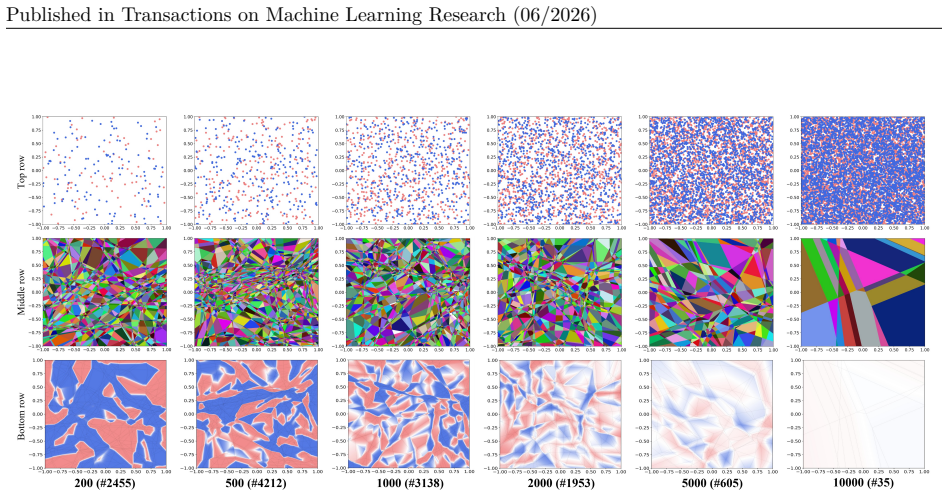
For multilayer perceptrons with piecewise-affine activations, the number of affine pieces realized along an affine line-segment probe is upper bounded by an explicit product of layer-wise width terms and activation breakpoint factors. Under fixed architectures and training protocols, increasing input-label complexity yields trained solutions with markedly fewer realized regions in the evaluation domain, even though worst-case architectural capacity is unchanged.
What carries the argument
Architecture-dependent upper bound on affine pieces along a line-segment probe, given by the product of per-layer widths and per-neuron breakpoint counts.
If this is right
- A neuron-threshold lower bound exists for representing target functions that require a prescribed one-dimensional piece count.
- Region-usage collapse in the hardest regimes coincides with visibly degraded decision boundaries.
- Training dynamics exhibit a consistent refinement process that partitions the input domain into successively finer affine regions.
Where Pith is reading between the lines
- Optimization may be implicitly favoring low-region solutions on complex tasks, suggesting a bias toward simpler partitions.
- Capacity measures based on worst-case region counts may overestimate what networks actually deploy after training.
- The saturation effect could be tested by swapping activations or adding explicit region-count penalties to the loss.
Load-bearing premise
Under fixed architectures and training protocols, increasing input-label complexity yields trained solutions with markedly fewer realized regions.
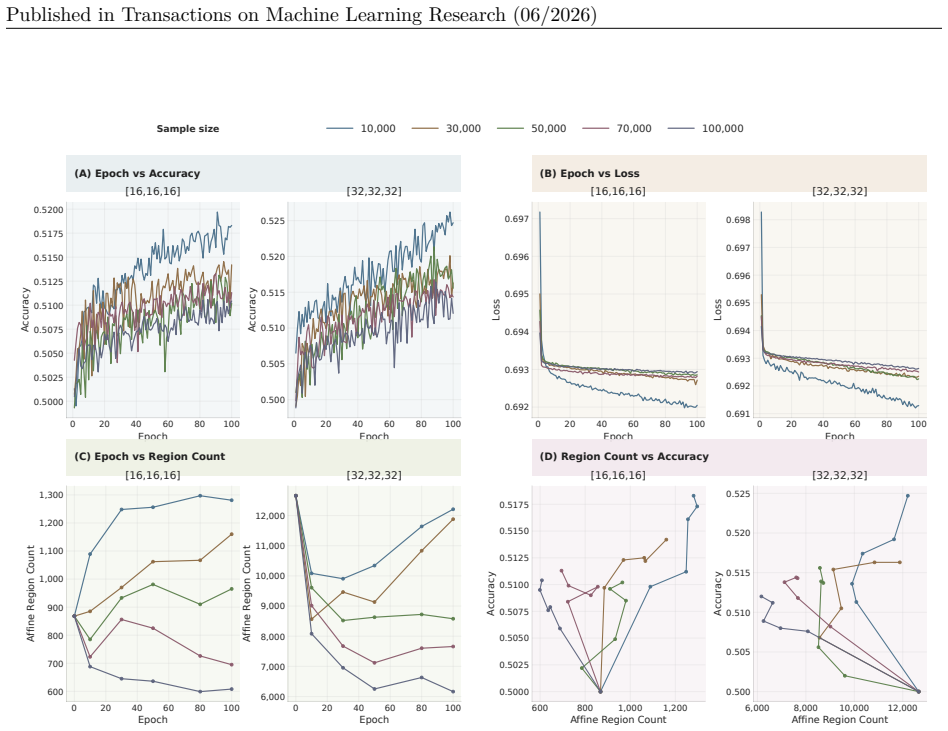
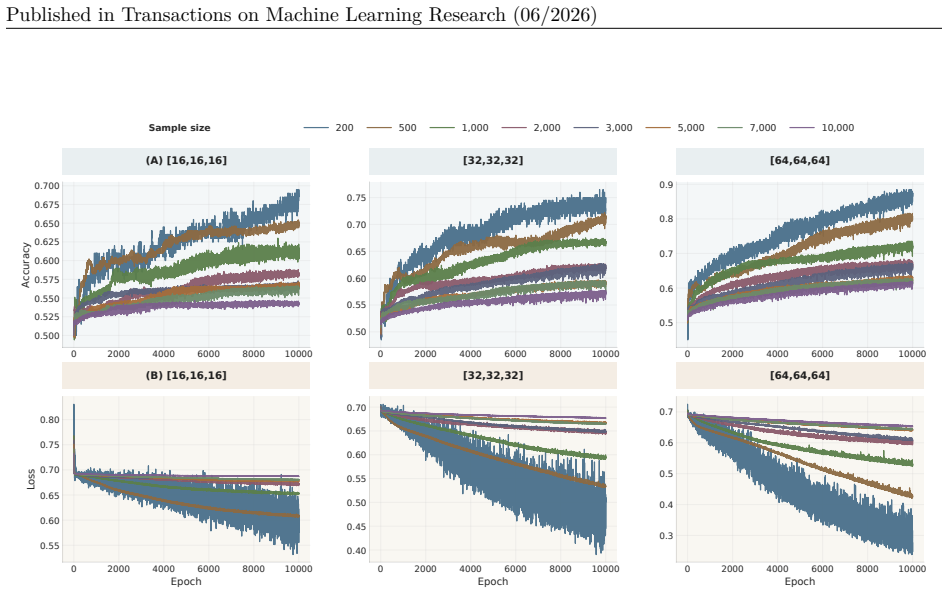
What would settle it
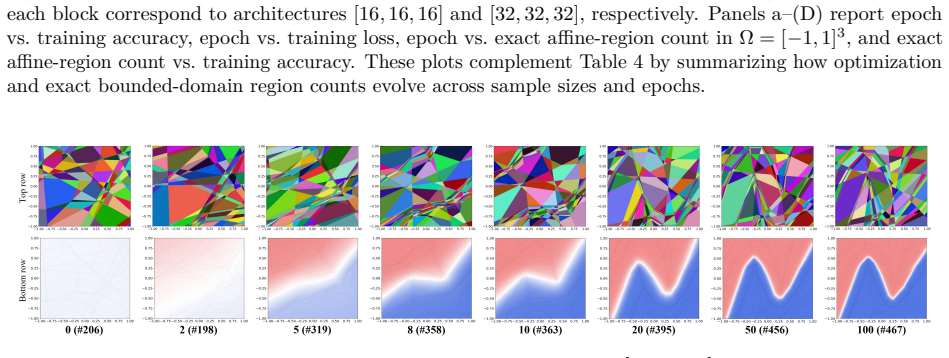
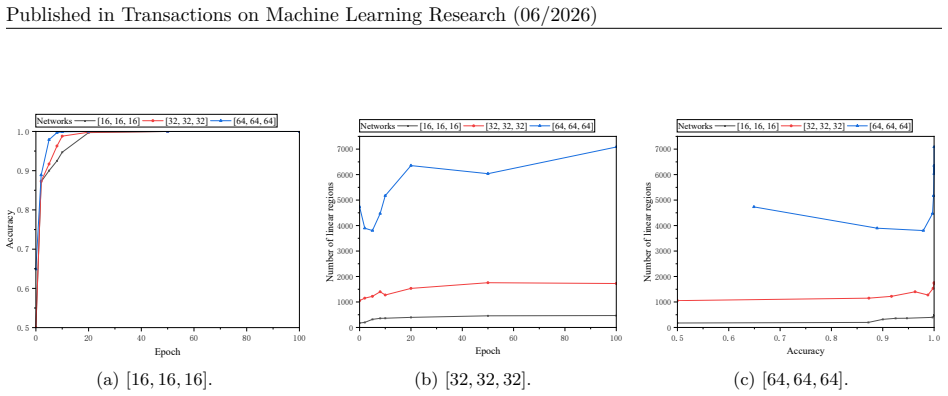
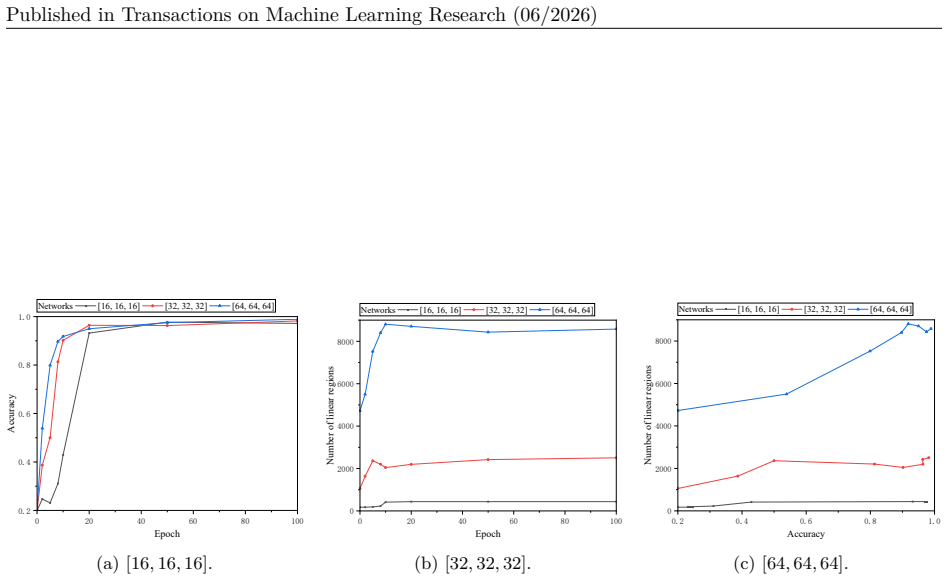
Enumerating regions after training the same network on a high-complexity task and finding more realized regions than on the corresponding low-complexity task would falsify the saturation claim.
Figures





read the original abstract
Piecewise-affine neural networks (e.g., with ReLU or LeakyReLU activations) implement continuous piecewise-affine maps, and the number of affine regions provides a natural proxy for expressive capacity. However, the gap between theoretical region capacity and the affine regions realized after training remains insufficiently understood. We study this gap from two complementary perspectives. First, we give a rigorous, architecture-dependent theorem for affine line-segment probes: for multilayer perceptrons with piecewise-affine activations, the number of affine pieces realized along an affine line-segment probe is upper bounded by an explicit product of layer-wise width terms (and activation breakpoint factors). This yields a neuron-threshold lower bound for representing target functions with prescribed one-dimensional piece complexity, formalizing the minimal region budget required for complex signals. Second, we exactly enumerate affine regions realized within bounded 2D and higher-dimensional domains under controlled task complexity. Under fixed architectures and training protocols, increasing input--label complexity yields trained solutions with markedly fewer realized regions in the evaluation domain, even though worst-case architectural capacity is unchanged; we call this reduced region usage expressivity saturation. Moreover, in the most challenging regimes, 2D visualizations show that region-usage collapse often coincides with degraded decision boundaries. Finally, we visualize the training dynamics of affine-region partitions and decision boundaries, revealing a consistent refinement process during optimization.
Editorial analysis
A structured set of objections, weighed in public.
Referee Report
Summary. The paper claims two main contributions for piecewise-affine networks (e.g., ReLU MLPs): (1) a rigorous architecture-dependent upper bound on the number of affine pieces realized along any affine line-segment probe, expressed as an explicit product of layer widths and breakpoint factors; (2) an empirical finding, obtained by exact enumeration of regions in bounded domains, that trained networks realize markedly fewer affine regions as input-label complexity increases under fixed architecture and training protocol, a phenomenon termed 'expressivity saturation' that often coincides with degraded decision boundaries.
Significance. If the empirical saturation result survives controls for optimization quality, the work would usefully quantify the gap between worst-case architectural capacity and post-training realized expressivity, complementing existing region-counting theory with a concrete training-dependent reduction. The line-segment bound itself supplies a clean neuron-threshold lower bound for one-dimensional target complexity.
major comments (3)
- [enumeration experiments] Enumeration experiments (abstract): the central claim that 'increasing input-label complexity yields trained solutions with markedly fewer realized regions' lacks any reported controls that hold final training loss or test accuracy fixed across complexity levels; without such controls the reduction could simply track underfitting rather than an intrinsic saturation effect.
- [theorem] Line-segment theorem (abstract): while the upper bound is stated to be architecture-dependent, the manuscript provides no post-training comparison of realized region counts against this explicit bound, leaving open whether the observed saturation is operating near the architectural limit or well below it.
- [2D visualizations] 2D visualizations (abstract): the observation that region collapse 'often coincides with degraded decision boundaries' is presented without quantitative metrics (e.g., boundary error or loss values) that would allow readers to assess the strength of the coincidence.
minor comments (2)
- [abstract] The abstract refers to 'exact enumeration' but supplies no description of the enumeration algorithm, its computational complexity, or verification that all regions inside the bounded domain are counted without omission.
- [enumeration experiments] No error bars, statistical tests, or baseline comparisons (random initialization, untrained networks) are mentioned for the reported region counts.
Simulated Author's Rebuttal
We thank the referee for the constructive comments. We address each major point below and indicate the revisions we will make to strengthen the empirical support.
read point-by-point responses
-
Referee: Enumeration experiments (abstract): the central claim that 'increasing input-label complexity yields trained solutions with markedly fewer realized regions' lacks any reported controls that hold final training loss or test accuracy fixed across complexity levels; without such controls the reduction could simply track underfitting rather than an intrinsic saturation effect.
Authors: We agree that the absence of controls for final loss or accuracy is a valid concern and could indicate underfitting rather than saturation. The experiments fix the training protocol but do not enforce matched performance. In revision we will report training and test losses/accuracies for every complexity level and, where feasible, add matched-performance controls by varying epoch count or using early stopping before re-enumerating regions. revision: yes
-
Referee: Line-segment theorem (abstract): while the upper bound is stated to be architecture-dependent, the manuscript provides no post-training comparison of realized region counts against this explicit bound, leaving open whether the observed saturation is operating near the architectural limit or well below it.
Authors: The theorem supplies an explicit upper bound only for one-dimensional line-segment probes. Our enumeration results concern full two-dimensional domains. We will add, in the revised manuscript, a direct comparison of realized affine pieces along random line segments extracted from the trained networks against the theorem bound, thereby clarifying the distance between observed saturation and architectural capacity. revision: yes
-
Referee: 2D visualizations (abstract): the observation that region collapse 'often coincides with degraded decision boundaries' is presented without quantitative metrics (e.g., boundary error or loss values) that would allow readers to assess the strength of the coincidence.
Authors: We acknowledge that the visual observation would be strengthened by quantitative metrics. The revision will include supporting numbers such as test accuracy, a boundary-error measure (fraction of points within a small distance of the decision boundary that are misclassified), and a simple correlation between region count and these quantities. revision: yes
Circularity Check
No circularity: theorem is architecture-derived bound; saturation is empirical observation
full rationale
The paper presents two distinct contributions. The first is an architecture-dependent upper bound theorem on affine pieces along line-segment probes, expressed as an explicit product of layer widths and breakpoint factors; this is a standard counting argument over piecewise-affine maps and does not reduce any reported quantity to a fitted parameter or self-citation by construction. The second is an empirical enumeration showing fewer realized regions under higher input-label complexity under fixed training; this is a direct measurement, not a prediction derived from the same data or from any fitted input. No self-citation load-bearing steps, uniqueness theorems, or ansatz smuggling appear in the abstract or described claims. The derivation chain remains self-contained against external benchmarks.
Axiom & Free-Parameter Ledger
axioms (1)
- domain assumption Piecewise-affine neural networks implement continuous piecewise-affine maps whose affine regions serve as a natural proxy for expressive capacity.
invented entities (1)
-
expressivity saturation
no independent evidence
Reference graph
Works this paper leans on
-
[1]
Fast and exact enumeration of deep networks partitions regions.arXiv preprint arXiv:2401.11188,
Randall Balestriero and Yann LeCun. Fast and exact enumeration of deep networks partitions regions.arXiv preprint arXiv:2401.11188,
-
[2]
Fast and exact enumeration of deep networks partitions regions.arXiv preprint arXiv:2401.11188,
doi: 10.48550/arXiv.2401.11188. Arturs Berzins. Polyhedral complex extraction from ReLU networks using edge subdivision. InProc. Int. Conf. Mach. Learn. (ICML), volume 202, pp. 2234–2244. PMLR,
-
[3]
Kuan-Lin Chen, Harinath Garudadri, and Bhaskar D
doi: 10.1016/j.neunet.2023.09.025. Kuan-Lin Chen, Harinath Garudadri, and Bhaskar D. Rao. Improved bounds on neural complexity for representing piecewise linear functions. InAdvances in Neural Information Processing Systems, volume 35,
-
[4]
doi: 10.1016/j.cam.2023.115667. J. Elisenda Grigsby and Kathryn Lindsey. On transversality of bent hyperplane arrangements and the topological expressiveness of ReLU neural networks.SIAM J. Appl. Algebra Geom., 6(2):216–242,
-
[5]
Christian Haase, Christoph Hertrich, and Georg Loho
doi: 10.1137/20M1368902. Christian Haase, Christoph Hertrich, and Georg Loho. Lower bounds on the depth of integral ReLU neural networks via lattice polytopes. InProc. Int. Conf. Learn. Represent. (ICLR). OpenReview.net,
-
[6]
doi: 10.4208/jcm.1901-m2018-0160. 17 Published in Transactions on Machine Learning Research (06/2026) Christoph Hertrich, Amitabh Basu, Marco Di Summa, and Martin Skutella. Towards lower bounds on the depth of ReLU neural networks.SIAM J. Discret. Math., 37(2):997–1029,
-
[7]
Qiang Hu, Hao Zhang, Feifei Gao, Chengwen Xing, and Jianping An
doi: 10.1137/22M1489332. Qiang Hu, Hao Zhang, Feifei Gao, Chengwen Xing, and Jianping An. Analysis on the number of linear regions of piecewise linear neural networks.IEEE Trans. Neural Netw. Learn. Syst., 33(2):644–653,
-
[8]
Ahmed Imtiaz Humayun, Randall Balestriero, Guha Balakrishnan, and Richard G
doi: 10.1109/TNNLS.2020.3028431. Ahmed Imtiaz Humayun, Randall Balestriero, Guha Balakrishnan, and Richard G. Baraniuk. Splinecam: Exact visualization and characterization of deep network geometry and decision boundaries. InProc. IEEE/CVF Conf. Comput. Vis. Pattern Recognit. (CVPR), pp. 3789–3798. IEEE,
-
[9]
Hu Wang, Yuanhong Chen, Congbo Ma, et al
doi: 10.1109/ CVPR52729.2023.00369. Zhiwei Li and Cheng Wang. Achieving sharp upper bounds on the expressive power of neural networks via tropical polynomials.IEEE Trans. Neural Netw. Learn. Syst., 36(2):2931–2945,
-
[10]
Adversarial examples: Attacks and defenses for deep learning
doi: 10.1109/TNNLS. 2024.3350786. Andrew L. Maas, Awni Y. Hannun, and Andrew Y. Ng. Rectifier nonlinearities improve neural network acoustic models. InProc. ICML Workshop on Deep Learning for Audio, Speech and Language Processing, Atlanta, GA, USA,
-
[11]
Training-Time Batch Normalization Reshapes Local Partition Geometry in Piecewise-Affine Networks
Xuan Qi, Yi Wei, Xue Mei, Ryad Chellali, and Shipin Yang. Comparative analysis of the linear regions in relu and leakyrelu networks. InInternational Conference on Neural Information Processing, pp. 528–539. Springer, 2023a. Xuan Qi, Yi Wei, Xue Mei, Ryad Chellali, and Shipin Yang. Empirical study on the effect of residual networks on the expressiveness of...
work page internal anchor Pith review Pith/arXiv arXiv
-
[12]
The computational complexity of counting linear regions in relu neural networks.Advances in Neural Information Processing Systems,
18 Published in Transactions on Machine Learning Research (06/2026) Moritz Stargalla, Christoph Hertrich, and Daniel Reichman. The computational complexity of counting linear regions in relu neural networks.Advances in Neural Information Processing Systems,
2026
-
[13]
doi: 10.24963/ijcai.2022/492. Yi Wei, Xuan Qi, and Furao Shen. Region seeding via pre-activation regularization: A geometric view from piecewise affine nerual networks.arXiv preprint arXiv:2605.06300, 2026a. Yi Wei, Xuan Qi, Furao Shen, Jian Zhao, Vittorio Murino, and Cigdem Beyan. Affinelens: Capturing the continuous piecewise affine functions of neural ...
work page internal anchor Pith review Pith/arXiv arXiv doi:10.24963/ijcai.2022/492 2022
-
[14]
doi: 10.1109/TPAMI.2024.3361155. Xiao Zhang and Dongrui Wu. Empirical studies on the properties of linear regions in deep neural networks. InProc. Int. Conf. Learn. Represent. (ICLR). OpenReview.net,
-
[15]
This is the standard setting for line-restricted region counting
19 Published in Transactions on Machine Learning Research (06/2026) A Proofs A.1 Proof of Theorem 5 Throughout this subsection, we consider aline-segment probe γ(t) =x0 +tv, t∈[0,1],(14) for somex 0,v∈Rd. This is the standard setting for line-restricted region counting. CPWA activation.Letσ:R→Rbe CPWA with (finite) breakpoint set −∞=t0 <t 1 <···<tK <t K+1...
2026
-
[16]
Let[0, 1]be partitioned into Rℓ−1intervals as in equation 20 such thathℓ−1◦γis affine on each open interval
21 Published in Transactions on Machine Learning Research (06/2026) Inductive step.Fix ℓ∈{1,...,L}and assume equation 32 holds forℓ−1. Let[0, 1]be partitioned into Rℓ−1intervals as in equation 20 such thathℓ−1◦γis affine on each open interval. On each such open interval, Lemma 11 gives a refinement into at mostKnℓ+ 1open subintervals on whichhℓ◦γis affine...
2026
-
[17]
= 1 L ( K L∑ ℓ=1 nℓ+ L∑ ℓ=1 1 ) ,(41) = 1 L(KN+L),(42) = 1 +KN L .(43) Combining equation 39, equation 40, and equation 43 gives Q(g)≤ ( 1 +KN L )L .(44) 22 Published in Transactions on Machine Learning Research (06/2026) TakingL-th roots and rearranging yields N≥L K ( Q(g)1/L−1 ) .(45) Ifn ℓ=wfor allℓ, then equation 39 becomes (Kw+
2026
-
[18]
L ≥Q(g),(46) equivalently w≥Q(g)1/L−1 K .(47) Sincewis an integer, we obtain w≥ ⌈Q(g)1/L−1 K ⌉ ,(48) as claimed. 23 Published in Transactions on Machine Learning Research (06/2026) B Residual-Connection Ablation under Complex 2D Inputs This appendix reports an additional ablation for the 2D random-label setting in which the baseline MLP is augmented with ...
2026
-
[19]
These plots provide optimization context for the final exact region counts in Table 5 and show that the optimization trajectories vary across both sample size and architecture
Architecture (with one residual) 200 500 1000 2000 3000 5000 7000 10000 [16,16,16]+ residual 2049 ±17 2176 ±43 2189 ±8 1874 ±31 853 ±24 512 ±46 347 ±13 48±7 [32,32,32]+ residual 3748 ±29 5597 ±6 3793 ±41 2147 ±18 2908 ±35 741 ±9 911 ±48 115 ±12 [64,64,64]+ residual 7613 ±12 9050 ±44 7421 ±27 6879 ±5 2683 ±39 1287 ±16 594 ±33 98±15 Training accuracy and lo...
2000
-
[20]
The larger architectures start with and maintain substantially more regions than the smaller architecture, reflecting their larger architectural capacity
This trend is consistent with the visual intuition that the networks progressively refine their piecewise-affine partitions in order to represent the curved binary decision boundary. The larger architectures start with and maintain substantially more regions than the smaller architecture, reflecting their larger architectural capacity. At the same time, t...
2026
-
[21]
29 Published in Transactions on Machine Learning Research (06/2026) (a)[16,16,16]
Together with the make_moons results, these visualizations support the view that, in structured and learnable settings, optimization can refine both the affine-region partition and the corresponding decision boundary over time. 29 Published in Transactions on Machine Learning Research (06/2026) (a)[16,16,16]. (b)[32,32,32]. (c)[64,64,64]. Figure 13: Evolu...
2026
discussion (0)
Sign in with ORCID, Apple, or X to comment. Anyone can read and Pith papers without signing in.