G-RRM: Guiding Symbolic Solvers with Recurrent Reasoning Models
Pith reviewed 2026-07-03 13:04 UTC · model grok-4.3
The pith
Neural guidance from symbol-equivariant recurrent reasoning models accelerates symbolic solvers on constraint problems when search spaces are large and solvers can override imperfect hints.
A machine-rendered reading of the paper's core claim, the machinery that carries it, and where it could break.
Core claim
When problem instances possess an expansive combinatorial search space and the solver can dynamically overwrite its branching choices, SE-RRM guidance drives median conflict counts to zero and yields significant wall-clock speedups: on 9 by 9 Sudoku, where the SE-RRM solves 91.1 percent of instances correctly, backtracking accelerates by 33.3 times and Glucose 4.1 by 1.70 times, with Glucose retaining a 1.17 times speedup on perfect-hint 25 by 25 grids; CaDiCaL, which always respects hints, shows no significant speedup.
What carries the argument
G-RRM, the integration of SE-RRMs that generate full solution proposals to guide symbolic solvers capable of overwriting branching choices when hints are imperfect.
If this is right
- Guidance reduces median conflict counts to zero when the two stated conditions hold.
- Backtracking receives a 33.3 times median speedup on 9 by 9 Sudoku.
- Glucose 4.1 receives a 1.70 times median speedup on 9 by 9 Sudoku and retains 1.17 times on perfect-hint 25 by 25 grids.
- CaDiCaL 3.0.0, which never overwrites hints, shows no significant speedup and a small mean slowdown.
- Efficacy of neural guidance is limited to regimes satisfying both the search-space and overwrite conditions.
Where Pith is reading between the lines
- The same guidance pattern could be tested on other combinatorial problems whose solvers already allow flexible branching.
- Solvers engineered to treat neural proposals as soft suggestions rather than hard directives may obtain larger gains than rigid ones.
- On instances where the neural model is known to be highly accurate, even overhead-heavy solvers might still benefit at extreme scales.
- Hybrid systems could be built in which the neural model proposes and the symbolic engine both verifies and selectively corrects.
Load-bearing premise
Sudoku instances stand in for the wider class of constraint satisfaction problems that have expansive combinatorial search spaces, and the tested solvers stand in for architectures that can dynamically overwrite branching choices.
What would settle it
Run the same G-RRM guidance on a different constraint satisfaction problem with an expansive search space using a solver architecture that permits overwriting of hints, and observe whether median conflict counts remain near zero and wall-clock speedups disappear.
Figures

read the original abstract
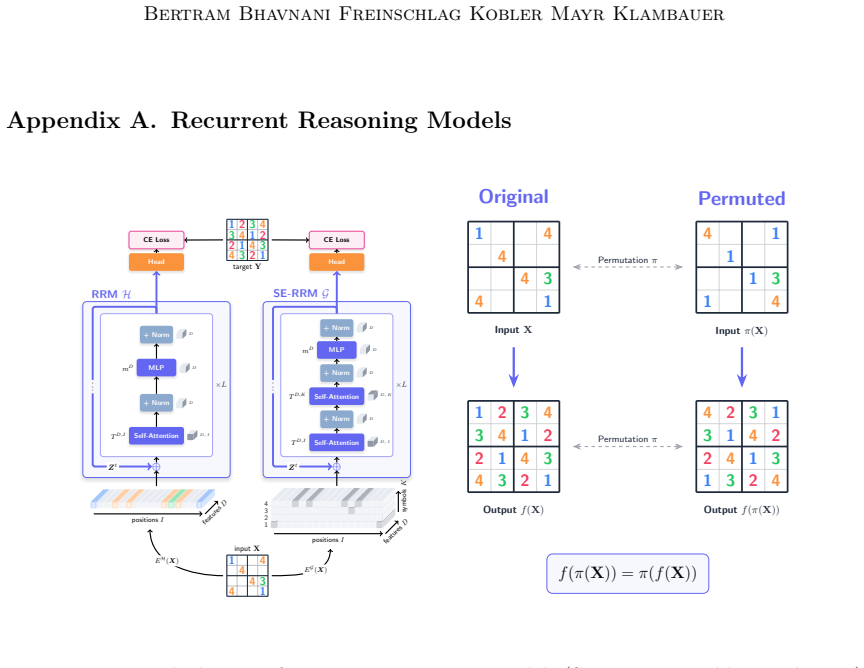
In this work, we focus on SE-RRMs, a symbol-equivariant instantiation of RRMs that exhibits improved extrapolation to larger problem sizes. We propose a neuro-symbolic approach, ``Guiding with Recurrent Reasoning Models'' (G-RRM), which integrates SE-RRMs with symbolic solvers for constraint satisfaction problems. SE-RRMs act as neural solvers that generate full solution proposals and guide classical symbolic solvers, such as backtracking or SAT-based methods like Glucose 4.1 and CaDiCaL 3.0.0, that produce globally correct solutions. Centrally, we investigate when neural guidance with G-RRM improves the search efficiency of symbolic solvers. % Our experiments show that the efficacy of G-RRM depends on two conditions: first, the problem instances must have an expansive combinatorial search space to expose potential gains, and second, the solver architecture must be capable of dynamically overwriting its branching choices to recover when neural hints are imperfect. When these conditions hold, guidance drives median conflict counts to zero and yields significant wall-clock speedups: on $9\times9$ Sudoku, where the SE-RRM correctly solves $91.1\%$ of instances, backtracking accelerates by $33.3\times$ and Glucose 4.1 by $1.70\times$ (median, $p<0.001$), with Glucose 4.1 retaining a $1.17\times$ speedup on perfect-hint $25\times25$ grids. In contrast, CaDiCaL 3.0.0, whose runtime is overhead-dominated and which always respects the injected branching hints rather than overwriting them, shows no significant speedup (median $1.02\times$, n.s.) and even a small significant mean slowdown ($0.90\times$) on $9\times9$. These results delineate the regimes in which neural guidance translates into practical speedups.
Editorial analysis
A structured set of objections, weighed in public.
Referee Report
Summary. The paper proposes G-RRM, a neuro-symbolic method that uses symbol-equivariant recurrent reasoning models (SE-RRMs) to generate solution proposals and guide classical symbolic solvers (backtracking, Glucose 4.1, CaDiCaL 3.0.0) on constraint satisfaction problems. It claims that neural guidance improves search efficiency precisely when instances possess expansive combinatorial search spaces and the solver can dynamically overwrite imperfect branching hints; this is supported by Sudoku experiments showing 91.1% SE-RRM accuracy, median conflict counts driven to zero, 33.3× backtracking speedup, 1.70× Glucose speedup on 9×9 grids (p<0.001), and retained 1.17× on perfect-hint 25×25, with no gain for CaDiCaL.
Significance. If the two conditions generalize beyond the tested setting, the work provides a concrete delineation of regimes where hybrid guidance yields practical wall-clock gains without requiring perfect neural solutions, strengthening the case for neuro-symbolic integration on hard CSPs.
major comments (2)
- [Abstract] Abstract and experimental results: the central claim that efficacy requires 'expansive combinatorial search space' and 'solver architecture capable of dynamically overwriting branching choices' rests entirely on 9×9 and 25×25 Sudoku instances; no experiments are reported on other CSPs (e.g., random k-SAT, graph coloring, or scheduling) that would test whether the uniform constraint structure and moderate variable count of Sudoku are necessary for the observed conflict reduction and speedups.
- [Abstract] Abstract: the reported statistical tests (median 33.3×, 1.70×, p<0.001) and accuracy figure (91.1%) lack accompanying details on instance generation protocol, train/test split, model architecture hyperparameters, or raw data, preventing verification that the speedups are not driven by unstated post-hoc choices or non-representative Sudoku distributions.
minor comments (1)
- The manuscript should clarify whether the SE-RRM accuracy of 91.1% is measured on the same held-out instances used for the solver timing experiments.
Simulated Author's Rebuttal
We thank the referee for the constructive feedback on the scope of our experiments and the need for greater reproducibility. We address each major comment point by point below.
read point-by-point responses
-
Referee: [Abstract] Abstract and experimental results: the central claim that efficacy requires 'expansive combinatorial search space' and 'solver architecture capable of dynamically overwriting branching choices' rests entirely on 9×9 and 25×25 Sudoku instances; no experiments are reported on other CSPs (e.g., random k-SAT, graph coloring, or scheduling) that would test whether the uniform constraint structure and moderate variable count of Sudoku are necessary for the observed conflict reduction and speedups.
Authors: Sudoku instances were selected because they permit systematic scaling of combinatorial search space size (via grid dimension) while holding constraint uniformity fixed, which directly isolates the two conditions under study. The differential outcomes across solver architectures (backtracking and Glucose vs. CaDiCaL) already demonstrate that gains depend on overwriting capability rather than Sudoku-specific traits. While experiments on heterogeneous CSPs such as k-SAT or graph coloring would strengthen generalizability claims, the controlled setting here enables a precise delineation of the regimes where guidance is effective; we do not claim universality beyond the tested conditions. revision: no
-
Referee: [Abstract] Abstract: the reported statistical tests (median 33.3×, 1.70×, p<0.001) and accuracy figure (91.1%) lack accompanying details on instance generation protocol, train/test split, model architecture hyperparameters, or raw data, preventing verification that the speedups are not driven by unstated post-hoc choices or non-representative Sudoku distributions.
Authors: We agree that these details are required for full verification. The revised manuscript will expand the experimental section to specify the instance generation protocol, train/test split methodology, all model hyperparameters, and will include a link to the raw data and code repository. revision: yes
Circularity Check
No significant circularity; central claims are empirical measurements on held-out Sudoku instances
full rationale
The paper's core contribution is an empirical investigation of when G-RRM guidance yields speedups, conditioned on expansive search spaces and solver overwrite capability. All reported metrics (91.1% SE-RRM accuracy, 33.3× backtracking speedup, 1.70× Glucose speedup, CaDiCaL contrast) are direct wall-clock and conflict-count measurements on held-out 9×9 and 25×25 Sudoku grids. No derivation, uniqueness theorem, or fitted parameter is invoked whose output is definitionally identical to its input. The two conditions are stated as hypotheses tested by the experiments rather than derived from prior self-citations or ansatzes. Self-citations, if present, are not load-bearing for any claimed result. This is a standard non-circular empirical paper.
Axiom & Free-Parameter Ledger
Reference graph
Works this paper leans on
-
[1]
ARC-AGI-2: A New Challenge for Frontier AI Reasoning Systems
Francois Chollet, Mike Knoop, Gregory Kamradt, Bryan Landers, and Henry Pinkard. ARC-AGI-2: A new challenge for frontier AI reasoning systems.arXiv preprint arXiv:2505.11831,
work page internal anchor Pith review Pith/arXiv arXiv
-
[2]
Symbol-equivariant recurrent reasoning models.arXiv preprint arXiv:2603.02193,
Richard Freinschlag, Timo Bertram, Erich Kobler, Andreas Mayr, and Günter Klambauer. Symbol-equivariant recurrent reasoning models.arXiv preprint arXiv:2603.02193,
-
[3]
Neuro-symbolic Sudoku solver.arXiv preprint arXiv:2307.00653,
11 Bertram Bha vnani Freinschlag Kobler Mayr Klambauer Ashutosh Hathidara and Lalit Pandey. Neuro-symbolic Sudoku solver.arXiv preprint arXiv:2307.00653,
-
[4]
Solving Sudoku using oscillatory neural networks.arXiv preprint arXiv:2508.02250,
Bram F Haverkort, Federico Sbravati, Stefan Porfir, and Aida Todri-Sanial. Solving Sudoku using oscillatory neural networks.arXiv preprint arXiv:2508.02250,
-
[5]
Towards universally accessible SAT technology
Alexey Ignatiev, Zi Li Tan, and Christos Karamanos. Towards universally accessible SAT technology. In27th International Conference on Theory and Applications of Satisfiability Testing (SAT 2024), pages 16:1–16:11. Schloss Dagstuhl–Leibniz-Zentrum für Informatik,
work page 2024
-
[6]
Less is More: Recursive Reasoning with Tiny Networks
Alexia Jolicoeur-Martineau. Less is more: Recursive reasoning with tiny networks.arXiv preprint arXiv:2510.04871,
work page internal anchor Pith review Pith/arXiv arXiv
-
[7]
Large language model guided tree-of-thought,
Jieyi Long. Large language model guided tree-of-thought.arXiv preprint arXiv:2305.08291,
-
[8]
The CP-SAT-LP solver (invited talk)
Laurent Perron, Frédéric Didier, and Steven Gay. The CP-SAT-LP solver (invited talk). In29th International Conference on Principles and Practice of Constraint Programming (CP 2023), pages 3:1–3:2. Schloss Dagstuhl–Leibniz-Zentrum für Informatik,
work page 2023
-
[9]
Sudoku-Bench: Evaluating creative reasoning with Sudoku variants.arXiv preprint arXiv:2505.16135,
Jeffrey Seely, Yuki Imajuku, Tianyu Zhao, Edoardo Cetin, and Llion Jones. Sudoku-Bench: Evaluating creative reasoning with Sudoku variants.arXiv preprint arXiv:2505.16135,
-
[10]
Guan Wang, Jin Li, Yuhao Sun, Xing Chen, Changling Liu, Yue Wu, Meng Lu, Sen Song, and Yasin Abbasi Yadkori. Hierarchical reasoning model.arXiv preprint arXiv:2506.21734,
work page internal anchor Pith review Pith/arXiv arXiv
-
[11]
Looped transform- ers are better at learning learning algorithms
12 G-RRM: Guiding Symbolic Sol vers with Recurrent Reasoning Models Liu Yang, Kangwook Lee, Robert Nowak, and Dimitris Papailiopoulos. Looped transform- ers are better at learning learning algorithms. InInternational conference on Learning Representations, volume 2024, pages 42195–42214,
work page 2024
-
[12]
13 Bertram Bha vnani Freinschlag Kobler Mayr Klambauer Appendix A. Recurrent Reasoning Models 1 4 4 4 3 4 1 RRMH ×L Self-AttentionT D,I D, I + Norm D MLPmD D + Norm D ⨁ Head CE Loss ··· Zt positions I features D 1 2 3 4 SE-RRMG ×L Self-AttentionT D,I D, I + Norm D Self-AttentionT D,K D, K + Norm D MLPmD D + Norm D ⨁ Head CE Loss ··· Zt positions I feature...
work page 2026
-
[13]
LetZt ∈R D×I denote the recurrent state at iterationt, whereDis the feature dimension. An input embedding EH maps the symbolic instance into the same shape,EH(X)∈R D×I ,typically as a sum of a symbol embedding and a positional encoding. AnRRM blockHis a mappingH:R D×I ×R D×I →R D×I ,which updates the stateZ as Zt+1 =H EH(X),Z t ,(2) whereZ 0 is a learned ...
work page 2026
discussion (0)
Sign in with ORCID, Apple, or X to comment. Anyone can read and Pith papers without signing in.