REVIEW 3 major objections 5 minor 1 cited by
Frustration-Enhanced Quantum Annealing Correction Models with Additional Inter-replica Interactions
T0 review · 3 major / 5 minor · reviewed 2026-08-04 · deepseek-v4-flash
Pith's one-line read Quantum annealing correction models can reach optimal solutions through small energy gaps by stacking replicas with antiferromagnetic couplings, because many low-lying eigenstates decode to the correct answer.
desk verdict Worth refereeing: a hardware-backed QAC result with a plausible mechanism, but the mechanism is only shown at N=3 where the gap is not small, and the hardware evidence is a single instance with no error bars. read the letter →
The pith
A machine-rendered reading of the paper's core claim, the machinery that carries it, and where it could break.
The reading
What carries the argument
The central object is the stacked QAC Hamiltonian with periodic boundary conditions, where K replicas of the problem are coupled by inter-replica interactions J_p; choosing J_p < 0 (antiferromagnetic) with odd K introduces frustration among replicas. The workhorse property is the decodability property: a large set of low-lying eigenstates of the coupled system correspond, under energy-minimization decoding, to the optimal solution of the unprotected problem. This property is what lets diabatic transitions still yield success, and it disappears when the inter-replica couplings are ferromagnetic or when boundary conditions remove the frustration.
What would settle it
Run a full time-dependent Schrödinger simulation of the periodic-boundary stacked model on a frustrated ring with N≥11, where the gap is genuinely small, and count how many low-lying eigenstates decode to the optimum; if the fraction of optimal-decodable low-energy states collapses and the success-probability advantage disappears, the central claim is falsified.
Extended reading notes
Core claim
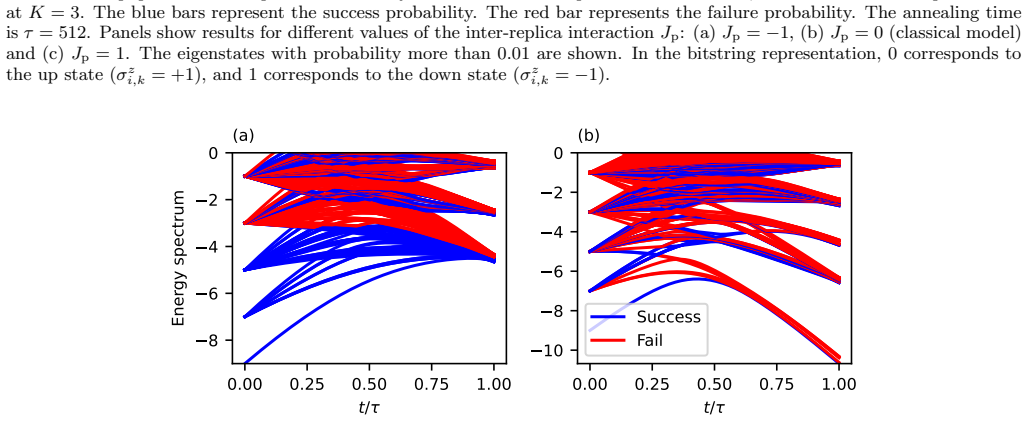
On the frustrated ring benchmark, the periodic-boundary stacked QAC model with antiferromagnetic inter-replica interactions makes the optimal solution of the original problem appear, after energy-minimization decoding, in dozens of the lowest eigenstates of the coupled Hamiltonian (47 of the lowest 47 states for N=3, K=3). Consequently the annealer does not need to remain in the ground state to return the right answer: diabatic transitions into these low-lying states still decode to success. The same decodability is absent for ferromagnetic couplings and is weaker for the open-boundary stacked and penalty-spin models, which must rely on adiabatic evolution and are more sensitive to interacti
Load-bearing premise
The paper assumes that the decodability property observed at N=3, where the frustrated-ring gap is still relatively large, persists in the small-gap regime that governs the N=61 hardware results, since no direct simulation covers a small-gap coupled system.
Editorial extensions
If this is right
- On near-term annealers with limited coherence, the periodic-boundary stacked model with moderately strong antiferromagnetic couplings can reach near-optimal solutions at 1 microsecond, where the classical parallel model fails.
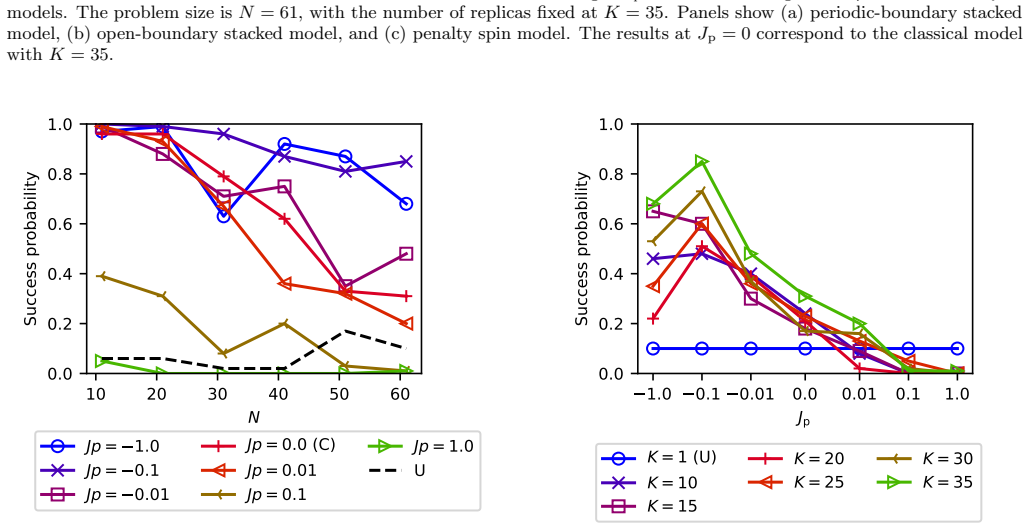
- Frustration among replicas is the load-bearing feature: with odd K and periodic boundaries the success probability stays high even for large |J_p|, whereas open-boundary stacked and penalty-spin models degrade at strong coupling.
- The decodability property is preserved under energy-minimization decoding, so the mechanism should transfer to other ground-state-search Ising solvers, not only quantum annealers.
- Strong antiferromagnetic couplings still hurt at short annealing times because energy-scale effects dominate, so interaction strength must be tuned relative to the annealing schedule.
- Adding replicas increases chain length and embedding overhead, especially for the penalty-spin model, so the stacked model is the more embedding-friendly route in practice.
Reading between the lines
- If the decodability mechanism is spectral rather than hardware-specific, it should also improve classical heuristics: running simulated annealing on the coupled QAC Hamiltonian and decoding the lowest-energy replica may outperform the same heuristic on the original problem, a testable extension the paper does not make.
- The even-odd dependence of success probability on K under strong antiferromagnetic coupling is a sharp experimental signature; a reader could probe it directly on hardware to confirm the frustration mechanism.
- The N=3 numerical basis suggests a scaling risk: if the number of optimal-decodable low-energy states grows only polynomially with N while the gap closes exponentially, the short-time advantage could fade for very large problems; simulating with N≥11 would resolve this.
- The authors' design principle, engineering frustration into the replicated Hamiltonian so that low-lying states are 'correct' under decoding, could be applied to other hard optimization problems such as spin glasses or MAX-CUT, with the prediction that odd frustrated loops should outperform open, non-frustrated replicas.
Editorial analysis
A structured set of objections, weighed in public.
Referee Report
Summary. The paper studies three quantum annealing correction (QAC) constructions—the penalty-spin model, the open-boundary stacked model, and the periodic-boundary stacked model—applied to a frustrated ring with a small energy gap. It reports experiments on D-Wave Advantage2 for system sizes N=11–61 with up to K=35 replicas and annealing times 1–2000 µs, together with exact time-dependent Schrödinger simulations at N=3, K=3. The central finding is that antiferromagnetic inter-replica interactions improve success probability relative to the classical/unprotected model, while ferromagnetic interactions degrade it. The periodic-boundary stacked model performs best, and the authors attribute this to geometric frustration among replicas and to the fact that many low-lying eigenstates of the coupled Hamiltonian decode to the optimal solution, so that diabatic transitions do not necessarily lead to failure. The paper concludes that QAC models can solve small-gap problems at short annealing times by exploiting diabatic transitions.
Significance. If substantiated, the work identifies a concrete and somewhat counterintuitive mechanism for QAC: antiferromagnetic inter-replica couplings, especially with periodic boundary conditions, create a low-energy manifold of states that all decode to the optimum, so that nonadiabatic evolution remains successful. The odd/even K dependence and the decodable-manifold counts are testable predictions, and the use of exact diagonalization to illustrate the spectral structure is a strength. The broad experimental contrast between antiferromagnetic and ferromagnetic couplings is large and credible. The main weakness is that the proposed mechanism is demonstrated only at N=3, where the frustrated-ring gap is not small, while the claim that motivates the paper is specifically about the small-gap regime.
major comments (3)
- [Sec. IV.B (Figs. 8, 9) and Fig. 14] The mechanism central to the abstract—that QAC succeeds in small-gap problems because many low-lying eigenstates decode to the optimum—is established only for N=3, where Fig. 14 shows the bare frustrated-ring gap is O(1), not the exponentially small gap that defines the bottleneck. The paper does not show that the property '47 lowest-energy states correspond to the optimal solution' persists as N grows and the gap closes. The N=61 hardware data are a single instance and cannot resolve the spectrum. Please provide larger-N numerical evidence (e.g., N=5–11 exact or tensor-network calculations) or an analytic argument that the decodable low-energy manifold survives in the small-gap regime; otherwise the small-gap part of the central claim is an extrapolation.
- [Sec. III and Sec. IV.A, Fig. 4] All hardware success probabilities are based on num_reads=100 with no confidence intervals. Under binomial sampling, adjacent entries such as 0.91 and 0.87 at τ=20 µs in Fig. 4(a) differ by less than one standard deviation (about 0.03–0.05), so fine-grained claims such as 'enhancement is observed regardless of the magnitude of the antiferromagnetic interactions' are not statistically supported. The large contrast between antiferromagnetic and classical models is credible, but the quantitative near-unity values and the detailed J_p/τ patterns need error bars, more reads, or appropriately restricted language.
- [Abstract/Conclusion vs Sec. III] All results are for a single instance of the frustrated ring with fixed parameters J_R=0.45, J_L=0.5, h1=0.01. The abstract and conclusion state a general result for 'problems with a small energy gap'. Without additional instances, a range of parameters, or a theoretical argument that the decodable-manifold mechanism is generic, the central claim is overgeneralized. At minimum, the claims should be explicitly restricted to the frustrated-ring instance and to the tested parameter range.
minor comments (5)
- [Appendix D, Eq. (D1)] The formula for n_suc is incorrect: for K=1 it gives N rather than 1. The correct number of combined states with at least one replica in the nondegenerate ground state is (2^N)^K − (2^N−1)^K; if the intended count is exactly one ground replica, it is K(2^N−1)^{K−1}. Please correct or remove this formula.
- [Fig. 4 and Fig. 7] The vertical axis is labeled 's', but the caption and text use µs. Please unify the units.
- [Sec. III (experimental setup)] The manuscript states 'All other parameters were set to their default values.' For reproducibility, please report the chain strength, the minor-embedding tool settings, and the physical qubit count used for each model at N=61, K=35.
- [Figs. 5, 6, 12, 13] The lines between points are guides to the eye and no error bars are shown. Given that failure/success is a Bernoulli quantity, error bars or raw sample counts should be provided.
- [Sec. IV.B] The simulation uses linear schedules A(t)=1−t/τ and B(t)=t/τ, which differ from the device schedules. This is acceptable for a mechanistic study, but the text should explicitly state that the absolute annealing-time comparison between numerics and hardware is not intended.
Circularity Check
No significant circularity: the central results are produced by direct hardware measurements and exact diagonalization, not by fitting, decoding by construction, or self-citation chains.
full rationale
The paper's central claim—that QAC stacked models with moderate antiferromagnetic inter-replica interactions reach the optimum at short annealing times through diabatic transitions—is supported by (i) hardware success probabilities on the N=61 frustrated ring and (ii) exact diagonalization of the time-dependent Schrödinger equation at N=3, K=3. The success probability metric is not defined so that it equals the QAC Hamiltonian's ground-state overlap only; it is computed by summing the final-state population over eigenstates that decode to the optimal replica, and the paper explicitly computes how many low-lying eigenstates decode to the optimum for different Jp (e.g., 'For Jp=-1.0 and -0.1, the 47 lowest-energy states correspond to the optimal solution'). This is a verified spectral property, not an assumption. Jp is scanned over a grid, not fitted to the reported success probabilities, so no fitted parameter is renamed as a prediction. The references to prior QAC work, including Ref. [63] co-authored by S. Tanaka, are background: the stacked model is adopted from [62,63,66] and the paper then contributes new dynamics and hardware results; no theorem or uniqueness claim from those references is used to force the conclusion. The numerical success probabilities in Fig. 7 and the analytic classical-model formula in Appendix D are independent checks rather than inputs to the main claim. The only concern worth noting is an extrapolation: the decodable low-energy manifold is demonstrated at N=3 where the bare frustrated-ring gap is O(1), while the hardware claim concerns small-gap N=61; that is a robustness/validity gap, not a circular reduction, and therefore does not raise the circularity score.
Assumptions & free parameters
free parameters (3)
- h1 (longitudinal field) =
0.01
- J_R and J_L (ring couplings) =
J_R=0.45, J_L=0.5, J=1
- Numerical annealing schedules =
A(t)=1-t/τ, B(t)=t/τ
assumptions (5)
- standard math Transverse-field quantum annealing Hamiltonian and boundary conditions of the schedules (Eqs. 1-2).
- domain assumption The frustrated ring with J_R=0.45, J_L=0.5 has a spin-glass bottleneck with gap closing in the thermodynamic limit.
- domain assumption Energy-minimization decoding is the correct decoding strategy for QAC models.
- ad hoc to paper The decodability mechanism observed at N=3 transfers to the small-gap regime.
- domain assumption The D-Wave annealer with default control parameters faithfully implements the intended Hamiltonian; embedding artifacts are small enough not to invert the conclusions.
Cite this review
Pith. "Pith review of Frustration-Enhanced Quantum Annealing Correction Models with Additional Inter-replica Interactions." pith.science (2026). https://pith.science/paper/X43OSM3S
@misc{pith2026250911217,
  author       = {Pith},
  title        = {Pith review of: Frustration-Enhanced Quantum Annealing Correction Models with Additional Inter-replica Interactions},
  year         = {2026},
  howpublished = {\url{https://pith.science/paper/X43OSM3S}},
  note         = {Machine review of arXiv:2509.11217}
}
read the original abstract
Quantum annealing correction (QAC) models provide a promising approach for mitigating errors in quantum annealers. Previous studies have established that QAC models are crucial for ensuring the robustness of the ground state of the Ising model on hardware. In this work, the effects of QAC models incorporating replicas with additional interactions, specifically, the penalty spin model and the stacked model, are investigated for problems characterized by a small energy gap between the ground and first excited states during quantum annealing, a well-known bottleneck to reaching the ground state. The results demonstrate that these QAC models can obtain the optimal solution within short annealing times by exploiting diabatic transitions, even for problems with a small energy gap. These findings highlight the potential of QAC models as practical near-term algorithms for hardware subject to runtime limitations and control noise.
Figures


Figures from the paper (10 more)






Forward citations
Cited by 1 Pith paper
-
Structural Comparison of Error Mitigation Methods for Ising Machines: Penalty-Spin Model versus Stacked Model
On sparse assignment problems, ferromagnetically coupled stacked replicas of an Ising model outperform the centralized penalty-spin design, which loses solution structure when many replicas are averaged in its auxilia...
Reference graph
Works this paper leans on
-
[1]
Kadowaki and H
T. Kadowaki and H. Nishimori, Quantum annealing in the transverse Ising model, Phys. Rev. E58, 5355 (1998)
1998
- [2]
-
[3]
C. C. McGeoch,Adiabatic quantum computation and quantum annealing: Theory and practice(Morgan & Claypool Publishers, 2014)
2014
-
[4]
Tanaka, R
S. Tanaka, R. Tamura, and B. K. Chakrabarti,Quan- tum spin glasses, annealing and computation(Cambridge University Press, 2017)
2017
-
[5]
Albash and D
T. Albash and D. A. Lidar, Adiabatic quantum compu- tation, Rev. Mod. Phys.90, 015002 (2018)
2018
-
[6]
B. K. Chakrabarti, H. Leschke, P. Ray, T. Shirai, and 13 1.0 0.1 0.01 0.0 0.01 0.1 1.0 Jp 1.0 20.0 100.0 1000.0 2000.0 s 0.58 0.57 0.18 0.16 0.2 0.04 0.0 0.99 0.91 0.91 0.45 0.36 0.0 0.0 0.95 0.93 0.92 0.53 0.25 0.0 0.0 1.0 0.96 0.89 0.86 0.54 0.0 0.0 0.99 0.87 0.99 0.83 0.59 0.0 0.0 (a) 1.0 0.1 0.01 0.0 0.01 0.1 1.0 Jp 1.0 20.0 100.0 1000.0 2000.0 s 0.65...
2000
-
[7]
Karimi and G
H. Karimi and G. Rosenberg, Boosting quantum annealer performance via sample persistence, Quantum Inf. Pro- cess.16, 166 (2017)
2017
-
[8]
Karimi, G
H. Karimi, G. Rosenberg, and H. G. Katzgraber, Effec- tive optimization using sample persistence: A case study on quantum annealers and various Monte Carlo optimiza- tion methods, Phys. Rev. E96, 043312 (2017)
2017
Show all 74 references
-
[9]
H. Irie, H. Liang, T. Doi, S. Gongyo, and T. Hatsuda, Hybrid quantum annealing via molecular dynamics, Sci. Rep.11, 8426 (2021)
2021
-
[10]
Atobe, M
Y. Atobe, M. Tawada, and N. Togawa, Hybrid annealing method based on subQUBO model extraction with mul- tiple solution instances, IEEE Trans. Comput.71, 2606 (2022)
2022
-
[11]
Kikuchi, N
S. Kikuchi, N. Togawa, and S. Tanaka, Hybrid opti- mization method using simulated-annealing-based Ising machine and quantum annealer, J. Phys. Soc. Jpn.92, 124002 (2023), https://doi.org/10.7566/JPSJ.92.124002
2023 doi
-
[12]
Hattori, H
T. Hattori, H. Irie, T. Kadowaki, and S. Tanaka, Advan- tages of fixing spins in quantum annealing, J. Phys. Soc. Jpn.94, 013001 (2025)
2025
-
[13]
Hattori, H
T. Hattori, H. Irie, T. Kadowaki, and S. Tanaka, Impact of fixing spins in a quantum annealer with energy rescal- ing, J. Phys. Soc. Jpn.94, 074001 (2025)
2025
-
[14]
Hirama and M
S. Hirama and M. Ohzeki, Efficient algorithm for binary quadratic problem by column generation and quantum annealing, J. Phys. Soc. Jpn.92, 113002 (2023)
2023
-
[15]
Kanai, M
H. Kanai, M. Yamashita, K. Tanahashi, and S. Tanaka, Annealing-assisted column generation for inequality- constrained combinatorial optimization problems, IEEE Access12, 157669 (2024)
2024
-
[16]
Hattori and S
T. Hattori and S. Tanaka, Controlled diagonal cata- lyst improves the efficiency of quantum annealing, arXiv preprint arXiv:2503.15244 (2025)
2025
-
[17]
M. H. Amin, A. D. King, J. Raymond, R. Harris, W. Bernoudy, A. J. Berkley, K. Boothby, A. Smirnov, F. Altomare, M. Babcock,et al., Quantum er- ror mitigation in quantum annealing, arXiv preprint arXiv:2311.01306 (2023)
2023 arXiv
-
[18]
Shingu, T
Y. Shingu, T. Nikuni, S. Kawabata, and Y. Matsuzaki, Quantum annealing with error mitigation, Phys. Rev. A 109, 042606 (2024)
2024
-
[19]
Tanahashi, S
K. Tanahashi, S. Takayanagi, T. Motohashi, and S. Tanaka, Application of Ising machines and a software development for Ising machines, J. Phys. Soc. Jpn.88, 061010 (2019)
2019
-
[20]
Kitai, J
K. Kitai, J. Guo, S. Ju, S. Tanaka, K. Tsuda, J. Shiomi, and R. Tamura, Designing metamaterials with quantum annealing and factorization machines, Phys. Rev. Res.2, 013319 (2020)
2020
-
[21]
Izawa, K
S. Izawa, K. Kitai, S. Tanaka, R. Tamura, and K. Tsuda, Continuous black-box optimization with an Ising ma- chine and random subspace coding, Phys. Rev. Res.4, 023062 (2022)
2022
-
[22]
Inoue, Y
T. Inoue, Y. Seki, S. Tanaka, N. Togawa, K. Ishizaki, and S. Noda, Towards optimization of photonic-crystal surface-emitting lasers via quantum annealing, Opt. Ex- press30, 43503 (2022)
2022
-
[23]
Matsumori, M
T. Matsumori, M. Taki, and T. Kadowaki, Application of QUBO solver using black-box optimization to struc- tural design for resonance avoidance, Sci. Rep.12, 12143 (2022)
2022
-
[24]
K. Nawa, T. Suzuki, K. Masuda, S. Tanaka, and Y. Miura, Quantum annealing optimization method for the design of barrier materials in magnetic tunnel junc- tions, Phys. Rev. Appl.20, 024044 (2023)
2023
-
[25]
Couzini´ e, Y
Y. Couzini´ e, Y. Seki, Y. Nishiya, H. Nishi, T. Kosugi, S. Tanaka, and Y.-i. Matsushita, Machine learning sup- ported annealing for prediction of grand canonical crystal structures, J. Phys. Soc. Jpn.94, 044802 (2025)
2025
-
[26]
Tamura, Y
R. Tamura, Y. Seki, Y. Minamoto, K. Kitai, Y. Mat- suda, S. Tanaka, and K. Tsuda, Black-box optimization using factorization and Ising machines, arXiv preprint arXiv:2507.18003 (2025)
2025 arXiv
-
[27]
Harris, Y
R. Harris, Y. Sato, A. J. Berkley, M. Reis, F. Altomare, M. Amin, K. Boothby, P. Bunyk, C. Deng, C. Enderud, et al., Phase transitions in a programmable quantum spin glass simulator, Science361, 162 (2018)
2018
-
[28]
A. D. King, J. Carrasquilla, J. Raymond, I. Ozfidan, 14 E. Andriyash, A. Berkley, M. Reis, T. Lanting, R. Harris, F. Altomare,et al., Observation of topological phenom- ena in a programmable lattice of 1,800 qubits, Nature 560, 456 (2018)
2018
-
[29]
K. Endo, Y. Matsuda, S. Tanaka, and M. Muramatsu, A phase-field model by an Ising machine and its application to the phase-separation structure of a diblock polymer, Sci. Rep.12, 10794 (2022)
2022
-
[30]
Honda, K
R. Honda, K. Endo, T. Kaji, Y. Suzuki, Y. Matsuda, S. Tanaka, and M. Muramatsu, Development of optimiza- tion method for truss structure by quantum annealing, Sci. Rep.14, 13872 (2024)
2024
-
[31]
Z. Xu, W. Shang, S. Kim, E. Lee, and T. Luo, Quan- tum annealing-assisted lattice optimization, npj Comput. Mater.11, 4 (2025)
2025
-
[32]
Rosenberg, P
G. Rosenberg, P. Haghnegahdar, P. Goddard, P. Carr, K. Wu, and M. L. De Prado, Solving the optimal trading trajectory problem using a quantum annealer, inPro- ceedings of the 8th workshop on high performance com- putational finance(2015) pp. 1–7
2015
-
[33]
Grant, T
E. Grant, T. S. Humble, and B. Stump, Benchmarking quantum annealing controls with portfolio optimization, Phys. Rev. Appl.15, 014012 (2021)
2021
-
[34]
Kato, On the adiabatic theorem of quantum mechan- ics, J
T. Kato, On the adiabatic theorem of quantum mechan- ics, J. Phys. Soc. Jan.5, 435 (1950)
1950
-
[35]
Lucas, Ising formulations of many NP problems, Front
A. Lucas, Ising formulations of many NP problems, Front. Phys.2, 5 (2014)
2014
-
[36]
Altshuler, H
B. Altshuler, H. Krovi, and J. Roland, Anderson local- ization makes adiabatic quantum optimization fail, Pro- ceedings of the National Academy of Sciences107, 12446 (2010)
2010
-
[37]
Pearson, A
A. Pearson, A. Mishra, I. Hen, and D. A. Lidar, Ana- log errors in quantum annealing: doom and hope, npj Quantum Inf.5, 107 (2019)
2019
-
[38]
Albash and D
T. Albash and D. A. Lidar, Decoherence in adiabatic quantum computation, Phys. Rev. A91, 062320 (2015)
2015
-
[39]
Seki and H
Y. Seki and H. Nishimori, Quantum annealing with an- tiferromagnetic fluctuations, Phys. Rev. E85, 051112 (2012)
2012
-
[40]
R. D. Somma, D. Nagaj, and M. Kieferov´ a, Quantum speedup by quantum annealing, Phys. Rev. Lett.109, 050501 (2012)
2012
-
[41]
Y. Susa, Y. Yamashiro, M. Yamamoto, and H. Nishimori, Exponential speedup of quantum annealing by inhomo- geneous driving of the transverse field, J. Phys. Soc. Jpn. 87, 023002 (2018)
2018
-
[42]
Y. Susa, Y. Yamashiro, M. Yamamoto, I. Hen, D. A. Lidar, and H. Nishimori, Quantum annealing of the p- spin model under inhomogeneous transverse field driving, Phys. Rev. A98, 042326 (2018)
2018
-
[43]
J. I. Adame and P. L. McMahon, Inhomogeneous driving in quantum annealers can result in orders-of-magnitude improvements in performance, Quantum Sci. Technol.5, 035011 (2020)
2020
-
[44]
Albash and M
T. Albash and M. Kowalsky, Diagonal catalysts in quan- tum adiabatic optimization, Phys. Rev. A103, 022608 (2021)
2021
-
[45]
Zaborniak and R
T. Zaborniak and R. Sousa, Benchmarking Hamiltonian Noise in the D-Wave Quantum Annealer, IEEE Trans. Quantum Eng.2, 3100206 (2021)
2021
-
[46]
Feinstein, L
N. Feinstein, L. Fry-Bouriaux, S. Bose, and P. A. War- burton, Effects of XX catalysts on quantum annealing spectra with perturbative crossings, Phys. Rev. A110, 042609 (2024)
2024
-
[47]
Ghosh, L
R. Ghosh, L. A. Nutricati, N. Feinstein, P. A. Warburton, and S. Bose, Exponential speed-up of quantum anneal- ing via n-local catalysts, arXiv preprint arXiv:2409.13029 (2024)
2024
-
[48]
Crosson and D
E. Crosson and D. Lidar, Prospects for quantum en- hancement with diabatic quantum annealing, Nat. Rev. Phys.3, 466 (2021)
2021
-
[49]
Cˆ ot´ e, F
J. Cˆ ot´ e, F. Sauvage, M. Larocca, M. Jonsson, L. Cincio, and T. Albash, Diabatic quantum annealing for the frus- trated ring model, Quantum Sci. and Technol.8, 045033 (2023)
2023
-
[50]
Feinstein, I
N. Feinstein, I. Shalashilin, S. Bose, and P. Warburton, Robustness of diabatic enhancement in quantum anneal- ing, Quantum Sci. Technol.10, 025011 (2025)
2025
-
[51]
Pelofske, G
E. Pelofske, G. Hahn, and H. N. Djidjev, Parallel quan- tum annealing, Sci. Rep.12, 4499 (2022)
2022
-
[52]
K. L. Pudenz, T. Albash, and D. A. Lidar, Error- corrected quantum annealing with hundreds of qubits, Nat. Commun.5, 3243 (2014)
2014
-
[53]
K. L. Pudenz, T. Albash, and D. A. Lidar, Quantum annealing correction for random Ising problems, Phys. Rev. A91, 042302 (2015)
2015
-
[55]
Vinci, T
W. Vinci, T. Albash, G. Paz-Silva, I. Hen, and D. A. Lidar, Quantum annealing correction with minor embed- ding, Phys. Rev. A92, 042310 (2015)
2015
-
[56]
Vinci, T
W. Vinci, T. Albash, and D. A. Lidar, Nested quantum annealing correction, npj Quantum Inf.2, 1 (2016)
2016
-
[57]
Matsuura, H
S. Matsuura, H. Nishimori, T. Albash, and D. A. Li- dar, Mean field analysis of quantum annealing correction, Phys. Rev. Lett.116, 220501 (2016)
2016
-
[58]
Mishra, T
A. Mishra, T. Albash, and D. A. Lidar, Performance of two different quantum annealing correction codes, Quan- tum Inf. Process.15, 609 (2016)
2016
-
[59]
Matsuura, H
S. Matsuura, H. Nishimori, W. Vinci, T. Albash, and D. A. Lidar, Quantum-annealing correction at finite tem- perature: Ferromagnetic p-spin models, Phys. Rev. A95, 022308 (2017)
2017
-
[60]
Vinci and D
W. Vinci and D. A. Lidar, Scalable effective-temperature reduction for quantum annealers via nested quantum an- nealing correction, Phys. Rev. A97, 022308 (2018)
2018
-
[61]
Matsuura, H
S. Matsuura, H. Nishimori, W. Vinci, and D. A. Lidar, Nested quantum annealing correction at finite tempera- ture: p-spin models, Phys. Rev. A99, 062307 (2019)
2019
-
[62]
Bennett, A
J. Bennett, A. Callison, T. O’Leary, M. West, N. Chan- cellor, and V. Kendon, Using copies can improve preci- sion in continuous-time quantum computing, Quantum Sci. Technol.8, 035031 (2023)
2023
-
[63]
Hino and S
K. Hino and S. Tanaka, Physical properties of error re- duction algorithms for Ising machines, in2024 IEEE In- ternational Conference on Quantum Computing and En- gineering (QCE), Vol. 02 (2024) pp. 434–435
2024
-
[64]
R. Y. Li, T. Albash, and D. A. Lidar, Improved Boltz- mann machines with error corrected quantum annealing, arXiv preprint arXiv:1910.01283 (2019)
1910 arXiv
-
[65]
R. Y. Li, T. Albash, and D. A. Lidar, Limitations of error corrected quantum annealing in improving the per- formance of Boltzmann machines, Quantum Sci. Technol. 5, 045010 (2020)
2020
-
[66]
K. C. Young, R. Blume-Kohout, and D. A. Lidar, Adia- batic quantum optimization with the wrong hamiltonian, Phys. Rev. A88, 062314 (2013). 15
2013
-
[67]
Roberts, L
D. Roberts, L. Cincio, A. Saxena, A. Petukhov, and S. Knysh, Noise amplification at spin-glass bottlenecks of quantum annealing: A solvable model, Phys. Rev. A 101, 042317 (2020)
2020
-
[68]
R. Wang, V. R. Arezzo, K. Thengil, G. Pecci, and G. E. Santoro, From exponential to quadratic: Optimal control for a frustrated Ising ring model, Quantum Sci. Technol. (2025)
2025
-
[69]
Kirkpatrick, C
S. Kirkpatrick, C. D. Gelatt Jr, and M. P. Vecchi, Optimization by simulated annealing, Science220, 671 (1983)
1983
-
[70]
Per-QPU solver properties and schedules,https: //docs.dwavequantum.com/en/latest/quantum_ research/solver_properties_specific.html# advantage2-system1-6, (accessed 2025-9-11)
2025
-
[71]
Boothby, K
A. Boothby, K. andKing and J. Raymond, Zephyr topol- ogy of D-Wave quantum processors (2021)
2021
-
[72]
Choi, Minor-embedding in adiabatic quantum compu- tation: I
V. Choi, Minor-embedding in adiabatic quantum compu- tation: I. The parameter setting problem, Quantum Inf. Process.7, 193 (2008)
2008
-
[73]
Choi, Minor-embedding in adiabatic quantum compu- tation: II
V. Choi, Minor-embedding in adiabatic quantum compu- tation: II. Minor-universal graph design, Quantum Inf. Process.10, 343 (2011)
2011
-
[74]
Johansson, P
J. Johansson, P. D. Nation, and F. Nori, QuTiP: An open-source Python framework for the dynamics of open quantum systems., Phys. Comm.183, 1760 (2012)
2012
-
[75]
Johansson, P
J. Johansson, P. D. Nation, and F. Nori, QuTiP 2: A Python framework for the dynamics of open quantum systems., Phys. Comm.184, 1234 (2013)
2013
Reviewed August 4, 2026 · model on record in the stance chip above.
Discussion (0). Sign in to comment.