REVIEW 4 major objections 4 minor 1 cited by
Realizing Robotic Swimming with Unified Fluid-Robot Multiphysics
T0 review · 4 major / 4 minor · reviewed 2026-08-07 · deepseek-v4-flash
Pith's one-line read One least-action principle governs both swimming robot and the fluid around it, and the resulting simulator's gradients plan a C-start turn that works on hardware.
desk verdict A genuinely new differentiable fluid-robot simulator with solid steady-swimming hardware validation; the flagship C-start sim-to-real claim rests on one qualitative trial and needs reinforcement, but the paper deserves a serious referee. read the letter →
The pith
A machine-rendered reading of the paper's core claim, the machinery that carries it, and where it could break.
The reading
What carries the argument
The central object is the unified action functional that combines the fluid Lagrangian (kinetic energy minus gravitational potential, with viscous dissipation treated as an external force) and the robot Lagrangian (kinetic minus potential of the articulated bodies), subject to no-slip, incompressibility, boundary, and joint constraints. The argument is carried by three pieces: discrete variational mechanics applied directly to this action, which produces a stable implicit midpoint and leap-frog integrator; an integral-form immersed boundary method whose integrated convolution matrix $\bar{E}$ maps fluid velocities to boundary velocities without node-based singularities; and the implicit function theorem applied to the implicit dynamics, which yields exact derivatives of the coupled system for optimization.
What would settle it
Run the optimized C-start gait on hardware in pools of different water depths, for example 5 cm and 20 cm, and compare the final heading and head trajectory. If the turn angle or path changes substantially with depth, the unmodeled free-surface dynamics are doing real work and the simulator is not predictive in that regime. Alternatively, measure the head-link trajectory for a novel gait never used in optimization; an RMSE above roughly 20 cm over a 4-second rollout would indicate the model is not generally predictive.
Extended reading notes
Core claim
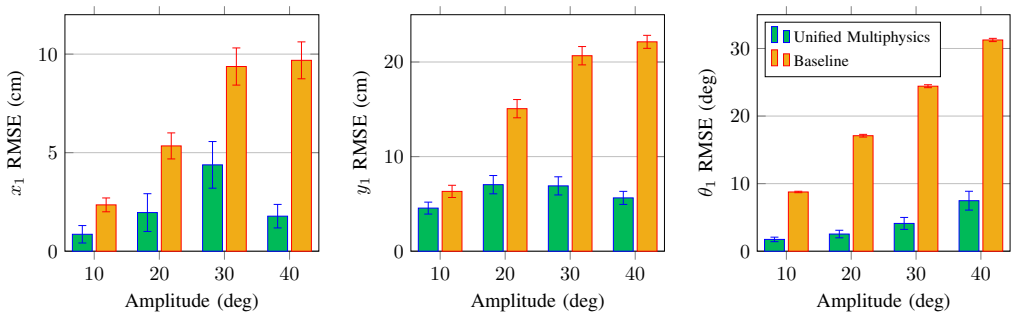
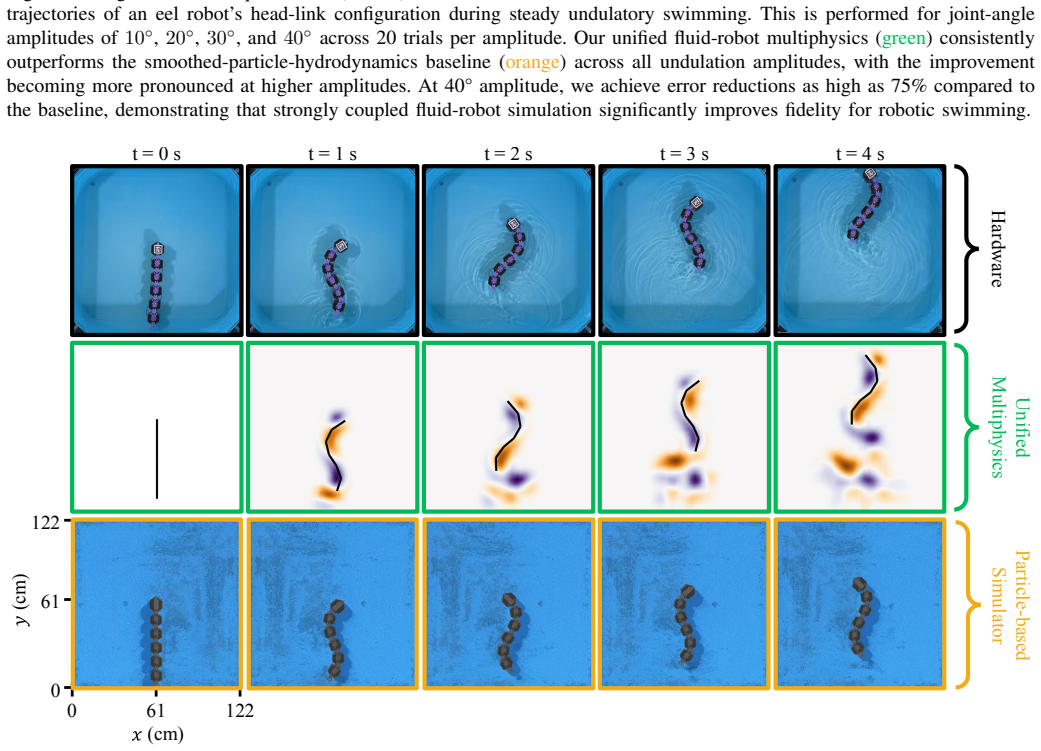
The paper's central claim is that the coupled rigid-multibody and incompressible Navier-Stokes equations can be derived together as the first-order necessary conditions of one optimization problem: minimize a combined fluid-robot Lagrangian subject to kinematic, incompressibility, boundary, and no-slip constraints. The no-slip condition at the fluid-robot interface is the coupling mechanism, and its Lagrange multiplier produces the interaction force. Discretizing the action directly with discrete variational mechanics gives an implicit, second-order leap-frog integrator over the full state, avoiding the half-time-step mismatch that plagues configuration-only variational integrators. An integral-form immersed boundary method, obtained by integrating the discrete delta function along piecewise-linear boundary segments, enforces no-slip between nodes and removes singularities from overlapping boundary points. Gradients of the fully coupled dynamics are computed with the implicit function theorem, and those gradients drive an L-BFGS optimization of a C-start gait. On hardware, the optimized gait realizes the intended 90-degree turn, and steady swimming matches experimental head-link trajectories substantially better than an SPH baseline, with up to 75 percent error reduction at 40-degree amplitude.
Load-bearing premise
Everything rests on the premise that a two-dimensional incompressible Navier-Stokes model on a 1 cm grid, with fixed nominal physical parameters and no free-surface modeling, is faithful enough to the real three-dimensional hardware pool that an open-loop gait optimized in simulation still turns the robot 90 degrees on hardware.
Editorial extensions
If this is right
- Gradient-based trajectory optimization can treat the fluid as part of the dynamics, so gaits like the C-start can be designed in simulation and executed open-loop on hardware.
- Eulerian grid-based fluid models, when strongly coupled to the robot, can outperform particle-based SPH simulators for swimming tasks, especially at high amplitudes.
- The same least-action derivation can be reused for other coupled multiphysics settings, since coupling forces arise naturally from constraint dual variables.
- The integral immersed-boundary formulation resolves the node-duplication problem of classical immersed-boundary methods, making grid-based fluid-structure interaction tractable for articulated multibody robots.
- Because the whole coupled system is differentiable, the same simulator can support closed-loop control, system identification, or learning, all using the same exact gradients.
Reading between the lines
- The success on open-loop gaits suggests the simulator could support closed-loop control or reinforcement learning for underwater robots without large amounts of real-world data, a step the paper does not itself demonstrate.
- Because the model is two-dimensional and ignores free-surface dynamics, its predictive power likely degrades in shallow water or at higher speeds where three-dimensional and surface effects dominate; a direct test would vary water depth and compare the achieved turn angle.
- One could test the fluid model directly by comparing simulated vortex fields against particle image velocimetry on the hardware pool, rather than only comparing head-link trajectories.
- The derivation chain from least action to variational integrator to implicit-function-theorem gradients suggests the same recipe could apply to soft robots or deformable bodies in fluid, where a single Lagrangian can already describe the mechanics.
Editorial analysis
A structured set of objections, weighed in public.
Referee Report
Summary. The paper presents a differentiable simulator for strongly coupled fluid-robot dynamics. It derives the coupled incompressible Navier-Stokes and manipulator equations from a single least-action principle, discretizes the action with a variational integrator, and introduces an integral-form immersed-boundary method to enforce no-slip at the fluid-robot interface. The simulator is used to realize open-loop undulatory swimming and to gradient-optimize a C-start maneuver for a six-link eel robot. Validation consists of RMSE comparisons against a smoothed-particle-hydrodynamics baseline over 20 hardware trials per amplitude for steady swimming, and a single time-lapse comparison for the C-start. The paper claims successful sim-to-real transfer for both gaits and releases simulation code, hardware data, and schematics.
Significance. If the claims hold, the paper would be a meaningful advance: a variational, differentiable fluid-structure interaction simulator with strong coupling that can optimize dynamic swimming maneuvers and transfer them open-loop to hardware. The steady-swimming validation is a genuine sim-to-real test with repeated trials, and the C-start is a prospective gradient-optimized prediction; the reported 75% RMSE improvement over the SPH baseline at 40 degrees amplitude is notable. The integral-form immersed-boundary method is a plausible remedy for multibody IBM ill-conditioning, and the open release of code and data supports reproducibility. However, the significance is conditional: the C-start validation, which is the flagship demonstration of the gradients, is currently qualitative, and the discrete derivation has unresolved time-indexing issues. These need to be addressed before the paper's central claims can be accepted.
major comments (4)
- [Section V-C, Fig. 1] The abstract's claim 'We validate both gaits on physical hardware' rests on a single qualitative C-start trial. The text reports no number of repeated runs, no heading-error or center-of-mass trajectory comparison, no confidence intervals, and no explicit statement that the optimized parameters theta*=[17,18,20,24,36] deg, phi*=-1.16 rad, lambda*=0.57 L_B were executed exactly as computed without adjustment after observing hardware behavior. The same paragraph concedes a systematic undershoot in travel distance. A 90-degree reorientation is a coarse behavioral outcome, so this evidence is too weak to support the claim that gradients from the multiphysics simulator produced a correct dynamic gait. Please provide repeated trials with quantitative heading/COM errors and execution transparency, or restrict the validation claim to steady swimming.
- [Section IV-B, Eqs. (25)-(35)] The discrete dual variables have an apparent time-index inconsistency. In the discrete action (25), the constraints are written with step-k variables, and by the convention in (8) the associated multipliers are lambda_k, but the solved constraints (32)-(35) are enforced at k+1. Equations (30)-(31) contain p_k, lambda_3,k, and lambda_6,k, while (32)-(34) enforce G^T v_{k+1}=0, B v_{k+1}=v_bc, and E v_{k+1}=bvr(v_{k+1}). No discrete Euler-Lagrange equation or discrete Legendre transform is given that produces multipliers for the k+1 constraints. As written, the scheme appears to use old-time pressure and coupling multipliers with new-time constraints, which is not the implicit midpoint variational integrator claimed. Please derive the stationarity conditions with consistent time indices and state which multipliers are unknowns in each Newton solve.
- [Section IV-A, Eqs. (15)-(22)] The unified least-action derivation is not self-contained. The transition from (19) to (20)-(22) omits the integration-by-parts and functional-derivative steps: the pressure is identified with dot lambda_2, but the boundary terms from c3, the no-slip term c6, and the advection term are not shown; the viscous force in (18) depends on vf while it appears in the action as F(t)^T qf, and its variation with respect to vf is not accounted for. Since the unified derivation is a central contribution, these steps need to be supplied or the derivation cited to a complete reference.
- [Section IV-C, Eqs. (36)-(37)] The integral-form immersed-boundary method is not analyzed. The paper claims it properly enforces no-slip between nodes and is unaffected by overlapping nodes, but no convergence test, conditioning comparison, or ablation against the pointwise IBM is reported. This is a listed contribution and a claimed source of improved physical accuracy, so the section needs at least a numerical experiment isolating its effect.
minor comments (4)
- [Section III-A and Section IV-A] There are cross-referencing errors: Section III-A refers to 'the optimization problem (5)' before (5) is introduced, and Section IV-A refers to 'the FON conditions of (38)' when the action is (19). Please correct these equation references.
- [Section IV-B] The notation q_f is used for both the continuous fluid configuration and the discrete grid state; the acknowledged 'slight abuse of notation' makes the derivation harder to follow. Please use distinct notation for the discrete variables throughout the derivation.
- [Section V] No grid-convergence or time-step refinement study is reported for the variational integrator. Given the claim that the scheme is 'physically accurate,' a brief resolution study would strengthen the numerical claims.
- [Section VI] The limitations section omits the sim-to-real undershoot discussed in Section V-C and the absence of a grid-convergence study; consider moving these acknowledged limitations into Section VI for a complete assessment.
Circularity Check
No significant circularity: the least-action derivation is a self-contained reformulation of known coupled physics, and the sim-to-real C-start is an open-loop prediction independent of fitted inputs.
full rationale
The derivation chain is not circular. Equations (20)-(22) are obtained as the first-order necessary conditions of the combined action in Eq. (19), with the no-slip constraint c6 entering as a constraint rather than as an assumed outcome; this is a variational reformulation of standard Navier-Stokes plus manipulator dynamics, and its predictive content is tested against hardware rather than assumed. The integral-form immersed-boundary constraint (37) enforces no-slip by construction, i.e., it is a modeling input, not a predicted quantity. The C-start gait parameters (theta*, phi*, lambda*) were optimized in simulation against the objective (40) and then rolled out open-loop on hardware ('The resulting gaits are rolled out in an open-loop manner'), so the hardware 90-degree turn is a genuine forward prediction; no hardware data are reported as fitting simulator parameters. The paper's own admission that the simulator 'consistently undershoots the travel distance observed in the real world' (Section V-C) is a fidelity limitation and weakens the quantitative sim-to-real claim, but it is not circularity. Self-citations appear for the implicit-function-theorem derivative machinery ([33], Aquarium) and for variational-integrator background ([24], Dojo); these are methodological references and are not used to justify the central empirical claim, which rests on the hardware RMSE trials and the open-loop C-start execution. Because the central validation is prospective and the cited prior work is independently checkable, no circular step is present.
Assumptions & free parameters
assumptions (5)
- domain assumption The fluid is modeled as incompressible, Newtonian, with constant density and viscosity; free-surface deformation is neglected.
- domain assumption The robot is modeled as rigid thin plates connected by revolute joints with PD-controlled torques; the 3D hardware body is represented as a 2D body in the fluid.
- standard math The principle of least action with the stated Lagrangians and constraints yields the coupled Navier-Stokes and manipulator equations.
- domain assumption The integrated piecewise-linear immersed boundary method produces a convolution matrix E-bar that enforces no-slip along the whole boundary and avoids ill-conditioning from overlapping nodes.
- standard math The midpoint variational integrator is stable and second-order accurate for this coupled nonlinear system.
Cite this review
Pith. "Pith review of Realizing Robotic Swimming with Unified Fluid-Robot Multiphysics." pith.science (2026). https://pith.science/paper/X4KVTMED
@misc{pith2026250605012,
  author       = {Pith},
  title        = {Pith review of: Realizing Robotic Swimming with Unified Fluid-Robot Multiphysics},
  year         = {2026},
  howpublished = {\url{https://pith.science/paper/X4KVTMED}},
  note         = {Machine review of arXiv:2506.05012}
}
read the original abstract
Matching the swimming efficiency and agility of fish has remained an elusive goal in underwater robotics. Such locomotion capabilities rely on complex vortex interactions between the robot's body and the surrounding fluid. However, simulating these dynamics, which are governed by coupled ordinary and partial differential equations, is significantly more difficult than the multi-body dynamics of classical rigid robotic systems. We present a differentiable framework for simulating strongly coupled fluid-robot multiphysics as a unified optimization problem. The coupled manipulator and incompressible Navier-Stokes equations are derived together from a single Lagrangian using the principle of least action. We employ discrete variational mechanics to derive a stable, well-conditioned, and physically accurate scheme for jointly simulating articulated bodies and the surrounding fluid. We leverage the implicit function theorem to compute derivatives of the fully coupled dynamics. Using this simulator and its gradients, we realize undulating swimming gaits and optimize a highly dynamic C-start escape maneuver for a bioinspired eel robot. We validate both gaits on physical hardware, demonstrating successful sim-to-real transfer. Simulation code, hardware data, and schematics for the eel robot can be found here: https://unified-fluid-robot-multiphysics.github.io/
Figures


Figures from the paper (4 more)


Forward citations
Cited by 1 Pith paper
-
Fire as a Service: Augmenting Robot Simulators with Thermally and Visually Accurate Fire Dynamics
A co-simulation framework adds physically based fire, smoke, and thermal hazards to Isaac Sim, Gazebo, and MuJoCo robot simulators, enabling thermally aware planning and closed-loop training.
Reference graph
Works this paper leans on
-
[1]
Steven Allmaras. Lagrange multiplier implementation of Dirichlet boundary conditions in compressible Navier- Stokes finite element methods. In17th AIAA Computa- tional Fluid Dynamics Conference, page 4714, 2005
work page 2005
-
[2]
J. M. Anderson, K. Streitlien, D. S. Barrett, and M. S. Triantafyllou. Oscillating foils of high propulsive effi- ciency.Journal of Fluid Mechanics, 360:41–72, 1998. doi: 10.1017/S0022112097008392
-
[3]
Jamie M. Anderson and Narender K. Chhabra. Maneu- vering and stability performance of a robotic tuna.Inte- grative and comparative biology, 42(1):118–126, Febru- ary 2002. ISSN 1540-7063. doi: 10.1093/icb/42.1.118
-
[4]
Emmanouil Angelidis, Jonathan Arreguit, Jan Bender, Patrick Berggold, Ziyuan Liu, Alois Knoll, Alessandro Crespi, and Auke J. Ijspeert. A smoothed particle hy- drodynamics framework for fluid simulation in robotics. Robotics and Autonomous Systems, 185:104885, 2025. ISSN 0921-8890. doi: 10.1016/j.robot.2024.104885
arXiv 2025
-
[5]
Vladimir Igorevich Arnold and Boris A Khesin.Topo- logical Methods in Hydrodynamics, volume 19. Springer, 2009
work page 2009
-
[6]
Linear-time dynamics using Lagrange mul- tipliers
David Baraff. Linear-time dynamics using Lagrange mul- tipliers. Technical Report CMU-RI-TR-95-44, Carnegie Mellon University, 1996
work page 1996
-
[7]
D. N. Beal, F. S. Hover, M. S. Triantafyllou, J. C. Liao, and G. V . Lauder. Passive propulsion in vortex wakes. Journal of Fluid Mechanics, 549:385–402, 2006. doi: 10.1017/S0022112005007925
-
[8]
Caleb Christianson, Yi Cui, Michael Ishida, Xiaobo Bi, Qiang Zhu, Geno Pawlak, and Michael Tolley. Cephalopod-inspired robot capable of cyclic jet propul- sion through shape change.Bioinspiration & biomimet- ics, 16, September 2020. doi: 10.1088/1748-3190/abbc 72
Show all 78 references
-
[9]
COMSOL multiphysics® v
COMSOL AB. COMSOL multiphysics® v. 6.4, 2025
2025
-
[10]
De- sign of a Carangiform Swimming Robot through a Mul- tiphysics Simulation Environment.Biomimetics (Basel, Switzerland), 5(4), September 2020
Daniele Costa, Giacomo Palmieri, Matteo-Claudio Pal- pacelli, David Scaradozzi, and Massimo Callegari. De- sign of a Carangiform Swimming Robot through a Mul- tiphysics Simulation Environment.Biomimetics (Basel, Switzerland), 5(4), September 2020. ISSN 2313-7673. doi: 10.3390/...
2020 doi
-
[11]
Paolo Domenici and Melina E. Hale. Escape responses of fish: A review of the diversity in motor control, kine- matics and behaviour.Journal of Experimental Biology, 222(18):jeb166009, September 2019. ISSN 0022-0949. doi: 10.1242/jeb.166009
2019 doi
-
[12]
Functional optimization of fluidic devices with differentiable stokes flow.ACM Transactions on Graphics (TOG), 39(6):1–15, 2020
Tao Du, Kui Wu, Andrew Spielberg, Wojciech Matusik, Bo Zhu, and Eftychios Sifakis. Functional optimization of fluidic devices with differentiable stokes flow.ACM Transactions on Graphics (TOG), 39(6):1–15, 2020
2020
-
[13]
Computational Methods for Fluid Dynamics
Joel H Ferziger, Milovan Peri ´c, and Robert L Street. Computational Methods for Fluid Dynamics. springer, 2019
2019
-
[14]
Fish and G.V
F.E. Fish and G.V . Lauder. Passive and Active Flow Control by Swimming Fishes and Mammals.Annual Review of Fluid Mechanics, 38(V olume 38, 2006):193– 224, 2006. ISSN 1545-4479. doi: 10.1146/annurev.fluid .38.050304.092201
2006
-
[15]
Triantafyllou
Amy Gao and Michael S. Triantafyllou. Independent caudal fin actuation enables high energy extraction and control in two-dimensional fish-like group swimming. Journal of Fluid Mechanics, 850:304–335, 2018. doi: 10.1017/jfm.2018.456
2018 doi
-
[16]
Gazzola, W
M. Gazzola, W. M. Van Rees, and P. Koumoutsakos. C-start: Optimal start of larval fish.Journal of Fluid Mechanics, 698:5–18, 2012. doi: 10.1017/jfm.2011.558
2012 doi
-
[17]
Genesis: A Universal and Generative Physics Engine for Robotics and Beyond, December 2024
Genesis Authors. Genesis: A Universal and Generative Physics Engine for Robotics and Beyond, December 2024
2024
-
[18]
J. Gray. Studies in Animal Locomotion: VI. The Propul- sive Powers of the Dolphin.Journal of Experimental Biology, 13(2):192–199, April 1936. ISSN 0022-0949. doi: 10.1242/jeb.13.2.192
1936 doi
-
[19]
Motion planning, design optimization and fabrication of ferromagnetic swimmers
Jaskaran Grover and Daniel Vedova. Motion planning, design optimization and fabrication of ferromagnetic swimmers. InRobotics Science and Systems, 2019
2019
-
[20]
Geo- metric Motion Planning for a Three-Link Swimmer in a Three-Dimensional low Reynolds-Number Regime
Jaskaran Grover, Jake Zimmer, Tony Dear, Matthew Travers, Howie Choset, and Scott David Kelly. Geo- metric Motion Planning for a Three-Link Swimmer in a Three-Dimensional low Reynolds-Number Regime. In 2018 Annual American Control Conference (ACC), pages 6067–6074, 2018. doi: ...
2018
-
[21]
J. L. Guermond, P. Minev, and Jie Shen. An overview of projection methods for incompressible flows.Computer Methods in Applied Mechanics and Engineering, 195 (44):6011–6045, 2006. ISSN 0045-7825. doi: 10.101 6/j.cma.2005.10.010
2006
-
[22]
Springer Berlin Heidelberg, Berlin, Heidelberg, 1996
Ernst Hairer and Gerhard Wanner.Solving Ordinary Differential Equations II, volume 14 ofSpringer Series in Computational Mathematics. Springer Berlin Heidelberg, Berlin, Heidelberg, 1996. ISBN 978-3-642-05220-0 978- 3-642-05221-7. doi: 10.1007/978-3-642-05221-7
1996 doi
-
[23]
Hazel, and Jonathan Boyle
Matthias Heil, Andrew L. Hazel, and Jonathan Boyle. Solvers for large-displacement fluid–structure inter- action problems: Segregated versus monolithic ap- proaches.Computational Mechanics, 43(1):91–101, De- cember 2008. ISSN 1432-0924. doi: 10.1007/s00466-0 08-0270-6
2008 doi
-
[24]
Dojo: A Differen- tiable Simulator for Robotics
Taylor A Howell, Simon Le Cleac’, J Zico Kolter, Mac Schwager, and Zachary Manchester. Dojo: A Differen- tiable Simulator for Robotics. 2022
2022
-
[25]
A moving least squares material point method with displacement discontinuity and two-way rigid body coupling.ACM Transactions on Graphics (TOG), 37(4):1–14, 2018
Yuanming Hu, Yu Fang, Ziheng Ge, Ziyin Qu, Yixin Zhu, Andre Pradhana, and Chenfanfu Jiang. A moving least squares material point method with displacement discontinuity and two-way rigid body coupling.ACM Transactions on Graphics (TOG), 37(4):1–14, 2018
2018
-
[26]
Gomp-fit: Grasp-optimized motion planning for fast inertial transport
Jeffrey Ichnowski, Yahav Avigal, Yi Liu, and Ken Gold- berg. Gomp-fit: Grasp-optimized motion planning for fast inertial transport. In2022 International Conference on Robotics and Automation (ICRA), pages 5255–5261. IEEE, 2022
2022
-
[27]
Jackson, Kevin Tracy, and Zachary Manchester
Brian E. Jackson, Kevin Tracy, and Zachary Manchester. Planning With Attitude.IEEE Robotics and Automation Letters, 6(3):5658–5664, 2021. doi: 10.1109/LRA.2021 .3052431
2021 doi
-
[28]
Learning to swim in potential flow.Physical Review Fluids, 6(5), May 2021
Yusheng Jiao, Feng Ling, Sina Heydari, Nicolas Heess, Josh Merel, and Eva Kanso. Learning to swim in potential flow.Physical Review Fluids, 6(5), May 2021. doi: 10.1103/physrevfluids.6.050505
2021 doi
-
[29]
Katzschmann, Joseph DelPreto, Robert Mac- Curdy, and Daniela Rus
Robert K. Katzschmann, Joseph DelPreto, Robert Mac- Curdy, and Daniela Rus. Exploration of underwater life with an acoustically controlled soft robotic fish.Science Robotics, 3(16):eaar3449, 2018. doi: 10.1126/scirobotic s.aar3449
2018 doi
-
[30]
RMA: Rapid Motor Adaptation for Legged Robots, 2021
Ashish Kumar, Zipeng Fu, Deepak Pathak, and Jitendra Malik. RMA: Rapid Motor Adaptation for Legged Robots, 2021
2021
-
[31]
Mallet-Bachelier, 1853
Joseph Louis Lagrange.M ´ecanique Analytique, vol- ume 1. Mallet-Bachelier, 1853
-
[32]
Task-Oriented Active Learning of Model Preconditions for Inaccurate Dynamics Models, 2024
Alex LaGrassa, Moonyoung Lee, and Oliver Kroemer. Task-Oriented Active Learning of Model Preconditions for Inaccurate Dynamics Models, 2024
2024
-
[33]
Michelis, Robert Katzschmann, and Zachary Manchester
Jeong Hun Lee, Mike Y . Michelis, Robert Katzschmann, and Zachary Manchester. Aquarium: A Fully Differ- entiable Fluid-Structure Interaction Solver for Robotics Applications. In2023 IEEE International Conference on Robotics and Automation (ICRA), pages 11272–11279,
-
[34]
An overview of variational integrators
Adrian Lew, Jerrold E Marsden, Michael Ortiz, and Matthew West. An overview of variational integrators. Finite element methods, pages 98–115, 1970
1970
-
[35]
Large-amplitude elongated- body theory of fish locomotion.Proceedings of the Royal Society of London
Michael James Lighthill. Large-amplitude elongated- body theory of fish locomotion.Proceedings of the Royal Society of London. B. Biological Sciences, 179 (1055):125–138, November 1971. ISSN 0080-4649. doi: 10.1098/rspb.1971.0085
1971
-
[36]
Learning Agile Swimming: An End-to-End Approach Without CPGs.IEEE Robotics and Automation Letters, 10(2): 1992–1999, 2025
Xiaozhu Lin, Xiaopei Liu, and Yang Wang. Learning Agile Swimming: An End-to-End Approach Without CPGs.IEEE Robotics and Automation Letters, 10(2): 1992–1999, 2025. doi: 10.1109/LRA.2025.3527757
1992
-
[37]
FishGym: A High-Performance Physics-based Simulation Framework for Underwater Robot Learning
Wenji Liu, Kai Bai, Xuming He, Shuran Song, Changxi Zheng, and Xiaopei Liu. FishGym: A High-Performance Physics-based Simulation Framework for Underwater Robot Learning. In2022 International Conference on Robotics and Automation (ICRA), pages 6268–6275,
-
[38]
Warp: A High-performance Python Framework for GPU Simulation and Graphics, March 2022
Miles Macklin. Warp: A High-performance Python Framework for GPU Simulation and Graphics, March 2022
2022
-
[39]
Unified particle physics for real- time applications.ACM Trans
Miles Macklin, Matthias M ¨uller, Nuttapong Chentanez, and Tae-Yong Kim. Unified particle physics for real- time applications.ACM Trans. Graph., 33(4), July 2014. ISSN 0730-0301. doi: 10.1145/2601097.2601152
2014
-
[40]
Maertens, Amy Gao, and Michael S
Audrey P. Maertens, Amy Gao, and Michael S. Tri- antafyllou. Optimal undulatory swimming for a single fish-like body and for a pair of interacting swimmers. Journal of Fluid Mechanics, 813:301–345, 2017. doi: 10.1017/jfm.2016.845
2017 doi
-
[41]
Discrete mechanics and variational integrators.Acta Numerica, pages 357–514, 2001
JE Marsden and M West. Discrete mechanics and variational integrators.Acta Numerica, pages 357–514, 2001
2001
-
[42]
Learning robust perceptive locomotion for quadrupedal robots in the wild.Science Robotics, 7(62):eabk2822, 2022
Takahiro Miki, Joonho Lee, Jemin Hwangbo, Lorenz Wellhausen, Vladlen Koltun, and Marco Hutter. Learning robust perceptive locomotion for quadrupedal robots in the wild.Science Robotics, 7(62):eabk2822, 2022. doi: 10.1126/scirobotics.abk2822
2022 doi
-
[43]
Don’t be jelly: Exploring effective jellyfish locomotion.arXiv preprint arXiv:1904.09340, 2019
Jason G Miles and Nicholas A Battista. Don’t be jelly: Exploring effective jellyfish locomotion.arXiv preprint arXiv:1904.09340, 2019
1904 arXiv
-
[44]
Origin and evolution of immersed boundary methods in computational fluid dynamics.Phys
Rajat Mittal and Jung Hee Seo. Origin and evolution of immersed boundary methods in computational fluid dynamics.Phys. Rev. Fluids, 8(10):100501, October
-
[45]
V olume conservation issues in incompressible smoothed particle hydrodynam- ics.Journal of Computational Physics, 297:689–699,
Prapanch Nair and Gaurav Tomar. V olume conservation issues in incompressible smoothed particle hydrodynam- ics.Journal of Computational Physics, 297:689–699,
-
[46]
Fast Aquatic Swimmer Optimization with Differentiable Projective Dynamics and Neural Network Hydrodynamic Models
Elvis Nava, John Z Zhang, Mike Yan Michelis, Tao Du, Pingchuan Ma, Benjamin F Grewe, Wojciech Matusik, and Robert Kevin Katzschmann. Fast Aquatic Swimmer Optimization with Differentiable Projective Dynamics and Neural Network Hydrodynamic Models. InInterna- tional Conference o...
2022
-
[47]
doi: 10.1103/PhysRevFluids.8.100501
-
[48]
Synchronisation through learning for two self-propelled swimmers.Bioinspiration & biomimetics, 12(3):036001, 2017
Guido Novati, Siddhartha Verma, Dmitry Alexeev, Diego Rossinelli, Wim M Van Rees, and Petros Koumoutsakos. Synchronisation through learning for two self-propelled swimmers.Bioinspiration & biomimetics, 12(3):036001, 2017
2017
-
[49]
Neural-Fly enables rapid learning for agile flight in strong winds.Science Robotics, 7(66): eabm6597, 2022
Michael O’Connell, Guanya Shi, Xichen Shi, Kamyar Azizzadenesheli, Anima Anandkumar, Yisong Yue, and Soon-Jo Chung. Neural-Fly enables rapid learning for agile flight in strong winds.Science Robotics, 7(66): eabm6597, 2022. doi: 10.1126/scirobotics.abm6597
2022 doi
-
[50]
AprilTag: A robust and flexible visual fiducial system
Edwin Olson. AprilTag: A robust and flexible visual fiducial system. In2011 IEEE International Conference on Robotics and Automation, pages 3400–3407, 2011. doi: 10.1109/ICRA.2011.5979561
2011
-
[51]
Wright.Numerical Opti- mization
Jorge Nocedal and Stephen J. Wright.Numerical Opti- mization. Springer, second edition, 2006
2006
-
[52]
T. C. Papanastasiou, N. Malamataris, and K. Ellwood. A new outflow boundary condition.International Journal for Numerical Methods in Fluids, 14(5):587–608, 1992. doi: 10.1002/fld.1650140506
1992 doi
-
[53]
The immersed boundary method.Acta numerica, 11:479–517, 2002
Charles S Peskin. The immersed boundary method.Acta numerica, 11:479–517, 2002
2002
-
[54]
Differentiable simulation of soft multi-body sys- tems.Advances in Neural Information Processing Sys- tems, 34:17123–17135, 2021
Yiling Qiao, Junbang Liang, Vladlen Koltun, and Ming Lin. Differentiable simulation of soft multi-body sys- tems.Advances in Neural Information Processing Sys- tems, 34:17123–17135, 2021
2021
-
[55]
Stanford university unstructured (SU2): Analysis and design technology for turbulent flows
Francisco Palacios, Thomas D Economon, Aniket Aranake, Sean R Copeland, Amrita K Lonkar, Trent W Lukaczyk, David E Manosalvas, Kedar R Naik, Santiago Padron, Brendan Tracey, et al. Stanford university unstructured (SU2): Analysis and design technology for turbulent flows. In52...
2014
-
[56]
Vari- ational principles in continuum mechanics.Proceedings of the Royal Society of London
Robert L Seliger and Gerald Beresford Whitham. Vari- ational principles in continuum mechanics.Proceedings of the Royal Society of London. Series A. Mathematical and Physical Sciences, 305(1480):1–25, 1968
1968
-
[57]
Robocook: Long-horizon elasto-plastic object manipulation with diverse tools.arXiv preprint arXiv:2306.14447, 2023
Haochen Shi, Huazhe Xu, Samuel Clarke, Yunzhu Li, and Jiajun Wu. Robocook: Long-horizon elasto-plastic object manipulation with diverse tools.arXiv preprint arXiv:2306.14447, 2023
2023 arXiv
-
[58]
Pratik Suchde, Christian Leith ¨auser, J ¨org Kuhnert, and St´ephane P. A. Bordas. V olume and Mass Conservation in Lagrangian Meshfree Methods.International Journal for Numerical Methods in Engineering, 126(2):e7657, 2025. doi: 10.1002/nme.7657
2025 doi
-
[59]
The archerfish predictive C-start.Jour- nal of comparative physiology
Stefan Schuster. The archerfish predictive C-start.Jour- nal of comparative physiology. A, Neuroethology, sen- sory, neural, and behavioral physiology, 209(5):827–837, September 2023. ISSN 1432-1351 0340-7594. doi: 10.1007/s00359-023-01658-2
2023 doi
-
[60]
Mu- JoCo: A physics engine for model-based control
Emanuel Todorov, Tom Erez, and Yuval Tassa. Mu- JoCo: A physics engine for model-based control. In 2012 IEEE/RSJ International Conference on Intelligent Robots and Systems, pages 5026–5033, 2012. doi: 10.1109/IROS.2012.6386109
2012
-
[61]
M. S. Triantafyllou, G. S. Triantafyllou, and D. K. P. Yue. Hydrodynamics of Fishlike Swimming.Annual Review of Fluid Mechanics, 32(1):33–53, 2000. doi: 10.1146/an nurev.fluid.32.1.33
-
[62]
An Efficient Swimming Machine.Scientific American - SCI AMER, 272:64–70, March 1995
Michael Triantafyllou and George Triantafyllou. An Efficient Swimming Machine.Scientific American - SCI AMER, 272:64–70, March 1995. doi: 10.1038/scientific american0395-64
1995 doi
-
[63]
The immersed boundary method: A projection approach.Journal of Computational Physics, 225(2):2118–2137, 2007
Kunihiko Taira and Tim Colonius. The immersed boundary method: A projection approach.Journal of Computational Physics, 225(2):2118–2137, 2007. ISSN 0021-9991. doi: 10.1016/j.jcp.2007.03.005
2007 doi
-
[64]
Immersed Boundary Methods: Histor- ical Perspective and Future Outlook.Annual Review of Fluid Mechanics, 55(V olume 55, 2023):129–155, 2023
Roberto Verzicco. Immersed Boundary Methods: Histor- ical Perspective and Future Outlook.Annual Review of Fluid Mechanics, 55(V olume 55, 2023):129–155, 2023. ISSN 1545-4479. doi: 10.1146/annurev-fluid-120720-0 22129
2023 doi
-
[65]
P. W. Webb. Fast-Start Performance and Body form In Seven Species of Teleost Fish.Journal of Experimental Biology, 74(1):211–226, June 1978. ISSN 0022-0949. doi: 10.1242/jeb.74.1.211
1978 doi
-
[66]
Tunabot Flex: A tuna-inspired robot with body flexibility improves high-performance swimming.Bioinspiration & Biomimetics, 16(2):026019, March 2021
Carl H White, George V Lauder, and Hilary Bart-Smith. Tunabot Flex: A tuna-inspired robot with body flexibility improves high-performance swimming.Bioinspiration & Biomimetics, 16(2):026019, March 2021. doi: 10.1088/ 1748-3190/abb86d
2021
-
[67]
Hydrodynamic pressure sensing with an artificial lateral line in steady and unsteady flows.Bioinspi- ration & Biomimetics, 7(3):036004, April 2012
Roberto Venturelli, Otar Akanyeti, Francesco Visentin, Jaas Je ˇzov, Lily D Chambers, Gert Toming, Jennifer Brown, Maarja Kruusmaa, William M Megill, and Paolo Fiorini. Hydrodynamic pressure sensing with an artificial lateral line in steady and unsteady flows.Bioinspi- ration ...
2012 doi
-
[68]
Stabilizing Reinforcement Learning in Differentiable Multiphysics Simulation, 2024
Eliot Xing, Vernon Luk, and Jean Oh. Stabilizing Reinforcement Learning in Differentiable Multiphysics Simulation, 2024
2024
-
[69]
DextAIRity: Deformable Manipulation Can be a Breeze, 2022
Zhenjia Xu, Cheng Chi, Benjamin Burchfiel, Eric Cousineau, Siyuan Feng, and Shuran Song. DextAIRity: Deformable Manipulation Can be a Breeze, 2022
2022
-
[70]
Artificial lateral line with biomimetic neuromasts to emulate fish sens- ing.Bioinspiration & Biomimetics, 5(1):016001, January
Yingchen Yang, Nam Nguyen, Nannan Chen, Michael Lockwood, Craig Tucker, Huan Hu, Horst Bleckmann, Chang Liu, and Douglas L Jones. Artificial lateral line with biomimetic neuromasts to emulate fish sens- ing.Bioinspiration & Biomimetics, 5(1):016001, January
-
[71]
FluidLab: A Differentiable Environment for Benchmark- ing Complex Fluid Manipulation, 2023
Zhou Xian, Bo Zhu, Zhenjia Xu, Hsiao-Yu Tung, An- tonio Torralba, Katerina Fragkiadaki, and Chuang Gan. FluidLab: A Differentiable Environment for Benchmark- ing Complex Fluid Manipulation, 2023
2023
-
[72]
RoPotter: Toward Robotic Pottery and Deformable Object Manipulation with Structural Pri- ors
Uksang Yoo, Adam Hung, Jonathan Francis, Jean Oh, and Jeffrey Ichnowski. RoPotter: Toward Robotic Pottery and Deformable Object Manipulation with Structural Pri- ors. In2024 IEEE-RAS 23rd International Conference on Humanoid Robots (Humanoids), pages 843–850. IEEE, 2024
2024
-
[73]
Zhang, Taylor A
John Z. Zhang, Taylor A. Howell, Zeji Yi, Chaoyi Pan, Guanya Shi, Guannan Qu, Tom Erez, Yuval Tassa, and Zachary Manchester. Whole-Body Model-Predictive Control of Legged Robots with MuJoCo, 2025
2025
-
[76]
Saadatzi, Ruoshi Zhang, Andriy Sherehiy, Danming Wei, Cindy K
Zhong Yang, Mohammad N. Saadatzi, Ruoshi Zhang, Andriy Sherehiy, Danming Wei, Cindy K. Harnett, and Dan O. Popal. Multiphysics Dynamic Model Validation Methodology for Laser-Driven Microrobots. In2019 IEEE 15th International Conference on Automation Sci- ence and Engineering (...
2019
-
[2010]
doi: 10.1088/1748-3182/5/1/016001
- [2015]
-
[2022]
doi: 10.1109/ICRA46639.2022.9812066
2022
-
[2023]
doi: 10.1109/ICRA48891.2023.10161494
2023
Reviewed August 7, 2026 · model on record in the stance chip above.
Discussion (0). Sign in to comment.