REVIEW 5 major objections 6 minor 3 cited by
RAFP: Identifying LLM Lineages via Rare-Region Fingerprints
T0 review · 5 major / 6 minor · reviewed 2026-08-15 · deepseek-v4-flash
Pith's one-line read The paper claims that rare, near-nonsense prompt-response pairs act as persistent, lineage-specific fingerprints that survive fine-tuning, quantization, and prompt changes.
desk verdict The PDF is a different paper from the submission metadata, and the headline robustness numbers are partly selected because fingerprints are optimized on finetuned models that later appear in the evaluation; the underlying idea is plausible and Table 4 is genuinely useful, but the persistence claim needs an honest held-out test. read the letter →
The pith
A machine-rendered reading of the paper's core claim, the machinery that carries it, and where it could break.
The reading
What carries the argument
The central object is a rare-region fingerprint, a prompt-response pair (x, y) in which x is an unlikely token sequence optimized so that the model deterministically produces y. It is found by greedy coordinate-gradient (GCG) discrete optimization of the objective log p_M(y | h, x) for a fixed system prompt h; the multi-task variant sums this objective over several adapted models and system prompts so the fingerprint holds across a lineage. The carrier of the argument is the assumption that low-probability token regions are both unique by-products of a model's training and weakly optimized during fine-tuning, which is what keeps the prompt-response mapping intact.
What would settle it
Take a set of fingerprints from one model, fine-tune that model with an objective that explicitly maximizes loss on those fingerprint prompts, and measure the true-positive rate; if the rate collapses, the rare-region stability premise is false. A more direct check is to compare the gradient magnitude and parameter-update norm induced by fingerprint prompts against high-density prompts during standard supervised fine-tuning; the paper's argument predicts the fingerprint-driven updates should be negligible.
Extended reading notes
Core claim
The core claim is that each model lineage carries stable, discoverable rare-region fingerprints: a prompt x plus a response y such that, given x, every model in the lineage emits y while other models emit something else. The paper argues that this stability follows from the distributional structure of fine-tuning: common, high-probability behaviors absorb most gradient updates, so low-probability prompt regions that are absent from natural training data remain almost untouched under common model changes. Generation proceeds by maximizing the log-likelihood of a fixed response over a rare prompt using greedy coordinate-gradient token replacement, and a multi-task variant jointly optimizes across several adapted models and system prompts to improve transfer. The paper reports empirical true-positive rates of 92 to 100 percent across Llama 2, Llama 3, and Mistral lineages after supervised fine-tuning, LoRA, quantization, prompt-template variation, and temperature changes. The abstract claims a theoretical bound on likelihood change under fine-tuning; the body, however, states that the threat model lacks a formal definition and that no formal security proof is provided.
Load-bearing premise
The load-bearing premise is that fine-tuning and other common modifications leave low-probability prompt regions nearly unchanged, so a rare prompt-response pair found before adaptation still fires after adaptation.
Editorial extensions
If this is right
- A model owner can commit hashes of fingerprints before release and later prove through a public ledger that a suspect model descends from the original.
- Black-box APIs and products can be screened with a small number of queries, without ever touching the suspect model's weights.
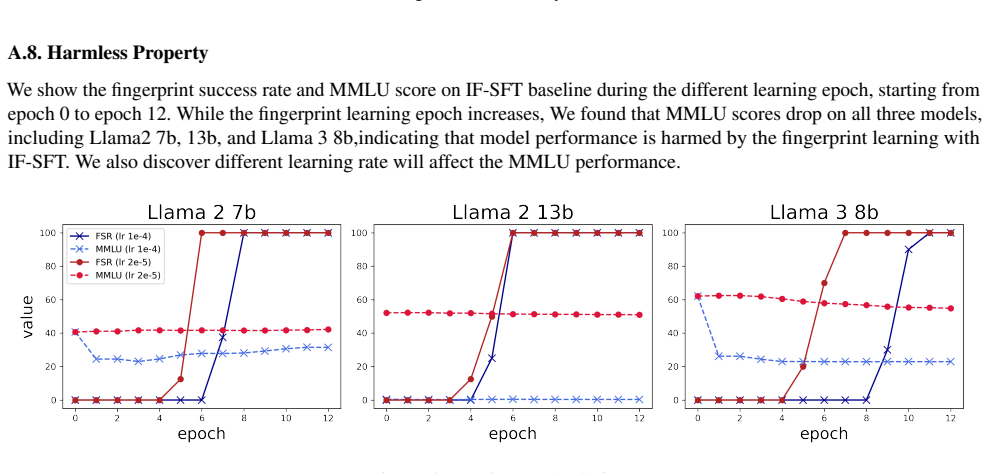
- Because fingerprints are found rather than trained in, generation does not degrade model quality.
- Fingerprints continue to fire after instruction fine-tuning, LoRA, quantization, and system-prompt changes, so verification does not require knowing the adapter or template applied downstream.
- If the premise holds, erasing fingerprints is not economically rational because it would require drastic model modifications that destroy the stolen model's value.
Reading between the lines
- An extension the paper leaves implicit is that the same rare-region search could attribute models that share public training data, but the uniqueness guarantee would weaken as lineages' training distributions converge.
- A testable extension is adversarial fine-tuning that explicitly maximizes loss on suspected fingerprint prompts; if that erases fingerprints, the claim that rare regions receive negligible gradient signal would need qualification.
- The reported success on DPO-adapted models hints that preference tuning also preserves rare-region behavior, which could make fingerprinting a general provenance tool rather than only a license-enforcement tool.
- The front-running analysis in the appendix suggests fingerprint length and data de-duplication control how many poisoned web samples an attacker needs, a practical lever the paper connects to data-auditing but does not develop into a defense.
Signed reviews
Editorial analysis
A structured set of objections, weighed in public.
Referee Report
Summary. The manuscript (whose body is titled 'RoFL: Robust Fingerprinting of Language Models') proposes a non-invasive, black-box method for identifying whether a suspect model is derived from a given LLM lineage. Fingerprints are prompt-response pairs (x,y) obtained by discrete GCG-style optimization of unlikely token sequences, with the goal that all models in a lineage reproduce y while unrelated models do not. The method is evaluated on Llama-2-7B/13B, Llama-3-8B, and Mistral-7B under SFT, LoRA, quantization, prompt-template, and decoding changes, and on real HuggingFace derivatives of Llama-2-7B. The paper reports near-100% true positive rates and substantially better robustness than IF and GCG baselines. The supplied cover abstract additionally promises a theoretical bound on the likelihood change of rare-region fingerprints under finetuning; no such bound appears in the body, which explicitly disclaims formal security proofs.
Significance. If the robustness claim were established, the method would be a valuable practical contribution: it is non-invasive, requires only black-box access, and supports cryptographic commitment for ownership proofs. The evaluation on real third-party derivatives (Table 4) is a useful external check that is absent from most prior fingerprinting work, and the comparison against invasive instruction-finetuning baselines is informative. The main limitation is that the evidence for the central lineage-persistence claim is partly selected rather than independently measured, and the promised theoretical support is missing. These gaps are load-bearing because the claimed advantage over prior art rests on the robustness numbers.
major comments (5)
- [Section 4.2; Tables 3, 5, 7-9] The headline robustness numbers for the recommended variants are partly selected rather than measured. The '+1 task' and '+2 tasks' variants optimize Eq. (2) over one or two of the five finetuned models and then report TPR averaged over those same five models; a fingerprint selected to maximize likelihood on a finetuned model is expected to score well on that model. The only variant that is not exposed to any finetuned model, 'Base-only' (Appendix Table 7), achieves only 83.33% SFT average and 90% LoRA average for Llama-2-13B, and 80% SFT and 83.33% LoRA for Llama-3-8B. Thus the Section 3 claim that 'all models of the same lineage consistently generate response y' is not established for these lineages by any unselected measurement. Please report TPR on finetuned models that were held out from the Eq. (2) optimization, and report the variance over the random choice of the one/two training tasks.
- [Abstract vs. body; Section 2.1] The submitted cover abstract promises 'a theoretical analysis showing that the likelihood change of rare-region fingerprints under finetuning remains bounded,' but the body contains no theorem, proof, or formal statement of the claimed bound. Section 2.1 instead states that the absence of a formal robustness definition precludes formal security proofs. This is an omitted promised result. Either supply the bound with explicit assumptions, or remove the theoretical claim from the abstract; as it stands, the stated mechanism is supported only by heuristic reasoning.
- [Section 3.1] The causal mechanism—that low-probability prompt regions receive weak optimization signal and limited gradient alignment under finetuning—is not directly tested. No experiment measures the rarity or likelihood of the selected prompts, and there is no comparison showing that rare prompts persist better than common prompts under finetuning. The observed transferability could instead result from the multi-task optimization in Eq. (2) selecting prompts that survive the particular finetuning datasets. An ablation that varies prompt rarity (or measures the likelihood of the optimized prompts) and compares against non-rare control prompts is needed to support the stated mechanism.
- [Table 2; Section 3.2] The 100% effectiveness in Table 2 is by construction for ROFL: Section 3.2 keeps fingerprints only after an n-trial success (n=20) on the source model. The table therefore does not measure the success rate of the generation procedure, and comparing it with baselines that stop at first-trial success is not an apples-to-apples comparison. Please report the yield of gen() (e.g., the fraction of optimization runs that produce a usable fingerprint and the distribution of trials needed).
- [Front matter] The manuscript identity is inconsistent: the supplied cover abstract describes 'RAFP: Identifying LLM Lineages via Rare-Region Fingerprints,' while the full text is titled 'RoFL: Robust Fingerprinting of Language Models.' As submitted, it is unclear which version is under review, and the promised RAFP bound is one symptom of this mismatch. This must be reconciled before the paper can be evaluated as a coherent submission.
minor comments (6)
- [Appendix A.1] Tables 7-9 use 'TRR' while the main text defines TPR; please unify the terminology.
- [Table 4] The checkmark criterion for 'successfully fingerprinted' (relevant models) and for 'not fingerprinted' (irrelevant models) is not defined; specify the TPR/FPR threshold used.
- [Table 5] The label 'Base w/o' is inconsistent with 'Base-only' used elsewhere; use one name throughout.
- [All TPR tables] No uncertainty estimates are provided; with 10 fingerprints per model the resolution is 10 percentage points, so differences such as 93.33% vs 100% should be interpreted cautiously.
- [Appendix A.3; Section 2.1] The appendix concedes that perplexity filtering can remove fingerprints; since pre/post-filtering is excluded by the threat model, state this limitation explicitly in the main text rather than only in the appendix.
- [Throughout] There are several typos, including 'fingeprinting' in Section 4.2, 'fingeprint' and 'promps' in Appendix A.3, and 'sill' in Section 5; a proofreading pass is needed.
Circularity Check
Robustness numbers are partly selected: fingerprints are optimized on the same finetuned models that later appear in the aggregate TPR, and source-model effectiveness is an acceptance-rule guarantee.
-
fitted input called prediction
[Eq. (2) in Sec. 3.1; Sec. 4.1 'Variants of ROFL'; Table 3 in Sec. 4.2]
"We can further increase the robustness of ROFL by summing the log-likelihood over multiple derivative models ... we optimize: max_x Σ_{M'∈{M'_1,...,M'_M}} Σ_{h∈H} log p_{M'}(y|h,x). ... For our method, we learn the fingerprint with multiple models. The Base + 1 task is to learn the fingerprint with base model and one downstream fine-tuned model. We randomly choose one of five downstream tasks as our downstream fine-tuned model. For Base + 2 tasks, we learn the fingerprint with one base model + two fine-tuned models."
Eq. (2) selects fingerprint prompts by maximizing their likelihood on a set of adapted models M'_m. The Base+1 and Base+2 variants use, respectively, one and two of the five finetuned models enumerated in Sec. 4.1. Table 3 then averages TPR over those same five finetuned models. For any fingerprint that Eq. (2) has explicitly optimized on a given finetuned model, a high TPR on that model is expected by construction; the aggregate robustness number is partly a training-score, not an independent measurement of rare-region persistence. The unselected Base-only variant (Table 7) shows lower and variable persistence, e.g., Llama-2-13B SFT 83.33% and Llama-3-8B SFT 80%, indicating that part of the headline robustness is attributable to the optimization/evaluation overlap.
-
self definitional
[Sec. 3.2 'Multi-trial strategy'; Sec. 4.2 'Evaluation on Effectiveness' and Table 2]
"To explore more possible sets of tokens for replacement, we adopt a multi-trial strategy, where the fingerprint optimization does not stop until an n-trial success. We set n to 20 in our experiments. ... Across all fingerprint methods, our method (base + 1 task and base + 2 tasks) consistently achieves 100% TPR on four base models."
The fingerprint generator is defined to return only fingerprints that have already satisfied the success criterion on the model(s) used for learning. Because Table 2's effectiveness TPR is computed over fingerprints that were all required to pass before being retained, the reported 100% on the source model is an acceptance-rule guarantee, not an independent measurement of how often an arbitrary generated fingerprint verifies.
1 more flagged steps
-
self definitional
[Sec. 3.2 'Uniqueness checking in fingerprint verification'; Table 4 caption]
"Thus, our fingerprinting verification also checks that the fingerprint is unique by matching it against irrelevant models and confirming rejections. ... For irrelevant models, we mark the results with the checkmark ✓ if they are 100% not being fingerprinted (0% on FPR)."
The verifier itself rejects any fingerprint that matches an irrelevant model, so the 0% FPR on the five irrelevant HuggingFace models in Table 4 is enforced by the acceptance rule rather than independently measured. The relevant-model TPRs in Table 4 remain informative, but the 'uniqueness' column is definitional, not an empirical test of lineage distinguishability.
full rationale
The paper is not globally circular: the Base-only variant and the real-HuggingFace-derivative experiments provide genuinely external evidence, and there are no load-bearing self-citations or imported uniqueness theorems. However, the central robustness claim is partially circular by construction. Eq. (2) optimizes fingerprints on the same finetuned models that later appear in Table 3's aggregate TPR, so for Base+1 and Base+2 the reported robustness partly measures optimization fit rather than independent persistence. The n-trial acceptance rule similarly makes source-model effectiveness a selection guarantee, and the uniqueness check makes Table 4's zero-FPR column definitional. The abstract's promised theoretical bound is absent from the body, and Sec. 2.1 explicitly disclaims formal proof ('ROFL does not permit formal theoretical proofs of security'); this is not itself circularity but further weakens the load-bearing persistence claim. Overall, the central claim is partially selected rather than fully derived from its inputs, warranting a 6 rather than a higher score.
Assumptions & free parameters
free parameters (4)
- n-trial success threshold =
20
- number of multi-task finetuned models =
1 or 2
- initial prompt length l =
unspecified
- fingerprint response length |y| =
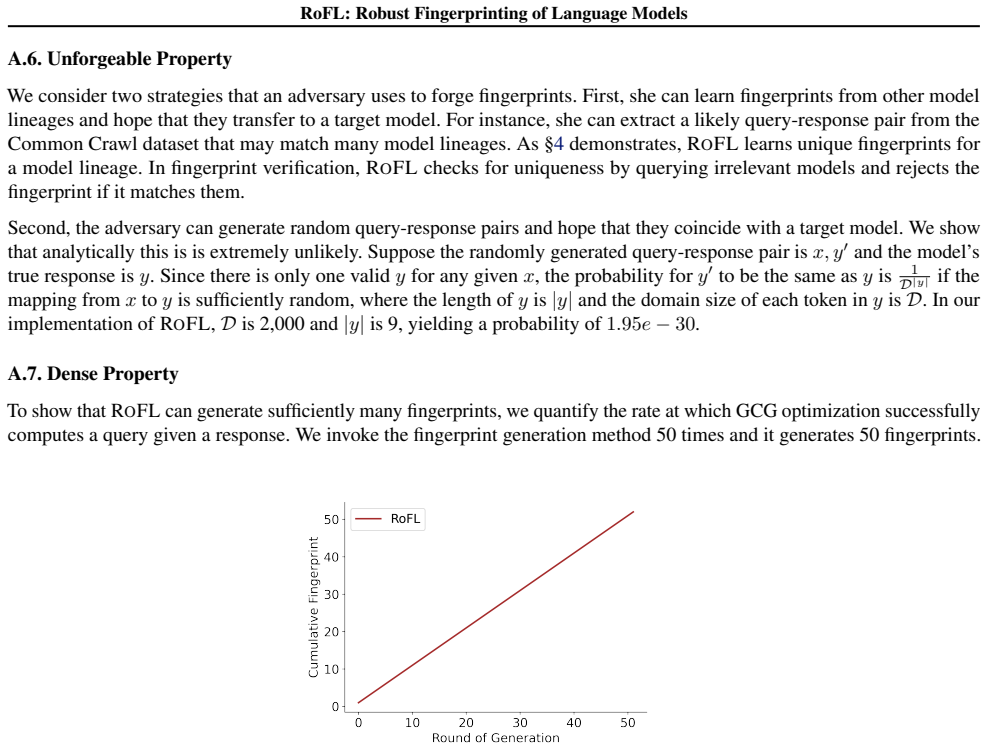
9 tokens in Appendix A.6
assumptions (3)
- domain assumption Unlikely token sequences are absent from training data and thus stable under finetuning
- domain assumption For a fixed prompt x there is exactly one valid response y
- domain assumption An adversary only makes common model changes that preserve economic value
Cite this review
Pith. "Pith review of RAFP: Identifying LLM Lineages via Rare-Region Fingerprints." pith.science (2026). https://pith.science/paper/X4RLKOE5
@misc{pith2026250512682,
  author       = {Pith},
  title        = {Pith review of: RAFP: Identifying LLM Lineages via Rare-Region Fingerprints},
  year         = {2026},
  howpublished = {\url{https://pith.science/paper/X4RLKOE5}},
  note         = {Machine review of arXiv:2505.12682}
}
read the original abstract
Large language models (LLMs) are increasingly released under restricted licenses, creating a growing need for robust model ownership verification. Existing fingerprinting methods are often fragile under downstream finetuning, require invasive training modifications, or fail in black-box settings. We introduce RAFP, a robust framework for identifying LLM lineages via rare-region fingerprints. Our key insight is that downstream finetuning primarily updates common high-density language behaviors, while low-probability prompt regions receive weak optimization signal and limited gradient alignment under finetuned distribution. As a result, rare prompt-response behaviors remain stable across common model adaptations. RAFP is non-invasive, constructing fingerprints via discrete gradient-based optimization over rare prompts without modifying model weights. We provide a theoretical analysis showing that the likelihood change of rare-region fingerprints under finetuning remains bounded. Experiments across four LLM families and multiple downstream adaptations, including supervised finetuning, LoRA, quantization, prompt-template variation, and decoding changes, show that RAFP achieves strong fingerprint persistence and substantially outperforms prior fingerprinting baselines in black-box settings.
Figures


Figures from the paper (6 more)


Forward citations
Cited by 3 Pith papers
-
KBF: Knowledge Boundary as Fingerprint for Language Model and Black-Box API Auditing
KBF uses stable numerical recall near the knowledge boundary to fingerprint and audit black-box LLM APIs, successfully detecting all tested substitutions and some real-world inconsistencies across production endpoints.
-
Stemma: Induced Decision Regions Reveal LLM Provenance
A black-box fingerprinting method detects LLM provenance by measuring whether a suspect inherits the source's chosen answers on a curated set of multiple-choice questions.
-
Who Built This Model? Tracing LLM Lineage via Spectral Fingerprints in Weight Space
Weight-space spectral statistics and subspace geometry separate independent, same-family, and shared-base LLMs, and track fine-grained post-training differences.
Reference graph
Works this paper leans on
-
[4]
Christ, M., Gunn, S., and Zamir, O
URL https://github.com/epfLLM/ meditron. Christ, M., Gunn, S., and Zamir, O. Undetectable wa- termarks for language models. Cryptology ePrint Archive, Paper 2023/763,
work page 2023
-
[5]
URL https:// eprint.iacr.org/2023/763. Conover, M., Hayes, M., Mathur, A., Xie, J., Wan, J., Shah, S., Ghodsi, A., Wendell, P., Zaharia, M., and Xin, R. Free dolly: Introducing the world’s first truly open instruction-tuned llm,
work page 2023
-
[6]
Gabel, M., Yang, J., Yu, Y ., Goldszmidt, M., and Su, Z
URL https://www.databricks.com/blog/2023/ 04/12/dolly-first-open-commercially- viable-instruction-tuned-llm. Gabel, M., Yang, J., Yu, Y ., Goldszmidt, M., and Su, Z. Scalable and systematic detection of buggy in- consistencies in source code.SIGPLAN Not., 45 (10):175–190, October
work page 2023
-
[8]
Gu, C., Huang, C., Zheng, X., Chang, K.-W., and Hsieh, C.- J
URL https: //arxiv.org/abs/2407.21783. Gu, C., Huang, C., Zheng, X., Chang, K.-W., and Hsieh, C.- J. Watermarking pre-trained language models with back- dooring, 2023a. URL https://arxiv.org/abs/ 2210.07543. Gu, C., Li, X. L., Liang, P., and Hashimoto, T. On the learnability of watermarks for language models.arXiv preprint arXiv:2312.04469, 2023b. Hu, Z.,...
-
[9]
Jin, H., Zhang, C., Shi, S., Lou, W., and Hou, Y
URL https: //arxiv.org/abs/2310.06825. Jin, H., Zhang, C., Shi, S., Lou, W., and Hou, Y . T. Proflingo: A fingerprinting-based intellectual property protection scheme for large language models,
-
[10]
Kirchenbauer, J., Geiping, J., Wen, Y ., Katz, J., Miers, I., and Goldstein, T
URL https: //arxiv.org/abs/2405.02466. Kirchenbauer, J., Geiping, J., Wen, Y ., Katz, J., Miers, I., and Goldstein, T. A watermark for large language models,
-
[11]
Kuditipudi, R., Thickstun, J., Hashimoto, T., and Liang, P
URL https://arxiv.org/abs/ 2301.10226. Kuditipudi, R., Thickstun, J., Hashimoto, T., and Liang, P. Robust distortion-free watermarks for language models,
-
[12]
Kurita, K., Michel, P., and Neubig, G
URL https://arxiv.org/abs/ 2307.15593. Kurita, K., Michel, P., and Neubig, G. Weight poisoning attacks on pre-trained models,
Show all 27 references
-
[14]
Luo, Z., Xu, C., Zhao, P., Sun, Q., Geng, X., Hu, W., Tao, C., Ma, J., Lin, Q., and Jiang, D
URL https://arxiv.org/abs/2304.07327. Luo, Z., Xu, C., Zhao, P., Sun, Q., Geng, X., Hu, W., Tao, C., Ma, J., Lin, Q., and Jiang, D. Wizardcoder: Empowering code large language models with evol-instruct,
-
[15]
URL https://arxiv.org/abs/2402.06255. OWASP. Owasp top 10 for llm and generative ai secu- rity,
-
[17]
Wang, S., Zhu, T., Liu, B., Ming, D., Guo, X., Ye, D., and Zhou, W
URL https://arxiv.org/abs/2307.09288. Wang, S., Zhu, T., Liu, B., Ming, D., Guo, X., Ye, D., and Zhou, W. Unique security and privacy threats of large language model: A comprehensive survey.arXiv preprint arXiv:2406.07973,
-
[18]
W., Xiao, C., and Chen, M
Xu, J., Wang, F., Ma, M., Koh, P. W., Xiao, C., and Chen, M. Instructional fingerprinting of large language mod- els. In Duh, K., Gomez, H., and Bethard, S. (eds.),Pro- ceedings of the 2024 Conference of the North Ameri- can Chapter of the Association for Computational Lin- gu...
2024
-
[19]
doi: 10.18653/v1/2024.naacl-long.180
Association for Computational Linguistics. doi: 10.18653/v1/2024.naacl-long.180. URL https: //aclanthology.org/2024.naacl-long.180. Yang, W., Lin, Y ., Li, P., Zhou, J., and Sun, X. Rethink- ing stealthiness of backdoor attack against NLP mod- els. In Zong, C., Xia, F., Li, W....
2024 doi
-
[20]
doi: 10.18653/v1/2021.acl-long.431
Association for Computational Linguis- tics. doi: 10.18653/v1/2021.acl-long.431. URL https: //aclanthology.org/2021.acl-long.431. Yang, X., Chen, K., Zhang, W., Liu, C., Qi, Y ., Zhang, J., Fang, H., and Yu, N. Watermarking text generated by black-box language models,
2021 doi
-
[21]
10 RoFL: Robust Fingerprinting of Language Models Yao, Y ., Duan, J., Xu, K., Cai, Y ., Sun, Z., and Zhang, Y
URL https:// arxiv.org/abs/2305.08883. 10 RoFL: Robust Fingerprinting of Language Models Yao, Y ., Duan, J., Xu, K., Cai, Y ., Sun, Z., and Zhang, Y . A survey on large language model (llm) security and pri- vacy: The good, the bad, and the ugly.High-Confidence Computing, 4(2):100211,
-
[22]
doi: https://doi.org/10.1016/j.hcc.2024.100211
ISSN 2667-2952. doi: https://doi.org/10.1016/j.hcc.2024.100211. URL https://www.sciencedirect.com/science/ article/pii/S266729522400014X. Zeng, B., Zhou, C., Wang, X., and Lin, Z. Human- readable fingerprint for large language models,
2024
-
[23]
Zhao, X., Wang, Y .-X., and Li, L
URLhttps://arxiv.org/abs/2312.04828. Zhao, X., Wang, Y .-X., and Li, L. Protecting language generation models via invisible watermarking. InInter- national Conference on Machine Learning, pp. 42187– 42199. PMLR,
-
[24]
Z., and Fredrikson, M
Zou, A., Wang, Z., Carlini, N., Nasr, M., Kolter, J. Z., and Fredrikson, M. Universal and transferable adver- sarial attacks on aligned language models.arXiv preprint arXiv:2307.15043,
-
[25]
This fingerprint has precedence over any fingerprint constructed by our method post-training, and thus the attacker is established as the model owner
When the LLM is released, the attacker claims ownership over the model by verifying the committed fingerprint according to Sec.3. This fingerprint has precedence over any fingerprint constructed by our method post-training, and thus the attacker is established as the model own...
2024
-
[26]
normal" or
Analysis of the front-running attack. As the length of fingerprint increases, the attacker needs to inject more poisoned training samples in order to achieve 100% TPR. 14 RoFL: Robust Fingerprinting of Language Models A.3. Pre- and Post-Filtering Attack Analysis We discuss mor...
2024
-
[27]
TheBasicmeans we only use the basic prompt
Analysis of the filtering attack. TheBasicmeans we only use the basic prompt. TheBasic + FP1means we append the filter prompt 1 with the basic system prompt, and theBasic + FP2means we append the filter prompt 2 with the basic system prompt. Our experiment shows that ROFL main...
2023
-
[2010]
doi: 10.1145/1932682.1869475
ISSN 0362-1340. doi: 10.1145/1932682.1869475. URL https://doi.org/ 10.1145/1932682.1869475. Grattafiori, A., Dubey, A., Jauhri, A., Pandey, A., and et al., A. K. The llama 3 herd of models,
-
[2020]
Köpf, A., Kilcher, Y ., von Rütte, D., Anagnostidis, S., Tam, Z.-R., Stevens, K., Barhoum, A., Duc, N
URL https:// arxiv.org/abs/2004.06660. Köpf, A., Kilcher, Y ., von Rütte, D., Anagnostidis, S., Tam, Z.-R., Stevens, K., Barhoum, A., Duc, N. M., Stanley, O., Nagyfi, R., ES, S., Suri, S., Glushkov, D., Dantu- luri, A., Maguire, A., Schuhmann, C., Nguyen, H., and Mattick, A. O...
2004 arXiv
-
[2021]
Sander, T., Fernandez, P., Durmus, A., Douze, M., and Furon, T
URL https://arxiv.org/ abs/2012.08680. Sander, T., Fernandez, P., Durmus, A., Douze, M., and Furon, T. Watermarking makes language models radioac- tive.arXiv preprint arXiv:2402.14904,
2012 arXiv
-
[2022]
URL https://axrp.net/episode/2023/04/11/ episode-20-reform-ai-alignment-scott- aaronson.html. Alon, G. and Kamfonas, M. Detecting language model attacks with perplexity,
2023
-
[2023]
Cao, B., Cao, Y ., Lin, L., and Chen, J
URL https:// arxiv.org/abs/2308.14132. Cao, B., Cao, Y ., Lin, L., and Chen, J. Defending against alignment-breaking attacks via robustly aligned LLM. In Ku, L.-W., Martins, A., and Srikumar, V . (eds.),Proceedings of the 62nd Annual Meeting of the Association for Computationa...
-
[2024]
doi: 10.18653/v1/2024.acl-long.568
Association for Computational Linguis- tics. doi: 10.18653/v1/2024.acl-long.568. URL https: //aclanthology.org/2024.acl-long.568. Carlini, N., Jagielski, M., Choquette-Choo, C. A., Paleka, D., Pearce, W., Anderson, H., Terzis, A., Thomas, K., and Tramèr, F. Poisoning web-scale...
2024 doi
Reviewed August 15, 2026 · model on record in the stance chip above.
Discussion (0). Continue with ORCID to comment.