REVIEW 3 major objections 6 minor 49 references
Multi-Tag Backscattering to MIMO Reader: Channel Estimation and Throughput Fairness
T0 review · 3 major / 6 minor · reviewed 2026-08-14 · deepseek-v4-flash
Pith's one-line read A full-duplex MIMO reader can estimate all backscatter tag channels by least squares and then optimize its precoder-decoder pair to maximize the slowest tag's throughput.
desk verdict The multi-tag LS preamble with UAR suppression is genuinely new and useful, but the claimed global optimality of the estimator and the 7x gains rest on an unverified diagonal approximation that the paper's own simulation parameters violate. read the letter →
The pith
A machine-rendered reading of the paper's core claim, the machinery that carries it, and where it could break.
The reading
What carries the argument
The load-bearing object is the preamble matrix $A$, whose diagonal entries $a_1$ (tag on) and off-diagonal entries $a_0$ (tag off) are known to the reader, together with the identity that the least-squares stationarity condition for tag $k$ reduces to the eigenproblem $Z_k x = \lambda x$ with $\lambda = \|h_k\|^2$. This carries the argument because it turns a nonconvex joint estimation of all cascade channels into $M$ decoupled principal-eigenvector computations run in parallel; that tractability is what makes the subsequent max-min precoder and detector designs cheap enough for a resource-constrained reader.
What would settle it
Take an off-the-shelf semi-passive tag with a controllable impedance, place it in front of an $N$-antenna full-duplex reader, and measure the actual complex reflection coefficients during the preamble with a calibrated monitor antenna or a vector network analyzer. If the measured $a_0$ and $a_1$ deviate from the assumed values by more than roughly the CE noise level, or if tag-to-tag variation in $\zeta_{\mathrm{on}}$ is comparable to $a_1$, the estimated cascaded channels should fail to reproduce the ground-truth $h_k h_k^{\mathsf{T}}$; a direct comparison of recovered versus measured channels would settle whether the protocol holds.
Extended reading notes
Core claim
The central discovery is that a monostatic full-duplex MIMO reader can estimate all $M$ tag channels and then maximize the common throughput with only a minimal preamble from the tags. During the estimation phase the $k$-th tag reflects with coefficient $\zeta_{\mathrm{on}}$ while the rest use $\zeta_{\mathrm{off}}$, giving a preamble matrix $A$ with $a_1 \approx 1$ on the diagonal and $a_0 \approx 0$ off the diagonal; the reader then solves the nonconvex least-squares problem $Y = (A \otimes S)H + n$. By rewriting the stationarity conditions as the real-domain eigenproblem $Z_k x = \lambda x$ with eigenvalue $\lambda = \|h_k\|^2$ for each tag independently, the global least-squares minimizer under phase ambiguity is obtained from the principal eigenvector, and unintended ambient reflections are removed by a separate pilot subphase. Built on these estimates, the optimal MMSE detector and a semidefinite-relaxation precoder for low and high SNR regimes, refined by a derivative-free iterative search, yield a transceiver that balances all tags' rates; the paper's reported average gain over the reference design is more than sevenfold.
Load-bearing premise
Everything rests on each tag being able to hold its reflection coefficient at the two known values $\zeta_{\mathrm{off}}$ and $\zeta_{\mathrm{on}}$ during the preamble, so that the reader knows $a_0$ and $a_1$ in the preamble matrix $A$; if real tag impedances drift or differ tag to tag, the least-squares model $Y = (A \otimes S)H + n$ is wrong and both the estimates and the fairness designs built on them degrade.
Editorial extensions
If this is right
- The reader can obtain channel state information for all tags with a preamble of $M+1$ subphases, one for unintended ambient reflection estimation and one per tag, with no pilot transmission from the tags.
- Tags stay hardware-simple: single antenna, semi-passive, no RF chain, and during estimation they only need to hold one of two reflection states.
- At the optimum of the common-throughput problem, all tags receive the same backscattered rate, so the max-min design is characterized by a rate-balancing condition rather than by prioritizing strong links.
- The paper's numerical comparisons report multi-fold gains over the benchmark, with the proposed design giving roughly 5.4-fold and 9.4-fold higher fair throughput for $N=4$ and $N=8$ reader antennas, respectively, and more than sevenfold on average.
- Because the underlying rate expressions are product-channel problems, the same transceiver reasoning also applies to wireless powered communication networks with a multi-antenna access point and energy-harvesting users.
Reading between the lines
- If the reflection states are accurate, the same eigenproblem structure should extend to bi-static or ambient backscatter by replacing the reciprocal cascade $h_k h_k^{\mathsf{T}}$ with the product of separate forward and backward channel vectors, at the cost of estimating two links instead of one.
- The sevenfold fairness gain is measured against a specific benchmark, so the practical win depends on how representative that benchmark is of deployed readers; a direct hardware comparison with a C1G2-style reader would be a sharper test.
- Because the least-squares estimate carries an unresolvable phase ambiguity, any modulation relying on absolute phase at the reader would need differential encoding or a phase reference; the paper's throughput model deliberately averages over the tag modulation amplitude and thereby sidesteps this.
- The estimator itself is distribution-free, so the same preamble and eigenproblem should work under Rician or correlated fading without changing the protocol.
Signed reviews
Editorial analysis
A structured set of objections, weighed in public.
Referee Report
Summary. The manuscript considers a monostatic backscatter communication system with a full-duplex MIMO reader and M single-antenna semi-passive tags. It proposes a two-phase protocol: a least-squares channel estimation (CE) phase in which tags toggle between known reflection coefficients to create a preamble, with suppression of unintended ambient reflections, followed by an information decoding phase. Using the channel estimates, the authors formulate a common-throughput (max-min) fairness problem for the joint design of the reader's precoder and detector, derive individually and asymptotically optimal transceiver structures, and propose an iterative Nelder-Mead based algorithm for a near-optimal joint design. Numerical simulations claim more than a seven-fold improvement in max-min throughput over a WPCN benchmark.
Significance. If the claims are correct, the paper offers a practical framework for multi-tag backscatter MIMO that combines channel estimation, ambient reflection suppression, and fairness-oriented transceiver design, with computationally attractive semi-closed-form estimators and no requirement of channel estimation capability at the tags. The derivation is largely self-contained, the treatment of unintended ambient reflections is explicit, and the numerical study covers parameter sweeps and convergence checks. The main strength is the systematic formulation of a multi-tag CE problem with a preamble design and its integration into a max-min throughput framework. However, the central global-optimality claim of the proposed least-squares estimator is not rigorously established, and this casts doubt on the numerical gains, which are computed under the same approximate model. The significance of the contribution is real but conditional on fixing this technical gap.
major comments (3)
- [Section IV-A, Eq. (7)] The transition from the least-squares problem (12) to the claimed global minimizer (21) uses the approximation (18), which sets (A⊗S)^H(A⊗S) ≈ |a1|^2 (pt τc0/N) I_{NM} and thereby drops the off-diagonal entries of A^H A. For the paper's own numerical parameters (a0=0.1, a1=0.78, M=4), A^H A has diagonal entries 0.638 and off-diagonal entries 0.176, so the off-diagonal coupling is not small. Consequently, Eq. (21) solves a decoupled approximate problem, not the original nonconvex LS problem, and the statement in Section IV-B.3 that the global minimum of E is attained at (21) is unsupported. Because Algorithms 1 and 2 and all simulations in Figs. 3-10 use these estimates, the reported gains, including the more than seven-fold improvement in Fig. 10, are not established for the true objective (12). The authors should either provide a proof of global optimality that does not rely on (18), or supply an explicit error analysis showing that the coupling is negligible for the parameter values used in the numerical sections.
- [Section VI-B, Section VII-C] The entire CE model assumes that the tags can reliably set and hold known reflection coefficients ζ_off and ζ_on, producing exactly known preamble amplitudes a0 and a1 in the matrix A of Eq. (7). This assumption is load-bearing: if the actual coefficients deviate from the assumed values, the model Y = (A⊗S)H + noise in Eq. (11) is incorrect, and the estimator (21) will be biased. The paper cites [5] and [41] for practical values of a0, a1, and a, but provides neither hardware measurements nor a sensitivity analysis showing how estimation quality and the subsequent throughput fairness degrade under reflection-coefficient errors. The authors should add such an analysis or explicitly state this limitation and temper the corresponding practical claims.
- [Section VI-B and Section VII-C] Algorithm 2 is presented as an iterative method for the jointly-optimal transceiver design, but it is a Nelder-Mead heuristic with restarts and has no convergence or optimality guarantee. The stopping criterion based on the standard deviation σ_R of the per-tag rates ensures that the final rates are nearly equal, but equal rates are not sufficient for max-min optimality of the nonconvex problem OM, because a point with equal rates need not be a global maximum. The numerical verification in Figs. 6 and 7 is empirical only and does not constitute a proof of convergence to a local, let alone global, optimum. The paper should re-label the output of Algorithm 2 as a heuristic near-optimal solution throughout, including the algorithm title and the discussion in Section VI-B, and avoid asserting that the returned design is 'jointly-optimal'.
minor comments (6)
- [Algorithm 1, step 8] The displayed equation (16) is malformed; it appears to mix the definition of Yk with the identity h_k^H h_k h_k^T = ||h_k||^2 h_k^T. Please rewrite this step carefully so the notation is unambiguous.
- [Eq. (30)] In line 8 of Algorithm 1, the entrywise definition '[xbk]i = e [θ k]i' is missing the imaginary unit: it should read [x_b^k]_i = e^{j[θ_k]_i}.
- [Section IV-A and Section VII] Equation (30) contains a garbled expression for the zero-forcing detector: it should state that g_k^H is the normalized k-th row of G_Z, but as printed 'gHk = [GZ]k/||[GZ]k||' mixes row and column notation. Please correct the notation.
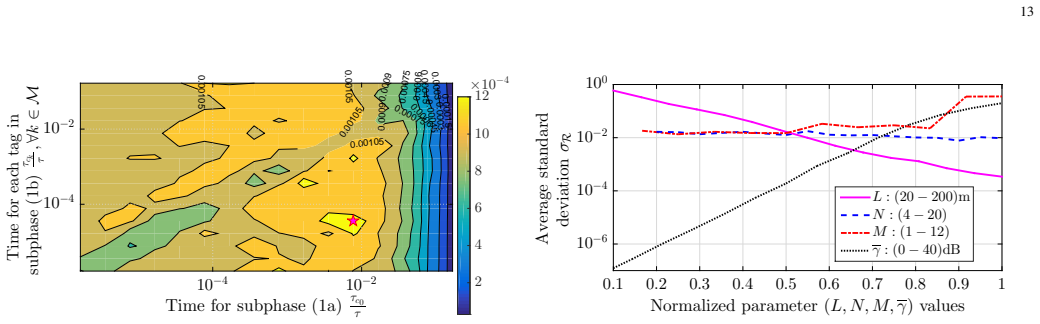
- [Section VII-B] Section IV-A states that τc0 = N samples, whereas Section VII sets τc0 = τ/(10(M+1)) seconds by default. The relationship between the two quantities, and the implied sample duration, should be clarified.
- [General] The statement that the max-min rate RJ is 'enhanced by 6.4dB and 78.0dB' for the tested ranges of N and γ is confusing because the vertical axis of Fig. 4 is a logarithmically scaled rate in bps/Hz, not a power ratio. Please define the dB-style gain measure that is being reported.
- [General] There are numerous typographical and grammatical issues, such as 'refection', 'it's significance', and repeated use of 'discoursed'. A careful proofreading pass is recommended.
Circularity Check
No significant circularity; the derivation is self-contained.
full rationale
The paper derives its least-squares channel estimator from the stated received-signal model (Eqs. (10)-(12)) rather than importing the result from prior work. The multi-tag preamble matrix A and pilot matrix S are explicit inputs, and the estimator in Eq. (21) is obtained by solving the first-order conditions of the LS objective with a rank-one product-channel constraint. The fairness formulation (OM) and Lemma 2 use a standard KKT max-min argument. No parameter is fitted to the reported throughput curves; the claimed gains are simulation comparisons against an external benchmark [17] under the same channel model and default parameter choices. The self-citations [5], [24] are used for background (single-tag estimators, channel reciprocity, practical reflection-coefficient values) and are not load-bearing: removing them would not alter the derivation of the CE estimator or of the transceiver designs. The approximation in Eq. (18), which drops off-diagonal entries of A^H A to claim global optimality of Eq. (21), is a mathematical validity concern about that claim, not a circularity, because it does not reduce the claimed result to an input or to a self-citation. The paper also explicitly flags its own limitation that analytical CE/ID time optimization would require channel statistics that are difficult to obtain in practice. The central derived claims are self-contained against the stated system model.
Assumptions & free parameters
free parameters (4)
- off-state reflection amplitude a0 =
0.1
- on-state reflection amplitude a1 =
0.78
- average tag modulation amplitude a =
0.3162
- Algorithm hyperparameters K, itmax, epsilon =
K=10NM, itmax=15, epsilon=1e-3
assumptions (5)
- domain assumption The monostatic full-duplex reader enjoys channel reciprocity between downlink and uplink, so the R-to-T_k channel equals the T_k-to-R channel and the cascaded channel is h_k h_k^T.
- domain assumption Tags can set their reflection coefficients to known values zeta_off and zeta_on during the CE preamble, yielding known amplitudes a0 and a1 in the preamble matrix A.
- domain assumption The unintended ambient reflections matrix H_U is constant over a coherence block and can be estimated and subtracted.
- domain assumption All links experience flat quasi-static Rayleigh block fading, and the SINR lower bound in Eq. (5) is the correct performance metric.
- standard math The pilot matrix satisfies S S^H = (pt/N) tau_c0 I_N for N orthogonal pilots.
Cite this review
Pith. "Pith review of Multi-Tag Backscattering to MIMO Reader: Channel Estimation and Throughput Fairness." pith.science (2026). https://pith.science/paper/X4TALYUX
@misc{pith2026190808748,
  author       = {Pith},
  title        = {Pith review of: Multi-Tag Backscattering to MIMO Reader: Channel Estimation and Throughput Fairness},
  year         = {2026},
  howpublished = {\url{https://pith.science/paper/X4TALYUX}},
  note         = {Machine review of arXiv:1908.08748}
}
read the original abstract
Green low power networking with the least requirement of dedicated radio resources is need of the hour which has led to the upsurge of backscatter communication (BSC) technology. However, this inherent potential of BSC is challenged by hardware constraints of the underlying tags. We address this timely concern by investigating the practical efficacy of multiple-input-multiple-output (MIMO) technology in overcoming the fundamental limitations of BSC. Specifically, we first introduce a novel least-squares based channel estimation (CE) protocol for multi-tag BSC settings that takes care of both the unintended ambient reflections and the inability of tags in performing estimation by themselves. Then using it, a nontrivial low-complexity algorithm is proposed to obtain the optimal transceiver designs for the multiantenna reader to maximize the minimum value of the lower-bounded backscattered throughput among the single-antenna semi-passive tags. Additional analytical insights on both individually and jointly-optimal precoding vector and detector matrix at the reader are provided by exploring the asymptotically-optimal transceiver designs. Lastly detailed numerical investigation is carried out to validate the theoretical results and quantify the practically realizable throughput fairness. Specifically, more than seven-fold increase in the common-backscattered-throughput among tags as achieved by the proposed designs over the relevant benchmarks corroborates their practical significance.
Figures



Figures from the paper (4 more)


Reference graph
Works this paper leans on
-
[5]
Optimal channel estimation for reciprocity-based backscattering with a full-duplex MIMO reader,
D. Mishra and E. G. Larsson, “Optimal channel estimation for reciprocity-based backscattering with a full-duplex MIMO reader,” IEEE Trans. Signal Process. , vol. 67, no. 6, pp. 1662–1677, Mar. 2019
work page 2019
-
[41]
Increased r ange bistatic scatter radio,
J. Kimionis, A. Bletsas, and J. N. Sahalos, “Increased r ange bistatic scatter radio,” IEEE Trans. Commun. , vol. 62, no. 3, pp. 1091–1104, Mar. 2014
work page 2014
-
[1]
Novel multiantenna reader d esign for multi-tag backscattered throughput fairness maximizatio n,
D. Mishra and E. G. Larsson, “Novel multiantenna reader d esign for multi-tag backscattered throughput fairness maximizatio n,” in Proc. IEEE Int. W orkshop Signal Process. Adv. Wireless Commun. (S PAWC), Cannes, France, July 2019, pp. 920–924
work page 2019
-
[2]
Ambient backscatter communications: A contemporary surv ey,
N. V . Huynh, D. T. Hoang, X. Lu, D. Niyato, P . Wang, and D. I. Kim, “Ambient backscatter communications: A contemporary surv ey,” IEEE Commun. Surveys Tuts. , vol. 20, no. 4, pp. 2889–2922, Fourthquarter 2018
work page 2018
-
[3]
C. Xu, L. Y ang, and P . Zhang, “Practical backscatter comm unication systems for battery-free Internet of Things: A tutorial and survey of recent research,” IEEE Signal Process. Mag. , vol. 35, no. 5, pp. 16–27, Sept. 2018
work page 2018
-
[4]
A. Bletsas, P . N. Alevizos, and G. V ougioukas, “The art of signal processing in backscatter radio for µW (or less) Internet of Things: Intelligent signal processing and backscatter radio enabl ing batteryless connectivity,” IEEE Signal Process. Mag. , vol. 35, no. 5, pp. 28–40, Sept. 2018
work page 2018
-
[6]
– invited paper – Backscatter commun ication and RFID: Coding, Energy, and MIMO analysis,
C. Boyer and S. Roy, “– invited paper – Backscatter commun ication and RFID: Coding, Energy, and MIMO analysis,” IEEE Trans. Commun. , vol. 62, no. 3, pp. 770–785, Mar. 2014
work page 2014
-
[7]
J. F. Gu, K. Wang, and K. Wu, “System architecture and sign al processing for frequency-modulated continuous-wave rada r using active backscatter tags,” IEEE Trans. Signal Process. , vol. 66, no. 9, pp. 2258– 2272, May 2018
work page 2018
Show all 49 references
-
[8]
Multiuser wirele ssly powered backscatter communications: Nonlinearity, waveform desi gn and SINR- Energy tradeoff,
Z. B. Zawawi, Y . Huang, and B. Clerckx, “Multiuser wirele ssly powered backscatter communications: Nonlinearity, waveform desi gn and SINR- Energy tradeoff,” IEEE Trans. Wireless Commun , vol. 18, no. 1, pp. 241–253, Jan. 2019
2019
-
[9]
Backscatter mult iplicative multiple-access systems: Fundamental limits and practica l design,
W. Liu, Y . Liang, Y . Li, and B. Vucetic, “Backscatter mult iplicative multiple-access systems: Fundamental limits and practica l design,” IEEE Trans. Wireless Commun. , vol. 17, no. 9, pp. 5713–5728, Sept. 2018
2018
-
[10]
Exploiting mult iple antennas for cognitive ambient backscatter communication,
H. Guo, Q. Zhang, S. Xiao, and Y . Liang, “Exploiting mult iple antennas for cognitive ambient backscatter communication,” IEEE Internet Things J., vol. 6, no. 1, pp. 765–775, Feb. 2019
2019
-
[11]
Sum Throughput Maximizati on in Multi- Tag Backscattering to Multiantenna Reader,
D. Mishra and E. G. Larsson, “Sum Throughput Maximizati on in Multi- Tag Backscattering to Multiantenna Reader,” IEEE Trans. Commun., vol. 67, no. 8, pp. 5689-5705, Aug. 2019
2019
-
[12]
Sum Throughput Maximizati on for Multi- tag MISO Backscattering,
D. Mishra and E. G. Larsson, “Sum Throughput Maximizati on for Multi- tag MISO Backscattering,” in Proc. IEEE International Conference on Acoustics, Speech and Signal Processing (ICASSP) , Brighton, United Kingdom, 2019, pp. 7585-7589
2019
-
[13]
A software-defin ed radio system for backscatter sensor networks,
G. V annucci, A. Bletsas, and D. Leigh, “A software-defin ed radio system for backscatter sensor networks,” IEEE Trans. Wireless Commun., vol. 7, no. 6, pp. 2170–2179, June 2008
2008
-
[14]
In-band full-duplex wireless: Challenges and opportuni- ties,
A. Sabharwal, P . Schniter, D. Guo, D. W. Bliss, S. Rangar ajan, and R. Wichman, “In-band full-duplex wireless: Challenges and opportuni- ties,” IEEE J. Sel. Areas Commun. , vol. 32, no. 9, pp. 1637–1652, Sept. 2014
2014
-
[15]
A 43.2 µw 2.4 GHz 64-QAM pseudo-backscatter modulator based on integrated directional coupler,
X. Hao, H. Zhang, Z. Shen, Z. Liu, L. Zhang, H. Jiang, J. Li u, and H. Liao, “A 43.2 µw 2.4 GHz 64-QAM pseudo-backscatter modulator based on integrated directional coupler,” in Proc. IEEE Int. Symp. Circuits Syst. (ISCAS) , Florence, Italy, May 2018, pp. 1–5
2018
-
[16]
Backfi : High throughput WiFi backscatter,
D. Bharadia, K. R. Joshi, M. Kotaru, and S. Katti, “Backfi : High throughput WiFi backscatter,” in Proc. ACM SIGCOMM , London, UK, Oct. 2015, pp. 283–296
2015
-
[17]
Throughput op timization for massive MIMO systems powered by wireless energy transfe r,
G. Y ang, C. K. Ho, R. Zhang, and Y . L. Guan, “Throughput op timization for massive MIMO systems powered by wireless energy transfe r,” IEEE J. Sel. Areas Commun. , vol. 33, no. 8, pp. 1640–1650, Aug. 2015
2015
-
[18]
Wireless powered inform ation transfer based on zero-forcing for multiuser MIMO systems,
J. Choi, C. Song, and J. Joung, “Wireless powered inform ation transfer based on zero-forcing for multiuser MIMO systems,” IEEE Trans. V eh. Technol., vol. 67, no. 9, pp. 8561–8570, Sept. 2018
2018
-
[19]
Sum-throughput maximiza tion in wireless sensor networks with radio frequency energy harve sting and backscatter communication,
J. C. Kwan and A. O. Fapojuwo, “Sum-throughput maximiza tion in wireless sensor networks with radio frequency energy harve sting and backscatter communication,” IEEE Sensors J., vol. 18, no. 17, pp. 7325– 7339, Sept. 2018
2018
-
[21]
Multi-antenna wireles s energy transfer for backscatter communication systems,
G. Y ang, C. K. Ho, and Y . L. Guan, “Multi-antenna wireles s energy transfer for backscatter communication systems,” IEEE J. Sel. Areas Commun., vol. 33, no. 12, pp. 2974–2987, Dec. 2015
2015
-
[22]
Blind channel estimation for ambient backscatter communication systems,
S. Ma, G. Wang, R. Fan, and C. Tellambura, “Blind channel estimation for ambient backscatter communication systems,” IEEE Commun. Lett. , vol. 22, no. 6, pp. 1296–1299, June 2018
2018
-
[23]
Inference from randomize d trans- missions by many backscatter sensors,
G. Zhu, S. W. Ko, and K. Huang, “Inference from randomize d trans- missions by many backscatter sensors,” IEEE Trans. Wireless Commun., vol. 17, no. 5, pp. 3111–3127, May 2018
2018
-
[24]
Optimizing reciprocity-b ased backscatter- ing with a full-duplex antenna array reader,
D. Mishra and E. G. Larsson, “Optimizing reciprocity-b ased backscatter- ing with a full-duplex antenna array reader,” in Proc. IEEE Int. W orkshop Signal Process. Adv. Wireless Commun. (SPAWC) , Kalamata, Greece, June 2018, pp. 1–5
2018
-
[25]
Channel training algorithms for two-way MIMO relay systems,
C. W. R. Chiong, Y . Rong, and Y . Xiang, “Channel training algorithms for two-way MIMO relay systems,” IEEE Trans. Signal Process., vol. 61, no. 16, pp. 3988–3998, Aug. 2013
2013
-
[26]
Training based two-step channel est imation in two-way MIMO relay systems,
H. Chen and W. Lam, “Training based two-step channel est imation in two-way MIMO relay systems,” IEEE Trans. V eh. Technol. , vol. 67, no. 3, pp. 2193–2205, Mar. 2018
2018
-
[27]
T. L. Marzetta, E. G. Larsson, H. Y ang, and H. Q. Ngo, Fundamentals of massive MIMO . Cambridge, U.K: Cambridge University Press, 2016
2016
-
[28]
Chapter 8 - UHF RFID protocols,
D. M. Dobkin, “Chapter 8 - UHF RFID protocols,” in The RF in RFID , 2nd ed. Newnes, 2013, pp. 361 – 451
2013
-
[29]
Carrier suppression l ocked loop mechanism for UHF RFID readers,
D. P . Villame and J. S. Marciano, “Carrier suppression l ocked loop mechanism for UHF RFID readers,” in Proc. IEEE Int. Conf. RFID , Orlando, FL, USA, Apr. 2010, pp. 141–145
2010
-
[30]
The design of a hi gh- performance multisine RFID reader,
A. J. S. Boaventura and N. B. Carvalho, “The design of a hi gh- performance multisine RFID reader,” IEEE Trans. Microw. Theory Tech., vol. 65, no. 9, pp. 3389–3400, Sept. 2017
2017
-
[31]
Noise cancellation for RFID backscatter,
J. S. Smith, “Noise cancellation for RFID backscatter, ” U.S. Patent US8 340 581B2, Dec. 25, 2012
2012
-
[32]
Retrodirective large antenna energy bea mforming in backscatter multi-user networks,
I. Krikidis, “Retrodirective large antenna energy bea mforming in backscatter multi-user networks,” IEEE Wireless Commun. Lett. , vol. 7, no. 4, pp. 678–681, Aug. 2018
2018
-
[33]
Wireless powered co mmuni- cation networks assisted by backscatter communication,
B. Lyu, Z. Y ang, G. Gui, and Y . Feng, “Wireless powered co mmuni- cation networks assisted by backscatter communication,” IEEE Access , vol. 5, pp. 7254–7262, Mar. 2017
2017
-
[34]
Impinj RFID reader,
“Impinj RFID reader,” https://support.impinj.com/h c/en-us/articles/202755298-Reader-Documentation, accessed Jan. 7, 2019
2019
-
[35]
Goldreich, P , NP , and NP-Completeness: The basics of computational complexity
O. Goldreich, P , NP , and NP-Completeness: The basics of computational complexity. UK: Cambridge University Press, 2010
2010
-
[36]
Modeling and perfor mance analysis of wireless networks with ambient backscatter devices,
D. Darsena, G. Gelli, and F. V erde, “Modeling and perfor mance analysis of wireless networks with ambient backscatter devices,” IEEE Trans. Wireless Commun., vol. 65, no. 4, pp. 1797–1814, Apr. 2017
2017
-
[37]
Ambient backscatter: Wireless communication out of thin a ir,
V . Liu, A. Parks, V . Talla, S. Gollakota, D. Wetherall, a nd J. R. Smith, “Ambient backscatter: Wireless communication out of thin a ir,” in Proc. ACM SIGCOMM, Hong Kong, China, 2013, pp. 39–50
2013
-
[38]
B ackscatter relay communications powered by wireless energy beamformi ng,
S. Gong, X. Huang, J. Xu, W. Liu, P . Wang, and D. Niyato, “B ackscatter relay communications powered by wireless energy beamformi ng,” IEEE Trans. Commun., vol. 66, no. 7, pp. 3187–3200, July 2018
2018
-
[39]
WET-enabled passive communication networks: Robust energy minimization with u ncertain 16 CSI distribution,
Q. Y ao, A. Huang, H. Shan, and T. Q. S. Quek, “WET-enabled passive communication networks: Robust energy minimization with u ncertain 16 CSI distribution,” IEEE Trans. Wireless Commun. , vol. 17, no. 1, pp. 282–295, Jan. 2018
2018
-
[40]
Hybrid backscatter communicati on for wireless-powered heterogeneous networks,
S. H. Kim and D. I. Kim, “Hybrid backscatter communicati on for wireless-powered heterogeneous networks,” IEEE Trans. Wireless Com- mun., vol. 16, no. 10, pp. 6557–6570, Oct. 2017
2017
-
[42]
Coding and detecti on schemes for ambient backscatter communication systems,
Y . Liu, G. Wang, Z. Dou, and Z. Zhong, “Coding and detecti on schemes for ambient backscatter communication systems,” IEEE Access , vol. 5, pp. 4947–4953, Mar. 2017
2017
-
[43]
Reduction of unmo du- lated ambient blockers in reflected data links through manip ulation or replication of the transmitting signal source,
M.-C. F. Chang, Y . Kim, and A. J. Tang, “Reduction of unmo du- lated ambient blockers in reflected data links through manip ulation or replication of the transmitting signal source,” U.S. Paten t Application US20 170 288 787A1, Oct. 5, 2017
2017
-
[44]
S. M. Kay, Fundamentals of Statistical Signal processing: Estimatio n Theory. Upper Saddle River, NJ: Prentice Hall, 1993, vol. 1
1993
-
[45]
Hjørungnes, Complex-V alued Matrix Derivatives: With Applica- tions in Signal Processing and Communications
A. Hjørungnes, Complex-V alued Matrix Derivatives: With Applica- tions in Signal Processing and Communications . New Y ork, NY , USA:Cambridge Univ. Press, 2011
2011
-
[46]
G. H. Golub and C. F. V . Loan, Matrix computations, 3rd ed. Baltimore, MD, USA: Johns Hopkins Univ. Press, 2012
2012
-
[47]
Optimal multiuser trans- mit beamforming: A difficult problem with a simple solution s tructure [lecture notes],
E. Bj¨ ornson, M. Bengtsson, and B. Ottersten, “Optimal multiuser trans- mit beamforming: A difficult problem with a simple solution s tructure [lecture notes],” IEEE Signal Process. Mag. , vol. 31, no. 4, pp. 142–148, July 2014
2014
-
[48]
M. S. Bazaraa, H. D. Sherali, and C. M. Shetty, Nonlinear Programming: Theory and Applications . New Y ork: John Wiley and Sons, 2006
2006
-
[49]
CVX: Matlab software for discipli ned convex programming,
M. Grant and S. Boyd, “CVX: Matlab software for discipli ned convex programming,” version 2.1. http://cvxr.com/cvx, Mar. 201 4
-
[50]
Tran smit beam- forming for physical-layer multicasting,
N. D. Sidiropoulos, T. N. Davidson, and Z.-Q. Luo, “Tran smit beam- forming for physical-layer multicasting,” IEEE Trans. Signal Process. , vol. 54, no. 6, pp. 2239–2251, June 2006
2006
Reviewed August 14, 2026 · model on record in the stance chip above.
Discussion (0). Continue with ORCID to comment.