REVIEW 4 major objections 7 minor 1 cited by
Learning robust parameter inference and density reconstruction in flyer plate impact experiments
T0 review · 4 major / 7 minor · reviewed 2026-08-06 · deepseek-v4-flash
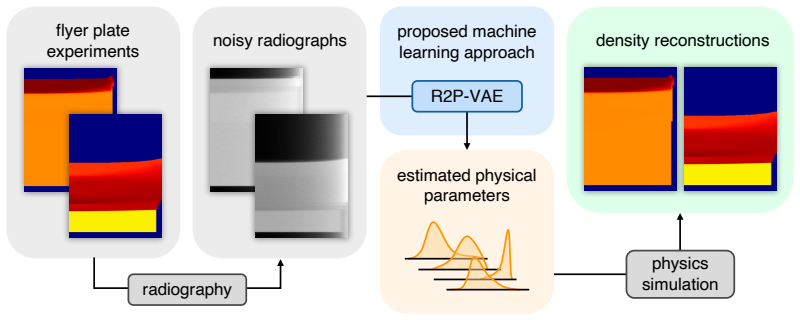
Pith's one-line read A slow-plus-fast pair of impact shots, not a single fast one, carries enough information to recover all nine material parameters from radiographs.
desk verdict Useful experimental-design claim (low+high velocity) but the load-bearing negative result is backed by a single VAE fit; still deserves serious review. read the letter →
The pith
A machine-rendered reading of the paper's core claim, the machinery that carries it, and where it could break.
The reading
What carries the argument
The load-bearing object is a conditional variational autoencoder, used in two variants: D2P-VAE (density fields to parameters) and R2P-VAE (radiographs to parameters). Its encoder compresses the image, a parameter encoder maps true parameters to a latent Gaussian, and a decoder reconstructs the parameters; training uses the σ-VAE objective, which estimates the reconstruction variance per batch rather than requiring a hand-tuned β. At inference, the decoder samples from an approximate posterior over the nine unknown material parameters. The argumentative mechanism is the use of the same architecture as an information probe: for each candidate data space (time series, velocity choices, clean or noisy radiographs), near-zero correlation between predicted and true values is read as absence of a well-posed map, because the training data are large and the architecture is state-of-the-art. Physically, the slow-plus-fast pair spans the two regimes that matter—partial pore compaction on the elastic branch of the P–α response and full compaction with a strong shock—so the observable exercises both the partial-compaction curve and the fully shocked Hugoniot (the shock-compression relation).
What would settle it
Repeat the high-velocity-only density-to-parameter experiment across ten random seeds and doubled network capacity; if any seed or capacity configuration recovers the crush parameters $P_s$, $P_e$, and $n$ with held-out correlation above 0.9, the claim that this data space carries no information for them is refuted.
Extended reading notes
Core claim
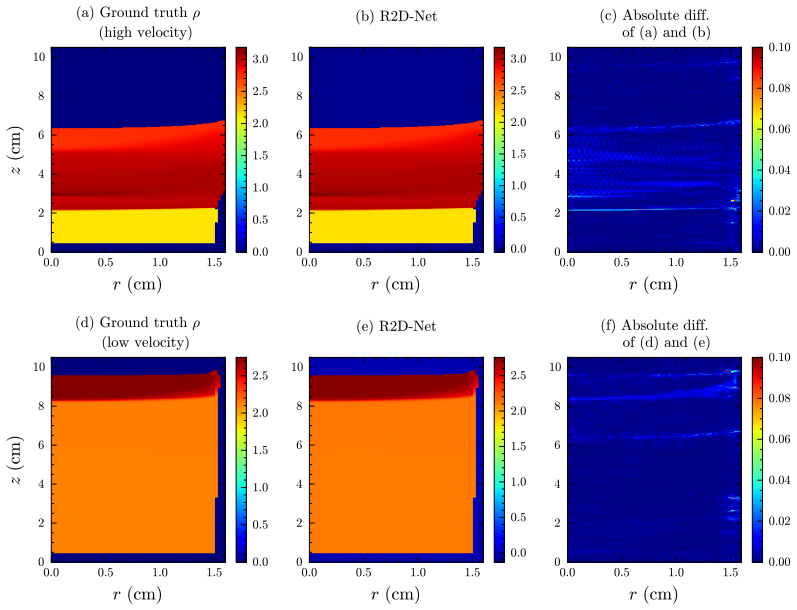
The central discovery is an information-structure statement: a well-posed map from a single high-velocity impact observation to the full set of Mie-Grüneisen equation-of-state and P–α crush parameters does not exist, regardless of whether the observable is a final density field or a dynamic sequence of density fields. The paper supports this by training the density-to-parameters VAE on thousands of simulations and reporting near-zero correlation for the crush parameters $P_s$, $P_e$, and $n$ at the high impact velocity of $5\cdot10^5$ cm/s, while the same parameters are recovered with correlations above 0.99 when a low-velocity experiment at $5\cdot10^4$ cm/s is added. The physical reason given is that the high-velocity final state consists only of fully compacted or nearly uncompressed aluminum, so the multi-parameter compaction curve is not exercised. Moving to noisy radiographs, the second shock is obscured by radiographic noise, which explains why the shock parameters $c_s$ and $s$ and the exponent $n$ become harder to infer; nevertheless the posteriors are well calibrated overall, and density fields reconstructed by running sampled parameters through the hydrocode are accurate, with errors concentrated at material interfaces. The paper also claims graceful degradation under out-of-distribution noise and under an entirely different equation of state (Sesame tables), where the inferred parameters yield reconstructions closer to the true density fields than any training density field.
Load-bearing premise
The conclusion that high-velocity data contain no crush information rests on trusting that the trained density-to-parameters network is expressive enough to learn any well-posed map that actually exists; if the network underfits the crush parameters, the near-zero correlations would be model failure rather than evidence of missing information.
Editorial extensions
If this is right
- A two-shot campaign—one low-velocity and one high-velocity flyer-plate impact—is sufficient, in the simulated setting, to infer all nine Mie-Grüneisen and P–α parameters from a single pair of radiographs.
- Noisy radiographs degrade inference most for the sound speed $c_s$, the slope $s$, and the crush exponent $n$, because radiographic noise hides the second shock; shot designs that keep that feature visible would recover these parameters.
- Running posterior parameter samples through a hydrodynamic solver produces density fields that obey conservation laws and match a dedicated image-to-density network in accuracy, while also supplying a per-pixel uncertainty estimate.
- The VAE's predictive posterior is calibrated well enough overall to be used as an experimental uncertainty proxy, with only mild overconfidence for $\rho_p$ and underconfidence for $P_e$.
- The pipeline degrades gracefully rather than failing when radiographs carry out-of-distribution noise or when the true equation of state is not the one used in training.
Reading between the lines
- Going beyond the paper, the two-regime requirement is probably a property of the physics, not of this dataset: any experiment that observes only fully compacted or undisturbed material will leave crush parameters unidentifiable no matter how many images are taken, which a formal identifiability analysis of the forward map could prove directly.
- The authors' correlation-probe methodology is itself a reusable test: train the ideal-observable network, inspect held-out correlation, and if no architecture or seed change recovers a parameter, the observation lacks information; a more rigorous variant would compute the rank of the parameter-to-observable Jacobian.
- The experimental design could be made adaptive: instead of pre-committing to one slow and one fast shot, use the posterior entropy of the VAE to choose the next impact velocity, which would handle materials where the two fixed velocities do not span both regimes.
- Before field deployment, the synthetic radiographic noise model needs validation against real detector behavior; the out-of-distribution test is a useful first stress test but not a substitute for measured scatter and spectral effects.
Editorial analysis
A structured set of objections, weighed in public.
Referee Report
Summary. This paper presents a machine-learning framework for inferring nine Mie-Grüneisen equation-of-state and P-alpha crush model parameters in simulated flyer plate impact experiments from density fields or synthetic radiographs. The authors train conditional variational autoencoders (D2P-VAE and R2P-VAE) on 30,000 CTH simulations at three impact velocities, and claim that a single high-velocity observation, even with full density fields or a time sequence, does not provide enough information to identify the crush parameters Ps, Pe, and n, whereas combining one low- and one high-velocity experiment enables robust inference of all parameters. They then use the inferred parameters to drive forward CTH simulations, yielding physically admissible density reconstructions that are competitive with a direct image-to-density U-Net, and demonstrate robustness to out-of-distribution noise and a mismatched (Sesame) equation of state.
Significance. If the central negative claim holds, the paper would provide a concrete, actionable experimental design for calibrating porosity and EoS models in dynamic compression experiments, and the proposed R2P-VAE pipeline offers a practical route to parameter inference directly from radiographs. The paper has several strengths: the forward model is realistic and carefully specified; the evaluation uses held-out test sets; the R2P-VAE posterior is checked with empirical coverage calibration (Figure 9); and the density-reconstruction comparison against a U-Net baseline, including model-mismatch tests, is informative. However, the load-bearing negative claim about high-velocity insufficiency is inferred from a single VAE fit, and the paper does not provide a model-independent identifiability or sensitivity analysis for the three crush parameters in the high-velocity regime. Consequently, the significance of the experimental-design recommendation is currently conditional on establishing that the observed failure is an information limitation rather than an estimator limitation.
major comments (4)
- [Section 3.1 (Table 4, Figure 4)] The central negative claim that a single high-velocity observation is informationally insufficient for Ps, Pe, and n rests entirely on the performance of one D2P-VAE architecture with one random initialization. The text states 'Assuming that the D2P-VAE samples from the true posterior of parameter values for a given density field, these point estimates will be optimal in terms of MSE and r2,' but no posterior calibration check, repeated-seed training, or capacity-bounding experiment is provided for the D2P-VAE. I request the following additions: (a) re-training with multiple seeds and reporting the spread of r and MAPE values in Table 4; (b) a capacity-ablation study (e.g., larger latent dimension or more convolutional channels) to show that the near-zero correlations for Ps, Pe, and n persist; (c) a control experiment using uninformative inputs (e.g., parameter-independent or randomized density fields) to demonstrate that the network can produce high correlations when information is present and low correlations when it is not; and (d) D2P-VAE empirical coverage plots analogous to Figure 9. Without these, the observed near-zero correlations could equally reflect underfitting, posterior misspecification, or optimization failure, and the claim of 'high confidence' in the abstract and in Section 3.1 is not supported.
- [Section 3.1 (Figures 4 and 7)] The physical explanation for the presumed insufficiency is that the high-velocity density field contains only fully compacted and nearly uncompressed material, which does not 'span the potential compaction dynamics,' but this is asserted rather than demonstrated. For cs and s, the authors provide sensitivity line-outs in Figure 7 that help explain partial recoverability; no analogous sensitivity analysis is shown for Ps, Pe, and n in the high-velocity regime. Please add a study that varies Ps, Pe, and n individually over their Table 3 ranges (and, if helpful, over exaggerated ranges as in Figure 7) and plots the resulting density-field and radiograph line-outs. If those parameters have no measurable effect on the high-velocity observables, the information-theoretic claim would be substantially strengthened. If they do have an effect, the failure of the D2P-VAE to recover them would indicate an estimator deficiency, changing the paper's main conclusion.
- [Section 3.1 (paragraph beginning 'We observe that...')] The statement 'Due to the large quantity of training data and use of state-of-the-art ML architectures, these results provide high confidence that a well-posed mapping ... cannot be constructed' overstates what can be inferred from a single model fit. The D2P-VAE is a Gaussian latent-variable model with a specific capacity and regularization; neither the quantity of training data nor the use of a well-known architecture rules out underfitting or undesirable local optima. I recommend either tempering this claim to state that the results provide evidence for the difficulty within the chosen model class, or adding direct support such as training and test loss curves, a training-set-size study, and a comparison against a simpler linear regression baseline. Alternatively, an independent, non-ML identifiability analysis (e.g., a local Fisher information or Cramér-Rao bound for the high-velocity observable) would place the negative claim on firmer ground.
- [Section 3.1 (high-velocity time-series experiment)] The conclusion that a 'dynamic sequence of images' from a single high-velocity experiment does not help resolve Ps, Pe, or n is based on exactly one temporal sampling schedule, t in {0, 2, 4, 6, 8, 10, 12} microseconds. Because the compaction process may occur on a timescale not resolved by this schedule, the claim is too broad. Please either test additional schedules (e.g., more frames at earlier times during the compaction phase) or explicitly qualify the conclusion to the schedules considered. This is particularly relevant because the stated purpose of the experiment is to determine 'sufficient conditions' for parameter inference.
minor comments (7)
- [Section 1.1] The word 'high-fidelty' should be 'high-fidelity'.
- [Table 1 caption] The phrase 'Initial geometry the of flyer plate experiment' should be 'Initial geometry of the flyer plate experiment'.
- [Section 2.1] The phrase 'and n is an parameter' should be 'and n is a parameter'.
- [Section 3.1] The phrase 'we consider a training the D2P-VAE' should be 'we consider training the D2P-VAE'.
- [Section 2.1] The material strength model is referred to as 'V on Mises'; the correct spelling is 'von Mises'.
- [Table 4 caption] If the table is printed in grayscale, the red highlighting of low-performing entries is lost; please also mark those entries with an asterisk or boldface.
- [Figure 7] The varied cs and s ranges extend far beyond the prior ranges in Table 3; the authors acknowledge this, but it would be useful to also show variations within the actual ranges to assess distinguishability under realistic priors.
Circularity Check
No significant circularity: the identifiability claim is an empirical, held-out finding, not a construction-level tautology.
full rationale
The paper's central claim—that a single high-velocity density field (or a time sequence of such fields) does not suffice to infer all nine Mie-Grüneisen and P–α parameters—is obtained by training a D2P-VAE on 8,000 forward CTH simulations with parameters drawn uniformly from stated priors, then evaluating posterior-mean point estimates on a disjoint 1,000-case test set (Figure 4, Table 4). Nothing is fitted to the test labels or to the conclusion; the near-zero correlations for Ps, Pe, and n are measured against held-out ground truth. The proposed combined high-plus-low impact velocity design is likewise validated on held-out data (Figure 5, Table 4). The paper's statement 'assuming that the D2P-VAE samples from the true posterior' (Section 3.1) is an unverified assumption about estimator quality, and the absence of repeated-seed or capacity-bounding experiments is a genuine correctness risk, but it is not circularity: the alternative failure mode is estimator underfitting, not a conclusion encoded into the model construction. Self-citations (refs. 20, 30, 53) supply the radiographic forward model and related inverse-ML methodology, but the identifiability result does not reduce to those citations. No equation defines the target parameters in terms of the observables by construction, and no fitted parameter is renamed as a prediction. Hence no circular step can be exhibited; the score of 1 reflects only the presence of minor, non-load-bearing self-citations for methods and forward-model details.
Assumptions & free parameters
free parameters (4)
- σ_blur =
not specified
- κ (scatter amplitude) =
not specified
- a, b (background tilt coefficients) =
not specified
- γ_g, γ_p (noise rates) =
not specified
assumptions (5)
- domain assumption CTH hydrocode correctly implements the Mie-Grüneisen EoS and P-alpha porosity models for 2024 aluminum and 4130 steel.
- domain assumption The radiographic forward model (Abel transform, Beer-Lambert law, additive noise) is a faithful representation of real flyer plate radiography.
- domain assumption The conditional VAE approximates the true posterior distribution over parameters given images.
- ad hoc to paper Material parameters are uniformly distributed over the ranges in Table 3, representing the prior for the real experiment.
- domain assumption The density field is axially symmetric, permitting the Abel transform.
Cite this review
Pith. "Pith review of Learning robust parameter inference and density reconstruction in flyer plate impact experiments." pith.science (2026). https://pith.science/paper/X4TBAK6D
@misc{pith2026250623914,
  author       = {Pith},
  title        = {Pith review of: Learning robust parameter inference and density reconstruction in flyer plate impact experiments},
  year         = {2026},
  howpublished = {\url{https://pith.science/paper/X4TBAK6D}},
  note         = {Machine review of arXiv:2506.23914}
}
read the original abstract
Estimating physical parameters or material properties from experimental observations is a common objective in many areas of physics and material science. In many experiments, especially in shock physics, radiography is the primary means of observing the system of interest. However, radiography does not provide direct access to key state variables, such as density, which prevents the application of traditional parameter estimation approaches. Here we focus on flyer plate impact experiments on porous materials, and resolving the underlying parameterized equation of state (EoS) and crush porosity model parameters given radiographic observation(s). We use machine learning as a tool to demonstrate with high confidence that using only high impact velocity data does not provide sufficient information to accurately infer both EoS and crush model parameters, even with fully resolved density fields or a dynamic sequence of images. We thus propose an observable data set consisting of low and high impact velocity experiments/simulations that capture different regimes of compaction and shock propagation, and proceed to introduce a generative machine learning approach which produces a posterior distribution of physical parameters directly from radiographs. We demonstrate the effectiveness of the approach in estimating parameters from simulated flyer plate impact experiments, and show that the obtained estimates of EoS and crush model parameters can then be used in hydrodynamic simulations to obtain accurate and physically admissible density reconstructions. Finally, we examine the robustness of the approach to model mismatches, and find that the learned approach can provide useful parameter estimates in the presence of out-of-distribution radiographic noise and previously unseen physics, thereby promoting a potential breakthrough in estimating material properties from experimental radiographic images.
Figures


Figures from the paper (18 more)



Forward citations
Cited by 1 Pith paper
-
Causal Multi-fidelity Surrogate Forward and Inverse Models for ICF Implosions
A causal multi-fidelity neural surrogate, anchored to a physics-based shell ODE, predicts DT interface dynamics from radiation drive and recovers the drive from as few as four time snapshots.
Reference graph
Works this paper leans on
-
[1]
Jorgensen, D. G. Using geophysical logs to estimate porosity, water resistivity, and intrinsic permeability. Tech. Rep., USGPO, (1989)
work page 1989
-
[2]
Collins, G. S., Housen, K. R., Jutzi, M. & Nakamura, A. M. Planetary impact processes in porous materials. Shock. Phenom. Granul. Porous Mater. 103–136 (2019)
work page 2019
-
[3]
Sharma, A. & Dubey, D. K. Effect of porosity on shock propagation behaviour of single crystal aluminium: A molecular dynamics investigation. Mech. Mater. 177, 104535 (2023)
work page 2023
-
[4]
Li, C., Hamilton, B. W. & Strachan, A. Hotspot formation due to shock-induced pore collapse in 1, 3, 5, 7-tetranitro-1, 3, 5, 7-tetrazoctane (HMX): Role of pore shape and shock strength in collapse mechanism and temperature. J. Appl. Phys. 127 (2020)
work page 2020
-
[5]
Tikhonchuk, V . & Weber, S. Physics of porous materials under extreme laser-generated conditions. Matter Radiat. at Extrem. 9 (2024)
work page 2024
-
[6]
Housen, K. R. & Holsapple, K. A. Impact cratering on porous asteroids. Icarus 163, 102–119 (2003)
work page 2003
-
[7]
Nakamura, A. M. Impact cratering on porous targets in the strength regime. Planet. Space Sci. 149, 5–13 (2017)
work page 2017
-
[8]
Barker, L. & Hollenbach, R. Laser interferometer for measuring high velocities of any reflecting surface. J. Appl. Phys. 43, 4669–4675 (1972)
work page 1972
Show all 68 references
-
[9]
Malone, R. M. et al. Overview of the line-imaging VISAR diagnostic at the National Ignition Facility (NIF). In International Optical Design Conference, ThA5 (Optica Publishing Group, 2006)
2006
-
[10]
McCoy, C. A. & Knudson, M. D. Lagrangian technique to calculate window interface velocity from shock velocity measurements: Application for quartz windows. J. Appl. Phys. 122 (2017)
2017
-
[11]
Reinhart, W. D. et al. Equation of state measurements of materials using a three-stage gun to impact velocities of 11 km/s. Int. J. Impact Eng. 26, 625–637 (2001)
2001
-
[12]
& Lipkin, J
Asay, J. & Lipkin, J. A self-consistent technique for estimating the dynamic yield strength of a shock-loaded material. J. Appl. Phys. 49, 4242–4247 (1978)
1978
-
[13]
& Asay, J
Lipkin, J. & Asay, J. Reshock and release of shock-compressed 6061-T6 aluminum. J. applied physics 48, 182–189 (1977)
1977
-
[14]
& Ding, J
Brown, J., Alexander, C., Asay, J., V ogler, T. & Ding, J. Extracting strength from high pressure ramp-release experiments. J. Appl. Phys. 114 (2013)
2013
-
[15]
Williams, B. et al. Combining experimental data and computer simulations, with an application to flyer plate experiments. Bayesian Analysis 1, 765–792 (2006). 15/24
2006
-
[16]
F., Blewett, P
Barnes, J. F., Blewett, P. J., McQueen, R. G., Meyer, K. A. & Venable, D. Taylor instability in solids.J. Appl. Phys. 45, 727–732 (1974)
1974
-
[17]
& Weber, S
Colvin, J., Legrand, M., Remington, B., Schurtz, G. & Weber, S. A model for instability growth in accelerated solid metals. J. Appl. Phys. 93, 5287–5301 (2003)
2003
-
[18]
Barton, N. R. et al. A multiscale strength model for extreme loading conditions. J. Appl. Phys. 109 (2011)
2011
-
[19]
Miller, D. J. et al. Hugoniot measurements utilizing in situ synchrotron x-ray radiation. J. Dyn. Behav. Mater. 5, 93–104 (2019)
2019
-
[20]
Serino, D. A. et al. Learning physical unknowns from hydrodynamic shock and material interface features in ICF capsule implosions. arXiv preprint arXiv:2412.20192 (2024)
2024 arXiv
-
[21]
Ravishankar, S., Ye, J. C. & Fessler, J. A. Image reconstruction: From sparsity to data-adaptive methods and machine learning. Proc. IEEE 108, 86–109 (2019)
2019
-
[22]
Fessler, J. A. Model-based image reconstruction for MRI. IEEE Signal Process. Mag. 27, 81–89 (2010)
2010
-
[23]
Elbakri, I. A. & Fessler, J. A. Statistical image reconstruction for polyenergetic x-ray computed tomography. IEEE Transactions on Med. Imaging 21, 89–99 (2002)
2002
-
[24]
Espy, M. et al. Spectral characterization of flash and high flux x-ray radiographic sources with a magnetic compton spectrometer. Rev. Sci. Instruments 92 (2021)
2021
-
[25]
Espy, M. A. et al. A wide-acceptance compton spectrometer for spectral characterization of a medical x-ray source. In Medical Imaging 2016: Physics of Medical Imaging , vol. 9783, 1304–1314 (SPIE, 2016)
2016
-
[26]
& Bouman, C
Sauer, K. & Bouman, C. A local update strategy for iterative reconstruction from projections. IEEE Transactions on Signal Process. 41, 534–548 (2002)
2002
-
[27]
T., Klasky, M
McCann, M. T., Klasky, M. L., Schei, J. L. & Ravishankar, S. Local models for scatter estimation and descattering in polyenergetic x-ray tomography. Opt. Express 29, 29423–29438 (2021)
2021
-
[28]
T., Hu, J
Xu, X., Klasky, M., McCann, M. T., Hu, J. & Fessler, J. A. Swap-net: A memory-efficient 2.5d network for sparse-view 3d cone beam CT reconstruction to ICF applications. IEEE Transactions on Comput. Imaging (2025)
2025
-
[29]
& Ravishankar, S
Huang, Z., Klasky, M., Wilcox, T. & Ravishankar, S. Physics-driven learning of wasserstein GAN for density reconstruction in dynamic tomography. Appl. Opt. 61, 2805–2817 (2022)
2022
-
[30]
A., Klasky, M
Serino, D. A., Klasky, M. L., Nadiga, B. T., Xu, X. & Wilcox, T. Reconstructing richtmyer–meshkov instabilities from noisy radiographs using low dimensional features and attention-based neural networks. Opt. Express 32, 43366–43386 (2024)
2024
-
[31]
Hossain, M. et al. High-precision inversion of dynamic radiography using hydrodynamic features. Opt. Express 30, 14432–14452 (2022)
2022
-
[32]
L., Fessler, J
Lahiri, A., Maliakal, G., Klasky, M. L., Fessler, J. A. & Ravishankar, S. Sparse-view cone beam CT reconstruction using data-consistent supervised and adversarial learning from scarce training data. IEEE Transactions on Comput. Imaging 9, 13–28 (2023)
2023
-
[33]
Wood, J. C. et al. Ultrafast imaging of laser driven shock waves using betatron x-rays from a laser wakefield accelerator. Sci. Reports 8, 11010 (2018)
2018
-
[34]
Bayesian inference in physics
von Toussaint, U. Bayesian inference in physics. Rev. Mod. Phys. 83, 943–999, DOI: 10.1103/RevModPhys.83.943 (2011)
2011 doi
-
[35]
& Grédiac, M
Pierron, F. & Grédiac, M. Towards material testing 2.0. a review of test design for identification of constitutive parameters from full-field measurements. Strain 57, e12370 (2021)
2021
-
[36]
& Delikta¸ s, B
Tariq, A. & Delikta¸ s, B. An inverse parameter identification in finite element problems using machine learning-aided optimization framework. Exp. Mech. 1–25 (2025)
2025
-
[37]
& Fernandes, J
Prates, P., Pereira, A., Sakharova, N., Oliveira, M. & Fernandes, J. Inverse strategies for identifying the parameters of constitutive laws of metal sheets. Adv. Mater. Sci. Eng. 2016, 4152963 (2016)
2016
-
[38]
& Notta-Cuvier, D
Markiewicz, É., Langrand, B. & Notta-Cuvier, D. A review of characterisation and parameters identification of materials constitutive and damage models: From normalised direct approach to most advanced inverse problem resolution. Int. J. Impact Eng. 110, 371–381 (2017)
2017
-
[39]
& Vacher, P
Pottier, T., Toussaint, F., Louche, H. & Vacher, P. Inelastic heat fraction estimation from two successive mechanical and thermal analyses and full-field measurements. Eur. J. Mech. 38, 1–11 (2013). 16/24
2013
-
[40]
& Pompoli, F
Bonfiglio, P. & Pompoli, F. Inversion problems for determining physical parameters of porous materials: Overview and comparison between different methods. Acta Acustica United with Acustica 99, 341–351 (2013)
2013
-
[41]
M., Carroll, M
Butcher, B. M., Carroll, M. M. & Holt, A. C. Shock-wave compaction of porous aluminum. J. Appl. Phys. 45, 3864–3875, DOI: 10.1063/1.1663877 (1974). https://pubs.aip.org/aip/jap/article-pdf/45/9/3864/18368181/3864_1_online.pdf
1974 doi
-
[42]
Drumheller, D. S. The theoretical treatment of a porous solid using a mixture theory. Int. J. Solids Struct. 14, 441–456, DOI: https://doi.org/10.1016/0020-7683(78)90009-4 (1978)
1978 doi
-
[43]
Taylor, P. A. An introduction to plastic yield strength modeling for CTH applications. Tech. Rep., Sandia National Lab.(SNL-NM), Albuquerque, NM (United States) (2006)
2006
-
[44]
CTH equation of state package: Porosity and reactive burn models
Kerley, G. CTH equation of state package: Porosity and reactive burn models. Sandia Natl. Lab. report SAND92-0553 (1992)
1992
-
[45]
H., McQueen, R
Rice, M. H., McQueen, R. G. & Walsh, J. M. Compression of solids by strong shock waves. In Seitz, F. & Turnbull, D. (eds.) Advances in Research and Applications , vol. 6 of Solid State Physics , 1–63, DOI: https://doi.org/10.1016/ S0081-1947(08)60724-9 (Academic Press, 1958)
-
[46]
Constitutive Equation for the Dynamic Compaction of Ductile Porous Materials
Herrmann, W. Constitutive Equation for the Dynamic Compaction of Ductile Porous Materials. J. Appl. Phys. 40, 2490–2499, DOI: 10.1063/1.1658021 (1969)
1969 doi
-
[47]
& Holt, A
Carroll, M. & Holt, A. C. Suggested modification of the p- α model for porous materials. J. Appl. Phys. 43, 759–761 (1972)
1972
-
[48]
& Kober, E
Menikoff, R. & Kober, E. Equation of state and Hugoniot locus for porous materials: P- α model revisited. In AIP conference proceedings, vol. 505, 129–132 (American Institute of Physics, 2000)
2000
-
[49]
& Lee, T.-W
Mahon, K. & Lee, T.-W. Compaction of granular HMX: P-α porosity model in CTH hydrocode. AIP Adv. 5 (2015)
2015
-
[50]
& Michel, P
Jutzi, M., Benz, W. & Michel, P. Numerical simulations of impacts involving porous bodies: I. implementing sub-resolution porosity in a 3d sph hydrocode. Icarus 198, 242–255 (2008)
2008
-
[51]
& Davidsson, B
de Niem, D., Kührt, E., Hviid, S. & Davidsson, B. Low velocity collisions of porous planetesimals in the early solar system. Icarus 301, 196–218 (2018)
2018
-
[52]
& Wen, H
Wang, Z. & Wen, H. A modified p-α equation of state for concrete-like materials. J. Build. Eng. 67, 106017 (2023)
2023
-
[53]
A., Klasky, M
Serino, D. A., Klasky, M. L., Nadiga, B. T., Xu, X. & Wilcox, T. Reconstructing richtmyer-meshkov instabilities from noisy radiographs using low dimensional features and attention-based neural networks. Opt. Express 32, 43366–43386, DOI: 10.1364/OE.538495 (2024)
2024 doi
-
[54]
Kingma, D. P. & Welling, M. Auto-encoding variational bayes. In Bengio, Y . & LeCun, Y . (eds.) 2nd International Conference on Learning Representations, ICLR 2014, Banff, AB, Canada, April 14-16, 2014, Conference Track Proceedings (2014)
2014
-
[55]
P., Mohamed, S., Jimenez Rezende, D
Kingma, D. P., Mohamed, S., Jimenez Rezende, D. & Welling, M. Semi-supervised learning with deep generative models. Adv. neural information processing systems 27 (2014)
2014
-
[56]
& Levine, S
Rybkin, O., Daniilidis, K. & Levine, S. Simple and effective vae training with calibrated decoders. In International conference on machine learning, 9179–9189 (PMLR, 2021)
2021
-
[57]
McHardy, J. D. An introduction to the theory and use of SESAME equations of state. Tech. Rep., Los Alamos National Laboratory (LANL), Los Alamos, NM (United States) (2018). DOI: 10.2172/1487368
2018 doi
-
[58]
Lucas, J., Tucker, G., Grosse, R. B. & Norouzi, M. Understanding posterior collapse in generative latent variable models. In Deep Generative Models for Highly Structured Data, ICLR 2019 Workshop, New Orleans, Louisiana, United States, May 6, 2019 (OpenReview.net, 2019)
2019
-
[59]
Higgins, I. et al. beta-V AE: Learning basic visual concepts with a constrained variational framework. InInternational Conference on Learning Representations (2017)
2017
-
[60]
& Lempitsky, V
Ulyanov, D., Vedaldi, A. & Lempitsky, V . Instance normalization: The missing ingredient for fast stylization. arXiv preprint arXiv:1607.08022 (2016)
2016 arXiv
-
[61]
Ramachandran, P., Zoph, B. & Le, Q. V . Searching for activation functions. In 6th International Conference on Learning Representations, ICLR 2018, V ancouver , BC, Canada, April 30 - May 3, 2018, Workshop Track Proceedings (OpenReview.net, 2018)
2018
-
[62]
& Hutter, F
Loshchilov, I. & Hutter, F. Decoupled weight decay regularization. InInternational Conference on Learning Representations (2019). 17/24
2019
-
[63]
Pytorch: An imperative style, high-performance deep learning library
Paszke, A. Pytorch: An imperative style, high-performance deep learning library. arXiv preprint arXiv:1912.01703 (2019)
2019 arXiv
-
[64]
& The PyTorch Lightning team
Falcon, W. & The PyTorch Lightning team. PyTorch Lightning, DOI: 10.5281/zenodo.3828935 (2019)
2019 doi
-
[65]
Welford, B. P. Note on a method for calculating corrected sums of squares and products. Technometrics 4, 419–420 (1962)
1962
-
[66]
& Brox, T
Ronneberger, O., Fischer, P. & Brox, T. U-net: Convolutional networks for biomedical image segmentation. In Medical image computing and computer-assisted intervention–MICCAI 2015: 18th international conference, Munich, Germany, October 5-9, 2015, proceedings, part III 18 , 234...
2015
-
[67]
& Simonyan, K
Brock, A., Donahue, J. & Simonyan, K. Large scale GAN training for high fidelity natural image synthesis. InInternational Conference on Learning Representations (2019)
2019
-
[68]
posterior collapse
Whang, J. et al. Deblurring via stochastic refinement. In Proceedings of the IEEE/CVF Conference on Computer Vision and Pattern Recognition, 16293–16303 (2022). Acknowledgments This work was supported by the Laboratory Directed Research and Development program at Los Alamos Na...
2022
Reviewed August 6, 2026 · model on record in the stance chip above.
Discussion (0). Sign in to comment.