REVIEW 3 major objections 6 minor 43 references
Mastering emergent language: learning to guide in simulated navigation
T0 review · 3 major / 6 minor · reviewed 2026-08-14 · deepseek-v4-flash
Pith's one-line read An autonomous Guide that communicates through a discrete emergent language speeds up learning for new navigation agents, generalizes across tasks, and is interpretable enough to be spoken back by the authors with 72-76% obedience.
desk verdict Solid speedup and transfer results in emergent navigation guidance, but the 'mastered the language' section needs causal controls before it can be believed. read the letter →
The pith
A machine-rendered reading of the paper's core claim, the machinery that carries it, and where it could break.
The reading
What carries the argument
The load-bearing mechanism is the Guide's discrete communication bottleneck: between the Guide's memory LSTM and its policy, a decoder must compress continuous information into a sequence of discrete tokens, made trainable with a straight-through Gumbel softmax estimator. Because the message length is fixed at two and the vocabulary at three, every piece of guidance must pass through one of nine messages, which forces the protocol to be compact and reusable. The Causal Influence of Communication metric then measures how much the Learner's next action depends on the message, and correlation analysis over message-action and message-observation pairs supplies the interpretation the authors use to send their own commands.
What would settle it
In GoToObj and GoToLocal, compare the Learner's obedience to the same preset messages under three conditions: normal visual input, masked visual input, and random messages. If the 72-76% obedience persists when visual input is masked, the messages themselves carry the instruction; if obedience collapses, the reported numbers partly reflect the environment and the Learner's own policy.
Extended reading notes
Core claim
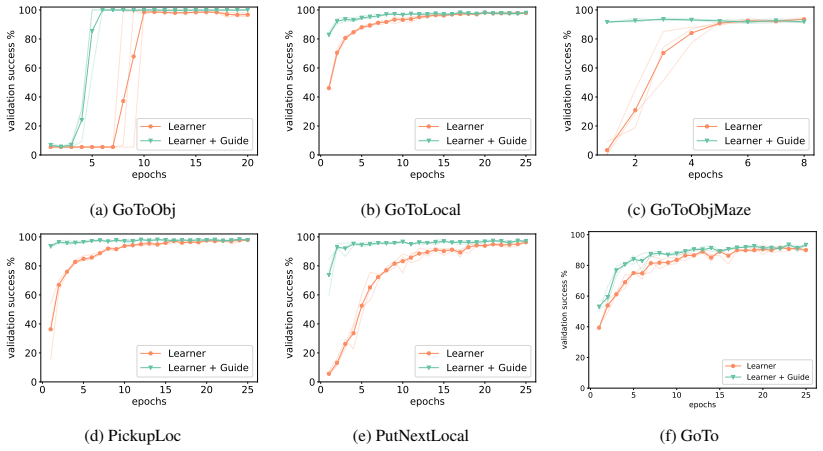
Working in the BabyAI gridworld, the paper trains a Guide whose memory output must pass through a discrete bottleneck and be emitted as a fixed-length message of two tokens drawn from a vocabulary of three, giving nine possible messages. A pretrained Guide is then coupled with a new Learner, and both are trained by behavioral cloning on demonstrations from reinforcement-learned experts. The central result is that the Guide's messages cause a large increase in the Learner's learning speed on every level tested, that a Guide pretrained on one level still helps at related unseen levels, and that a Guide trained on three levels at once is as helpful as a level-specialized Guide. The Causal Influence of Communication metric shows the messages matter most early in training and fade as the Learner becomes independent. Using message-action correlations computed at the highest-influence epoch, the authors hijack the Guide and send preset messages, successfully directing a pirouette and a waltz and obtaining 72-76% obedience.
Load-bearing premise
The speech-back claim assumes that message-action correlations measured on training-distribution frames stay valid when the authors hijack the Guide and send preset messages out of distribution, while the Learner still receives its own visual observations.
Editorial extensions
If this is right
- On all six BabyAI levels tested, a new Learner paired with a pretrained Guide reaches high validation success faster than an unguided baseline Learner.
- Guidance learned on one level transfers to related harder levels, so the messages encode generalizable skills instead of level-specific solutions.
- A single Guide trained on three levels at once is as helpful as per-level specialized Guides, showing the protocol is not overfit to one task.
- The causal influence of messages is highest early in training and declines as the Learner improves, so guidance acts as a temporary scaffold rather than a permanent dependency.
- Message-action correlations are strong enough that preset choreographed messages produce obedience rates of 72-76%, letting an outside party address the Learner in its own language.
Reading between the lines
- The 72-76% obedience figures should be read as an upper bound on linguistic control: because the Learner also sees the grid, an ablation that masks visual input or scrambles messages would separate message-driven compliance from environment-driven behavior.
- Because the Guide is finetuned while paired with the Learner, the protocol is co-negotiated rather than fixed; freezing the pretrained Guide would test whether the language remains stable and reusable across different Learners.
- The CIC decline suggests a testable scaffolding effect: a Learner trained longer with a Guide should transfer better to a no-Guide setting, since the messages have already faded in causal importance.
Signed reviews
Editorial analysis
A structured set of objections, weighed in public.
Referee Report
Summary. The paper introduces a two-agent system in the BabyAI gridworld: a continuously-trained Learner and a Guide that emits fixed-length discrete messages (two tokens, three symbols) after being trained by imitation learning. The authors compare a baseline Learner with a Learner assisted by a pretrained Guide across six levels, report curriculum-transfer experiments, and analyze the emergent communication through message-action correlations, message-observation correlations, and the Causal Influence of Communication (CIC) metric. They also present an 'obedience' experiment in which the experimenters preset messages to guide a trained Learner, reporting 72–76% obedience in two levels. The central claims are that the Guide's messages speed up learning of new agents, transfer across related levels, and that the emergent language is interpretable enough for direct experimenter control.
Significance. If the claims hold, the paper would demonstrate that an emergent, unsupervised discrete communication protocol can provide reusable guidance for new agents in sequential decision tasks, and that such protocols can be partially decoded by post hoc analysis. The learning-speedup and transfer results are evaluated on new Learners, so they are not circular. The paper provides three-seed learning curves, a clear architecture, and a reasonable CIC analysis. However, the strongest novel claim—that the experimenters have 'mastered the agent language'—rests on an obedience experiment that lacks critical controls and variance reporting, and the speedup claim does not isolate the message channel from the extra capacity of the co-adapted Guide. These issues make the current evidence suggestive rather than conclusive for the paper's headline claims, but they are addressable with additional experiments.
major comments (3)
- [Section 4.1, Section 3.3] The claim that the pretrained Guide's messages 'cause a great increase in the learning speed of a new agent' is not isolated from the effect of additional model capacity and co-adaptation. In stage 3, the Guide's weights are not frozen (Section 3.3), so the guided Learner includes a second network whose parameters are jointly finetuned, whereas the baseline Learner does not. A control with a frozen Guide, or with a Guide whose messages are replaced by fixed or random tokens while the visual pathway remains unchanged, is needed to attribute the speedup to the communicative content rather than to the extra parameters or to the Guide's pretrained visual representations.
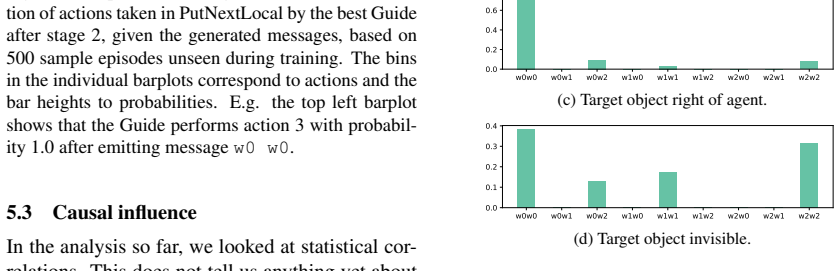
- [Section 5.4] The obedience experiment does not include a control condition in which the message channel is ablated or randomized (e.g., uniform random messages, a fixed message, or no message). Because the Learner receives the 7x7x3 visual observation at every step (Section 3.2), the 72–76% obedience could partly reflect the Learner's own policy acting on the visual input, with the preset messages merely coinciding with actions the Learner would take anyway. Additionally, the epoch is selected post hoc as the one with maximum CIC, and the obedience percentages are reported without variance across seeds or epochs. Reporting control-message obedience and error bars is necessary to support the 'we have mastered the agent language' claim.
- [Section 5.3, Figure 8] The statement that 'CIC tends to decrease over time' is contradicted by the GoToObj panel in Figure 8, which shows a positive correlation between training time and CIC. The text says the trend is negative if more epochs after convergence are considered, but those data are not shown. Please either provide the extended curves for GoToObj or qualify the claim to the five levels where the trend holds; the abstract and Section 5.3 present the decrease as a general finding.
minor comments (6)
- [Section 5.2] The reference to 'Figure A.2' for the messages-given-observation distributions is incorrect: Figure A.2 shows distributions of actions given messages, not messages given observations. The correct reference appears to be Figure 7 in the main text and Figure A.3 in the supplement.
- [Section 5.4, Figure 9] The text says the waltz was performed in GoToLocal, but the caption of Figure 9b says 'Waltz in PutNextLocal'. Please align the text and caption.
- [Table A.1] The caption contains a placeholder 'from ?' where a citation should appear; please fill in the reference.
- [Section 4.2] The statement that the difference between guided new Learners and pretrained Learners is 'not significant' is not supported by any reported statistical test; please specify the test used and report the relevant statistic.
- [Section 4.1] The learning-speedup claim is based on visual inspection of the curves; a quantitative measure such as area under the learning curve or epochs to a success-rate threshold would strengthen the claim.
- [Figure 3] The captions say 'results per run are shown by shaded lines' but it is unclear whether the solid line is the mean and the shaded region is min-max or standard deviation; please clarify in the captions.
Circularity Check
No circularity: speedup, transfer, and CIC analyses are evaluated on held-out agents; the self-referential §5.4 obedience test is a validity limitation, not a construction-level reduction.
full rationale
The paper's central empirical claims are not circular. In §4.1–4.3, the learning-speedup and curriculum-transfer results are measured by validation success rate of new Learners, with the pretrained Guide either finetuned or transferred across levels; these comparisons are genuine out-of-sample evaluations and do not reuse fitted quantities as predictions. The CIC analysis in §5.3 applies an external metric (Lowe et al. 2019) to validation frames and reports a measured decrease over training, which is an empirical observation rather than an input to the method. The only potentially self-referential element is §5.4, where the message-action codebook is computed from the same trained Learner-Guide system, and the test epoch is selected by maximum CIC. The resulting 72–76% obedience therefore demonstrates internal consistency of the learned protocol rather than externally grounded semantics. However, this is not circular by construction: the paper's own text acknowledges that 'the observational input always remains important, especially when random messages are sent,' and nothing in the architecture or loss forces the hijacked messages to be followed. The obedience values could have been low under the distribution shift; the lack of random-message and no-message controls is a confound that weakens external validity, but it does not make the derivation equivalent to its inputs. There are no load-bearing self-citations, no imported uniqueness theorems, and no fitted parameter renamed as a prediction.
Assumptions & free parameters
free parameters (2)
- message_length =
2
- vocabulary_size =
3
assumptions (4)
- domain assumption Behavioral cloning from PPO expert demonstrations defines the target behavior for all agents.
- domain assumption The BabyAI skill hierarchy is a valid model of task relatedness and transfer.
- domain assumption One-step Causal Influence of Communication (CIC), as defined by Lowe et al. (2019), is a valid measure of message influence.
- standard math The straight-through Gumbel softmax provides a usable gradient estimator for the discrete bottleneck.
Cite this review
Pith. "Pith review of Mastering emergent language: learning to guide in simulated navigation." pith.science (2026). https://pith.science/paper/X64ZG5MZ
@misc{pith2026190805135,
  author       = {Pith},
  title        = {Pith review of: Mastering emergent language: learning to guide in simulated navigation},
  year         = {2026},
  howpublished = {\url{https://pith.science/paper/X64ZG5MZ}},
  note         = {Machine review of arXiv:1908.05135}
}
read the original abstract
To cooperate with humans effectively, virtual agents need to be able to understand and execute language instructions. A typical setup to achieve this is with a scripted teacher which guides a virtual agent using language instructions. However, such setup has clear limitations in scalability and, more importantly, it is not interactive. Here, we introduce an autonomous agent that uses discrete communication to interactively guide other agents to navigate and act on a simulated environment. The developed communication protocol is trainable, emergent and requires no additional supervision. The emergent language speeds up learning of new agents, it generalizes across incrementally more difficult tasks and, contrary to most other emergent languages, it is highly interpretable. We demonstrate how the emitted messages correlate with particular actions and observations, and how new agents become less dependent on this guidance as training progresses. By exploiting the correlations identified in our analysis, we manage to successfully address the agents in their own language.
Figures


Figures from the paper (6 more)




Reference graph
Works this paper leans on
-
[1]
URL: " 'urlintro :=
ENTRY address author booktitle chapter edition editor howpublished institution journal key month note number organization pages publisher school series title type volume year eprint doi pubmed url lastchecked label extra.label sort.label short.list INTEGERS output.state before.all mid.sentence after.sentence after.block STRINGS urlintro eprinturl eprintpr...
-
[2]
write newline
" write newline "" before.all 'output.state := FUNCTION n.dashify 't := "" t empty not t #1 #1 substring "-" = t #1 #2 substring "--" = not "--" * t #2 global.max substring 't := t #1 #1 substring "-" = "-" * t #2 global.max substring 't := while if t #1 #1 substring * t #2 global.max substring 't := if while FUNCTION word.in bbl.in capitalize " " * FUNCT...
-
[3]
Yoav Artzi and Luke Zettlemoyer. 2013. Weakly supervised learning of semantic parsers for mapping instructions to actions. Transactions of the Association for Computational Linguistics, 1:49--62
work page 2013
-
[4]
Dzmitry Bahdanau, Felix Hill, Jan Leike, Edward Hughes, Pushmeet Kohli, and Edward Grefenstette. 2018. Learning to follow language instructions with adversarial reward induction. arXiv preprint arXiv:1806.01946
arXiv 2018
-
[5]
Yoshua Bengio, Nicholas L \'e onard, and Aaron Courville. 2013. Estimating or propagating gradients through stochastic neurons for conditional computation. arXiv preprint arXiv:1308.3432
arXiv 2013
-
[6]
Simon Brodeur, Ethan Perez, Ankesh Anand, Florian Golemo, Luca Celotti, Florian Strub, Jean Rouat, Hugo Larochelle, and Aaron Courville. 2017. Home: A household multimodal environment. arXiv preprint arXiv:1711.11017
arXiv 2017
-
[7]
Angelo Cangelosi, Emmanouil Hourdakis, and Vadim Tikhanoff. 2006. Language acquisition and symbol grounding transfer with neural networks and cognitive robots. In The 2006 IEEE International Joint Conference on Neural Network Proceedings, pages 1576--1582. IEEE
work page 2006
-
[8]
Devendra Singh Chaplot, Kanthashree Mysore Sathyendra, Rama Kumar Pasumarthi, Dheeraj Rajagopal, and Ruslan Salakhutdinov. 2018. Gated-attention architectures for task-oriented language grounding. In Thirty-Second AAAI Conference on Artificial Intelligence
work page 2018
Show all 43 references
-
[9]
David L Chen and Raymond J Mooney. 2011. Learning to interpret natural language navigation instructions from observations. In Twenty-Fifth AAAI Conference on Artificial Intelligence
2011
-
[10]
Maxime Chevalier-Boisvert, Dzmitry Bahdanau, Salem Lahlou, Lucas Willems, Chitwan Saharia, Thien Huu Nguyen, and Yoshua Bengio. 2018. Babyai: First steps towards grounded language learning with a human in the loop. arXiv preprint arXiv:1810.08272
2018 arXiv
-
[11]
Kyunghyun Cho, Bart Van Merri \"e nboer, Caglar Gulcehre, Dzmitry Bahdanau, Fethi Bougares, Holger Schwenk, and Yoshua Bengio. 2014. Learning phrase representations using rnn encoder-decoder for statistical machine translation. In Proceedings of the 2014 Conference on Empirica...
2014
-
[12]
John D Co-Reyes, Abhishek Gupta, Suvansh Sanjeev, Nick Altieri, John DeNero, Pieter Abbeel, and Sergey Levine. 2018. Guiding policies with language via meta-learning. arXiv preprint arXiv:1811.07882
2018 arXiv
-
[13]
Vincent Crawford. 1998. https://EconPapers.repec.org/RePEc:eee:jetheo:v:78:y:1998:i:2:p:286-298 A survey of experiments on communication via cheap talk . Journal of Economic Theory, 78(2):286--298
1998
-
[14]
Hal Daum \'e , John Langford, and Daniel Marcu. 2009. Search-based structured prediction. Machine learning, 75(3):297--325
2009
-
[15]
Serhii Havrylov and Ivan Titov. 2017. http://papers.nips.cc/paper/6810-emergence-of-language-with-multi-agent-games-learning-to-communicate-with-sequences-of-symbols.pdf Emergence of language with multi-agent games: Learning to communicate with sequences of symbols . In I. Guy...
2017
-
[16]
Sachithra Hemachandra, Felix Duvallet, Thomas M Howard, Nicholas Roy, Anthony Stentz, and Matthew R Walter. 2015. Learning models for following natural language directions in unknown environments. In 2015 IEEE International Conference on Robotics and Automation (ICRA), pages 5...
2015
-
[17]
Karl Moritz Hermann, Felix Hill, Simon Green, Fumin Wang, Ryan Faulkner, Hubert Soyer, David Szepesvari, Wojciech Marian Czarnecki, Max Jaderberg, Denis Teplyashin, et al. 2017. Grounded language learning in a simulated 3d world. arXiv preprint arXiv:1706.06551
2017 arXiv
-
[18]
Sepp Hochreiter and J \"u rgen Schmidhuber. 1997. Long short-term memory. Neural computation, 9(8):1735--1780
1997
-
[19]
Eric Jang, Shixiang Gu, and Ben Poole. 2017. Categorical reparameterization with gumbel-softmax. In Proceedings of the International Conference on Learning Representations
2017
-
[20]
Emilio Jorge, Mikael K geb \" a ck, and Emil Gustavsson. 2016. http://arxiv.org/abs/1611.03218 Learning to play guess who? and inventing a grounded language as a consequence . CoRR, abs/1611.03218
2016 arXiv
-
[21]
Angeliki Lazaridou, Alexander Peysakhovich, and Marco Baroni. 2017. https://openreview.net/forum?id=Hk8N3Sclg Multi-agent cooperation and the emergence of (natural) language . In 5th International Conference on Learning Representations, ICLR 2017, Toulon, France, April 24-26, ...
2017
-
[22]
Ryan Lowe, Jakob Foerster, Y-Lan Boureau, Joelle Pineau, and Yann Dauphin. 2019. http://arxiv.org/abs/1903.05168 On the pitfalls of measuring emergent communication
2019 arXiv
-
[23]
Hongyuan Mei, Mohit Bansal, and Matthew R Walter. 2016. Listen, attend, and walk: Neural mapping of navigational instructions to action sequences. In Thirtieth AAAI Conference on Artificial Intelligence
2016
-
[24]
Tomas Mikolov, Armand Joulin, and Marco Baroni. 2016. https://doi.org/10.1007/978-3-319-75477-2\_2 A roadmap towards machine intelligence . In Computational Linguistics and Intelligent Text Processing - 17th International Conference, CICLing 2016, Konya, Turkey, April 3-9, 201...
2016 doi
-
[25]
Igor Mordatch and Pieter Abbeel. 2017. http://arxiv.org/abs/1703.04908 Emergence of grounded compositional language in multi-agent populations
2017 arXiv
-
[26]
Ng and Stuart Russell
Andrew Y. Ng and Stuart Russell. 2000. Algorithms for inverse reinforcement learning. In in Proc. 17th International Conf. on Machine Learning, pages 663--670. Morgan Kaufmann
2000
-
[27]
Ethan Perez, Florian Strub, Harm De Vries, Vincent Dumoulin, and Aaron Courville. 2018. Film: Visual reasoning with a general conditioning layer. In Thirty-Second AAAI Conference on Artificial Intelligence
2018
-
[28]
D. A. Pomerleau . 1991. https://doi.org/10.1162/neco.1991.3.1.88 Efficient training of artificial neural networks for autonomous navigation . Neural Computation, 3(1):88--97
1991 doi
-
[29]
St \'e phane Ross, Geoffrey Gordon, and Drew Bagnell. 2011. A reduction of imitation learning and structured prediction to no-regret online learning. In Proceedings of the fourteenth international conference on artificial intelligence and statistics, pages 627--635
2011
-
[30]
Stéphane Ross and Drew Bagnell. 2010. http://dblp.uni-trier.de/db/journals/jmlr/jmlrp9.html#RossB10 Efficient reductions for imitation learning. In AISTATS, volume 9 of JMLR Proceedings, pages 661--668. JMLR.org
2010
-
[31]
Stuart Russell. 1998. Learning agents for uncertain environments (extended abstract). In Proceedings of the Eleventh Annual Conference on Computational Learning Theory, pages 101--103. ACM Press
1998
-
[32]
John Schulman, Filip Wolski, Prafulla Dhariwal, Alec Radford, and Oleg Klimov. 2017. Proximal policy optimization algorithms. arXiv preprint arXiv:1707.06347
2017 arXiv
-
[33]
Brian Skyrms. 2010. https://doi.org/10.1093/acprof:oso/9780199580828.001.0001 Signals: Evolution, Learning, and Information
2010
-
[34]
Sainbayar Sukhbaatar, Arthur Szlam, and Rob Fergus. 2016. http://papers.nips.cc/paper/6398-learning-multiagent-communication-with-backpropagation.pdf Learning multiagent communication with backpropagation . In D. D. Lee, M. Sugiyama, U. V. Luxburg, I. Guyon, and R. Garnett, ed...
2016
-
[35]
Stefanie Tellex, Thomas Kollar, Steven Dickerson, Matthew R Walter, Ashis Gopal Banerjee, Seth Teller, and Nicholas Roy. 2011. Understanding natural language commands for robotic navigation and mobile manipulation. In Twenty-Fifth AAAI Conference on Artificial Intelligence
2011
-
[36]
Reggia, Juan Uriagereka, and Gerald S
Kyle Wagner, James A. Reggia, Juan Uriagereka, and Gerald S. Wilkinson. 2003. https://doi.org/10.1177/10597123030111003 Progress in the simulation of emergent communication and language . Adaptive Behavior, 11(1):37--69
2003 doi
-
[37]
Sida I Wang, Percy Liang, and Christopher D Manning. 2016. Learning language games through interaction. arXiv preprint arXiv:1606.02447
2016 arXiv
-
[38]
Edward C Williams, Nakul Gopalan, Mine Rhee, and Stefanie Tellex. 2018. Learning to parse natural language to grounded reward functions with weak supervision. In 2018 IEEE International Conference on Robotics and Automation (ICRA), pages 1--7. IEEE
2018
-
[39]
Terry Winograd. 1972. Understanding natural language. Cognitive psychology, 3(1):1--191
1972
-
[40]
Wooldridge
Michael J. Wooldridge. 2009. An Introduction to MultiAgent Systems (2. ed.) . Wiley
2009
-
[41]
Yi Wu, Yuxin Wu, Georgia Gkioxari, and Yuandong Tian. 2018. Building generalizable agents with a realistic and rich 3d environment. arXiv preprint arXiv:1801.02209
2018 arXiv
-
[42]
Haonan Yu, Haichao Zhang, and Wei Xu. 2018. Interactive grounded language acquisition and generalization in a 2d world. arXiv preprint arXiv:1802.01433
2018 arXiv
-
[43]
Brian D Ziebart, Andrew L Maas, J Andrew Bagnell, and Anind K Dey. 2008. Maximum entropy inverse reinforcement learning. In Aaai, volume 8, pages 1433--1438. Chicago, IL, USA
2008
Reviewed August 14, 2026 · model on record in the stance chip above.
Discussion (0). Continue with ORCID to comment.