Intermediate States in Chaotic Triple Evolution and Applications to Black Hole Merger Statistics
Pith reviewed 2026-06-27 12:03 UTC · model grok-4.3
The pith
Three-body interactions in star clusters produce between 2.6 and 4.4 percent observably eccentric black hole mergers.
A machine-rendered reading of the paper's core claim, the machinery that carries it, and where it could break.
Core claim
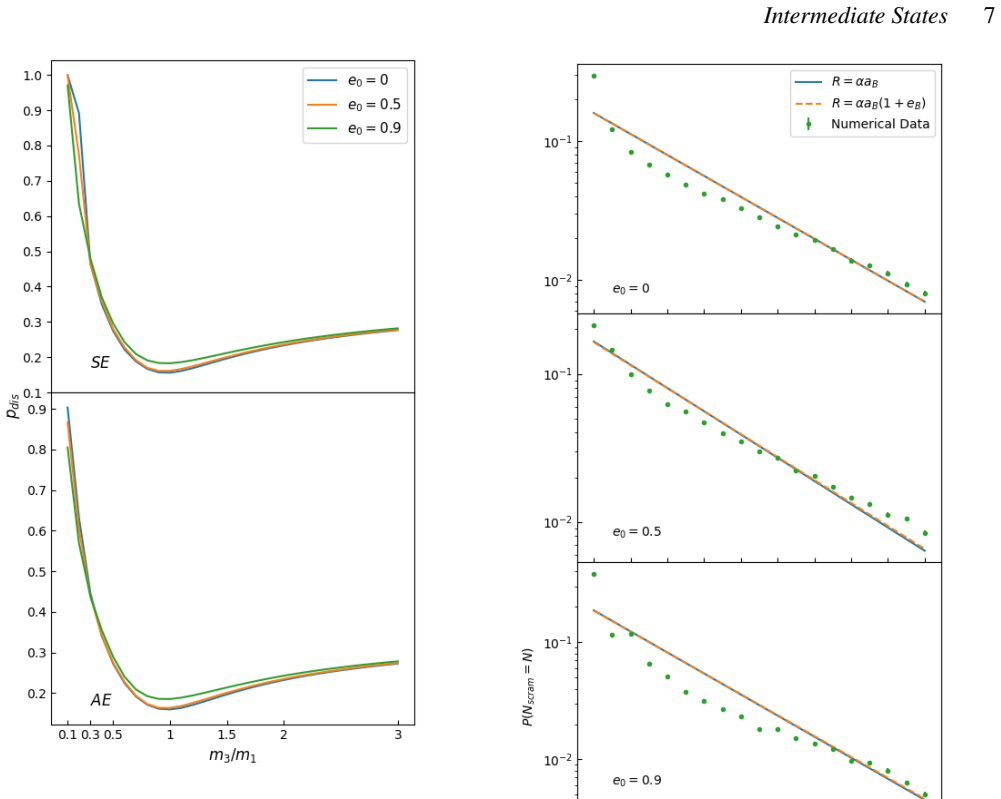
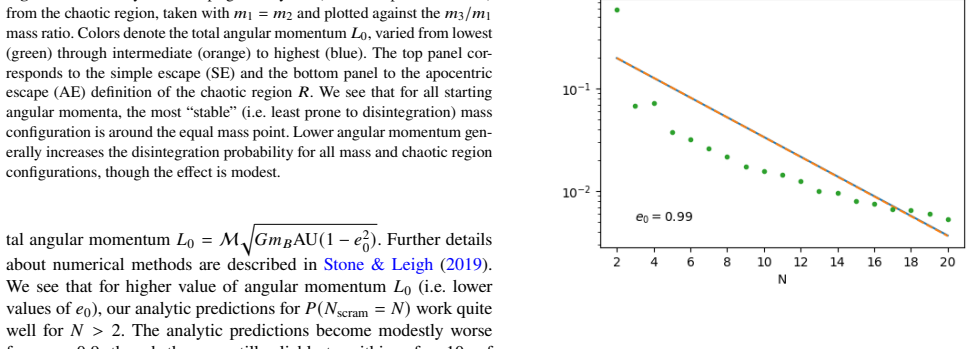
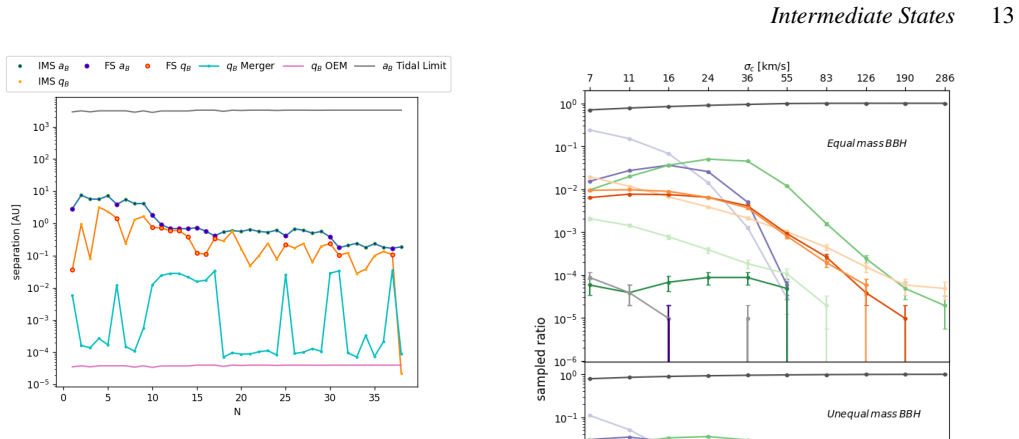
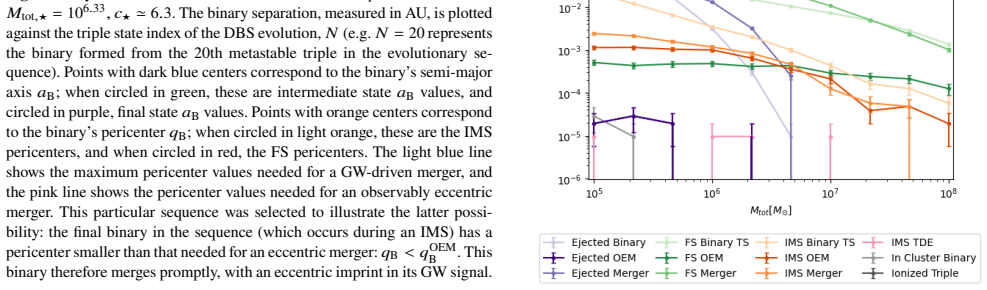
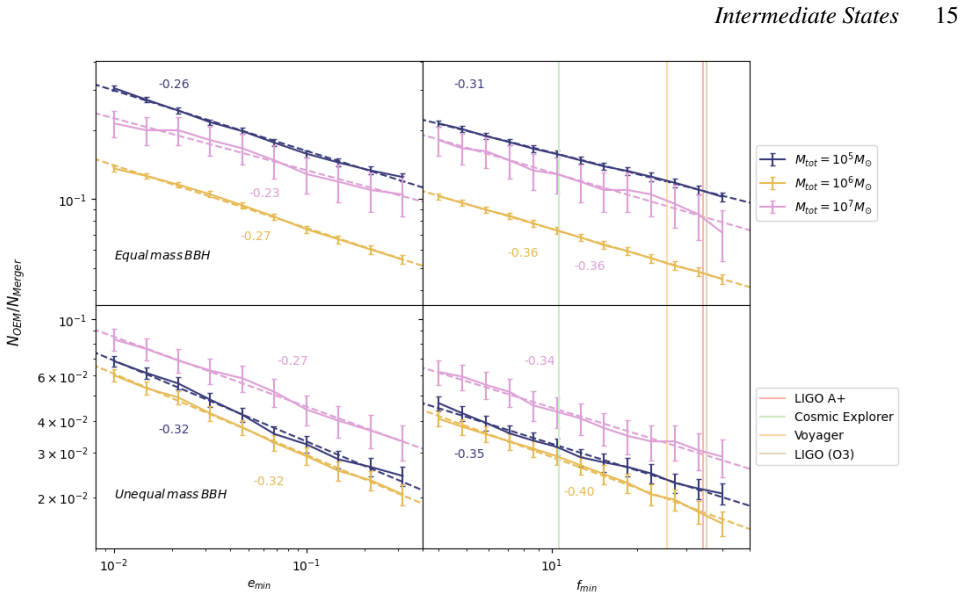
We re-derive the elliptic outcome distribution using equilibrium statistical mechanics and explore it together with the hyperbolic distribution. When comparing to N-body simulations, we find that we can reduce the elliptic outcome model to one free parameter instead of the previously used two and that the predicted disintegration probabilities agree except for very low angular momentum triples. We then use both outcome distributions along with a star cluster model to design a Monte Carlo algorithm for repeated binary-single scatterings within dense star systems. Assuming an OEM detection sensitivity of f_min=10 Hz, e_min = 0.1, we find the elliptic OEMs are about ∼(32−63)% of the total ellip
What carries the argument
The elliptic outcome distribution derived from equilibrium statistical mechanics, which assigns probabilities to the hierarchical states that follow chaotic triple evolution and thereby governs the production of eccentric binaries.
If this is right
- The reduced one-parameter elliptic model reproduces N-body disintegration probabilities except at very low angular momentum.
- Elliptic observably eccentric mergers account for 32 to 63 percent of all elliptic mergers under the stated detector thresholds.
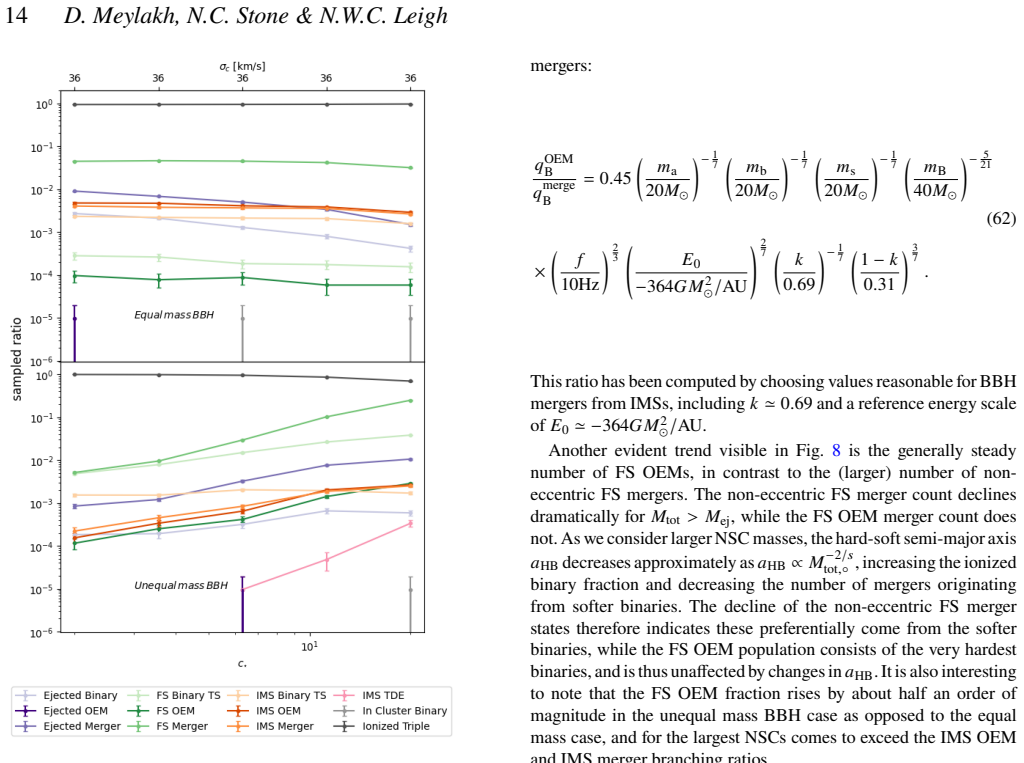
- Higher total cluster mass increases the fraction of binaries ejected before merger.
- Raising the minimum frequency to current detector values lowers the predicted OEM fraction to 1.6-3.1 percent.
Where Pith is reading between the lines
- The same statistical-mechanics reduction might be tested against direct N-body runs that include post-Newtonian terms during the chaotic phase.
- Varying the assumed cluster density or velocity dispersion would show how sensitive the OEM fraction is to environment.
- The predicted eccentricity distribution could be folded into population-synthesis codes to assess overlap with other black-hole formation channels.
Load-bearing premise
The equilibrium statistical mechanics derivation of the elliptic outcome distribution remains valid across the full range of angular momenta encountered in realistic cluster scatterings.
What would settle it
A measured fraction of eccentric black hole mergers in LIGO-Virgo catalogs that lies well outside the 2.6-4.4 percent interval predicted for the star-cluster channel would falsify the model's applicability.
Figures
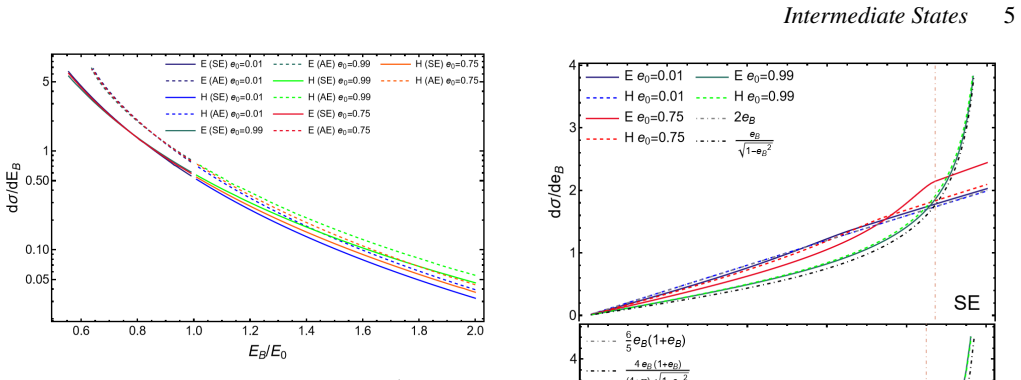
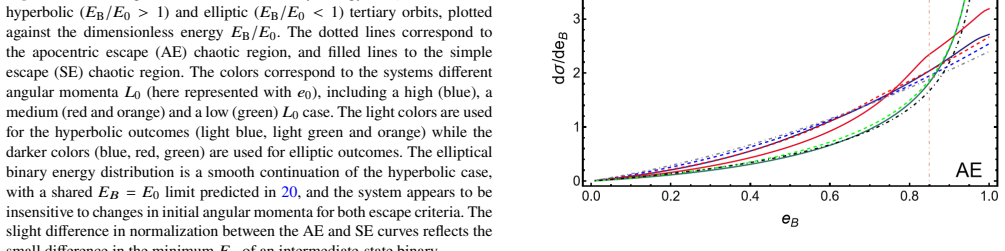
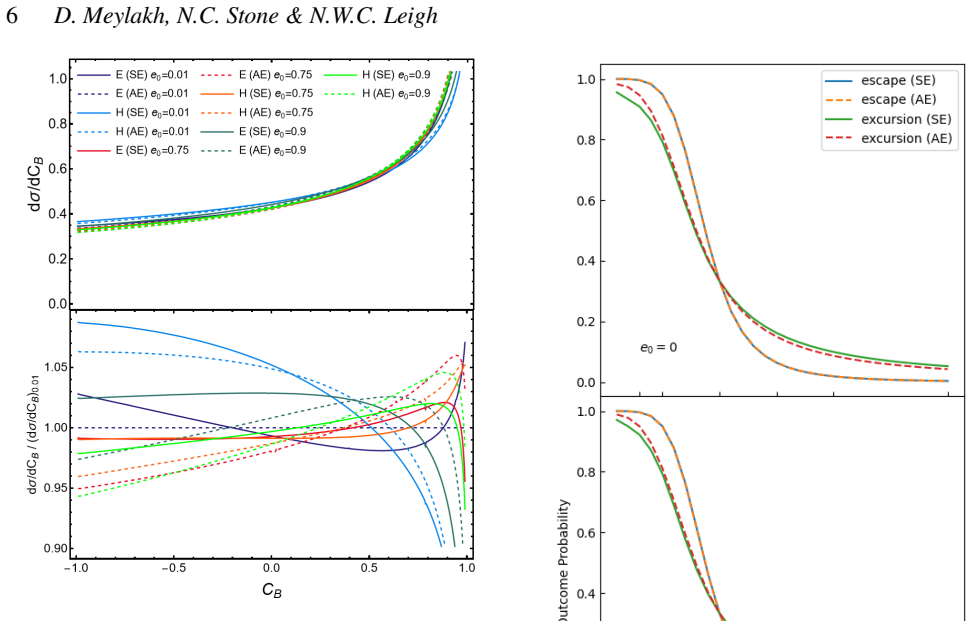
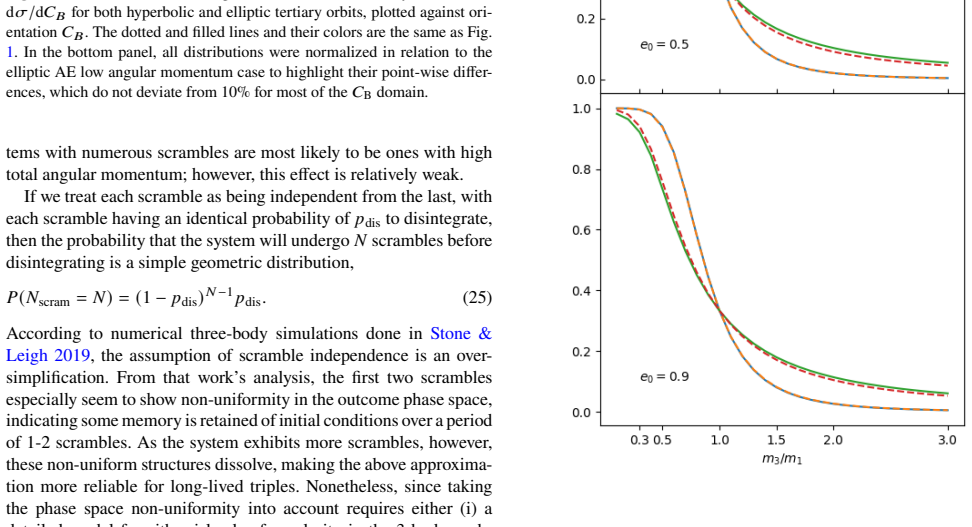
read the original abstract
Three-body interactions exhibit phases of strong chaotic evolution as well as hierarchical motion where one body separates from a binary and follows a hyperbolic or elliptic trajectory around it. The binaries produced during phases of hierarchical motion may lead to gravitational wave (GW) inspirals, but this depends on the outcomes of the chaotic states. In this paper we re-derive the elliptic outcome distribution using equilibrium statistical mechanics and explore it together with the hyperbolic distribution. When comparing to N-body simulations, we find that we can reduce the elliptic outcome model to one free parameter instead of the previously used two and that the predicted disintegration probabilities agree except for very low angular momentum triples. We then use both outcome distributions along with a star cluster model to design a Monte Carlo algorithm for repeated binary-single scatterings within dense star systems. We explore star cluster masses of $[10^5 - 10^7] M_{\odot}$, with the goal of quantifying observably eccentric merger (OEM) GWs, visible to instruments such as LIGO and Virgo. Assuming an OEM detection sensitivity of $f_{\rm min}=10 {\rm Hz}, e_{\rm min} = 0.1$, we find the elliptic OEMs are about $\sim (32 - 63)\%$ of the total elliptic mergers and that the total cluster mass greatly impacts the fraction of ejected binaries. The OEM to total merger fraction (OEM fraction) is found to be $(2.6 - 4.4)\%$. Considering the detection sensitivity that GW interferometers have today $(f_{\rm min} \simeq 34.4 {\rm Hz})$ we obtain the OEM fraction in the $(1.6 - 3.1)\%$ range.
Editorial analysis
A structured set of objections, weighed in public.
Referee Report
Summary. The paper re-derives the elliptic outcome distribution for chaotic three-body interactions via equilibrium statistical mechanics, reduces the model to a single free parameter (with agreement to N-body simulations except at very low angular momentum), and applies the resulting hyperbolic and elliptic distributions in a Monte Carlo algorithm for repeated binary-single scatterings in star clusters of mass [10^5-10^7] M_⊙. It reports that elliptic OEMs comprise ~32-63% of total elliptic mergers and that the OEM-to-total-merger fraction is (2.6-4.4)% assuming f_min=10 Hz and e_min=0.1 (dropping to 1.6-3.1% at f_min~34.4 Hz).
Significance. If the one-parameter reduction and its applicability hold, the work supplies a simplified statistical-mechanics framework for triple outcomes that can be embedded in cluster population synthesis, offering quantitative predictions for the contribution of observably eccentric black-hole mergers from dense environments to the LIGO/Virgo band.
major comments (3)
- [Abstract] Abstract: the reduction of the elliptic outcome model to a single free parameter is asserted on the basis of N-body agreement, yet no explicit derivation steps, choice criterion for the parameter value, or error budget across the full angular-momentum range are supplied; this choice directly determines the disintegration probabilities fed into the Monte Carlo and therefore the quoted OEM fractions.
- [Abstract] Abstract and Monte Carlo description: the model is stated to disagree with N-body results at very low angular momentum, but the Monte Carlo for [10^5-10^7] M_⊙ clusters necessarily samples encounter angular momenta that include this regime; no weighting, cutoff, or sensitivity test is reported to show that the discrepancy does not shift the OEM-to-total-merger fraction outside the quoted (2.6-4.4)% interval.
- [Abstract] Abstract: the elliptic distribution is re-derived from statistical mechanics and then tuned to match simulations; because the final OEM fractions inherit this fitted parameter, an independent test (e.g., against an orthogonal set of N-body runs or an analytic limit) is required to establish that the (2.6-4.4)% range is not an artifact of the tuning procedure.
minor comments (1)
- Notation for the single free parameter and its relation to the earlier two-parameter model should be defined once in a dedicated subsection rather than introduced only in the abstract.
Simulated Author's Rebuttal
We thank the referee for the careful review and constructive comments. We address each major comment below, indicating planned revisions where appropriate.
read point-by-point responses
-
Referee: [Abstract] Abstract: the reduction of the elliptic outcome model to a single free parameter is asserted on the basis of N-body agreement, yet no explicit derivation steps, choice criterion for the parameter value, or error budget across the full angular-momentum range are supplied; this choice directly determines the disintegration probabilities fed into the Monte Carlo and therefore the quoted OEM fractions.
Authors: Section 2 of the manuscript presents the equilibrium statistical mechanics derivation of the elliptic outcome distribution. The reduction from two to one free parameter is obtained by direct comparison of predicted disintegration probabilities against N-body results, with the retained parameter chosen to minimize the mean absolute deviation over the sampled angular-momentum range. We will add an explicit error-budget figure and a short appendix describing the fitting criterion in the revised manuscript. revision: yes
-
Referee: [Abstract] Abstract and Monte Carlo description: the model is stated to disagree with N-body results at very low angular momentum, but the Monte Carlo for [10^5-10^7] M_⊙ clusters necessarily samples encounter angular momenta that include this regime; no weighting, cutoff, or sensitivity test is reported to show that the discrepancy does not shift the OEM-to-total-merger fraction outside the quoted (2.6-4.4)% interval.
Authors: The Monte Carlo does sample low-angular-momentum encounters. Because the cluster encounter-rate weighting strongly suppresses the lowest angular-momentum tail, the affected fraction of outcomes is small; however, no explicit sensitivity test was performed. We will add such a test (varying the low-L treatment and recomputing the OEM fraction) to the revised manuscript and confirm that the reported (2.6-4.4)% interval is robust. revision: yes
-
Referee: [Abstract] Abstract: the elliptic distribution is re-derived from statistical mechanics and then tuned to match simulations; because the final OEM fractions inherit this fitted parameter, an independent test (e.g., against an orthogonal set of N-body runs or an analytic limit) is required to establish that the (2.6-4.4)% range is not an artifact of the tuning procedure.
Authors: The statistical-mechanics derivation itself is independent of N-body data and supplies the functional form; the single-parameter adjustment is a calibration to compensate for the equilibrium approximation. The quoted OEM range already spans the full cluster-mass interval explored. While an additional orthogonal simulation suite would strengthen the claim, the existing validation against published N-body results in the dominant angular-momentum regime supports the fractions; we will clarify this distinction in the revised text. revision: partial
Circularity Check
No significant circularity; derivation remains self-contained
full rationale
The paper re-derives the elliptic outcome distribution from equilibrium statistical mechanics, compares it to N-body simulations to reduce the model from two free parameters to one (noting disagreement only at very low angular momentum), and then applies the resulting distributions in a separate Monte Carlo algorithm to compute OEM fractions for cluster masses in [10^5-10^7] M_⊙. This chain does not reduce any load-bearing prediction to its inputs by construction: the parameter reduction is an external calibration step against independent N-body data, the final OEM-to-total-merger fraction (2.6-4.4)% is generated by applying the calibrated model to a distinct cluster scattering simulation, and no self-citation, self-definition, or renaming of known results is invoked as the justification for the central result. The derivation is therefore independent of the target statistic.
Axiom & Free-Parameter Ledger
free parameters (1)
- single free parameter for elliptic outcome distribution
axioms (1)
- domain assumption Equilibrium statistical mechanics accurately describes the phase-space distribution of outcomes after chaotic triple evolution.
Reference graph
Works this paper leans on
-
[1]
The cosmic evolution of binary black holes in young, globular, and nuclear star clusters: rates, masses, spins, and mixing fractions. , keywords =. doi:10.1093/mnras/stac422 , archivePrefix =. 2109.06222 , primaryClass =
-
[2]
Population synthesis of black hole binary mergers from star clusters. , keywords =. doi:10.1093/mnras/stz3584 , archivePrefix =. 1906.11855 , primaryClass =
-
[3]
Dynamical formation of black hole binaries in dense star clusters: Rapid cluster evolution code. , keywords =. doi:10.1103/PhysRevD.110.043023 , archivePrefix =. 2210.10055 , primaryClass =
-
[4]
Eccentricity dynamics of wide binaries - I. The effect of Galactic tides. , keywords =. doi:10.1093/mnras/stad2073 , archivePrefix =. 2303.15531 , primaryClass =
-
[5]
How to Escape from a Trap: Outcomes of Repeated Black Hole Mergers in Active Galactic Nuclei. , keywords =. doi:10.3847/2041-8213/adb7dc , archivePrefix =. 2410.19904 , primaryClass =
-
[6]
Analytic computation of the secular effects of encounters on a binary: features arising from second-order perturbation theory. , keywords =. doi:10.1093/mnras/stz1646 , archivePrefix =. 1904.09624 , primaryClass =
work page internal anchor Pith review Pith/arXiv arXiv doi:10.1093/mnras/stz1646 1904
-
[7]
Nuclear star clusters in 228 spiral galaxies in the HST/WFPC2 archive: catalogue and comparison to other stellar systems. , keywords =. doi:10.1093/mnras/stu797 , archivePrefix =. 1404.5956 , primaryClass =
work page internal anchor Pith review Pith/arXiv arXiv doi:10.1093/mnras/stu797
-
[8]
2020, MNRAS, 497, 536, doi: 10.1093/mnras/staa1915
PETAR: a high-performance N-body code for modelling massive collisional stellar systems. , keywords =. doi:10.1093/mnras/staa1915 , archivePrefix =. 2006.16560 , primaryClass =
-
[9]
Remnant Black Hole Kicks and Implications for Hierarchical Mergers. , keywords =. doi:10.3847/2041-8213/ac20db , archivePrefix =. 2106.07179 , primaryClass =
-
[10]
Mind the Gap: The Location of the Lower Edge of the Pair-instability Supernova Black Hole Mass Gap. , keywords =. doi:10.3847/1538-4357/ab518b , archivePrefix =. 1910.12874 , primaryClass =
-
[11]
MOCCA-SURVEY Database I: Coalescing Binary Black Holes Originating From Globular Clusters
MOCCA-SURVEY Database - I. Coalescing binary black holes originating from globular clusters. , keywords =. doi:10.1093/mnrasl/slw177 , archivePrefix =. 1608.02520 , primaryClass =
work page internal anchor Pith review Pith/arXiv arXiv doi:10.1093/mnrasl/slw177
-
[12]
Two kinds of stellar collapse. , keywords =. doi:10.1038/253698a0 , adsurl =
-
[13]
Merging black hole binaries in galactic nuclei: implications for advanced-LIGO detections
Merging Black Hole Binaries in Galactic Nuclei: Implications for Advanced-LIGO Detections. , keywords =. doi:10.3847/0004-637X/831/2/187 , archivePrefix =. 1606.04889 , primaryClass =
work page internal anchor Pith review Pith/arXiv arXiv doi:10.3847/0004-637x/831/2/187
-
[14]
Binary Black Hole Mergers from Young Massive and Open Clusters: Comparison to GWTC-2 Gravitational Wave Data. , keywords =. doi:10.3847/2041-8213/ac00a7 , archivePrefix =. 2103.10447 , primaryClass =
-
[15]
Merger rate density of binary black holes formed in open clusters. , keywords =. doi:10.1093/mnras/staa1440 , archivePrefix =. 2001.10690 , primaryClass =
-
[16]
Nuclear star clusters. , keywords =. doi:10.1007/s00159-020-00125-0 , archivePrefix =. 2001.03626 , primaryClass =
-
[18]
Binary black hole mergers from field triples: properties, rates and the impact of stellar evolution
Binary Black Hole Mergers from Field Triples: Properties, Rates, and the Impact of Stellar Evolution. , keywords =. doi:10.3847/1538-4357/aa6f5e , archivePrefix =. 1703.06614 , primaryClass =
work page internal anchor Pith review Pith/arXiv arXiv doi:10.3847/1538-4357/aa6f5e
-
[19]
Gravitational waves from scattering of stellar-mass black holes in galactic nuclei. , keywords =. doi:10.1111/j.1365-2966.2009.14653.x , archivePrefix =. 0807.2638 , primaryClass =
-
[20]
Mind Your Ps and Qs: The Interrelation between Period (P) and Mass-ratio (Q) Distributions of Binary Stars. , keywords =. doi:10.3847/1538-4365/aa6fb6 , archivePrefix =. 1606.05347 , primaryClass =
work page internal anchor Pith review Pith/arXiv arXiv doi:10.3847/1538-4365/aa6fb6
-
[21]
What is a globular cluster? An observational perspective. , keywords =. doi:10.1007/s00159-019-0119-3 , archivePrefix =. 1911.02835 , primaryClass =
-
[22]
Encyclopedia of Astrophysics, Volume 4 , year = 2026, volume =
The formation of globular clusters. Encyclopedia of Astrophysics, Volume 4 , year = 2026, volume =. doi:10.1016/B978-0-443-21439-4.00078-X , archivePrefix =. 2501.16438 , primaryClass =
-
[23]
Binary black hole mergers from globular clusters: Masses, merger rates, and the impact of stellar evolution. , keywords =. doi:10.1103/PhysRevD.93.084029 , archivePrefix =. 1602.02444 , primaryClass =
work page internal anchor Pith review Pith/arXiv arXiv doi:10.1103/physrevd.93.084029
-
[24]
Modeling Dense Star Clusters in the Milky Way and Beyond with the CMC Cluster Catalog. , keywords =. doi:10.3847/1538-4365/ab7919 , archivePrefix =. 1911.00018 , primaryClass =
-
[25]
, year = 1967, month = jan, volume =
A Study of the Dynamics of Triple Systems by Means of Statistical Sampling. , year = 1967, month = jan, volume =
1967
-
[26]
On the Astrophysical Origin of Binary Black Hole Subpopulations: A Tale of Three Channels?, 2026
On the Astrophysical Origin of Binary Black Hole Subpopulations: A Tale of Three Channels?. arXiv e-prints , keywords =. doi:10.48550/arXiv.2603.17987 , archivePrefix =. 2603.17987 , primaryClass =
-
[27]
Assisted Inspirals of Stellar Mass Black Holes Embedded in AGN Disks: Solving the "Final AU Problem"
Assisted inspirals of stellar mass black holes embedded in AGN discs: solving the `final au problem'. , keywords =. doi:10.1093/mnras/stw2260 , archivePrefix =. 1602.04226 , primaryClass =
work page internal anchor Pith review Pith/arXiv arXiv doi:10.1093/mnras/stw2260
-
[28]
GWTC-4.0: Updating the Gravitational-Wave Transient Catalog with Observations from the First Part of the Fourth LIGO-Virgo-KAGRA Observing Run. arXiv e-prints , keywords =. doi:10.48550/arXiv.2508.18082 , archivePrefix =. 2508.18082 , primaryClass =
work page internal anchor Pith review Pith/arXiv arXiv doi:10.48550/arxiv.2508.18082
-
[29]
Solar System Dynamics. doi:10.1017/CBO9781139174817 , adsurl =
-
[30]
Predicting the Stability of Hierarchical Triple Systems with Convolutional Neural Networks. , keywords =. doi:10.3847/1538-4357/ac8eab , archivePrefix =. 2206.12402 , primaryClass =
-
[31]
doi:10.1046/j.1365-8711.2001.04719.x , eprint =
Tidal interactions in star cluster simulations. , keywords =. doi:10.1046/j.1365-8711.2001.03974.x , adsurl =
-
[32]
Dynamics of rotating triple systems: statistical escape theory versus numerical simulations. , keywords =. doi:10.1111/j.1365-2966.2005.09540.x , adsurl =
-
[33]
The Formation of Eccentric Compact Binary Inspirals and the Role of Gravitational Wave Emission in Binary-Single Stellar Encounters. , keywords =. doi:10.1088/0004-637X/784/1/71 , archivePrefix =. 1308.2964 , primaryClass =
work page internal anchor Pith review Pith/arXiv arXiv doi:10.1088/0004-637x/784/1/71
-
[34]
Eccentric Black Hole Mergers Forming in Globular Clusters
Eccentric black hole mergers forming in globular clusters. , keywords =. doi:10.1103/PhysRevD.97.103014 , archivePrefix =. 1711.07452 , primaryClass =
work page internal anchor Pith review Pith/arXiv arXiv doi:10.1103/physrevd.97.103014
-
[35]
A statistical solution to the chaotic, non-hierarchical three-body problem. , keywords =. doi:10.1038/s41586-019-1833-8 , archivePrefix =. 1909.05272 , primaryClass =
-
[36]
Physical Review X , keywords =
Analytical, Statistical Approximate Solution of Dissipative and Nondissipative Binary-Single Stellar Encounters. Physical Review X , keywords =. doi:10.1103/PhysRevX.11.031020 , archivePrefix =. 2011.00010 , primaryClass =
-
[37]
Gravitational Radiation and the Motion of Two Point Masses , author =. Phys. Rev. , volume =. 1964 , month =. doi:10.1103/PhysRev.136.B1224 , url =
-
[38]
Research Notes of the American Astronomical Society , keywords =
An Accurate Analytical Fit to the Gravitational-wave Inspiral Duration for Eccentric Binaries. Research Notes of the American Astronomical Society , keywords =. doi:10.3847/2515-5172/ac2d35 , archivePrefix =. 2110.09254 , primaryClass =
-
[39]
The Astrophysical Journal , author =
A. The Astrophysical Journal , author =. 2015 , note =. doi:10.1088/2041-8205/806/2/L28 , language =
-
[40]
Monthly Notices of the Royal Astronomical Society , author =
Binary. Monthly Notices of the Royal Astronomical Society , author =. 1975 , pages =. doi:10.1093/mnras/173.3.729 , abstract =
-
[41]
The DRAGON-II simulations - II. Formation mechanisms, mass, and spin of intermediate-mass black holes in star clusters with up to 1 million stars. , keywords =. doi:10.1093/mnras/stad2292 , archivePrefix =. 2307.04806 , primaryClass =
-
[42]
Stellar-mass black holes in star clusters: implications for gravitational wave radiation , volume =. Monthly Notices of the Royal Astronomical Society , author =. 2010 , pages =. doi:10.1111/j.1365-2966.2009.15880.x , abstract =
-
[43]
Interpretation of high-resolution spectroscopic observations with asymptotic giant branch models
Compact binaries in star clusters –. Monthly Notices of the Royal Astronomical Society , author =. 2011 , pages =. doi:10.1111/j.1365-2966.2011.19023.x , abstract =
-
[45]
Monthly Notices of the Royal Astronomical Society , author =. 2018 , note =. doi:10.1093/mnras/sty1859 , abstract =
-
[46]
Proceedings of the International Astronomical Union , author =
The. Proceedings of the International Astronomical Union , author =. 2019 , note =. doi:10.1017/S1743921319007269 , abstract =
-
[47]
Galactic Dynamics: Second Edition
-
[48]
Dynamical evolution of black hole sub-systems in idealised star clusters
Dynamical evolution of black hole subsystems in idealized star clusters. , keywords =. doi:10.1093/mnras/stt628 , archivePrefix =. 1304.3401 , primaryClass =
work page internal anchor Pith review Pith/arXiv arXiv doi:10.1093/mnras/stt628
-
[49]
Formation of Massive Black Holes in Galactic Nuclei: Runaway Tidal Encounters
Formation of massive black holes in galactic nuclei: runaway tidal encounters. , keywords =. doi:10.1093/mnras/stx097 , archivePrefix =. 1606.01909 , primaryClass =
work page internal anchor Pith review Pith/arXiv arXiv doi:10.1093/mnras/stx097
-
[50]
Kippenhahn, Rudolf and Weigert, Alfred , year =. Stellar. doi:10.1007/978-3-642-61523-8 , keywords =
-
[51]
Tidal disruption of stars by black holes of 106–108 solar masses in nearby galaxies , volume =. Nature , author =. 1988 , note =. doi:10.1038/333523a0 , abstract =
-
[52]
Physical Review X , author =. 2023 , note =. doi:10.1103/PhysRevX.13.041039 , abstract =
-
[53]
Search for Eccentric Black Hole Coalescences during the Third Observing Run of LIGO and Virgo. , keywords =. doi:10.3847/1538-4357/ad65ce , archivePrefix =. 2308.03822 , primaryClass =
-
[54]
The Astrophysical Journal , author =
Search for. The Astrophysical Journal , author =. 2019 , note =. doi:10.3847/1538-4357/ab3c2d , abstract =
-
[55]
The Astrophysical Journal , author =
Four. The Astrophysical Journal , author =. 2022 , note =. doi:10.3847/1538-4357/ac9798 , abstract =
-
[56]
Grishin, Evgeni and Gilbaum, Shmuel and Stone, Nicholas C. , month = jul, year =. The. doi:10.48550/arXiv.2307.07546 , abstract =
-
[57]
Astronomy and Astrophysics , author =
Impact of common envelope development criteria on the formation of. Astronomy and Astrophysics , author =. 2021 , note =. doi:10.1051/0004-6361/202140520 , abstract =
-
[58]
The Astrophysical Journal , author =
Binary. The Astrophysical Journal , author =. 2021 , note =. doi:10.3847/1538-4357/ac2610 , abstract =
-
[59]
Astronomy and Astrophysics , author =
Common-envelope ejection in massive binary stars. Astronomy and Astrophysics , author =. 2016 , note =. doi:10.1051/0004-6361/201629420 , abstract =
-
[60]
The Astrophysical Journal , author =
On the. The Astrophysical Journal , author =. 2020 , note =. doi:10.3847/2041-8213/abbc0a , abstract =
-
[61]
Monthly Notices of the Royal Astronomical Society , author =
A. Monthly Notices of the Royal Astronomical Society , author =. 1976 , pages =. doi:10.1093/mnras/176.1.63 , abstract =
-
[62]
Valtonen, Mauri and Karttunen, Hannu , month = mar, year =. The
-
[63]
Monthly Notices of the Royal Astronomical Society , author =
A. Monthly Notices of the Royal Astronomical Society , author =. 1976 , pages =. doi:10.1093/mnras/177.3.583 , abstract =
-
[64]
Monthly Notices of the Royal Astronomical Society , author =
A statistical theory of the disruption of three-body systems –. Monthly Notices of the Royal Astronomical Society , author =. 1978 , pages =. doi:10.1093/mnras/184.1.119 , abstract =
-
[65]
Celestial Mechanics and Dynamical Astronomy , author =
Flux-based statistical prediction of three-body outcomes , volume =. Celestial Mechanics and Dynamical Astronomy , author =. 2021 , note =. doi:10.1007/s10569-021-10015-x , abstract =
-
[66]
Natural dynamical reduction of the three-body problem , url =
Kol, Barak , month = jul, year =. Natural dynamical reduction of the three-body problem , url =. doi:10.48550/arXiv.2107.12372 , abstract =
-
[67]
Monthly Notices of the Royal Astronomical Society , author =
Testing the flux-based statistical prediction of the three-body problem , volume =. Monthly Notices of the Royal Astronomical Society , author =. 2021 , note =. doi:10.1093/mnras/stab1689 , abstract =
-
[68]
Celestial Mechanics and Dynamical Astronomy , author =
Regularized phase-space volume for the three-body problem , volume =. Celestial Mechanics and Dynamical Astronomy , author =. 2022 , note =. doi:10.1007/s10569-022-10108-1 , abstract =
-
[70]
Monthly Notices of the Royal Astronomical Society: Letters , author =
Analytic. Monthly Notices of the Royal Astronomical Society: Letters , author =. 2022 , note =. doi:10.1093/mnrasl/slac145 , abstract =
-
[71]
Physical Review Letters , author =
Post-. Physical Review Letters , author =. 2018 , note =. doi:10.1103/PhysRevLett.120.151101 , abstract =
-
[72]
L., Amaro-Seoane, P., Chatterjee, S., et al
Post-. Physical Review D , author =. 2018 , note =. doi:10.1103/PhysRevD.98.123005 , abstract =
-
[73]
The Astrophysical Journal , author =. 2018 , note =. doi:10.3847/1538-4357/aaab52 , abstract =
-
[74]
Merging black holes in young star clusters , volume =. Monthly Notices of the Royal Astronomical Society , author =. 2019 , note =. doi:10.1093/mnras/stz1453 , abstract =
-
[75]
Dall'Amico, Marco and Mapelli, Michela and Torniamenti, Stefano and Arca Sedda, Manuel , month = mar, year =. Eccentric black hole mergers via three-body interactions in young, globular and nuclear star clusters , url =. doi:10.48550/arXiv.2303.07421 , abstract =
-
[76]
The Astrophysical Journal , author =
On the. The Astrophysical Journal , author =. 2017 , pages =. doi:10.3847/2041-8213/aa6f0b , abstract =
-
[77]
Astrophysics and Space Science , author =
The. Astrophysics and Space Science , author =. 1971 , note =. doi:10.1007/BF00649201 , abstract =
-
[78]
X-ray binaries in globular clusters. , volume =. The Astrophysical Journal , author =. 1975 , note =. doi:10.1086/181869 , abstract =
-
[79]
High-. Science , author =. 2001 , note =. doi:10.1126/science.1061135 , abstract =
-
[80]
Monthly Notices of the Royal Astronomical Society , author =
The formation of binaries containing black holes by the exchange of companions and the. Monthly Notices of the Royal Astronomical Society , author =. 1976 , note =. doi:10.1093/mnras/175.1.1P , abstract =
-
[81]
White dwarfs and neutron stars in globular cluster. Nature , author =. 1983 , note =. doi:10.1038/301587a0 , abstract =
-
[82]
The Astrophysical Journal , author =
Dynamical. The Astrophysical Journal , author =. 2003 , note =. doi:10.1086/377074 , abstract =
-
[83]
The Astrophysical Journal , author =
Dynamical. The Astrophysical Journal , author =. 2006 , note =. doi:10.1086/507027 , abstract =
discussion (0)
Sign in with ORCID, Apple, or X to comment. Anyone can read and Pith papers without signing in.