REVIEW 3 major objections 4 minor 94 references
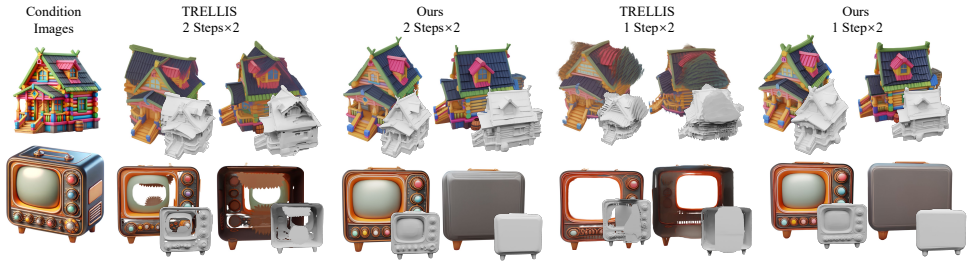
This paper claims that a 3D flow generator can be distilled to one or two sampling steps per stage by replacing the intractable transport integral with two tractable losses, cutting latency about ninefold with little fidelity loss.
Reviewed by Pith at T0; open to challenge. T0 means a machine referee read the full paper against a public rubric. the ladder, T0–T4 →
MDT-dist distills a pretrained 3D flow model into a 1-2 step generator using velocity matching plus velocity distillation, cutting TRELLIS inference from 6.1s to 0.68s while approximately preserving generation quality.
T0 review reviewed 2026-08-05 challenge →
load-bearing objection Practical one-step distillation for TRELLIS with real speedups, but the theoretical equivalence claim is overstated and the VM bias is unquantified. the 3 major comments →
Few-step Flow for 3D Generation via Marginal-Data Transport Distillation
The pith
A machine-rendered reading of the paper's core claim, the machinery that carries it, and where it could break.
The reading
Core claim
The central claim is that the marginal-data transport—the student mapping that carries any noised sample back to clean data—can be learned by splitting it into a velocity-level loss and a distribution-level loss. Velocity Matching defines the student velocity u_theta = phi_theta + t d(phi_theta)/dt and matches it to the teacher's velocity; Theorem 1 bounds the primary transport error by the velocity error. Because the derivative term cannot be backpropagated efficiently, the paper uses a finite-difference approximation along the teacher ODE trajectory and detaches the gradient, which it acknowledges gives biased estimates. Velocity Distillation then treats the learned velocity difference as
What carries the argument
The load-bearing object is the student transport map phi_theta(xt, t) with its induced velocity u_theta = phi_theta + t d(phi_theta)/dt. Differentiating the primary transport objective with respect to t turns the intractable velocity integral into a tractable pointwise velocity-matching loss; the same velocity difference, applied to samples synthesized by the student and diffused, serves as the distribution-level gradient in Velocity Distillation. A finite-difference step along the teacher ODE approximates the derivative, and gradient detachment makes training feasible at the cost of bias.
Load-bearing premise
The intractable transport objective is assumed to be well approximated by the velocity-matching and velocity-distillation losses, so the biased, detached gradient estimates still drive the student toward the teacher's one-step map.
What would settle it
On a synthetic flow-matching problem with an exactly known teacher, train MDT-dist and compare the student's one-step output with the exact transport map. If the one-step transport error is much larger than the uniform velocity-error bound predicts, or if shrinking the finite-difference step size changes results significantly, the proxy losses are not faithfully optimizing the primary objective.
If this is right
- Sampling steps per flow transformer drop from 25 to 1 or 2, with end-to-end latency 0.68s (1x2) and 0.94s (2x2) on A800, a 9.0x and 6.5x speedup over the teacher.
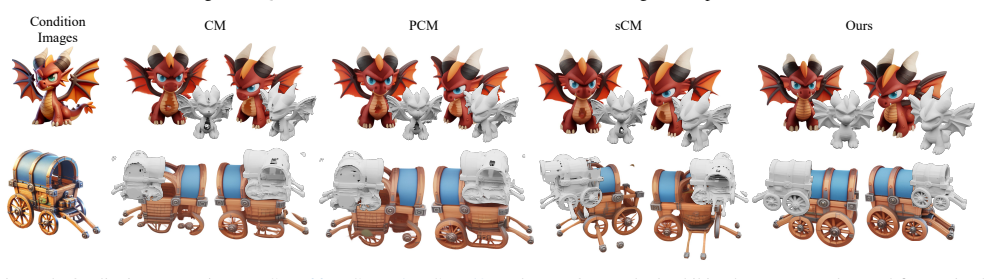
- The distilled one-step/two-step generator keeps appearance and geometry close to the teacher's 25-step output and outperforms consistency-model baselines at the same step budget.
- The two losses are complementary: Velocity Matching improves all time steps and Velocity Distillation sharpens one-step distribution quality; running both beats either alone in reported metrics.
- The method needs no extra score or diffusion model for distribution distillation, keeping memory overhead low relative to score-distillation variants.
- The formulation is tied to a pretrained velocity field, so it applies wherever such a teacher ODE exists, not only to the two-stage 3D generator tested.
Where Pith is reading between the lines
- Because the derivation only assumes a teacher velocity field, the same two-loss scheme should transfer to other latent flow generators; the 3D results are likely a special case of a general few-step flow-distillation recipe.
- The acknowledged gradient bias suggests a concrete ablation the paper does not run: replacing the detached finite-difference derivative with a fully backpropagated or higher-order estimate would isolate how much of the Velocity Distillation contribution is correcting bias rather than adding distribution-level signal.
- The biggest scaling bottleneck is the need for high-quality geometric training data; if the teacher can supply geometry pseudo-labels from image conditions, the distillation could be run on image-only data, which the paper lists as future work.
- A distilled student that already approximates the teacher transport could be distilled again, compounding the speedup beyond 1-2 steps in settings that tolerate a small fidelity drop.
Editorial analysis
A structured set of objections, weighed in public.
Referee Report
Summary. The paper proposes MDT-dist, a few-step distillation framework for pretrained flow-based 3D generation models, applied to TRELLIS. The authors introduce a primary objective of learning the marginal-data transport from a noisy marginal distribution to the data distribution, and then derive two tractable surrogate objectives: Velocity Matching (VM), which matches the student and teacher velocity fields, and Velocity Distillation (VD), which performs probability density distillation. The method reduces the inference steps of TRELLIS from 25 to 1–2 per flow transformer, reporting 9.0x and 6.5x speedups with quantitative and qualitative results that outperform existing consistency-model distillations.
Significance. If the central equivalence claim held, the paper would provide a practically important and conceptually clean acceleration technique for 3D flow generation. The empirical work is substantial: ablations show consistent gains from each loss component, comparisons against CM/PCM/sCM are clearly positive, and the reported latency improvements are concrete. The paper also benefits from an open-code commitment. However, the theoretical derivation that justifies the method is not yet rigorous: the actual optimized objective is a stop-gradient finite-difference surrogate of the stated VM loss, and Theorem 1 bounds the primary error under a uniform velocity-error assumption that the algorithm does not demonstrably enforce. The VD loss is shown to relate to score distillation, not directly to the primary transport objective. These gaps undermine the paper's core claim that the proposed losses 'equivalently convert' the primary objective, though the empirical results suggest the method has value.
major comments (3)
- [Sec. 4.2, Eq. (12) and Appendix A.1] Eq. (12) defines u_theta(xt,t) = phi_theta(xt,t) + t d phi_theta(xt,t)/dt, and Theorem 1 relies on u_theta being the derivative of T_theta(t)=t phi_theta(xt,t). But xt=(1-t)x0+t z depends on t, so the total derivative contains an additional term t * grad_x phi_theta(xt,t) * (z-x0). This term is generally nonzero and is omitted. Consequently Theorem 1's bound does not follow for the quantity actually defined in Eq. (12); the proof requires an additional argument that this term is negligible or that the student is evaluated along a different path.
- [Sec. 4.2, Eq. (14) and Algorithm 1] The finite-difference approximation in Eq. (14) follows the teacher trajectory, xt-Delta_t = xt - v_pretrain(xt,t) Delta_t, whereas the derivative in Eq. (12) is taken along the interpolation path xt=(1-t)x0+t z. These are different directions in general, so even without gradient detachment the difference quotient is not a consistent estimator of the intended derivative. Moreover, the gradient of the second term is detached in Algorithm 1 (lines 10 and 18), so the optimized loss is not LVM as written in Eq. (13). The paper acknowledges a biased gradient in Sec. 4.3, but gives no bound, no measurement of the bias, and no comparison against an unbiased/unrolled objective. Thus a small value of the implemented loss does not imply small Lprimary, and the precondition of Theorem 1 may never be satisfied. Reporting final LVM and Lprimary values, or at least a bias estimate, would be needed to
- [Sec. 4.3 and Appendix A.2] Theorem 2 establishes that, under the velocity–score substitution, VD equals score distillation up to a factor (1/2) g(t)^2. This is not an equivalence with the primary marginal-data transport objective of Eq. (10). The substitution additionally assumes that the student's velocity field u_theta is the PF-ODE velocity for the student's marginal distribution, but this correspondence is not proved for the student defined by x' = z' - phi_theta(z'). The abstract's claim that VM and VD 'equivalently convert' the transport objective is therefore overstated. The authors should either prove the equivalence under explicit assumptions, or reformulate the claim as optimizing surrogate objectives whose relation to the primary objective is approximate and empirically validated.
minor comments (4)
- [Sec. 4.3, Eq. (17) and Algorithm 1] Eq. (17) is written as an expression for grad_theta L_VD(theta), but Algorithm 1 (line 19) and Eq. (18) treat L_VD as a scalar loss. The notation should be made consistent, e.g., define L_VD first and then state its gradient.
- [Algorithm 1] When t is close to 0, t - Delta_t may be negative; the algorithm does not specify how to handle this boundary, which matters if the model or teacher is only defined for t in [0,1].
- [Table 1] The footnote under Table 1 is ambiguous about which metrics are computed on the 'subset of Toys4K' and which are from the original papers. Clarify the exact evaluation protocol for each row.
- [Abstract and Sec. 4.2] The phrase 'equivalently convert' in the abstract conflicts with the later statement that VM 'inevitably provides biased gradient estimates.' A more precise wording, such as 'surrogate objectives with a theoretically motivated relation to the primary objective,' would better reflect the actual technical content.
Circularity Check
No significant circularity: the empirical speed/quality claims are checked against external metrics and an external teacher; the biased-gradient issue in VM/VD is a rigor gap, not an input-output identity.
full rationale
MDT-dist's central derivation is not circular. The primary objective (Eq. 10) is defined as matching the student transport t*phi_theta against the teacher's transport integral; Velocity Matching (Eq. 13) follows by differentiating that objective in time, and Theorem 1 (Appendix A.1) bounds the primary error under a uniform velocity-error assumption. The student is initialized from the teacher and fine-tuned, but the reported 0.68s/0.94s latencies and FD/ULIP scores are evaluated against external benchmarks and the pretrained TRELLIS teacher, not fitted to the method's own constants. The two self-citations ([86],[87]) are related-work examples and carry no load-bearing argument. Appendix A.2 shows VD reduces to score distillation up to a 1/2 g(t)^2 factor, but the paper explicitly acknowledges this relation; that is a novelty/positioning observation, not a circular derivation of the empirical result. The paper's own limitation—VM provides biased gradient estimates due to the stop-gradient in Eq. 14/Algorithm 1—is a genuine correctness/rigor gap (the precondition of Theorem 1 may not be guaranteed), but it is not a case of a prediction being equivalent to its input by construction. No definitional, fitted-input, self-citation, or renaming circularity is present.
Axiom & Free-Parameter Ledger
free parameters (5)
- loss weight lambda =
1.0
- finite-difference step Delta_t =
1e-2
- CFG guidance scale for VM =
40
- CFG guidance scale for VD =
100
- learning rates and training steps =
4e-8 for 6k steps (structure), 1e-8 for 4k steps (sparse)
axioms (4)
- domain assumption The teacher velocity field v_pretrain approximates the marginal transport, so that its time integral equals the transport from q_t to q_data.
- ad hoc to paper The velocity-score relation v = f - (1/2) g^2 s (Appendix A.2, Eq. 26) holds for the student-generated distribution, so the student velocity can stand in for the student score in the KL gradient.
- standard math In Theorem 1, the velocity matching loss is uniformly bounded by M for all t, x0, z.
- ad hoc to paper The finite-difference derivative with gradient detachment (Eq. 14, Algorithm 1) provides a usable surrogate for the exact derivative in Eq. 12.
Cite this review
Pith. "Pith review of Few-step Flow for 3D Generation via Marginal-Data Transport Distillation." pith.science (2026). https://pith.science/paper/XAX2MCJD
@misc{pith2026250904406,
  author       = {Pith},
  title        = {Pith review of: Few-step Flow for 3D Generation via Marginal-Data Transport Distillation},
  year         = {2026},
  howpublished = {\url{https://pith.science/paper/XAX2MCJD}},
  note         = {Machine review of arXiv:2509.04406}
}
read the original abstract
Flow-based 3D generation models typically require dozens of sampling steps during inference. Though few-step distillation methods, particularly Consistency Models (CMs), have achieved substantial advancements in accelerating 2D diffusion models, they remain under-explored for more complex 3D generation tasks. In this study, we propose a novel framework, MDT-dist, for few-step 3D flow distillation. Our approach is built upon a primary objective: distilling the pretrained model to learn the Marginal-Data Transport. Directly learning this objective needs to integrate the velocity fields, while this integral is intractable to be implemented. Therefore, we propose two optimizable objectives, Velocity Matching (VM) and Velocity Distillation (VD), to equivalently convert the optimization target from the transport level to the velocity and the distribution level respectively. Velocity Matching (VM) learns to stably match the velocity fields between the student and the teacher, but inevitably provides biased gradient estimates. Velocity Distillation (VD) further enhances the optimization process by leveraging the learned velocity fields to perform probability density distillation. When evaluated on the pioneer 3D generation framework TRELLIS, our method reduces sampling steps of each flow transformer from 25 to 1 or 2, achieving 0.68s (1 step x 2) and 0.94s (2 steps x 2) latency with 9.0x and 6.5x speedup on A800, while preserving high visual and geometric fidelity. Extensive experiments demonstrate that our method significantly outperforms existing CM distillation methods, and enables TRELLIS to achieve superior performance in few-step 3D generation.
Figures




Reference graph
Works this paper leans on
-
[1]
Mohammadreza Armandpour, Huangjie Zheng, Ali Sadeghian, Amir Sadeghian, and Mingyuan Zhou. Re- imagine the negative prompt algorithm: Transform 2d diffusion into 3d, alleviate janus problem and beyond. arXiv preprint arXiv:2304.04968, 2023. 2
Pith/arXiv arXiv 2023
-
[2]
DreamAvatar: Text-and-Shape Guided 3D Human Avatar Generation via Diffusion Models
Yukang Cao, Yan-Pei Cao, Kai Han, Ying Shan, and Kwan- Yee K Wong. Dreamavatar: Text-and-shape guided 3d hu- man avatar generation via diffusion models. arXiv preprint arXiv:2304.00916, 2023. 2
work page internal anchor Pith review Pith/arXiv arXiv 2023
-
[3]
Mode regularized generative adversarial networks
Tong Che, Yanran Li, Athul Jacob, Yoshua Bengio, and Wen- jie Li. Mode regularized generative adversarial networks. In International Conference on Learning Representations ,
-
[4]
Mar-3d: Progressive masked auto-regressor for high-resolution 3d generation
Jinnan Chen, Lingting Zhu, Zeyu Hu, Shengju Qian, Yugang Chen, Xin Wang, and Gim Hee Lee. Mar-3d: Progressive masked auto-regressor for high-resolution 3d generation. In CVPR, 2025. 2
2025
-
[5]
Fantasia3d: Disentangling geometry and appearance for high-quality text-to-3d content creation
Rui Chen, Yongwei Chen, Ningxin Jiao, and Kui Jia. Fantasia3d: Disentangling geometry and appearance for high-quality text-to-3d content creation. arXiv preprint arXiv:2303.13873, 2023. 2
Pith/arXiv arXiv 2023
-
[6]
Dora: Sampling and benchmarking for 3d shape varia- tional auto-encoders
Rui Chen, Jianfeng Zhang, Yixun Liang, Guan Luo, Weiyu Li, Jiarui Liu, Xiu Li, Xiaoxiao Long, Jiashi Feng, and Ping Tan. Dora: Sampling and benchmarking for 3d shape varia- tional auto-encoders. In CVPR, 2025. 1, 2
2025
-
[7]
Sar3d: Autoregressive 3d object genera- tion and understanding via multi-scale 3d vqvae
Yongwei Chen, Yushi Lan, Shangchen Zhou, Tengfei Wang, and XIngang Pan. Sar3d: Autoregressive 3d object genera- tion and understanding via multi-scale 3d vqvae. In CVPR,
-
[8]
Text-to-3d using gaussian splatting
Zilong Chen, Feng Wang, and Huaping Liu. Text-to-3d using gaussian splatting. arXiv preprint arXiv:2309.16585, 2023. 2
Pith/arXiv arXiv 2023
-
[9]
3dtopia-xl: Scaling high- quality 3d asset generation via primitive diffusion
Zhaoxi Chen, Jiaxiang Tang, Yuhao Dong, Ziang Cao, Fangzhou Hong, Yushi Lan, Tengfei Wang, Haozhe Xie, Tong Wu, Shunsuke Saito, et al. 3dtopia-xl: Scaling high- quality 3d asset generation via primitive diffusion. InCVPR,
-
[10]
Abo: Dataset and benchmarks for real-world 3d object understand- ing
Jasmine Collins, Shubham Goel, Kenan Deng, Achlesh- war Luthra, Leon Xu, Erhan Gundogdu, Xi Zhang, Tomas F Yago Vicente, Thomas Dideriksen, Himanshu Arora, Matthieu Guillaumin, and Jitendra Malik. Abo: Dataset and benchmarks for real-world 3d object understand- ing. CVPR, 2022. 7
2022
-
[11]
Objaverse: A universe of annotated 3d objects
Matt Deitke, Dustin Schwenk, Jordi Salvador, Luca Weihs, Oscar Michel, Eli VanderBilt, Ludwig Schmidt, Kiana Ehsani, Aniruddha Kembhavi, and Ali Farhadi. Objaverse: A universe of annotated 3d objects. In CVPR, 2023. 7
2023
-
[12]
3d-future: 3d fur- niture shape with texture
Huan Fu, Rongfei Jia, Lin Gao, Mingming Gong, Binqiang Zhao, Steve Maybank, and Dacheng Tao. 3d-future: 3d fur- niture shape with texture. IJCV, 2021. 7 9
2021
-
[13]
Get3d: A generative model of high quality 3d tex- tured shapes learned from images
Jun Gao, Tianchang Shen, Zian Wang, Wenzheng Chen, Kangxue Yin, Daiqing Li, Or Litany, Zan Gojcic, and Sanja Fidler. Get3d: A generative model of high quality 3d tex- tured shapes learned from images. NeurIPS, 2022. 2
2022
-
[14]
Mean flows for one-step genera- tive modeling
Zhengyang Geng, Mingyang Deng, Xingjian Bai, J Zico Kolter, and Kaiming He. Mean flows for one-step genera- tive modeling. arXiv preprint arXiv:2505.13447, 2025. 6
Pith/arXiv arXiv 2025
-
[15]
Generative adversarial networks
Ian Goodfellow, Jean Pouget-Abadie, Mehdi Mirza, Bing Xu, David Warde-Farley, Sherjil Ozair, Aaron Courville, and Yoshua Bengio. Generative adversarial networks. Commu- nications of the ACM, 2020. 2, 3, 4
2020
-
[16]
3dgen: Triplane latent diffusion for textured mesh generation
Anchit Gupta, Wenhan Xiong, Yixin Nie, Ian Jones, and Bar- las O˘guz. 3dgen: Triplane latent diffusion for textured mesh generation. arXiv preprint arXiv:2303.05371, 2023. 2
Pith/arXiv arXiv 2023
-
[17]
Classifier-free diffusion guidance
Jonathan Ho and Tim Salimans. Classifier-free diffusion guidance. arXiv preprint arXiv:2207.12598, 2022. 7
Pith/arXiv arXiv 2022
-
[18]
Denoising diffu- sion probabilistic models
Jonathan Ho, Ajay Jain, and Pieter Abbeel. Denoising diffu- sion probabilistic models. NeurIPS, 2020. 2, 3
2020
-
[19]
Lrm: Large reconstruction model for single image to 3d
Yicong Hong, Kai Zhang, Jiuxiang Gu, Sai Bi, Yang Zhou, Difan Liu, Feng Liu, Kalyan Sunkavalli, Trung Bui, and Hao Tan. Lrm: Large reconstruction model for single image to 3d. arXiv preprint arXiv:2311.04400, 2023. 2
Pith/arXiv arXiv 2023
-
[20]
DreamWaltz: Make a Scene with Complex 3D Animatable Avatars
Yukun Huang, Jianan Wang, Ailing Zeng, He Cao, Xianbiao Qi, Yukai Shi, Zheng-Jun Zha, and Lei Zhang. Dreamwaltz: Make a scene with complex 3d animatable avatars. arXiv preprint arXiv:2305.12529, 2023. 2
work page internal anchor Pith review Pith/arXiv arXiv 2023
-
[21]
TeCH: Text-guided Reconstruction of Lifelike Clothed Humans
Yangyi Huang, Hongwei Yi, Yuliang Xiu, Tingting Liao, Ji- axiang Tang, Deng Cai, and Justus Thies. Tech: Text-guided reconstruction of lifelike clothed humans. arXiv preprint arXiv:2308.08545, 2023
work page internal anchor Pith review Pith/arXiv arXiv 2023
-
[22]
Zero-shot text-guided object gen- eration with dream fields
Ajay Jain, Ben Mildenhall, Jonathan T Barron, Pieter Abbeel, and Ben Poole. Zero-shot text-guided object gen- eration with dream fields. In CVPR, 2022
2022
-
[23]
AvatarCraft: Transforming Text into Neural Human Avatars with Parameterized Shape and Pose Control
Ruixiang Jiang, Can Wang, Jingbo Zhang, Menglei Chai, Mingming He, Dongdong Chen, and Jing Liao. Avatar- craft: Transforming text into neural human avatars with parameterized shape and pose control. arXiv preprint arXiv:2303.17606, 2023. 2
work page internal anchor Pith review Pith/arXiv arXiv 2023
-
[24]
Shap-e: Generat- ing conditional 3d implicit functions
Heewoo Jun and Alex Nichol. Shap-e: Generat- ing conditional 3d implicit functions. arXiv preprint arXiv:2305.02463, 2023. 2
Pith/arXiv arXiv 2023
-
[25]
3d gaussian splatting for real-time radiance field rendering
Bernhard Kerbl, Georgios Kopanas, Thomas Leimk ¨uhler, and George Drettakis. 3d gaussian splatting for real-time radiance field rendering. ACM Transactions on Graphics, 42 (4), 2023. 1, 2, 3, 14, 15
2023
-
[26]
Chang, and Manolis Savva
Mukul Khanna*, Yongsen Mao*, Hanxiao Jiang, Sanjay Haresh, Brennan Shacklett, Dhruv Batra, Alexander Clegg, Eric Undersander, Angel X. Chang, and Manolis Savva. Habitat Synthetic Scenes Dataset (HSSD-200): An Analy- sis of 3D Scene Scale and Realism Tradeoffs for ObjectGoal Navigation. arXiv preprint, 2023. 7
2023
-
[27]
Auto-encoding vari- ational bayes
Diederik P Kingma and Max Welling. Auto-encoding vari- ational bayes. arXiv preprint arXiv:1312.6114, 2013. 2, 3, 4
Pith/arXiv arXiv 2013
-
[28]
Unleashing vecset diffusion model for fast shape generation
Zeqiang Lai, Yunfei Zhao, Zibo Zhao, Haolin Liu, Fuyun Wang, Huiwen Shi, Xianghui Yang, Qingxiang Lin, Jingwei Huang, Yuhong Liu, et al. Unleashing vecset diffusion model for fast shape generation. arXiv preprint arXiv:2503.16302,
-
[29]
Ln3diff: Scalable latent neural fields diffusion for speedy 3d generation
Yushi Lan, Fangzhou Hong, Shuai Yang, Shangchen Zhou, Xuyi Meng, Bo Dai, Xingang Pan, and Chen Change Loy. Ln3diff: Scalable latent neural fields diffusion for speedy 3d generation. In ECCV, 2024. 6, 8
work page 2024
-
[30]
Tango: Text-driven photorealistic and robust 3d stylization via lighting decom- position
Jiabao Lei, Yabin Zhang, Kui Jia, et al. Tango: Text-driven photorealistic and robust 3d stylization via lighting decom- position. NeurIPS, 2022. 2
work page 2022
-
[31]
Instant3d: Fast text-to-3d with sparse-view generation and large reconstruction model
Jiahao Li, Hao Tan, Kai Zhang, Zexiang Xu, Fujun Luan, Yinghao Xu, Yicong Hong, Kalyan Sunkavalli, Greg Shakhnarovich, and Sai Bi. Instant3d: Fast text-to-3d with sparse-view generation and large reconstruction model. arXiv preprint arXiv:2311.06214, 2023. 2
Pith/arXiv arXiv 2023
-
[32]
Sweet- dreamer: Aligning geometric priors in 2d diffusion for con- sistent text-to-3d
Weiyu Li, Rui Chen, Xuelin Chen, and Ping Tan. Sweet- dreamer: Aligning geometric priors in 2d diffusion for con- sistent text-to-3d. arXiv preprint arXiv:2310.02596 , 2023. 2
Pith/arXiv arXiv 2023
-
[33]
Craftsman: High-fidelity mesh generation with 3d native generation and interactive geometry refiner
Weiyu Li, Jiarui Liu, Rui Chen, Yixun Liang, Xuelin Chen, Ping Tan, and Xiaoxiao Long. Craftsman: High-fidelity mesh generation with 3d native generation and interactive geometry refiner. arXiv preprint arXiv:2405.14979, 2024. 2
Pith/arXiv arXiv 2024
-
[34]
Step1x-3d: Towards high-fidelity and con- trollable generation of textured 3d assets
Weiyu Li, Xuanyang Zhang, Zheng Sun, Di Qi, Hao Li, Wei Cheng, Weiwei Cai, Shihao Wu, Jiarui Liu, Zihao Wang, et al. Step1x-3d: Towards high-fidelity and con- trollable generation of textured 3d assets. arXiv preprint arXiv:2505.07747, 2025. 1, 2
Pith/arXiv arXiv 2025
-
[35]
Luciddreamer: Towards high-fidelity text-to-3d generation via interval score match- ing, 2023
Yixun Liang, Xin Yang, Jiantao Lin, Haodong Li, Xiao- gang Xu, and Yingcong Chen. Luciddreamer: Towards high-fidelity text-to-3d generation via interval score match- ing, 2023. 2
work page 2023
-
[36]
Magic3d: High-resolution text-to-3d content creation
Chen-Hsuan Lin, Jun Gao, Luming Tang, Towaki Takikawa, Xiaohui Zeng, Xun Huang, Karsten Kreis, Sanja Fidler, Ming-Yu Liu, and Tsung-Yi Lin. Magic3d: High-resolution text-to-3d content creation. In CVPR, 2023. 2
work page 2023
-
[37]
Flow matching for generative mod- eling
Yaron Lipman, Ricky TQ Chen, Heli Ben-Hamu, Maximil- ian Nickel, and Matt Le. Flow matching for generative mod- eling. arXiv preprint arXiv:2210.02747, 2022. 2, 3
Pith/arXiv arXiv 2022
-
[38]
Zero-1-to- 3: Zero-shot one image to 3d object
Ruoshi Liu, Rundi Wu, Basile Van Hoorick, Pavel Tok- makov, Sergey Zakharov, and Carl V ondrick. Zero-1-to- 3: Zero-shot one image to 3d object. arXiv preprint arXiv:2303.11328, 2023. 2
Pith/arXiv arXiv 2023
-
[39]
Flow straight and fast: Learning to generate and transfer data with rectified flow
Xingchao Liu, Chengyue Gong, and Qiang Liu. Flow straight and fast: Learning to generate and transfer data with rectified flow. arXiv preprint arXiv:2209.03003, 2022. 2, 3
Pith/arXiv arXiv 2022
-
[40]
Syncdreamer: Gen- erating multiview-consistent images from a single-view im- age
Yuan Liu, Cheng Lin, Zijiao Zeng, Xiaoxiao Long, Lingjie Liu, Taku Komura, and Wenping Wang. Syncdreamer: Gen- erating multiview-consistent images from a single-view im- age. arXiv preprint arXiv:2309.03453, 2023. 2
Pith/arXiv arXiv 2023
-
[41]
Wonder3d: Sin- gle image to 3d using cross-domain diffusion.arXiv preprint arXiv:2310.15008, 2023
Xiaoxiao Long, Yuan-Chen Guo, Cheng Lin, Yuan Liu, Zhiyang Dou, Lingjie Liu, Yuexin Ma, Song-Hai Zhang, Marc Habermann, Christian Theobalt, et al. Wonder3d: Sin- gle image to 3d using cross-domain diffusion.arXiv preprint arXiv:2310.15008, 2023. 2
Pith/arXiv arXiv 2023
-
[42]
Decoupled weight decay regularization
Ilya Loshchilov and Frank Hutter. Decoupled weight decay regularization. arXiv preprint arXiv:1711.05101, 2017. 7 10
Pith/arXiv arXiv 2017
-
[43]
Simplifying, stabilizing and scaling continuous-time consistency models
Cheng Lu and Yang Song. Simplifying, stabilizing and scaling continuous-time consistency models. arXiv preprint arXiv:2410.11081, 2024. 1, 2, 7, 8
Pith/arXiv arXiv 2024
-
[44]
Dpm-solver: A fast ode solver for diffusion probabilistic model sampling in around 10 steps
Cheng Lu, Yuhao Zhou, Fan Bao, Jianfei Chen, Chongxuan Li, and Jun Zhu. Dpm-solver: A fast ode solver for diffusion probabilistic model sampling in around 10 steps. NeurIPS,
-
[45]
Don’t blame the elbo! a linear vae perspective on posterior collapse
James Lucas, George Tucker, Roger B Grosse, and Moham- mad Norouzi. Don’t blame the elbo! a linear vae perspective on posterior collapse. NeurIPS, 2019. 3
work page 2019
-
[46]
Scalable 3d captioning with pretrained models
Tiange Luo, Chris Rockwell, Honglak Lee, and Justin John- son. Scalable 3d captioning with pretrained models. arXiv preprint arXiv:2306.07279, 2023. 2
Pith/arXiv arXiv 2023
-
[47]
Geodream: Disentan- gling 2d and geometric priors for high-fidelity and consistent 3d generation
Baorui Ma, Haoge Deng, Junsheng Zhou, Yu-Shen Liu, Tiejun Huang, and Xinlong Wang. Geodream: Disentan- gling 2d and geometric priors for high-fidelity and consistent 3d generation. arXiv preprint arXiv:2311.17971, 2023. 2
Pith/arXiv arXiv 2023
-
[48]
Latent-nerf for shape-guided generation of 3d shapes and textures
Gal Metzer, Elad Richardson, Or Patashnik, Raja Giryes, and Daniel Cohen-Or. Latent-nerf for shape-guided generation of 3d shapes and textures. In CVPR, 2023. 2
work page 2023
-
[49]
Text2mesh: Text-driven neural stylization for meshes
Oscar Michel, Roi Bar-On, Richard Liu, Sagie Benaim, and Rana Hanocka. Text2mesh: Text-driven neural stylization for meshes. In CVPR, 2022. 2
work page 2022
-
[50]
Nerf: Representing scenes as neural radiance fields for view syn- thesis
Ben Mildenhall, Pratul P Srinivasan, Matthew Tancik, Jonathan T Barron, Ravi Ramamoorthi, and Ren Ng. Nerf: Representing scenes as neural radiance fields for view syn- thesis. In ECCV, 2020. 2, 3
work page 2020
-
[51]
Point-e: A system for generat- ing 3d point clouds from complex prompts
Alex Nichol, Heewoo Jun, Prafulla Dhariwal, Pamela Mishkin, and Mark Chen. Point-e: A system for generat- ing 3d point clouds from complex prompts. arXiv preprint arXiv:2212.08751, 2022. 2
Pith/arXiv arXiv 2022
-
[52]
Dinov2: Learning robust visual features without supervision
Maxime Oquab, Timoth ´ee Darcet, Th ´eo Moutakanni, Huy V o, Marc Szafraniec, Vasil Khalidov, Pierre Fernandez, Daniel Haziza, Francisco Massa, Alaaeldin El-Nouby, et al. Dinov2: Learning robust visual features without supervision. arXiv preprint arXiv:2304.07193, 2023. 8
Pith/arXiv arXiv 2023
-
[53]
Chasing Consistency in Text-to-3D Generation from a Single Image
Yichen Ouyang, Wenhao Chai, Jiayi Ye, Dapeng Tao, Yib- ing Zhan, and Gaoang Wang. Chasing consistency in text-to-3d generation from a single image. arXiv preprint arXiv:2309.03599, 2023. 2
work page internal anchor Pith review Pith/arXiv arXiv 2023
-
[54]
Dreamfusion: Text-to-3d using 2d diffusion
Ben Poole, Ajay Jain, Jonathan T Barron, and Ben Milden- hall. Dreamfusion: Text-to-3d using 2d diffusion. arXiv preprint arXiv:2209.14988, 2022. 2, 5, 6
Pith/arXiv arXiv 2022
-
[55]
Richdreamer: A generalizable normal-depth diffusion model for detail richness in text-to- 3d
Lingteng Qiu, Guanying Chen, Xiaodong Gu, Qi Zuo, Mu- tian Xu, Yushuang Wu, Weihao Yuan, Zilong Dong, Liefeng Bo, and Xiaoguang Han. Richdreamer: A generalizable normal-depth diffusion model for detail richness in text-to- 3d. In CVPR, 2024. 2
work page 2024
-
[56]
Dream- booth3d: Subject-driven text-to-3d generation
Amit Raj, Srinivas Kaza, Ben Poole, Michael Niemeyer, Nataniel Ruiz, Ben Mildenhall, Shiran Zada, Kfir Aber- man, Michael Rubinstein, Jonathan Barron, et al. Dream- booth3d: Subject-driven text-to-3d generation. arXiv preprint arXiv:2303.13508, 2023. 2
Pith/arXiv arXiv 2023
-
[57]
Stochastic backpropagation and approximate inference in deep generative models
Danilo Jimenez Rezende, Shakir Mohamed, and Daan Wier- stra. Stochastic backpropagation and approximate inference in deep generative models. In ICML. PMLR, 2014. 2
work page 2014
-
[58]
High-resolution image syn- thesis with latent diffusion models
Robin Rombach, Andreas Blattmann, Dominik Lorenz, Patrick Esser, and Bj¨orn Ommer. High-resolution image syn- thesis with latent diffusion models. In CVPR, 2022. 1, 2
work page 2022
-
[59]
Ditto-nerf: Diffusion-based iterative text to omni- directional 3d model
Hoigi Seo, Hayeon Kim, Gwanghyun Kim, and Se Young Chun. Ditto-nerf: Diffusion-based iterative text to omni- directional 3d model. arXiv preprint arXiv:2304.02827 ,
-
[60]
Let 2d diffusion model know 3d- consistency for robust text-to-3d generation
Junyoung Seo, Wooseok Jang, Min-Seop Kwak, Jaehoon Ko, Hyeonsu Kim, Junho Kim, Jin-Hwa Kim, Jiyoung Lee, and Seungryong Kim. Let 2d diffusion model know 3d- consistency for robust text-to-3d generation. arXiv preprint arXiv:2303.07937, 2023. 2
Pith/arXiv arXiv 2023
-
[61]
Gamba: Marry gaussian splatting with mamba for single view 3d reconstruc- tion
Qiuhong Shen, Xuanyu Yi, Zike Wu, Pan Zhou, Hanwang Zhang, Shuicheng Yan, and Xinchao Wang. Gamba: Marry gaussian splatting with mamba for single view 3d reconstruc- tion. arXiv preprint arXiv:2403.18795, 2024. 2
Pith/arXiv arXiv 2024
-
[62]
Mvdream: Multi-view diffusion for 3d gen- eration
Yichun Shi, Peng Wang, Jianglong Ye, Mai Long, Kejie Li, and Xiao Yang. Mvdream: Multi-view diffusion for 3d gen- eration. arXiv preprint arXiv:2308.16512, 2023. 2
Pith/arXiv arXiv 2023
-
[63]
Denoising diffusion implicit models
Jiaming Song, Chenlin Meng, and Stefano Ermon. Denoising diffusion implicit models. arXiv preprint arXiv:2010.02502, 2020. 2
Pith/arXiv arXiv 2010
-
[64]
Roomdreamer: Text-driven 3d indoor scene synthesis with coherent geome- try and texture
Liangchen Song, Liangliang Cao, Hongyu Xu, Kai Kang, Feng Tang, Junsong Yuan, and Yang Zhao. Roomdreamer: Text-driven 3d indoor scene synthesis with coherent geome- try and texture. arXiv preprint arXiv:2305.11337, 2023. 2
Pith/arXiv arXiv 2023
-
[65]
Score-based generative modeling through stochastic differential equa- tions
Yang Song, Jascha Sohl-Dickstein, Diederik P Kingma, Ab- hishek Kumar, Stefano Ermon, and Ben Poole. Score-based generative modeling through stochastic differential equa- tions. arXiv preprint arXiv:2011.13456, 2020. 2, 5, 13
Pith/arXiv arXiv 2011
-
[66]
Yang Song, Prafulla Dhariwal, Mark Chen, and Ilya Sutskever. Consistency models. In ICML, 2023. 1, 2, 6, 7, 8
work page 2023
-
[67]
Veegan: Reducing mode col- lapse in gans using implicit variational learning
Akash Srivastava, Lazar Valkov, Chris Russell, Michael U Gutmann, and Charles Sutton. Veegan: Reducing mode col- lapse in gans using implicit variational learning. NeurIPS,
-
[68]
Using shape to categorize: Low-shot learning with an explicit shape bias
Stefan Stojanov, Anh Thai, and James M Rehg. Using shape to categorize: Low-shot learning with an explicit shape bias. In CVPR, 2021. 6, 7
work page 2021
-
[69]
Dreamcraft3d: Hierarchi- cal 3d generation with bootstrapped diffusion prior
Jingxiang Sun, Bo Zhang, Ruizhi Shao, Lizhen Wang, Wen Liu, Zhenda Xie, and Yebin Liu. Dreamcraft3d: Hierarchi- cal 3d generation with bootstrapped diffusion prior. arXiv preprint arXiv:2310.16818, 2023. 2
Pith/arXiv arXiv 2023
-
[70]
Dreamgaussian: Generative gaussian splatting for effi- cient 3d content creation
Jiaxiang Tang, Jiawei Ren, Hang Zhou, Ziwei Liu, and Gang Zeng. Dreamgaussian: Generative gaussian splatting for effi- cient 3d content creation. arXiv preprint arXiv:2309.16653,
-
[71]
Jiaxiang Tang, Zhaoxi Chen, Xiaokang Chen, Tengfei Wang, Gang Zeng, and Ziwei Liu. Lgm: Large multi-view gaussian model for high-resolution 3d content creation.arXiv preprint arXiv:2402.05054, 2024. 2, 6, 8
Pith/arXiv arXiv 2024
-
[72]
Conditional flow matching: Simulation-free dynamic optimal transport
Alexander Tong, Nikolay Malkin, Guillaume Huguet, Yanlei Zhang, Jarrid Rector-Brooks, Kilian Fatras, Guy Wolf, and Yoshua Bengio. Conditional flow matching: Simulation-free dynamic optimal transport. arXiv preprint arXiv:2302.00482, 2(3), 2023. 2, 3 11
Pith/arXiv arXiv 2023
-
[73]
Textmesh: Gen- eration of realistic 3d meshes from text prompts
Christina Tsalicoglou, Fabian Manhardt, Alessio Tonioni, Michael Niemeyer, and Federico Tombari. Textmesh: Gen- eration of realistic 3d meshes from text prompts. arXiv preprint arXiv:2304.12439, 2023. 2
Pith/arXiv arXiv 2023
-
[74]
Fu-Yun Wang, Zhaoyang Huang, Alexander Bergman, Dazhong Shen, Peng Gao, Michael Lingelbach, Keqiang Sun, Weikang Bian, Guanglu Song, Yu Liu, et al. Phased consistency models. NeurIPS, 2024. 1, 2, 7, 8
work page 2024
-
[75]
Embodiedgen: Towards a generative 3d world engine for embodied intel- ligence, 2025
Xinjie Wang, Liu Liu, Yu Cao, Ruiqi Wu, Wenkang Qin, Dehui Wang, Wei Sui, and Zhizhong Su. Embodiedgen: Towards a generative 3d world engine for embodied intel- ligence, 2025. 1
work page 2025
-
[76]
Zhengyi Wang, Cheng Lu, Yikai Wang, Fan Bao, Chongxuan Li, Hang Su, and Jun Zhu. Prolificdreamer: High-fidelity and diverse text-to-3d generation with variational score distilla- tion. arXiv preprint arXiv:2305.16213, 2023. 2, 5, 6
Pith/arXiv arXiv 2023
-
[77]
Hd- fusion: Detailed text-to-3d generation leveraging multiple noise estimation
Jinbo Wu, Xiaobo Gao, Xing Liu, Zhengyang Shen, Chen Zhao, Haocheng Feng, Jingtuo Liu, and Errui Ding. Hd- fusion: Detailed text-to-3d generation leveraging multiple noise estimation. arXiv preprint arXiv:2307.16183 , 2023. 2
Pith/arXiv arXiv 2023
-
[78]
Direct3d: Scalable image-to-3d generation via 3d latent diffusion transformer
Shuang Wu, Youtian Lin, Feihu Zhang, Yifei Zeng, Jingxi Xu, Philip Torr, Xun Cao, and Yao Yao. Direct3d: Scalable image-to-3d generation via 3d latent diffusion transformer. arXiv preprint arXiv:2405.14832, 2024. 1, 2
Pith/arXiv arXiv 2024
-
[79]
Direct3d-s2: Gigascale 3d generation made easy with spatial sparse attention
Shuang Wu, Youtian Lin, Feihu Zhang, Yifei Zeng, Yikang Yang, Yajie Bao, Jiachen Qian, Siyu Zhu, Philip Torr, Xun Cao, and Yao Yao. Direct3d-s2: Gigascale 3d generation made easy with spatial sparse attention. arXiv preprint arXiv:2505.17412, 2025. 1, 2, 8
Pith/arXiv arXiv 2025
-
[80]
Inception-v3 for flower classification
Xiaoling Xia, Cui Xu, and Bing Nan. Inception-v3 for flower classification. In 2017 2nd international conference on im- age, vision and computing (ICIVC). IEEE, 2017. 8
work page 2017
This paper was first reviewed by deepseek-v4-flash on August 5, 2026.
discussion (0)
Sign in with ORCID, Apple, or X to comment. Anyone can read and Pith papers without signing in.