REVIEW 4 major objections 4 minor 2 cited by
Fine-tuning only a small cross-attention module with about 3,000 images lets character-ID models follow long narrative prompts while keeping the face recognizable.
Reviewed by Pith at T0; open to challenge. T0 means a machine referee read the full paper against a public rubric. the ladder, T0–T4 →
EditIDv2 fine-tunes only PerceiverAttention cross-attention weights on 3K images to inject editability into Flux-based ID customization, reporting selective gains on the self-proposed IBench benchmark.
T0 review reviewed 2026-08-05 challenge →
load-bearing objection Modest new combination for editability in ID customization, but the core ID loss in Eq. (9) is undefined as written and the 'SOTA' claim outruns the evidence. the 4 major comments →
EditIDv2: Editable ID Customization with Data-Lubricated ID Feature Integration for Text-to-Image Generation
The pith
A machine-rendered reading of the paper's core claim, the machinery that carries it, and where it could break.
The reading
Core claim
EditIDv2 claims that the bottleneck for editable ID customization is not the text-to-image backbone or the face encoder but the ID feature integration module: the PerceiverAttention cross-attention that injects identity into the generation branch. By decomposing that module into separate query, key, and value paths, training only its cross-attention weights with an ID cosine-similarity loss jointly with the flow-matching diffusion loss, and then fusing several fine-tuned weight sets offline, the method reports large gains in pose diversity, landmark diversity, and expression diversity on long narrative prompts while holding identity similarity at 0.659 Facesim versus 0.735 for the rigid PuLI
What carries the argument
The central mechanism is the decomposed PerceiverAttention module used as the ID feature integration bridge. It separates the computation into Q from the ID feature, K and V from the generation branch, modulates the query path with alpha(t) = alpha_0 * (1 - t/T), defines an ID loss as cosine similarity between the generated latent and the reference ID embedding, and jointly trains with the flow-matching diffusion loss under cosine-decayed ID guidance. Offline weighted fusion of multiple fine-tuned attention weight variants, one favoring consistency and one favoring editability, gives stepwise control. This set of mechanisms is what the paper claims carries the editability injection.
Load-bearing premise
The ID loss in Eq. (9) is written as a cosine similarity between a generated spatial image latent and a compact face-recognition embedding, but the paper does not specify the projection that puts these two quantities in the same vector space; if that operation is not meaningful, the joint training scheme cannot be implemented as written.
What would settle it
Check the dimensions in Eq. (9): if the generated latent x_hat_0 is a spatial feature map and e_ref is a 512-dimensional face embedding, compute the loss as written and see whether training runs at all or needs an unspecified projection. Separately, run a controlled ablation that fixes the 3K-image data budget and varies only the offline fusion weights; if the editability gains disappear when the consistency-biased variant is removed, the claimed stepwise control mechanism is not what drives the result.
If this is right
- Only the PerceiverAttention cross-attention weights need to be trainable, so adapting an existing ID pipeline costs a small fine-tune rather than full model training.
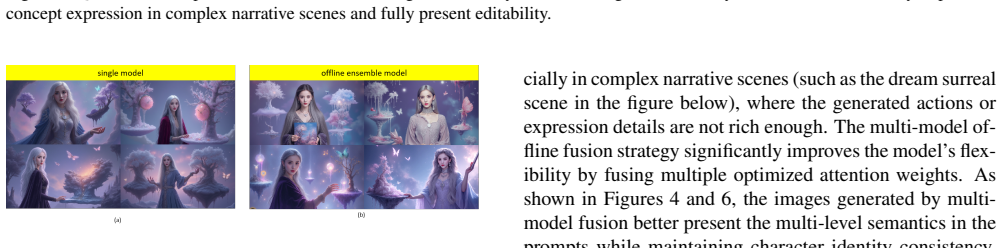
- Long-prompt narrative scenes, with actions, expressions, and environmental changes, become addressable by the same ID customization model instead of only simple single-subject prompts.
- A modest drop in face similarity, about 0.08 Facesim, is traded for large gains in pose diversity and landmark diversity, making the consistency-editability trade-off explicit and tunable.
- The offline fusion idea allows deployment to choose between consistency-biased and editability-biased weights per task without retraining.
- The paper states the framework can extend to other ID customization algorithms equipped with character feature branches.
Where Pith is reading between the lines
- The paper leaves implicit that data lubrication is about attribute diversity per identity rather than identity count; a direct extension would vary the number of identities versus images per identity to map where editability gains saturate.
- If the mechanism is as general as claimed, applying the same fine-tune-only-cross-attention recipe to other ID adapters with different face encoders or different DiT bases should produce similar editability gains; this is testable by measuring pose and landmark variance without the full IBench suite.
- The cosine-similarity ID loss in Eq. (9) is written between a spatial image latent and a compact face embedding; a reader should expect either a projection or a pooled latent to make the dot product well-defined, and the paper's silence on this point is the most likely implementation gap.
- The reported trade-off implies a predictable relationship: as the initial integration strength alpha_0 decreases, editability metrics should rise while Facesim falls; plotting that curve would give practitioners a direct calibration tool.
Editorial analysis
A structured set of objections, weighed in public.
Referee Report
Summary. The paper proposes EditIDv2, a method for identity-preserving text-to-image customization aimed at high-complexity narrative scenes and long prompts. It builds on the authors' prior EditID framework and the Flux/PuLID base model. The main ideas are: decomposing the PerceiverAttention cross-attention module, introducing an ID loss based on cosine similarity, jointly training the ID loss with the flow-matching diffusion loss, using a dynamic integration strength schedule, and merging multiple fine-tuned attention weight sets offline via a weighted fusion. Only about 3K labeled images are used to fine-tune the cross-attention weights. The paper claims state-of-the-art editability results on the IBench benchmark, particularly on pose, landmark, and expression diversity metrics.
Significance. If the central claims held, the contribution would be notable: a minimal-data, partial fine-tuning scheme that improves editability in long-prompt narrative scenes while preserving identity, and a modular decomposition of the ID integration process that could transfer to other ID customization systems. The paper also gives a clear practical emphasis on business-relevant scenarios. However, the technical foundation is undermined by an undefined ID loss, and the reported table does not support the claimed SOTA status. The benchmark and primary baseline come from the authors' own prior work, and no error bars or protocol details are given, so the empirical contribution is not currently established.
major comments (4)
- [§3.3, Eq. (9)] The ID loss is defined as a cosine similarity between x̂₀, the predicted clean latent of the Flux DiT (a spatial latent or token sequence), and e_ref, a compact face-recognition embedding from Antelopev2 (typically 512-d). These vectors live in different spaces; the dot product is dimensionally undefined unless a projection, pooling, or decode-and-re-encode operation is specified. No such operation appears in §3.3 or §4.2, although §4.2 refers to the 'cosine similarity between the generated image and the reference ID features.' This makes the joint training objective uncomputable as written and undermines the experimental foundation.
- [§5.2, Table 1] The abstract and introduction claim SOTA results in the editability indicators of IBench, but Table 1 does not support this. InfiniteYou (sim) reports higher Yaw (25.02 vs 18.17), Roll (12.30 vs 11.39), and Exprdiv (0.635 vs 0.611) than EditIDv2. Moreover, FID, Dino, and Fgis are missing for EditIDv2, so generation quality and structural fidelity cannot be compared; the text criticizes InfiniteYou's high FID but reports no FID for EditIDv2. The table therefore does not substantiate the central claim.
- [§5.1 and §3.4, Eq. (12)] The evaluation uses IBench, a benchmark proposed in the authors' own prior work EditID [11], and the primary baseline EditID is also their own. The offline fusion coefficients w_i in Eq. (12) are 'automatically adjusted based on validation set performance,' i.e., tuned to the target benchmark. No error bars, statistical significance tests, or cross-validation are provided. These factors make the SOTA claim fragile and difficult to verify independently.
- [§5.3] The ablations for the ID loss and offline fusion strategies are presented only with qualitative examples (Figs. 5 and 6) and no quantitative metric tables. Given that the paper's central claims concern the contribution of these components to editability, the absence of IBench metrics for the ablations prevents the reader from confirming which component is responsible for the reported improvements.
minor comments (4)
- [§3.2, Eq. (6)] The roles of query, key, and value in Eq. (6) are unusual: Q is computed from the ID features and K/V from the generation branch. In standard cross-attention, the query usually comes from the generation branch and keys/values from the conditioning branch. Please clarify the intended attention direction and how this relates to the PerceiverAttention design.
- [Abstract and §4.2] The paper repeatedly calls the approach 'tuning-free' while fine-tuning the cross-attention weights on about 3K images. This terminology is misleading; a term such as 'partial fine-tuning' or 'minimal tuning' would be more accurate.
- [Table 1] The dashes for FID, Dino, and Fgis for EditIDv2 are not explained. If these metrics were not computed, state so explicitly; if they were, report them. The same applies to the missing Dino/Fgis for InfiniteYou.
- [§4.1] The training-data section says data come from MyStyle and 'publicly crawled data from the internet,' with no details on licenses, filters, or preprocessing. For reproducibility, include a more precise description of the data collection and labeling pipeline.
Circularity Check
No derivational circularity; minor self-citation of IBench/EditID but central method independent.
full rationale
Walking the derivation chain, EditIDv2's core components (PerceiverAttention decomposition, ID loss, joint dynamic training, offline fusion) are presented as design choices with empirical evaluation, not derived from the quantities they claim to predict. The SOTA claim is evaluated on IBench, a benchmark proposed in the authors' own prior EditID paper, and EditID is also the primary baseline; this is a genuine self-citation that merits a minor flag. However, it is not load-bearing in a derivational sense: IBench metrics are computed from generated images and are externally reproducible, and comparisons include independent methods such as PuLID and InfiniteYou. The offline fusion coefficients in Eq. (12) are adjusted based on validation-set performance; absent evidence that the final IBench numbers come from the same split, this is a standard hyperparameter-selection concern rather than a demonstrated fitting-to-the-evaluation call. The unprojected cosine loss in Eq. (9) between a spatial latent and a face embedding is a serious correctness gap, but it is not circularity: it does not make the conclusion equivalent to the input. No equation reduces to another by construction, and no fitted parameter is renamed as a prediction. Thus score 2 reflects only the minor self-citation, not derivational circularity.
Axiom & Free-Parameter Ledger
free parameters (4)
- lambda (ID loss weight) =
0.5
- alpha_0 (initial integration strength) =
not reported
- beta(t) (ID guidance weight) =
not reported, cosine decay
- offline fusion coefficients w_i =
automatically adjusted on validation set
axioms (5)
- standard math Flow matching formulation of diffusion, and Flux as base model (Eqs. 1-5).
- domain assumption PerceiverAttention can be decomposed into independent Q/K/V paths and fine-tuned without damaging the base model (Section 3.2).
- domain assumption A small labeled dataset of ~3K images, mostly Asian faces from MyStyle and crawled data, is enough to generalize to arbitrary identities and narrative scenes (Section 4.1).
- domain assumption IBench is a valid and complete measure of editability for long-prompt ID customization (Section 5.1).
- ad hoc to paper The generated latent representation and reference ID embedding are in a common vector space for cosine similarity (Eq. (9)).
Cite this review
Pith. "Pith review of EditIDv2: Editable ID Customization with Data-Lubricated ID Feature Integration for Text-to-Image Generation." pith.science (2026). https://pith.science/paper/XBADBEGZ
@misc{pith2026250905659,
  author       = {Pith},
  title        = {Pith review of: EditIDv2: Editable ID Customization with Data-Lubricated ID Feature Integration for Text-to-Image Generation},
  year         = {2026},
  howpublished = {\url{https://pith.science/paper/XBADBEGZ}},
  note         = {Machine review of arXiv:2509.05659}
}
read the original abstract
We propose EditIDv2, a tuning-free solution specifically designed for high-complexity narrative scenes and long text inputs. Existing character editing methods perform well under simple prompts, but often suffer from degraded editing capabilities, semantic understanding biases, and identity consistency breakdowns when faced with long text narratives containing multiple semantic layers, temporal logic, and complex contextual relationships. In EditID, we analyzed the impact of the ID integration module on editability. In EditIDv2, we further explore and address the influence of the ID feature integration module. The core of EditIDv2 is to discuss the issue of editability injection under minimal data lubrication. Through a sophisticated decomposition of PerceiverAttention, the introduction of ID loss and joint dynamic training with the diffusion model, as well as an offline fusion strategy for the integration module, we achieve deep, multi-level semantic editing while maintaining identity consistency in complex narrative environments using only a small amount of data lubrication. This meets the demands of long prompts and high-quality image generation, and achieves excellent results in the IBench evaluation.
Figures



Forward citations
Cited by 2 Pith papers
-
LayerCache: Exploiting Layer-wise Velocity Heterogeneity for Efficient Flow Matching Inference
LayerCache enables per-layer-group caching in flow matching models via adaptive JVP span selection and greedy 3D scheduling, delivering 1.37x speedup with PSNR 37.46 dB, SSIM 0.9834, and LPIPS 0.0178 on Qwen-Image.
-
PhysEdit: Physically-Consistent Region-Aware Image Editing via Adaptive Spatio-Temporal Reasoning
PhysEdit introduces adaptive reasoning depth and spatial masking to make image editing faster and more instruction-aligned without retraining the base model.
Reference graph
Works this paper leans on
-
[1]
Uno: Unsupervised occupancy fields for perception and forecasting
Ben Agro, Quinlan Sykora, Sergio Casas, Thomas Gilles, and Raquel Urtasun. Uno: Unsupervised occupancy fields for perception and forecasting. InProceedings of the IEEE/CVF Conference on Computer Vision and Pattern Recognition, pages 14487–14496, 2024. 3
work page 2024
-
[2]
Stephen Batifol, Andreas Blattmann, Frederic Boesel, Sak- sham Consul, Cyril Diagne, Tim Dockhorn, Jack English, Zion English, Patrick Esser, Sumith Kulal, et al. Flux. 1 kontext: Flow matching for in-context image generation and editing in latent space.arXiv e-prints, pages arXiv–2506,
-
[3]
Bowen Chen, Mengyi Zhao, Haomiao Sun, Li Chen, Xu Wang, Kang Du, and Xinglong Wu. Xverse: Consistent multi-subject control of identity and semantic attributes via dit modulation.arXiv preprint arXiv:2506.21416, 2025. 3
Pith/arXiv arXiv 2025
-
[4]
Unireal: Universal image generation and editing via learning real-world dynamics
Xi Chen, Zhifei Zhang, He Zhang, Yuqian Zhou, Soo Ye Kim, Qing Liu, Yijun Li, Jianming Zhang, Nanxuan Zhao, Yilin Wang, et al. Unireal: Universal image generation and editing via learning real-world dynamics. InProceedings of the Computer Vision and Pattern Recognition Conference, pages 12501–12511, 2025. 2
2025
-
[5]
Arcface: Additive angular margin loss for deep face recognition
Jiankang Deng, Jia Guo, Niannan Xue, and Stefanos Zafeiriou. Arcface: Additive angular margin loss for deep face recognition. InProceedings of the IEEE/CVF con- ference on computer vision and pattern recognition, pages 4690–4699, 2019. 6
2019
-
[6]
Scaling recti- fied flow transformers for high-resolution image synthesis
Patrick Esser, Sumith Kulal, Andreas Blattmann, Rahim Entezari, Jonas M ¨uller, Harry Saini, Yam Levi, Dominik Lorenz, Axel Sauer, Frederic Boesel, et al. Scaling recti- fied flow transformers for high-resolution image synthesis. InForty-first international conference on machine learning,
-
[7]
Rinon Gal, Yuval Alaluf, Yuval Atzmon, Or Patash- nik, Amit H Bermano, Gal Chechik, and Daniel Cohen- Or. An image is worth one word: Personalizing text-to- image generation using textual inversion.arXiv preprint arXiv:2208.01618, 2022. 2
Pith/arXiv arXiv 2022
-
[8]
Zinan Guo, Yanze Wu, Chen Zhuowei, Peng Zhang, Qian He, et al. Pulid: Pure and lightning id customization via contrastive alignment.Advances in neural information pro- cessing systems, 37:36777–36804, 2024. 2, 3
work page 2024
-
[9]
Liming Jiang, Qing Yan, Yumin Jia, Zichuan Liu, Hao Kang, and Xin Lu. Infiniteyou: Flexible photo recrafting while preserving your identity.arXiv preprint arXiv:2503.16418,
-
[10]
Multi-concept customization of text-to-image diffusion
Nupur Kumari, Bingliang Zhang, Richard Zhang, Eli Shechtman, and Jun-Yan Zhu. Multi-concept customization of text-to-image diffusion. InProceedings of the IEEE/CVF conference on computer vision and pattern recognition, pages 1931–1941, 2023. 2
1931
-
[11]
Guandong Li and Zhaobin Chu. Editid: Training-free ed- itable id customization for text-to-image generation.arXiv preprint arXiv:2503.12526, 2025. 2, 3
Pith/arXiv arXiv 2025
-
[12]
Flow matching for generative mod- eling.arXiv preprint arXiv:2210.02747, 2022
Yaron Lipman, Ricky TQ Chen, Heli Ben-Hamu, Maximil- ian Nickel, and Matt Le. Flow matching for generative mod- eling.arXiv preprint arXiv:2210.02747, 2022. 3
Pith/arXiv arXiv 2022
-
[13]
FaceChain: A Playground for Human-centric Artificial Intelligence Generated Content
Yang Liu, Cheng Yu, Lei Shang, Yongyi He, Ziheng Wu, Xingjun Wang, Chao Xu, Haoyu Xie, Weida Wang, Yuze Zhao, et al. Facechain: A playground for human-centric artificial intelligence generated content.arXiv preprint arXiv:2308.14256, 2023. 2
work page internal anchor Pith review Pith/arXiv arXiv 2023
-
[14]
Dreamo: A unified framework for image customization.arXiv preprint arXiv:2504.16915,
Chong Mou, Yanze Wu, Wenxu Wu, Zinan Guo, Pengze Zhang, Yufeng Cheng, Yiming Luo, Fei Ding, Shiwen Zhang, Xinghui Li, et al. Dreamo: A unified framework for image customization.arXiv preprint arXiv:2504.16915,
-
[15]
Mystyle: A personalized generative prior
Yotam Nitzan, Kfir Aberman, Qiurui He, Orly Liba, Michal Yarom, Yossi Gandelsman, Inbar Mosseri, Yael Pritch, and Daniel Cohen-Or. Mystyle: A personalized generative prior. ACM Transactions on Graphics (TOG), 41(6):1–10, 2022. 6
work page 2022
-
[16]
Scalable diffusion models with transformers
William Peebles and Saining Xie. Scalable diffusion models with transformers. InProceedings of the IEEE/CVF inter- national conference on computer vision, pages 4195–4205,
-
[17]
Portraitbooth: A versatile portrait model for fast identity-preserved personalization
Xu Peng, Junwei Zhu, Boyuan Jiang, Ying Tai, Donghao Luo, Jiangning Zhang, Wei Lin, Taisong Jin, Chengjie Wang, and Rongrong Ji. Portraitbooth: A versatile portrait model for fast identity-preserved personalization. InProceedings of the IEEE/CVF Conference on Computer Vision and Pattern Recognition, pages 27080–27090, 2024. 3
work page 2024
-
[18]
Dustin Podell, Zion English, Kyle Lacey, Andreas Blattmann, Tim Dockhorn, Jonas M ¨uller, Joe Penna, and Robin Rombach. Sdxl: Improving latent diffusion mod- els for high-resolution image synthesis.arXiv preprint arXiv:2307.01952, 2023. 6
Pith/arXiv arXiv 2023
-
[19]
Dreambooth: Fine tuning text-to-image diffusion models for subject-driven generation
Nataniel Ruiz, Yuanzhen Li, Varun Jampani, Yael Pritch, Michael Rubinstein, and Kfir Aberman. Dreambooth: Fine tuning text-to-image diffusion models for subject-driven generation. InProceedings of the IEEE/CVF conference on computer vision and pattern recognition, pages 22500– 22510, 2023. 2
2023
-
[20]
Eva-clip: Improved training techniques for clip at scale
Quan Sun, Yuxin Fang, Ledell Wu, Xinlong Wang, and Yue Cao. Eva-clip: Improved training techniques for clip at scale. arXiv preprint arXiv:2303.15389, 2023. 6
Pith/arXiv arXiv 2023
-
[21]
Zhenxiong Tan, Songhua Liu, Xingyi Yang, Qiaochu Xue, and Xinchao Wang. Ominicontrol: Minimal and uni- versal control for diffusion transformer.arXiv preprint arXiv:2411.15098, 2024. 2
Pith/arXiv arXiv 2024
-
[22]
Yoad Tewel, Omri Kaduri, Rinon Gal, Yoni Kasten, Lior Wolf, Gal Chechik, and Yuval Atzmon. Training-free consis- tent text-to-image generation.ACM Transactions on Graph- ics (TOG), 43(4):1–18, 2024. 2
work page 2024
-
[23]
Shaojin Wu, Mengqi Huang, Yufeng Cheng, Wenxu Wu, Ji- ahe Tian, Yiming Luo, Fei Ding, and Qian He. Uso: Unified style and subject-driven generation via disentangled and re- ward learning.arXiv preprint arXiv:2508.18966, 2025. 2
Pith/arXiv arXiv 2025
-
[24]
Shaojin Wu, Mengqi Huang, Wenxu Wu, Yufeng Cheng, Fei Ding, and Qian He. Less-to-more generalization: Unlocking more controllability by in-context generation.arXiv preprint arXiv:2504.02160, 2025. 2
Pith/arXiv arXiv 2025
-
[25]
Fastcomposer: Tuning-free multi- subject image generation with localized attention.Interna- tional Journal of Computer Vision, 133(3):1175–1194, 2025
Guangxuan Xiao, Tianwei Yin, William T Freeman, Fr ´edo Durand, and Song Han. Fastcomposer: Tuning-free multi- subject image generation with localized attention.Interna- tional Journal of Computer Vision, 133(3):1175–1194, 2025. 2
2025
-
[26]
Hu Ye, Jun Zhang, Sibo Liu, Xiao Han, and Wei Yang. Ip- adapter: Text compatible image prompt adapter for text-to- image diffusion models.arXiv preprint arXiv:2308.06721,
This paper was first reviewed by deepseek-v4-flash on August 5, 2026.
discussion (0)
Sign in with ORCID, Apple, or X to comment. Anyone can read and Pith papers without signing in.