Three faces of random walks in hyperbolic domain: BKT, Lifshitz tails, and KPZ
Pith reviewed 2026-05-25 07:52 UTC · model grok-4.3
The pith
Diffusion in the hyperbolic plane unifies the BKT transition, KPZ fluctuations, and Lifshitz tails.
A machine-rendered reading of the paper's core claim, the machinery that carries it, and where it could break.
Core claim
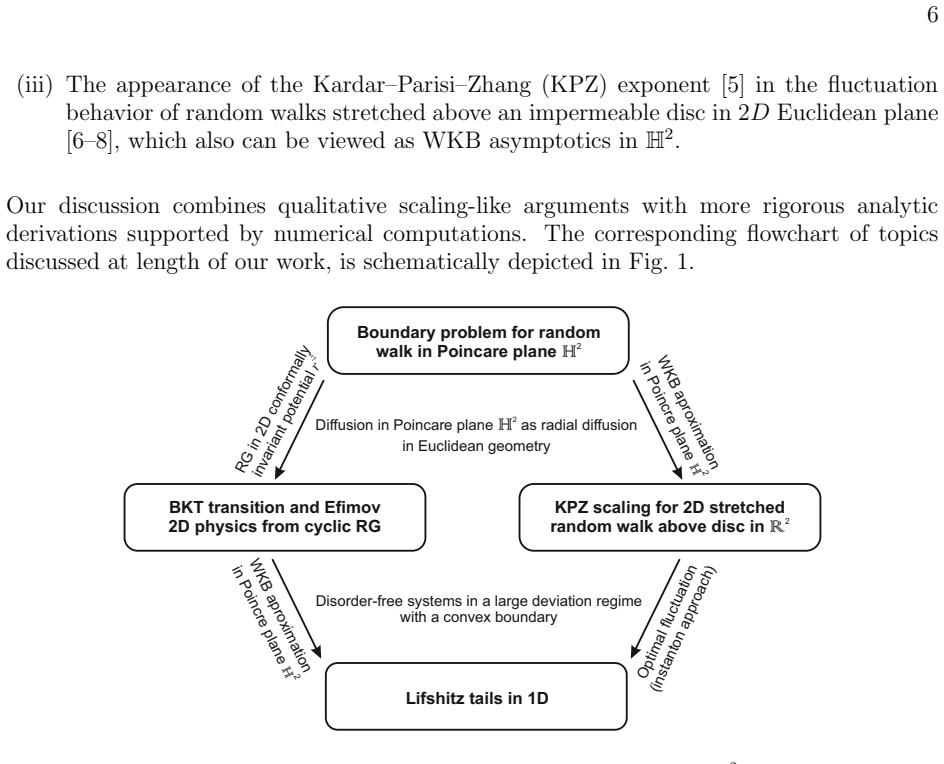
Continuous random walks in H² = {(x,y) | y > 0} simultaneously encode the non-analytic divergence of the correlation length at the BKT transition, the KPZ exponent in the survival probability of stretched walks near the boundary, and the Lifshitz tails that appear in the deterministic large-deviation statistics of paths; the same adapted RG equations that capture the BKT singularity also allow WKB and numerical extraction of the KPZ scaling and instanton derivation of the Lifshitz tails.
What carries the argument
Continuous diffusion (random walks) in the Poincaré hyperbolic upper half-plane H², with the adapted renormalization-group flow from the Efimov problem supplying the BKT divergence and scaling arguments plus instantons supplying the KPZ and Lifshitz behaviors.
If this is right
- The BKT correlation length diverges as exp(c / sqrt(T - Tc)) when the RG flow for diffusion in H² is solved.
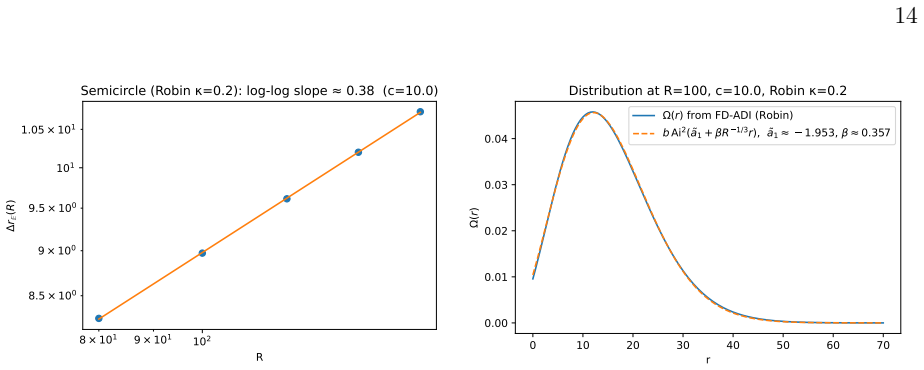
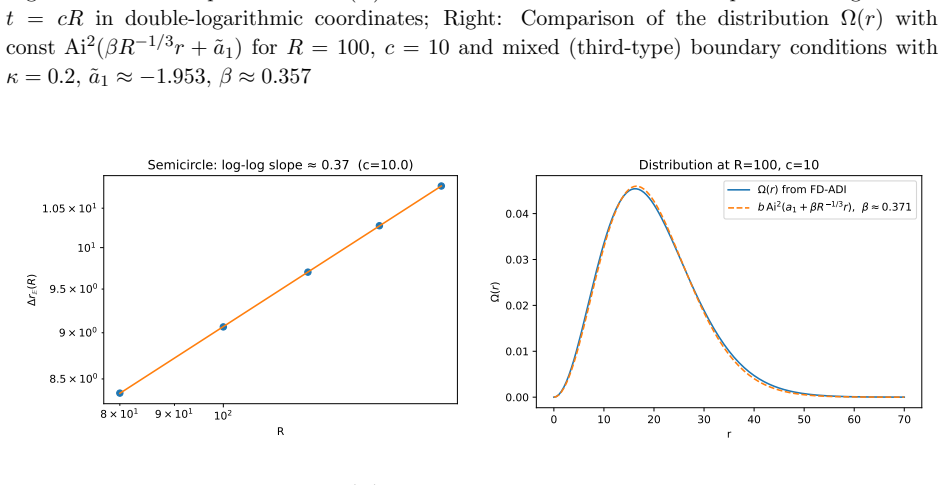
- The survival probability of walks constrained above the boundary of H² decays with the KPZ roughness exponent 1/3 in the stretched regime.
- The probability of rare large-deviation paths in H² develops Lifshitz tails whose functional form matches the 1D Poisson-trap problem.
- BKT-like physics is conjectured to be carried by the subset of trajectories that reach the large-deviation stretched regime.
Where Pith is reading between the lines
- The unification suggests that hyperbolic geometry may underlie other BKT–KPZ crossovers in planar systems without explicit curvature.
- The instanton treatment of Lifshitz tails could be tested by measuring the tail of the distribution of maximal heights of random walks on a disc.
- If the conjecture holds, finite-size scaling near the BKT point should show a crossover from ordinary diffusive to stretched-path dominance at a length scale set by the hyperbolic metric.
Load-bearing premise
The renormalization-group equations developed for the Efimov effect in a 2D conformally invariant potential can be transplanted to diffusion in H² without modifications that would change the form of the BKT divergence.
What would settle it
Direct numerical integration of the diffusion equation or Monte Carlo sampling of walks in H² that either reproduces or fails to reproduce the essential singularity in the correlation length predicted by the adapted RG flow.
Figures
read the original abstract
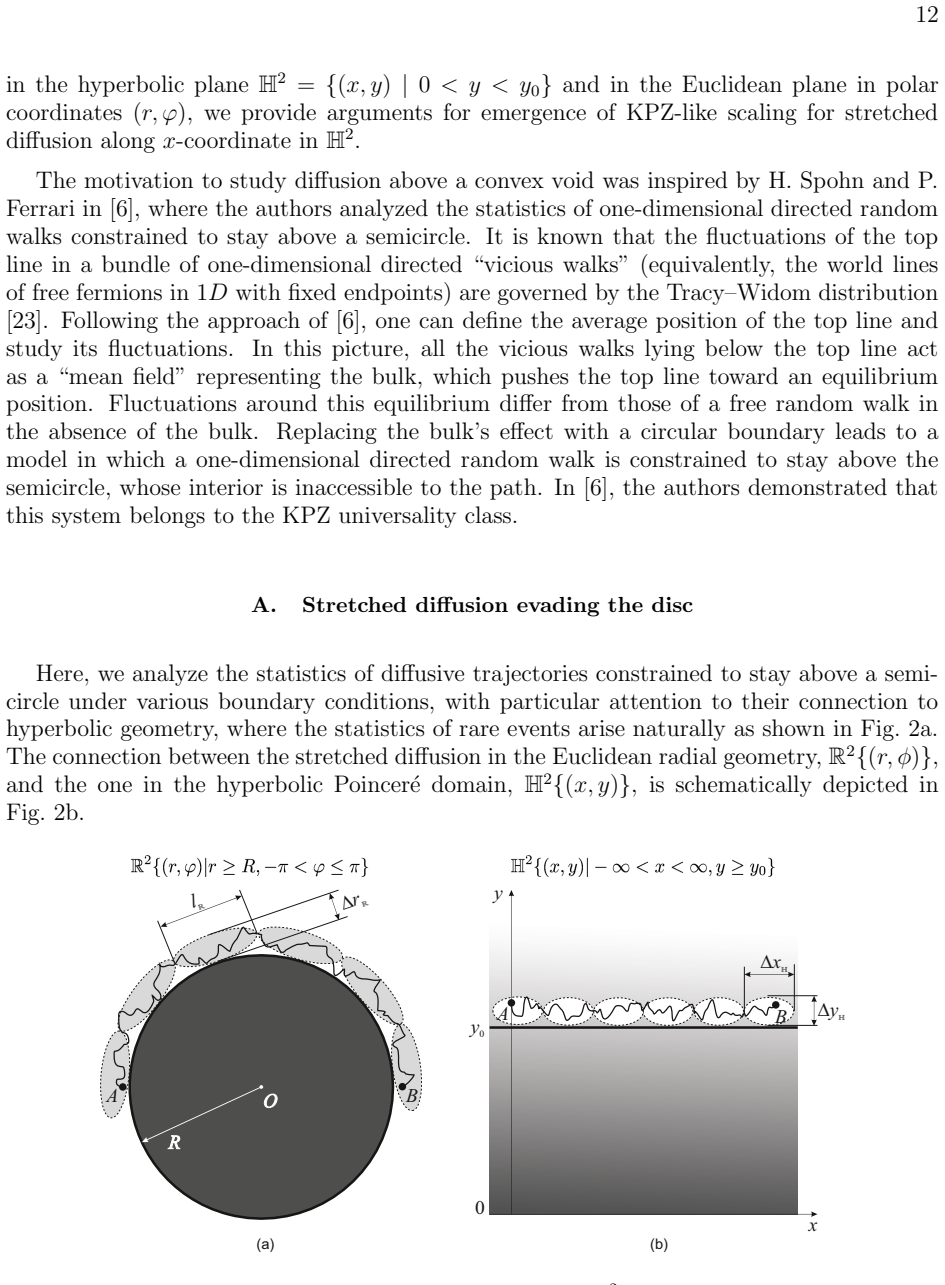
We show that continuous random walks (diffusion) in the Poincar\'{e} hyperbolic upper halfplane $\mathbb{H}^2 = \{(x,y)|y>0\}$ provide a unifying description of three seemingly unrelated phenomena: (i) the non-analytic divergence of the correlation length at the Berezinskii--Kosterlitz--Thouless (BKT) transition; (ii) the appearance of the Kardar--Parisi--Zhang (KPZ) exponent in the fluctuational behavior of stretched random walks constrained above an impermeable disc; and (iii) the emergence of Lifshitz tails (LT) in 1D statistics of rare events. We adapt the renormalization-group equations originally developed for the Efimov effect in a 2D conformally invariant potential to the case of diffusion in $\mathbb{H}^2$, thereby reproducing the BKT--type divergence of the correlation length. In frameworks of the same model we derive the KPZ--type behavior for the survival probability of stretched random walks near the boundary of $\mathbb{H}^2$ using scaling arguments, WKB--type approach, and numerical analysis. We demonstrate that LT emerge naturally in a deterministic large-deviation random walks' statistics in $\mathbb{H}^2$ via instanton approach, which rhymes with the rare-event behavior of 1D diffusion in the array of traps with the Poisson distribution. We conjecture that the dominant contribution to the statistics of paths responsible for BKT--like physics emerges from trajectories pushed to large-deviation stretched regime.
Editorial analysis
A structured set of objections, weighed in public.
Referee Report
Summary. The manuscript claims that continuous random walks (diffusion) in the Poincaré hyperbolic upper half-plane H² unify three phenomena: (i) the non-analytic divergence of the correlation length at the BKT transition, obtained by adapting Efimov RG equations to diffusion in H²; (ii) KPZ-type behavior in the survival probability of stretched random walks near the boundary, derived via scaling arguments, WKB approach, and numerical analysis; and (iii) Lifshitz tails in 1D rare-event statistics, obtained via an instanton approach in deterministic large-deviation statistics. A conjecture is made that BKT-like physics is dominated by trajectories in the large-deviation stretched regime.
Significance. If the RG adaptation is shown to be faithful, the work would provide a geometric unification of BKT, KPZ, and Lifshitz-tail phenomena through hyperbolic diffusion, with the multi-method approach (RG, scaling/WKB/numerics, instantons) offering cross-checks where derivations are explicit.
major comments (1)
- [Abstract (RG adaptation paragraph)] Abstract (RG adaptation paragraph): The central claim for the BKT divergence rests on directly adapting the Efimov RG equations to diffusion in H² without additional terms from the hyperbolic Laplacian or Poincaré metric altering the beta functions. Explicit verification that the mapping is term-by-term faithful (i.e., no geometry-induced corrections appear at the same order in the scaling regime) is required; without it, reproduction of the essential singularity remains unverified and the unification for (i) is not load-bearing.
Simulated Author's Rebuttal
We thank the referee for the constructive report and the identification of a point requiring clarification in our treatment of the BKT divergence. We address the single major comment below and will revise the manuscript to strengthen the presentation.
read point-by-point responses
-
Referee: The central claim for the BKT divergence rests on directly adapting the Efimov RG equations to diffusion in H² without additional terms from the hyperbolic Laplacian or Poincaré metric altering the beta functions. Explicit verification that the mapping is term-by-term faithful (i.e., no geometry-induced corrections appear at the same order in the scaling regime) is required; without it, reproduction of the essential singularity remains unverified and the unification for (i) is not load-bearing.
Authors: We agree that the manuscript states the adaptation of the Efimov RG equations but does not supply an explicit term-by-term derivation showing that the hyperbolic Laplacian and Poincaré metric introduce no corrections to the beta functions at the scaling order of interest. The adaptation is motivated by the conformal equivalence of the Poincaré metric to the flat metric together with the form of the diffusion operator, which we expect to preserve the relevant RG structure. Nevertheless, the referee is correct that this expectation must be verified explicitly. In the revised version we will add a dedicated appendix that starts from the diffusion equation on H², performs the change of variables to the Efimov variables, and demonstrates that geometry-induced terms either vanish or appear only at higher order in the scaling regime, thereby confirming reproduction of the essential singularity. revision: yes
Circularity Check
No significant circularity; derivations rely on external RG adaptation and independent scaling/WKB/numerical/instanton methods within the model.
full rationale
The paper adapts RG equations from the Efimov effect (external prior work) to reproduce BKT divergence in H² diffusion, then derives KPZ behavior via scaling arguments, WKB, and numerics, and Lifshitz tails via instanton approach. The final conjecture on trajectory dominance is explicitly labeled as such and does not serve as a load-bearing derivation step. No self-definitional loops, fitted inputs renamed as predictions, self-citation load-bearing premises, uniqueness theorems, or smuggled ansatzes appear in the provided text. The model is self-contained against the cited external benchmarks and internal calculations.
Axiom & Free-Parameter Ledger
axioms (1)
- domain assumption Diffusion in the Poincaré upper half-plane obeys the same conformal properties used in the Efimov RG flow.
Lean theorems connected to this paper
-
IndisputableMonolith/Foundation/AlexanderDuality.leanalexander_duality_circle_linking unclear?
unclearRelation between the paper passage and the cited Recognition theorem.
We adapt the renormalization-group equations originally developed for the Efimov effect in a 2D conformally invariant potential to the case of diffusion in H², thereby reproducing the BKT-type divergence of the correlation length.
-
IndisputableMonolith/Cost/FunctionalEquation.leanwashburn_uniqueness_aczel unclear?
unclearRelation between the paper passage and the cited Recognition theorem.
the BKT essential singularity... Δ∼exp(−2π/τ), τ=√(σ−1/4)
What do these tags mean?
- matches
- The paper's claim is directly supported by a theorem in the formal canon.
- supports
- The theorem supports part of the paper's argument, but the paper may add assumptions or extra steps.
- extends
- The paper goes beyond the formal theorem; the theorem is a base layer rather than the whole result.
- uses
- The paper appears to rely on the theorem as machinery.
- contradicts
- The paper's claim conflicts with a theorem or certificate in the canon.
- unclear
- Pith found a possible connection, but the passage is too broad, indirect, or ambiguous to say the theorem truly supports the claim.
Reference graph
Works this paper leans on
-
[1]
Note that the naive scaling consideration (18) based on the estimation of characteristic decay of the distribution function inH 2 is fully consistent with the RG approach. The associated energy gap scale, ∆, can be estimated as ∆∼Λ −2 ∼e −2π/ r σ− 1 4 (31) In next Section we provide arguments supporting the point of view that ∆ has a meaning of the Lifshi...
-
[2]
Following this procedure, one can straightforwardly compute the function Θ(r;R, c, t) using (43) and then evaluate ∆r E(R) for two different boundary conditions: (i) mixed,∂ rP(r)| r=R +κP(R) = 0, and (ii) Dirichlet,P(R) = 0. The corresponding results for ∆r E(R) and the radial conditional distribution of the middle point of the Brownian bridge, Ω(r;R, c,...
work page 1944
-
[3]
S. K. Nechaev and Y. G. Sinai, Limiting-type theorem for conditional distributions of products of independent unimodular 2×2 matrices, Bol. Soc. Brasil. Mat. (N.S.)21, 121 (1991)
work page 1991
-
[4]
P. Bougerol and T. Jeulin, Brownian bridge on hyperbolic spaces and on homogeneous trees, Probability Theory and Related Fields115, 95 (1999)
work page 1999
-
[5]
J. Kosterlitz, Kosterlitz–thouless physics: a review of key issues, Reports on Progress in Physics79, 026001 (2016)
work page 2016
-
[6]
I. M. Lifshitz, The theory of fluctuation levels in disordered systems, Soviet Physics JETP 26, 462 (1968), translated from Zh. Eksp. Teor. Fiz. 53, 743 (1967)
work page 1968
-
[7]
T. Halpin-Healy and Y. Zhang, Kinetic roughening phenomena, stochastic growth, directed polymers and all that: Aspects of multidisciplinary statistical mechanics, Physics Reports 254, 215 (1995)
work page 1995
-
[8]
P. Ferrari and H. Spohn, Constrained brownian motion: Fluctuations away from circular and parabolic barriers, Annals of Probability33, 1302 (2005)
work page 2005
-
[9]
S. Nechaev, K. Polovnikov, S. Shlosman, A. Valov, and A. Vladimirov, Anomalous one-dimensional fluctuations of a simple two-dimensional random walk in a large-deviation regime, Physical Review E99, 012110 (2019)
work page 2019
-
[10]
D. Fedotov and S. Nechaev, Non-algebraic first return probability of a stretched random walk near a convex boundary and its effect on adsorption (2025), arXiv:2506.17829 [cond-mat.stat- mech]
-
[11]
D. B. Kaplan, J.-W. Lee, D. T. Son, and M. A. Stephanov, Conformality lost, Physical Review D80, 125005 (2009)
work page 2009
-
[12]
K. M. Bulycheva and A. S. Gorsky, Limit cycles in renormalization group dynamics, Physics- Uspekhi57, 171 (2014)
work page 2014
-
[13]
O. Ovdat and E. Akkermans, The breaking of continuous scale invariance to discrete scale invariance: a universal quantum phase transition, inFractal Geometry and Stochastics VI, Progress in Probability, Vol. 76, edited by U. Freiberg, B. Hambly, M. Hinz, and S. Winter (Birkh¨ auser Cham, 2021) pp. 209–238
work page 2021
- [14]
- [15]
-
[16]
I. M. Lifshitz, S. A. Gredeskul, and L. A. Pastur,Introduction to the Theory of Disordered Systems(Wiley, New York, 1988)
work page 1988
-
[17]
J. Luck and T. Nieuwenhuizen, Lifshitz tails and long-time decay in random systems with arbitrary disorder, Journal of Statistical Physics52, 1 (1988)
work page 1988
-
[18]
A.Gorsky, S.Nechaev, and A.Valov, Lifshitz tails at spectral edge and holography with a finite cutoff, Journal of High Energy Physics2021, 80 (2021)
work page 2021
-
[19]
B. Balagurov and V. Vaks, Random walks of a particle on lattices with traps, Soviet Physics JETP38, 968 (1974)
work page 1974
-
[20]
M. D. Donsker and S. R. S. Varadhan, Large deviations for stationary gaussian processes, Communications in Mathematical Physics97, 187 (1985). 20
work page 1985
-
[21]
K. E. Polovnikov, S. K. Nechaev, and A. Y. Grosberg, Stretching of a fractal polymer around a disc reveals kardar–parisi–zhang scaling, Physical Review Letters129, 097801 (2022)
work page 2022
-
[22]
J. Ma, Z. Ren, N. Touzi, and J. Zhang, Large deviations for non-markovian diffusions and a path-dependent eikonal equation, Annales de l’Institut Henri Poincar´ e (B) Probability and Statistics52, 1196 (2016), arXiv:1407.5314 [math.PR]
work page internal anchor Pith review Pith/arXiv arXiv 2016
-
[23]
C. M. Bender and S. A. Orszag,Advanced Mathematical Methods for Scientists and Engineers I: Asymptotic Methods and Perturbation Theory, 1st ed. (McGraw-Hill, New York, 1978)
work page 1978
-
[24]
T. M. Nieuwenhuizen, Trapping and lifshitz tails in random media, self-attracting polymers, and the number of distinct sites visited: A renormalized instanton approach in three dimen- sions, Physical Review Letters62, 357 (1989)
work page 1989
-
[25]
C. A. Tracy and H. Widom, Level spacing distributions and the airy kernel, Communications in Mathematical Physics159, 151 (1994)
work page 1994
-
[26]
D. W. Peaceman and J. Henry H. Rachford, The numerical solution of parabolic and elliptic differential equations, Journal of the Society for industrial and Applied Mathematics3.1, 28 (1955)
work page 1955
discussion (0)
Sign in with ORCID, Apple, or X to comment. Anyone can read and Pith papers without signing in.