REVIEW 4 major objections 5 minor 29 references
Camera Pose Correction in SLAM Based on Bias Values of Map Points
T0 review · 4 major / 5 minor · reviewed 2026-08-14 · deepseek-v4-flash
Pith's one-line read This paper derives a linear map-point bias correction that cuts average SLAM trajectory error roughly from 0.13 m to 0.09 m.
desk verdict A sensible correction heuristic with a promising empirical result, but the central pose-bias derivation does not hold as written and the bias mapping is unspecified. read the letter →
The pith
A machine-rendered reading of the paper's core claim, the machinery that carries it, and where it could break.
The reading
What carries the argument
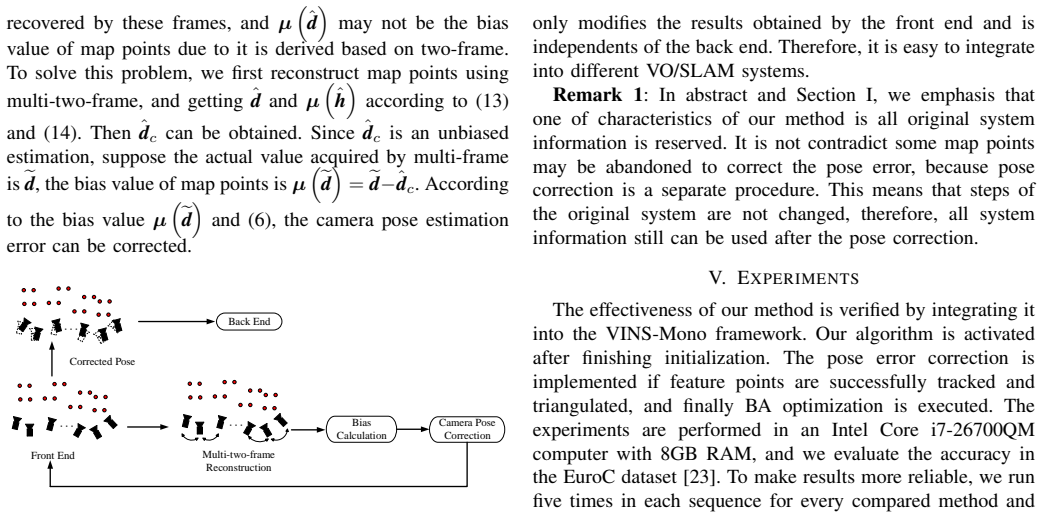
The load-bearing object is the first-order identity $E[\epsilon_x] = -H_x^+ H_p \mathbf{1} \mu_p$, which turns a statistical property of map points into a deterministic pose correction. The bias values themselves come from a two-frame inverse-depth estimator whose expected error is expressed in closed form, averaged over multiple two-frame reconstructions to reduce depth noise; those averaged values are then treated as the map-point bias in the identity. A heuristic filter removes points whose estimated bias is too large, with thresholds chosen according to camera angular velocity, so that mismatched or badly reconstructed points do not destabilize the correction.
What would settle it
Take a sequence with ground-truth trajectory, run the SLAM system repeatedly with the same images and with synthetic bias injected into the reconstructed map points, and compare the observed pose error against the value predicted by $E[\epsilon_x] = -H_x^+ H_p \mathbf{1} \mu_p$; if the measured error does not track the predicted correction, the identity fails. A simpler version is to flip the sign of the correction: if the claimed relation is correct, subtracting the bias should improve the trajectory and adding it should degrade it, and a reader could check this on any of the ten benchmark sequences.
Extended reading notes
Core claim
The central claim is that the expected pose error in an optimization-based visual SLAM system is determined by the bias of map points through $E[\epsilon_x] = -H_x^+ H_p \mathbf{1} \mu_p$, where $\epsilon_x$ is the pose error, $H_x$ and $H_p$ are the Jacobians of the projection model with respect to pose and point coordinates, $\mathbf{1}$ is the matrix that sums contributions from all observed points, and $\mu_p$ is the map-point bias vector. If the bias can be measured, this identity gives a pose correction that can be applied before the normal bundle adjustment, leaving the rest of the system unchanged. The paper argues that the bias of a map point can be estimated by averaging the inverse-depth bias of several two-frame reconstructions, and that correcting poses this way outperforms both the uncorrected system and a feature-selection strategy, especially when the system is subject to IMU noise.
Load-bearing premise
The argument assumes that the linear relation obtained from a one-step Gauss-Newton update with a pseudo-inverse Jacobian holds for the actual multi-frame nonlinear bundle adjustment in the SLAM system; if the real optimizer does not obey that linear relation, subtracting the computed bias will not reduce pose error.
Editorial extensions
If this is right
- Any SLAM front-end that already optimizes a pose-and-point objective can add the correction between tracking and bundle adjustment, because the method only rewrites the pose estimate, not the optimization structure.
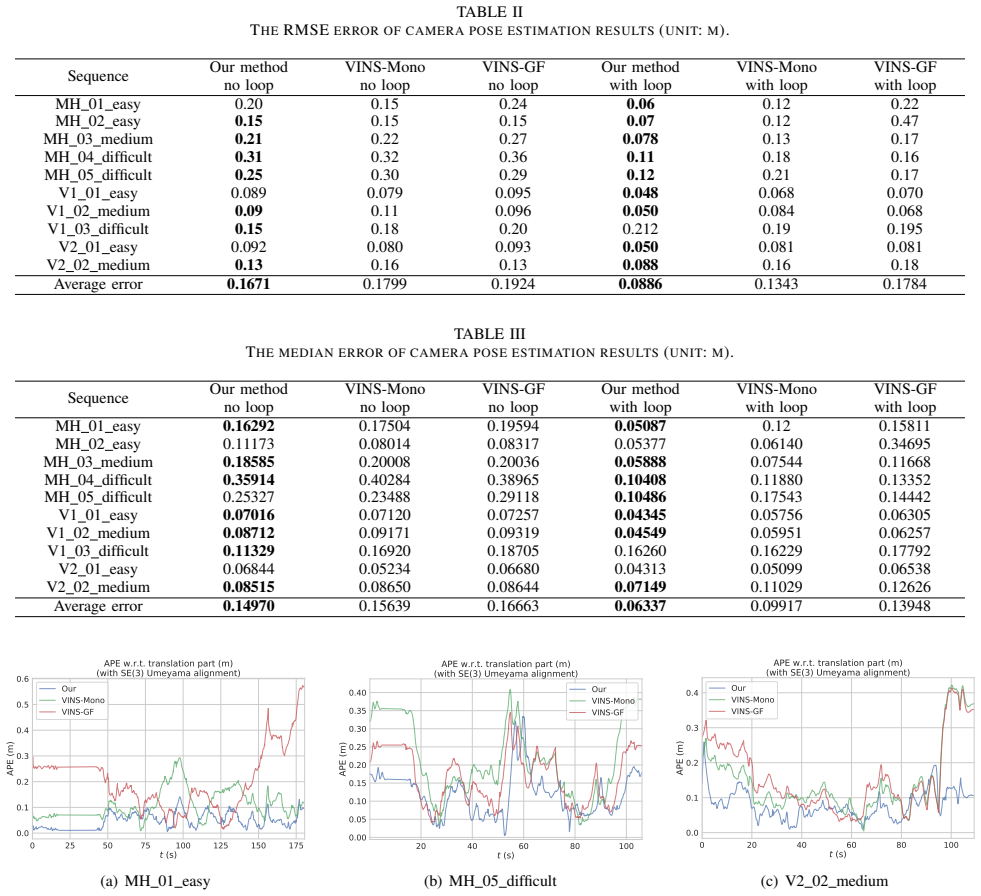
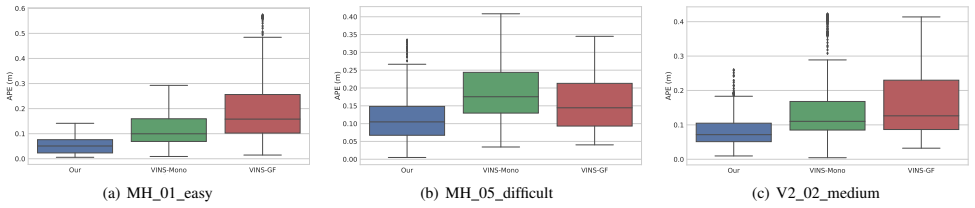
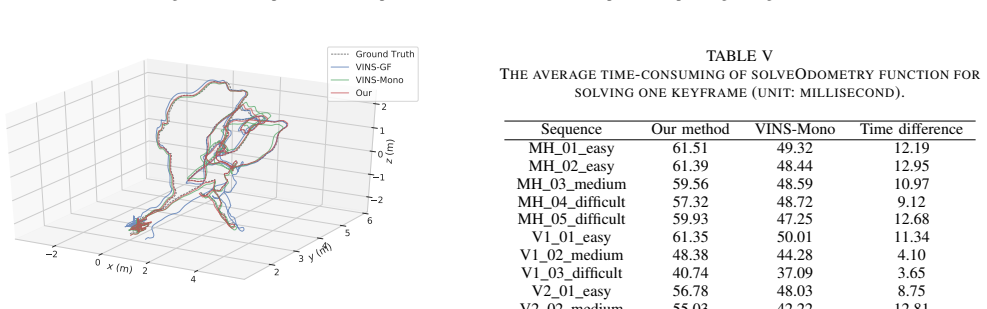
- The reported average error with loop closure falls from about 0.13 m to 0.09 m across ten sequences, with individual sequences showing larger gains (for example, from 0.12 m to 0.06 m).
- Because the correction uses all tracked map points rather than a selected subset, it should remain stable when IMU noise or sparse features hurt feature-selection methods.
- The added computation is roughly 10 ms per keyframe, concentrated in the bias calculation, so real-time use depends on the number of map points and the frame rate.
Reading between the lines
- One direction the paper does not explore is applying the same bias estimate to correct the map points themselves; if the inverse-depth bias is meaningful, updating the point coordinates as well as the pose might yield further gains.
- The same recipe, derive a first-order sensitivity of the output to latent-variable bias, estimate that bias independently, and subtract, could be transferred to other latent quantities such as IMU bias or scale, not just camera pose.
- A testable extension would replace the hand-set bias thresholds with an adaptive noise model learned from the residual distribution, which could make the correction work without sequence-specific tuning.
Signed reviews
Editorial analysis
A structured set of objections, weighed in public.
Referee Report
Summary. This paper proposes a post-processing pose-correction method for visual SLAM. The authors derive a linear relation between camera pose estimation error and the bias of map points from a Gauss-Newton update (Eq. (5)-(6)), compute a map-point bias from two-frame inverse-depth estimation using a statistical error-propagation expression from [29] (Eq. (12)-(14)), and use an anomaly threshold to discard large-bias points before compensating the front-end pose in VINS-Mono. Experiments on ten EuRoC sequences compare the modified VINS-Mono with the original system, a feature-selection variant, and several VIO algorithms, reporting improved RMSE and median APE at an average added cost of about 9.8 ms per keyframe.
Significance. If the derivation were correct, the method would be a compact, back-end-agnostic way to reduce pose drift in existing VIO/SLAM systems, and the experiments would support the claimed practical benefit. The paper has several strengths: it integrates the proposed step into a widely used open-source system, evaluates over ten benchmark sequences, compares against multiple VIO baselines, and reports the computational overhead explicitly. However, the central mathematical relation is not established for the actual joint nonlinear optimization performed by VINS-Mono, the quantity computed in Section IV.A is not connected to the quantity required by Eq. (6), and the evaluation is confounded by thresholds set on the test data. These issues affect the main claim, so the results do not currently support the conclusions.
major comments (4)
- [Section III, Eq. (4)-(7)] The derivation of the central pose-bias relation is not valid as written. Eq. (4) is a single pose-only Gauss-Newton step in which all map points are held fixed, whereas VINS-Mono solves a joint nonlinear sliding-window optimization over pose and inverse-depth states; the pose increment under a point bias is governed by the Schur complement S = H_xx - H_xp H_pp^{-1} H_px, not by -H_x^+ H_p. Eq. (5) describes one update step, not the bias of the converged estimate, and the paper does not show that iterating Eq. (4) accumulates to Eq. (6). Moreover, the 3n x 3n matrix 1 in Eq. (7) is not justified: H_p mu_p already accounts for the point residuals through the matrix product, and summing the x,y,z components of each 3D bias vector is dimensionally meaningless. This invalidates the correction formula that all experiments rely on.
- [Section IV.A, Eq. (12)-(14)] The computed bias is for the scalar inverse depth d of a two-frame optical-flow reconstruction, but Eq. (6) requires a 3D map-point bias vector mu_p in the sliding-window bundle adjustment. No transformation linking the scalar inverse-depth bias to the 3D map-point bias is provided. Furthermore, the definition mu(~d) = ~d - hat(d)_c treats the multi-frame reconstruction ~d as truth; since ~d is precisely the quantity whose bias the method is meant to correct, this is circular and cannot validate the correction.
- [Section IV.B, Eq. (15)] The anomaly thresholds are set based on testing results in different datasets, and the evaluation in Tables II-IV uses the EuRoC benchmark; no training/test separation or sensitivity analysis is reported. The improvements attributed to the method are therefore confounded with parameters fitted to the test data, and the claim that the method generalizes to new environments is not supported by the experiments as presented.
- [Section III, Eq. (1)] The cost function in Eq. (1) omits the IMU residuals, marginalization factors, and prior terms that are part of VINS-Mono's optimization; the subsequent derivation therefore does not describe the system in which the correction is deployed. The paper gives no argument that the pose-bias relation is invariant to adding these terms, so the connection between the derived formula and the implemented system is not established.
minor comments (5)
- [Abstract and Section V] The dataset name is misspelled as "EuroC" in the experiments; it should be "EuRoC".
- [Section IV.A] In the sentence describing the multi-two-frame reconstruction, "mu(hat(h))" appears to be a typo for "mu(hat(d))", since the bias is defined for the inverse-depth estimate.
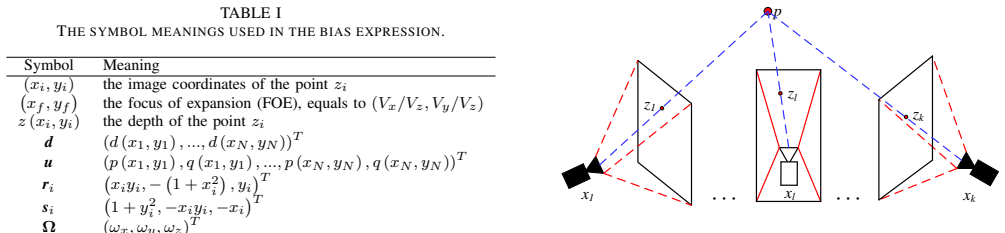
- [Fig. 2] Figure 2 contains unexplained symbols (preal, Pll, prl, plr, xll, xlreal, xlr) and appears to duplicate parts of Figure 1; the caption and figure should be clarified.
- [Section III and IV] The paper's contribution is described as integrating a bias calculating method into a SLAM framework, but Eq. (12) is taken from [29]; the authors should state clearly which parts of the bias calculation are new.
- [Throughout] There are several typographical errors, including "Gaussian-Newton" for "Gauss-Newton", "Levenburg-Marquadt" for "Levenberg-Marquardt", "Rao-Blacwellized" for "Rao-Blackwellized", and "syetem" for "system".
Circularity Check
Two partial circularities: map-point bias is defined as an internal difference between the system's own multi-frame and two-frame estimates, and the anomaly thresholds are tuned on the evaluation datasets.
-
fitted input called prediction
[Section IV-B, Eq. (15)]
"thresh of bias= { 0.1m if ‖ωcam‖2≥ 0.5; 0.3m if 0.3≤‖ωcam‖2 < 0.5; 0.5m if ‖ωcam‖2 < 0.3 } ... These thresh values are set based on testing results in different datasets, which makes our algorithm get stable and accurate results."
The anomaly thresholds determine which map points are used in the pose correction. The paper states they are 'set based on testing results in different datasets' and then reports pose RMSE/median improvements on those same EuRoC datasets in Tables II-IV. Thus the reported improvements are partly produced by parameters fitted to the evaluation data, rather than being out-of-sample predictions of an independent method.
-
self definitional
[Section IV-A, after Eqs. (13)-(14)]
"Since ˆdc is an unbiased estimation, suppose the actual value acquired by multi-frame is~d, the bias value of map points isµ(~d)=~d−ˆdc."
Eq. (6) requires the true mean bias µ_p of the map points relative to ground truth. The paper instead defines the bias as µ(~d)=~d−ˆdc, where ~d is the multi-frame reconstruction obtained with the very camera poses being corrected and ˆdc is the two-frame corrected depth from the same front end. This makes the 'bias' a difference between two estimates from the same biased pipeline, not an error measured against independent truth; the pose correction therefore algebraically relates the system's own estimates to each other, and the paper gives no transformation from scalar inverse-depth bias to the 3D µ_p of Eq. (6).
full rationale
The paper's central algebra (Eqs. 4-6) is not itself circular: it is a first-order Gauss-Newton relation derived from the cost in Eq. (1), and the bias formula (12) is imported from [29]. The circularity arises in the use of that relation. Sec. IV.A defines the map-point bias actually plugged into Eq. (6) as µ(~d)=~d−ˆdc, i.e., the difference between the multi-frame reconstruction (obtained with the very camera poses the method corrects) and a two-frame corrected depth from the same front end. That is an internal difference between two estimates from the same biased pipeline, not a bias measured against independent ground truth, and no transformation connects the scalar inverse-depth bias to the 3D µ_p required by Eq. (6). Second, the anomaly thresholds of Eq. (15) are explicitly set based on testing results in EuRoC, so the RMSE/median improvements in Tables II-IV are partly produced by parameters fitted to the same benchmark sequences. The derivation also has correctness risks (pose-only update rather than joint BA Schur complement; the unexplained 3n×3n summation matrix 1), but those are correctness concerns, not circularity. Overall, the paper has some independent content, but the key bias input is self-referential and the validation uses test-set-fitted thresholds, giving partial circularity.
Assumptions & free parameters
free parameters (2)
- Anomaly thresholds =
0.1, 0.3, 0.5 m depending on angular velocity
- L (number of two-frame reconstructions)
assumptions (5)
- domain assumption Image observation error ε_zi is zero-mean Gaussian.
- domain assumption Map point error ε_pi is non-zero-mean Gaussian with mean μ_pi.
- ad hoc to paper The bias expression in Eq (12) from [29] is correct for the system.
- ad hoc to paper The two-frame bias-corrected depth d_c is an unbiased estimate of true depth, so μ(~d)=~d-d_c is the map point bias in multi-frame reconstruction.
- ad hoc to paper The pose update from Gauss-Newton can be written as Eq (4) and the linearized relation Eq (5) holds.
Cite this review
Pith. "Pith review of Camera Pose Correction in SLAM Based on Bias Values of Map Points." pith.science (2026). https://pith.science/paper/XC6XVUIQ
@misc{pith2026190809072,
  author       = {Pith},
  title        = {Pith review of: Camera Pose Correction in SLAM Based on Bias Values of Map Points},
  year         = {2026},
  howpublished = {\url{https://pith.science/paper/XC6XVUIQ}},
  note         = {Machine review of arXiv:1908.09072}
}
read the original abstract
Accurate camera pose estimation result is essential for visual SLAM (VSLAM). This paper presents a novel pose correction method to improve the accuracy of the VSLAM system. Firstly, the relationship between the camera pose estimation error and bias values of map points is derived based on the optimized function in VSLAM. Secondly, the bias value of the map point is calculated by a statistical method. Finally, the camera pose estimation error is compensated according to the first derived relationship. After the pose correction, procedures of the original system, such as the bundle adjustment (BA) optimization, can be executed as before. Compared with existing methods, our algorithm is compact and effective and can be easily generalized to different VSLAM systems. Additionally, the robustness to system noise of our method is better than feature selection methods, due to all original system information is preserved in our algorithm while only a subset is employed in the latter. Experimental results on benchmark datasets show that our approach leads to considerable improvements over state-of-the-art algorithms for absolute pose estimation.
Figures

Figures from the paper (3 more)
Reference graph
Works this paper leans on
-
[14]
Good Feature Selection for Least Squares Pose Optimization in VO/VSLAM
Y . Zhao and P. A. Vela, “Good Feature Selection for Least Squares Pose Optimization in VO/VSLAM”, International Conference on Intelligent Robots and Systems, pp. 1183-1189, 2018
work page 2018
-
[29]
Statistical Error Propagation in 3D Modeling from Monocular Video
A. R. Chowdhury and R. Chellappa, “Statistical Error Propagation in 3D Modeling from Monocular Video”, IEEE Conference on Computer Vision and Pattern Recognition Workshop, 2003
work page 2003
-
[1]
A Monocular SLAM System Lever- aging Structural Regularity in Manhattan World
H. Li, J. Yao, J. C. Bazin, et al. , “A Monocular SLAM System Lever- aging Structural Regularity in Manhattan World”, IEEE International Conference on Robotics and Automation, pp. 2518-2525, 2018
work page 2018
-
[2]
P. Kim, B. Coltin, and H. J. Kim, “Low-Drift Visual Odometry in Structured Environments by Decoupling Rotational and Translational Motion”, IEEE International Conference on Robotics and Automation, pp. 7247-7253, 2018
work page 2018
-
[3]
BAFS: Bundle Adjustment with Feature Scale Constraints for Enhanced Estimation Accuracy
V . Ovechkin and V . Indelman, “BAFS: Bundle Adjustment with Feature Scale Constraints for Enhanced Estimation Accuracy”, IEEE Interna- tional Conference on Robotics and Automation, pp. 804-810, 2018
work page 2018
-
[4]
Dense Planar-Inertial SLAM with Structural Constraints
M. Hsiao, E. Westman, and M. Kaess, “Dense Planar-Inertial SLAM with Structural Constraints”, IEEE International Conference on Robotics and Automation, pp. 6521-6528, 2018
work page 2018
-
[5]
A Linear Least Square Initialization Method for 3D Pose Graph Optimization Problem
S. M. Nasiri, H. Moradi, and R. Hosseini, “A Linear Least Square Initialization Method for 3D Pose Graph Optimization Problem”, IEEE International Conference on Robotics and Automation, pp. 2474-2479, 2018
work page 2018
-
[6]
Dense Visual SLAM for RGB-D Cameras
C. Kerl, J. Sturm, and D. Cremers, “Dense Visual SLAM for RGB-D Cameras”, International Conference on Intelligent Robots and Systems, pp. 2100-2106, 2013
work page 2013
Show all 29 references
-
[7]
Direct Visual SLAM using Sparse Depth for Camera-LiDAR System
Y . S. Shin, Y . S. Park, and A. Kim, “Direct Visual SLAM using Sparse Depth for Camera-LiDAR System”, IEEE International Conference on Robotics and Automation, pp. 5144-5151, 2018
2018
-
[8]
Fast and ac- curate SLAM with RaoBlackwellized particle filters
G. Grisetti, G. D. Tipaldi, C. Stachniss, and et al. , “Fast and ac- curate SLAM with RaoBlackwellized particle filters”, Robotics and Autonomous Systems vol. 55, no. 1, pp. 30-38, 2007
2007
-
[9]
Unscented FastSLAM: A Ro- bust and Efficient Solution to the SLAM Problem
C. Kim, R. Sakthivel, and W. K. Chung, “Unscented FastSLAM: A Ro- bust and Efficient Solution to the SLAM Problem”, IEEE Transactions on Robotics vol. 24, no. 4, pp. 808-820, 2008
2008
-
[10]
Hierarchical SLAM: Real- Time Accurate Mapping of Large Environments
C. Estrada, J. Neira, and J. D. Tardos, “Hierarchical SLAM: Real- Time Accurate Mapping of Large Environments”, IEEE Transactions on Robotics vol. 21, no. 4, pp. 588-596, 2005
2005
-
[11]
CNN-SLAM: Real- time dense monocular SLAM with learned depth prediction
K. Tateno, F. Tombari, I. Laina, and et al. , “CNN-SLAM: Real- time dense monocular SLAM with learned depth prediction”, IEEE Conference on Computer Vision and Pattern Recognition, pp. 6243- 6252, 2017
2017
-
[12]
Toward a Unified Bayesian Approach to Hybrid MetricTopological SLAM
J. L. Blanco, J. A. F. Madrigal, and J. Gonzalez, “Toward a Unified Bayesian Approach to Hybrid MetricTopological SLAM”, IEEE Trans- actions on Robotics vol. 24, no. 2, pp. 259-270, 2008
2008
-
[13]
ICE-BA: Incremental, Consistent and Efficient Bundle Adjustment for Visual-Inertial SLAM
H. Liu, M. Chen, G. Zhang, and et al., “ICE-BA: Incremental, Consistent and Efficient Bundle Adjustment for Visual-Inertial SLAM”, IEEE Conference on Computer Vision and Pattern Recognition, pp. 1974- 1982, 2017
1974
-
[15]
Real-Time Global Registration for Globally Consistent RGB-D SLAM
L. Han, L. Xu, D. Bobkov, and et al. , “Real-Time Global Registration for Globally Consistent RGB-D SLAM”, IEEE Transactions on Robotics vol. 35, no. 2, pp. 498-509, 2019
2019
-
[16]
A Synchronized Visual- Inertial Sensor System with FPGA Pre-Processing for Accurate Real- Time SLAM
J. Nikolic, J. Rehder, M. Burri, and et al. , “A Synchronized Visual- Inertial Sensor System with FPGA Pre-Processing for Accurate Real- Time SLAM”, IEEE International Conference on Robotics and Automa- tion, pp. 431-437, 2014
2014
-
[17]
Keyframe-Based Visual-Inertial SLAM Using Nonlinear Optimization
S. Leutenegger, P. Furgale, V . Rabaud, and et al. , “Keyframe-Based Visual-Inertial SLAM Using Nonlinear Optimization”, Robotics: Sci- ence and Systems, DOI: 10.1177/0278364914554813
-
[18]
Visual-Inertial Monocular SLAM With Map Reuse
R. M. Artal and J. D. Tardos, “Visual-Inertial Monocular SLAM With Map Reuse”, IEEE Robotics and Automation Letter, vol. 2, no. 2, pp. 796-803, 2017
2017
-
[19]
ORB-SLAM: A Versatile and Accurate Monocular SLAM Syetem
R. M. Artal, J. M. M. Montiel, and J. D. Tardos, “ORB-SLAM: A Versatile and Accurate Monocular SLAM Syetem”, IEEE Transactions on Robotics vol. 31, no. 5, pp. 1-17, 2015
2015
-
[20]
VINS-Mono: A Robust and Versa- tile Monocular Visual-Inertial State Estimator
T. Qin, P. Lin, and S. Shen, “VINS-Mono: A Robust and Versa- tile Monocular Visual-Inertial State Estimator”, IEEE Transactions on Robotics vol. 34, no. 4, pp. 1004-1020, 2018
2018
-
[21]
SVO: Fast Semi- Direct Monocular Visual Odometry
C. Forster, M. Pizzoli, and D. Scaramuzza, “SVO: Fast Semi- Direct Monocular Visual Odometry”, IEEE International Conference on Robotics and Automation, pp. 15-22, 2014
2014
-
[22]
Multiple View Geometry in Computer Vision
R. Hartley, “Multiple View Geometry in Computer Vision”, 2th edition, pp. 156
-
[23]
The EuRoC micro aerial vehicle datasets
M. Burri et al., “The EuRoC micro aerial vehicle datasets”, International Journal of Robotics Research, vol. 35, no. 10, pp. 1157-1163, 2016
2016
-
[24]
Robocentric Visual-Inertial Odometry
H. Zheng and G. Huang, “Robocentric Visual-Inertial Odometry”, Inter- national Conference on Intelligent Robots and Systems, pp. 6319-6326, 2018
2018
-
[25]
Robot Visual Inertial Odometry Using a Direct EKF-based Approach
M. Bloesch, S. Omari, M. Hutter, and R. Siegwart, “Robot Visual Inertial Odometry Using a Direct EKF-based Approach”, International Conference on Intelligent Robots and Systems, pp. 298-304, 2015
2015
-
[26]
A Benchmark Comparison of Monoc- ular Visual-Inertial Odometry Algorithms for Flying Robots
J. Delmerico and D. Scaramuzza, “A Benchmark Comparison of Monoc- ular Visual-Inertial Odometry Algorithms for Flying Robots”, IEEE International Conference on Robotics and Automation, pp. 2502-2509, 2018
2018
-
[27]
A Multi-State Constraint Kalman Filter for Vision-Aided Inertial Navigation
A. I. Mourikis and S. I. Roumeliotis, “A Multi-State Constraint Kalman Filter for Vision-Aided Inertial Navigation”, IEEE International Confer- ence on Robotics and Automation, pp. 3565-3572, 2007
2007
-
[28]
Keyframe-Based Visual Inertial SLAM Using Nonlinear Optimization
S. Leutenegger, S. Lynen, M. Bosse, et al. , “Keyframe-Based Visual Inertial SLAM Using Nonlinear Optimization”, International Journal of Robotics Research, vol. 34, no. 3, pp. 314-334, 2015
2015
Reviewed August 14, 2026 · model on record in the stance chip above.
Discussion (0). Continue with ORCID to comment.