REVIEW 5 major objections 5 minor 76 references
Relation-aware Hierarchical Prompt for Open-vocabulary Scene Graph Generation
T0 review · 5 major / 5 minor · reviewed 2026-08-11 · deepseek-v4-flash
Pith's one-line read This paper claims that replacing fixed predicate prompts with hierarchical entity-aware and region-aware text prompts, filtered by a vision-language model, consistently improves open-vocabulary scene graph generation on Visual Genome and…
desk verdict RAHP is a plausible and well-controlled empirical extension of hierarchical prompting for open-vocabulary scene graph generation, but the paper's own ablation shows the region-aware prompts only work when paired with dynamic selection, and the claimed grounding mechanism is not directly validated. read the letter →
The pith
A machine-rendered reading of the paper's core claim, the machinery that carries it, and where it could break.
The reading
What carries the argument
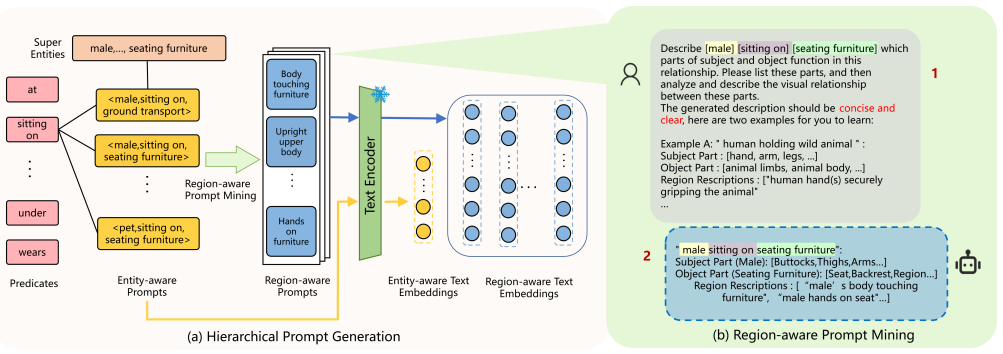
The carrying object is the hierarchical prompt stack plus a top-k filter. Entity clustering (WordNet grouping, VLM-embedding K-means, LLM naming) compresses the cubic triplet space into super-entity pairs so entity-aware prompts are feasible. A large language model then mines region-aware descriptions that name the part-level contact between subject and object. A vision-language model scores these region prompts against the union bounding-box crop, keeps the top k, and the final predicate logit is a weighted mixture of the entity-aware and region-aware similarities. The hyperparameters k and α control how many region prompts survive and how much they weigh.
What would settle it
If the top-k region prompts selected by vision-language matching are no more predictive of the true predicate than k prompts drawn at random from the same pool, then the dynamic selection mechanism is not contributing; that comparison is directly computable on Visual Genome using the paper's own pipeline.
Extended reading notes
Core claim
RAHP's central claim is that the quality of open-vocabulary relation prediction is determined less by the visual encoder than by the text representation it must match. The framework keeps the vision-language model's text encoder frozen and instead expands the text side: predicates are combined with entity clusters to form entity-aware prompts, and an LLM decomposes subject and object into parts to generate region-aware descriptions such as "human buttocks are making contact with the seat of the furniture." During inference, the union region of the subject-object pair is used to rank the region prompts, keep the top k, and weight them into the final predicate score. On Visual Genome and Open Images v6, the paper reports consistent state-of-the-art results, with the largest gains on novel (unseen) predicates.
Load-bearing premise
The whole mechanism presumes that region-aware text descriptions written by an LLM without seeing an image land close, in the vision-language model's embedding space, to the visual features of the actual image region, so that top-k selection keeps helpful prompts rather than noise.
Editorial extensions
If this is right
- Any one-stage or two-stage scene graph model can adopt RAHP by replacing its fixed predicate classifier, as demonstrated with SGTR+, PE-NET, OvSGTR, and VS3.
- Novel (unseen) predicate recall improves substantially; for example, PE-NET+RAHP raises novel mR@100 from 19.32 to 23.73 on Visual Genome PredCLS over a fixed-prompt baseline.
- Filtering region prompts with the vision-language model is necessary: using all region prompts hurts novel predicate performance, while keeping only the top-1 hurts diversity.
- The method transfers to fully open-vocabulary detection+relation settings, improving novel relation recall on OVD+R-SGG.
- Entity clustering to 30 super entities on Visual Genome recovers nearly all the benefit of using all 1,125,000 full triplets.
Reading between the lines
- Because the text side is frozen and only prompts change, the framework could port to other open-vocabulary tasks such as object detection, segmentation, or human-object interaction, where part-level region descriptions can be mined without visual grounding.
- The paper's own ablation hints that the region descriptions are the main source of novel-relation gains; a direct test would be to see whether paraphrased or ground-truth-grounded descriptions change performance, which would isolate whether the LLM's wording or its part decomposition carries the signal.
- The weakest link is likely the diversity of LLM-generated descriptions; if one could measure visual grounding of each region prompt or add image-conditioned prompt generation, the top-k selection might become even more effective, and the method might extend beyond the datasets tested.
- Entity clustering granularity is a latent trade-off: too few super entities wash out object identity, too many reintroduce the triplet-space explosion; this suggests an adaptive clustering scheme as a natural next step.
Editorial analysis
A structured set of objections, weighed in public.
Referee Report
Summary. The paper proposes RAHP, a prompt-construction framework for CLIP-based open-vocabulary scene graph generation (OV-SGG). It clusters entity categories into super entities, generates entity-aware prompts by combining super entities with predicates, and uses an LLM to produce region-aware part-level descriptions for each super-entity triplet. A VLM-guided dynamic selection step chooses the top-k region prompts per union-box visual feature, and predicate scores are obtained by a weighted average of entity-aware and region-aware similarities. Experiments on Visual Genome and Open Images v6 under OVR-SGG and OVD+R-SGG settings report consistent gains over fixed-prompt counterparts, with ablations decomposing the contributions of the three components. Code is released.
Significance. The paper addresses a real bottleneck in OV-SGG: fixed text prompts limit CLIP-based relation classification. The entity-clustering trick is a practical way to control the combinatorial explosion of triplets, and the idea of generating region-level descriptions with an LLM is timely. The controlled within-backbone comparisons (PE-NET+RAHP vs. PE-NET+p, SGTR†+RAHP vs. SGTR†+p) show credible gains on novel predicates, the ablation isolates components, and the held-out novel predicate evaluation is external to the prompt-generation process. If the mechanism is validated, RAHP would be a useful and transferable recipe for other VLM-based open-vocabulary tasks. However, the empirical support for "consistently state-of-the-art" is weakened by single-run results, partly confounded cross-backbone comparisons, and the absence of direct evidence that the region prompts selected by Eq. (3) are actually grounded in the visual interaction.
major comments (5)
- [§5.2, Tables 1 and 2] The abstract and Sec. 6 state that RAHP "consistently achieves state-of-the-art performance", but the cross-method comparisons in Tables 1 and 2 are not controlled. The headline improvement over PGSG (e.g., 21.56 points in total R@100 on OIV6) compares models with different backbones and detectors (ViT DETR* vs. R-101 DETR, R-101 Faster R-CNN) and different predicate splits. The controlled gains (e.g., PE-NET+RAHP vs. PE-NET+p) are credible, but the manuscript should either soften the SOTA claim or present like-for-like comparisons with published methods under identical backbones and splits.
- [§4.4, Eq. (3) and Table 4] The central novelty claim is that region-aware prompts capture fine-grained visual interactions, but no experiment verifies that the prompts selected by Eq. (3) are visually grounded. Table 4 row 3 shows that adding region-aware prompts without dynamic selection drops novel R@50 from 6.15 to 2.38, so the entire benefit of the region-aware component is attributed to selection. Selection is based on CLIP similarity with the union box, which may be driven by generic part/object recognition rather than predicate-specific interaction. The paper should provide direct evidence—e.g., analysis of selected prompts per predicate, comparison with random or static prompt subsets, or a region-grounding metric—before attributing the gain to "fine-grained visual interactions".
- [Tables 1–3] All reported numbers are single-run point estimates with no error bars or significance tests. Some controlled margins are small—e.g., SGTR†+RAHP vs. SGTR†+p on VG: total R@50 39.92 vs. 39.48 and base R@50 41.29 vs. 40.78—so the "consistently" claim requires multiple seeds (at least 3) and reported mean ± std, especially for novel-predicate metrics.
- [§4.4, Eqs. (3)–(5)] The definition of the selection score is ambiguous. T^r_j is defined in Sec. 4.2 as an element of R^{C_p × N^r_j × d}, but Eq. (3) computes φ(U, T^r_j) with φ defined in Eq. (1) for 2D inputs, and writes the output as S^se_j ∈ R^{N × N^r_j}. It is unclear whether selection is performed separately per predicate or shared across all C_p predicates, and how Eq. (5) maps the selected 3D tensor to the 2D score S^r_j. Please clarify the tensor shapes and indexing; this is essential for reproducibility of the dynamic-selection mechanism.
- [§5.3, Table 3] In the fully open-vocabulary OVD+R-SGG setting, OvSGTR+RAHP improves novel predicate R@100 from 11.19 to 16.46 but decreases novel object R@50/R@100 from 14.37/17.44 to 12.45/15.38, and total R@100 increases only from 16.36 to 16.52. The paper mentions this trade-off but does not analyze it. Since the framework is proposed for open-vocabulary scene graph generation, the reported degradation on novel objects should be investigated or clearly qualified before claiming "state-of-the-art generalization" in this setting.
minor comments (5)
- [References] The reference list contains entries unrelated to the paper (Alpher et al. 2002–2005; Anonymous 2024a,b) that appear to be leftover template text; they should be removed.
- [Appendix E.7] The sentence "The total cost of generating region-aware prompts ... is [insert cost here]" is an unfinished placeholder and must be completed or deleted.
- [§5.1] The implementation details refer to "PR-NET" but the rest of the paper and Table 4 use "PE-NET"; please correct the typo.
- [Table 4 and Table 7] There are typos in the table headers: "Realtion" in Table 4 and "CPT-4o-mini" in Table 7 should be "Relation" and "GPT-4o-mini".
- [Appendix C.1] The statistics "20.32 unique objects and 7.58 unique relations" are unclear; please specify whether these are per triplet, per predicate, or across the whole prompt set.
Circularity Check
No significant circularity: held-out novel predicate evaluation and frozen CLIP/LLM prompts keep the empirical claims independent; the only self-citations are backbone/loss reuse and are not load-bearing.
full rationale
The paper is an empirical alignment system rather than a derivation-from-principles, so the default circularity checks mostly do not apply. The central claims are evaluated on held-out novel predicate splits (VG and OIV6) that are external to the prompt-generation procedure: the LLM generates region descriptions from predicate and super-entity names without access to test images, and the CLIP text encoder is frozen. Novel predicates are not fitted on training data, and test recall is measured against externally defined categories. Equations (3)-(7) combine a CLIP-based prompt-selection step with cosine-similarity predicate scoring; although the same frozen CLIP backbone is reused for both selection and scoring, the inputs are different (union-region features U versus relation features R, and different text embedding sets), so no output is equal to an input by construction. The self-citations, notably SGTR+ as a backbone and the multi-task loss design, are standard engineering reuse rather than load-bearing premises, and no uniqueness theorem is imported from the authors' prior work. The ablation in Table 4 and the stated limitations (limited diversity of LLM-generated region descriptions, entity-clustering granularity) are honest empirical caveats rather than circular reasoning. The reference list contains placeholder 'Frobnication' entries and Appendix E.7 contains an '[insert cost here]' placeholder; these are completeness defects that do not create a circular reduction. Overall, the empirical pipeline is self-contained against external benchmarks, and the minor self-citation is not load-bearing, consistent with a low circularity score.
Assumptions & free parameters
free parameters (4)
- Number of super entities M =
30 for VG, 53 for OIV6
- Dynamic selection top-k =
3
- Aggregation weight alpha =
0.25
- Loss weights lambda1, lambda2, lambda3 =
2, 1, 20
assumptions (4)
- domain assumption CLIP frozen encoders provide a reliable shared space for image-text matching.
- ad hoc to paper LLM-generated region descriptions are semantically grounded without being generated from images.
- domain assumption Entity clustering preserves the information needed for relation prediction.
- domain assumption The base/novel splits and Recall@K metrics faithfully measure open-vocabulary generalization.
invented entities (1)
-
Super-entity categories (e.g., 'limb and appendage', 'seating furniture')
Cite this review
Pith. "Pith review of Relation-aware Hierarchical Prompt for Open-vocabulary Scene Graph Generation." pith.science (2026). https://pith.science/paper/XDEWEZXS
@misc{pith2026241219021,
  author       = {Pith},
  title        = {Pith review of: Relation-aware Hierarchical Prompt for Open-vocabulary Scene Graph Generation},
  year         = {2026},
  howpublished = {\url{https://pith.science/paper/XDEWEZXS}},
  note         = {Machine review of arXiv:2412.19021}
}
read the original abstract
Open-vocabulary Scene Graph Generation (OV-SGG) overcomes the limitations of the closed-set assumption by aligning visual relationship representations with open-vocabulary textual representations. This enables the identification of novel visual relationships, making it applicable to real-world scenarios with diverse relationships. However, existing OV-SGG methods are constrained by fixed text representations, limiting diversity and accuracy in image-text alignment. To address these challenges, we propose the Relation-Aware Hierarchical Prompting (RAHP) framework, which enhances text representation by integrating subject-object and region-specific relation information. Our approach utilizes entity clustering to address the complexity of relation triplet categories, enabling the effective integration of subject-object information. Additionally, we utilize a large language model (LLM) to generate detailed region-aware prompts, capturing fine-grained visual interactions and improving alignment between visual and textual modalities. RAHP also introduces a dynamic selection mechanism within Vision-Language Models (VLMs), which adaptively selects relevant text prompts based on the visual content, reducing noise from irrelevant prompts. Extensive experiments on the Visual Genome and Open Images v6 datasets demonstrate that our framework consistently achieves state-of-the-art performance, demonstrating its effectiveness in addressing the challenges of open-vocabulary scene graph generation. The code is available at: https://github.com/Leon022/RAHP
Figures


Figures from the paper (4 more)


Reference graph
Works this paper leans on
-
[1]
, " * write output.state after.block = add.period write newline
ENTRY address archivePrefix author booktitle chapter edition editor eid eprint howpublished institution isbn journal key month note number organization pages publisher school series title type volume year label extra.label sort.label short.list INTEGERS output.state before.all mid.sentence after.sentence after.block FUNCTION init.state.consts #0 'before.a...
-
[2]
write newline
" write newline "" before.all 'output.state := FUNCTION n.dashify 't := "" t empty not t #1 #1 substring "-" = t #1 #2 substring "--" = not "--" * t #2 global.max substring 't := t #1 #1 substring "-" = "-" * t #2 global.max substring 't := while if t #1 #1 substring * t #2 global.max substring 't := if while FUNCTION word.in bbl.in capitalize " " * FUNCT...
-
[3]
Alpher, F. 2002. Frobnication. IEEE TPAMI, 12(1): 234--778
work page 2002
-
[4]
Alpher, F.; and Fotheringham-Smythe, F. 2003. Frobnication revisited. Journal of Foo, 13(1): 234--778
work page 2003
-
[5]
Alpher, F.; Fotheringham-Smythe, F.; and Gamow, F. 2004. Can a machine frobnicate? Journal of Foo, 14(1): 234--778
work page 2004
-
[6]
Alpher, F.; and Gamow, F. 2005. Can a computer frobnicate? In CVPR, 234--778
work page 2005
-
[7]
Anonymous. 2024 a . The frobnicatable foo filter. ECCV submission ID 00324, supplied as supplemental material 00324.pdf
work page 2024
-
[8]
Anonymous. 2024 b . Frobnication tutorial. Supplied as supplemental material tr.pdf
work page 2024
Show all 76 references
-
[9]
M.; and Hassner, T., eds
Avidan, S.; Brostow, G.; Cissé, M.; Farinella, G. M.; and Hassner, T., eds. 2022. Computer Vision -- ECCV 2022. Springer
2022
-
[10]
D.; Dhariwal, P.; Neelakantan, A.; Shyam, P.; Sastry, G.; Askell, A.; et al
Brown, T.; Mann, B.; Ryder, N.; Subbiah, M.; Kaplan, J. D.; Dhariwal, P.; Neelakantan, A.; Shyam, P.; Sastry, G.; Askell, A.; et al. 2020. Language models are few-shot learners. Advances in neural information processing systems, 33: 1877--1901
2020
-
[11]
Bucher, M.; Vu, T.-H.; Cord, M.; and P \'e rez, P. 2019. Zero-shot semantic segmentation. Advances in Neural Information Processing Systems, 32
2019
-
[12]
Carion, N.; Massa, F.; Synnaeve, G.; Usunier, N.; Kirillov, A.; and Zagoruyko, S. 2020. End-to-end object detection with transformers. In European conference on computer vision, 213--229. Springer
2020
-
[13]
Chen, S.; Jin, Q.; Wang, P.; and Wu, Q. 2020. Say as you wish: Fine-grained control of image caption generation with abstract scene graphs. In Proceedings of the IEEE/CVF conference on computer vision and pattern recognition, 9962--9971
2020
-
[14]
Chen, Z.; Wu, J.; Lei, Z.; Zhang, Z.; and Chen, C. 2023. Expanding Scene Graph Boundaries: Fully Open-vocabulary Scene Graph Generation via Visual-Concept Alignment and Retention. arXiv preprint arXiv:2311.10988
2023 arXiv
-
[15]
Gao, K.; Chen, L.; Zhang, H.; Xiao, J.; and Sun, Q. 2023. Compositional prompt tuning with motion cues for open-vocabulary video relation detection. arXiv preprint arXiv:2302.00268
2023 arXiv
-
[16]
Ge, Y.; Ren, J.; Gallagher, A.; Wang, Y.; Yang, M.-H.; Adam, H.; Itti, L.; Lakshminarayanan, B.; and Zhao, J. 2023. Improving zero-shot generalization and robustness of multi-modal models. In Proceedings of the IEEE/CVF conference on computer vision and pattern recognition, 11...
2023
-
[17]
Ghiasi, G.; Gu, X.; Cui, Y.; and Lin, T.-Y. 2022. Scaling open-vocabulary image segmentation with image-level labels. In European Conference on Computer Vision, 540--557. Springer
2022
-
[18]
Gothoskar, N.; Cusumano-Towner, M.; Zinberg, B.; Ghavamizadeh, M.; Pollok, F.; Garrett, A.; Tenenbaum, J.; Gutfreund, D.; and Mansinghka, V. 2021. 3DP3: 3D scene perception via probabilistic programming. Advances in Neural Information Processing Systems, 34: 9600--9612
2021
-
[19]
Gu, J.; Joty, S.; Cai, J.; Zhao, H.; Yang, X.; and Wang, G. 2019 a . Unpaired image captioning via scene graph alignments. In Proceedings of the IEEE/CVF International Conference on Computer Vision, 10323--10332
2019
-
[20]
Gu, J.; Zhao, H.; Lin, Z.; Li, S.; Cai, J.; and Ling, M. 2019 b . Scene graph generation with external knowledge and image reconstruction. In Proceedings of the IEEE/CVF conference on computer vision and pattern recognition, 1969--1978
2019
-
[21]
Gu, X.; Lin, T.-Y.; Kuo, W.; and Cui, Y. 2021. Open-vocabulary object detection via vision and language knowledge distillation. arXiv preprint arXiv:2104.13921
2021 arXiv
-
[22]
He, K.; Zhang, X.; Ren, S.; and Sun, J. 2016. Deep residual learning for image recognition. In Proceedings of the IEEE conference on computer vision and pattern recognition, 770--778
2016
-
[23]
He, T.; Gao, L.; Song, J.; and Li, Y.-F. 2022. Towards open-vocabulary scene graph generation with prompt-based finetuning. In European Conference on Computer Vision, 56--73. Springer
2022
-
[24]
Jia, C.; Yang, Y.; Xia, Y.; Chen, Y.-T.; Parekh, Z.; Pham, H.; Le, Q.; Sung, Y.-H.; Li, Z.; and Duerig, T. 2021. Scaling up visual and vision-language representation learning with noisy text supervision. In International conference on machine learning, 4904--4916. PMLR
2021
-
[25]
Johnson, J.; Krishna, R.; Stark, M.; Li, L.-J.; Shamma, D.; Bernstein, M.; and Fei-Fei, L. 2015. Image retrieval using scene graphs. In Proceedings of the IEEE conference on computer vision and pattern recognition, 3668--3678
2015
-
[26]
Kamath, A.; Singh, M.; LeCun, Y.; Synnaeve, G.; Misra, I.; and Carion, N. 2021. Mdetr-modulated detection for end-to-end multi-modal understanding. In Proceedings of the IEEE/CVF International Conference on Computer Vision, 1780--1790
2021
-
[27]
S.; Reid, M.; Matsuo, Y.; and Iwasawa, Y
Kojima, T.; Gu, S. S.; Reid, M.; Matsuo, Y.; and Iwasawa, Y. 2022. Large language models are zero-shot reasoners. Advances in neural information processing systems, 35: 22199--22213
2022
-
[28]
A.; et al
Krishna, R.; Zhu, Y.; Groth, O.; Johnson, J.; Hata, K.; Kravitz, J.; Chen, S.; Kalantidis, Y.; Li, L.-J.; Shamma, D. A.; et al. 2017. Visual genome: Connecting language and vision using crowdsourced dense image annotations. International journal of computer vision, 123: 32--73
2017
-
[29]
Kuznetsova, A.; Rom, H.; Alldrin, N.; Uijlings, J.; Krasin, I.; Pont-Tuset, J.; Kamali, S.; Popov, S.; Malloci, M.; Kolesnikov, A.; et al. 2020. The open images dataset v4: Unified image classification, object detection, and visual relationship detection at scale. Internationa...
2020
-
[30]
Lee, S.; Kim, J.-W.; Oh, Y.; and Jeon, J. H. 2019. Visual question answering over scene graph. In 2019 First International Conference on Graph Computing (GC), 45--50. IEEE
2019
-
[31]
Li, J.; Li, D.; Savarese, S.; and Hoi, S. 2023. Blip-2: Bootstrapping language-image pre-training with frozen image encoders and large language models. arXiv preprint arXiv:2301.12597
2023 arXiv
-
[32]
Li, J.; Wang, Y.; Guo, X.; Yang, R.; and Li, W. 2024 a . Leveraging Predicate and Triplet Learning for Scene Graph Generation. In Proceedings of the IEEE/CVF Conference on Computer Vision and Pattern Recognition, 28369--28379
2024
-
[33]
Li, L.; Xiao, J.; Chen, G.; Shao, J.; Zhuang, Y.; and Chen, L. 2024 b . Zero-shot visual relation detection via composite visual cues from large language models. Advances in Neural Information Processing Systems, 36
2024
-
[34]
Li, R.; Zhang, S.; and He, X. 2024. SGTR+: End-to-end Scene Graph Generation with Transformer. arXiv:2401.12835
2024 arXiv
-
[35]
Li, R.; Zhang, S.; Lin, D.; Chen, K.; and He, X. 2024 c . From Pixels to Graphs: Open-Vocabulary Scene Graph Generation with Vision-Language Models. In Proceedings of the IEEE/CVF Conference on Computer Vision and Pattern Recognition, 28076--28086
2024
-
[36]
Li, X.; Chen, L.; Ma, W.; Yang, Y.; and Xiao, J. 2022. Integrating object-aware and interaction-aware knowledge for weakly supervised scene graph generation. In Proceedings of the 30th ACM International Conference on Multimedia, 4204--4213
2022
-
[37]
Li, Y.; Pan, Y.; Chen, J.; Yao, T.; and Mei, T. 2021. X-modaler: A versatile and high-performance codebase for cross-modal analytics. In Proceedings of the 29th ACM International Conference on Multimedia, 3799--3802
2021
-
[38]
Liang, F.; Wu, B.; Dai, X.; Li, K.; Zhao, Y.; Zhang, H.; Zhang, P.; Vajda, P.; and Marculescu, D. 2023. Open-vocabulary semantic segmentation with mask-adapted clip. In Proceedings of the IEEE/CVF Conference on Computer Vision and Pattern Recognition, 7061--7070
2023
-
[39]
Liao, Y.; Zhang, A.; Lu, M.; Wang, Y.; Li, X.; and Liu, S. 2022. Gen-vlkt: Simplify association and enhance interaction understanding for hoi detection. In Proceedings of the IEEE/CVF Conference on Computer Vision and Pattern Recognition, 20123--20132
2022
-
[40]
Lin, T.-Y.; Goyal, P.; Girshick, R.; He, K.; and Doll \'a r, P. 2017. Focal loss for dense object detection. In Proceedings of the IEEE international conference on computer vision, 2980--2988
2017
-
[41]
L.; Ricci, E.; Csurka, G.; and Volpi, R
Liu, M.; Hayes, T. L.; Ricci, E.; Csurka, G.; and Volpi, R. 2024. SHiNe: Semantic Hierarchy Nexus for Open-vocabulary Object Detection. arXiv preprint arXiv:2405.10053
2024 arXiv
-
[42]
Liu, Z.; Lin, Y.; Cao, Y.; Hu, H.; Wei, Y.; Zhang, Z.; Lin, S.; and Guo, B. 2021. Swin transformer: Hierarchical vision transformer using shifted windows. In Proceedings of the IEEE/CVF international conference on computer vision, 10012--10022
2021
-
[43]
Ma, Z.; Luo, G.; Gao, J.; Li, L.; Chen, Y.; Wang, S.; Zhang, C.; and Hu, W. 2022. Open-vocabulary one-stage detection with hierarchical visual-language knowledge distillation. In Proceedings of the IEEE/CVF Conference on Computer Vision and Pattern Recognition, 14074--14083
2022
-
[44]
Menon, S.; and Vondrick, C. 2022. Visual classification via description from large language models. arXiv preprint arXiv:2210.07183
2022 arXiv
-
[45]
Miller, G. A. 1995. WordNet: a lexical database for English. Communications of the ACM, 38(11): 39--41
1995
-
[46]
Nguyen, K.; Tripathi, S.; Du, B.; Guha, T.; and Nguyen, T. Q. 2021. In defense of scene graphs for image captioning. In Proceedings of the IEEE/CVF International Conference on Computer Vision, 1407--1416
2021
-
[47]
OpenAI. 2024. GPT-4 Technical Report. arXiv:2303.08774
2024 arXiv
-
[48]
W.; Hallacy, C.; Ramesh, A.; Goh, G.; Agarwal, S.; Sastry, G.; Askell, A.; Mishkin, P.; Clark, J.; et al
Radford, A.; Kim, J. W.; Hallacy, C.; Ramesh, A.; Goh, G.; Agarwal, S.; Sastry, G.; Askell, A.; Mishkin, P.; Clark, J.; et al. 2021. Learning transferable visual models from natural language supervision. In International conference on machine learning, 8748--8763. PMLR
2021
-
[49]
Shi, J.; Zhong, Y.; Xu, N.; Li, Y.; and Xu, C. 2021. A simple baseline for weakly-supervised scene graph generation. In Proceedings of the IEEE/CVF International Conference on Computer Vision, 16393--16402
2021
-
[50]
Suhail, M.; Mittal, A.; Siddiquie, B.; Broaddus, C.; Eledath, J.; Medioni, G.; and Sigal, L. 2021. Energy-based learning for scene graph generation. In Proceedings of the IEEE/CVF conference on computer vision and pattern recognition, 13936--13945
2021
-
[51]
Sung, Y.-L.; Cho, J.; and Bansal, M. 2022. Vl-adapter: Parameter-efficient transfer learning for vision-and-language tasks. In Proceedings of the IEEE/CVF Conference on Computer Vision and Pattern Recognition, 5227--5237
2022
-
[52]
Tang, K.; Zhang, H.; Wu, B.; Luo, W.; and Liu, W. 2019. Learning to compose dynamic tree structures for visual contexts. In Proceedings of the IEEE/CVF conference on computer vision and pattern recognition, 6619--6628
2019
-
[53]
Teney, D.; Liu, L.; and van Den Hengel, A. 2017. Graph-structured representations for visual question answering. In Proceedings of the IEEE conference on computer vision and pattern recognition, 1--9
2017
-
[54]
Wang, H.; Yang, M.; Wei, K.; and Deng, C. 2023. Hierarchical prompt learning for compositional zero-shot recognition. In Proceedings of the Thirty-Second International Joint Conference on Artificial Intelligence, 1470--1478
2023
-
[55]
Wang, Y.; Jiang, X.; Cheng, D.; Li, D.; and Zhao, C. 2024. Learning Hierarchical Prompt with Structured Linguistic Knowledge for Vision-Language Models. In Proceedings of the AAAI Conference on Artificial Intelligence, volume 38, 5749--5757
2024
-
[56]
Wang, Z.; Lu, Y.; Li, Q.; Tao, X.; Guo, Y.; Gong, M.; and Liu, T. 2022 a . Cris: Clip-driven referring image segmentation. In Proceedings of the IEEE/CVF conference on computer vision and pattern recognition, 11686--11695
2022
-
[57]
Wang, Z.; Wang, P.; Liu, T.; Lin, B.; Cao, Y.; Sui, Z.; and Wang, H. 2022 b . HPT: Hierarchy-aware prompt tuning for hierarchical text classification. arXiv preprint arXiv:2204.13413
2022 arXiv
-
[58]
Wu, J.; Li, X.; Xu, S.; Yuan, H.; Ding, H.; Yang, Y.; Li, X.; Zhang, J.; Tong, Y.; Jiang, X.; et al. 2024. Towards open vocabulary learning: A survey. IEEE Transactions on Pattern Analysis and Machine Intelligence
2024
-
[59]
Wu, X.; Zhu, F.; Zhao, R.; and Li, H. 2023. CORA: Adapting CLIP for Open-Vocabulary Detection with Region Prompting and Anchor Pre-Matching. In Proceedings of the IEEE/CVF Conference on Computer Vision and Pattern Recognition, 7031--7040
2023
-
[60]
Xian, Y.; Choudhury, S.; He, Y.; Schiele, B.; and Akata, Z. 2019. Semantic projection network for zero-and few-label semantic segmentation. In Proceedings of the IEEE/CVF Conference on Computer Vision and Pattern Recognition, 8256--8265
2019
-
[61]
B.; and Fei-Fei, L
Xu, D.; Zhu, Y.; Choy, C. B.; and Fei-Fei, L. 2017. Scene graph generation by iterative message passing. In Proceedings of the IEEE conference on computer vision and pattern recognition, 5410--5419
2017
-
[62]
Yang, X.; Tang, K.; Zhang, H.; and Cai, J. 2019. Auto-encoding scene graphs for image captioning. In Proceedings of the IEEE/CVF conference on computer vision and pattern recognition, 10685--10694
2019
-
[63]
Yao, T.; Pan, Y.; Li, Y.; and Mei, T. 2018. Exploring visual relationship for image captioning. In Proceedings of the European conference on computer vision (ECCV), 684--699
2018
-
[64]
Yu, Q.; Li, J.; Wu, Y.; Tang, S.; Ji, W.; and Zhuang, Y. 2023. Visually-Prompted Language Model for Fine-Grained Scene Graph Generation in an Open World. arXiv preprint arXiv:2303.13233
2023 arXiv
-
[65]
Yuan, H.; Zhang, S.; Wang, X.; Albanie, S.; Pan, Y.; Feng, T.; Jiang, J.; Ni, D.; Zhang, Y.; and Zhao, D. 2023. RLIPv2: Fast Scaling of Relational Language-Image Pre-training. In Proceedings of the IEEE/CVF International Conference on Computer Vision, 21649--21661
2023
-
[66]
Yuksekgonul, M.; Bianchi, F.; Kalluri, P.; Jurafsky, D.; and Zou, J. 2022. When and why vision-language models behave like bags-of-words, and what to do about it? arXiv e-prints, arXiv--2210
2022
-
[67]
D.; Hu, D
Zareian, A.; Rosa, K. D.; Hu, D. H.; and Chang, S.-F. 2021. Open-vocabulary object detection using captions. In Proceedings of the IEEE/CVF Conference on Computer Vision and Pattern Recognition, 14393--14402
2021
-
[68]
Zellers, R.; Yatskar, M.; Thomson, S.; and Choi, Y. 2018. Neural motifs: Scene graph parsing with global context. In Proceedings of the IEEE conference on computer vision and pattern recognition, 5831--5840
2018
-
[69]
Zhang, C.; Stepputtis, S.; Campbell, J.; Sycara, K.; and Xie, Y. 2024. HiKER-SGG: Hierarchical Knowledge Enhanced Robust Scene Graph Generation. In Proceedings of the IEEE/CVF Conference on Computer Vision and Pattern Recognition, 28233--28243
2024
-
[70]
Zhang, C.; Yu, J.; Song, Y.; and Cai, W. 2021 a . Exploiting edge-oriented reasoning for 3d point-based scene graph analysis. In Proceedings of the IEEE/CVF conference on computer vision and pattern recognition, 9705--9715
2021
-
[71]
Zhang, R.; Fang, R.; Zhang, W.; Gao, P.; Li, K.; Dai, J.; Qiao, Y.; and Li, H. 2021 b . Tip-adapter: Training-free clip-adapter for better vision-language modeling. arXiv preprint arXiv:2111.03930
2021 arXiv
-
[72]
Zhang, Y.; Pan, Y.; Yao, T.; Huang, R.; Mei, T.; and Chen, C.-W. 2023. Learning To Generate Language-Supervised and Open-Vocabulary Scene Graph Using Pre-Trained Visual-Semantic Space. In Proceedings of the IEEE/CVF Conference on Computer Vision and Pattern Recognition, 2915--2924
2023
-
[73]
Zheng, C.; Lyu, X.; Gao, L.; Dai, B.; and Song, J. 2023. Prototype-based embedding network for scene graph generation. In Proceedings of the IEEE/CVF Conference on Computer Vision and Pattern Recognition, 22783--22792
2023
-
[74]
???? Learning to Generate Scene Graph from Natural Language Supervision
Zhong, Y.; Shi, J.; Yang, J.; Xu, C.; and Li, Y. ???? Learning to Generate Scene Graph from Natural Language Supervision. In 2021 IEEE. In CVF International Conference on Computer Vision (ICCV), 1803--1814
2021
-
[75]
H.; Zhou, L.; Dai, X.; Yuan, L.; Li, Y.; et al
Zhong, Y.; Yang, J.; Zhang, P.; Li, C.; Codella, N.; Li, L. H.; Zhou, L.; Dai, X.; Yuan, L.; Li, Y.; et al. 2022. Regionclip: Region-based language-image pretraining. In Proceedings of the IEEE/CVF Conference on Computer Vision and Pattern Recognition, 16793--16803
2022
-
[76]
C.; and Liu, Z
Zhou, K.; Yang, J.; Loy, C. C.; and Liu, Z. 2022. Learning to prompt for vision-language models. International Journal of Computer Vision, 130(9): 2337--2348
2022
Reviewed August 11, 2026 · model on record in the stance chip above.
Discussion (0). Continue with ORCID to comment.