REVIEW 4 major objections 5 minor 92 references
Accelerated Patient-Specific Calibration via Differentiable Hemodynamics Simulations
T0 review · 4 major / 5 minor · reviewed 2026-08-11 · deepseek-v4-flash
Pith's one-line read A differentiable 1D-0D hemodynamics solver enables gradient-based inference of patient-specific vessel and Windkessel parameters from pressure data, with forward predictions matching an established solver within 1% error.
desk verdict A genuinely useful differentiable 1D hemodynamics solver with solid forward validation, but the calibration claims rest on synthetic self-consistency and an unexamined transient-optimization shortcut. read the letter →
The pith
A machine-rendered reading of the paper's core claim, the machinery that carries it, and where it could break.
The reading
What carries the argument
The load-bearing object is the differentiable solver itself, which is a finite-volume discretization of the dimension-reduced Navier-Stokes equations for a compliant tube: conservation laws for cross-sectional area $A$ and flow rate $Q$, closed by the tube-law pressure relation $P = P_{\mathrm{ext}} + \beta(\sqrt{A/A_0}-1)$ with elasticity coefficient $\beta$. A MUSCL scheme with total-variation-diminishing slope limiting and Lax-Friedrichs fluxes advances the hyperbolic system; inlet values come from Riemann-invariant extrapolation of given pressure or flow data, and outlets are coupled to three-element Windkessel (RCR) models whose roots are found by a frozen Newton method. Because the whole chain is implemented in JAX with padding and masking to vectorize across vessels, automatic differentiation yields gradients of any simulated quantity with respect to any parameter, and it is these gradients that both the Adafactor and the Hamiltonian Monte Carlo inference procedures consume.
What would settle it
Repeat the four-parameter resistance inference on the same bifurcation geometry, but this time iterate the solver to the paper's own convergence criterion (pressure changing by less than 0.1 mmHg between cardiac cycles) before taking gradients, and compare the recovered $R_1$ and $R_2$ values with those obtained from the truncated unconverged window; if any parameter differs by more than the optimizer's tolerance, the accelerated protocol is fitting a transient that the converged periodic state would contradict.
Extended reading notes
Core claim
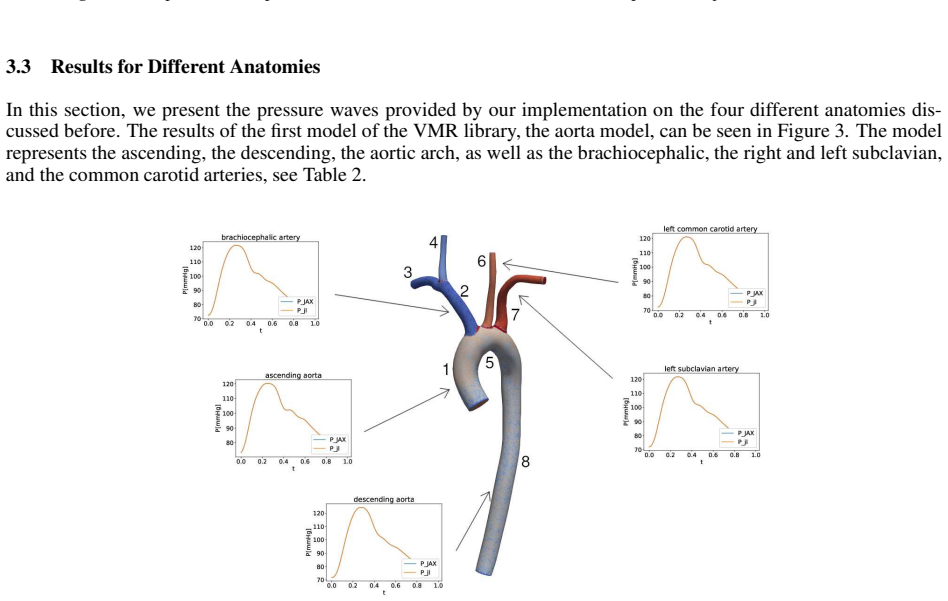
Stated on the paper's own terms, the discovery is that the full pipeline — cross-sectionally averaged 1D Navier-Stokes equations, tube-law pressure closure, MUSCL finite-volume time stepping, Riemann-invariant boundary conditions, and Windkessel outlets solved by Newton's method — can be written in JAX so that automatic differentiation flows through every step. The paper demonstrates two consequences of this differentiability. First, calibration: minimizing a normalized pressure error with the Adafactor optimizer recovers a single terminal resistance close to its ground-truth value within about 500 iterations (under a minute), and recovers four Windkessel resistances of a two-outlet bifurcation within 1000 iterations (under two minutes), while Hamiltonian Monte Carlo yields a posterior concentrated at the same values after 500 sampling steps in less than four minutes. Second, fidelity: pressure waveforms from jaxFlowSim overlap those of openBF on aortic, abdominal, cerebral, and full-body ADAN56 anatomies with relative errors between $2.5 \times 10^{-4}$ and $5.5 \times 10^{-3}$, with the JAX implementation nearly twice as fast on the 77-segment network.
Load-bearing premise
The optimization experiments stop the solver before the flow has settled into its repeating heartbeat cycle, and the claim of fast calibration assumes that gradients computed from that truncated, not-yet-converged window still point toward the parameters of the true periodic state.
Editorial extensions
If this is right
- Windkessel resistances and compliances — parameters that cannot be measured noninvasively — can be recovered from pressure data by gradient descent in roughly a minute for a single parameter and under two minutes for four parameters.
- Hamiltonian Monte Carlo inference over four parameters is close to ground truth after 500 sampling steps, completing in less than four minutes, which makes posterior uncertainty estimates practical in a calibration setting.
- The solver's forward predictions agree with openBF to within 1% relative error on networks from 9 to 77 vessels, and wall-clock time scales almost linearly with vessel count while compile time stays near constant.
- Sensitivity analysis of any simulated biomarker with respect to vessel and outlet parameters becomes a single backward pass, which the paper positions as a step toward deciding which patient-specific measurements are informative.
- JAX's device-agnostic execution means the same solver can run batched on a GPU, so many patient models could be calibrated in parallel.
Reading between the lines
- The differentiability the paper builds for parameter calibration also invites learning the tube law itself from data: the authors note that the pressure–area relation is empirical and contested, and the solver-in-a-loop idea they sketch would let pressure measurements select among or refine such constitutive laws.
- The authors deliberately optimize on simulations that have not reached periodic steady state; a natural extension is to test how few cardiac cycles suffice for reliable gradients, since each skipped cycle multiplies the calibration speedup.
- The junction solves, flagged as not readily GPU-parallelizable, are the likely scaling bottleneck; reformulating all junctions as one sparse system is the concrete step that would let GPU batching of many patients pay off.
- Gradients of pressure with respect to measurement location could guide experimental design: placing sensors where gradient norms are largest would yield the most informative data for identifying RCR parameters.
Editorial analysis
A structured set of objections, weighed in public.
Referee Report
Summary. The paper presents jaxFlowSim, a differentiable 0D-1D reduced-order hemodynamics solver implemented in JAX using a MUSCL finite-volume scheme, Windkessel outlet models, and junction treatments. The forward solver is validated against the open-source openBF solver on four vascular anatomies, with relative L1 pressure errors below 1%. Wall-clock timings show speedups over openBF for anatomies with more than roughly 15 vessel segments. The authors then use gradients through the solver to perform deterministic (Adafactor) and probabilistic (Hamiltonian Monte Carlo) inference of Windkessel RCR parameters on a single-bifurcation synthetic geometry, reporting convergence to known ground-truth values within one to four minutes.
Significance. If the parameter-inference claims are substantiated, the differentiable solver would be a genuinely useful tool for interpretable, gradient-based calibration of reduced-order hemodynamic models. The forward validation against an independent solver is a concrete strength, as is the engineering achievement of near-constant compile time and roughly linear compute scaling in the number of vessel segments. The current inference experiments, however, are synthetic self-consistency checks on truncated transients with no comparison to gradient-free baselines, so the central 'accelerated patient-specific calibration' claim is not yet established by the evidence presented.
major comments (4)
- [§3.5.1, Tables 5–7] The loss function L(ξ) defined in §3.5.1 is a normalized sum of squared errors and is therefore nonnegative, yet all loss values in Tables 5, 6, and 7 are negative (e.g., −5.77, −10.25, −13.41). This inconsistency makes the reported convergence behavior uninterpretable from the stated objective. Please either correct the reported values or clarify that a different objective, such as a negative log-likelihood, is being tabulated, and define that objective explicitly.
- [§3.5.1, paragraph before Fig. 9] The optimization is deliberately run on non-converged, truncated simulations: the text states 'we simulated for time-steps despite our simulation not having converged yet.' The paper provides no argument or experiment showing that gradients computed from this transient window point toward the parameters that reproduce the converged periodic pressure waveform. Because patient calibration ultimately targets the periodic steady state, the recovered R1 and R2 values could match the truncated transient while being incorrect for the actual periodic state. Please demonstrate, for the same test cases, that the parameters obtained from the truncated loss also reproduce the converged periodic solution, e.g., by re-running the forward solver with the optimized parameters until convergence and reporting the periodic-state pressure error.
- [§3.5, Tables 5–7] The abstract and introduction claim 'faster' and 'accelerated' parameter inference, but no comparison against gradient-free calibration methods is provided for the inverse problem. The wall-clock times in Tables 5–7 are absolute and are not contrasted with, for example, Nelder–Mead, CMA-ES, or Bayesian optimization on the same calibration task. Figure 2 compares only forward-solve timings. To support the acceleration claim, please add inverse-problem wall-clock times and iteration counts for at least one standard gradient-free baseline.
- [§3.5.2, paragraph after Fig. 10] The HMC section states 'We set N = 1000, implying that only the last time step that we simulated is used in our loss function.' This contradicts the earlier usage of N as the number of simulated time steps and the statement in §3.5.1 that N = 1000 means all simulated time steps are used in the loss. Please clarify which time steps enter the HMC likelihood and correct the inconsistency; the current text leaves the exact likelihood ambiguous and hampers reproducibility of the posterior results.
minor comments (5)
- [§3.5.1, first case] The text says measurements were evaluated at M = 2 locations 'at the end of each outlet vessel,' but Figure 9 is described as showing pressure in the middle of the first outlet vessel. Please clarify the measurement locations and match them to the plotted waveforms.
- [§3.5.1, initialization] The initialization is described as ξ0 = {2 × log(1 + e^{s0}) × ξ̂}, and the table column is labeled 'scaling factors' but lists values that equal softplus(s0), not s0 itself. Please define and label the tabulated quantity consistently.
- [§2.2, Eq. (10)] The density ρ is written as a function of z and t in Eq. (10), although the reduction assumed blood density to be constant. Please use a constant ρ or explain the retained dependence.
- [§3.1, Windkessel parameter distribution] The parallel-circuit distribution uses ξ_i = Σ_j A_{0,j}/A_{0,i}, but the derivation is not shown. Please provide a brief explanation of why resistance is distributed inversely with reference cross-sectional area and how the parallel-circuit rule is applied.
- [§3.4, Figure 7] The text calls the 19-vessel geometry an outlier in the compute-time scaling, but no quantitative justification is given. Please either report the timings for all four geometries or explain the source of the apparent outlier.
Circularity Check
No significant circularity: the forward solver is validated against an external solver, and the parameter-inference experiments are synthetic self-consistency checks rather than derivationally circular predictions.
full rationale
The forward model is derived from the Navier-Stokes equations and the tube law, and its numerical implementation is checked against an independent solver: 'we compared it to the openBF 1D hemodynamic solver [82] written and validated by Melis et al. [59]' and report 'a smaller than 1% relative error difference between openBF and the proposed implementation, which validates our implementation.' This gives the forward predictions external support. The parameter-inference sections use synthetic ground truth generated by the same solver (for example, 'The parameter set with which the ground truth was computed is ξ̂ = {6.8123 × 10^7}'), so those experiments demonstrate self-consistency of the optimization pipeline rather than clinical predictive validity. That is an evidentiary limitation, not a circular reduction: the optimized parameters are obtained from pressure residuals, not from the known parameter values, and recovering the known values from pressure data is a genuine inverse-problem check. The admitted use of unconverged transients ('To increase the efficiency of the optimization process, we simulated for time-steps despite our simulation not having converged yet') is an unsupported assumption about gradient alignment with the periodic steady state, but it is not a definitional or self-citational circularity. Self-citations [10]–[12] are background references and are not load-bearing for the solver derivation, validation, or inference claims. No step in the derivation chain equates its conclusion to its inputs by construction.
Assumptions & free parameters
free parameters (2)
- velocity profile exponent gamma =
9 (with alpha set to 1)
- Windkessel nominal configuration =
Pmean=120 mmHg, Qcar=80 ml/s, Ctot=1e-8 m3/Pa, R1:R2=9:91
assumptions (8)
- domain assumption Blood is incompressible, Newtonian, and its properties do not vary over a cross section.
- domain assumption Vessel walls displace only radially and by small amounts (epsilon << 1), with no longitudinal displacement.
- domain assumption Pressure is given by the linear elastic tube law P = Pext + beta(sqrt(A/A0) - 1) with incompressible wall (nu = 1/2).
- domain assumption Plug-like velocity profile with gamma = 9 and Coriolis coefficient alpha = 1.
- domain assumption Empirical wall thickness and Young's modulus formulas from Blanco et al. and Ottesen et al.
- ad hoc to paper Windkessel outlet resistances are distributed using total resistance and compliance nominal values with a 9:91 R1:R2 split.
- ad hoc to paper Gradients from a non-converged, truncated simulation are informative for the converged periodic steady-state parameters.
- ad hoc to paper HMC priors s0 ~ N(-0.5, 0.1) and uniform draws for the softplus parameterization are reasonable.
Cite this review
Pith. "Pith review of Accelerated Patient-Specific Calibration via Differentiable Hemodynamics Simulations." pith.science (2026). https://pith.science/paper/XE5BVGME
@misc{pith2026241214572,
  author       = {Pith},
  title        = {Pith review of: Accelerated Patient-Specific Calibration via Differentiable Hemodynamics Simulations},
  year         = {2026},
  howpublished = {\url{https://pith.science/paper/XE5BVGME}},
  note         = {Machine review of arXiv:2412.14572}
}
read the original abstract
One of the goals of personalized medicine is to tailor diagnostics to individual patients. Diagnostics are performed in practice by measuring quantities, called biomarkers, that indicate the existence and progress of a disease. In common cardiovascular diseases, such as hypertension, biomarkers that are closely related to the clinical representation of a patient can be predicted using computational models. Personalizing computational models translates to considering patient-specific flow conditions, for example, the compliance of blood vessels that cannot be a priori known and quantities such as the patient geometry that can be measured using imaging. Therefore, a patient is identified by a set of measurable and nonmeasurable parameters needed to well-define a computational model; else, the computational model is not personalized, meaning it is prone to large prediction errors. Therefore, to personalize a computational model, sufficient information needs to be extracted from the data. The current methods by which this is done are either inefficient, due to relying on slow-converging optimization methods, or hard to interpret, due to using `black box` deep-learning algorithms. We propose a personalized diagnostic procedure based on a differentiable 0D-1D Navier-Stokes reduced order model solver and fast parameter inference methods that take advantage of gradients through the solver. By providing a faster method for performing parameter inference and sensitivity analysis through differentiability while maintaining the interpretability of well-understood mathematical models and numerical methods, the best of both worlds is combined. The performance of the proposed solver is validated against a well-established process on different geometries, and different parameter inference processes are successfully performed.
Figures


Figures from the paper (7 more)


Reference graph
Works this paper leans on
-
[1]
Heart disease and stroke statis tics–2015 update
AHA Statistical Update. Heart disease and stroke statis tics–2015 update. Circulation, 131:e29–e322, 2015
2015
-
[2]
Eurostat Database, pages 1–2
Edviges Coelho. Eurostat Database, pages 1–2. Springer International Publishing, 2020
2020
-
[3]
Towards precision medicine
Euan A Ashley. Towards precision medicine. Nature Reviews Genetics, 17(9):507–522, 2016
2016
-
[4]
Toward precision medic ine: building a knowledge network for biomedical research and a new taxonomy of disease
National Research Council et al. Toward precision medic ine: building a knowledge network for biomedical research and a new taxonomy of disease. National Academic Press, 2011
2011
-
[5]
Role of imaging in the era of precision medicine
Angela Giardino, Supriya Gupta, Emmi Olson, Karla Sepul veda, Leon Lenchik, Jana Ivanidze, Rebecca Rakow- Penner, Midhir J Patel, Rathan M Subramaniam, and Dhakshina moorthy Ganeshan. Role of imaging in the era of precision medicine. Academic radiology, 24(5):639–649, 2017
2017
-
[6]
Integrating multiple clinical tests to in crease predictive power
Harry B Burke. Integrating multiple clinical tests to in crease predictive power. Tumor Marker Protocols, pages 3–10, 1998
1998
-
[7]
4d flow mri
Michael Markl, Alex Frydrychowicz, Sebastian Kozerke, Mike Hope, and Oliver Wieben. 4d flow mri. Journal of Magnetic Resonance Imaging , 36(5):1015–1036, 2012
2012
-
[8]
Beyond the placental bed: placent al and systemic determinants of the uterine artery doppler waveform
TR Everett and CC Lees. Beyond the placental bed: placent al and systemic determinants of the uterine artery doppler waveform. Placenta, 33(11):893–901, 2012
2012
Show all 92 references
-
[9]
Adverse cerebral events detected after subarachn oid hemorrhage using brain oxygen and microdialysis probes
Rupert Kett-White, Peter J Hutchinson, Pippa G Al-Rawi, Arun K Gupta, John D Pickard, and Peter J Kirk- patrick. Adverse cerebral events detected after subarachn oid hemorrhage using brain oxygen and microdialysis probes. Neurosurgery, 50(6):1213–1222, 2002
2002
-
[10]
Fuse: Fast unified simulation and estimation for pdes
Levi E Lingsch, Dana Grund, Siddhartha Mishra, and Geor gios Kissas. Fuse: Fast unified simulation and estimation for pdes. arXiv preprint arXiv:2405.14558 , 2024
2024 arXiv
-
[11]
T owards Digital Twins for Cardiovascular Flows: A Hybrid Machine Learning and Computa- tional Fluid Dynamics Approach
Georgios Kissas. T owards Digital Twins for Cardiovascular Flows: A Hybrid Machine Learning and Computa- tional Fluid Dynamics Approach . PhD thesis, University of Pennsylvania, 2023. 24
2023
-
[12]
Feasibility of vascular parameter estimation for assessing hypertensive pregnancy disorders
Georgios Kissas, Eileen Hwuang, Elizabeth W Thompson, Nadav Schwartz, John A Detre, Walter R Witschey, and Paris Perdikaris. Feasibility of vascular parameter estimation for assessing hypertensive pregnancy disorders. Journal of Biomechanical Engineering , 144(12):121011, 2022
2022
-
[13]
Bayesian win dkessel calibration using optimized 0d surrogate models
Jakob Richter, Jonas Nitzler, Luca Pegolotti, Karthik Menon, Jonas Biehler, Wolfgang A Wall, Daniele E Schi- avazzi, Alison L Marsden, and Martin R Pfaller. Bayesian win dkessel calibration using optimized 0d surrogate models. arXiv preprint arXiv:2404.14187 , 2024
2024 arXiv
-
[14]
The fr ontier of simulation-based inference
Kyle Cranmer, Johann Brehmer, and Gilles Louppe. The fr ontier of simulation-based inference. Proceedings of the National Academy of Sciences , 117(48):30055–30062, 2020
2020
-
[15]
Simulation-based inference for cardiova scular models
Antoine Wehenkel, Jens Behrmann, Andrew C Miller, Guil lermo Sapiro, Ozan Sener, Marco Cuturi, and Jörn- Henrik Jacobsen. Simulation-based inference for cardiova scular models. arXiv preprint arXiv:2307.13918 , 2023
2023 arXiv
-
[16]
Addressing misspecification in simulatio n-based inference through data-driven calibration
Antoine Wehenkel, Juan L Gamella, Ozan Sener, Jens Behr mann, Guillermo Sapiro, Marco Cuturi, and Jörn- Henrik Jacobsen. Addressing misspecification in simulatio n-based inference through data-driven calibration. arXiv preprint arXiv:2405.08719 , 2024
2024 arXiv
-
[17]
Inverse problems in blood flow modeling: A review
David Nolte and Cristobal Bertoglio. Inverse problems in blood flow modeling: A review. International journal for numerical methods in biomedical engineering , 38(8):e3613, 2022
2022
-
[18]
Infinite number of solutions to the hemo- dynamic inverse problem
Christopher M Quick, William L Y oung, and Abraham Noord ergraaf. Infinite number of solutions to the hemo- dynamic inverse problem. American Journal of Physiology-Heart and Circulatory Phys iology, 280(4):H1472– H1479, 2001
2001
-
[19]
Patient-specific mode ling of cardiovascular mechanics
Charles A Taylor and CA Figueroa. Patient-specific mode ling of cardiovascular mechanics. Annual review of biomedical engineering, 11:109–134, 2009
2009
-
[20]
Parameter estimation in a cardiovascul ar computational model using numerical optimization: Patient simulation, searching for a digital twin, 2022
Giulia Tuccio. Parameter estimation in a cardiovascul ar computational model using numerical optimization: Patient simulation, searching for a digital twin, 2022
2022
-
[21]
Optimization in cardiovascular mode ling
Alison L Marsden. Optimization in cardiovascular mode ling. Annual review of fluid mechanics , 46:519–546, 2014
2014
-
[22]
Optimization framework for patient-specific car diac modeling
Joshua Mineroff, Andrew D McCulloch, David Krummen, Ba skar Ganapathysubramanian, and Adarsh Krish- namurthy. Optimization framework for patient-specific car diac modeling. Cardiovascular engineering and technology, 10:553–567, 2019
2019
-
[23]
Patient-specific modelling and param- eter optimisation to simulate dilated cardiomyopathy in ch ildren
Selim Bozkurt, Waleed Paracha, Kaushiki Bakaya, and Si lvia Schievano. Patient-specific modelling and param- eter optimisation to simulate dilated cardiomyopathy in ch ildren. Cardiovascular Engineering and T echnology, 13(5):712–724, 2022
2022
-
[24]
Multiscale models of the vascular system
Luca Formaggia, Alfio Quarteroni, and Alessandro V enez iani. Multiscale models of the vascular system. Car- diovascular Mathematics: Modeling and simulation of the ci rculatory system, pages 395–446, 2009
2009
-
[25]
Geometric multiscale modeling of the cardiovas- cular system, between theory and practice
Alfio Quarteroni, Alessandro V eneziani, and Christian V ergara. Geometric multiscale modeling of the cardiovas- cular system, between theory and practice. Computer Methods in Applied Mechanics and Engineering , 302:193– 252, 2016
2016
-
[26]
P14 blood flow analysis of the aortic arch using computational fluid dynamics in a cou pled 3d-0d framework, 2020
Scott Black, Konstantinos Ritos, Craig Maclean, Robbi e Brodie, and Asimina Kazakidi. P14 blood flow analysis of the aortic arch using computational fluid dynamics in a cou pled 3d-0d framework, 2020
2020
-
[27]
Investigating the effects of a penetrating vessel occlusion with a multi- scale microvasculature model of the human cerebral cortex
Wahbi K El-Bouri and Stephen J Payne. Investigating the effects of a penetrating vessel occlusion with a multi- scale microvasculature model of the human cerebral cortex. NeuroImage, 172:94–106, 2018
2018
-
[28]
Numerical simulation of blood flow and p ressure drop in the pulmonary arterial and venous circulation
M Umar Qureshi, Gareth DA V aughan, Christopher Sainsbu ry, Martin Johnson, Charles S Peskin, Mette S Olufsen, and NA Hill. Numerical simulation of blood flow and p ressure drop in the pulmonary arterial and venous circulation. Biomechanics and modeling in mechanobiology , 13(5...
2014
-
[29]
V as- cular graph model to simulate the cerebral blood flow in reali stic vascular networks
Johannes Reichold, Marco Stampanoni, Anna Lena Keller , Alfred Buck, Patrick Jenny, and Bruno Weber. V as- cular graph model to simulate the cerebral blood flow in reali stic vascular networks. Journal of Cerebral Blood Flow & Metabolism , 29(8):1429–1443, 2009
2009
-
[30]
JAX: composable transfor- mations of Python+NumPy programs, 2018
James Bradbury, Roy Frostig, Peter Hawkins, Matthew Ja mes Johnson, Chris Leary, Dougal Maclaurin, George Necula, Adam Paszke, Jake V anderPlas, Skye Wanderman-Milne, and Qiao Zhang. JAX: composable transfor- mations of Python+NumPy programs, 2018
2018
-
[31]
Machine learning for cardio- vascular biomechanics modeling: challenges and beyond
Amirhossein Arzani, Jian-Xun Wang, Michael S Sacks, an d Shawn C Shadden. Machine learning for cardio- vascular biomechanics modeling: challenges and beyond. Annals of Biomedical Engineering , 50(6):615–627, 2022. 25
2022
-
[32]
Fundamentals of Aerodynamics (SI units)
John Anderson. Fundamentals of Aerodynamics (SI units) . McGraw hill, 2011
2011
-
[33]
An elastic tube theory of pulse transmission and oscillator y flow in mammalian arteries
John R Womersley. An elastic tube theory of pulse transmission and oscillator y flow in mammalian arteries . Number 614. Wright Air Development Center, 1957
1957
-
[34]
Mathematical analysis o f the quasilinear effects in a hyperbolic model blood flow through compliant axi-symmetric vessels
Suncica Canic and Eun Heui Kim. Mathematical analysis o f the quasilinear effects in a hyperbolic model blood flow through compliant axi-symmetric vessels. Mathematical Methods in the Applied Sciences , 26:1161 – 1186, 09 2003
2003
-
[35]
Dimension Reduced Modeling of Blood Flow in Large Arteries: An Introduc- tion for Master Students and First Y ear Doctoral Students
Tobias Köppl and Rainer Helmig. Dimension Reduced Modeling of Blood Flow in Large Arteries: An Introduc- tion for Master Students and First Y ear Doctoral Students. Springer Nature, 2023
2023
-
[36]
A theory o f fluid flow in compliant tubes
ACL Barnard, W A Hunt, WP Timlake, and E V arley. A theory o f fluid flow in compliant tubes. Biophysical journal, 6(6):717–724, 1966
1966
-
[37]
Reduced modelling of blood flow in the cerebral circulation: coupling 1-d, 0-d and cerebral auto-regulation models
Jordi Alastruey, SM Moore, KH Parker, T David, J Peiró, a nd SJ Sherwin. Reduced modelling of blood flow in the cerebral circulation: coupling 1-d, 0-d and cerebral auto-regulation models. International journal for numerical methods in fluids , 56(8):1061–1067, 2008
2008
-
[38]
Analysis of blood flow in one dim ensional elastic artery using navier-stokes conserva- tion laws
Cristóbal Rodero Gómez. Analysis of blood flow in one dim ensional elastic artery using navier-stokes conserva- tion laws. arXiv preprint arXiv:1710.06258 , 2017
2017 arXiv
-
[39]
Traite de Mecanique celeste, volume 1
Pierre Simon comte de Laplace. Traite de Mecanique celeste, volume 1. Crapelet, 1799
-
[40]
An essay on the cohesion of fluids
Y oung Thomas. An essay on the cohesion of fluids. Philos. Trans. R. Soc. London , 95:65–87, 1805
-
[41]
R. Hooke. Lectures de Potentia Restitutiva, Or of Spring Explaining t he Power of Springing Bodies . Cutlerian lecture. John Martyn, 1678
-
[42]
One-dimensional modelling of a vascular network in space-time variables
SJ Sherwin, V Franke, J Peiró, and K20389821200 Parker. One-dimensional modelling of a vascular network in space-time variables. Journal of engineering mathematics , 47:217–250, 2003
2003
-
[43]
Computational modelling of 1d blood flow with variable mechanical properties and its application to the simulation of wave propagation in the human arterial system
Spencer J Sherwin, Luca Formaggia, Joaquim Peiro, and V Franke. Computational modelling of 1d blood flow with variable mechanical properties and its application to the simulation of wave propagation in the human arterial system. International journal for numerical methods in flu...
2003
-
[44]
Numerical simulation of arterial blood flow
Peter Hunter. Numerical simulation of arterial blood flow. PhD thesis, ResearchSpace@ Auckland, 1972
1972
-
[45]
Generation of an anatomically based geometric coronary model
Nicolas P Smith, AJ Pullan, and PJ Hunter. Generation of an anatomically based geometric coronary model. Annals of biomedical engineering , 28:14–25, 2000
2000
-
[46]
An anatomically based model of transient coronary blood flow in the heart
NP Smith, AJ Pullan, and Peter J Hunter. An anatomically based model of transient coronary blood flow in the heart. SIAM Journal on Applied mathematics , 62(3):990–1018, 2002
2002
-
[47]
Cardiovascular Mathematics: Modeling and simulation of the circulatory system , volume 1
Luca Formaggia, Alfio Quarteroni, and Allesandro V enez iani. Cardiovascular Mathematics: Modeling and simulation of the circulatory system , volume 1. Springer Science & Business Media, 2010
2010
-
[48]
Numerical schemes f or unsteady fluid flow through collapsible tubes
D Elad, D Katz, E Kimmel, and S Einav. Numerical schemes f or unsteady fluid flow through collapsible tubes. Journal of biomedical engineering , 13(1):10–18, 1991
1991
-
[49]
Numerical mode lling of the pressure wave propagation in the arterial flow
Giuseppe Pontrelli and Enrico Rossoni. Numerical mode lling of the pressure wave propagation in the arterial flow. International journal for numerical methods in fluids , 43(6-7):651–671, 2003
2003
-
[50]
V alidation of a one-dimensional model of the systemic arterial tree
Philippe Reymond, Fabrice Merenda, Fabienne Perren, D aniel Rufenacht, and Nikos Stergiopulos. V alidation of a one-dimensional model of the systemic arterial tree. American Journal of Physiology-Heart and Circulatory Physiology, 297(1):H208–H222, 2009
2009
-
[51]
Puls atile pressure and flow through distensible vessels
Victor L Streeter, W Ford Keitzer, and David F Bohr. Puls atile pressure and flow through distensible vessels. Circulation Research, 13(1):3–20, 1963
1963
-
[52]
The non-linearities of arterial blood flow
WE Bodley. The non-linearities of arterial blood flow. Physics in Medicine & Biology , 16(4):663, 1971
1971
-
[53]
Forward and backward running waves in the arteries: analysis using the method of characteristics
Kim H Parker and CJH Jones. Forward and backward running waves in the arteries: analysis using the method of characteristics. Journal of Biomechanical Engineering , 1990
1990
-
[54]
Wave propagation in a model of the a rterial circulation
JJ Wang and KH Parker. Wave propagation in a model of the a rterial circulation. Journal of biomechanics , 37(4):457–470, 2004
2004
-
[55]
Time-domain representation of ventricular-arterial coupling as a windkessel and wave s ystem
Jiun-Jr Wang, Aoife B O’Brien, Nigel G Shrive, Kim H Park er, and John V Tyberg. Time-domain representation of ventricular-arterial coupling as a windkessel and wave s ystem. American Journal of Physiology-Heart and Circulatory Physiology, 284(4):H1358–H1368, 2003
2003
-
[56]
Shock-capturing methods for free-surface shallow flows
Eleuterio Francisco Toro et al. Shock-capturing methods for free-surface shallow flows . Wiley and Sons Ltd., 2001. 26
2001
-
[57]
Efficient implementati on of essentially non-oscillatory shock-capturing schemes
Chi-Wang Shu and Stanley Osher. Efficient implementati on of essentially non-oscillatory shock-capturing schemes. Journal of computational physics , 77(2):439–471, 1988
1988
-
[58]
Uniformly high order accurate essentially non-oscillatory schemes, III
Ami Harten, Bjorn Engquist, Stanley Osher, and Sukumar R Chakravarthy. Uniformly high order accurate essentially non-oscillatory schemes, III . Springer, 1997
1997
-
[59]
Gaussian process emulators for 1D vascular models
Alessandro Melis. Gaussian process emulators for 1D vascular models . PhD thesis, University of Sheffield, 2017
2017
-
[60]
Numerical solution s for unsteady gravity-driven flows in collapsible tubes: evolution and roll-wave instability of a steady stat e
BS Brook, SAEG Falle, and TJ Pedley. Numerical solution s for unsteady gravity-driven flows in collapsible tubes: evolution and roll-wave instability of a steady stat e. Journal of Fluid Mechanics , 396:223–256, 1999
1999
-
[61]
A model for time-dependent flow in (giraffe jugular) veins: uniform tube properties
BS Brook and TJ Pedley. A model for time-dependent flow in (giraffe jugular) veins: uniform tube properties. Journal of biomechanics, 35(1):95–107, 2002
2002
-
[62]
On the coupling of 3d and 1d navier–stokes equations for flow problems in compliant vess els
Luca Formaggia, Jean-Frédéric Gerbeau, Fabio Nobile, and Alfio Quarteroni. On the coupling of 3d and 1d navier–stokes equations for flow problems in compliant vess els. Computer methods in applied mechanics and engineering, 191(6-7):561–582, 2001
2001
-
[63]
A one-dimensional finite element method for simulat ion-based medical planning for cardiovascular disease
Jing Wan, Brooke Steele, Sean A Spicer, Sven Strohband, Gonzalo R Feijo´ o, Thomas JR Hughes, and Charles A Taylor. A one-dimensional finite element method for simulat ion-based medical planning for cardiovascular disease. Computer Methods in Biomechanics & Biomedical Engineeri...
2002
-
[64]
A finite-element model of blood flow in arteries including taper, branches, and obstructions
G Porenta, DF Y oung, and TR Rogge. A finite-element model of blood flow in arteries including taper, branches, and obstructions. Journal of Biomechanical Engineering , 1986
1986
-
[65]
A finite-element sim ulation of pulsatile flow in flexible obstructed tubes
Elkana Rooz, DF Y oung, and TR Rogge. A finite-element sim ulation of pulsatile flow in flexible obstructed tubes. Journal of Biomechanical Engineering , 1982
1982
-
[66]
Experimental validation of a time-domain-based wave propagation model of blood flow i n viscoelastic vessels
David Bessems, Christina G Giannopapa, Marcel CM Rutte n, and Frans N van de V osse. Experimental validation of a time-domain-based wave propagation model of blood flow i n viscoelastic vessels. Journal of biomechanics, 41(2):284–291, 2008
2008
-
[67]
W ave propagation in fluids: models and numerical techniques
Vincent Guinot. W ave propagation in fluids: models and numerical techniques . John Wiley & Sons, 2012
2012
-
[68]
Towards the ultimate conservative diffe rence scheme
Bram V an Leer. Towards the ultimate conservative diffe rence scheme. iv. a new approach to numerical convec- tion. Journal of computational physics , 23(3):276–299, 1977
1977
-
[69]
Towards the ultimate conservative diffe rence scheme
Bram V an Leer. Towards the ultimate conservative diffe rence scheme. v. a second-order sequel to godunov’s method. Journal of computational Physics , 32(1):101–136, 1979
1979
-
[70]
The piecewise para bolic method (ppm) for gas-dynamical simulations
Phillip Colella and Paul R Woodward. The piecewise para bolic method (ppm) for gas-dynamical simulations. Journal of computational physics , 54(1):174–201, 1984
1984
-
[71]
Numerical methods for conservation laws , volume 214
Randall J LeV eque and Randall J Leveque. Numerical methods for conservation laws , volume 214. Springer, 1992
1992
-
[72]
Über die F ortpflanzung ebener Luftwellen von endlicher Schw ingungsweite, volume 8
Bernhard Riemann. Über die F ortpflanzung ebener Luftwellen von endlicher Schw ingungsweite, volume 8. V er- lag der Dieterichschen Buchhandlung, 1860
-
[73]
The method of characteristics with appli cations to conservation laws
Scott A Sarra. The method of characteristics with appli cations to conservation laws. Journal of Online mathe- matics and its Applications , 3:1–16, 2003
2003
-
[74]
Lumped parameter out flow models for 1-d blood flow simulations: Effect on pulse waves and parameter estimation
KH Parker, J Peiró, and SJ Sherwin. Lumped parameter out flow models for 1-d blood flow simulations: Effect on pulse waves and parameter estimation. Communications in Computational Physics , 4(2):317–336, 2008
2008
-
[75]
The W ashington manual of surgery
Mary E Klingensmith et al. The W ashington manual of surgery. Lippincott Williams & Wilkins, 2008
2008
-
[76]
An introduction to numerical analysis
Kendall Atkinson. An introduction to numerical analysis . John wiley & sons, 1991
1991
-
[77]
On a class of frozen regularized gauss-newt on methods for nonlinear inverse problems
Qinian Jin. On a class of frozen regularized gauss-newt on methods for nonlinear inverse problems. Mathematics of Computation, 79(272):2191–2211, 2010
2010
-
[78]
Maximum efficiency for a family of newton-like methods with frozen derivatives and some appli cations
Sergio Amat, Sonia Busquier, Àngela Grau, and Miquel Gr au-Sánchez. Maximum efficiency for a family of newton-like methods with frozen derivatives and some appli cations. Applied Mathematics and Computation , 219(15):7954–7963, 2013
2013
-
[79]
On two high-order families of frozen newton-type methods
Sergio Amat, I Argyros, Sonia Busquier, and MA Hernánde z-V erón. On two high-order families of frozen newton-type methods. Numerical Linear Algebra with Applications , 25(1):e2126, 2018
2018
-
[80]
One-dimensional models for blood flow in arteries
Luca Formaggia, Daniele Lamponi, and Alfio Maria Quarte roni. One-dimensional models for blood flow in arteries. Journal of Engineering Mathematics , 47:251–276, 2003
2003
-
[81]
V ascular model repository, 2023
SimV ascular. V ascular model repository, 2023. 27
2023
-
[82]
A. Melis. openbf, 2023
2023
-
[83]
An anatomically detailed arterial network model for one-dime nsional computational hemodynamics
Pablo J Blanco, Sansuke M Watanabe, Marco Aurélio RF Pas sos, Pedro A Lemos, and Raúl A Feijóo. An anatomically detailed arterial network model for one-dime nsional computational hemodynamics. IEEE Trans- actions on biomedical engineering , 62(2):736–753, 2014
2014
-
[84]
Applied mathematical models in human physiology
Johnny T Ottesen, Mette S Olufsen, and Jesper K Larsen. Applied mathematical models in human physiology . SIAM, 2004
2004
-
[85]
Simvascular, 2023
SimV ascular. Simvascular, 2023
2023
-
[86]
Julia: A fresh approach to numerical com- puting
Jeff Bezanson, Alan Edelman, Stefan Karpinski, and Vir al B Shah. Julia: A fresh approach to numerical com- puting. SIAM Review, 59(1):65–98, 2017
2017
-
[87]
Aortic input impedance in normal man: relationship to pressure wave forms
JOSEPH P Murgo, NICO Westerhof, JOHN P Giolma, and STEPH EN A Altobelli. Aortic input impedance in normal man: relationship to pressure wave forms. Circulation, 62(1):105–116, 1980
1980
-
[88]
Blood flow distribution in an anatomically detailed arterial netw ork model: criteria and algorithms
Pablo J Blanco, Sansuke M Watanabe, Enzo A Dari, Marco Au rélio RF Passos, and Raúl A Feijóo. Blood flow distribution in an anatomically detailed arterial netw ork model: criteria and algorithms. Biomechanics and modeling in mechanobiology , 13:1303–1330, 2014
2014
-
[89]
Blanco, Lucas O
Etienne Boileau, Perumal Nithiarasu, Pablo J. Blanco, Lucas O. Müller, Fredrik Eikeland Fossan, Leif Rune Hellevik, Wouter P . Donders, Wouter Huberts, Marie Willeme t, and Jordi Alastruey. A benchmark study of numerical schemes for one-dimensional arterial blood flow m odellin...
2015
-
[90]
Adafactor: Adaptive l earning rates with sublinear memory cost
Noam Shazeer and Mitchell Stern. Adafactor: Adaptive l earning rates with sublinear memory cost. In Interna- tional Conference on Machine Learning , pages 4596–4604. PMLR, 2018
2018
-
[91]
The deepmind jax ecosystem, 2020
I Babuschkin DeepMind, K Baumli, A Bell, S Bhupatiraju, J Bruce, P Buchlovsky, D Budden, T Cai, A Clark, I Danihelka, et al. The deepmind jax ecosystem, 2020
2020
-
[92]
Just After eXecution
Du Phan, Neeraj Pradhan, and Martin Jankowiak. Composa ble effects for flexible and accelerated probabilistic programming in numpyro. arXiv preprint arXiv:1912.11554 , 2019. A Implementation Since differentiability was a priority in the implementati on of this model, the JAX li...
1912 arXiv
Reviewed August 11, 2026 · model on record in the stance chip above.
Discussion (0). Continue with ORCID to comment.