Applicability of kinetic theory in strongly coupled thermal quantum systems
Pith reviewed 2026-06-26 02:10 UTC · model grok-4.3
The pith
In 1D lattice models of strongly interacting fermions, two-particle correlations become subdominant at high temperatures where thermal energy matches interaction strength, supporting kinetic theory applicability.
A machine-rendered reading of the paper's core claim, the machinery that carries it, and where it could break.
Core claim
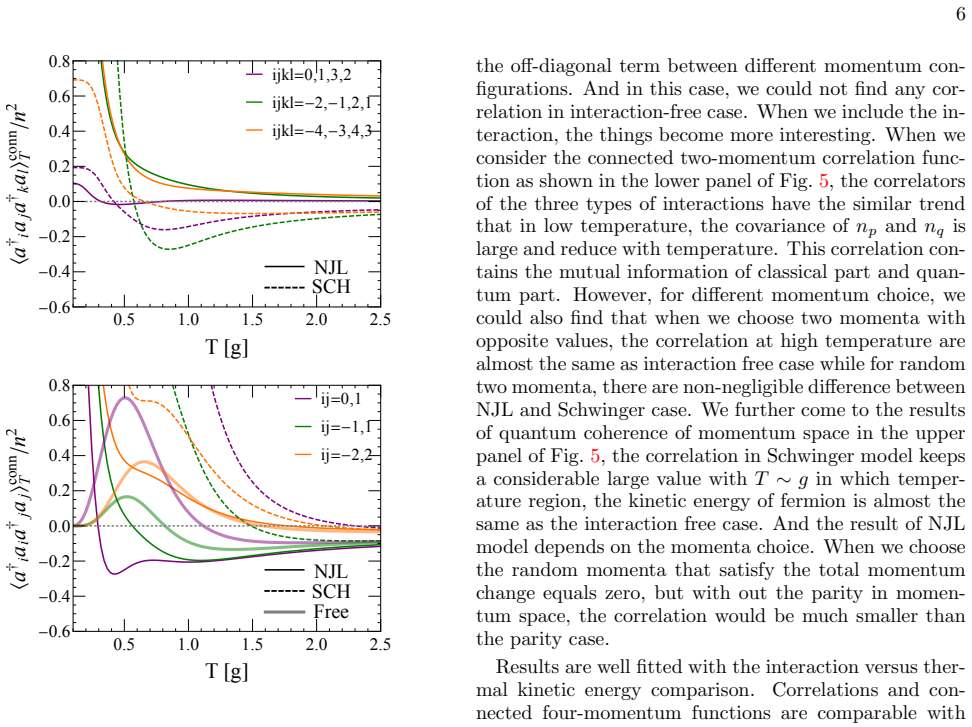
In these one-dimensional interacting lattice spinor theories, ab-initio calculations of single-particle and two-particle momentum distribution functions at finite temperature show that for a high-enough temperature at which the thermal kinetic energy is comparable with the interaction, the two-particle correlation is subdominant compared to the single particle distributions, which indicates the applicability of kinetic theory.
What carries the argument
The direct comparison of single-particle momentum distribution functions against the connected component of the two-particle momentum correlation functions, extracted from finite-temperature lattice computations.
Load-bearing premise
That the subdominance of connected two-particle correlations seen in these specific one-dimensional momentum-discretized lattice models is enough to conclude that kinetic theory applies across the wider class of strongly coupled thermal quantum systems.
What would settle it
A calculation or measurement in a different model, dimension, or without momentum discretization showing that connected two-particle correlations remain comparable to or larger than single-particle distributions even when thermal kinetic energy matches the interaction strength would falsify the indication.
Figures
read the original abstract
In this work, we construct one-dimensional interacting lattice spinor theories with discretization in momentum space. We focus on strongly interacting Schwinger and Nambu--Jona-Lasinio models and perform ab-initio calculation of their single-particle and two-particle momentum distribution functions at finite temperature. We observe, at low temperature, high-momentum tail in single-particle and two particle distribution which reveals relative momentum in fermion-antifermion boundstates, as well as quasi-free spinor gases behavior at high temperature. The non-vanishing connected four-momentum function reveals the quantum coherence in momentum space under thermal equilibrium of the system and indicate the single particle correlation would remember more microscopic details within a thermal system. Overall, for a high-enough temperature at which the thermal kinetic energy comparable with the interaction, we observe that the two-particle correlation is subdominant compared to the single particle distributions, which indicates the applicability of kinetic theory.
Editorial analysis
A structured set of objections, weighed in public.
Referee Report
Summary. The manuscript constructs one-dimensional interacting lattice spinor theories with momentum-space discretization, focusing on the Schwinger and Nambu-Jona-Lasinio models. Through ab-initio calculations, it examines single-particle and two-particle momentum distribution functions at finite temperature. The authors report high-momentum tails at low temperatures indicative of fermion-antifermion bound states, quasi-free behavior at high temperatures, and a non-vanishing connected four-momentum function suggesting quantum coherence. The central claim is that at high enough temperatures where thermal kinetic energy is comparable to the interaction strength, the two-particle correlation is subdominant to single-particle distributions, indicating the applicability of kinetic theory.
Significance. If the observed hierarchy generalizes, the work provides numerical evidence for the conditions under which kinetic theory may apply even in strongly coupled regimes. The explicit demonstration in specific models and the note on quantum coherence add to the discussion of thermal quantum systems. However, the lack of analytical support or broader tests limits the significance to a case study.
major comments (3)
- [Abstract] Abstract: The claim that subdominance of the two-particle correlation indicates applicability of kinetic theory to strongly coupled thermal quantum systems in general is not supported by any derivation or argument showing why this observation is not specific to the 1D lattice models with momentum discretization studied here.
- [Abstract] Abstract: The non-vanishing connected four-momentum function, which reveals quantum coherence in momentum space, is noted but not quantitatively reconciled with the conclusion that kinetic theory applies, as kinetic theory typically assumes incoherent quasiparticle dynamics.
- [Abstract] Abstract: No evidence or discussion is provided on whether the subdominance holds in higher dimensions, continuum limits, or other strongly coupled systems beyond the specific Schwinger and NJL lattice models.
minor comments (2)
- [Abstract] Grammatical issues: 'comparable with the interaction' should be 'comparable to the interaction'; 'indicate the single particle correlation would remember' should be 'indicates that the single-particle correlation would remember'.
- [Abstract] The phrase 'quasi-free spinor gases behavior' is unclear; consider rephrasing to 'behavior of a quasi-free spinor gas'.
Simulated Author's Rebuttal
We thank the referee for the detailed comments on our manuscript. We address each major comment point by point below, with revisions where appropriate.
read point-by-point responses
-
Referee: [Abstract] Abstract: The claim that subdominance of the two-particle correlation indicates applicability of kinetic theory to strongly coupled thermal quantum systems in general is not supported by any derivation or argument showing why this observation is not specific to the 1D lattice models with momentum discretization studied here.
Authors: We agree that the manuscript presents numerical results for specific 1D lattice Schwinger and NJL models and does not contain a general derivation establishing applicability beyond these cases. The central observation is that the two-particle correlation becomes subdominant when thermal kinetic energy is comparable to the interaction strength in the models studied. We will revise the abstract to clarify that this hierarchy is observed in the 1D lattice models considered, providing case-study evidence rather than a general claim. revision: partial
-
Referee: [Abstract] Abstract: The non-vanishing connected four-momentum function, which reveals quantum coherence in momentum space, is noted but not quantitatively reconciled with the conclusion that kinetic theory applies, as kinetic theory typically assumes incoherent quasiparticle dynamics.
Authors: The non-vanishing connected four-momentum function is reported as evidence of residual quantum coherence. Our calculations nevertheless show the two-particle distributions remain subdominant to single-particle ones at sufficiently high temperature. We will add a paragraph in the discussion section providing a quantitative comparison of the relative magnitudes of the connected and disconnected contributions to address how coherence coexists with the observed hierarchy. revision: partial
-
Referee: [Abstract] Abstract: No evidence or discussion is provided on whether the subdominance holds in higher dimensions, continuum limits, or other strongly coupled systems beyond the specific Schwinger and NJL lattice models.
Authors: The work is a targeted case study of 1D lattice models with momentum-space discretization. Extending the analysis to higher dimensions or the continuum limit would require new numerical implementations and is outside the present scope. revision: no
- Lack of a general derivation showing why the observed hierarchy should hold beyond the specific 1D lattice models.
- Absence of evidence or discussion for higher dimensions, continuum limits, or other strongly coupled systems.
Circularity Check
No derivation chain present; claim is direct observation from model computations
full rationale
The paper constructs specific 1D lattice models (Schwinger and NJL), performs ab-initio computations of momentum distributions, and reports an observational finding that two-particle correlations become subdominant at high T. The statement that this 'indicates the applicability of kinetic theory' is an interpretive conclusion from the numerics in those models, not a derivation or prediction that reduces to its own inputs by construction. No equations are presented that equate a claimed result to a fitted parameter or self-cited premise. No self-citations, ansatze, or uniqueness theorems are invoked in the provided text. The generalization to broader strongly coupled systems is a scope limitation rather than a circular step in any derivation.
Axiom & Free-Parameter Ledger
Reference graph
Works this paper leans on
-
[1]
Strongly coupled quark-gluon plasma in heavy ion collisions,
Edward Shuryak, “Strongly coupled quark-gluon plasma in heavy ion collisions,” Rev. Mod. Phys.89, 035001 (2017), arXiv:1412.8393 [hep-ph]
Pith/arXiv arXiv 2017
-
[2]
Why does the quark gluon plasma at RHIC behave as a nearly ideal fluid?
Edward Shuryak, “Why does the quark gluon plasma at RHIC behave as a nearly ideal fluid?” Prog. Part. Nucl. Phys.53, 273–303 (2004), arXiv:hep-ph/0312227
Pith/arXiv arXiv 2004
-
[3]
’Bottom up’ thermalization in heavy ion collisions,
R. Baier, Alfred H. Mueller, D. Schiff, and D. T. Son, “’Bottom up’ thermalization in heavy ion collisions,” Phys. Lett. B502, 51–58 (2001), arXiv:hep-ph/0009237
Pith/arXiv arXiv 2001
-
[4]
Isotropization and hydro- dynamization in weakly coupled heavy-ion collisions,
Aleksi Kurkela and Yan Zhu, “Isotropization and hydro- dynamization in weakly coupled heavy-ion collisions,” Phys. Rev. Lett.115, 182301 (2015), arXiv:1506.06647 [hep-ph]
Pith/arXiv arXiv 2015
-
[5]
Bose– Einstein Condensation and Thermalization of the Quark Gluon Plasma,
Jean-Paul Blaizot, Francois Gelis, Jin-Feng Liao, Larry McLerran, and Raju Venugopalan, “Bose– Einstein Condensation and Thermalization of the Quark Gluon Plasma,” Nucl. Phys. A873, 68–80 (2012), arXiv:1107.5296 [hep-ph]
Pith/arXiv arXiv 2012
-
[6]
Jean-Paul Blaizot, Jinfeng Liao, and Larry McLerran, “Gluon Transport Equation in the Small Angle Approx- imation and the Onset of Bose-Einstein Condensation,” Nucl. Phys. A920, 58–77 (2013), arXiv:1305.2119 [hep- ph]
Pith/arXiv arXiv 2013
-
[7]
Bose condensation far from equilibrium,
J. Berges and D. Sexty, “Bose condensation far from equilibrium,” Phys. Rev. Lett.108, 161601 (2012), arXiv:1201.0687 [hep-ph]
Pith/arXiv arXiv 2012
-
[8]
Universality far from equilibrium: From super- fluid Bose gases to heavy-ion collisions,
J. Berges, K. Boguslavski, S. Schlichting, and R. Venu- gopalan, “Universality far from equilibrium: From super- fluid Bose gases to heavy-ion collisions,” Phys. Rev. Lett. 114, 061601 (2015), arXiv:1408.1670 [hep-ph]
Pith/arXiv arXiv 2015
-
[9]
Quark pro- duction, Bose–Einstein condensates and thermalization of the quark–gluon plasma,
Jean-Paul Blaizot, Bin Wu, and Li Yan, “Quark pro- duction, Bose–Einstein condensates and thermalization of the quark–gluon plasma,” Nucl. Phys. A930, 139–162 (2014), arXiv:1402.5049 [hep-ph]
Pith/arXiv arXiv 2014
-
[10]
Thermalization of gluons with Bose-Einstein condensation,
Zhe Xu, Kai Zhou, Pengfei Zhuang, and Carsten Greiner, “Thermalization of gluons with Bose-Einstein condensation,” Phys. Rev. Lett.114, 182301 (2015), arXiv:1410.5616 [hep-ph]
Pith/arXiv arXiv 2015
-
[11]
Xingjian Lu and Shuzhe Shi, “Spectral Bogoliubov-Born- Green-Kirkwood-Yvon hierarchical approach: A scalable scheme for nonlinear Boltzmann and correlation kinet- ics,” Phys. Rev. C113, 034917 (2026), arXiv:2507.14243 [nucl-th]
arXiv 2026
-
[12]
Decoupling hydrody- namization from thermalization via nonlinear Boltzmann equation,
Xingjian Lu and Shuzhe Shi, “Decoupling hydrody- namization from thermalization via nonlinear Boltzmann equation,” (2025), arXiv:2509.23978 [hep-ph]
arXiv 2025
-
[13]
Gauge Invariance and Mass. 2
Julian S. Schwinger, “Gauge Invariance and Mass. 2.” Phys. Rev.128, 2425–2429 (1962)
1962
-
[14]
Quantum electro- dynamics in two-dimensions,
J. H. Lowenstein and J. A. Swieca, “Quantum electro- dynamics in two-dimensions,” Annals Phys.68, 172–195 (1971)
1971
-
[15]
SCHWINGER MODEL ON S(2),
C. Jayewardena, “SCHWINGER MODEL ON S(2),” Helv. Phys. Acta61, 636–711 (1988). 8
1988
-
[16]
On the fermion condensate in Schwinger model,
Andrei V. Smilga, “On the fermion condensate in Schwinger model,” Phys. Lett. B278, 371–376 (1992)
1992
-
[17]
Instantons and vacuum expectation values in the Schwinger model,
C. Adam, “Instantons and vacuum expectation values in the Schwinger model,” Z. Phys. C63, 169–180 (1994)
1994
-
[18]
Massive Schwinger model within mass perturbation theory,
Christoph Adam, “Massive Schwinger model within mass perturbation theory,” Annals Phys.259, 1–63 (1997), arXiv:hep-th/9704064
Pith/arXiv arXiv 1997
-
[19]
More About the Massive Schwinger Model,
Sidney R. Coleman, “More About the Massive Schwinger Model,” Annals Phys.101, 239 (1976)
1976
-
[20]
The Schwinger mass in the massive Schwinger model,
Christoph Adam, “The Schwinger mass in the massive Schwinger model,” Phys. Lett. B382, 383–388 (1996), arXiv:hep-ph/9507331
Pith/arXiv arXiv 1996
-
[21]
General bound state structure of the massive Schwinger model,
C. Adam, “General bound state structure of the massive Schwinger model,” Phys. Lett. B382, 111–116 (1996), arXiv:hep-th/9602175
Pith/arXiv arXiv 1996
-
[22]
The boson-boson bound state in the massive Schwinger model,
Christoph Adam, “The boson-boson bound state in the massive Schwinger model,” Z. Phys. C74, 727–730 (1997), arXiv:hep-ph/9601227
Pith/arXiv arXiv 1997
-
[23]
Quan- tum thermalization of Quark-Gluon Plasma,
Shile Chen, Li Yan, and Shuzhe Shi, “Quan- tum thermalization of Quark-Gluon Plasma,” (2024), arXiv:2412.00662 [hep-ph]
arXiv 2024
-
[24]
Collective motion in the massive Schwinger model via Tensor Net- work,
Haiyang Shao, Shile Chen, and Shuzhe Shi, “Collective motion in the massive Schwinger model via Tensor Net- work,” (2025), arXiv:2509.10835 [hep-ph]
arXiv 2025
-
[25]
Onset of Bjorken Flow in Quantum Evolution of the Massive Schwinger Model,
Haiyang Shao, Shile Chen, and Shuzhe Shi, “Onset of Bjorken Flow in Quantum Evolution of the Massive Schwinger Model,” (2025), arXiv:2509.10855 [hep-ph]
arXiv 2025
-
[26]
Long time derivation of the Boltzmann equation from hard sphere dynamics,
Yu Deng, Zaher Hani, and Xiao Ma, “Long time derivation of the Boltzmann equation from hard sphere dynamics,” arXiv e-prints , arXiv:2408.07818 (2024), arXiv:2408.07818 [math.AP]
arXiv 2024
-
[27]
Hilbert’s sixth problem: derivation of fluid equations via Boltzmann’s kinetic theory,
Yu Deng, Zaher Hani, and Xiao Ma, “Hilbert’s sixth problem: derivation of fluid equations via Boltzmann’s kinetic theory,” arXiv e-prints , arXiv:2503.01800 (2025), arXiv:2503.01800 [math.AP]
arXiv 2025
-
[28]
Gluon Polarimetry with Energy-Energy Correlators,
Yu-Kun Song, Shu-Yi Wei, Lei Yang, and Jian Zhou, “Gluon Polarimetry with Energy-Energy Correlators,” Phys. Rev. Lett.136, 131901 (2026), arXiv:2509.14960 [hep-ph]
arXiv 2026
-
[29]
Accessing Nucleon Transversity with One-Point Energy Correlators,
Mei-Sen Gao, Zhong-Bo Kang, Wanchen Li, and Ding Yu Shao, “Accessing Nucleon Transversity with One-Point Energy Correlators,” Phys. Rev. Lett.136, 151902 (2026), arXiv:2509.15809 [hep-ph]
Pith/arXiv arXiv 2026
-
[30]
Jo˜ ao Barata, Jos´ e Guilherme Milhano, Andrey V. Sad- ofyev, and Jo˜ ao M. Silva, “Early-Time Dynamics of Heavy-Ion Collisions through Energy Correlators: ce- lestial blocks and the spacetime structure of out-of- equilibrium QCD matter,” (2025), arXiv:2512.17009 [hep-ph]
arXiv 2025
-
[31]
No Go Theorem for Regularizing Chiral Fermions,
Holger Bech Nielsen and M. Ninomiya, “No Go Theorem for Regularizing Chiral Fermions,” Phys. Lett. B105, 219–223 (1981)
1981
-
[32]
Mo- mentum Lattice Simulation on a Small Lattice Using Stochastic Quantization,
H. Kroger, S. Lantagne, and K. J. M. Moriarty, “Mo- mentum Lattice Simulation on a Small Lattice Using Stochastic Quantization,” J. Comput. Phys.122, 335– 342 (1995), arXiv:hep-lat/9310012
Pith/arXiv arXiv 1995
-
[33]
Physics from Breit-Frame reg- ularization of a lattice Hamiltonian,
H. Kroger and N. Scheu, “Physics from Breit-Frame reg- ularization of a lattice Hamiltonian,” Phys. Rev. D56, 1455–1469 (1997), arXiv:hep-lat/9607006
Pith/arXiv arXiv 1997
-
[34]
The Massive Schwinger model: A Hamiltonian lattice study in a fast moving frame,
Helmut Kroger and Norbert Scheu, “The Massive Schwinger model: A Hamiltonian lattice study in a fast moving frame,” Phys. Lett. B429, 58–63 (1998), arXiv:hep-lat/9804024
Pith/arXiv arXiv 1998
-
[35]
Dynamical Model of Elementary Particles Based on an Analogy with Su- perconductivity. 1
Yoichiro Nambu and G. Jona-Lasinio, “Dynamical Model of Elementary Particles Based on an Analogy with Su- perconductivity. 1.” Phys. Rev.122, 345–358 (1961)
1961
-
[36]
QCD phenomenol- ogy based on a chiral effective Lagrangian,
Tetsuo Hatsuda and Teiji Kunihiro, “QCD phenomenol- ogy based on a chiral effective Lagrangian,” Phys. Rept. 247, 221–367 (1994), arXiv:hep-ph/9401310
Pith/arXiv arXiv 1994
-
[37]
NJL model analysis of quark mat- ter at large density,
Michael Buballa, “NJL model analysis of quark mat- ter at large density,” Phys. Rept.407, 205–376 (2005), arXiv:hep-ph/0402234
Pith/arXiv arXiv 2005
-
[38]
Chiral phase transition within effective mod- els with constituent quarks,
O. Scavenius, A. Mocsy, I. N. Mishustin, and D. H. Rischke, “Chiral phase transition within effective mod- els with constituent quarks,” Phys. Rev. C64, 045202 (2001), arXiv:nucl-th/0007030
Pith/arXiv arXiv 2001
-
[39]
Pion super- fluidity and meson properties at finite isospin density,
Lian-yi He, Meng Jin, and Peng-fei Zhuang, “Pion super- fluidity and meson properties at finite isospin density,” Phys. Rev. D71, 116001 (2005), arXiv:hep-ph/0503272
Pith/arXiv arXiv 2005
-
[40]
Quantum simulation of chiral phase transi- tions,
Alexander M. Czajka, Zhong-Bo Kang, Henry Ma, and Fanyi Zhao, “Quantum simulation of chiral phase transi- tions,” JHEP08, 209 (2022), arXiv:2112.03944 [hep-ph]
arXiv 2022
-
[41]
Quantum computing of chirality imbalance in SU(2) gauge theory,
Guofeng Zhang, Xingyu Guo, Enke Wang, and Hongxi Xing, “Quantum computing of chirality imbalance in SU(2) gauge theory,” Phys. Rev. D111, 056031 (2025), arXiv:2411.18869 [hep-ph]
arXiv 2025
-
[42]
About the Pauli exclusion principle,
Pascual Jordan and Eugene P. Wigner, “About the Pauli exclusion principle,” Z. Phys.47, 631–651 (1928)
1928
-
[43]
Res- onating mean field theoretical description of pi and sigma mesons by the Nambu-Jona-Lasinio model,
S. Nishiyama, J. da Providencia, and O. Ohno, “Res- onating mean field theoretical description of pi and sigma mesons by the Nambu-Jona-Lasinio model,” Nucl. Phys. A688, 882–904 (2001)
2001
-
[44]
Revealing the short-range structure of the mirror nuclei 3H and 3He,
S. Liet al., “Revealing the short-range structure of the mirror nuclei 3H and 3He,” Nature609, 41–45 (2022), arXiv:2210.04189 [nucl-ex]
arXiv 2022
-
[45]
Dawei Siet al., “Extracting Neutron-Neutron Interac- tion Strength and Spatiotemporal Dynamics of Neutron Emission from the Two-Particle Correlation Function,” Phys. Rev. Lett.134, 222301 (2025), arXiv:2501.09576 [nucl-ex]
arXiv 2025
discussion (0)
Sign in with ORCID, Apple, or X to comment. Anyone can read and Pith papers without signing in.