REVIEW 2 major objections 6 minor 42 references
Nucleon spin polarization in intermediate-energy heavy-ion collisions
T0 review · 2 major / 6 minor · reviewed 2026-08-14 · deepseek-v4-flash
Pith's one-line read Non-central heavy-ion collisions at intermediate energies produce nucleon spin polarization that is governed by the time-odd part of the nuclear spin-orbit potential, not by density-gradient forces.
desk verdict A useful first baseline for nucleon spin polarization at intermediate energies, but the headline claim that the time-odd spin-orbit potential dominates rests on visual contours rather than a quantitative decomposition. read the letter →
The pith
A machine-rendered reading of the paper's core claim, the machinery that carries it, and where it could break.
The reading
What carries the argument
The load-bearing object is the Skyrme spin-orbit energy density functional $V_{so}$ and its split into time-even and time-odd pieces. Expressed in lattice-evaluated densities, $V_{so}= -(W_0/2)[\rho\nabla\cdot\vec{J} + \vec{s}\cdot\nabla\times\vec{j} + \sum_\tau (\rho_\tau \nabla\cdot\vec{J}_\tau + \vec{s}_\tau\cdot\nabla\times\vec{j}_\tau)]$, where the terms with $\vec{s}$ and $\vec{j}$ are the time-odd ones. In the simulation each nucleon carries a unit spin vector $\vec{\sigma}_i$ that precesses through $d\vec{\sigma}_i/dt = \vec{I}_i \times \vec{\sigma}_i$, with $\vec{I}_i$ built from lattice sums over density, spin density, and $\nabla\times\vec{j}$. The lattice Hamiltonian method is what turns the continuous functional into site sums that generate the precession torque, making the time-odd contribution concrete enough to compare against the time-even one.
What would settle it
Take the simulation and remove the time-odd terms in the spin-orbit functional: the central claim implies most of the polarization, both in the $y$ direction and in the $z$ direction in the participant region, should disappear. Experimentally, measure the azimuthal-angle dependence of the longitudinal polarization of midrapidity high-$p_T$ protons in peripheral Au+Au collisions near 100 AMeV; the predicted sign at $b=12$ fm is opposite to that at $b=4$ and $8$ fm, so a measured pattern that does not reverse with impact parameter would rule out the time-odd-dominated mechanism as implemented.
Extended reading notes
Core claim
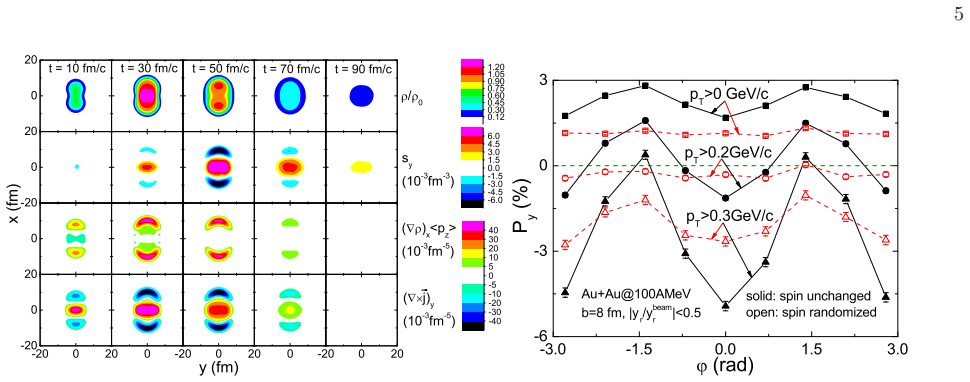
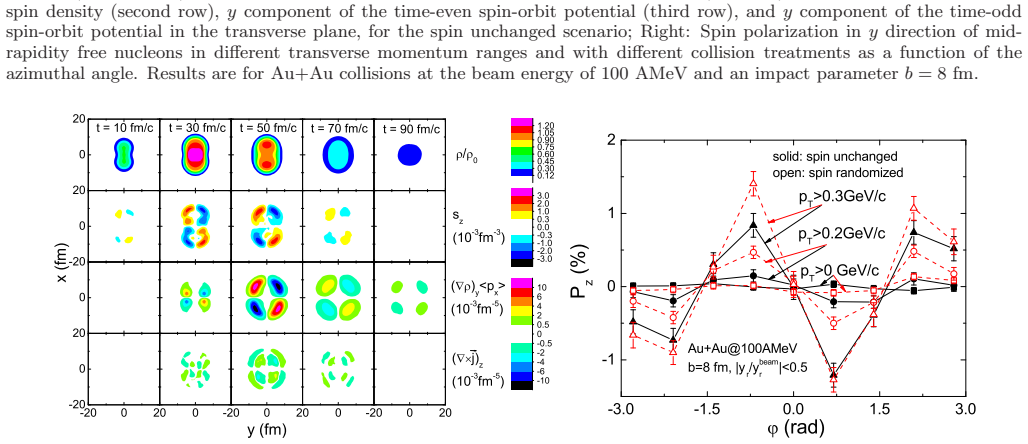
The paper's central claim is that in non-central intermediate-energy heavy-ion collisions, the nucleon spin polarization is set by the time-odd component of the nuclear spin-orbit potential. In the energy density functional $V_{so}$, the time-odd terms are those involving the spin density $\vec{s}$ and the momentum (current) density $\vec{j}$, in particular $\vec{s}\cdot(\nabla\times\vec{j})$ and its isospin-dependent counterpart, while the time-even terms involve the number density $\rho$ and the spin-current density $\vec{J}$. In Au+Au collisions at 100 AMeV and $b=8$ fm, the time-odd potential gives an opposite and larger torque than the time-even term, aligning participant nucleons parallel to the collision's angular momentum ($+y$) and spectator nucleons antiparallel. The same decomposition explains the local polarization along the beam direction: although the time-even $(\nabla\rho)_y\langle p_x\rangle$ term is locally strong, it mostly acts on spectator matter, whereas the time-odd $\nabla\times\vec{j}$ term dominates the participant region that produces the observable free nucleons. The paper reports that global polarization grows toward midrapidity, is larger for peripheral collisions, and saturates around 100-150 AMeV, and that the local longitudinal polarization reverses its azimuthal sign at $b=12$ fm relative to $b=4$ and $8$ fm.
Load-bearing premise
The spin dynamics treats each nucleon's spin as a classical unit vector that precesses in the mean field and, after each collision, is either left unchanged or rotated by a random angle because the in-medium spin-flip process is largely unknown; if that treatment is not faithful, the polarization magnitude and the inferred dominance of the time-odd term could change.
Editorial extensions
If this is right
- In non-central intermediate-energy collisions, the global spin polarization of emitted nucleons should peak at midrapidity and its azimuthal dependence should show the spectator-blocking pattern seen here: valleys near the reaction-plane directions and peaks near the out-of-plane directions.
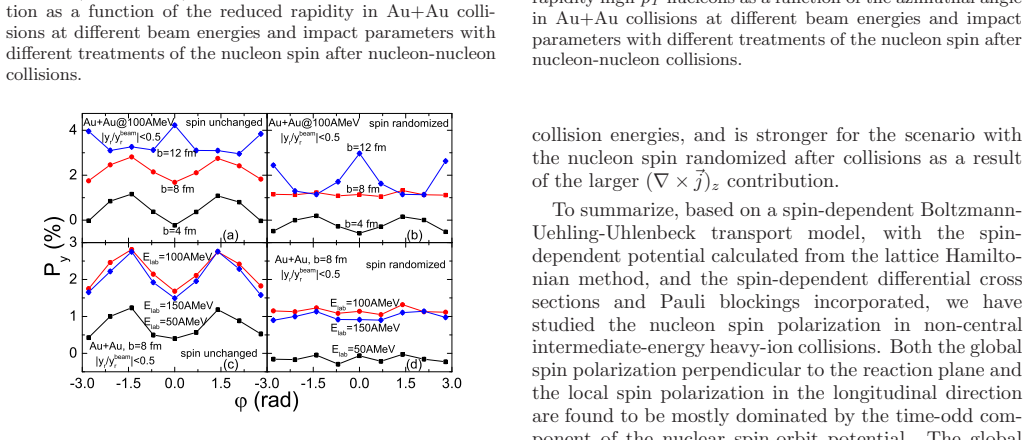
- The global polarization should be larger in peripheral collisions ($b=12$ fm) than in midcentral ones, and its magnitude should stop growing beyond a beam energy of roughly 100 to 150 AMeV.
- The longitudinal (beam-direction) polarization of midrapidity high-$p_T$ nucleons should reverse its sign as a function of azimuth when going from $b=4$ or $8$ fm to $b=12$ fm.
- Randomizing the nucleon spin after each collision weakens the global polarization but can enhance the local longitudinal polarization, because the spin-randomized scenario produces a larger $(\nabla \times \vec{j})_z$ in the participant region.
- Uncertainty in the spin-orbit strength $W_0$ translates directly into uncertainty in the polarization magnitude: lower strength, near 80 MeV fm$^5$, gives weaker polarization than the default 150 MeV fm$^5$.
Reading between the lines
- A direct experimental test of the time-odd-dominated mechanism could use the predicted sign reversal of the longitudinal polarization between midcentral and peripheral impact parameters, since that reversal is a geometric fingerprint of the $\nabla\times\vec{j}$ torque rather than of density-gradient forces.
- The same precession mechanism should act on composite fragments or light clusters emitted from the participant region; if the spin rotation operates before fragment formation, their decay asymmetries could carry a larger and cleaner polarization signal than free nucleons alone.
- Because the time-odd torque depends on the curl of the momentum density, the predicted signal may be sensitive to the assumed initial momentum sampling; repeating the calculation with different Fermi-momentum or flow initializations would test how much of the claimed dominance is robust to that modeling choice.
Signed reviews
Editorial analysis
A structured set of objections, weighed in public.
Referee Report
Summary. This paper extends a spin-dependent Boltzmann-Uehling-Uhlenbeck transport model, with spin-dependent densities evaluated on a lattice Hamiltonian grid, to study global spin polarization perpendicular to the reaction plane and local longitudinal spin polarization in non-central intermediate-energy heavy-ion collisions. The authors state in the abstract and conclusion that both polarizations are mostly dominated by the time-odd component of the nuclear spin-orbit potential. They also report dependence of the polarization on the spin-orbit strength W0, on two ad hoc treatments of the nucleon spin after two-body collisions, and on beam energy and impact parameter, including a saturation near 100-150 AMeV and a sign reversal of the local longitudinal polarization at b = 12 fm. The paper is framed as a baseline for spin polarization studies in nucleon-dominated heavy-ion collisions.
Significance. If the central mechanism claim holds, the paper would identify a concrete microscopic source of spin polarization in intermediate-energy collisions and provide falsifiable predictions (stronger midrapidity polarization, peripheral enhancement, energy saturation, and an azimuthal sign reversal at large impact parameter). The model is not fitted to the polarization observable: W0 is taken from nuclear-structure fits, spin-dependent cross sections come from phase-shift analyses, and the lattice parameters are stated explicitly. The paper is also transparent about the uncertain treatment of post-collision spin flips. However, the central mechanistic claim is currently supported mainly by visual comparison of potential-density contours rather than by a quantitative decomposition, and the quantitative predictions are scenario-dependent; these issues are fixable and should be addressed before publication.
major comments (2)
- [§3, Figs. 1-3 and abstract/conclusion] The claim that both global and local spin polarizations are 'mostly dominated by the time-odd component' is not quantitatively established. The evidence in Figs. 1-3 is a side-by-side view of the time-even and time-odd potential densities at selected times, accompanied by statements that one component is 'opposite but larger' or 'dominates the participant region.' However, the final polarization is generated by the time-integrated spin precession of Eq. (17), dσ_i/dt = I_i × σ_i, with I_i containing both time-even and time-odd terms, and the observable is then filtered by the free-nucleon density cut and spectator blocking. A larger potential density at one time does not imply a larger contribution to the final polarization. I recommend running controlled decomposition tests, e.g., switching off the time-even or time-odd terms in Eq. (17) (or integrating the torque contributions along nucleon trajectories), and comparing the resulting P_y and P_z. This is load-bearing because the stated novelty is the mechanism, not merely the existence of polarization.
- [§2, collision-treatment paragraph] The treatment of the nucleon spin after a two-body collision is underspecified and unvalidated. The paper states that 'how the nucleon spin is changed after collisions is largely unknown, especially in nuclear medium,' and then models the realistic scenario by rotating the spin around the vector I_i of Eq. (18) by 'a random angle.' The distribution of the random angle is not given, so the results are not fully reproducible. More importantly, Figs. 4-6 show that the two collision scenarios change the magnitude and even the sign of P_y at large rapidity and the magnitude of P_z at all rapidities; the randomized scenario also enhances the longitudinal polarization through a larger (∇ × j)_z contribution. Because the central quantitative predictions are scenario-dependent, the manuscript should at least specify the rotation-angle distribution and quantify the sensitivity, and ideally constrain the treatment against an independent spin-dependent observable from the same transport framework.
minor comments (6)
- [§2, Eq. (17)] The isospin-dependent term in Eq. (17) is left as 1/i [σ_i, N l^3 Σ_α V^τ_so] with the comment that it has 'the same structure.' Writing this term explicitly would improve reproducibility, since the isospin index convention is otherwise unclear.
- [§2, collision-treatment paragraph] If the 'random angle' in the post-collision spin rotation is drawn from a specific distribution (e.g., uniform in [0, 2π]), that distribution should be stated explicitly; otherwise the scenario is not reproducible.
- [§3, Fig. 4 and summary] The text says the polarization 'saturates at the beam energy of around 100 AMeV' in the summary but 'saturates around the beam energy of 100 ∼ 150 AMeV' in the main text; please make the statement consistent.
- [§3, Fig. 6 caption and text] The caption of Fig. 6 refers to 'mid-rapidity high-pT nucleons' while the text says 'mid-rapidity free nucleons in z direction'; please clarify which selection of pT is used for each panel.
- [§3, Figs. 1-6] No statistical uncertainties are reported. Since the simulations use N = 200 parallel events with finite binning in rapidity, pT, and azimuthal angle, error bars would help assess whether the sign reversal at b = 12 fm and the differences between collision scenarios are significant rather than numerical noise.
- [Title/header] There are typographic artifacts in the manuscript source, e.g., 'heavy-i on collisions' in the header; these should be corrected in the final version.
Circularity Check
No circularity found: the spin-polarization results are out-of-sample predictions with externally fixed inputs, and no equation reduces the observable to a fitted parameter or to a self-citation.
full rationale
The paper's derivation chain is self-contained against external inputs. The spin-orbit strength W0 is taken from nuclear structure fits (Refs. [40-42], 'W0 = 80~150 MeVfm5'), and the spin-dependent cross sections come from phase-shift analyses (Ref. [38]) parameterized in Ref. [39]; neither is adjusted to reproduce the computed polarizations. The central claim that time-odd components dominate is a mechanistic attribution based on comparing time-even and time-odd potential densities in Figs. 1-3, not a quantity defined as its own input: Eq. (17) contains both types of torque, and the observed polarization is the integrated result of the spin-precession dynamics, spectator blocking, and the free-nucleon density cut. No equation reduces the predicted P_y or P_z to a fitted parameter, and no 'uniqueness theorem' or self-citation is invoked to force the choice of the time-odd term. Self-citations to Refs. [29,30,34,39] concern the SBUU formalism and previous flow studies; they are methodological and do not assume the polarization result. Even the weaker-support concern that the time-odd dominance is read off potential-density plots rather than a controlled switch-off decomposition is a correctness/validation issue, not circularity. Under the stated criteria, no step is circular.
Assumptions & free parameters
free parameters (3)
- W0 (spin-orbit coupling strength) =
default 150 MeV fm^5; range 80 to 150 MeV fm^5
- Lattice discretization parameters (l = 1 fm, N = 200, n = 2) =
l = 1 fm, N = 200, n = 2
- Free-nucleon density threshold =
1/8 rho0 = 0.02 fm^-3
assumptions (4)
- domain assumption The Skyrme-type spin-orbit effective interaction of Eq. (1), with the time-even and time-odd contributions of Eq. (2), governs the nuclear spin dynamics.
- domain assumption Spin-dependent BUU transport with test particles and lattice-Hamiltonian densities is a valid approximation to the nuclear many-body dynamics.
- domain assumption Nucleon spin can be treated as a classical unit vector precessing via Eq. (17), with post-collision spin changes represented by the unchanged and randomized scenarios.
- domain assumption Spin- and isospin-dependent Pauli blocking and spin-dependent cross sections from phase-shift analyses (Refs. [38,39]) are applicable in the medium.
Cite this review
Pith. "Pith review of Nucleon spin polarization in intermediate-energy heavy-ion collisions." pith.science (2026). https://pith.science/paper/XENO4TZK
@misc{pith2026190802097,
  author       = {Pith},
  title        = {Pith review of: Nucleon spin polarization in intermediate-energy heavy-ion collisions},
  year         = {2026},
  howpublished = {\url{https://pith.science/paper/XENO4TZK}},
  note         = {Machine review of arXiv:1908.02097}
}
read the original abstract
Based on a spin-dependent Boltzmann-Uehling-Uhlenbeck transport model with spin-dependent potentials incorporated using the lattice Hamiltonian method, we have studied the global spin polarization perpendicular to the reaction plane as well as the local spin polarization in the longitudinal direction in non-central intermediate-energy heavy-ion collisions, as an extension of similar studies in relativistic heavy-ion collisions. Both the global and the local spin polarizations are found to be mostly dominated by the time-odd component of the nuclear spin-orbit potential. Impacts of various theoretical uncertainties on the nucleon spin polarization as well as its dependence on the beam energy and impact parameter are discussed. Our study serves as a baseline for understanding the spin polarization mechanism of strongly interacting matter produced in heavy-ion collisions dominated by nucleon degree of freedom.
Figures

Figures from the paper (2 more)

Reference graph
Works this paper leans on
-
[1]
Z. T. Liang and X. N. Wang, Phys. Rev. Lett. 94, 102301 (2005); 96, 039901(E) (2006)
work page 2005
-
[2]
B. I. Abelev et al. [STAR Collaboration], Phys. Rev. C 76, 024915 (2007)
work page 2007
-
[3]
B. I. Abelev et al. [STAR Collaboration], Phys. Rev. C 77, 061902 (2008)
work page 2008
- [4]
- [5]
-
[6]
B. Betz, M. Gyulassy, and G. Torrieri, Phys. Rev. C 76, 044901 (2007)
work page 2007
-
[7]
Becattini, F
F. Becattini, F. Piccinini, and J. Rizzo, Phys. Rev. C 77, 024906 (2008)
2008
- [8]
Show all 42 references
-
[9]
Becattini, V
F. Becattini, V. Chandra, L. Del Zanna, and E. Grossi, Ann. Phys. 338, 32 (2013)
2013
-
[10]
Becattini, L
F. Becattini, L. P. Csernai, and D. J. Wang, Phys. Rev. C 88, 034905 (2013); 93, 069901 (E) (2016)
2013
-
[11]
R. H. Fang, L. G. Pang, Q. Wang, and X. N. Wang, Phys. Rev. C 94, 024904 (2016)
2016
-
[12]
Jiang, Z
Y. Jiang, Z. W. Lin, and J. Liao, Phys. Rev. C 94, 044910 (2016)
2016
-
[13]
H. Li, L. G. Pang, Q. Wang, and X. L. Xia, Phys. Rev. C 96, 054908 (2017)
2017
-
[14]
Sun and C
Y. Sun and C. M. Ko, Phys. Rev. C 96, 024906 (2017)
2017
-
[15]
Y. Xie, D. Wang, and L. P. Csernai, Phys. Rev. C 95, 031901 (2017)
2017
-
[16]
Becattini, I
F. Becattini, I. Karpenko, M. A. Lisa, I. Upsal, and S. A. Voloshin, Phys. Rev. C 95, 054902 (2017)
2017
-
[17]
L. G. Pang, H. Petersen, Q. Wang, and X. N. Wang, Phys. Rev. Lett. 117, 192301 (2016)
2016
-
[18]
X. L. Xia, H. Li, Z. B. Tang, and Q. Wang, Phys. Rev. C 98, 024905 (2018)
2018
-
[19]
Sun and C
Y. Sun and C. M. Ko, Phys. Rev. C 99, 011903 (2019)
2019
-
[20]
Becattini and Iu
F. Becattini and Iu. Karpenko, Phys. Rev. Lett. 120, 012302 (2018)
2018
-
[21]
Adam et al
J. Adam et al. [STAR Collaboration], Phys. Rev. Lett. 123, 132301 (2019)
2019
-
[22]
X. L. Xia, H. Li, X. G. Huang, and H. Z. Huang, Phys. Rev. C 100, 014913 (2019)
2019
-
[23]
Becattini, G
F. Becattini, G. Cao, and E. Speranza, Eur. Phys. J. C 79, 741 (2019)
2019
-
[24]
M. G. Mayer, Phys. Rev. 74, 235 (1948); M. G. Mayer, Phys. Rev. 75, 1969 (1949)
1948
-
[25]
Haxel, J
O. Haxel, J. H. D. Jensen, and H. E. Suess, Phys. Rev. 75, 1766 (1949)
1949
-
[26]
J. Xu, B. A. Li, W. Q. Shen, and Y. Xia, Front. Phys. 10, 102501 (2015)
2015
-
[27]
A. S. Umar, M. R. Strayer, and P. G. Reinhard, Phys. Rev. Lett. 56, 2793 (1986)
1986
-
[28]
G. F. Dai, L. Guo, E. G. Zhao, and S. G. Zhou, Phys. Rev. C 90, 044609 (2014)
2014
-
[29]
Y. Xia, J. Xu, B. A. Li, and W. Q. Shen, Phys. Rev. C 89, 064606 (2014)
2014
-
[30]
Xu and B
J. Xu and B. A. Li, Phys. Lett. B 724, 346 (2013)
2013
-
[31]
Vautherin and D
D. Vautherin and D. M. Brink, Phys. Rev. C 5, 626 (1972)
1972
-
[32]
L. W. Chen, C. M. Ko, B. A. Li, and J. Xu, Phys. Rev. C 82, 024321 (2010)
2010
-
[33]
Y. M. Engel, D. M. Brink, K. Goeke, S. J. Krieger, and D. Vautherin, Nucl. Phys. A 249, 215 (1975)
1975
-
[34]
Y. Xia, J. Xu, B. A. Li, and W. Q. Shen, Phys. Lett. B 759, 596 (2016)
2016
-
[35]
C. Y. Wong, Phys. Rev. C 25, 1460 (1982)
1982
-
[36]
G. F. Bertsch and S. Das Gupta, Phys. Rep. 160, 189 (1988)
1988
-
[37]
R. J. Lenk and V. R. Pandharipande, Phys. Rev. C 39, 2242 (1989)
1989
-
[38]
R. A. Arndt et al. , Phys. Rev. C 15, 1002 (1977)
1977
-
[39]
Y. Xia, J. Xu, B. A. Li, and W. Q. Shen, Phys. Rev. C 96, 044618 (2017)
2017
-
[40]
Lesinski, M
T. Lesinski, M. Bender, K. Bennaceur, T. Duguet, and J. Meyer, Phys. Rev. C 76, 014312 (2007)
2007
-
[41]
Zalewski, J
M. Zalewski, J. Dobaczewski, W. Satula, and T. R. Werner, Phys. Rev. C 77, 024316 (2008)
2008
-
[42]
Bender, K
M. Bender, K. Bennaceur, T. Duguet, P. H. Heenen, T. Lesinski, and J. Meyer, Phys. Rev. C 80, 064302 (2009)
2009
Reviewed August 14, 2026 · model on record in the stance chip above.
Discussion (0). Continue with ORCID to comment.