REVIEW 4 major objections 6 minor 14 references
TNASS: Tensor Network Active Space Selection with the Entanglement Feature
T0 review · 4 major / 6 minor · reviewed 2026-08-05 · deepseek-v4-flash
Pith's one-line read Selecting active spaces by multi-orbital Rényi-2 entanglement entropy lowers ground-state energies and improves dipole moments relative to single-orbital entropy ranking and HOMO/LUMO-gap selection.
desk verdict Best-k TNASS's headline advantage is an in-sample energy-minimization artifact; the fixed-k method is a solid but unproven extension of the entanglement feature. read the letter →
The pith
A machine-rendered reading of the paper's core claim, the machinery that carries it, and where it could break.
The reading
What carries the argument
The Entanglement Feature (EF) is an MPS formed by doubling each site tensor and contracting physical indices either directly (identity) or after swapping (swap), producing a local tensor with bond dimension χ^4; contracting the EF with a binary partition bitstring returns e^{-S2(A)}, so the Rényi-2 entropy of any orbital subset is one tensor contraction. This EF-MPS is the oracle that scores candidate active spaces. The search strategies—exact brute force, greedy, block greedy with block size k, and best-k over all block sizes—trade oracle calls against robustness; single-orbital entropy ranking is recovered as the k=1 limit.
What would settle it
Search for a molecule or geometry where two orbital subsets have nearly identical Rényi-2 entropy but CASCI energies differing by more than a few millihartree; if TNASS picks the higher-energy subset, the entropy oracle is not faithfully tracking energetic importance. Concretely, at a stretched geometry where the greedy method fails, enumerate all subsets of size n for a small system and compare entropy rank against CASCI energy rank.
Extended reading notes
Core claim
The paper introduces the Tensor Network Active Space Selection (TNASS) method, which constructs a matrix product state—the Entanglement Feature—whose amplitudes are the purities of all possible partitions of the molecular spin-orbital lattice. For a desired active-space size n, TNASS searches for the subset of n spatial orbitals that maximizes the Rényi-2 entropy of the bipartition, using tensor-network contractions as the oracle. On BeO and BN in the 6-31G* basis, the block-greedy and best-k variants select active spaces that give lower CASCI energies along compressed and stretched geometries and dipole moments closer to CCSD(T) reference values than orbitals chosen by single-orbital entrop
Load-bearing premise
The load-bearing premise is that the Rényi-2 entropy of an orbital subset, computed from a very cheap bond-dimension-4 MPS, ranks subsets by their energetic importance for a later CASCI treatment.
Editorial extensions
If this is right
- Active-space selection can be fully automated for strongly correlated molecules, removing user bias and manual atom preselection.
- Multi-orbital entropy captures correlations invisible to single-orbital marginals, so gains should grow for larger, more strongly correlated systems.
- Best-k greedy is a robust default among the tested variants, while plain greedy should be avoided.
- TNASS-selected active spaces can seed subsequent orbital optimisation and embedding workflows, potentially improving multiscale and quantum-computing simulations.
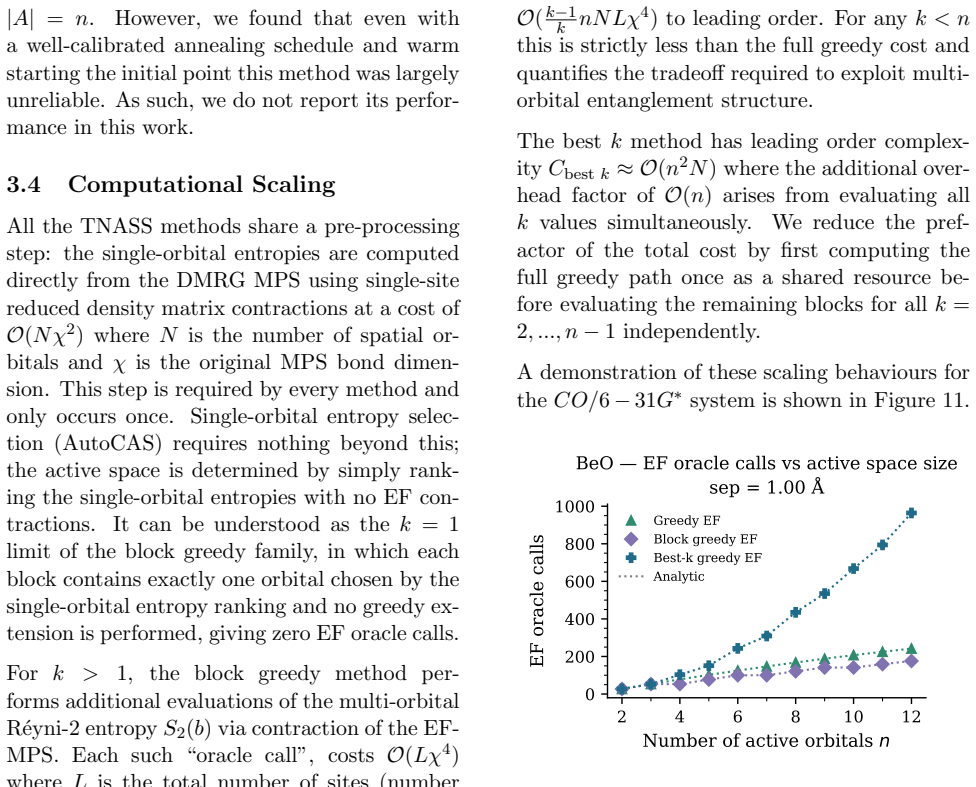
- The analytic oracle-call count lets users predict the computational overhead trade-off for a chosen block size k.
Reading between the lines
- A parameter-free version using an epsilon cutoff on the entropy gain would remove the need to fix n; the paper describes the cutoff but does not implement it, so its reliability is untested.
- Because the greedy failure mode indicates non-submodularity, exact subset enumeration on small molecules could map how often local optima occur and whether block size k=3 or another heuristic systematically escapes them.
- The dipole-moment results suggest scoring candidates by property sensitivity rather than energy alone could sharpen selection in near-degenerate regions, though the paper does not propose this.
- Adopting tensor cross interpolation for the EF, as the paper notes, is the likely bottleneck-breaker for applying TNASS to transition-metal complexes.
Editorial analysis
A structured set of objections, weighed in public.
Referee Report
Summary. The paper introduces Tensor Network Active Space Selection (TNASS), a family of active-space selection methods built on the Entanglement Feature (EF). The EF encodes the Rényi-2 entropies of all orbital bipartitions as a Matrix Product State, constructed from a cheap DMRG wave function. TNASS then uses this EF as an oracle to rank orbital subsets, with variants including brute force, greedy, block greedy, and best-k greedy. The methods are tested on BeO and BN in the 6-31G* basis, comparing CASCI energies and dipole moments against HOMO/LUMO-based selection and single-orbital-entropy ranking (an AutoCAS-like scheme), with CCSD(T) as reference. The central claim is that TNASS yields lower ground-state energies and more accurate dipole moments than other fully automated selection schemes.
Significance. If the comparative claims are correct, TNASS is a meaningful step toward fully automated active-space selection based on multi-orbital entanglement, avoiding target-atom preselection and high-order density matrices. The EF construction is clearly explained, the oracle-call count is analytic and validated, and the software is open source. The authors are appropriately cautious about the small test set. However, the headline advantage rests on the best-k variant, which selects k using the CASCI energy that is later reported as the method's result; this in-sample selection undermines the advertised superiority over single-orbital-entropy ranking. The fixed-k block-greedy results are close to parity with existing methods, so the significance is conditional on a re-analysis that separates selection from evaluation.
major comments (4)
- [§3.3, Figs. 13–14] The best-k greedy method selects k as the value that yields the lowest CASCI energy and then reports that same energy as the method's outcome. Since k=1 reproduces the single-orbital-entropy ranking, the best-k result is the minimum over k of the reported energies and therefore cannot be worse than the single-orbital-entropy baseline by construction. This makes the 'lower ground state energies' claim for best-k an artifact of in-sample model selection rather than evidence for the multi-orbital EF oracle. The dipole comparison in Fig. 15 inherits the same energy-selected active spaces, so it is not independent. The paper should present fixed-k comparisons as the primary evidence and treat best-k as a model-selection procedure whose evaluation requires a held-out metric (e.g., dipole moment or a separate reference) or a penalty for the selection cost.
- [§3.2, Fig. 10] The choice of DMRG bond dimension χ=4 is justified by qualitative agreement of single-orbital entropies with a CASCI reference. However, TNASS's oracle is the multi-orbital Rényi-2 entropy S2(A) for arbitrary subsets A. No evidence is given that χ=4 faithfully ranks multi-orbital subsets by their energetic importance. The failure of plain greedy selection in §4.2 already indicates that the EF objective does not perfectly track CASCI energy. A concrete test would be to compare EF rankings at χ=4 against rankings from χ=6 or from exact CASCI for a set of random subsets; without such validation, the mapping from entropy to energy remains an untested assumption.
- [§4.2, Fig. 13b and Fig. 14b] The fixed-k block-greedy results, which do not use CASCI energies to choose k, are close to parity with existing methods. At the intermediate BeO geometry the default HOMO/LUMO selection matches or exceeds block greedy (Fig. 13b), and in BN the advanced methods are nearly identical to AutoCAS (Fig. 14b). Thus, once best-k is removed, there is little support for the abstract's claim that TNASS leads to lower ground-state energies than other fully automated schemes. The authors should either temper the abstract/conclusion claims or identify a regime where the fixed-k method is clearly superior.
- [§4.3, Fig. 15] The dipole moment comparison is presented as evidence of more accurate dipoles, but the active spaces used for all methods (including best-k) were selected by the same energy-based criteria. In particular, the best-k active spaces were chosen to minimize CASCI energy, not dipole error. The dipole results therefore do not provide independent validation of the selection oracle. A cleaner test would compare dipole errors for fixed k, or use a separate property to select k.
minor comments (6)
- [§3.1, Eq. (3)] The notation 'I-SWAP' is missing an operator symbol: it should be 'I - SWAP_{i}' or similar. Please clarify.
- [§3.4, Eq. (14)] The simplified expression for C_block when k divides n appears to have a sign/grouping ambiguity; check the derivation and ensure the formula matches the code for small cases.
- [§3.2, Table 2] The memory estimates are lower bounds; the text should state that actual usage may be higher due to MPS normalization and intermediate tensors.
- [Abstract and throughout] The name 'Rényi' is misspelled in several places (e.g., 'R´eyni' in Eq. (1) and elsewhere). Please fix the diacritics.
- [§4.1, Implementation Details] The paper states that the notebook is available upon request; for reproducibility, consider providing it in the repository or as supplementary material.
- [§5, Conclusion] The conclusion states that 'best-k greedy was the most consistently strong performer' but does not mention that this is partly a tautology given the selection criterion. This should be nuanced.
Circularity Check
Best-k TNASS's headline energy win is a nested-minimum artifact: k is fit to the CASCI energy used for scoring, with k=1 = AutoCAS.
-
fitted input called prediction
[Section 3.3 (best-k definition) and Section 3.4 (k=1 baseline); reported in Sections 4.2 and 4.3]
"Finally, the best k greedy EF method returns active space selections for all k = 1, ..., n. We then select the best active space to be the one which produces the lowest energy in a CASCI calculation. [...] It can be understood as the k = 1 limit of the block greedy family, in which each block contains exactly one orbital chosen by the single-orbital entropy ranking and no greedy extension is performed."
The CASCI energy is used both as the selection criterion for k and as the evaluation metric for the reported 'best-k' energies. Since the loop includes k=1, which is exactly the single-orbital-entropy/AutoCAS baseline, the best-k energy is the lower envelope of a family containing that baseline; therefore the claimed improvement over AutoCAS is enforced by construction, not learned from multi-orbital Rényi-2 entanglement. Dipole moments are then computed from the same energy-selected active spaces, so they are not an independent test of the EF oracle. The fixed-k block-greedy results avoid this selection step but are at or near parity with the baselines in the reported data, so the abstract's headline comparison rests on the in-sample best-k curve.
full rationale
Most of TNASS is not circular. The EF-MPS construction follows fixed tensor contractions from a low-bond-dimension DMRG MPS; the bond-dimension choice χ=4 is checked qualitatively against a CASCI single-orbital entropy benchmark (Section 3.2, Figure 10); and greedy/block-greedy variants optimize an independent entanglement objective rather than minimizing energy. The proxy assumption that Rényi-2 multi-orbital entropy tracks energetic importance is a physical ansatz, not a definitional reduction, and there is no load-bearing self-citation chain: the EF construction cites Kolisnyk et al. and Akhtar/You, not the present authors. The circularity is concentrated in the best-k variant. Section 3.3 selects k by the lowest CASCI energy, and Section 3.4 shows k=1 is exactly the single-orbital-entropy ranking used as the AutoCAS-like baseline. Hence the best-k energy curve is the minimum over a family containing that baseline, making the advertised 'lower ground state energies than ... single-orbital entropy' true by construction for that curve. The dipole comparison uses the same energy-selected active spaces and therefore cannot independently validate the method. The fixed-k block-greedy (k=3) results are not energy-selected and thus provide some independent content, but they are at or near parity with the baselines in the reported BeO intermediate geometry and BN curves. The abstract's comparative claim therefore rests substantially on the in-sample best-k selection. This is partial circularity: one central reported comparison is forced by construction, while the EF construction and fixed-k method retain independent methodological content.
Assumptions & free parameters
free parameters (4)
- block size k =
3
- best-k selection by CASCI energy =
chosen k minimizing CASCI energy
- DMRG bond dimension chi =
4
- active space size n =
n=8 for dissociation curves; n=2..12 sweep for BeO
assumptions (3)
- domain assumption Maximizing the Rényi-2 entropy S2(A) over subsets A identifies the best active space for CASCI accuracy.
- domain assumption A DMRG MPS at chi=4 captures enough entanglement structure for reliable selection.
- standard math The swap-based tensor contraction correctly evaluates subsystem purities in the Jordan-Wigner qubit representation (the T_swap component of Eqs. 6-7).
Cite this review
Pith. "Pith review of TNASS: Tensor Network Active Space Selection with the Entanglement Feature." pith.science (2026). https://pith.science/paper/XGZU5OCK
@misc{pith2026260803645,
  author       = {Pith},
  title        = {Pith review of: TNASS: Tensor Network Active Space Selection with the Entanglement Feature},
  year         = {2026},
  howpublished = {\url{https://pith.science/paper/XGZU5OCK}},
  note         = {Machine review of arXiv:2608.03645}
}
read the original abstract
The quality of multi-scale modelling techniques in molecular electronic structure calculations, such as embedding and subspace methods, relies upon the chosen active space. The automation of active space selection is vital for ensuring the accuracy, reproducibility, and scalability in such calculations. In this work, we introduce Tensor Network Active Space Selection using the Entanglement Feature. Through the isolation of strongly correlated electrons, this method provides a scalable foundation for embedding methods in multi-scale modelling. By representing the purities of all possible orbital partitions as a Matrix Product State, our method isolates regions of strong electron correlation without requiring manual preselection of target atoms or the calculation of expensive high-order density matrices. The results demonstrate that this approach leads to lower ground state energies and more accurate dipole moments than other fully automated selection schemes such as those based solely on single-orbital entropy or the selection of spatial orbitals around the HOMO/LUMO gap.
Figures


Figures from the paper (10 more)




Reference graph
Works this paper leans on
-
[1]
Challenges for density functional theory
Aron J Cohen, Paula Mori-S´ anchez, and Weitao Yang. “Challenges for density functional theory”. In:Chemical reviews 112.1 (2012), pp. 289–320
work page 2012
-
[2]
autoCAS: A program for fully auto- mated multiconfigurational calculations
Christopher J Stein and Markus Rei- her. “autoCAS: A program for fully auto- mated multiconfigurational calculations”. In:Journal of computational chemistry 40.25 (2019), pp. 2216–2226
work page 2019
-
[3]
Automated construction of molecular ac- tive spaces from atomic valence orbitals
Elvira R Sayfutyarova, Qiming Sun, Gar- net Kin-Lic Chan, and Gerald Knizia. “Automated construction of molecular ac- tive spaces from atomic valence orbitals”. In:Journal of chemical theory and compu- tation13.9 (2017), pp. 4063–4078
work page 2017
-
[4]
Fabio Tarocco, Pi AB Haase, Fabi- jan Pavoˇ sevi´ c, Vijay Krishna, Leonardo Guidoni, Stefan Knecht, and Martina Stella. “AEGISS–Atomic orbital and Entropy-based Guided Inference for Space Selection–A novel semi-automated ac- tive space selection workflow for quan- tum chemistry and quantum comput- ing applications”. In:arXiv preprint arXiv:2508.10671(2025)
arXiv 2025
-
[5]
Per- formance of Automatic Active Space Se- lection for Electronic Excitation Ener- gies
Reza G Shirazi, Alexander Zech, Peter Pinski, and Vladimir V Rybkin. “Per- formance of Automatic Active Space Se- lection for Electronic Excitation Ener- gies”. In:arXiv preprint arXiv:2511.05732 (2025)
arXiv 2025
-
[6]
Scal- able approach to quantum simulation via projection-based embedding
Alexis Ralli, Michael Williams de la Bastida, and Peter V Coveney. “Scal- able approach to quantum simulation via projection-based embedding”. In:Physical Review A109.2 (2024), p. 022418
work page 2024
-
[7]
Thomas M Bickley, Angus Mingare, Tim Weaving, Michael Williams de la Bastida, Shunzhou Wan, Martina Nibbi, Philipp Seitz, Alexis Ralli, Peter J Love, Minh Chung, Mario Hern´ andez Vera, Laura Shulz, and Peter V. Coveney. “Extending quantum computing through subspace, embedding and classical molecular dy- namics techniques”. In:Digital Discovery 4.12 (2025...
work page 2025
-
[8]
Multi- region entanglement in locally scrambled quantum dynamics
AA Akhtar and Yi-Zhuang You. “Multi- region entanglement in locally scrambled quantum dynamics”. In:Physical Review B102.13 (2020), p. 134203
work page 2020
Show all 14 references
-
[9]
Quantum information-assisted complete active space optimization (qi- cas)
Lexin Ding, Stefan Knecht, and Christian Schilling. “Quantum information-assisted complete active space optimization (qi- cas)”. In:The Journal of Physical Chem- istry Letters14.49 (2023), pp. 11022– 11029
2023
-
[10]
Quantum information orbitals (QIO): Unveiling intrinsic many-body complexity by compressing single-body triviality
Ke Liao, Lexin Ding, and Christian Schilling. “Quantum information orbitals (QIO): Unveiling intrinsic many-body complexity by compressing single-body triviality”. In:The Journal of Physical Chemistry Letters15.26 (2024), pp. 6782– 6790
2024
-
[11]
Ten- sor cross interpolation of purities in quan- tum many-body systems
Dmytro Kolisnyk, Raimel A Medina, Ro- main Vasseur, and Maksym Serbyn. “Ten- sor cross interpolation of purities in quan- tum many-body systems”. In:Quantum 10 (2026), p. 2114
2026
-
[12]
Recent developments in the PySCF pro- gram package
Qiming Sun, Xing Zhang, Samragni Banerjee, Peng Bao, Marc Barbry, Nick S Blunt, Nikolay A Bogdanov, George H Booth, Jia Chen, Zhi-Hao Cui, et al. “Recent developments in the PySCF pro- gram package”. In:The Journal of chem- ical physics153.2 (2020)
2020
-
[13]
Block2: A comprehensive open source framework to develop and apply state-of-the-art DMRG algorithms in electronic structure and beyond
Huanchen Zhai, Henrik R Larsson, Se- unghoon Lee, Zhi-Hao Cui, Tianyu Zhu, Chong Sun, Linqing Peng, Ruojing Peng, Ke Liao, Johannes T¨ olle, Junjie Yang, Shuoxue Li, and Garnet Chan. “Block2: A comprehensive open source framework to develop and apply state-of-the-art DMRG algo...
2023
-
[14]
Automated active space selection with dipole moments
Benjamin W Kaufold, Nithin Chintala, Pratima Pandeya, and Sijia S Dong. “Automated active space selection with dipole moments”. In:Journal of Chemi- cal Theory and Computation19.9 (2023), pp. 2469–2483. 14
2023
Reviewed August 5, 2026 · model on record in the stance chip above.
Discussion (0). Continue with ORCID to comment.