REVIEW 4 major objections 5 minor 29 references
Tb2Te5 gets its first crystal structure and a two-step magnetic order, plus a 3.77 THz CDW mode.
Reviewed by Pith at T0; open to challenge. T0 means a machine referee read the full paper against a public rubric. the ladder, T0–T4 →
2026-08-04 20:46 UTC pith:XHA35EVI
load-bearing objection First structure and magnetism of Tb2Te5 are a real contribution, but the structure refinement and a cell-parameter mismatch between abstract and text need to be cleaned up before I'd trust the central claim. the 4 major comments →
Comparative study of terbium tellurides Tb2Te5 and TbTe3
The pith
A machine-rendered reading of the paper's core claim, the machinery that carries it, and where it could break.
Core claim
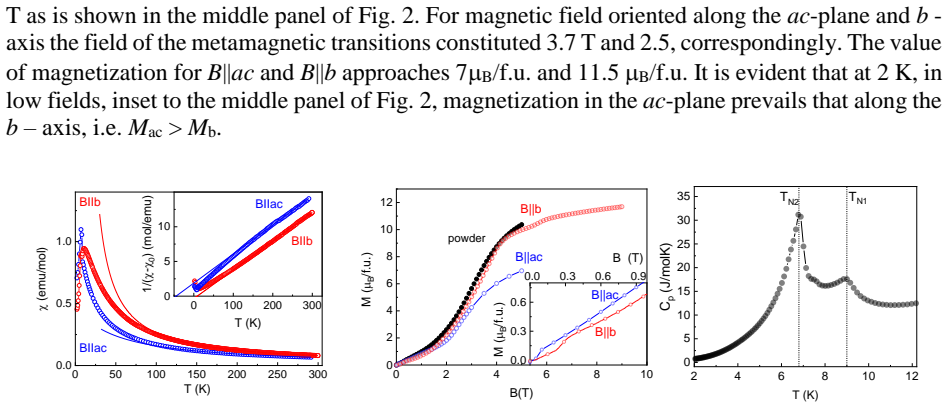
The paper's central claim is that Tb2Te5 is not an uncharacterized sibling of TbTe3 but a distinct Nd2Te5-type antiferromagnet: orthorhombic Cmcm with a = 4.3009 Å, b = 43.107 Å, c = 4.3016 Å, two inequivalent Tb sites, two magnetic transitions at TN1 = 9.0 K and TN2 = 6.8 K, and Tb moments lying predominantly in the ac plane. In pump-probe reflectivity, a 3.77 THz coherent oscillation appears in the first few picoseconds; the paper reads this as the CDW amplitude mode and takes the sudden drop of the zero-crossing delay time at 9 K as evidence that the antiferromagnetic order and the electronic subsystem are coupled. Against TbTe3, which has three magnetic transitions and a moment switch fr
What carries the argument
The load-bearing object is the layered crystal structure itself: TbTe layers separated alternately by single and double square Te nets, with two crystallographically distinct Tb sites in capped tetragonal-antiprism coordination. On top of that structure, the paper's diagnosis runs through three probes: single-crystal X-ray diffraction fixes the Cmcm cell; specific heat and magnetization fix the two Neel temperatures and the AF1/AF2 phase lines; and pump-probe reflectivity contributes the 3.77 THz oscillation (assigned to the CDW amplitude mode) plus the zero-crossing delay time tm, whose drop at TN1 signals electron-magnetic coupling. For TbTe3, a crystal-field Hamiltonian in the mean-field
Load-bearing premise
The structural assignment rests on fitting one Cmcm cell to X-ray data from a crystal the authors themselves describe as a growth twin or turbostratically disordered, with only 433 independent reflections and residual electron density up to 4.84 e/Å3; if that stacking model is wrong, the structure claim and the comparison to TbTe3 lose their foundation.
What would settle it
A clean single-crystal or neutron diffraction measurement on a Tb2Te5 crystal without turbostratic disorder: if it does not reproduce the Cmcm model (or yields a different Tb stacking or Te-net ordering) at low residuals, the structural and magnetic-site interpretation is wrong; separately, resonant x-ray scattering should reveal the CDW superlattice wave vector implied by the 3.77 THz amplitude-mode assignment.
If this is right
- Tb2Te5 can now be studied as a defined Cmcm member of the R2Te5 family rather than by analogy with other rare-earth tellurides.
- The AF1 and AF2 phases occupy a field-temperature region that is fully suppressed by a few tesla, providing a concrete magnetic phase diagram for future experiments.
- Tb moments remain ac-plane oriented through both magnetic transitions, unlike TbTe3's low-temperature switch toward the b axis.
- The 3.77 THz oscillation makes Tb2Te5 a candidate charge-density-wave system even though thermodynamic measurements showed no direct CDW signature.
- The higher ordering temperatures in Tb2Te5 compared with TbTe3 correlate with its shorter Tb-Te and Te-Te distances, linking structure to magnetic energy scales.
Where Pith is reading between the lines
- If the 3.77 THz mode is genuinely the CDW amplitude mode, Tb2Te5's CDW is stiffer than the 1.5-2.5 THz modes typical of RTe3; a direct x-ray search for a CDW superlattice peak would confirm or refute that inference.
- The two inequivalent Tb sites in the Cmcm cell make it plausible that TN1 and TN2 correspond to ordering of different Tb layers; neutron diffraction on a well-oriented crystal could test this sublattice scenario.
- Because TbTe3's third transition is attributed to CDW-AFM locking and Tb2Te5 lacks it, a natural extension is that Tb2Te5's CDW wave vector does not lock to the AFM order; measuring that wave vector would settle the point.
- The reported electron-magnetic coupling implies that Tb2Te5 may show magnetotransport anomalies below 9 K; field-dependent transport measurements would provide a direct test.
Editorial analysis
A structured set of objections, weighed in public.
Referee Report
Summary. The paper reports a combined structural, thermodynamic, ultrafast pump-probe, and torque-magnetometry study of the layered terbium tellurides Tb2Te5 and TbTe3. The principal new claims are: (i) Tb2Te5 crystallizes in orthorhombic space group Cmcm with a = 4.3009(17), b = 43.107(18), c = 4.3016(17) Å at 100 K; (ii) it orders antiferromagnetically in two steps at TN1 = 9.0 K and TN2 = 6.8 K, with Tb moments oriented predominantly in the ac plane at low temperatures; (iii) pump-probe data reveal a 3.77 THz oscillation assigned to a CDW amplitude mode, indicating electron-magnetic coupling; and (iv) a crystal-field plus exchange model reproduces the torque and magnetization of TbTe3, including the change of easy direction from the ac plane to the b axis at low temperatures.
Significance. If the structural assignment and the two-step magnetic ordering hold, the paper would provide the first structural and magnetic phase diagram for Tb2Te5 and extend the comparative physics of the RTe3/R2Te5 families. The magnetization, specific heat, and torque data are direct and, in principle, reproducible; the phase diagrams in Fig. 3 and the systematic anisotropy in Fig. 6 are useful experimental additions. The crystal-field/exchange calculation for TbTe3, however, is a refit of the same data it is used to validate, and the CDW assignment for Tb2Te5 rests on a single pump-probe frequency. The paper is therefore significant in its experimental phenomenology, but its structural and CDW claims need stronger support before they can be regarded as established.
major comments (4)
- [Crystal growth and X-Ray diffraction study] The central structural claim -- orthorhombic Cmcm for Tb2Te5 -- is not supported with the confidence stated. The authors themselves note that the diffraction pattern 'can be interpreted as growth twin or the consequence of turbostratic disorder' and that this disorder causes 'systematic mistakes in intensities' that occupancy refinement cannot fix. With only 433 independent reflections, (sin θ/λ)_max = 0.594 Å^-1, R1 = 0.0894, wR2 = 0.209, and residual density +4.84 e/Å^3, the model is not uniquely established. No alternative stacking models, lower-symmetry settings, or explicit twin laws are tested. The sentence 'the experiment allows us to unambiguously prove the composition and crystal structure' contradicts the stated limitations. Please re-analyze the diffraction data with alternative models and report a comparison of R factors and residual densities; otherwise the structural claim
- [Abstract vs. main text and Table S1] The reported unit cell parameters are inconsistent. The abstract gives a = 4.3120(5), b = 41.0305(76), c = 4.2979(8) Å, while the main text and Table S1 give a = 4.3009(17), b = 43.107(18), c = 4.3016(17) Å for the same 100 K structure. The b-axis difference is about 2.1 Å, far beyond the stated uncertainty. Since the cell parameters are load-bearing for the structural model and for comparisons with TbTe3, this discrepancy must be resolved and the correct values used consistently.
- [Calculations of magnetization and torque of TbTe3] Equation (2)-(4) and Table 1: the crystal-field parameters B_q^k and the exchange constants J_ij are fit to the same susceptibility, magnetization, and torque data that the calculation is then said to 'confirm.' This is circular as an independent validation. The paper acknowledges the result is 'qualitative in the absence of infrared spectroscopy,' but the text and Fig. 6 present the calculation as support for the experimental torque interpretation. Please present the calculation explicitly as a parametrization of the same data and identify which aspects, if any, are robust predictions that could be tested by future neutron or optical experiments.
- [Ultrafast pump-probe spectroscopy] The assignment of the 3.77 THz oscillation to a CDW amplitude mode is plausible but not 'strong evidence' as stated. The identification rests on a single Fourier peak in a pump-probe trace and on analogy with RTe3 and other CDW compounds; no static CDW superlattice reflection, transport anomaly, or optical conductivity signature is presented for Tb2Te5. The zero-crossing time tm changes near TN1, but the interpretation of this phenomenological quantity as electron-magnetic coupling is indirect. Please soften the claim to a suggestive observation or add corroborating evidence for the CDW.
minor comments (5)
- [References] "Eq. (3) in [2 2]" (in the 'Calculations' section) should likely be 'Eq. (3) in [24]', matching the earlier citation. Please correct the citation and unify the notation for the crystal-field Hamiltonian.
- [Crystal structure description] The text says 'Tb1O9 and Tb2O9 share edges'; the polyhedra are formed by Te atoms, so this should read 'Tb1Te9' and 'Tb2Te9' or simply 'Tb1 and Tb2 centered polyhedra.'
- [Fig. 6 and Eq. (1)] The sign convention for torque is not fully defined. Please state explicitly how φ=0 aligns with the b axis and what the signs of M_b and M_ac mean in Eq. (1), so that the reader can interpret the 'negative torque at 45°' criterion.
- [Table 1] The exchange parameters J are listed without uncertainties and with inconsistent decimal format (e.g., '5. K' vs '5.0 K'). Since the number of fitted parameters is large relative to the data, please provide at least a statement of the stability of the fit and the estimated uncertainty of the parameters.
- [Powder XRD] The powder pattern contains 16% Te impurity. Because the magnetization and specific heat were measured on crystals, the impurity may not affect the bulk data, but the influence of the Te impurity on the low-field data should be explicitly discussed.
Circularity Check
Tb2Te5 experimental findings are independent, but the TbTe3 'theoretical' torque calculation refits its own input rather than testing it.
specific steps
-
fitted input called prediction
[Calculations of magnetization and torque of TbTe3, after Eq. (4) and Table 1]
"In order to determine the crystal field parameters B_q^k ... we used the experimental data of the magnetic susceptibility χ(T) and magnetization curves M(B) along the main crystallographic axes and data of torque signals τ(φ) at various temperatures. ... Calculation of magnetization and susceptibility curves with the crystal field parameters given in Eq. (4) confirms the easy ac-plane anisotropy."
The CF parameters are explicitly fitted to the same χ(T), M(B), and τ(φ) data that the calculation is then said to 'confirm.' Similarly, Table 1 lists exchange parameters 'used for the calculation of τ(φ) dependencies' without any independent source, so they are evidently adjusted to reproduce the ordered-phase torque. The solid lines in Fig. 6 are therefore a refit of the data they are compared with, not an independent prediction; the agreement is by construction.
full rationale
The central new claims of the paper concern Tb2Te5: the Cmcm structure from single-crystal XRD, the two antiferromagnetic transitions at TN1=9.0 K and TN2=6.8 K from magnetization and specific heat, the ac-plane anisotropy from torque, and the 3.77 THz oscillation from pump-probe. These are independent experimental results and do not reduce to the model fitting. The TbTe3 crystal-field calculation is the only significant circular element: the CF parameters are fitted to the very susceptibility, magnetization, and torque data that the subsequent 'calculation' then reproduces, and the exchange constants in Table 1 are likewise inputs used to generate the torque curves rather than independently determined quantities. That makes the TbTe3 torque 'confirmation' a self-consistent fit, not a test. The structural refinements concerns—turbostratic disorder, R1=0.0894, residual density 4.84 e/Angstrom^3, and the abstract/full-text cell-parameter discrepancy—are robustness or correctness issues, not circularity. Because the central Tb2Te5 findings stand on their own experimental evidence, the overall circularity is partial rather than pervasive.
Axiom & Free-Parameter Ledger
free parameters (11)
- Crystal field parameter B20 =
-20 cm^-1
- Crystal field parameter B22 =
-117 cm^-1
- Crystal field parameter B40 =
-596 cm^-1
- Crystal field parameter B42 =
1220 cm^-1
- Crystal field parameter B44 =
413 cm^-1
- Crystal field parameter B60 =
1863 cm^-1
- Crystal field parameter B62 =
1182 cm^-1
- Crystal field parameter B64 =
-1992 cm^-1
- Crystal field parameter B66 =
1136 cm^-1
- Exchange constants J_i,j (Table 1) =
See Table 1; 12 values per AF1/AF2 phase, e.g. J11x=5 K (AF1), -5 K (AF2)
- Curie-Weiss fit parameters for Tb2Te5 =
chi0||=-4.6e-3 emu/mol, C||=24.4 emuK/mol, Theta||=-50 K; chi0_perp=-2.6e-3, C_perp=23.9, Theta_perp=11 K
axioms (4)
- domain assumption The disordered Tb2Te5 crystal can be modeled by a single ordered Cmcm unit cell.
- domain assumption Tb3+ magnetism in TbTe3 can be described by a crystal-field Hamiltonian for the ground multiplet within mean-field theory.
- ad hoc to paper The 3.77 THz oscillation in Tb2Te5 is the amplitude mode of a charge density wave.
- standard math Torque is given by tau = Mb*B*sin(phi) - Mac*B*cos(phi) for a purely axial system.
Cite this review
Pith. "Pith review of Comparative study of terbium tellurides Tb2Te5 and TbTe3." pith.science (2026). https://pith.science/paper/XHA35EVI
@misc{pith2026250908319,
  author       = {Pith},
  title        = {Pith review of: Comparative study of terbium tellurides Tb2Te5 and TbTe3},
  year         = {2026},
  howpublished = {\url{https://pith.science/paper/XHA35EVI}},
  note         = {Machine review of arXiv:2509.08319}
}
read the original abstract
Two terbium tellurides, TbTe3 and Tb2Te5, were studied by means of thermodynamics, ultrafast pump-probe spectroscopy and torque magnetometry. While crystal structure and some physical properties of TbTe3 were established previously, the crystal structure of Tb2Te5 was solved only in this work in the orthorhombic space group Cmcm with the parameters of unit cell a = 4.3120(5), b = 41.0305(76) and c = 4.2979(8) {\AA}. In contrast to TbTe3, which experiences three successive magnetic phase transitions, Tb2Te5 orders antiferromagnetically in two steps at TN1 = 9.0 K and TN2 = 6.8 K, both readily suppressed by an external magnetic field. The third transition in TbTe3 is due to the interaction of the magnetic subsystem with the charge density waves. The interaction of magnetic and electronic subsystems in Tb2Te5 has been revealed by the pump probe. Torque measurements of TbTe3 show that the magnetic moments of Tb are oriented predominantly in the ac plane at high temperatures and switch to the b axis at low temperatures. In Tb2Te5, the magnetic moments of Tb are oriented predominantly in the ac plane at low temperatures.
Figures



Reference graph
Works this paper leans on
-
[1]
A. R. Jha, Rare earth materials: properties and applications. (CRC Press, 2014)
work page 2014
-
[2]
L. Hou, Y. W. Li, C. Lane, High -Throughput Search and Prediction of Layered 4f -Materials. arXiv:2409.04632
work page internal anchor Pith review Pith/arXiv arXiv
-
[3]
R. W. Cahn, Binary alloy phase diagrams–second edition. (ASM international, Materials Park, Ohio, USA, 1990)
work page 1990
-
[4]
S. Chillal , E. Schierle , E . Weschke, F. Yokaichiya , J. -U. Hoffmann , O. S. Volkova, A. N. Vasiliev , A. A. Sinchenko, P. Lejay, A. Hadj -Azzem, P. Monceau , B. Lake, Strongly coupled charge, orbital, and spin order in TbTe3, Phys. Rev. B 102, 241110 (2020)
work page 2020
-
[5]
D. A. Zocco, J. J. Hamlin, K. Grube, J.-H. Chu, H.-H. Kuo, I. R. Fisher, M. B. Maple, Pressure dependence of the charge-density-wave and superconducting states in GdTe3, TbTe3, and DyTe3. Phys. Rev. B 91, 205114 (2015)
work page 2015
-
[6]
O. S. Volkova, A. Hadj -Azzem, G. Remenyi, J.E. Lorenzo, P. Monceau, Sinchenko A.A.,Vasiliev A.N. Magnetic phase diagram of van der Waals antiferromagnet TbTe 3, Materials, 15, 8772 (2022)
work page 2022
- [7]
-
[8]
A. Banerjee, Y. Feng, D. M. Silevitch, J. Wang, J. C. Lang, H. H. Kuo, I.R. Fisher, T. F. Rosenbaum, Charge transfer and multiple density waves in the rare earth tellurides. Phys. Rev. B 87, 155131 (2013)
work page 2013
-
[9]
D. A. Chareev, P. Evstigneeva, D. Phuyal, G. J. Man, H. Rensmo, A. N. Vasiliev, M. Abdel- Hafiez, Growth of transition -metal dichalcogenides by solvent evaporation technique. Crystal Growth & Design 20, 6930-6938 (2020)
work page 2020
- [10]
-
[11]
G.M. Sheldrick, SHELX -2018/3, Program package for crystal structure solution and refinement, Göttingen, Germany, 2018
work page 2018
-
[12]
See Supplemental Material at [URL will be inserted by publisher]
-
[13]
M. P. Pardo, J. Flahaut, Les tellurures superieurs des terres rares, de formules L 2Te5 et LTe3. Bull. Soc. Chim. France, 3658-3664 (1967)
work page 1967
-
[14]
A. Le Bail, H. Duroy, J.L. Fourquet. Ab-initio structure determination of LiSbWO6 by X-ray powder diffraction. Mater. Res. Bull., 23, 447-452 (1988)
work page 1988
-
[15]
V. Petricek, M. Dusek, L.Palatinus, Z. Crystallographic Computing System for Standard and Modulated Structures. Kristallogr. 229, 345−354 (2014)
work page 2014
-
[16]
D. Chen, S. Zhang, H.X. Yang, J.Q. Li, G.F. Chen. Magnetic and transport properties of a layered compound Ce2Te5. J. Phys.: Condens. Mat. 29, 265803 (2017)
work page 2017
-
[17]
Y. Liu, M. M.Bordelon, A. Weiland, P. F. Rosa, S. M. Thomas, J. D. Thompson, F. Ronning, E. D. Bauer, Physical properties of the layered f-electron van der Waals magnet Ce 2 Te 5. Phys. Rev. Mater. 6, 094407 (2022)
work page 2022
-
[18]
C. W. Luo, Y. T. Wang, A. Yabushita, T. Kobayashi, Ultrabroadband time -resolved spectroscopy in novel types of condensed matter. Optica 3, 82-92 (2016); C. W. Luo, Y. T. Wang, F. W. Chen, H. C. Shih, T. Kobayashi, Eliminate coherence spike in reflection -type pump-probe measurements. Optics Express 17, 11321-11327 (2009)
work page 2016
-
[19]
B. Koopmans, G. Malinowski, F. Dalla Longa, D. Steiauf, M. Fähnle, T. Roth, M. Ci nchetti, M. Aeschlimann, Explaining the paradoxical diversity of ultrafast laser-induced demagnetization. Nat. Mater. 9, 259 (2010)
work page 2010
-
[20]
P. E. Dolgirev, A. V. Rozhkov, A. Zong, A. Kogar, N. Gedik, B. V. Fine. Amplitude dynamics of the charge density wave in LaTe3: Theoretical description of pump-probe experiments. Physical Review B, 101, 054203 (2020); R. V. Yusupov, T. Mertelj, J. H. Chu, I. R. Fisher, D. Mihailovic, Single-particle and collective mode couplings associated with 1 -and 2 -...
work page 2020
-
[21]
H. C. Shih, T. H. Lin, C. W. Luo, J. Y. Lin, T. M. Uen, J. Y. Juang, K. H. Wu, J. M. Lee, J. M. Chen, T. Kobayashi, Magnetization dynamics and the Mn 3+ d-d excitation of hexagonal HoMnO3 single crystals using wavelength-tunable time-resolved femtosecond spectroscopy. Phys. Rev. B, 80, 024427 (2009); H. C. Shih, L. Y. Chen, C. W. Luo, K. H. Wu, J. Y. Lin,...
work page 2009
-
[22]
M. Perfetti, M. A.Sørensen, U. B. Hansen, H. Bamberger, S. Lenz, P. P. Hallmen, T. Fennell, G.G. Simeoni, A. Arauzo, J. Bartolomé, E. Bartolomé, K. Lefmann, H. Weihe, J. van Slageren, J. Bendix, Magnetic anisotropy switch: Easy axis to easy plane conversion and vice versa , Adv. Funct. Mater. 28, 1801846 (2018)
work page 2018
-
[23]
E.A. Popova, D.V. Volkov, A.N. Vasiliev, A.A. Demidov, N.P. Kolmakova, I.A. Gudim, L.N. Bezmaternykh, N. Tristan, Yu. Skourski, B. Buechner, et al., Magnetization and specific heat of TbFe3(BO3)4: Experiment and crystal-field calculations, Phys. Rev. B 75, 224413 (2007)
work page 2007
-
[24]
C. Ritter, A.I. Pankrats, A.A. Demidov, D.A. Velikanov, V.L. Temerov, I.A. Gudim, Inclined magnetic structure of iron borate Pr xY1− xFe3(BO3)4: A neutron diffraction study and crystal-field calculations, Phys. Rev. B 91,134416 (2015)
work page 2015
-
[25]
M.M. Markina, K.V. Zakharov, E.A. Ovchenkov, P.S. Berdonosov, V.A. Dolgikh, E.S. Kuznetsova, A.V. Olenev, S.A. Klimin, M.A. Kashchenko, I.V. Budkin, I.V. Yatsyk, A.A. Demidov, E.A. Zvereva and A.N. Vasiliev. Interplay of rare-earth and transition metal subsystems in Cu3Yb(SeO3)2O2Cl. Phys. Rev. B, 96, 134422 (2017)
work page 2017
-
[26]
M. N. Popova, S. A. Klimin, E. P. Chukalina, B. Z. Malkin, R. Z. Levitin, B. V. Mill, and E. Antic-Fidancev, High-resolution spectral study of crystal -field levels and magnetic ordering in (ErxY1− x)2BaNiO5 chain compounds, Phys. Rev. B 68, 155103 (2003)
work page 2003
-
[27]
Perfetti, Cantilever torque magnetometry on coordination compounds: from theory to experiments
M. Perfetti, Cantilever torque magnetometry on coordination compounds: from theory to experiments. Coord. Chem. Rev., 348, 171 (2017)
work page 2017
-
[28]
C. D. Malliakas, M. Iavarone, J. Fedor, M. G. Kanatzidis, Coexistence and coupling of two distinct charge density waves in Sm2Te5. J. Am. Chem. Soc. 130, 3310 (2008)
work page 2008
-
[29]
K. Y. Shin, J. Laverock, Y. Q. Wu, C. L. Condron, M. F. Toney, S. B.Dugdale, M.J. Kramer, I. R. Fisher, Charge density wave formation in R 2Te5 (R= Nd, Sm, and Gd) , Phys. Rev. B 77, 165101 (2008). SUPPLEMENTARY MATERIAL Table S1. Experimental details Crystal data Chemical formula Tb2Te5 Mr 955.84 Crystal system, space group Orthorhombic, Cmcm Temperature...
work page 2008
This paper was first reviewed by deepseek-v4-flash on August 4, 2026.
discussion (0)
Sign in with ORCID, Apple, or X to comment. Anyone can read and Pith papers without signing in.