REVIEW 3 major objections 5 minor 41 references
Phase ordering, transformation, and grain growth of two-dimensional binary colloidal crystals: A phase field crystal modeling
T0 review · 3 major / 5 minor · reviewed 2026-08-14 · deepseek-v4-flash
Pith's one-line read Two length scales and two densities explain the ordering of binary colloidal crystals.
desk verdict A promising exploratory PFC study of binary colloidal phases, but the phase diagrams are kinetic selection maps, not thermodynamically established; worth a serious referee with major revisions. read the letter →
The pith
A machine-rendered reading of the paper's core claim, the machinery that carries it, and where it could break.
The reading
What carries the argument
The load-bearing object is the binary PFC free energy functional (Eq. 10), a two-field Swift-Hohenberg-type energy: each species density field $n_A$, $n_B$ carries its own characteristic wavenumber $q_A$, $q_B$ through $(\nabla^2+q^2)^2$ terms, and the fields are coupled by elastic-like bilinear terms and cubic terms such as $\alpha_{AB}n_An_B$, $\beta_{AB}n_A(\nabla^2+q_{AB}^2)^2n_B$, $\frac{w}{2}n_A^2n_B$, and $\frac{u}{2}n_An_B^2$. This functional, together with the conserved dynamics of Eq. (8), is what generates all the predicted phases: the competition between $q_A$ and $q_B$ sets the relative spacing of the two sublattices, while the average densities $n_{A0}$ and $n_{B0}$ select which phase has the lowest free energy. The analytic phase diagrams use the one-mode amplitude ansätze collected in the Appendix, whose real-amplitude assumption is the source of the quantitative mismatch with the full numerical phase diagrams.
What would settle it
A decisive check would be to compare the model's predicted phase sequence at a fixed density with direct simulation of the full DDFT or particle-level simulation of the same binary mixture; for example, if the numerically stable phases in the $q_B/q_A=2$ diagram do not include the A-honeycomb/B-triangular motif at $n_{A0}=0.25$, $n_{B0}=0.4$ that the paper reports, the free-energy truncation would be the suspect.
Extended reading notes
Core claim
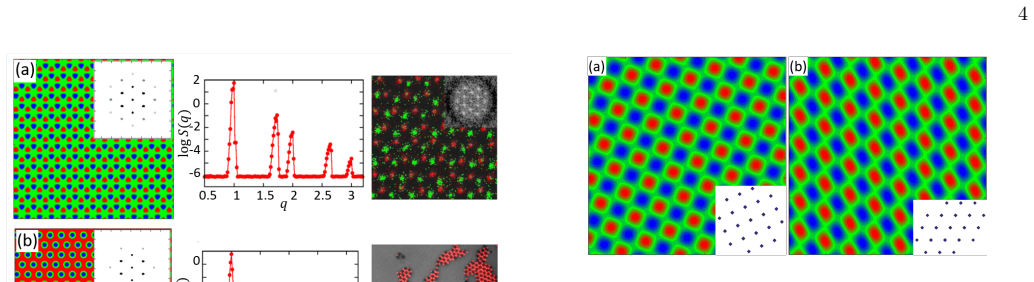
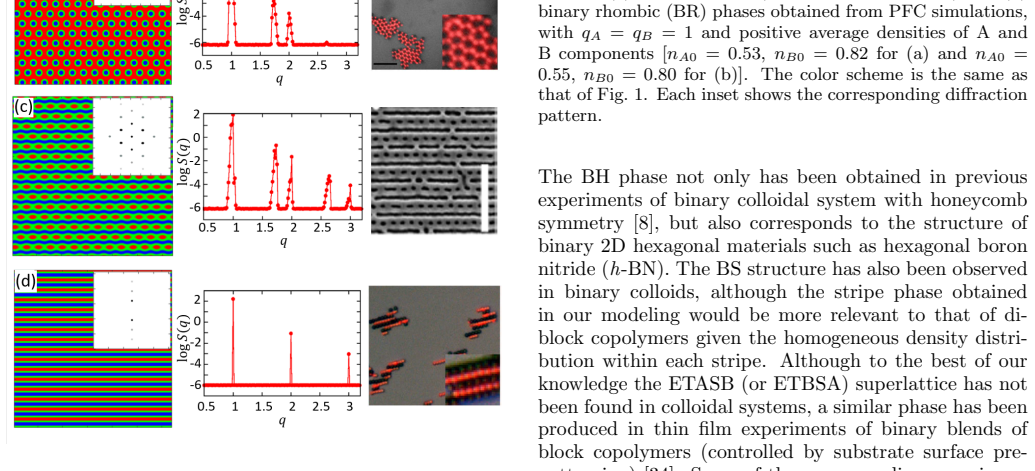
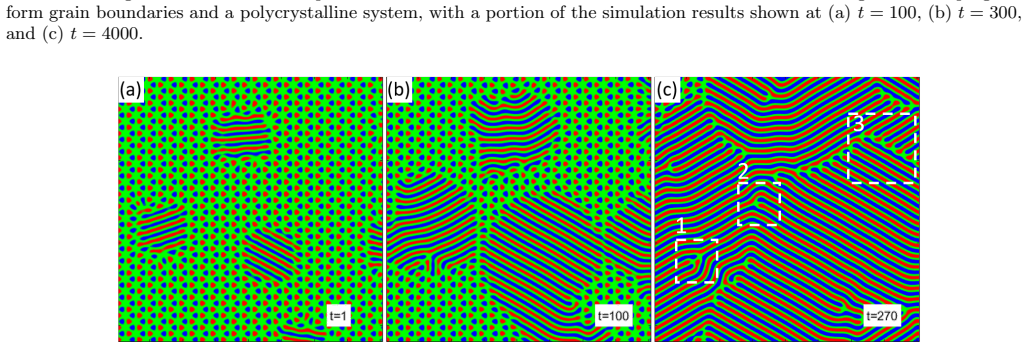
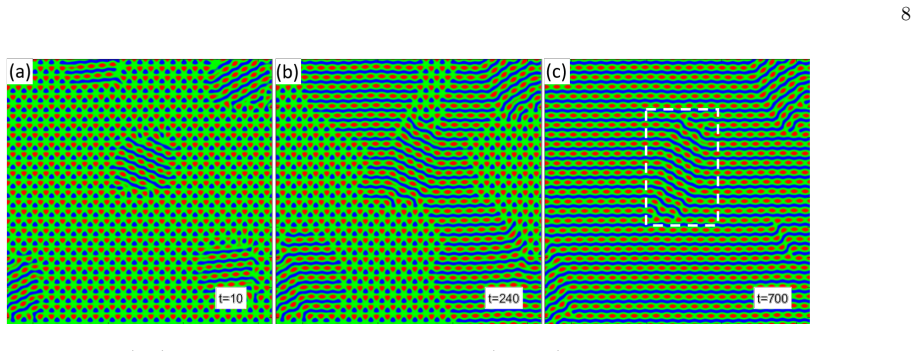
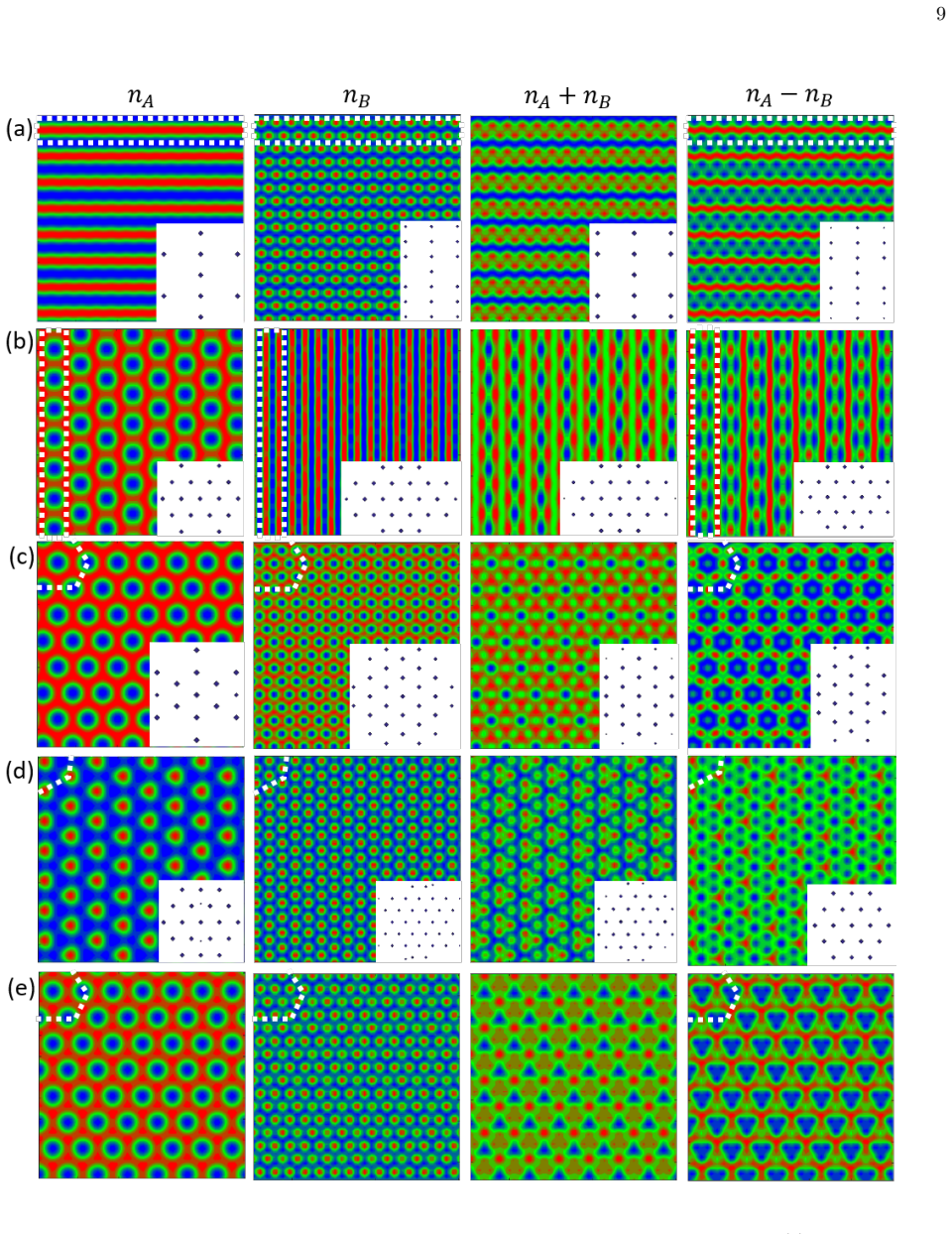
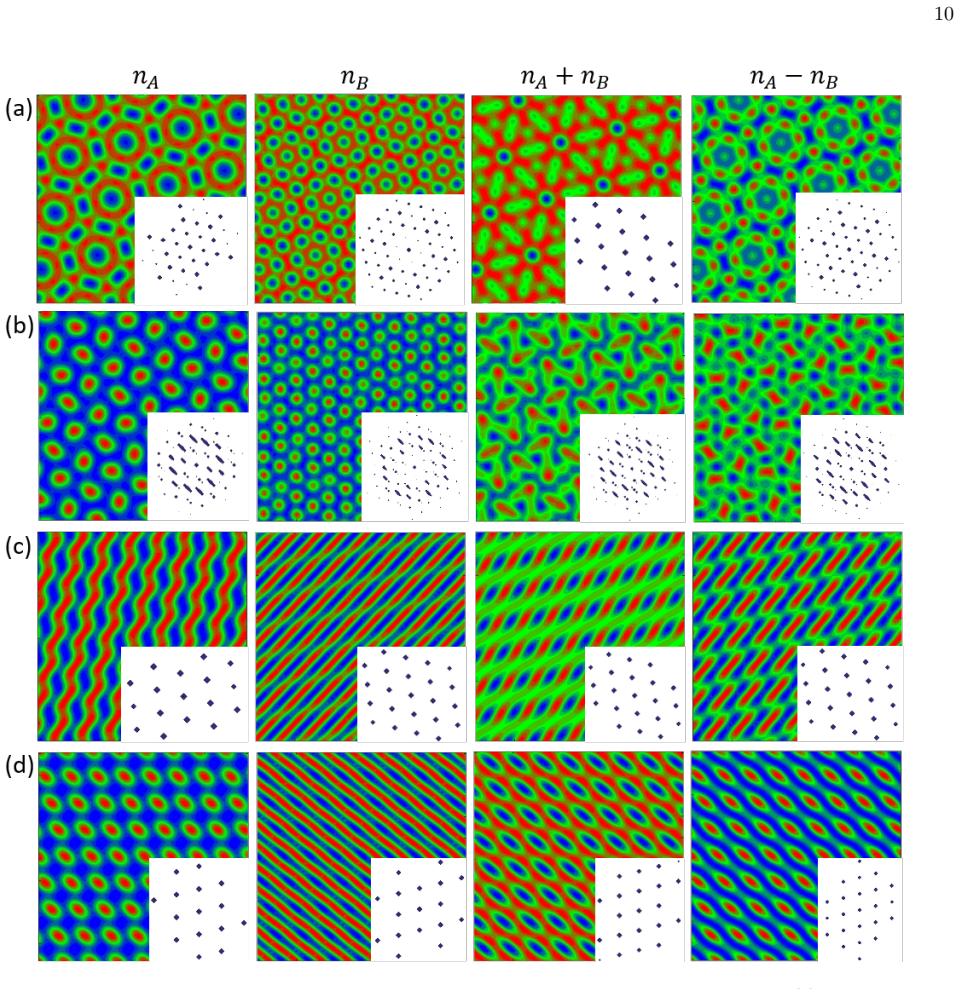
The central claim is that a binary phase field crystal free energy with one characteristic wavenumber per sublattice, plus bilinear and cubic cross-couplings between the two density fields, captures the ordering of two-dimensional binary colloidal crystals. Starting from classical dynamic density functional theory and keeping two- and three-point direct correlations, the authors derive a two-field model in which the ratio $q_B/q_A$ of the sublattice wavenumbers and the average density variations $n_{A0}$, $n_{B0}$ control which of many possible binary phases forms. With equal wavenumbers, seven phases emerge and their phase diagrams are constructed both analytically in a one-mode approximation and by direct simulation; the two disagree in detail, which the authors attribute to the one-mode approximation fixing real amplitudes rather than allowing the complex amplitude phase selection that the full model permits. With unequal wavenumbers, integer ratios produce combinations of triangular, honeycomb, and stripe sublattices, whereas noninteger ratios produce more complex motifs, and an irrational ratio corresponding to 12-fold symmetry produces strained quasicrystalline patterns under periodic boundary conditions. The paper further shows that grain growth from nuclei and structural transformations such as honeycomb-to-stripe proceed through growth and coalescence and generate topological defects.
Load-bearing premise
The whole prediction rests on the truncated free energy keeping only one characteristic length scale for each sublattice and approximating three-particle correlations by their zero-wavevector value; if that truncation misrepresents how the two species select amplitudes, the predicted phases and phase boundaries could be wrong.
Editorial extensions
If this is right
- At equal sublattice length scales, the same seven phases—including binary honeycomb, binary stripe, checkerboard square, and binary rhombic—should be found in experiments and particle-level simulations of 2D binary colloids across the density ranges the model maps.
- For integer length-scale ratios such as $q_B/q_A=2$, binary ordering reduces to regular combinations of single-species sublattice patterns, so scanning average densities should reveal the full catalog of such superlattices.
- For noninteger ratios, ordering is dominated by cluster or motif formation rather than simple sublattice combination, so structurally distinct binary superlattices are expected at ratios such as 1.62.
- At a ratio of $(\sqrt{2}+\sqrt{6})/2$, binary quasicrystalline patterns with 12-fold symmetry should appear, though their stability under periodic boundary conditions needs separate assessment.
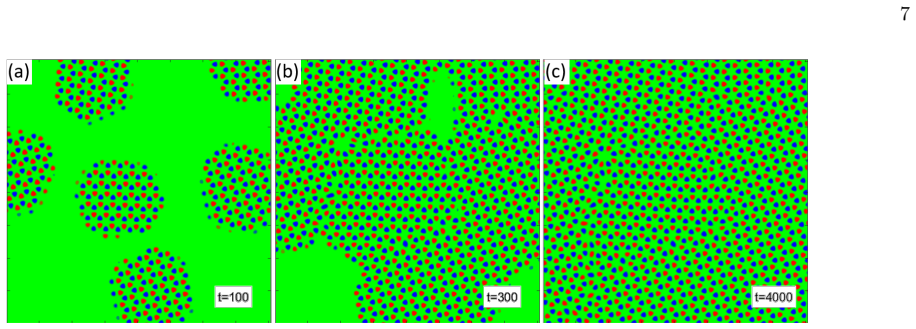
- The simulated dynamical pathways—BH grain nucleation, faceting, coalescence, and BH-to-BS and BH-to-ETASB transformations—predict specific defect populations (dislocations, disclinations, kinks, grain boundaries) that could be compared with time-resolved colloidal experiments.
Reading between the lines
- The paper's own comparison shows the one-mode analytic phase diagrams differ from the numerical ones; a natural extension is to redo the analytic calculation allowing complex relative phases of the A and B amplitudes, which should reconcile the diagrams and reveal which phase-selection rule the full model is really enforcing.
- Because the quasicrystalline patterns are flagged as strained by periodic boundary conditions, testing larger, boundary-relaxed cells would show whether stable binary quasicrystals exist or are metastable finite-size artifacts.
- The identified mechanism suggests a design rule for colloid experiments: choose size ratios corresponding to integer, rational, or irrational wavenumber ratios to target specific superlattice classes; this could be tested systematically with size-tunable colloidal particles.
- The model's DFT ancestry implies that the predicted phases could be cross-checked against density functional theory or Monte Carlo calculations at the same size ratios and densities, a comparison the paper does not perform.
Signed reviews
Editorial analysis
A structured set of objections, weighed in public.
Referee Report
Summary. The manuscript derives a two-component phase-field-crystal (PFC) model from classical dynamic density functional theory, retaining two- and three-point direct correlations and one characteristic length scale per sublattice. For equal sublattice length scales it reports seven ordered binary phases, presents analytic one-mode and direct numerical phase diagrams in the negative-density plane, and simulates grain nucleation/growth and structural transformations (BH-to-BS, BH-to-ETASB). For non-equal length scales (qB/qA = 2, 1.62, and 2cos(pi/12)) it exhibits a variety of superlattice and quasicrystalline patterns. The central claim is that sublattice length-scale competition/coupling and average density selection govern the binary phase ordering.
Significance. If the stability claims are substantiated, the model would provide a computationally efficient continuum tool for exploring binary colloidal self-assembly, with the notable strength that several predicted structures match experimental observations and that the model is derived, not purely phenomenological, from DDFT. The paper's strengths are the broad structure catalogue, the explicit derivation in Section II, and the direct comparison of simulation patterns with experimental images in Figs. 1 and 2. However, the thermodynamic support for the reported phase diagrams is currently incomplete: the analytic one-mode calculation is acknowledged to miss complex-amplitude phase selection, and the numerical 'phase diagrams' are kinetic maps unless free energies of final states are compared.
major comments (3)
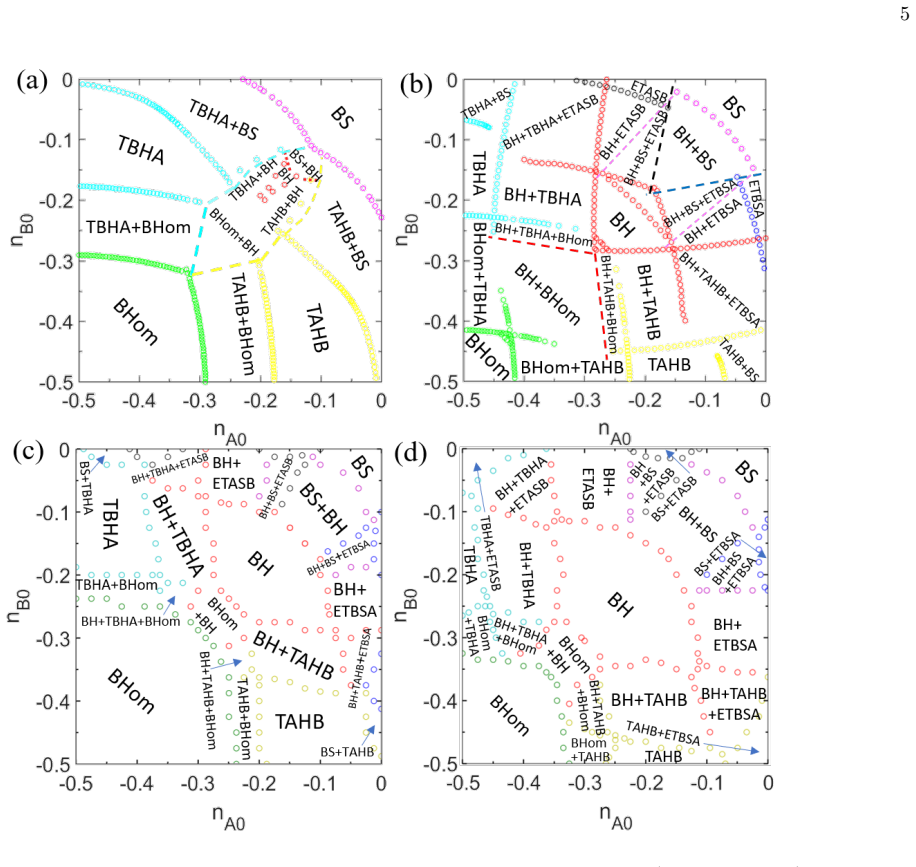
- [Section III.B, Figs. 3(c,d)] The phase diagrams labeled as direct numerical calculations are obtained by evolving Eq. (8) from random initial conditions without noise to steady state. A steady state of the conserved relaxational dynamics need not be the global free-energy minimum, and no comparison of the free-energy functional Eq. (10) for the different final structures is reported. Therefore the phase boundaries and coexistence regions in Figs. 3(c,d) are kinetic selection maps rather than equilibrium phase diagrams. To support the phase-diagram claims, the authors should compute the free-energy density of each final state and construct common-tangent/equal-grand-potential coexistence boundaries, or explicitly reframe the diagrams as kinetic selection maps.
- [Section III.A and Appendix, Eq. (A5)] The analytic one-mode phase diagrams in Figs. 3(a,b) are explicitly acknowledged in Section III.B to disagree with the numerical results because the one-mode expressions take the amplitudes A_j and B_j to be real and omit complex-amplitude phase selection, with details deferred to future work. Since the analytic free energies in Eq. (A5) are the only thermodynamic calculation in the paper, the claimed equilibrium phase boundaries and coexistence regions are not established. This is a load-bearing gap for the phase-diagram section; either the amplitude equations with complex phases must be solved, or the phase diagrams should be replaced by a proper numerical free-energy construction.
- [Section V, Figs. 7-9] For qB/qA = 2, 1.62, and the quasicrystalline ratio, the reported structures are presented as spot checks of simulation outcomes, and the paper itself cautions that the quasicrystalline patterns are strained by periodic boundary conditions. No free-energy or stability analysis is supplied for these states. The manuscript can legitimately claim that the model generates these patterns, but the stronger statements that the model predicts these as stable phases of the binary system are not supported by the current evidence.
minor comments (5)
- [Eq. (4)] The notation Delta rho_A^l is used both for the reference-state fraction rho_A^l/rho_l and in the logarithmic term as a denominator; writing x_A = rho_A^l/rho_l would improve readability.
- [Fig. 3 caption] The caption states n_A0, n_B0 < 0, but Section III discusses phases that require positive densities (BSq and BR) and Fig. 2 is not part of the phase diagram; the restricted range of the phase diagrams should be stated in the main text where they are first introduced.
- [Figs. 7 and 8] The fourth column shows n_A - n_B with red and blue representing maxima of A and B, while the first three columns use blue for minima of a single field; the dual use of blue in one figure may confuse readers and should be clarified in the caption.
- [Section IV, Eq. (13)] Eq. (13) is called nonconserved dynamics but includes chemical-potential terms; specifying the conserved/nonconserved distinction and the relation of mu_A and mu_B to the equilibrium chemical potentials would help.
- [Abstract and Conclusions] The abstract and conclusions describe phase diagrams for the model generally, but quantitative phase diagrams are only computed for equal length scales and negative densities; the text should make this scope explicit.
Circularity Check
No circular derivation: binary PFC structures and phase diagrams are generated from a DFT-derived free energy with hand-picked parameters, not by fitting or renaming the target patterns.
full rationale
The paper's derivation chain is self-contained in the sense that the PFC free energy functional is obtained from classical DDFT (Eqs. (1)-(10)) rather than being defined by the target structures. No parameter is fitted to the experimental patterns used for comparison; parameters such as alpha_AB=0.5, beta_AB=0.02, g_A=g_B=0.5, w=u=0.3 are chosen a priori, and the seven equal-length-scale phases emerge from numerical evolution of Eq. (8) from random initial conditions. The analytic one-mode phase diagram is an independent thermodynamic calculation, and the paper itself flags its failure: Section III.B states that discrepancies with numerics are due to complex amplitude phase selection with details 'presented elsewhere.' That is an admitted incompleteness or approximation error, not a circular reduction, because the one-mode ansatz is not derived from the numerical predictions. Similarly, the caution in Section V that quasicrystalline structures are strained by periodic boundary conditions is a validity limitation, not evidence that the results were assumed. Self-citations to Refs. [23] and [26] are used as normal derivation/genesis sources for the PFC formalism; the DDFT derivation is standard and externally grounded, and the cited binary PFC prior work is used to introduce the model, not to forbid alternatives or to import an unverified uniqueness theorem. No fitted input is renamed as a prediction, and no equation reduces to another by construction. Therefore the circularity score is 0.
Assumptions & free parameters
free parameters (7)
- epsilon (epsilon_A = epsilon_B) =
0.1, 0.3
- alpha_AB =
0.5
- beta_AB =
0.02 for equal length scales, 0 for competing length scales
- g_A = g_B =
0.5
- w = u =
0.3
- beta_B = v =
1
- qB/qA =
2, 1.62, (sqrt(2)+sqrt(6))/2
assumptions (4)
- domain assumption Classical DFT free energy expansion converges with only two- and three-point direct correlation functions.
- ad hoc to paper Three-point direct correlations are approximated by their zero-wavevector value, C^(3)_ijk(q,q') ~ -C^(3)_ijk(0,0).
- ad hoc to paper Equal reference densities for A and B, rho_A^l = rho_B^l.
- ad hoc to paper One-mode approximation for density fields in the analytic phase diagram calculation.
Cite this review
Pith. "Pith review of Phase ordering, transformation, and grain growth of two-dimensional binary colloidal crystals: A phase field crystal modeling." pith.science (2026). https://pith.science/paper/XHQFZ6WV
@misc{pith2026190809404,
  author       = {Pith},
  title        = {Pith review of: Phase ordering, transformation, and grain growth of two-dimensional binary colloidal crystals: A phase field crystal modeling},
  year         = {2026},
  howpublished = {\url{https://pith.science/paper/XHQFZ6WV}},
  note         = {Machine review of arXiv:1908.09404}
}
read the original abstract
The formation and dynamics of a wide variety of binary two-dimensional ordered structures and superlattices are investigated through a phase field crystal model with sublattice ordering. Various types of binary ordered phases, the phase diagrams, and the grain growth dynamics and structural transformation processes, including the emergence of topological defects, are examined. The results are compared to the ordering and assembly of two-component colloidal systems. Two factors governing the binary phase ordering are identified, the coupling and competition between the length scales of two sublattices and the selection of average particle densities of two components. The control and variation of these two factors lead to the prediction of various complex binary ordered patterns, with different types of sublattice ordering for integer vs. noninteger ratios of sublattice length scales. These findings will enable further systematic studies of complex ordering and assembly processes of binary systems particularly binary colloidal crystals.
Figures
Figures from the paper (6 more)

Reference graph
Works this paper leans on
-
[1]
C. J. Kiely, J. Fink, M. Brust, D. Bethell, and D. J. Schiffrin, Spontaneous ordering of bimodal ensembles of nanoscopic gold clusters, Nature 396, 444 (1998)
work page 1998
-
[2]
K. S. Khalil, A. Sagastegui, Y. Li, M. A. Tahir, J. E. S. Socolar, B. J. Wiley, and B. B. Yellen, Binary col- loidal structures assembled through ising interactions, Nat. Commun. 3, 794 (2012)
work page 2012
-
[3]
M. H. Kim, S. H. Im, and O. O. Park, Fabrication and structural analysis of binary colloidal crystals with two- dimensional superlattices, Adv. Mater. 17, 2501 (2005)
work page 2005
-
[4]
F. X. Redl, K.-S. Cho, C. B. Murray, and S. O’Brien, Three-dimensional binary superlattices of magnetic nanocrystals and semiconductor quantum dots, Nature 423, 968 (2003)
work page 2003
-
[5]
E. V. Shevchenko, D. V. Talapin, N. A. Kotov, S. O’Brien, and C. B. Murray, Structural diversity in bi- nary nanoparticle superlattices, Nature 439, 55 (2006)
work page 2006
-
[6]
Z. Cai, Y. J. Liu, X. Lu, and J. Teng, Fabrication of well- ordered binary colloidal crystals with extended size ratios for broadband reflectance, ACS Appl. Mater. Interfaces 6, 10265 (2014)
work page 2014
-
[7]
U. Ognysta, A. Nych, V. Nazarenko, M. Skarabot, and I. Musevic, Design of 2D binary colloidal crystals in a nematic liquid crystal, Langmuir 25, 12092 (2009)
work page 2009
- [8]
Show all 41 references
-
[9]
Y. Wan, Z. Cai, L. Xia, L. Wang, Y. Li, Q. Li, and X. Zhao, Simulation and fabrication of binary colloidal photonic crystals and their inverse structures, Mater. Lett. 63, 2078 (2009)
2009
-
[10]
W. H. Evers, B. D. Nijs, L. Filion, S. Castillo, M. Dijk- stra, and D. Vanmaekelbergh, Entropy-driven formation of binary semiconductor-nanocrystal superlattices, Nano Lett. 10, 4235 (2010). 13
2010
-
[11]
Chen and S
Z. Chen and S. O’Brien, Structure direction of II-VI semi- conductor quantum dot binary nanoparticle superlattices by tuning radius ratio, ACS Nano 2, 1219 (2008)
2008
-
[12]
P.-Y. Wang, H. Pingle, P. Koegler, H. Thissen, and P. Kingshott, Self-assembled binary colloidal crystal monolayers as cell culture substrates, J. Mater. Chem. B 3, 2545 (2015)
2015
-
[13]
P.-Y. Wang, S. S.-C. Hung, H. Thissen, P. Kingshott, and R. C.-B. Wong, Binary colloidal crystals (BCCs) as a feeder-free system to generate human induced pluripo- tent stem cells (hiPSCs), Sci. Rep. 6, 36845 (2016)
2016
-
[14]
M. A. Kostiainen, P. Hiekkataipale, A. Laiho, V. Lemieux, J. Seitsonen, J. Ruokolainen, and P. Ceci, Electrostatic assembly of binary nanoparticle superlat- tices using protein cages, Nat. Nanotechnol. 8, 52 (2013)
2013
-
[15]
M. D. Eldridge, P. A. Madden, and D. Frenkel, Entropy- driven formation of a superlattice in a hard-sphere binary mixture, Nature 365, 35 (1993)
1993
-
[16]
M. I. Bodnarchuk, M. V. Kovalenko, W. Heiss, and D. V. Talapin, Energetic and entropic contributions to self- assembly of binary nanocrystal superlattices: Tempera- ture as the structure-directing factor, J. Am. Chem. Soc. 132, 11967 (2010)
2010
-
[17]
K. L. Heatley, F. Ma, and N. Wu, Colloidal molecules assembled from binary spheres under an AC electric field, Soft Matter 13, 436 (2017)
2017
-
[18]
S. N. Petris, J. Stankovich, D. Y. C. Chan, and R. H. Ot- tewill, Modeling the structure of charged binary colloidal dispersions, Langmuir 19, 1121 (2003)
2003
-
[19]
Y. Yang, L. Fu, C. Marcoux, J. E. S. Socolar, P. Charbon- neau, and B. B. Yellen, Phase transformations in binary colloidal monolayers, Soft Matter 11, 2404 (2015)
2015
-
[20]
Stirner and Sun, Molecular dynamics simulation of the structural configuration of binary colloidal monolayers, Langmuir 21, 6636 (2005)
T. Stirner and Sun, Molecular dynamics simulation of the structural configuration of binary colloidal monolayers, Langmuir 21, 6636 (2005)
2005
-
[21]
K. R. Elder, M. Katakowski, M. Haataja, and M. Grant, Modeling elasticity in crystal growth, Phys. Rev. Lett. 88, 245701 (2002); K. R. Elder and M. Grant, Mod- eling elastic and plastic deformations in nonequilibrium processing using phase field crystals, Phys. Rev. E 70, 051605 (2004)
2002
-
[22]
K. R. Elder, N. Provatas, J. Berry, P. Stefanovic, and M. Grant, Phase field crystal modeling and classical density functional theory of freezing, Phys. Rev. B 75, 064107 (2007)
2007
-
[23]
Huang, K
Z.-F. Huang, K. R. Elder, and N. Provatas, Phase-field- crystal dynamics for binary systems: Derivation from dy- namical density functional theory, amplitude equation formalism, and applications to alloy heterostructures, Phys. Rev. E 82, 021605 (2010)
2010
-
[24]
Huang and K
Z.-F. Huang and K. R. Elder, Mesoscopic and micro- scopic modeling of island formation in strained film epi- taxy, Phys. Rev. Lett. 101, 158701 (2008); Morphologi- cal instability, evolution, and scaling in strained epitaxial films: An amplitude-equation analysis of the phase-fie...
2008
-
[25]
Hirvonen, M
P. Hirvonen, M. M. Ervasti, Z. Fan, M. Jalalvand, M. Seymour, S. M. Vaez Allaei, N. Provatas, A. Harju, K. R. Elder, and T. Ala-Nissila, Multiscale modeling of polycrystalline graphene: A comparison of structure and defect energies of realistic samples from phase field crys- ta...
2016
-
[26]
D. Taha, S. K. Mkhonta, K. R. Elder, and Z.-F. Huang, Grain boundary structures and collective dynamics of inversion domains in binary two-dimensional materials, Phys. Rev. Lett. 118, 255501 (2017)
2017
-
[27]
Smirman, D
M. Smirman, D. Taha, A. K. Singh, Z.-F. Huang, and K. R. Elder, Influence of misorientation on graphene moir´ e patterns, Phys. Rev. B95, 085407 (2017)
2017
-
[28]
van Teeffelen, R
S. van Teeffelen, R. Backofen, A. Voigt, and H. L¨ owen, Derivation of the phase-field-crystal model for colloidal solidification, Phys. Rev. E 79, 051404 (2009)
2009
-
[29]
Tegze, L
G. Tegze, L. Gr´ an´ asy, G. I. T´ oth, J. F. Douglas, and T. Pusztai, Tuning the structure of non-equilibrium soft materials by varying the thermodynamic driving force for crystal ordering, Soft Matter 7, 1789 (2011)
2011
-
[30]
Greenwood, N
M. Greenwood, N. Ofori-Opoku, J. Rottler, and N. Provatas, Modeling structural transformations in bi- nary alloys with phase field crystals, Phys. Rev. B 84, 064104 (2011)
2011
-
[31]
Ofori-Opoku, J
N. Ofori-Opoku, J. Stolle, Z.-F. Huang, and N. Provatas, Complex order parameter phase-field models derived from structural phase-field-crystal models, Phys. Rev. B 88, 104106 (2013)
2013
-
[32]
Berry, K
J. Berry, K. R. Elder, and M. Grant, Simulation of an atomistic dynamic field theory for monatomic liquids: Freezing and glass formation, Phys. Rev. E 77, 061506 (2008)
2008
-
[33]
C. V. Achim, M. Schmiedeberg, and H. L¨ owen, Growth modes of quasicrystals, Phys. Rev. Lett. 112, 255501 (2014)
2014
-
[34]
Stein, G
A. Stein, G. Wright, K. G. Yager, G. S. Doerk, and C. T. Black, Selective directed self-assembly of coexisting mor- phologies using block copolymer blends, Nat. Commun. 7, 12366 (2016)
2016
-
[35]
Singh, Density-functional theory of freezing and prop- erties of the ordered phase, Phys
Y. Singh, Density-functional theory of freezing and prop- erties of the ordered phase, Phys. Rep. 207, 351 (1991)
1991
-
[36]
U. M. B. Marconi and P. Tarazona, Dynamic density functional theory of fluids, J. Chem. Phys. 110, 8032 (1999)
1999
-
[37]
A. J. Archer, Dynamical density functional theory: bi- nary phase-separating colloidal fluid in a cavity, J. Phys.: Condens. Matter 17, 1405 (2005)
2005
-
[38]
A. J. Archer and M. Rauscher, Dynamical density func- tional theory for interacting brownian particles: stochas- tic or deterministic?, J. Phys. A 37, 9325 (2004)
2004
-
[39]
S. J. Smithline and A. D. J. Haymet, Density functional theory for the freezing of 1:1 hard sphere mixtures, J. Chem. Phys. 86, 6486 (1987)
1987
-
[40]
Substituting Eq
binary systems. Substituting Eq. (4) into the DDFT Eqs. (2), choosing the same reference state for A and B, i.e., ρA l =ρB l , and keeping only the leading order terms (via scale analysis), we can derive a new binary PFC model represented by ∂nA/∂t =DA∇2 δF δnA + ∇·ηA, ∂nB/∂t ...
-
[41]
S. W. Rick and A. D. J. Haymet, Density functional the- ory for the freezing of Lennard-Jones binary mixtures, J. Chem. Phys. 90, 1188 (1989)
1989
Reviewed August 14, 2026 · model on record in the stance chip above.
Discussion (0). Continue with ORCID to comment.