REVIEW 3 major objections 4 minor 92 references
Local Spin Polarization in Anisotropic Gubser Flow: Suppression Mechanism and Formulation Dependence
T0 review · 3 major / 4 minor · reviewed 2026-08-05 · deepseek-v4-flash
Pith's one-line read This paper claims that the longitudinal spin polarization of Λ baryons in a perturbed Gubser flow is not fixed by thermal vorticity alone: the thermal shear contribution changes sign and can fully or partially cancel it, depending on the fo
desk verdict First analytic spin-polarization derivation from a real hydro solution, with a plausible suppression mechanism; but the 'exact' SBR cancellation is only exact within a truncated formula whose omitted terms are never quantified. read the letter →
The pith
A machine-rendered reading of the paper's core claim, the machinery that carries it, and where it could break.
The reading
What carries the argument
The carrying element is the perturbed Gubser solution: a conformal hydrodynamic background with longitudinal and transverse expansion deformed by modes X^(l) ∝ P_l^l(cos θ) cos(lφ) for l = 2, 3, with the leading large-size asymptotics χ^(l) ≈ 3/2 and σ^(l) ≈ 1. Combined with the modified Cooper–Frye formula, the relevant objects are the thermal vorticity tensor and thermal shear tensor built from β^μ = u^μ/T, and the reference vector n^μ that differs across formulations. The decisive mechanical identity is that in the BBPIK formulation the acceleration terms ∂_t u_x and ∂_t u_y cancel between vorticity and shear contributions independent of the velocity profile, leaving only non-acceleration
What would settle it
Compute the next-to-leading order in τ_f/L for the SBR polarization in this same flow: if the subleading correction to S_vort + S_shear is not small compared with the leading terms, the exact cancellation is an artifact of truncation. A second, more direct check: evaluate S_z^SBR with the full SBR formula of its defining paper (without omitting the 'unphysical' pieces) on the same isothermal freeze-out surface; a nonzero result would falsify the claim that the simplified formulas capture the cancellation.
Extended reading notes
Core claim
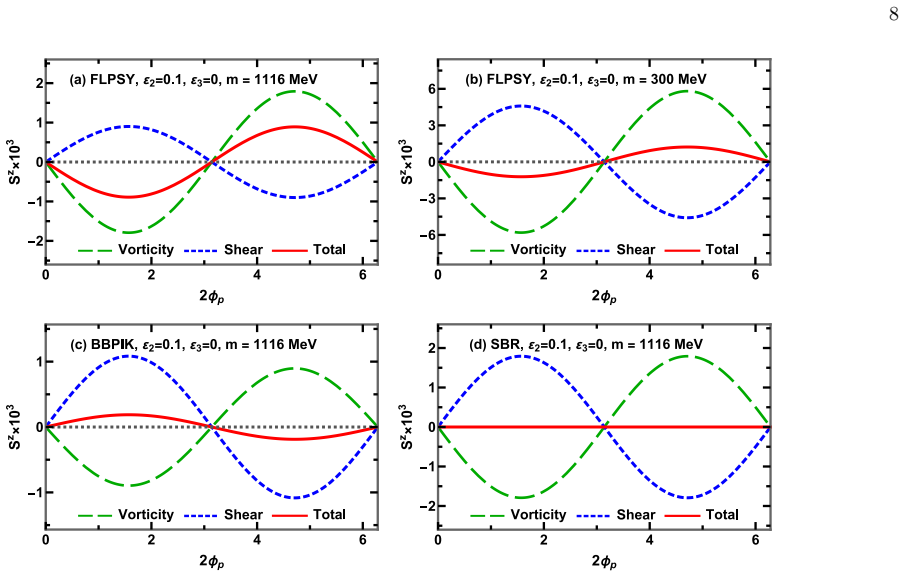
On its own terms, the paper claims that in the large-system-size limit of a perturbed Gubser flow with elliptic (l = 2) and triangular (l = 3) deformations, the longitudinal spin polarization can be computed analytically and exhibits a formulation-dependent cancellation pattern. For the formulation that chooses the reference unit vector as the normal to the isothermal freeze-out surface (SBR), the thermal-shear contribution is exactly minus the thermal-vorticity contribution at leading order, S_z^SBR = 0 (Eq. 62). For the formulation using the lab-frame time direction (BBPIK), the acceleration parts of the vorticity and shear tensors cancel exactly, and the surviving polarization comes from
Load-bearing premise
The load-bearing assumption is that the large-size limit τ_f/L ≪ 1 holds uniformly on the freeze-out surface, so all analytic formulas follow from the leading-order asymptotics χ ≈ 3/2, σ ≈ 1 and all O(τ_f/L) corrections are dropped; in addition, the SBR calculation uses a simplified isothermal-surface version of the formulation, omitting terms the full SBR formula would contribute.
Editorial extensions
If this is right
- If the SBR formulation is physical, the leading-order longitudinal polarization in this flow is exactly zero once the full freeze-out surface is integrated; nonzero values require subleading order or a non-isothermal surface.
- In the BBPIK formulation the acceleration parts drop out identically, so the polarization is a pure non-acceleration effect and has the observed sin(2φ_p) sign for p_T below about 3 GeV.
- The FLPSY formulation recovers the experimental sign only at small transverse momentum and only when the light quark mass is used; with the Λ mass it fails in this model.
- Vorticity-only calculations cannot reproduce the local polarization sign in this model; shear is necessary in every formulation considered.
- Initial eccentricities are the source: setting both ε_2 and ε_3 to zero makes the longitudinal polarization vanish, so the signal is a response to anisotropic flow.
Reading between the lines
- One testable extension: feed the same perturbed Gubser solution into a viscous hydrodynamic code and check whether the exact SBR cancellation survives beyond ideal hydrodynamics; if it does, current numerical disagreement may come from freeze-out prescription, not from shear physics.
- The acceleration-cancellation identity in BBPIK is independent of the velocity profile, so it likely generalizes to realistic velocity fields; computing the residual non-acceleration term in a realistic simulation would show whether the sign puzzle is resolved by shear or by non-acceleration gradients.
- The exact SBR zero suggests a possible degeneracy: if the surface-normal formulation is right, local spin polarization would be exceptionally sensitive to subleading and dissipative corrections, making it a useful probe of freeze-out dynamics rather than of equilibrium vorticity.
- Because the model gives simple analytic ratios S_vort/S_shear independent of T0 and L, the p_T dependence of the measured polarization can be used to discriminate the formulations without tuning initial conditions.
Signed reviews
Editorial analysis
A structured set of objections, weighed in public.
Referee Report
Summary. This paper presents an analytic study of the longitudinal spin polarization of Λ hyperons in a conformal, perturbed Gubser flow with elliptic (l=m=2) and triangular (l=m=3) deformations. Three formulations of the shear-induced polarization are compared: FLPSY (n^μ=u^μ), BBPIK (n^μ=δ^μ_0 with kinetic replacements), and SBR (n^μ normal to the freeze-out surface). In the large-L limit, explicit leading-order formulas are derived for the Fourier coefficients of S_z(p) (Eqs. 52-62). The results show that thermal vorticity alone has the sign opposite to experiment; thermal shear compensates. FLPSY gives the desired sign only at low p_T for m=300 MeV; BBPIK gives the desired sign up to moderately large p_T; SBR gives an exact cancellation at leading order. A general acceleration-term cancellation between vorticity and shear is identified in BBPIK and SBR. The rotating Hubble flow is also analyzed as a global-polarization benchmark.
Significance. If the results hold, this is one of the first analytic derivations of local spin polarization directly from a hydrodynamic solution, rather than from a blast-wave parametrization. The explicit formulas reveal parameter dependences (e.g., independence of the ratio S_vort/S_shear from T0hat and L) that provide checkable predictions for numerical simulations. The general cancellation of acceleration terms in BBPIK is demonstrated algebraically and does not depend on the flow profile. The paper is candid about the leading-order nature of the Gubser analysis and does not attempt to fit data. The main caveat is that the SBR exact-zero result is computed with a simplified version of the SBR formula; this limits the strength of the headline conclusion but does not affect the BBPIK results.
major comments (3)
- [Sec. III, Eq. (37)] The central SBR result, Eq. (62), is computed from Eqs. (36)-(37), which the authors themselves describe as less general than the complete SBR formulation of Ref. [72]. The omitted terms are called 'unphysical,' but no demonstration is given that they vanish on the isothermal freeze-out surface (33) or that they are numerically negligible. Since the abstract's headline is the 'exact cancellation' between S_z^SBR_vort and S_z^SBR_shear, this is not a side remark: if the omitted terms contribute at the same order, Eq. (62) could be an artifact of the truncation. Please either evaluate the complete SBR expression for this flow or provide a quantitative bound/argument showing that the additional terms cannot affect the leading-order cancellation.
- [Sec. II.D, Eq. (23)] All analytic formulas (52)-(62) are leading-order in the large-system-size expansion and inherit the asymptotic solution χ^(l)≃3/2, σ^(l)≃1 of Eqs. (20)-(21). This particular solution discards a homogeneous mode of Eq. (20) that behaves as e^{2ρ/3} as ρ→-∞; the manuscript does not state the boundary/regularity condition that selects χ=3/2, nor does it estimate the first subleading corrections under the consistency condition (35). Because the SBR cancellation is presented as 'exact' (even if at leading order), an estimate of corrections of order (τ_f/L) would clarify whether the vanishing of S_z^SBR is robust or an artifact of the truncation. A brief discussion of this point is needed.
- [Sec. V.C, Eqs. (66)-(67)] The text argues that the SBR formulation reduces to the BBPIK-like acceleration cancellation by approximating n^μ≈δ_0^μ at mid-rapidity. However, the exact SBR cancellation (62) is then presented as a separate result, and the text later states that the cancellation is 'probably an accidental cancellation.' The logical relation between the approximate n≈δ0 argument and the exact Eq. (62) is not fully spelled out. Please clarify whether the exact zero is a consequence of the mid-rapidity approximation or of the full hypersurface integration (the latter seems to be the case from the final paragraph of Sec. V.C). This distinction is important for readers assessing the generality of the proposed cancellation mechanism.
minor comments (4)
- [Various] Typographical errors: abstract 'anaytical'; Sec. I 'adpot'; Sec. VI 'aliged'.
- [Sec. V.B, Fig. 5] The independence of S_vort/S_shear from T0hat and L is a nontrivial check; it would be helpful to state this explicitly in the figure caption, since it is not obvious from the plotted curves.
- [Sec. III, Eq. (40)] The shorthand n_F(1−n_F)≃n_F≃e^{−β·p} is slightly imprecise; for the Boltzmann approximation, n_F(1−n_F)≃e^{−β·p} is the needed statement.
- [References] Ref. [72] is an arXiv preprint; please add journal publication information if it has appeared by the time of publication.
Circularity Check
No significant circularity: the derivation is a forward calculation from an external hydrodynamic solution and external spin formulas; the SBR cancellation is conditional on an unquantified truncation, which is a limitation rather than a circular step.
full rationale
The paper's inputs are the perturbed Gubser solution from Hatta et al. (Ref. [78]) and the three spin-polarization formulas from external works (FLPSY, BBPIK, SBR). The coefficients C(p) and D(p) are not fitted to reproduce the polarization sign; they are obtained from the freeze-out integrals and the stated parameters. The SBR cancellation in Eq. (62) is derived by explicit leading-order integration of Eqs. (36)-(37), not by assuming the target result. The paper explicitly states in Sec. III that it omits the more general 'unphysical contributions' of Ref. [72] and uses the simplified formulas, and in Sec. V.C it calls the exact vanishing 'probably an accidental cancellation' — this is an honest, clearly stated approximation that limits robustness but is not circular. Self-citations (Refs. [38,48,59,64,79]) are present but none is load-bearing: the anisotropic Gubser solution is attributed to Refs. [77,78] and the spin formulas to Refs. [60-63,72]. No fitted parameter is renamed a prediction, no uniqueness theorem is imported, and no definition is equivalent to the conclusion. The central claim is conditional on the large-system-size truncation and the simplified SBR formula, but the derivation itself is self-contained with respect to those stated assumptions.
Assumptions & free parameters
free parameters (6)
- T0hat =
3 (used in figures)
- L =
10 fm
- T_f =
150 MeV
- eps_2 =
0.1
- eps_3 =
0.01
- m (particle mass) =
1116 MeV or 300 MeV
assumptions (8)
- domain assumption Conformal equation of state e = 3p = lambda T^4 (Eq. 3)
- domain assumption Ideal, uncharged fluid (Eqs. 1-2)
- domain assumption Perturbed Gubser flow (27)-(28) is the correct leading-order hydro solution
- domain assumption Leading-order large-size asymptotics chi^(l) ~ 3/2 and sigma^(l) ~ 1 (Eq. 23)
- domain assumption Freeze-out on isothermal hypersurface T = T_f (Eq. 33) with tau_f << L
- domain assumption Modified Cooper-Frye formulas (36)-(37) with the three unit-vector choices
- domain assumption l=2 mode dominance via the zero-counting argument for P_l^2
- ad hoc to paper Mid-rapidity approximation n^mu ~ delta_0^mu for SBR (Eqs. 65-67)
Cite this review
Pith. "Pith review of Local Spin Polarization in Anisotropic Gubser Flow: Suppression Mechanism and Formulation Dependence." pith.science (2026). https://pith.science/paper/XHSBLXSN
@misc{pith2026260803945,
  author       = {Pith},
  title        = {Pith review of: Local Spin Polarization in Anisotropic Gubser Flow: Suppression Mechanism and Formulation Dependence},
  year         = {2026},
  howpublished = {\url{https://pith.science/paper/XHSBLXSN}},
  note         = {Machine review of arXiv:2608.03945}
}
read the original abstract
We analytically study the longitudinal spin polarization in relativistic heavy-ion collisions using a perturbed Gubser flow solution. In the large-system-size limit, we derive analytical expression of the local spin polarization along the beam direction. In our treatment, the contributions from thermal vorticity and thermal shear are of comparable magnitudes. The thermal vorticity yields the polarization with a sign opposite to that observed experimentally, while the thermal shear counteracts this effect, helping recover the desired sign. We find that the choice of the reference unit vector aligned with the fluid velocity gives the experimentally observed sign only at low transverse momenta, whereas another formulation with the unit vector fixed along the laboratory time direction yields the desired sign for a wide range of transverse momenta. Notably, a recent formulation with the unit vector normal to the freeze-out hypersurface exhibits an exact cancellation between contributions from thermal vorticity and thermal shear at leading order in the large-system-size limit. We identify a general cancellation pattern with acceleration dominance, which is manifest particularly in the latter two formulations. Thus, the total polarization originates from non-acceleration effects, which need not be substantial even when the elliptic flow is finite, as clearly demonstrated in our analytical results. For comparison, we also discuss the spin polarization in the Hubble flow with rotation.
Figures


Figures from the paper (2 more)


Reference graph
Works this paper leans on
-
[72]
C. Yi, X.-Y. Wu, J. Zhu, S. Pu, and G.-Y. Qin, Phys. Rev. C111, 044901 (2025), arXiv:2408.04296 [hep-ph]
work page Pith review arXiv 2025
-
[1]
FLPSY formulation [60, 62]:n µ is identified with the fluid velocityu µ
-
[2]
In addition, as proposed in Ref
BBPIK formulation [61]:n µ is set to ben µ =δ µ 0 in (t, x, y, z) coordinates. In addition, as proposed in Ref. [63], explicitT-gradients are removed by the replacements ofϖ µν →ϖ K µν andξ µν →ξ K µν, where ϖK µν =− 1 2 β(∂µuν −∂ νuµ),(41) ξK µν = 1 2 β(∂µuν +∂ νuµ).(42)
-
[3]
If Σ f is isothermal, i.e., with constant temper- ature,n µ =−∂ µT / p |∂νT ∂νT|
SBR formulation [72]:n µ is the normal vector to Σf . If Σ f is isothermal, i.e., with constant temper- ature,n µ =−∂ µT / p |∂νT ∂νT|. Then,T-gradient terms cancel out automatically inS µ(p), though eachS µ ϖ,ξ(p) receivesT-gradient contributions. It should be noted that the SBR formulation is applicable to an arbitrary Σ f , and its complete form in Ref...
-
[4]
Z.-T. Liang and X.-N. Wang, Phys. Rev. Lett.94, 102301 (2005), [Erratum: Phys.Rev.Lett. 96, 039901 (2006)], arXiv:nucl-th/0410079
arXiv 2005
- [5]
-
[6]
S. A. Voloshin, arXiv:nucl-th/0410089 (2004)
arXiv 2004
-
[7]
Adamczyket al.(STAR), Nature548, 62 (2017), arXiv:1701.06657 [nucl-ex]
L. Adamczyket al.(STAR), Nature548, 62 (2017), arXiv:1701.06657 [nucl-ex]
arXiv 2017
Show all 92 references
-
[8]
Acharyaet al.(ALICE), Phys
S. Acharyaet al.(ALICE), Phys. Rev. C101, 044611 (2020), [Erratum: Phys.Rev.C 105, 029902 (2022)], arXiv:1909.01281 [nucl-ex]
2020 arXiv
-
[9]
Abou Yassineet al.(HADES), Phys
R. Abou Yassineet al.(HADES), Phys. Lett. B835, 137506 (2022), arXiv:2207.05160 [nucl-ex]
2022 arXiv
-
[10]
Karpenko and F
I. Karpenko and F. Becattini, Eur. Phys. J. C77, 213 (2017), arXiv:1610.04717 [nucl-th]
2017 arXiv
-
[11]
Li, L.-G
H. Li, L.-G. Pang, Q. Wang, and X.-L. Xia, Phys. Rev. C96, 054908 (2017), arXiv:1704.01507 [nucl-th]
2017 arXiv
- [12]
-
[13]
Wei, W.-T
D.-X. Wei, W.-T. Deng, and X.-G. Huang, Phys. Rev. C 99, 014905 (2019), arXiv:1810.00151 [nucl-th]
2019 arXiv
-
[14]
Vitiuk, L
O. Vitiuk, L. V. Bravina, and E. E. Zabrodin, Phys. Lett. B803, 135298 (2020), arXiv:1910.06292 [hep-ph]
2020 arXiv
-
[15]
B. Fu, K. Xu, X.-G. Huang, and H. Song, Phys. Rev. C 103, 024903 (2021), arXiv:2011.03740 [nucl-th]
2021 arXiv
-
[16]
A. Lei, D. Wang, D.-M. Zhou, B.-H. Sa, and L. P. Cser- nai, Phys. Rev. C104, 054903 (2021), arXiv:2110.13485 [nucl-th]
2021 arXiv
-
[17]
S. Ryu, V. Jupic, and C. Shen, Phys. Rev. C104, 054908 (2021), arXiv:2106.08125 [nucl-th]
2021 arXiv
-
[18]
X.-Y. Wu, C. Yi, G.-Y. Qin, and S. Pu, Phys. Rev. C 105, 064909 (2022), arXiv:2204.02218 [hep-ph]
2022 arXiv
-
[19]
Becattini, V
F. Becattini, V. Chandra, L. Del Zanna, and E. Grossi, Annals Phys.338, 32 (2013), arXiv:1303.3431 [nucl-th]
2013 arXiv
-
[20]
Fang, L.-g
R.-h. Fang, L.-g. Pang, Q. Wang, and X.-n. Wang, Phys. Rev. C94, 024904 (2016), arXiv:1604.04036 [nucl-th]
2016 arXiv
-
[21]
Adamet al.(STAR), Phys
J. Adamet al.(STAR), Phys. Rev. Lett.123, 132301 (2019), arXiv:1905.11917 [nucl-ex]
2019
-
[22]
Acharyaet al.(ALICE), Phys
S. Acharyaet al.(ALICE), Phys. Rev. Lett.128, 172005 (2022), arXiv:2107.11183 [nucl-ex]
2022 arXiv
-
[23]
Abdulhamidet al.(STAR), Phys
M. Abdulhamidet al.(STAR), Phys. Rev. Lett.131, 202301 (2023), arXiv:2303.09074 [nucl-ex]
2023
-
[24]
Hayrapetyanet al.(CMS), Phys
A. Hayrapetyanet al.(CMS), Phys. Rev. Lett.135, 132301 (2025), arXiv:2502.07898 [nucl-ex]
2025
-
[25]
Becattini and I
F. Becattini and I. Karpenko, Phys. Rev. Lett.120, 012302 (2018), arXiv:1707.07984 [nucl-th]
2018 arXiv
-
[26]
X.-L. Xia, H. Li, Z.-B. Tang, and Q. Wang, Phys. Rev. C98, 024905 (2018), arXiv:1803.00867 [nucl-th]
2018 arXiv
-
[27]
Florkowski, A
W. Florkowski, A. Kumar, R. Ryblewski, and A. Mazeliauskas, Phys. Rev. C100, 054907 (2019), arXiv:1904.00002 [nucl-th]
2019 arXiv
-
[28]
Wu, L.-G
H.-Z. Wu, L.-G. Pang, X.-G. Huang, and Q. Wang, Phys. Rev. Research.1, 033058 (2019), arXiv:1906.09385 [nucl- th]
2019 arXiv
-
[29]
X.-L. Xia, H. Li, X.-G. Huang, and H. Z. Huang, Phys. Rev. C100, 014913 (2019), arXiv:1905.03120 [nucl-th]
2019 arXiv
-
[30]
Becattini, G
F. Becattini, G. Cao, and E. Speranza, Eur. Phys. J. C 79, 741 (2019), arXiv:1905.03123 [nucl-th]
2019 arXiv
-
[31]
Gao, Z.-T
J.-H. Gao, Z.-T. Liang, S. Pu, Q. Wang, and X.-N. Wang, Phys. Rev. Lett.109, 232301 (2012), arXiv:1203.0725 [hep-ph]
2012 arXiv
-
[32]
J.-W. Chen, S. Pu, Q. Wang, and X.-N. Wang, Phys. Rev. Lett.110, 262301 (2013), arXiv:1210.8312 [hep-th]
2013 arXiv
-
[33]
Hidaka, S
Y. Hidaka, S. Pu, and D.-L. Yang, Phys. Rev. D95, 091901 (2017), arXiv:1612.04630 [hep-th]
2017 arXiv
-
[34]
Hidaka, S
Y. Hidaka, S. Pu, and D.-L. Yang, Phys. Rev. D97, 016004 (2018), arXiv:1710.00278 [hep-th]
2018 arXiv
-
[35]
Gao and Z.-T
J.-H. Gao and Z.-T. Liang, Phys. Rev. D100, 056021 (2019), arXiv:1902.06510 [hep-ph]. 12
2019 arXiv
-
[36]
Weickgenannt, X.-L
N. Weickgenannt, X.-L. Sheng, E. Speranza, Q. Wang, and D. H. Rischke, Phys. Rev. D100, 056018 (2019), arXiv:1902.06513 [hep-ph]
2019 arXiv
-
[37]
Y.-C. Liu, K. Mameda, and X.-G. Huang, Chin. Phys. C44, 094101 (2020), [Erratum: Chin.Phys.C 45, 089001 (2021)], arXiv:2002.03753 [hep-ph]
2020 arXiv
-
[38]
Weickgenannt, E
N. Weickgenannt, E. Speranza, X.-l. Sheng, Q. Wang, and D. H. Rischke, Phys. Rev. Lett.127, 052301 (2021), arXiv:2005.01506 [hep-ph]
2021 arXiv
-
[39]
Weickgenannt, E
N. Weickgenannt, E. Speranza, X.-l. Sheng, Q. Wang, and D. H. Rischke, Phys. Rev. D104, 016022 (2021), arXiv:2103.04896 [nucl-th]
2021 arXiv
-
[40]
Sheng, N
X.-L. Sheng, N. Weickgenannt, E. Speranza, D. H. Rischke, and Q. Wang, Phys. Rev. D104, 016029 (2021), arXiv:2103.10636 [nucl-th]
2021 arXiv
-
[41]
Hidaka, S
Y. Hidaka, S. Pu, Q. Wang, and D.-L. Yang, Prog. Part. Nucl. Phys.127, 103989 (2022), arXiv:2201.07644 [hep- ph]
2022 arXiv
-
[42]
S. Fang, S. Pu, and D.-L. Yang, Phys. Rev. D106, 016002 (2022), arXiv:2204.11519 [hep-ph]
2022 arXiv
-
[43]
Dong, Y.-L
W.-B. Dong, Y.-L. Yin, and Q. Wang, Phys. Rev. C106, 054909 (2022), arXiv:2209.12402 [nucl-th]
2022 arXiv
-
[44]
S. Fang, S. Pu, and D.-L. Yang, Phys. Rev. D109, 034034 (2024), arXiv:2311.15197 [hep-ph]
2024 arXiv
- [45]
-
[46]
Montenegro, L
D. Montenegro, L. Tinti, and G. Torrieri, Phys. Rev. D 96, 076016 (2017), arXiv:1703.03079 [hep-th]
2017 arXiv
-
[47]
Florkowski, B
W. Florkowski, B. Friman, A. Jaiswal, and E. Speranza, Phys. Rev. C97, 041901 (2018), arXiv:1705.00587 [nucl- th]
2018 arXiv
-
[48]
Becattini, W
F. Becattini, W. Florkowski, and E. Speranza, Phys. Lett. B789, 419 (2019), arXiv:1807.10994 [hep-th]
2019 arXiv
-
[49]
Florkowski, A
W. Florkowski, A. Kumar, and R. Ryblewski, Prog. Part. Nucl. Phys.108, 103709 (2019), arXiv:1811.04409 [nucl- th]
2019 arXiv
-
[50]
Hattori, M
K. Hattori, M. Hongo, X.-G. Huang, M. Matsuo, and H. Taya, Phys. Lett. B795, 100 (2019), arXiv:1901.06615 [hep-th]
2019 arXiv
-
[51]
Fukushima and S
K. Fukushima and S. Pu, Phys. Lett. B817, 136346 (2021), arXiv:2010.01608 [hep-th]
2021 arXiv
-
[52]
S. Li, M. A. Stephanov, and H.-U. Yee, Phys. Rev. Lett. 127, 082302 (2021), arXiv:2011.12318 [hep-th]
2021 arXiv
-
[53]
Hongo, X.-G
M. Hongo, X.-G. Huang, M. Kaminski, M. Stephanov, and H.-U. Yee, JHEP11, 150 (2021), arXiv:2107.14231 [hep-th]
2021 arXiv
-
[54]
D. She, A. Huang, D. Hou, and J. Liao, Sci. Bull.67, 2265 (2022), arXiv:2105.04060 [nucl-th]
2022 arXiv
-
[55]
D.-L. Wang, S. Fang, and S. Pu, Phys. Rev. D104, 114043 (2021), arXiv:2107.11726 [nucl-th]
2021 arXiv
-
[56]
Weickgenannt, D
N. Weickgenannt, D. Wagner, E. Speranza, and D. H. Rischke, Phys. Rev. D106, L091901 (2022), arXiv:2208.01955 [nucl-th]
2022 arXiv
-
[57]
Weickgenannt, D
N. Weickgenannt, D. Wagner, E. Speranza, and D. H. Rischke, Phys. Rev. D106, 096014 (2022), arXiv:2203.04766 [nucl-th]
2022 arXiv
-
[58]
Z. Cao, K. Hattori, M. Hongo, X.-G. Huang, and H. Taya, PTEP2022, 071D01 (2022), arXiv:2205.08051 [hep-th]
2022 arXiv
-
[59]
Bhadury, W
S. Bhadury, W. Florkowski, A. Jaiswal, A. Kumar, and R. Ryblewski, Phys. Rev. Lett.129, 192301 (2022), arXiv:2204.01357 [nucl-th]
2022 arXiv
-
[60]
Florkowski and M
W. Florkowski and M. Hontarenko, Phys. Rev. Lett.134, 082302 (2025), arXiv:2405.03263 [hep-ph]
2025 arXiv
- [61]
-
[62]
S. Fang, K. Fukushima, S. Pu, and D.-L. Wang, arXiv:2506.20698 [nucl-th] (2025)
2025 arXiv
-
[63]
S. Y. F. Liu and Y. Yin, JHEP07, 188 (2021), arXiv:2103.09200 [hep-ph]
2021 arXiv
-
[64]
Becattini, M
F. Becattini, M. Buzzegoli, and A. Palermo, Phys. Lett. B820, 136519 (2021), arXiv:2103.10917 [nucl-th]
2021 arXiv
-
[65]
B. Fu, S. Y. F. Liu, L. Pang, H. Song, and Y. Yin, Phys. Rev. Lett.127, 142301 (2021), arXiv:2103.10403 [hep- ph]
2021 arXiv
-
[66]
Becattini, M
F. Becattini, M. Buzzegoli, G. Inghirami, I. Karpenko, and A. Palermo, Phys. Rev. Lett.127, 272302 (2021), arXiv:2103.14621 [nucl-th]
2021 arXiv
-
[67]
C. Yi, S. Pu, and D.-L. Yang, Phys. Rev. C104, 064901 (2021), arXiv:2106.00238 [hep-ph]
2021 arXiv
-
[68]
Florkowski, A
W. Florkowski, A. Kumar, A. Mazeliauskas, and R. Ryblewski, Phys. Rev. C105, 064901 (2022), arXiv:2112.02799 [hep-ph]
2022 arXiv
-
[69]
Buzzegoli, F
M. Buzzegoli, F. Becattini, G. Inghirami, I. Karpenko, and A. Palermo, Acta Phys. Polon. Supp.16, 1 (2023), arXiv:2208.04449 [nucl-th]
2023 arXiv
-
[70]
Palermo, F
A. Palermo, F. Becattini, M. Buzzegoli, G. Inghirami, and I. Karpenko, EPJ Web Conf.276, 01026 (2023), arXiv:2208.09874 [nucl-th]
2023 arXiv
-
[71]
Palermo, E
A. Palermo, E. Grossi, I. Karpenko, and F. Becattini, Eur. Phys. J. C84, 920 (2024), arXiv:2404.14295 [nucl- th]
2024 arXiv
-
[73]
Becattini, M
F. Becattini, M. Buzzegoli, T. Niida, S. Pu, A.-H. Tang, and Q. Wang, Int. J. Mod. Phys. E33, 2430006 (2024), arXiv:2402.04540 [nucl-th]
2024 arXiv
-
[74]
Niida and S
T. Niida and S. A. Voloshin, Int. J. Mod. Phys. E33, 2430010 (2024), arXiv:2404.11042 [nucl-ex]
2024 arXiv
- [75]
-
[76]
Alzhrani, S
S. Alzhrani, S. Ryu, and C. Shen, Phys. Rev. C106, 014905 (2022), arXiv:2203.15718 [nucl-th]
2022 arXiv
-
[77]
Arslan, W.-B
A. Arslan, W.-B. Dong, G.-L. Ma, S. Pu, and Q. Wang, Phys. Rev. C111, 044911 (2025), arXiv:2411.17285 [nucl-th]
2025 arXiv
-
[78]
Arslan, W.-B
A. Arslan, W.-B. Dong, C. Gale, S. Jeon, Q. Wang, and X.-Y. Wu, arXiv:2509.00796 [nucl-th] (2025)
2025
-
[79]
S. S. Gubser, Phys. Rev. D82, 085027 (2010), arXiv:1006.0006 [hep-th]
2010 arXiv
-
[80]
S. S. Gubser and A. Yarom, Nucl. Phys. B846, 469 (2011), arXiv:1012.1314 [hep-th]
2011 arXiv
-
[81]
Hatta, J
Y. Hatta, J. Noronha, G. Torrieri, and B.-W. Xiao, Phys. Rev. D90, 074026 (2014), arXiv:1407.5952 [hep-ph]
2014 arXiv
- [82]
-
[83]
Cs¨ org˝ o, F
T. Cs¨ org˝ o, F. Grassi, Y. Hama, and T. Kodama, Phys. Lett. B565, 107 (2003), arXiv:nucl-th/0305059
2003 arXiv
-
[84]
Hatta, J
Y. Hatta, J. Noronha, and B.-W. Xiao, Phys. Rev. D89, 114011 (2014), arXiv:1403.7693 [hep-th]
2014 arXiv
-
[85]
Weinberg,Gravitation and Cosmology: Principles and Applications of the General Theory of Relativity(John Wiley and Sons, New York, 1972)
S. Weinberg,Gravitation and Cosmology: Principles and Applications of the General Theory of Relativity(John Wiley and Sons, New York, 1972)
1972
-
[86]
J. D. Bjorken, Phys. Rev. D27, 140 (1983)
1983
-
[87]
K. Yagi, T. Hatsuda, and Y. Miake,Quark-gluon plasma: From big bang to little bang, Cambridge Monographs on Particle Physics, Nuclear Physics and Cosmology, Vol. 23 (Cambridge University Press, Cambridge, 2005)
2005
-
[88]
Henner, T
V. Henner, T. Belozerova, and K. Forinash,Mathemat- 13 ical Methods in Physics: Partial Differential Equations, Fourier Series, and Special Functions(A K Peters/CRC Press, New York, 2009)
2009
-
[89]
F. J. Belinfante, Physica6, 887 (1939)
1939
-
[90]
F. J. Belinfante, Physica7, 449 (1940)
1940
-
[91]
Rosenfeld, M´ em
L. Rosenfeld, M´ em. Acad. Roy. Belg.18, 1 (1940)
1940
-
[92]
Cao, Private communication
Z. Cao, Private communication
Reviewed August 5, 2026 · model on record in the stance chip above.
Discussion (0). Continue with ORCID to comment.