REVIEW 3 major objections 6 minor 51 references
The complex non-collinear magnetic orderings in Ba2YOsO6: A new approach to tuning spin-lattice interactions and controlling magnetic orderings in frustrated complex oxides
T0 review · 3 major / 6 minor · reviewed 2026-08-14 · deepseek-v4-flash
Pith's one-line read At zero temperature, non-collinear spin order beats collinear order in six oxides
desk verdict Solid DFT prediction of non-collinear order in six double perovskites, but the claimed ground states are only proven within a four-sublattice ansatz and the strain switch sits on a very small energy gap. read the letter →
The pith
A machine-rendered reading of the paper's core claim, the machinery that carries it, and where it could break.
The reading
What carries the argument
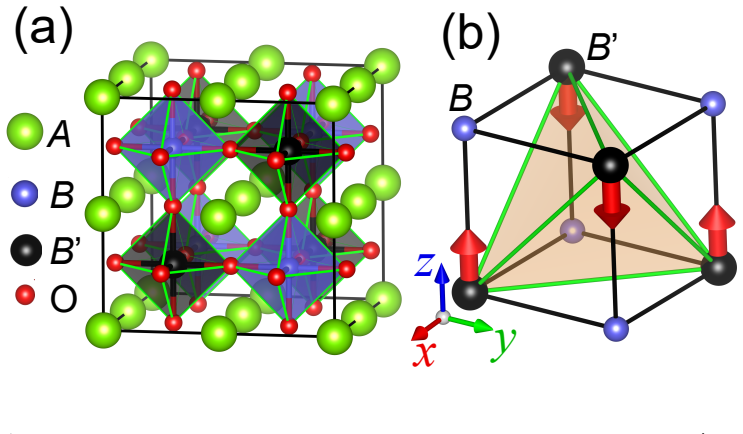
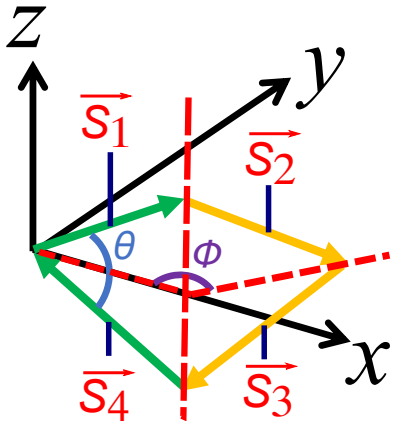
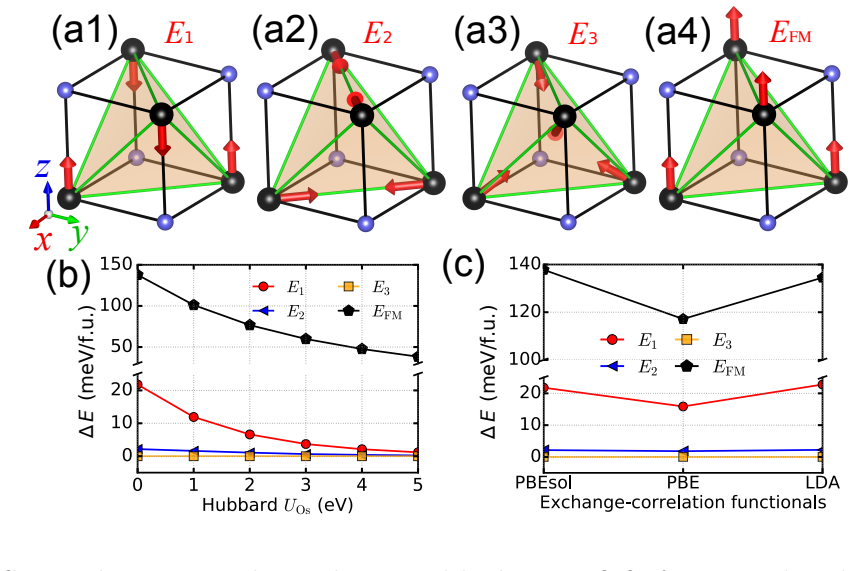
The argument is carried by a classical vector-spin Hamiltonian on the four spins of an fcc tetrahedron: Heisenberg exchange plus nearest-neighbor biquadratic and four-spin ring exchange, with the biquadratic and ring coefficients combined into a single parameter $\alpha_1 = a_1 + a_2$. On the fcc tetrahedron the Heisenberg term is a constant independent of spin direction, so the energy landscape is set entirely by the higher-order terms. Inserting a general two-angle parametrization of a four-spin ring yields an analytic energy $E/N = -2J_1 + \alpha_1\left(\frac{13}{4} - \cos\theta + \frac{7}{4}\cos 2\theta + 2\cos^4(\theta/2)\cos 2\phi\right) + E_0$, whose three extrema are exactly the collinear state $E_1$, the coplanar state $E_2$, and the non-coplanar state $E_3$. Positive $J_1$ and $\alpha_1$ give the ordering $E_3 < E_2 < E_1 < E_{FM}$ independent of their magnitudes. Adding spin-orbit coupling splits the states into nine distinct orderings; the near-degeneracy of two of them is what strain acts on.
What would settle it
Neutron scattering at millikelvin temperatures on Ba2YOsO6 or a similar compound: if the magnetic order stays type-I collinear down to the lowest temperature and no transition to the predicted coplanar or non-coplanar states appears, the central prediction is contradicted. Strain-dependent diffraction would further test the predicted switch at about 0.1% uniaxial compression.
Extended reading notes
Core claim
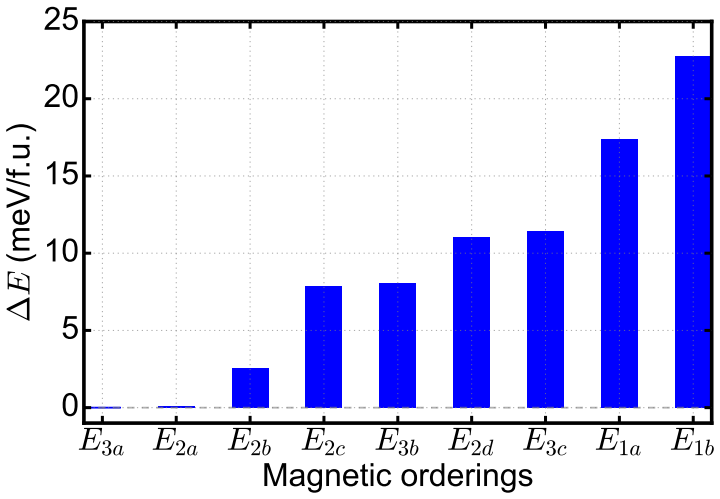
The central claim is that at zero temperature, non-collinear antiferromagnetic orderings are thermodynamically more stable than the type-I collinear ordering experimentally observed at finite temperatures in six frustrated double perovskite oxides: Sr2ScRuO6, Sr2YRuO6, Ba2YRuO6, Sr2ScOsO6, Sr2YOsO6, and Ba2YOsO6. The paper identifies two distinct non-collinear states of a tetrahedron of four $S=3/2$ spins—a coplanar state $E_2$ and a non-coplanar state $E_3$ with all spins at an angle $\arccos(1/3) \approx 71^\circ$—and shows that both sit lower in energy than the collinear state, independent of Hubbard $U$, exchange-correlation functional, and the presence or absence of spin-orbit coupling. With spin-orbit coupling included, the degeneracies split and nine stable orderings appear; in Ba2YOsO6 the two lowest, coplanar $E_{2a}$ and non-coplanar $E_{3a}$, are almost degenerate at about 0.10 meV per formula unit. Uniaxial strain moves the system across this near-degeneracy: tensile strain favors $E_{3a}$, while roughly 0.1% compressive strain makes $E_{2a}$ more stable.
Load-bearing premise
The predictions assume that the magnetic energy of each oxide is fully captured by the relative angles of four spins on one tetrahedron, with interactions only between nearest neighbors; longer-range or non-repeating magnetic patterns were not tested and could be lower in energy.
Editorial extensions
If this is right
- At sufficiently low temperatures, each of the six oxides should undergo a collinear-to-non-collinear magnetic transition, with the collinear state stabilized by entropy at finite temperature.
- The non-collinear states $E_{3a}$ and $E_{2a}$ are predicted to be the zero-temperature ground states in all six compounds, not just Ba2YOsO6.
- In Ba2YOsO6, the energy difference between the two lowest non-collinear states is about 0.10 meV per formula unit; uniaxial strain of about 0.1% compressive selects $E_{2a}$ and tensile strain selects $E_{3a}$.
- The energy ordering is robust against the choice of exchange-correlation functional (PBEsol, PBE, LDA), against Hubbard $U$ from 0 to 5 eV, and against whether spin-orbit coupling is included.
Reading between the lines
- The four-sublattice model confines the search to states compatible with a 40-atom supercell; the paper notes that second-neighbor exchange is a constant in such a cell, so other ordering wavevectors, longer-range interactions, or incommensurate states could be even lower in energy and would change the predicted ground state.
- The strain-switching result suggests a general design rule: look for frustrated oxides with accidental near-degeneracies between non-collinear orders, since even small lattice distortions can select the ground state; Ba2YOsO6 is the first concrete candidate.
- If the predicted low-temperature phases are confirmed by neutron scattering, they would give a direct measurement of biquadratic and four-spin ring exchange in 5d oxides, whose magnitudes are currently inferred mainly indirectly.
Signed reviews
Editorial analysis
A structured set of objections, weighed in public.
Referee Report
Summary. The paper reports DFT+U spin-polarized calculations, with and without spin-orbit coupling, for six ordered double perovskite oxides (Sr2ScRuO6, Sr2YRuO6, Ba2YRuO6, Sr2ScOsO6, Sr2YOsO6, Ba2YOsO6). Using a 40-atom supercell containing four magnetic ions on an fcc tetrahedron, it finds that at zero temperature non-collinear coplanar and non-coplanar antiferromagnetic orderings (denoted E2 and E3) are lower in energy than the type-I collinear ordering observed experimentally at finite temperatures. A classical Heisenberg plus biquadratic and four-spin ring-exchange model is shown to reproduce the ordering E3 < E2 < E1 < EFM for positive nearest-neighbor J1 and positive combined coefficient α1. After including SOC, nine spin-orbit-split states are identified, with E3a and E2a almost degenerate in Ba2YOsO6; the paper predicts that roughly 0.1% uniaxial strain can switch between these two states. The central predictions are that a collinear-to-noncollinear magnetic transition occurs at low temperatures and that strain offers a mechanical route to control non-collinear magnetic orderings.
Significance. If the zero-temperature ground-state claim and the strain-switching prediction survive scrutiny, this would be a valuable contribution: it identifies concrete candidate non-collinear magnetic structures in frustrated double perovskites that could be tested by low-temperature neutron scattering, and it proposes a practical strain-based control mechanism. The DFT evidence is internally consistent: the ordering E3 < E2 < E1 < EFM is stable across different functionals, Hubbard U values, and the presence or absence of SOC, at least for Ba2YOsO6. The analytic spin-model derivation is transparent and requires no fitted parameter values, only signs. The authors also make their data openly available in Zenodo. The significance is tempered, however, by two gaps: all tested magnetic states are commensurate with a single four-magnetic-ion tetrahedron, and the finite-temperature transition is inferred without any free-energy calculation.
major comments (3)
- [Section III.A, Fig. 1, and Eq. (2)] The search over magnetic orderings is restricted to a 40-atom supercell containing four magnetic ions, and the manuscript itself states that 'the second nearest-neighbor interaction is a constant in our DFT calculations'. Consequently, the energies compared in Figs. 3, 5, 7, and 8 only establish the relative stability of states commensurate with a single fcc tetrahedron. Frustrated fcc antiferromagnets can host type-II, type-III, and incommensurate spiral orderings with larger magnetic unit cells, and none of these is sampled here. This limitation is load-bearing because the abstract and conclusions claim that at zero temperature non-collinear orderings are 'more stable' than the type-I ordering, which implies a statement about the global ground state. The authors should either perform calculations in larger supercells containing candidate longer-period orders, or explicitly restrict the claim to the four-sublattice manifold. As written, the global ground-state claim is unproven.
- [Section III.B and Section IV] The finite-temperature conclusion is inferred without any free-energy calculation. The paper states that an 'entropy-driven collinear-to-noncollinear magnetic transition' could occur, but no partition function, Monte Carlo sampling, or high-temperature expansion is presented for either the spin model or the DFT-derived states. Since the experimentally observed state at finite temperature is the collinear type-I order, the key physical puzzle is why entropy would favor a state that is higher in energy at T=0. The paper's assertion is plausible but is not supported by a calculation. To make the central claim about a collinear-to-noncollinear transition load-bearing, the authors should provide at least a classical Monte Carlo or analytical free-energy estimate showing that the collinear state becomes entropically selected at the relevant temperatures.
- [Section III.B and Fig. 9] The strain-switching prediction rests on a very small energy difference, reported as about 0.10 meV/f.u. between E2a and E3a, and on a linear fit of DFT+SOC energies as a function of uniaxial strain. The critical strain is about 0.1%, which is comparable to the scale on which the two states are nearly degenerate. The manuscript does not report convergence of this energy difference with respect to k-point density, plane-wave cutoff, smearing, or structural relaxation tolerances, nor does it provide error bars or a measure of the quality of the linear fit. Because the sign of E2a - E3a under strain is the entire basis for the proposed mechanical switching, the authors should demonstrate that this small energy difference is numerically robust and not an artifact of computational settings. Without such tests, the strain-switching prediction is fragile even though the underlying near-degeneracy may be real.
minor comments (6)
- [Abstract and Section I] The abstract says 'a wide range of magnetically frustrated oxides' and 'universal' language appears in the text, but only six compounds are studied and functional/SOC robustness is demonstrated in detail only for Ba2YOsO6; the wording should be matched to the evidence.
- [Table I] The space groups are listed with different measurement temperatures in the parent references; a short note on whether the calculations use the low-temperature or room-temperature structures for each compound would improve reproducibility.
- [Fig. 9 and Eq. (6)] The strain is defined as a percentage in Eq. (6), but the x-axis label in Fig. 9 is 'εxx(%)'; please make the definition consistent and state whether the fitted line uses the DFT points at all plotted strains.
- [Supplementary Fig. S1] The energy zero is set to E3a in the main text but to E2a in Fig. S1; this is not an error, but the convention should be stated in every caption to avoid confusion.
- [References] Some reference titles and journal names, especially Ref. [16], contain garbled or non-standard characters ('Zeitschrift fr anorganische und allgemeine Chemie'); these should be corrected.
- [Eq. (1) and Fig. 2] The parameterization of the four-spin configuration is clear, but the text should state explicitly that this parameterization covers the zero-total-spin head-to-tail ring configurations considered in this work and that other closed configurations are not intended.
Circularity Check
DFT ordering and strain-switch predictions are self-contained; only the biquadratic-mechanism interpretation is mildly circular because the coupling sign is read off the same DFT energy sequence.
-
fitted input called prediction
[Section III A, Eq. (2)-(5) and the paragraph after Eq. (5)]
"For a positive J1 and a positive α1, Eq. (4) and Eq. (5) find an energy sequence E3 < E2 < E1 < EFM, irrespective of the values of J1 and α1. This reproduces our spin-polarized DFT results (fig. 5)."
In the model, Eqs. (4)-(5) give E1/N = -2J1 + 6α1 + E0, E2/N = -2J1 + 2α1 + E0, and E3/N = -2J1 + (2/3)α1 + E0, so E1-E2 = 4α1/N and E2-E3 = (4/3)α1/N. Thus the condition α1 > 0 is mathematically equivalent to the DFT-computed ordering E3 < E2 < E1. The paper does not determine α1 from an independent calculation; its sign is inferred by matching the same DFT energy ordering that the model is then said to 'reproduce'. Consequently, the mechanistic statement that higher-order biquadratic/ring exchange stabilizes the non-collinear states is a restatement of the DFT energy sequence in model language rather than an independent confirmation. The DFT total energies and the strain-switching result remain self-contained and external to this model-consistency step.
full rationale
The central predictions—zero-temperature non-collinear orderings and the uniaxial-strain switching in Ba2YOsO6—come directly from DFT total-energy comparisons in a 40-atom supercell, with results checked against multiple functionals and U values. These energies are computed, not generated by the classical spin model, so the core physics claims are not circular. The spin Hamiltonian in Eq. (2) is introduced after the DFT energies are known, and the statement that positive J1 and α1 yield E3 < E2 < E1 < EFM is a consistency check: α1 is not independently measured or calculated, and the sign is effectively fitted to the DFT ordering. This gives a mild circularity in the mechanistic attribution, but it does not affect the primary DFT evidence or the strain prediction. The skeptical concern that the single-tetrahedron supercell makes J2 a constant is a limitation about untested ordering wavevectors, not a circularity, and there is no load-bearing self-citation or imported uniqueness theorem. Overall score 2.
Assumptions & free parameters
free parameters (2)
- Hubbard U (Os/Ru) =
0 eV for main results; tested 0 to 5 eV
- Spin-model coefficients J1 and alpha1 (signs) =
not numerically fitted; only J1>0 and alpha1>0 are used
assumptions (5)
- domain assumption DFT exchange-correlation functionals (PBEsol, PBE, LDA) reliably rank the energies of non-collinear spin states in 4d/5d double perovskites.
- domain assumption The magnetic ions can be treated as classical vector spins of fixed length S=3/2 (|Si|=1).
- domain assumption Only nearest-neighbor Heisenberg, biquadratic, and 4-spin ring exchange terms are needed; longer-range Heisenberg terms are constant for the 4-sublattice states considered.
- standard math The higher-order exchange terms arise from the t/U expansion of a half-filled Hubbard model, with alpha1 proportional to t^3/U^2.
- domain assumption Experimental crystal structures are appropriate for comparing magnetic ordering energies.
Cite this review
Pith. "Pith review of The complex non-collinear magnetic orderings in Ba2YOsO6: A new approach to tuning spin-lattice interactions and controlling magnetic orderings in frustrated complex oxides." pith.science (2026). https://pith.science/paper/XHXLZXFO
@misc{pith2026190801916,
  author       = {Pith},
  title        = {Pith review of: The complex non-collinear magnetic orderings in Ba2YOsO6: A new approach to tuning spin-lattice interactions and controlling magnetic orderings in frustrated complex oxides},
  year         = {2026},
  howpublished = {\url{https://pith.science/paper/XHXLZXFO}},
  note         = {Machine review of arXiv:1908.01916}
}
abstract
Frustrated magnets are one class of fascinating materials that host many intriguing phases such as spin ice, spin liquid and complex long-range magnetic orderings at low temperatures. In this work we use first-principles calculations to find that in a wide range of magnetically frustrated oxides, at zero temperature a number of non-collinear magnetic orderings are more stable than the type-I collinear ordering that is observed at finite temperatures. The emergence of non-collinear orderings in those complex oxides is due to higher-order exchange interactions that originate from second-row and third-row transition metal elements. This implies a collinear-to-noncollinear spin transition at sufficiently low temperatures in those frustrated complex oxides. Furthermore, we find that in a particular oxide Ba$_2$YOsO$_6$, experimentally feasible uniaxial strain can tune the material between two different non-collinear magnetic orderings. Our work predicts new non-collinear magnetic orderings in frustrated complex oxides at very low temperatures and provides a mechanical route to tuning complex non-collinear magnetic orderings in those materials.
Figures
Figures from the paper (6 more)




Reference graph
Works this paper leans on
-
[1]
C. Balz, B. Lake, J. Reuther, H. Luetkens, R. Sch¨ onemann, T. Herrmannsd¨ orfer, Y. Singh, A. N. Islam, E. M. Wheeler, J. A. Rodriguez-Rivera, et al., Nature Phys. 12, 942 (2016)
work page 2016
-
[2]
Y. Li, D. Adroja, D. Voneshen, R. I. Bewley, Q. Zhang, A. A. Tsirlin, and P. Gegenwart, Nat. Commun. 8, 15814 (2017)
work page 2017
-
[3]
T. A. Bojesen and S. Onoda, Phys. Rev. Lett. 119, 227204 (2017)
work page 2017
-
[4]
E. Lantagne-Hurtubise, J. G. Rau, and M. J. P. Gingras, Phys. Rev. X 8, 021053 (2018)
work page 2018
-
[5]
Balents, Nature 464, 199 (2010)
L. Balents, Nature 464, 199 (2010)
2010
-
[6]
I. Rousochatzakis, Y. Sizyuk, and N. B. Perkins, Nat. Commun. 9, 1575 (2018)
work page 2018
-
[7]
Savary and L
L. Savary and L. Balents, Rep. Prog. Phys. 80, 016502 (2016)
2016
- [8]
Show all 51 references
-
[9]
M. R. Norman, Rev. Mod. Phys. 88, 041002 (2016)
2016
-
[10]
Kayser, B
P. Kayser, B. J. Kennedy, B. Ranjbar, J. A. Kimpton, and M. Avdeev, Inorg. Chem. 56, 2204 (2017)
2017
-
[11]
A. E. Taylor, R. Morrow, D. J. Singh, S. Calder, M. D. Lumsden, P. M. Woodward, and A. D. Christianson, Phys. Rev. B 91, 100406 (2015). 17
2015
-
[12]
A. E. Taylor, R. Morrow, R. S. Fishman, S. Calder, A. I. Kolesnikov, M. D. Lumsden, P. M. Woodward, and A. D. Christianson, Phys. Rev. B 93, 220408 (2016)
2016
-
[13]
Granado, J
E. Granado, J. W. Lynn, R. F. Jardim, and M. S. Torikachvili, Phys. Rev. Lett. 110, 017202 (2013)
2013
-
[14]
G. J. Nilsen, C. M. Thompson, G. Ehlers, C. A. Marjerrison, and J. E. Greedan, Phys. Rev. B 91, 054415 (2015)
2015
-
[15]
A. K. Paul, A. Sarapulova, P. Adler, M. Reehuis, S. Kanungo, D. Mikhailova, W. Schnelle, Z. Hu, C. Kuo, V. Siruguri, et al., Zeitschrift fr anorganische und allgemeine Chemie 641, 197 (2015)
2015
-
[16]
D. D. Maharaj, G. Sala, C. A. Marjerrison, M. B. Stone, J. E. Greedan, and B. D. Gaulin, Phys. Rev. B 98, 104434 (2018)
2018
-
[17]
Kayser, S
P. Kayser, S. Injac, B. Ranjbar, B. J. Kennedy, M. Avdeev, and K. Yamaura, Inorg. Chem. 56, 9009 (2017)
2017
-
[18]
Battle and W
P. Battle and W. Macklin, J. Solid State Chem. 52, 138 (1984)
1984
-
[19]
Izumiyama, Y
Y. Izumiyama, Y. Doi, M. Wakeshima, Y. Hinatsu, A. Nakamura, and Y. Ishii, J. Solid State Chem. 169, 125 (2002)
2002
-
[20]
Kermarrec, C
E. Kermarrec, C. A. Marjerrison, C. M. Thompson, D. D. Maharaj, K. Levin, S. Kroeker, G. E. Granroth, R. Flacau, Z. Yamani, J. E. Greedan, et al., Phys. Rev. B 91, 075133 (2015)
2015
-
[21]
Battle and C
P. Battle and C. Jones, J. Solid State Chem. 78, 108 (1989)
1989
-
[22]
Kresse and J
G. Kresse and J. Furthm¨ uller, Comp. Mater. Sci. 6, 15 (1996)
1996
-
[23]
Kresse and J
G. Kresse and J. Furthm¨ uller, Phys. Rev. B 54, 11169 (1996)
1996
-
[24]
S. L. Dudarev, G. A. Botton, S. Y. Savrasov, C. J. Humphreys, and A. P. Sutton, Phys. Rev. B 57, 1505 (1998)
1998
-
[25]
J. P. Perdew, A. Ruzsinszky, G. I. Csonka, O. A. Vydrov, G. E. Scuseria, L. A. Constantin, X. Zhou, and K. Burke, Phys. Rev. Lett. 100, 136406 (2008)
2008
-
[26]
Chen, npj Quant
H. Chen, npj Quant. Mater. 3, 57 (2018)
2018
-
[27]
E. I. P. Aulesti, Y. W. Cheung, Y.-W. Fang, J. He, K. Yamaura, K. T. Lai, S. K. Goh, and H. Chen, Appl. Phys. Lett. 113, 12902 (2018)
2018
-
[28]
Treiber and S
U. Treiber and S. Kemmler-Sack, Z. anorg. allg. Chem. (ZAAC) 478, 223 (1981)
1981
-
[29]
Chen and L
G. Chen and L. Balents, Phys. Rev. B 84, 094420 (2011)
2011
-
[30]
G. Lan, J. Song, and Z. Yang, J. Alloy. Compd. 749, 909 (2018). 18
2018
-
[31]
Kanungo, B
S. Kanungo, B. Yan, M. Jansen, and C. Felser, Phys. Rev. B 89, 214414 (2014)
2014
-
[32]
J. Chen, A. J. Millis, and C. A. Marianetti, Phys. Rev. B 91, 241111 (2015)
2015
-
[33]
Chen and A
H. Chen and A. J. Millis, Phys. Rev. B 93, 205110 (2016)
2016
-
[34]
Oguchi, H
T. Oguchi, H. Nishimori, and Y. Taguchi, J. Phys. Soc. Jpn. 54, 4494 (1985)
1985
-
[35]
C. J. Calzado, C. de Graaf, E. Bordas, R. Caballol, and J.-P. Malrieu, Phys. Rev. B 67, 132409 (2003)
2003
-
[36]
Coldea, S
R. Coldea, S. M. Hayden, G. Aeppli, T. G. Perring, C. D. Frost, T. E. Mason, S.-W. Cheong, and Z. Fisk, Phys. Rev. Lett. 86, 5377 (2001)
2001
-
[37]
Xiang, C
H. Xiang, C. Lee, H.-J. Koo, X. Gong, and M.-H. Whangbo, Dalton Trans. 42, 823 (2013)
2013
-
[38]
N. S. Fedorova, C. Ederer, N. A. Spaldin, and A. Scaramucci, Phys. Rev. B 91, 165122 (2015)
2015
-
[39]
K. Penc, N. Shannon, and H. Shiba, Phys. Rev. Lett. 93, 197203 (2004)
2004
-
[40]
K. Penc, N. Shannon, Y. Motome, and H. Shiba, J. Phys. Condens. Matter 19, 145267 (2007)
2007
-
[41]
Shannon, K
N. Shannon, K. Penc, and Y. Motome, Phys. Rev. B 81, 184409 (2010)
2010
-
[42]
T. A. Kaplan, Phys. Rev. B 80, 012407 (2009)
2009
-
[43]
Takahashi, J
M. Takahashi, J. Phys. C: Solid State Phys. 10, 1289 (1977)
1977
-
[44]
H. Yan, O. Benton, L. Jaubert, and N. Shannon, Phys. Rev. B 95, 094422 (2017)
2017
-
[45]
K. A. Ross, L. Savary, B. D. Gaulin, and L. Balents, Phys. Rev. X 1, 021002 (2011)
2011
-
[46]
C. W. Hicks, D. O. Brodsky, E. A. Yelland, A. S. Gibbs, J. A. Bruin, M. E. Barber, S. D. Edkins, K. Nishimura, S. Yonezawa, Y. Maeno, et al., Science 344, 283 (2014)
2014
-
[47]
M. E. Barber, A. S. Gibbs, Y. Maeno, A. P. Mackenzie, and C. W. Hicks, Phys. Rev. Lett. 120, 076602 (2018)
2018
-
[48]
Steppke, L
A. Steppke, L. Zhao, M. E. Barber, T. Scaffidi, F. Jerzembeck, H. Rosner, A. S. Gibbs, Y. Maeno, S. H. Simon, A. P. Mackenzie, et al., Science 355 (2017)
2017
-
[49]
Kissikov, R
T. Kissikov, R. Sarkar, M. Lawson, B. Bush, E. I. Timmons, M. A. Tanatar, R. Prozorov, S. Budko, P. C. Canfield, R. Fernandes, et al., Nat. Commun. 9, 1058 (2018)
2018
-
[50]
Fang and H
Y.-W. Fang and H. Chen, The complex non-collinear magnetic orderings in Ba 2YOsO6: A new approach to tuning spin-lattice interactions and controlling magnetic orderings in frus- trated complex oxides (2019), Dataset archived in Zenodo, URL https://doi.org/10.5281/ zenodo.32658...
2019 arXiv
-
[51]
Treiber and S
U. Treiber and S. Kemmler-Sack, Z. anorg. allg. Chem. (ZAAC) 478, 223 (1981). 5
1981
Reviewed August 14, 2026 · model on record in the stance chip above.
Discussion (0). Continue with ORCID to comment.