REVIEW 3 major objections 6 minor 1 cited by
SCAN: Bootstrapping Contrastive Pre-training for Data Efficiency
T0 review · 3 major / 6 minor · reviewed 2026-08-12 · deepseek-v4-flash
Pith's one-line read Pretraining with 30% less data costs under 1% accuracy
desk verdict SCAN's bootstrapping schedule and broad experiments are valuable, but the missing dynamic-random control leaves the core attribution unproven. read the letter →
The pith
A machine-rendered reading of the paper's core claim, the machinery that carries it, and where it could break.
The reading
What carries the argument
The engine of the method is the bootstrapping dataset mutation loop. Every $\tau_{\text{cos}}+1$ epochs, the method recomputes candidate pruning data from in-batch InfoNCE losses: the $\rho$ smallest-loss samples are labeled redundant and the $\rho$ largest-loss samples are labeled ill-matched, and their union across the two loss directions $L_{f\to g}$ and $L_{g\to f}$ forms the candidate pool. Within each round, the actual pruning ratio follows a cosine-annealing curve $\rho_{\text{cur}}$ that rises from 0 to $2\rho$, so the dataset is gradually shrunk to an average ratio $\rho$ and then restored to full size for the next round. This dynamic schedule is what distinguishes SCAN from static coreset selection, and a warm-up rule—start pruning only after epoch-wise loss differences fall below a threshold—protects early unstable training.
What would settle it
Record per-sample InfoNCE losses every epoch for a small CLIP model and check rank-order stability between the warm-up epoch and later epochs; if a substantial fraction of samples, say more than 10%, move from the lowest-loss quintile to the highest-loss quintile, or vice versa, the pruning decision would be wrong for those samples. Alternatively, take the pruned set from SCAN at a 30% ratio, add back a random 5% of pruned samples during the final training epochs, and measure whether downstream accuracy rises by more than the reported noise; if it does, those samples were not truly redundant.
Extended reading notes
Core claim
On its own terms, the paper establishes that dynamic, loss-based dataset bootstrapping during contrastive pre-training can reduce training data by roughly one third while preserving almost all downstream performance. The central discovery is that the per-sample InfoNCE loss computed inside each batch is a usable indicator of sample usefulness across the training trajectory: low-loss samples have been memorized and can be dropped as redundant, high-loss samples are semantically mismatched and can be dropped as ill-matched, and pruning the union of these two extremes under a periodically increasing cosine schedule preserves the information content of the full dataset. The method is validated on seven CLIP architectures on two image-text datasets and two MoCo architectures on ImageNet, for a total of 16 pre-trained models, with an average performance drop below 1% at 30-35% pruning.
Load-bearing premise
The load-bearing premise is that a sample's in-batch InfoNCE loss at pruning time is a reliable and stable signal of its future usefulness—specifically, that low-loss samples stay redundant and high-loss samples stay ill-matched for the rest of training, so neither ever becomes crucial later.
Editorial extensions
If this is right
- At a 30-35% pruning ratio, SCAN models stay within 1% average downstream performance of models trained on the full dataset, across both CLIP and MoCo.
- SCAN consistently outperforms static coreset baselines SemDeDup and D-Pruning, and the dynamic baseline Info-Batch, on zero-shot, linear probing, and fine-tuning evaluations.
- Pre-training time drops by roughly 25-30% because the same number of epochs is trained on fewer samples.
- The coresets left after SCAN pre-training, especially when intersected across two architectures, outperform existing static coresets when used to pre-train a new model from scratch.
- The benefit holds across vision-language (CLIP) and vision-centric (MoCo) frameworks and across ResNet, ViT, and Swin architectures.
Reading between the lines
- The in-batch loss signal is cheap enough that SCAN could plausibly scale to billion-sample web datasets, but the paper only tests up to 10.1M pairs, so whether the sub-1% bound survives at web scale is an open question.
- The two-sided pruning rule implies a testable claim: samples that are memorized or mismatched are interchangeable across architectures, as the overlap results partially suggest; a direct experiment would check whether a sample pruned by one architecture is ever critical for another.
- The cosine-annealed bootstrapping schedule resembles a curriculum over data difficulty; one could test whether the schedule itself, rather than the specific loss cutoff, drives the gains by comparing against fixed-ratio dynamic pruning at the same average rate.
- The paper notes that LLM pre-training typically runs for only 1-3 epochs, so the method may transfer more readily to other multi-epoch contrastive objectives, such as sentence embedding training, than to single-pass LLM training.
Signed reviews
Editorial analysis
A structured set of objections, weighed in public.
Referee Report
Summary. The paper proposes SCAN, a dynamic bootstrapping dataset pruning method for contrastive pre-training. Instead of selecting a static coreset once, SCAN identifies candidate samples from per-batch InfoNCE losses, keeping the very low-loss samples (treated as redundant) and very high-loss samples (treated as ill-matched), and then prunes a varying number of these candidates through a cosine-annealing mutation schedule with periodic regrowth. The method is evaluated on CLIP pre-training on CC3M+ and CC12M+ and on MoCo pre-training on ImageNet, across 16 total models, with pruning rates of 30–35%. The paper reports less than 1% average downstream degradation relative to full-data training, claims consistent gains over SemDeDup, D-Pruning, Info-Batch, and static random baselines, and shows that the produced static coresets outperform existing static coreset methods.
Significance. If the empirical claims hold, the paper makes a practically useful contribution: it shows that contrastive pre-training can use 30–35% less data on average with a relatively small downstream cost, and that dynamic, schedule-driven pruning can be competitive with or better than static coreset selection. The scope is broad for this line of work: seven CLIP architectures, two MoCo architectures, two CLIP dataset scales, several downstream and out-of-distribution evaluation sets, and comparisons with four baselines. The paper also ships code, which supports reproducibility. The main limitations are statistical and methodological: the headline 'less than 1% average degradation' is not supported by error bars or multiple seeds, and the specific benefit of the loss-extreme selection rule is not isolated from the bootstrapping schedule by a dynamic random-candidate control. These are fixable with additional experiments and more careful wording, rather than being fundamental flaws in the method's design.
major comments (3)
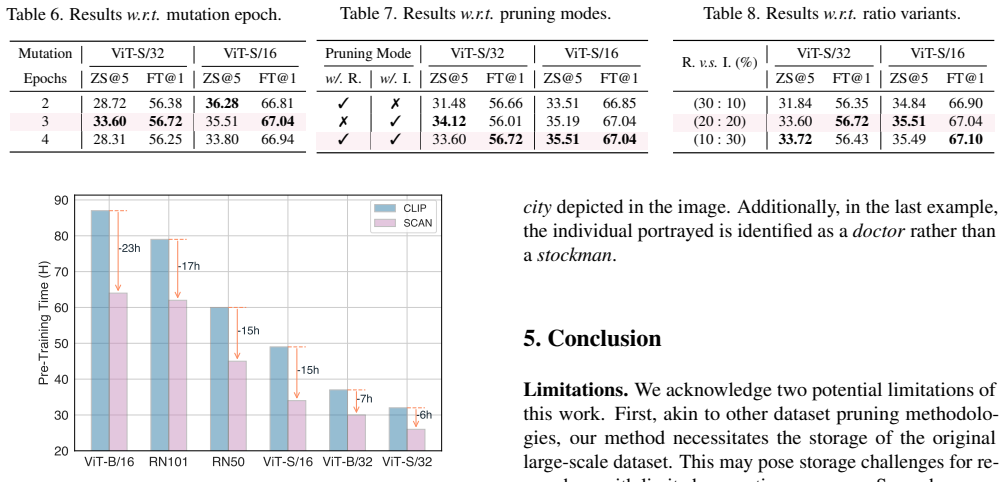
- [§3.3.1 Eq. (2), §3.3.2, §4.1 Tables 1–3, §4.4 Table 7] The central claim that loss-extreme selection drives the improvement is not isolated from the bootstrapping schedule. The Random baseline in Tables 1–3 is a static 70% subset, and the ablation in Table 7 only compares redundant vs. ill-matched selection with a fixed schedule. No control runs the same warm-up, cosine mutation schedule (Eq. 3), regrowth rounds, and epoch count while replacing Eq. (2) with uniform random candidate selection. Without such a control, the observed gains over static baselines could be attributable to the schedule alone. Please add this control or explicitly weaken the claim.
- [Abstract, Tables 1 and 3] The abstract's 'less than 1% on average' claim is not backed by per-seed variation or error bars, and the average conceals substantially larger per-metric degradations. For example, in Table 1, ViT-B/32 on CC12M+ drops from 63.40 to 61.55 on ImageNet Top-1 (-1.85 points) and from 31.09 to 29.23 on ImageNet-R (-1.86 points); in Table 3, RN101 on CC3M+ drops from 39.69 to 38.05 on ImageNet-R (-1.64 points). Please report standard deviations over multiple seeds, or explicitly state that results are single runs, and qualify the average-degradation claim accordingly.
- [§3.3.2, Eq. (3), and Table 8] The pruning-ratio bookkeeping is internally inconsistent and prevents exact reproduction. Eq. (3) ranges from 0 to 1 as τcur mod (τcos+1) goes from 0 to τcos, yet the text says 'ρcur increases from 0 to 2ρ'; the candidate set size is 2ρ|Dt| in §3.3.1, §4.1 states a pruning ratio of 30% for CLIP, and Table 8 lists R.v.s.I. ratios (30:10), (20:20), (10:30) that do not match an equal 15%:15% split of a 30% total. Please define ρ, ρcur, and the candidate-set fraction unambiguously and align the text, formulas, and table.
minor comments (6)
- [§3.3.1, Eq. (2)] The symbols ≺ρ and ≻ρ are not defined; please state explicitly that they return the indices of the ρ smallest and ρ largest per-sample losses in the batch.
- [§3.3.1] The phrase 'merge the subset intersection from Lf→g and Lg→f' is ambiguous; please specify whether the final candidate set is the union or the intersection of the two directional selections.
- [§4.1] The architecture list includes RN50, ViT-S/32, and ViT-S/16, but these do not appear in Tables 1 and 3; please point to the corresponding results in the supplementary material.
- [Figure 3] The y-axis ranges in Figure 3 are truncated (e.g., FT Acc from 56.00 to 57.00), which visually exaggerates the differences; please use full-scale axes or add error bars.
- [§4.2 and §2] There are minor typos: 'doamins' should be 'domains' in Section 2, and 'SACN' should be 'SCAN' in Section 4.2.
- [§3.3.1 and §3.3.2] The warm-up threshold Ttd and the mutation epoch τcos are free hyperparameters; please provide their values for each dataset and architecture in a reproducibility table.
Circularity Check
No significant circularity; SCAN is an empirical benchmark study whose pruning rate is an experimental control, not a derived prediction.
full rationale
This paper makes no first-principles derivation that reduces to its inputs. The selection rule in Eq. (2) is a heuristic criterion for choosing pruned candidates, and downstream accuracy is measured independently of that loss; low/high InfoNCE loss does not by construction imply better or worse downstream performance. The pruning rate is a controlled experimental variable: Section 3.3.2 states that the average pruning ratio is fixed at the predefined ρ, so the reported 30–35% pruning rate is an input setting, not a predicted output. The paper contains no load-bearing self-citations; the authors do not cite their own prior work, and the external citations are standard methods and datasets rather than an unverified uniqueness or ansatz source. The absence of a dynamic random-candidate ablation is a legitimate missing-control concern for isolating the contribution of the loss-extreme selection rule, but that is a correctness/experimental-design issue, not circularity. The coreset results in Section 4.3 are also empirical transfer evaluations, not equivalences by construction. Accordingly, no circular step can be exhibited from the paper's own equations or citation chain.
Assumptions & free parameters
free parameters (3)
- pruning ratio rho =
0.30 (CLIP), 0.35 (MoCo)
- mutation epoch tau_cos =
3
- warm-up threshold Ttd =
not reported
assumptions (3)
- domain assumption Per-sample InfoNCE loss within a batch is a reliable indicator of whether a sample is redundant (low loss) or ill-matched (high loss).
- domain assumption Dynamically pruning and regrowing the dataset with a cosine schedule keeps training stable and preserves downstream performance.
- domain assumption The in-batch loss comparison is meaningful across batches for identifying candidates.
Cite this review
Pith. "Pith review of SCAN: Bootstrapping Contrastive Pre-training for Data Efficiency." pith.science (2026). https://pith.science/paper/XHZKSEMV
@misc{pith2026241109126,
  author       = {Pith},
  title        = {Pith review of: SCAN: Bootstrapping Contrastive Pre-training for Data Efficiency},
  year         = {2026},
  howpublished = {\url{https://pith.science/paper/XHZKSEMV}},
  note         = {Machine review of arXiv:2411.09126}
}
read the original abstract
While contrastive pre-training is widely employed, its data efficiency problem has remained relatively under-explored thus far. Existing methods often rely on static coreset selection algorithms to pre-identify important data for training. However, this static nature renders them unable to dynamically track the data usefulness throughout pre-training, leading to subpar pre-trained models. To address this challenge, our paper introduces a novel dynamic bootstrapping dataset pruning method. It involves pruning data preparation followed by dataset mutation operations, both of which undergo iterative and dynamic updates. We apply this method to two prevalent contrastive pre-training frameworks: \textbf{CLIP} and \textbf{MoCo}, representing vision-language and vision-centric domains, respectively. In particular, we individually pre-train seven CLIP models on two large-scale image-text pair datasets, and two MoCo models on the ImageNet dataset, resulting in a total of 16 pre-trained models. With a data pruning rate of 30-35\% across all 16 models, our method exhibits only marginal performance degradation (less than \textbf{1\%} on average) compared to corresponding models trained on the full dataset counterparts across various downstream datasets, and also surpasses several baselines with a large performance margin. Additionally, the byproduct from our method, \ie coresets derived from the original datasets after pre-training, also demonstrates significant superiority in terms of downstream performance over other static coreset selection approaches.
Figures


Figures from the paper (2 more)

Forward citations
Cited by 1 Pith paper
-
Differential-informed Sample Selection Accelerates Multimodal Contrastive Learning
DISSect selects training samples for multimodal contrastive learning by ranking the difference between historical and current model similarity scores, matching full-data performance with 70% fewer samples.
Reference graph
Works this paper leans on
-
[1]
Amro Abbas, Kushal Tirumala, Daniel Simig, Surya Ganguli, and Ari S. Morcos. Semdedup: Data-efficient learning at web-scale through semantic deduplication. CoRR, 2023
work page 2023
-
[2]
Lawrence Zitnick, and Devi Parikh
Stanislaw Antol, Aishwarya Agrawal, Jiasen Lu, Margaret Mitchell, Dhruv Batra, C. Lawrence Zitnick, and Devi Parikh. VQA: visual question answering. In ICCV, pages 2425–2433. IEEE, 2015
work page 2015
-
[3]
Beit: BERT pre-training of image transformers
Hangbo Bao, Li Dong, Songhao Piao, and Furu Wei. Beit: BERT pre-training of image transformers. In ICLR. OpenRe- view.net, 2022
work page 2022
-
[4]
Clip retrieval: Easily compute clip em- beddings and build a clip retrieval system with them, 2022
Romain Beaumont. Clip retrieval: Easily compute clip em- beddings and build a clip retrieval system with them, 2022
work page 2022
-
[5]
Kevin W. Bowyer and Patrick J. Flynn. A 20th anniversary survey: Introduction to ’content-based image retrieval at the end of the early years’. TPAMI, 22(12):1348, 2000
work page 2000
-
[6]
Emerg- ing properties in self-supervised vision transformers
Mathilde Caron, Hugo Touvron, Ishan Misra, Hervé Jégou, Julien Mairal, Piotr Bojanowski, and Armand Joulin. Emerg- ing properties in self-supervised vision transformers. InICCV, pages 9630–9640. IEEE, 2021
work page 2021
-
[7]
Conceptual 12m: Pushing web-scale image-text pre-training to recognize long-tail visual concepts
Soravit Changpinyo, Piyush Sharma, Nan Ding, and Radu Soricut. Conceptual 12m: Pushing web-scale image-text pre-training to recognize long-tail visual concepts. In CVPR, pages 3558–3568. IEEE, 2021
work page 2021
-
[8]
Ting Chen, Simon Kornblith, Mohammad Norouzi, and Geof- frey E. Hinton. A simple framework for contrastive learning of visual representations. In ICML, pages 1597–1607. PMLR, 2020
work page 2020
Show all 73 references
-
[9]
Ting Chen, Simon Kornblith, Kevin Swersky, Mohammad Norouzi, and Geoffrey E. Hinton. Big self-supervised models are strong semi-supervised learners. In NeurIPS, 2020
2020
-
[10]
Girshick, and Kaiming He
Xinlei Chen, Haoqi Fan, Ross B. Girshick, and Kaiming He. Improved baselines with momentum contrastive learning. CoRR, 2020
2020
-
[11]
An empirical study of training self-supervised vision transformers
Xinlei Chen, Saining Xie, and Kaiming He. An empirical study of training self-supervised vision transformers. InICCV, pages 9620–9629. IEEE, 2021
2021
-
[12]
Data distillation can be like vodka: Distilling more times for better quality
Xuxi Chen, Yu Yang, Zhangyang Wang, and Baharan Mirza- soleiman. Data distillation can be like vodka: Distilling more times for better quality. In ICLR, 2024
2024
-
[13]
Imagenet: A large-scale hierarchical image database
Jia Deng, Wei Dong, Richard Socher, Li-Jia Li, Kai Li, and Li Fei-Fei. Imagenet: A large-scale hierarchical image database. In CVPR, pages 248–255. IEEE, 2009
2009
-
[14]
An image is worth 16x16 words: Transformers for image recognition at scale
Alexey Dosovitskiy, Lucas Beyer, Alexander Kolesnikov, Dirk Weissenborn, Xiaohua Zhai, Thomas Unterthiner, Mostafa Dehghani, Matthias Minderer, Georg Heigold, Syl- vain Gelly, Jakob Uszkoreit, and Neil Houlsby. An image is worth 16x16 words: Transformers for image recognition ...
2021
-
[15]
Sequential subset matching for dataset distillation
Jiawei Du, Qin Shi, and Joey Tianyi Zhou. Sequential subset matching for dataset distillation. In NeurIPS, 2023
2023
-
[16]
Second thoughts on the bootstrap
Bradley Efron. Second thoughts on the bootstrap. Statistical science, pages 135–140, 2003
2003
-
[17]
Rigging the lottery: Making all tickets winners
Utku Evci, Trevor Gale, Jacob Menick, Pablo Samuel Castro, and Erich Elsen. Rigging the lottery: Making all tickets winners. In ICML, pages 2943–2952. PMLR, 2020
2020
-
[18]
What neural networks memorize and why: Discovering the long tail via influence estimation
Vitaly Feldman and Chiyuan Zhang. What neural networks memorize and why: Discovering the long tail via influence estimation. In NeurIPS, 2020
2020
-
[19]
Simcse: Sim- ple contrastive learning of sentence embeddings
Tianyu Gao, Xingcheng Yao, and Danqi Chen. Simcse: Sim- ple contrastive learning of sentence embeddings. In EMNLP, pages 6894–6910. ACL, 2021
2021
-
[20]
A closer look at deep learning heuristics: Learning rate restarts, warmup and distillation
Akhilesh Gotmare, Nitish Shirish Keskar, Caiming Xiong, and Richard Socher. A closer look at deep learning heuristics: Learning rate restarts, warmup and distillation. In ICLR. OpenReview.net, 2019
2019
-
[21]
Deep residual learning for image recognition
Kaiming He, Xiangyu Zhang, Shaoqing Ren, and Jian Sun. Deep residual learning for image recognition. InCVPR, pages 770–778. IEEE, 2016
2016
-
[22]
Girshick
Kaiming He, Xinlei Chen, Saining Xie, Yanghao Li, Piotr Dollár, and Ross B. Girshick. Masked autoencoders are scal- able vision learners. In CVPR, pages 15979–15988. IEEE, 2022
2022
-
[23]
The many faces of robustness: A critical analysis of out-of-distribution generalization
Dan Hendrycks, Steven Basart, Norman Mu, Saurav Kada- vath, Frank Wang, Evan Dorundo, Rahul Desai, Tyler Zhu, Samyak Parajuli, Mike Guo, Dawn Song, Jacob Steinhardt, and Justin Gilmer. The many faces of robustness: A critical analysis of out-of-distribution generalization. In ...
2021
-
[24]
Clipscore: A reference-free evaluation metric for image captioning
Jack Hessel, Ari Holtzman, Maxwell Forbes, Ronan Le Bras, and Yejin Choi. Clipscore: A reference-free evaluation metric for image captioning. In EMNLP, pages 7514–7528. ACL, 2021
2021
-
[25]
Rae, and Laurent Sifre
Jordan Hoffmann, Sebastian Borgeaud, Arthur Mensch, Elena Buchatskaya, Trevor Cai, Eliza Rutherford, Diego de Las Casas, Lisa Anne Hendricks, Johannes Welbl, Aidan Clark, Tom Hennigan, Eric Noland, Katherine Millican, George van den Driessche, Bogdan Damoc, Aurelia Guy, Si- mo...
2022
-
[26]
Openclip, 2021
Gabriel Ilharco, Mitchell Wortsman, Ross Wightman, Cade Gordon, Nicholas Carlini, Rohan Taori, Achal Dave, Vaishaal Shankar, Hongseok Namkoong, John Miller, Hannaneh Ha- jishirzi, Ali Farhadi, and Ludwig Schmidt. Openclip, 2021
2021
-
[27]
Le, Yun-Hsuan Sung, Zhen Li, and Tom Duerig
Chao Jia, Yinfei Yang, Ye Xia, Yi-Ting Chen, Zarana Parekh, Hieu Pham, Quoc V . Le, Yun-Hsuan Sung, Zhen Li, and Tom Duerig. Scaling up visual and vision-language representation learning with noisy text supervision. In ICML, pages 4904–
-
[28]
Brown, Benjamin Chess, Rewon Child, Scott Gray, Alec Radford, Jeffrey Wu, and Dario Amodei
Jared Kaplan, Sam McCandlish, Tom Henighan, Tom B. Brown, Benjamin Chess, Rewon Child, Scott Gray, Alec Radford, Jeffrey Wu, and Dario Amodei. Scaling laws for neural language models. CoRR, abs/2001.08361, 2020
2001 arXiv
-
[29]
Understanding black-box predictions via influence functions
Pang Wei Koh and Percy Liang. Understanding black-box predictions via influence functions. In ICML, pages 1885–
-
[30]
Learning multiple layers of features from tiny images
Alex Krizhevsky, Geoffrey Hinton, et al. Learning multiple layers of features from tiny images. 2009
2009
-
[31]
Tiny imagenet visual recognition challenge
Ya Le and Xuan Yang. Tiny imagenet visual recognition challenge. CS 231N, 7(7):3, 2015. 9
2015
-
[32]
Namhoon Lee, Thalaiyasingam Ajanthan, and Philip H. S. Torr. Snip: single-shot network pruning based on connection sensitivity. In ICLR. OpenReview.net, 2019
2019
-
[33]
Error norm truncation: Robust training in the presence of data noise for text generation models
Tianjian Li, Haoran Xu, Philipp Koehn, Daniel Khashabi, and Kenton Murray. Error norm truncation: Robust training in the presence of data noise for text generation models. In ICLR, 2024
2024
-
[34]
UP-DP: unsupervised prompt learning for data pre-selection with vision-language models
Xin Li, Sima Behpour, Thang Long Doan, Wenbin He, Liang Gou, and Liu Ren. UP-DP: unsupervised prompt learning for data pre-selection with vision-language models. In NeurIPS, 2023
2023
-
[35]
An inverse scaling law for CLIP training
Xianhang Li, Zeyu Wang, and Cihang Xie. An inverse scaling law for CLIP training. In NeurIPS, 2023
2023
-
[36]
Belongie, James Hays, Pietro Perona, Deva Ramanan, Piotr Dollár, and C
Tsung-Yi Lin, Michael Maire, Serge J. Belongie, James Hays, Pietro Perona, Deva Ramanan, Piotr Dollár, and C. Lawrence Zitnick. Microsoft COCO: common objects in context. In ECCV, pages 740–755. Springer, 2014
2014
-
[37]
Do we actually need dense over- parameterization? in-time over-parameterization in sparse training
Shiwei Liu, Lu Yin, Decebal Constantin Mocanu, and Mykola Pechenizkiy. Do we actually need dense over- parameterization? in-time over-parameterization in sparse training. In ICML, pages 6989–7000. PMLR, 2021
2021
-
[38]
Swin transformer: Hierarchical vision transformer using shifted windows
Ze Liu, Yutong Lin, Yue Cao, Han Hu, Yixuan Wei, Zheng Zhang, Stephen Lin, and Baining Guo. Swin transformer: Hierarchical vision transformer using shifted windows. In ICCV, pages 9992–10002. IEEE, 2021
2021
-
[39]
SGDR: stochastic gradient descent with warm restarts
Ilya Loshchilov and Frank Hutter. SGDR: stochastic gradient descent with warm restarts. In ICLR. OpenReview.net, 2017
2017
-
[40]
D2 pruning: Message passing for balancing diversity and diffi- culty in data pruning
Adyasha Maharana, Prateek Yadav, and Mohit Bansal. D2 pruning: Message passing for balancing diversity and diffi- culty in data pruning. In ICLR, 2024
2024
-
[41]
SIEVE: multimodal dataset pruning using image captioning models
Anas Mahmoud, Mostafa Elhoushi, Amro Abbas, Yu Yang, Newsha Ardalani, Hugh Leather, and Ari Morcos. SIEVE: multimodal dataset pruning using image captioning models. In CVPR. IEEE, 2024
2024
-
[42]
Bilmes, and Jure Leskovec
Baharan Mirzasoleiman, Jeff A. Bilmes, and Jure Leskovec. Coresets for data-efficient training of machine learning mod- els. In ICML, pages 6950–6960. PMLR, 2020
2020
-
[43]
Scalable training of artificial neural networks with adaptive sparse connectivity inspired by network science
Decebal Constantin Mocanu, Elena Mocanu, Peter Stone, Phuong H Nguyen, Madeleine Gibescu, and Antonio Liotta. Scalable training of artificial neural networks with adaptive sparse connectivity inspired by network science. Nature com- munications, 9(1):2383, 2018
2018
-
[44]
Using relevance to reduce network size automatically
Michael C Mozer and Paul Smolensky. Using relevance to reduce network size automatically. Connection Science, 1(1): 3–16, 1989
1989
-
[45]
Fantastic weights and how to find them: Where to prune in dynamic sparse training
Aleksandra Nowak, Bram Grooten, Decebal Constantin Mo- canu, and Jacek Tabor. Fantastic weights and how to find them: Where to prune in dynamic sparse training. In NeurIPS, 2023
2023
-
[46]
Vicente Ordonez, Girish Kulkarni, and Tamara L. Berg. Im2text: Describing images using 1 million captioned pho- tographs. In NIPS, pages 1143–1151, 2011
2011
-
[47]
Deep learning on a data diet: Finding important examples early in training
Mansheej Paul, Surya Ganguli, and Gintare Karolina Dz- iugaite. Deep learning on a data diet: Finding important examples early in training. In NeurIPS, pages 20596–20607, 2021
2021
-
[48]
Infobatch: Loss- less training speed up by unbiased dynamic data pruning
Ziheng Qin, Kai Wang, Zangwei Zheng, Jianyang Gu, Xi- angyu Peng, Daquan Zhou, and Yang You. Infobatch: Loss- less training speed up by unbiased dynamic data pruning. In ICLR, 2024
2024
-
[49]
Learning transferable visual models from natural language supervision
Alec Radford, Jong Wook Kim, Chris Hallacy, Aditya Ramesh, Gabriel Goh, Sandhini Agarwal, Girish Sastry, Amanda Askell, Pamela Mishkin, Jack Clark, Gretchen Krueger, and Ilya Sutskever. Learning transferable visual models from natural language supervision. In ICML, pages 8748–...
2021
-
[50]
Do imagenet classifiers generalize to ima- genet? In ICML, pages 5389–5400
Benjamin Recht, Rebecca Roelofs, Ludwig Schmidt, and Vaishaal Shankar. Do imagenet classifiers generalize to ima- genet? In ICML, pages 5389–5400. PMLR, 2019
2019
-
[51]
Laion-400m: Open dataset of clip-filtered 400 million image-text pairs
Christoph Schuhmann, Robert Kaczmarczyk, Aran Komat- suzaki, Aarush Katta, Richard Vencu, Romain Beaumont, Je- nia Jitsev, Theo Coombes, and Clayton Mullis. Laion-400m: Open dataset of clip-filtered 400 million image-text pairs. In NeurIPS Workshop Datacentric AI. Jülich Super...
2021
-
[52]
LAION- 5B: an open large-scale dataset for training next generation image-text models
Christoph Schuhmann, Romain Beaumont, Richard Vencu, Cade Gordon, Ross Wightman, Mehdi Cherti, Theo Coombes, Aarush Katta, Clayton Mullis, Mitchell Wortsman, Patrick Schramowski, Srivatsa Kundurthy, Katherine Crowson, Lud- wig Schmidt, Robert Kaczmarczyk, and Jenia Jitsev. LAI...
2022
-
[53]
MIM4DD: mutual information maximization for dataset distillation
Yuzhang Shang, Zhihang Yuan, and Yan Yan. MIM4DD: mutual information maximization for dataset distillation. In NeurIPS, 2023
2023
-
[54]
Conceptual captions: A cleaned, hypernymed, image alt-text dataset for automatic image captioning
Piyush Sharma, Nan Ding, Sebastian Goodman, and Radu Soricut. Conceptual captions: A cleaned, hypernymed, image alt-text dataset for automatic image captioning. InACL, pages 2556–2565. ACL, 2018
2018
-
[55]
Fre- quency domain-based dataset distillation
DongHyeok Shin, Seungjae Shin, and Il-Chul Moon. Fre- quency domain-based dataset distillation. In NeurIPS, 2023
2023
-
[56]
An introduction to the bootstrap (bradley efron and robert j
Siva Sivaganesan. An introduction to the bootstrap (bradley efron and robert j. tibshirani). SIAM Rev., 36(4):677–678, 1994
1994
-
[57]
Beyond neural scaling laws: beating power law scaling via data pruning
Ben Sorscher, Robert Geirhos, Shashank Shekhar, Surya Gan- guli, and Ari Morcos. Beyond neural scaling laws: beating power law scaling via data pruning. In NeurIPS, 2022
2022
-
[58]
On the diversity and realism of distilled dataset: An efficient dataset distilla- tion paradigm
Peng Sun, Bei Shi, Daiwei Yu, and Tao Lin. On the diversity and realism of distilled dataset: An efficient dataset distilla- tion paradigm. In CVPR, 2024
2024
-
[59]
Hidenori Tanaka, Daniel Kunin, Daniel L. K. Yamins, and Surya Ganguli. Pruning neural networks without any data by iteratively conserving synaptic flow. In NeurIPS, 2020
2020
-
[60]
Training data-efficient image transformers & distillation through atten- tion
Hugo Touvron, Matthieu Cord, Matthijs Douze, Francisco Massa, Alexandre Sablayrolles, and Hervé Jégou. Training data-efficient image transformers & distillation through atten- tion. In ICML, pages 10347–10357. PMLR, 2021
2021
-
[61]
Represen- tation learning with contrastive predictive coding
Aäron van den Oord, Yazhe Li, and Oriol Vinyals. Represen- tation learning with contrastive predictive coding. 2018
2018
-
[62]
Gomez, Lukasz Kaiser, and Illia Polosukhin
Ashish Vaswani, Noam Shazeer, Niki Parmar, Jakob Uszkor- eit, Llion Jones, Aidan N. Gomez, Lukasz Kaiser, and Illia Polosukhin. Attention is all you need. In NIPS, pages 5998– 6008, 2017. 10
2017
-
[63]
Too large; data reduction for vision-language pre-training
Alex Jinpeng Wang, Kevin Qinghong Lin, David Junhao Zhang, Stan Weixian Lei, and Mike Zheng Shou. Too large; data reduction for vision-language pre-training. In ICCV, pages 3124–3134. IEEE, 2023
2023
-
[64]
Finetuned multimodal lan- guage models are high-quality image-text data filters
Weizhi Wang, Khalil Mrini, Linjie Yang, Sateesh Kumar, Yu Tian, Xifeng Yan, and Heng Wang. Finetuned multimodal lan- guage models are high-quality image-text data filters. CoRR, abs/2403.02677, 2024
2024 arXiv
-
[65]
Cliploss and norm-based data selection methods for multimodal con- trastive learning
Yiping Wang, Yifang Chen, Wendan Yan, Alex Fang, Wen- jing Zhou, Kevin Jamieson, and Simon Shaolei Du. Cliploss and norm-based data selection methods for multimodal con- trastive learning. CoRR, abs/2405.19547, 2024
2024 arXiv
-
[66]
On the de-duplication of LAION-2B
Ryan Webster, Julien Rabin, Loïc Simon, and Frédéric Jurie. On the de-duplication of LAION-2B. CoRR, 2023
2023
-
[67]
Cit: Curation in training for effective vision- language data
Hu Xu, Saining Xie, Po-Yao Huang, Licheng Yu, Russell Howes, Gargi Ghosh, Luke Zettlemoyer, and Christoph Fe- ichtenhofer. Cit: Curation in training for effective vision- language data. In ICCV, pages 15134–15143. IEEE, 2023
2023
-
[68]
Demystifying CLIP data
Hu Xu, Saining Xie, Xiaoqing Ellen Tan, Po-Yao Huang, Rus- sell Howes, Vasu Sharma, Shang-Wen Li, Gargi Ghosh, Luke Zettlemoyer, and Christoph Feichtenhofer. Demystifying CLIP data. 2024
2024
-
[69]
Dataset pruning: Reducing training data by examining generalization influence
Shuo Yang, Zeke Xie, Hanyu Peng, Min Xu, Mingming Sun, and Ping Li. Dataset pruning: Reducing training data by examining generalization influence. In ICLR, 2023
2023
-
[70]
Coca: Contrastive captioners are image-text foundation models
Jiahui Yu, Zirui Wang, Vijay Vasudevan, Legg Yeung, Mo- jtaba Seyedhosseini, and Yonghui Wu. Coca: Contrastive captioners are image-text foundation models. TMLPR, 2022
2022
-
[71]
MEST: accurate and fast memory- economic sparse training framework on the edge
Geng Yuan, Xiaolong Ma, Wei Niu, Zhengang Li, Zhenglun Kong, Ning Liu, Yifan Gong, Zheng Zhan, Chaoyang He, Qing Jin, Siyue Wang, Minghai Qin, Bin Ren, Yanzhi Wang, Sijia Liu, and Xue Lin. MEST: accurate and fast memory- economic sparse training framework on the edge. In NeurI...
2021
-
[72]
Dynamic sparse no training: Training-free fine-tuning for sparse llms
Yuxin Zhang, Lirui Zhao, Mingbao Lin, Yunyun Sun, Yiwu Yao, Xingjia Han, Jared Tanner, Shiwei Liu, and Rongrong Ji. Dynamic sparse no training: Training-free fine-tuning for sparse llms. In ICLR, 2024
2024
-
[73]
Learning to prompt for vision-language models
Kaiyang Zhou, Jingkang Yang, Chen Change Loy, and Ziwei Liu. Learning to prompt for vision-language models. IJCV, 130(9):2337–2348, 2022. 11
2022
Reviewed August 12, 2026 · model on record in the stance chip above.
Discussion (0). Continue with ORCID to comment.