REVIEW 3 major objections 5 minor 47 references
ProTAGAD: A Foundation Model for TAG Anomaly Detection with Decoupled Topological and Textual Prototypes
T0 review · 3 major / 5 minor · reviewed 2026-08-12 · deepseek-v4-flash
Pith's one-line read ProTAGAD claims that decoupling textual and topological prototypes, summed only at the final score, yields best AUROC on seven of eight unseen target graphs and an average rank of 1.12 against 18 baselines.
desk verdict Solid decoupled-prototype TAGAD method with a useful ABS diagnostic, but the zero-shot evaluation is contaminated by overlap between hand-written LLM skills and the injected anomaly families, and K is tuned on target graphs. read the letter →
The pith
A machine-rendered reading of the paper's core claim, the machinery that carries it, and where it could break.
The reading
What carries the argument
The load-bearing mechanism is the decoupled dual-prototype bank. The textual bank is built from mean embeddings of pseudo-labelled anomalous and normal nodes, pushed apart by a cosine-similarity alignment loss with terms involving $\phi(\cdot,\cdot)$; the topological bank consists of $K$-means centres of Graph Transformer embeddings, and an MLP is trained to reproduce the similarity distribution over those centres via KL divergence. The textual anomaly score sums the trained probability estimator, cosine affinity to the anomaly prototype, and squared deviation from the average neighbour text; the topological score sums the KL divergence between the two prototype-similarity distributions and squared distance to the nearest prototype. Fusing only the two Z-scored sums at the final scoring stage is what prevents one modality's aggregation from smoothing the other's anomaly cues.
What would settle it
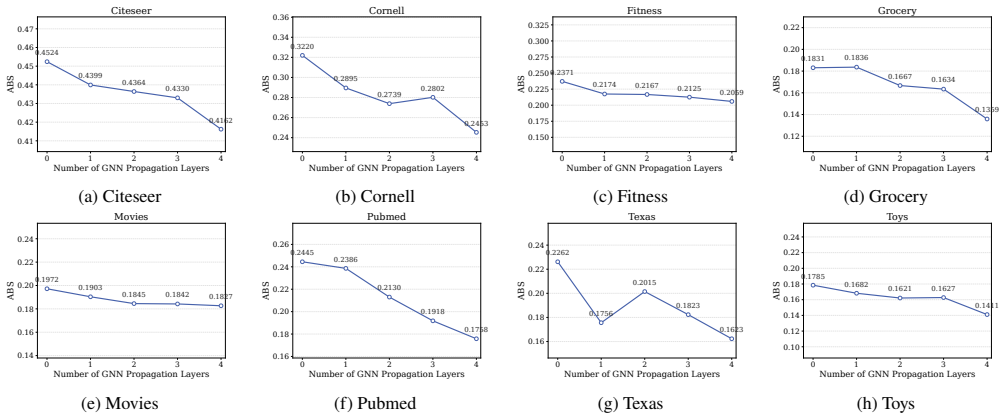
Take a target graph whose injected anomalies are not among the six written rules (for example, fabricated metadata or synonym-level spam) and compare ProTAGAD with a version that fuses text and structure throughout. If the decoupled model does not beat the coupled version there, the claim that decoupling generally sharpens the anomaly boundary is not supported. A supporting check is to measure boundary separability before and after four GNN layers on that target.
Extended reading notes
Core claim
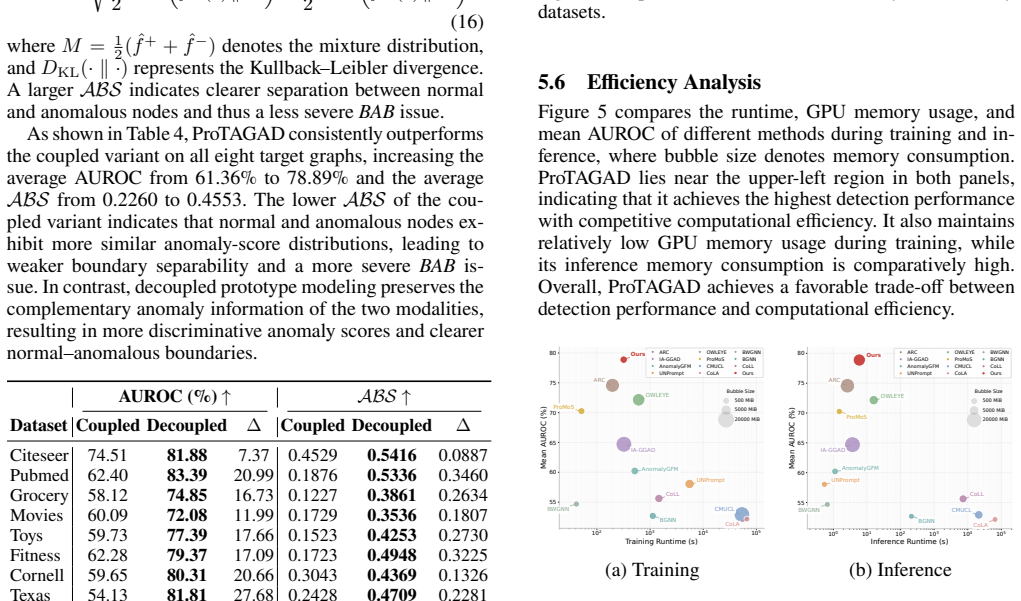
The central claim is that the Blurred-Anomaly-Boundary (BAB) problem — poor separability of the normal and anomalous anomaly-score distributions in text-attributed graph detection — is caused by coupled cross-modal message passing, and that decoupling fixes it. ProTAGAD learns a textual anomaly prototype $p^t_-$ and a textual normality prototype $p^t_+$ from LLM-pseudo-labelled node embeddings, plus $K$ topological normality prototypes $p^s_k$ from Graph Transformer embeddings with an MLP distilled to match their similarity distribution; anomaly scores from the two branches are Z-scored and summed only at the end. The paper reports best AUROC on seven of eight unseen targets with average rank 1.12 over 18 baselines, and shows the coupled variant's boundary separability falls from 0.2551 to 0.2082 as its GNN grows from zero to four layers.
Load-bearing premise
The load-bearing premise is that the six written rules the language model uses to spot suspicious text describe the same kinds of anomalies that the automatic injection procedure creates, so the labels learned on source graphs also apply to unseen graphs; if a new graph contains anomaly types outside those six, the textual half of the detector may mislead rather than help.
Editorial extensions
If this is right
- A single frozen detector can be trained once on six source graphs and applied directly to eight unseen target graphs, with best AUROC on seven of them at an average rank of 1.12.
- Coupled GNN propagation is directly implicated in the blurred boundary: separability drops by 18.41% as the coupled model goes from zero to four layers, so depth alone is not the cure.
- Textual and structural anomalies are complementary evidence: using only one prototype module leaves large gaps, while combining both achieves best results on every target graph.
- The LLM-based labelling step is an offline preprocessing cost, not a runtime dependency; all agent outputs are cached, so training and inference make no LLM calls after a one-time USD 6.64 preprocessing pass.
Reading between the lines
- Editorial inference: the six hand-written skills in Sec. 4.1 are nearly a verbal restatement of the anomaly types injected in Appendix A (text grafting, paper padding, keyword stuffing, fake product, fake entries, polluted content), so the textual prototype bank is supervised by a labeler that already knows the target anomaly families; a deployment facing anomalies outside this list could see the
- Editorial inference: the paper's ABS metric could serve as a cheap, label-free diagnostic for when decoupling helps; plotting ABS against GNN depth for other detectors may predict their zero-shot transfer failure before target labels exist.
- Editorial inference: the paper's design suggests a general recipe for multimodal graph foundation models — keep each modality's evidence in its own prototype space and fuse only at scoring, rather than learning a single joint representation.
Editorial analysis
A structured set of objections, weighed in public.
Referee Report
Summary. The paper proposes ProTAGAD, a prototype-based model for zero-shot cross-domain anomaly detection on text-attributed graphs (TAGs). The method decouples textual and topological evidence: a textual branch uses an LLM agent with hand-written domain skills to pseudo-label anomalous nodes, constructs textual normal/anomaly prototypes, and applies a probability estimator plus a prototype-alignment loss; a topological branch learns topology-aware representations via a Graph Transformer and an MLP student, with K-means structural normality prototypes. The two branches are fused only at the score level. The authors report AUROC/AUPRC on 14 TAG datasets with eight unseen targets, claiming state-of-the-art zero-shot performance with an average rank of 1.12, and present ablations showing that decoupled prototypes outperform a coupled variant and that the proposed Anomaly Boundary Separability (ABS) metric decreases with deeper GNN propagation.
Significance. The decoupled-prototype idea is a plausible and potentially useful approach to the Blurred-Anomaly-Boundary problem, and the paper provides a comprehensive benchmark, 18 baselines, ablations, and a new ABS metric. It explicitly gives an algorithmic description and reports runtime/cost details, which are strengths. However, the central zero-shot claim is not yet established: the hand-written LLM skills enumerate the same anomaly families that are injected into the target graphs, and the number of topological prototypes K is selected using target-domain performance. If these protocol issues are fixed, the paper could make a solid contribution; as it stands, the reported rankings may reflect benchmark contamination rather than generalization to unseen anomaly types.
major comments (3)
- [Sec. 4.1, Fig. 3, Appendix A] The zero-shot claim is undermined by benchmark contamination. The six hand-written skills in Figure 3 (Text Grafting, Paper Padding, Keyword Stuffing, Fake Product, Fake Entries, Polluted Content) are a near-verbal enumeration of the anomaly families constructed by the injection protocol in Appendix A (contextual insertion/replacement, fake entries, promotional content). Because the same anomaly-injection protocol is applied to both source and target graphs (Appendix A), the LLM pseudo-labeler in Eqs. (4)-(6) is effectively trained to recognize exactly the anomaly types that will appear in the unseen targets. Table 2's average rank of 1.12 therefore does not establish that the decoupled prototype design transfers to genuinely novel anomaly types; it may only show that the skill list matches the synthetic test distribution. To support the zero-shot claim, the authors should evaluate on anomaly families that are held out from the skill list, or use real-world anomaly labels.
- [Sec. 5.5, Appendix B] The number of topological prototypes K is selected using target graphs, violating the pretrain-only protocol stated in Sec. 5.1. Section 5.5 reports that K=10 is chosen because it achieves the best AUROC/AUPRC on Toys and Grocery, both of which are target graphs, and Appendix B states that K was 'selected from {1,5,10,15} and set to 10.' Because target-domain performance is used for hyperparameter selection, the reported AUROC figures are not zero-shot in the strict sense. K should be fixed a priori or chosen on a source-domain validation split, and the protocol should be restated to confirm that no target information is used.
- [Sec. 4.1, Eq. (4)] The elbow threshold used to binarize the LLM confidence scores into pseudo-labels is an unspecified free parameter. The text says 'we identify an elbow point in the anomaly confidence distribution as the threshold' without giving a concrete criterion (e.g., a curvature-based rule) or a sensitivity analysis. If this threshold is tuned on target data or varied per dataset, it is another channel of target information; if it is fixed, it should be stated explicitly and its influence on the textual prototypes should be reported.
minor comments (5)
- [Figure 3] Figure 3 contains the typo 'Anormaly Agent' in the upper-left box; it should read 'Anomaly Agent.'
- [Sec. 5.5, Figure 4] Section 5.5 says K=10 is the best, but Figure 4 only plots K values 1, 5, 10, 15; please clarify whether intermediate K values were tested or whether 'best' refers only to the tested grid.
- [Eq. (8)] Equation (8) uses the nonstandard notation 'update −→'; consider replacing it with a sentence explaining that L_prob updates the probability estimator and L_align updates the text encoder.
- [Table 2] The footnote says methods marked with * are supervised, but ARC and OWLEYE are also trained only on source graphs; please clarify the intended meaning of 'supervised' in this context.
- [Table 1] Table 1 lists 'Arxiv' only as a training set; the caption or table should explicitly note which datasets are sources and which are targets to avoid ambiguity.
Circularity Check
Hand-written LLM skills enumerate the anomaly families injected into target graphs, so the textual score reduces to retrieval against a prototype fitted to those families; the zero-shot rank 1.12 is substantially benchmark overlap rather than proven decoupling generalization.
-
fitted input called prediction
[Sec. 4.1 (Eqs. 4–6 and Eq. 9), Fig. 3, Sec. 5.1 / Appendix A (anomaly injection)]
"p^t_- = 1/||C||_1 Σ_i c_i · x^t_i, p^t_+ = 1/||1-C||_1 Σ_i (1-c_i) · x^t_i (Eq. 6) ... S^t(v_i) = f^θ_prob(x^t_i) + φ(x^t_i, p^t_-) + ||x^t_i - 1/|N(i)| Σ_{j∈N(i)} x^t_j||^2_2 (Eq. 9) ... We synthesize and inject realistic anomalies that mirror real-world scenarios, including off-topic papers, citation manipulation, misleading products, fraudulent co-purchases, fake encyclopedia entries, and promotional content (Sec. 5.1)."
The second term of Eq. (9) ranks every node by cosine affinity to p^t_-, which Eq. (6) defines as the mean textual embedding of nodes pseudo-labeled anomalous by Eq. (4). Eq. (4) is the LLM agent executing the hand-written skill list in Fig. 3 (Text Grafting, Paper Padding, Keyword Stuffing, Fake Product, Fake Entries, Polluted Content). Sec. 5.1 and Appendix A inject target anomalies of exactly these families (off-topic papers, misleading/fake products, fake encyclopedia entries, promotional content) into the 'unseen' target graphs. Thus the textual branch is a supervised retriever whose class definition was written to match the test-label generator; the zero-shot AUROC on targets measures prompt-to-benchmark overlap, not generalization to unseen anomaly types.
full rationale
ProTAGAD's decoupling architecture is internally coherent: Eqs. (10)-(14) form a reasonable topological normality module, and the ablation and coupled-vs-decoupled comparisons are consistent with the claim that fused message passing blurs anomaly scores. Those parts are not circular. The circularity is in the textual branch's claim to 'zero-shot cross-domain' generalization. Eq. (9) reduces, through Eq. (6), to cosine similarity against the centroid of nodes pseudo-labeled by the LLM agent of Eq. (4), and that agent's Fig. 3 skill list is a paraphrase of the anomaly families that Sec. 5.1 / Appendix A inject into source and target graphs. The target graphs are therefore not 'unseen' relative to the semantic content of the prompt; the model has been told in plain language what to look for, and the benchmark generator creates exactly those categories. This makes the average rank of 1.12 evidence of prompt-benchmark congruence rather than of decoupled prototypes transferring to genuinely novel anomaly types. Separately, Section 5.5 selects K on target datasets Toys and Grocery, which is evaluation leakage rather than an equation-level circle. I therefore score 6 rather than 0: the topological branch and internal ablations retain independent content, but the headline zero-shot claim is substantially reduced by the fit between the hand-written skills and the injection protocol.
Assumptions & free parameters
free parameters (2)
- number of topological prototypes K =
10
- textual pseudo-label elbow threshold =
unspecified
assumptions (4)
- ad hoc to paper The six hand-written agent skills cover all anomaly families injected into unseen target graphs.
- domain assumption The synthetic anomaly injection protocol yields anomalies representative of real-world TAG anomalies.
- domain assumption LLM pseudo-labels from a 6% stratified sample of source nodes are accurate enough to supervise the textual module on all nodes.
- domain assumption The self-supervised Graph Transformer produces topology-aware representations that transfer across domains after knowledge distillation.
Cite this review
Pith. "Pith review of ProTAGAD: A Foundation Model for TAG Anomaly Detection with Decoupled Topological and Textual Prototypes." pith.science (2026). https://pith.science/paper/XJ7GHP7I
@misc{pith2026260810699,
  author       = {Pith},
  title        = {Pith review of: ProTAGAD: A Foundation Model for TAG Anomaly Detection with Decoupled Topological and Textual Prototypes},
  year         = {2026},
  howpublished = {\url{https://pith.science/paper/XJ7GHP7I}},
  note         = {Machine review of arXiv:2608.10699}
}
read the original abstract
Text-Attributed Graphs (TAGs), endowed with abundant textual content along with topological structures, have emerged as a versatile backbone for real-world anomaly detection spanning large language model security, social network moderation, and cyber threat identification. Unlike conventional Graph Anomaly Detection (GAD), which relies primarily on structural irregularities, TAG anomaly detection must jointly leverage both topological patterns and fine-grained textual semantics to capture nuanced anomalous behaviors. The current GNN-based anomaly detectors adopt holistic message-passing schemes that indiscriminately fuse structural proximity and textual semantics during propagation, leading to deep cross-modality coupling. This entanglement acts as a noise amplifier, obscuring subtle anomalous signals and directly giving rise to the Blurred-Anomaly-Boundary (BAB) issue by rendering normal-anomalous decision boundaries poorly separable. This challenge is further amplified for graph foundation models that require robust cross-domain generalization. To bridge this gap, we introduce a novel foundation model for TAG anomaly detection featuring decoupled topological and textual prototypes. Our framework constructs dual prototype banks to independently model structural normality and semantic consistency, effectively isolating anomaly cues that are otherwise diluted during coupled aggregation. Extensive experiments across 14 diverse benchmark datasets demonstrate that our method consistently achieves state-of-the-art performance in cross-domain settings. Notably, the ablation studies further corroborate the prevalence of the BAB issue in conventional coupled TAG anomaly detectors, and show that our decoupled prototype design effectively mitigates this challenge.
Figures


Figures from the paper (3 more)

Reference graph
Works this paper leans on
-
[1]
Proceedings of the 2019 SIAM international conference on data mining , pages=
Deep anomaly detection on attributed networks , author=. Proceedings of the 2019 SIAM international conference on data mining , pages=. 2019 , organization=
work page 2019
-
[2]
arXiv preprint arXiv:2101.08543 , year=
Boost then convolve: Gradient boosting meets graph neural networks , author=. arXiv preprint arXiv:2101.08543 , year=
-
[3]
International conference on machine learning , pages=
Rethinking graph neural networks for anomaly detection , author=. International conference on machine learning , pages=. 2022 , organization=
work page 2022
-
[4]
Proceedings of the ACM web conference 2023 , pages=
Addressing heterophily in graph anomaly detection: A perspective of graph spectrum , author=. Proceedings of the ACM web conference 2023 , pages=
work page 2023
-
[5]
IEEE transactions on neural networks and learning systems , volume=
Anomaly detection on attributed networks via contrastive self-supervised learning , author=. IEEE transactions on neural networks and learning systems , volume=. 2021 , publisher=
work page 2021
-
[6]
Joint European conference on machine learning and knowledge discovery in databases , pages=
Hop-count based self-supervised anomaly detection on attributed networks , author=. Joint European conference on machine learning and knowledge discovery in databases , pages=. 2022 , organization=
work page 2022
-
[7]
Advances in Neural Information Processing Systems , volume=
Truncated affinity maximization: One-class homophily modeling for graph anomaly detection , author=. Advances in Neural Information Processing Systems , volume=
-
[8]
Advances in neural information processing systems , volume=
Generative semi-supervised graph anomaly detection , author=. Advances in neural information processing systems , volume=
Show all 47 references
-
[9]
IEEE Transactions on Computational Social Systems , volume=
Counterfactual data augmentation with denoising diffusion for graph anomaly detection , author=. IEEE Transactions on Computational Social Systems , volume=. 2024 , publisher=
2024
-
[10]
Proceedings of the Thirty-Fourth International Joint Conference on Artificial Intelligence,
GCTAM: Global and Contextual Truncated Affinity Combined Maximization Model For Unsupervised Graph Anomaly Detection , author =. Proceedings of the Thirty-Fourth International Joint Conference on Artificial Intelligence,. 2025 , month =. doi:10.24963/ijcai.2025/405 , url =
2025 doi
-
[11]
Advances in Neural Information Processing Systems , volume=
Arc: A generalist graph anomaly detector with in-context learning , author=. Advances in Neural Information Processing Systems , volume=
-
[12]
Advances in Neural Information Processing Systems , volume=
Ia-ggad: Zero-shot generalist graph anomaly detection via invariant and affinity learning , author=. Advances in Neural Information Processing Systems , volume=
-
[13]
Proceedings of the 31st ACM SIGKDD Conference on Knowledge Discovery and Data Mining V
Anomalygfm: Graph foundation model for zero/few-shot anomaly detection , author=. Proceedings of the 31st ACM SIGKDD Conference on Knowledge Discovery and Data Mining V. 2 , pages=
-
[14]
arXiv preprint arXiv:2410.14886 , year=
Zero-shot generalist graph anomaly detection with unified neighborhood prompts , author=. arXiv preprint arXiv:2410.14886 , year=
-
[15]
arXiv preprint arXiv:2601.19102 , year=
OWLEYE: Zero-Shot Learner for Cross-Domain Graph Data Anomaly Detection , author=. arXiv preprint arXiv:2601.19102 , year=
-
[16]
arXiv preprint arXiv:2605.26857 , year=
Generalist Graph Anomaly Detection via Prototype-Based Distillation , author=. arXiv preprint arXiv:2605.26857 , year=
-
[17]
arXiv preprint arXiv:2508.00513 , year=
Text-Attributed Graph Anomaly Detection via Multi-Scale Cross-and Uni-Modal Contrastive Learning , author=. arXiv preprint arXiv:2508.00513 , year=
-
[18]
Proceedings of the 33rd ACM International Conference on Multimedia , pages=
Court of LLMs: Evidence-Augmented Generation via Multi-LLM Collaboration for Text-Attributed Graph Anomaly Detection , author=. Proceedings of the 33rd ACM International Conference on Multimedia , pages=
-
[19]
Advances in Neural Information Processing Systems , volume=
Gadbench: Revisiting and benchmarking supervised graph anomaly detection , author=. Advances in Neural Information Processing Systems , volume=
-
[20]
2026 , url=
Changlong Fu and Zhenli He and Xiong Zhang and Cheng Xie and Xin Jin and Yun Yang , booktitle=. 2026 , url=
2026
-
[21]
arXiv preprint arXiv:2511.17584 , year=
LLM-Powered Text-Attributed Graph Anomaly Detection via Retrieval-Augmented Reasoning , author=. arXiv preprint arXiv:2511.17584 , year=
-
[22]
Advances in neural information processing systems , volume=
Self-refine: Iterative refinement with self-feedback , author=. Advances in neural information processing systems , volume=
-
[23]
Proceedings of the AAAI Conference on Artificial Intelligence , volume=
NoisehGNN: Synthesized similarity graph-based neural network for noised heterogeneous graph representation learning , author=. Proceedings of the AAAI Conference on Artificial Intelligence , volume=
-
[24]
IEEE transactions on knowledge and data engineering , volume=
A comprehensive survey on graph anomaly detection with deep learning , author=. IEEE transactions on knowledge and data engineering , volume=. 2021 , publisher=
2021
-
[25]
IEEE Transactions on Knowledge and Data Engineering , year=
Deep graph anomaly detection: A survey and new perspectives , author=. IEEE Transactions on Knowledge and Data Engineering , year=
-
[26]
Advances in Neural Information Processing Systems , volume=
Graphformers: Gnn-nested transformers for representation learning on textual graph , author=. Advances in Neural Information Processing Systems , volume=
-
[27]
arXiv preprint arXiv:2210.14709 , year=
Learning on large-scale text-attributed graphs via variational inference , author=. arXiv preprint arXiv:2210.14709 , year=
-
[28]
Proceedings of the 28th ACM SIGKDD conference on knowledge discovery and data mining , pages=
Graphmae: Self-supervised masked graph autoencoders , author=. Proceedings of the 28th ACM SIGKDD conference on knowledge discovery and data mining , pages=
-
[29]
Proceedings of the 28th ACM SIGKDD conference on knowledge discovery and data mining , pages=
Gppt: Graph pre-training and prompt tuning to generalize graph neural networks , author=. Proceedings of the 28th ACM SIGKDD conference on knowledge discovery and data mining , pages=
-
[30]
Proceedings of the ACM web conference 2023 , pages=
Graphprompt: Unifying pre-training and downstream tasks for graph neural networks , author=. Proceedings of the ACM web conference 2023 , pages=
2023
-
[31]
IEEE Transactions on Pattern Analysis and Machine Intelligence , year=
Graph foundation models: Concepts, opportunities and challenges , author=. IEEE Transactions on Pattern Analysis and Machine Intelligence , year=
-
[32]
ICASSP 2020-2020 IEEE International Conference on Acoustics, Speech and Signal Processing (ICASSP) , pages=
Anomalydae: Dual autoencoder for anomaly detection on attributed networks , author=. ICASSP 2020-2020 IEEE International Conference on Acoustics, Speech and Signal Processing (ICASSP) , pages=. 2020 , organization=
2020
-
[33]
Proceedings of the fifteenth ACM international conference on web search and data mining , pages=
Comga: Community-aware attributed graph anomaly detection , author=. Proceedings of the fifteenth ACM international conference on web search and data mining , pages=
-
[34]
arXiv preprint arXiv:2509.06609 , year=
A survey of generalization of graph anomaly detection: From transfer learning to foundation models , author=. arXiv preprint arXiv:2509.06609 , year=
-
[35]
Proceedings of the AAAI Conference on Artificial Intelligence , volume=
Cross-domain graph anomaly detection via anomaly-aware contrastive alignment , author=. Proceedings of the AAAI Conference on Artificial Intelligence , volume=
-
[36]
ACM Transactions on Knowledge Discovery from Data , volume=
Designated Masking Propagation Learning for Self-Supervised Heterogeneous Graph Representation , author=. ACM Transactions on Knowledge Discovery from Data , volume=. 2026 , publisher=
2026
-
[37]
Advances in neural information processing systems , volume=
Open graph benchmark: Datasets for machine learning on graphs , author=. Advances in neural information processing systems , volume=
-
[38]
AI magazine , volume=
Collective classification in network data , author=. AI magazine , volume=
-
[39]
Advances in Neural Information Processing Systems , volume=
A comprehensive study on text-attributed graphs: Benchmarking and rethinking , author=. Advances in Neural Information Processing Systems , volume=
-
[40]
arXiv preprint arXiv:2410.09132 , year=
When graph meets multimodal: Benchmarking and meditating on multimodal attributed graphs learning , author=. arXiv preprint arXiv:2410.09132 , year=
-
[41]
arXiv preprint arXiv:2007.02901 , year=
Wiki-cs: A wikipedia-based benchmark for graph neural networks , author=. arXiv preprint arXiv:2007.02901 , year=
2007 arXiv
-
[42]
Forty-second International Conference on Machine Learning , year=
Generalization Principles for Inference over Text-Attributed Graphs with Large Language Models , author=. Forty-second International Conference on Machine Learning , year=
-
[43]
Proceedings of the 47th international ACM SIGIR conference on research and development in information retrieval , pages=
C-pack: Packed resources for general chinese embeddings , author=. Proceedings of the 47th international ACM SIGIR conference on research and development in information retrieval , pages=
-
[44]
Advances in neural information processing systems , volume=
Toolformer: Language models can teach themselves to use tools , author=. Advances in neural information processing systems , volume=
-
[45]
arXiv preprint arXiv:2305.11738 , year=
Critic: Large language models can self-correct with tool-interactive critiquing , author=. arXiv preprint arXiv:2305.11738 , year=
-
[46]
ACM Computing Surveys , volume=
Graph-based approaches and functionalities in retrieval-augmented generation: A comprehensive survey , author=. ACM Computing Surveys , volume=. 2026 , publisher=
2026
-
[47]
Proceedings of the AAAI conference on artificial intelligence , volume=
Outlier aware network embedding for attributed networks , author=. Proceedings of the AAAI conference on artificial intelligence , volume=
Reviewed August 12, 2026 · model on record in the stance chip above.
Discussion (0). Continue with ORCID to comment.