REVIEW 3 major objections 5 minor 60 references
The Last Mile to Supervised Performance: Semi-Supervised Domain Adaptation for Semantic Segmentation
T0 review · 3 major / 5 minor · reviewed 2026-08-12 · deepseek-v4-flash
Pith's one-line read The paper claims that a framework mixing consistency regularization, supervised pixel contrastive learning, and self-training reaches near-supervised segmentation with as few as 50 target labels and beats prior SSDA baselines.
desk verdict A serious, well-executed empirical SSDA segmentation paper whose headline 'near-supervised at 50 labels' leans on a suspicious self-implemented DAFormer baseline and a vanilla supervised reference. read the letter →
The pith
A machine-rendered reading of the paper's core claim, the machinery that carries it, and where it could break.
The reading
What carries the argument
The mechanism is a student-teacher framework with three coordinated objectives. A mean-teacher model (an exponential moving average of the student) provides pseudo-targets for consistency regularization: the student must match the teacher's one-hot prediction on a strongly augmented unlabeled target image. A supervised pixel contrastive loss, applied only to the few labeled target pixels, pulls same-class embeddings together and pushes different classes apart. An iterative self-training loop generates confidence-thresholded pseudolabels for unlabeled target images, augments the labeled pool, and then fine-tunes on ground-truth labels only; the final prediction is an ensemble of the last two rounds. The supervised loss mixes source and target images in each batch with per-domain class weights, which the paper shows contributes domain robustness.
What would settle it
Train the fully supervised oracle with the same consistency and pixel-contrastive losses on all 2,975 Cityscapes labels and re-measure the GTA-to-Cityscapes mIoU; if that oracle rises well above 67.0 (for example above 70) while the 50-label model stays at 64.3, the 'near-supervised' claim fails. Alternatively, take the strongest Transformer-based UDA baseline from the paper, use its original codebase, tune it for the SSDA setting rather than adding a single cross-entropy term, and check whether its 50-label score exceeds 64.3.
Extended reading notes
Core claim
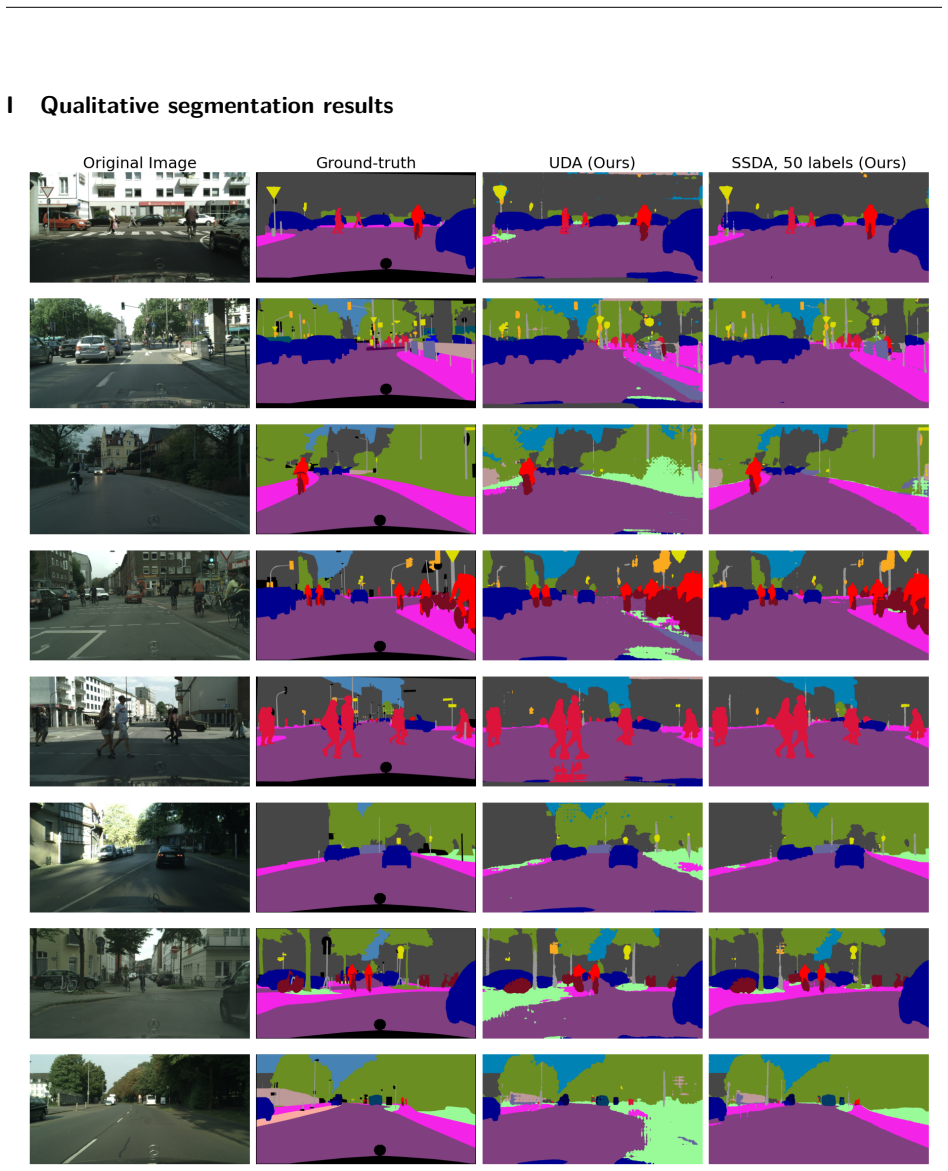
The central claim is that, in the SSDA setting, a model does not need elaborate domain alignment machinery to match a fully supervised segmenter; it needs tight, well-separated target clusters whose identities can be read off from a few labels. The framework's objective combines a weighted cross-entropy on mixed source/target batches, a consistency loss that forces a student model to agree with an EMA teacher under strong augmentations of unlabeled target images, and a supervised pixel contrastive loss that pulls same-class target pixels together in the embedding space. An offline self-training loop then adds confident pseudolabels from unlabeled target images to the labeled pool, with a fine-tuning stage on ground truth only. The paper reports that this reaches 64.3 mIoU at 50 labels and 66.0 at 100 on GTA-to-Cityscapes with a DeepLabv2+ResNet-101, surpassing all previous SSDA segmentation baselines in the low-label regime and matching or exceeding the fully supervised score on several other benchmarks.
Load-bearing premise
The claim that 50 labels are 'near-supervised' depends on the comparison points: the fully supervised oracle is a plain cross-entropy model without the framework's regularizers, and the main UDA baseline is a re-implementation the authors extended with a single loss term, so a stronger oracle or a better-tuned baseline could make the reported gap larger than the paper's interpretation.
Editorial extensions
If this is right
- At 1/60 of the target labels, the framework reaches 64.3 mIoU on GTA-to-Cityscapes, within 2.7 points of the 67.0 fully supervised model; at 1/30 the gap is 1.0 point.
- The method beats all previous SSDA segmentation baselines at 50, 100, and 200 labels, and at 50 labels outperforms several methods that use four to ten times more labels.
- Adding a source domain to a semi-supervised method is worth +9.0 mIoU at 50 labels, but only +0.5 mIoU at 500 labels, so source data matters most when target labels are very scarce.
- Existing UDA methods, extended to SSDA by simply adding a target-label loss, underperform a framework that emphasizes target feature compactness, indicating that SSDA needs its own design patterns.
- On Synthia-to-Cityscapes, GTA-to-BDD, and Synthia-to-BDD, the same fixed hyperparameters match or exceed fully supervised performance using only 1/30 of the target labels.
Reading between the lines
- If the cluster-compactness explanation is right, then when labels are extremely scarce the content of the fifty images matters more than their count: a practitioner should select labeled images that cover rare classes, because the per-class results show the largest gains from the few labels are in classes like train, wall, and terrain. This is an editorial inference, not stated in the paper.
- The paper's finding that consistency regularization makes source styling redundant suggests a testable extension: in any SSDA/SSL pipeline that already uses strong augmentation consistency, style-transfer preprocessing may add no benefit and could hurt; a controlled comparison across datasets and label budgets would settle it.
- The framework is architecture-sensitive, beating the leading Transformer-based UDA baseline in SSDA but not in UDA on Transformers; if the authors' hypothesis that a few labels curb overfitting to common classes is correct, SSDA could become a cheap way to stabilize Transformer UDA models that currently need special regularizers.
- The +6.9 mIoU jump from 0 to 50 labels quantifies the marginal value of annotation; a practical decision tool would plot such annotation-value curves across label budgets and class groups, which the paper does not provide.
Editorial analysis
A structured set of objections, weighed in public.
Referee Report
Summary. The paper studies Semi-Supervised Domain Adaptation (SSDA) for semantic segmentation, where a model has access to a labeled source dataset, a few labeled target images, and many unlabeled target images. The proposed framework combines a class-weighted supervised cross-entropy loss on mixed source/target batches, consistency regularization with an EMA teacher, a supervised pixel-contrastive loss on labeled target pixels, and an iterative offline self-training scheme with pseudolabel confidence thresholding and a final fine-tuning phase. The method is evaluated on GTA-to-Cityscapes, Synthia-to-Cityscapes, GTA-to-BDD, and Synthia-to-BDD, with the headline result that 50 to 100 target labels (1/60 to 1/30 of the target set) approach or match a fully supervised model on GTA-to-Cityscapes, and that the method outperforms prior SSDA baselines in the low-label regime. The paper also compares SSDA with UDA and SSL variants and reports ablations of each component.
Significance. If the central empirical claims hold, this is a practically valuable result: it would show that a simple combination of standard ingredients can reduce annotation cost for semantic segmentation by an order of magnitude relative to full supervision in a domain-shift setting. The paper has several strengths: the ablations are systematic (Tables 5–7 and the appendix), the method is evaluated on four benchmarks with a fixed hyperparameter configuration, the self-training analysis is detailed (Tables 6, 9, 10), and the authors are transparent about the Transformer-based results being weaker than DAFormer. The claim of near-supervised performance is, however, sensitive to the strength of two baselines: the self-implemented DAFormer SSDA extension and the vanilla cross-entropy 'supervised' oracle. Because the state-of-the-art claim is load-bearing and depends on the adequacy of these references, the evidence as presented is not yet fully convincing, though the core method is plausible and the deficiencies are addressable.
major comments (3)
- [App. E.2, Tab. 3] The DAFormer SSDA baseline is the authors' own re-implementation, obtained by keeping DAFormer hyperparameters and 'only' adding a cross-entropy term on target labels. In Tab. 3 this baseline behaves anomalously: DAFormer UDA reaches 68.3 mIoU but DAFormer SSDA with 50 labels drops to 66.2, so adding 50 target labels lowers performance. A well-posed SSDA extension should not degrade when given labels; the drop suggests the added loss or schedule is miscalibrated, potentially overfitting to the 50 labels or conflicting with DAFormer's training scheme. Because the headline claim of outperforming prior art in Tables 2 and 3 is measured largely against this self-implemented baseline, the authors should provide a properly tuned DAFormer SSDA baseline, use independently published SSDA numbers, or show that this anomaly does not affect the comparison. At 500 labels DAFormer already beats the proposed method (74.4 vs. 73.5), so the low-label margins are the only place where the SOTA claim rests, and those margins could shrink or invert under a stronger baseline.
- [Sec. 4.2.1, Tab. 2] The 'supervised' oracle used for the near-supervised claim is a vanilla cross-entropy model trained only on target labels (L_sup(T), 67.0 mIoU), without source data, batch mixing, consistency regularization, or self-training. Claiming that the method 'surpasses' supervised performance at 200 labels (67.3 vs. 67.0) is therefore a comparison against a deliberately weak reference; a supervised model trained with the same data and standard regularization would likely be stronger. Please report a stronger supervised baseline, for example the full framework trained on all 2975 target labels, or a conventional supervised segmentation model with data augmentation and class weighting, before making the 'near-supervised' or 'surpasses fully supervised' claim. The 2.7 mIoU gap at 50 labels (64.3 vs. 67.0) also needs to be interpreted against such a stronger oracle.
- [Tab. 2, Fig. 1] The main comparison table does not report standard deviations for any of the baselines, while the appendix reports standard deviations only for the authors' own self-training variants (Tab. 9). The claim of outperforming prior art at 50 labels rests on margins of roughly 2.5–3.0 mIoU over Chen et al. and the self-implemented DAFormer baseline, and with only three runs and no error bars it is not possible to judge whether these margins are significant. Report mean and standard deviation across at least 3 seeds for all methods in Tab. 2 and, ideally, Tab. 3, not only for the proposed method.
minor comments (5)
- [Fig. 1] The line 'Speaker UDASSDA Option 3 for ICCV' above Figure 1 appears to be a leftover template artifact; it should be removed.
- [Sec. 3.4] There are typos in the text: 'psuedolabels' should be 'pseudolabels', and 'innevitabily' should be 'inevitably'; also 'objecive' in Sec. 3.3 should be 'objective'.
- [Eq. (2), Tab. 8] The class weights α_c are used in Eq. (2) but defined only in Appendix B; define them in the main text to make the loss self-contained.
- [Tab. 4] The notation '64.5(73.9)' in the Synthia-to-Cityscapes rows is ambiguous; specify explicitly that the first number is the 16-class mIoU and the parenthesized number is the 13-class mIoU, both in the table and in the caption.
- [App. E.2] The subsection heading 'T raining details on DAF ormer architecture' contains stray spacing; formatting should be fixed.
Circularity Check
No significant circularity: all load-bearing claims are empirical comparisons against external benchmarks, and no derivation reduces to its own inputs.
full rationale
The paper does not present a formal derivation whose conclusions are equivalent to its assumptions. The proposed framework is an empirical composition of standard SSL/UDA ingredients: weighted cross-entropy on source and target labels (Eq. 1), consistency regularization with a mean teacher (Eqs. 3-4), supervised pixel contrastive learning (Eqs. 5-6), and offline iterative self-training (Algorithm 1). None of these components is defined in terms of the headline metric (mIoU on Cityscapes/BDD), and the reported numbers are measured against external datasets and previously published baselines, not recovered from the training objective by algebra. The 'supervised' reference is a plain cross-entropy model on the full target set, so the method surpassing or approaching it is an empirical outcome, not a tautology. The only notable caveats are fairness and framing issues rather than circularity: the DAFormer SSDA baseline is the authors' own re-implementation (App. E.2: 'For DAFormer ... SSDA results are our own'), and calling a 2.7 mIoU gap at 50 labels 'near-supervised' is a judgment call. These affect how persuasive the SOTA claim is, but they do not make any prediction a restatement of its input. The paper also explicitly reports regimes where it underperforms (DAFormer at 500 labels, UDA with Transformers), which is inconsistent with a constructed self-fulfilling evaluation. Accordingly, no circular step can be exhibited with the required specificity.
Assumptions & free parameters
free parameters (6)
- lambda_2 (pixel contrastive weight) =
0.2
- t (contrastive temperature) =
0.1
- N_pix (max contrastive pixels per class) =
50
- tau (pseudo-label confidence threshold) =
0.9
- K (self-training rounds) =
2
- n_drop (step to drop pseudo-labels) =
20k
assumptions (5)
- domain assumption The cluster and smoothness assumptions: data lie in classes with compact clusters separated by low-density regions, so consistency regularization improves classification.
- domain assumption The mean-teacher EMA provides more robust targets than the student model.
- domain assumption Confident pseudo-labels (above threshold tau) are accurate enough to serve as training labels.
- domain assumption Source and target domains share a common label space and are related enough that a domain-robust feature extractor can transfer knowledge.
- domain assumption Pixel contrastive learning on ground-truth target labels improves feature clusterability and downstream accuracy.
Cite this review
Pith. "Pith review of The Last Mile to Supervised Performance: Semi-Supervised Domain Adaptation for Semantic Segmentation." pith.science (2026). https://pith.science/paper/XJFDU7FS
@misc{pith2026241118728,
  author       = {Pith},
  title        = {Pith review of: The Last Mile to Supervised Performance: Semi-Supervised Domain Adaptation for Semantic Segmentation},
  year         = {2026},
  howpublished = {\url{https://pith.science/paper/XJFDU7FS}},
  note         = {Machine review of arXiv:2411.18728}
}
read the original abstract
Supervised deep learning requires massive labeled datasets, but obtaining annotations is not always easy or possible, especially for dense tasks like semantic segmentation. To overcome this issue, numerous works explore Unsupervised Domain Adaptation (UDA), which uses a labeled dataset from another domain (source), or Semi-Supervised Learning (SSL), which trains on a partially labeled set. Despite the success of UDA and SSL, reaching supervised performance at a low annotation cost remains a notoriously elusive goal. To address this, we study the promising setting of Semi-Supervised Domain Adaptation (SSDA). We propose a simple SSDA framework that combines consistency regularization, pixel contrastive learning, and self-training to effectively utilize a few target-domain labels. Our method outperforms prior art in the popular GTA-to-Cityscapes benchmark and shows that as little as 50 target labels can suffice to achieve near-supervised performance. Additional results on Synthia-to-Cityscapes, GTA-to-BDD and Synthia-to-BDD further demonstrate the effectiveness and practical utility of the method. Lastly, we find that existing UDA and SSL methods are not well-suited for the SSDA setting and discuss design patterns to adapt them.
Figures


Figures from the paper (3 more)


Reference graph
Works this paper leans on
-
[1]
Inigo Alonso, Alberto Sabater, David Ferstl, Luis Montesano, and Ana C Murillo. Semi-supervised semantic segmentation with pixel-level contrastive learning from a class-wise memory bank. In International Conference on Computer Vision (ICCV), pp.\ 8219--8228, 2021
work page 2021
-
[2]
Self-supervised augmentation consistency for adapting semantic segmentation
Nikita Araslanov and Stefan Roth. Self-supervised augmentation consistency for adapting semantic segmentation. In Conference on Computer Vision and Pattern Recognition (CVPR), pp.\ 15384--15394, 2021
work page 2021
-
[3]
Segnet: A deep convolutional encoder-decoder architecture for image segmentation
Vijay Badrinarayanan, Alex Kendall, and Roberto Cipolla. Segnet: A deep convolutional encoder-decoder architecture for image segmentation. IEEE Transactions on Pattern Analysis and Machine Intelligence (T-PAMI) , 39 0 (12): 0 2481--2495, 2017
work page 2017
-
[4]
Adamatch: A unified approach to semi-supervised learning and domain adaptation
David Berthelot, Rebecca Roelofs, Kihyuk Sohn, Nicholas Carlini, and Alex Kurakin. Adamatch: A unified approach to semi-supervised learning and domain adaptation. International Conference on Learning Representations (ICLR), 2021
work page 2021
-
[5]
Semi-supervised classification by low density separation
Olivier Chapelle and Alexander Zien. Semi-supervised classification by low density separation. In International workshop on artificial intelligence and statistics, pp.\ 57--64. PMLR, 2005
work page 2005
-
[6]
Liang-Chieh Chen, George Papandreou, Iasonas Kokkinos, Kevin Murphy, and Alan L Yuille. Deeplab: Semantic image segmentation with deep convolutional nets, atrous convolution, and fully connected crfs. IEEE Transactions on Pattern Analysis and Machine Intelligence (T-PAMI) , 40 0 (4): 0 834--848, 2017 a
work page 2017
-
[7]
Liang-Chieh Chen, George Papandreou, Iasonas Kokkinos, Kevin Murphy, and Alan L Yuille. Deeplab: Semantic image segmentation with deep convolutional nets, atrous convolution, and fully connected crfs. IEEE Transactions on Pattern Analysis and Machine Intelligence (T-PAMI) , 40 0 (4): 0 834--848, 2017 b
work page 2017
-
[8]
Encoder-decoder with atrous separable convolution for semantic image segmentation
Liang-Chieh Chen, Yukun Zhu, George Papandreou, Florian Schroff, and Hartwig Adam. Encoder-decoder with atrous separable convolution for semantic image segmentation. In European Conference on Computer Vision (ECCV), pp.\ 801--818, 2018
work page 2018
Show all 60 references
-
[9]
Deliberated domain bridging for domain adaptive semantic segmentation
Lin Chen, Zhixiang Wei, Xin Jin, Huaian Chen, Miao Zheng, Kai Chen, and Yi Jin. Deliberated domain bridging for domain adaptive semantic segmentation. Advances in neural information processing systems (NeurIPS), 2022
2022
-
[10]
Semi-supervised domain adaptation based on dual-level domain mixing for semantic segmentation
Shuaijun Chen, Xu Jia, Jianzhong He, Yongjie Shi, and Jianzhuang Liu. Semi-supervised domain adaptation based on dual-level domain mixing for semantic segmentation. In Conference on Computer Vision and Pattern Recognition (CVPR), pp.\ 11018--11027, 2021 a
2021
-
[11]
Semi-supervised semantic segmentation with cross pseudo supervision
Xiaokang Chen, Yuhui Yuan, Gang Zeng, and Jingdong Wang. Semi-supervised semantic segmentation with cross pseudo supervision. In Conference on Computer Vision and Pattern Recognition (CVPR), pp.\ 2613--2622, 2021 b
2021
-
[12]
Randaugment: Practical automated data augmentation with a reduced search space
Ekin D Cubuk, Barret Zoph, Jonathon Shlens, and Quoc V Le. Randaugment: Practical automated data augmentation with a reduced search space. In International Conference on Computer Vision (ICCV), pp.\ 702--703, 2020
2020
-
[13]
Ucc: Uncertainty guided cross-head co-training for semi-supervised semantic segmentation
Jiashuo Fan, Bin Gao, Huan Jin, and Lihui Jiang. Ucc: Uncertainty guided cross-head co-training for semi-supervised semantic segmentation. In Conference on Computer Vision and Pattern Recognition (CVPR), pp.\ 9947--9956, 2022
2022
-
[14]
Semi-supervised semantic segmentation needs strong, varied perturbations
Geoff French, Samuli Laine, Timo Aila, Michal Mackiewicz, and Graham Finlayson. Semi-supervised semantic segmentation needs strong, varied perturbations. arXiv preprint arXiv:1906.01916, 2019
1906 arXiv
-
[15]
Domain-adversarial training of neural networks
Yaroslav Ganin, Evgeniya Ustinova, Hana Ajakan, Pascal Germain, Hugo Larochelle, Fran c ois Laviolette, Mario Marchand, and Victor Lempitsky. Domain-adversarial training of neural networks. Journal of Machine Learning Research, 17 0 (1): 0 2096--2030, 2016
2016
-
[16]
Multi-source domain adaptation with collaborative learning for semantic segmentation
Jianzhong He, Xu Jia, Shuaijun Chen, and Jianzhuang Liu. Multi-source domain adaptation with collaborative learning for semantic segmentation. In Conference on Computer Vision and Pattern Recognition (CVPR), pp.\ 11008--11017, 2021
2021
-
[17]
Cycada: Cycle-consistent adversarial domain adaptation
Judy Hoffman, Eric Tzeng, Taesung Park, Jun-Yan Zhu, Phillip Isola, Kate Saenko, Alexei Efros, and Trevor Darrell. Cycada: Cycle-consistent adversarial domain adaptation. In International Conference on Machine Learning (ICML), pp.\ 1989--1998. PMLR, 2018
1989
-
[18]
Daformer: Improving network architectures and training strategies for domain-adaptive semantic segmentation
Lukas Hoyer, Dengxin Dai, and Luc Van Gool. Daformer: Improving network architectures and training strategies for domain-adaptive semantic segmentation. 2021 a
2021
-
[19]
Improving semi-supervised and domain-adaptive semantic segmentation with self-supervised depth estimation
Lukas Hoyer, Dengxin Dai, Qin Wang, Yuhua Chen, and Luc Van Gool. Improving semi-supervised and domain-adaptive semantic segmentation with self-supervised depth estimation. arXiv preprint arXiv:2108.12545, 2021 b
2021 arXiv
-
[20]
Hrda: Context-aware high-resolution domain-adaptive semantic segmentation
Lukas Hoyer, Dengxin Dai, and Luc Van Gool. Hrda: Context-aware high-resolution domain-adaptive semantic segmentation. European Conference on Computer Vision (ECCV), 2022
2022
-
[21]
Guided collaborative training for pixel-wise semi-supervised learning
Zhanghan Ke, Di Qiu, Kaican Li, Qiong Yan, and Rynson WH Lau. Guided collaborative training for pixel-wise semi-supervised learning. In European Conference on Computer Vision (ECCV), pp.\ 429--445. Springer, 2020
2020
-
[22]
Attract, perturb, and explore: Learning a feature alignment network for semi-supervised domain adaptation
Taekyung Kim and Changick Kim. Attract, perturb, and explore: Learning a feature alignment network for semi-supervised domain adaptation. In European Conference on Computer Vision (ECCV), pp.\ 591--607. Springer, 2020
2020
-
[23]
Semi-supervised semantic segmentation with error localization network
Donghyeon Kwon and Suha Kwak. Semi-supervised semantic segmentation with error localization network. In Conference on Computer Vision and Pattern Recognition (CVPR), pp.\ 9957--9967, 2022
2022
-
[24]
Exploring high-quality target domain information for unsupervised domain adaptive semantic segmentation
Junjie Li, Zilei Wang, Yuan Gao, and Xiaoming Hu. Exploring high-quality target domain information for unsupervised domain adaptive semantic segmentation. In Proceedings of the 30th ACM International Conference on Multimedia, pp.\ 5237--5245, 2022 a
2022
-
[25]
Class-balanced pixel-level self-labeling for domain adaptive semantic segmentation
Ruihuang Li, Shuai Li, Chenhang He, Yabin Zhang, Xu Jia, and Lei Zhang. Class-balanced pixel-level self-labeling for domain adaptive semantic segmentation. In Conference on Computer Vision and Pattern Recognition (CVPR), pp.\ 11593--11603, 2022 b
2022
-
[26]
Bidirectional learning for domain adaptation of semantic segmentation
Yunsheng Li, Lu Yuan, and Nuno Vasconcelos. Bidirectional learning for domain adaptation of semantic segmentation. In Conference on Computer Vision and Pattern Recognition (CVPR), pp.\ 6936--6945, 2019
2019
-
[27]
Adaptive early-learning correction for segmentation from noisy annotations
Sheng Liu, Kangning Liu, Weicheng Zhu, Yiqiu Shen, and Carlos Fernandez-Granda. Adaptive early-learning correction for segmentation from noisy annotations. In Conference on Computer Vision and Pattern Recognition (CVPR), pp.\ 2606--2616, 2022 a
2022
-
[28]
Bootstrapping semantic segmentation with regional contrast
Shikun Liu, Shuaifeng Zhi, Edward Johns, and Andrew J Davison. Bootstrapping semantic segmentation with regional contrast. In International Conference on Learning Representations (ICLR), 2022 b
2022
-
[29]
Bapa-net: Boundary adaptation and prototype alignment for cross-domain semantic segmentation
Yahao Liu, Jinhong Deng, Xinchen Gao, Wen Li, and Lixin Duan. Bapa-net: Boundary adaptation and prototype alignment for cross-domain semantic segmentation. In International Conference on Computer Vision (ICCV), pp.\ 8801--8811, 2021
2021
-
[30]
Perturbed and strict mean teachers for semi-supervised semantic segmentation
Yuyuan Liu, Yu Tian, Yuanhong Chen, Fengbei Liu, Vasileios Belagiannis, and Gustavo Carneiro. Perturbed and strict mean teachers for semi-supervised semantic segmentation. In Conference on Computer Vision and Pattern Recognition (CVPR), pp.\ 4258--4267, 2022 c
2022
-
[31]
Instance adaptive self-training for unsupervised domain adaptation
Ke Mei, Chuang Zhu, Jiaqi Zou, and Shanghang Zhang. Instance adaptive self-training for unsupervised domain adaptation. In European Conference on Computer Vision (ECCV), pp.\ 415--430. Springer, 2020
2020
-
[32]
Surprisingly simple semi-supervised domain adaptation with pretraining and consistency
Samarth Mishra, Kate Saenko, and Venkatesh Saligrama. Surprisingly simple semi-supervised domain adaptation with pretraining and consistency. In Proceedings of the British Machine Vision Conference, 2021
2021
-
[33]
Classmix: Segmentation-based data augmentation for semi-supervised learning
Viktor Olsson, Wilhelm Tranheden, Juliano Pinto, and Lennart Svensson. Classmix: Segmentation-based data augmentation for semi-supervised learning. In Proceedings of the IEEE/CVF Winter Conference on Applications of Computer Vision, pp.\ 1369--1378, 2021
2021
-
[34]
Multi-scale and cross-scale contrastive learning for semantic segmentation
Theodoros Pissas, Claudio S Ravasio, Lyndon Da Cruz, and Christos Bergeles. Multi-scale and cross-scale contrastive learning for semantic segmentation. 2022
2022
-
[35]
Contradictory structure learning for semi-supervised domain adaptation
Can Qin, Lichen Wang, Qianqian Ma, Yu Yin, Huan Wang, and Yun Fu. Contradictory structure learning for semi-supervised domain adaptation. In Proceedings of the 2021 SIAM International Conference on Data Mining (SDM), pp.\ 576--584. SIAM, 2021
2021
-
[36]
Playing for data: Ground truth from computer games
Stephan R Richter, Vibhav Vineet, Stefan Roth, and Vladlen Koltun. Playing for data: Ground truth from computer games. In European Conference on Computer Vision (ECCV), pp.\ 102--118. Springer, 2016
2016
-
[37]
Enhancing photorealism enhancement
Stephan R Richter, Hassan Abu Al Haija, and Vladlen Koltun. Enhancing photorealism enhancement. IEEE Transactions on Pattern Analysis and Machine Intelligence (T-PAMI) , 2022
2022
-
[38]
U-net: Convolutional networks for biomedical image segmentation
Olaf Ronneberger, Philipp Fischer, and Thomas Brox. U-net: Convolutional networks for biomedical image segmentation. In International Conference on Medical image computing and computer-assisted intervention, pp.\ 234--241. Springer, 2015
2015
-
[39]
The synthia dataset: A large collection of synthetic images for semantic segmentation of urban scenes
German Ros, Laura Sellart, Joanna Materzynska, David Vazquez, and Antonio M Lopez. The synthia dataset: A large collection of synthetic images for semantic segmentation of urban scenes. In Conference on Computer Vision and Pattern Recognition (CVPR), pp.\ 3234--3243, 2016
2016
-
[40]
Semi-supervised domain adaptation via minimax entropy
Kuniaki Saito, Donghyun Kim, Stan Sclaroff, Trevor Darrell, and Kate Saenko. Semi-supervised domain adaptation via minimax entropy. In International Conference on Computer Vision (ICCV), pp.\ 8050--8058, 2019
2019
-
[41]
Tune it the right way: Unsupervised validation of domain adaptation via soft neighborhood density
Kuniaki Saito, Donghyun Kim, Piotr Teterwak, Stan Sclaroff, Trevor Darrell, and Kate Saenko. Tune it the right way: Unsupervised validation of domain adaptation via soft neighborhood density. In International Conference on Computer Vision (ICCV), pp.\ 9184--9193, 2021
2021
-
[42]
Fixmatch: Simplifying semi-supervised learning with consistency and confidence
Kihyuk Sohn, David Berthelot, Nicholas Carlini, Zizhao Zhang, Han Zhang, Colin A Raffel, Ekin Dogus Cubuk, Alexey Kurakin, and Chun-Liang Li. Fixmatch: Simplifying semi-supervised learning with consistency and confidence. Advances in neural information processing systems (Neur...
2020
-
[43]
Mean teachers are better role models: Weight-averaged consistency targets improve semi-supervised deep learning results
Antti Tarvainen and Harri Valpola. Mean teachers are better role models: Weight-averaged consistency targets improve semi-supervised deep learning results. Advances in neural information processing systems (NeurIPS), 30, 2017
2017
-
[44]
The gist and rist of iterative self-training for semi-supervised segmentation
Eu Wern Teh, Terrance DeVries, Brendan Duke, Ruowei Jiang, Parham Aarabi, and Graham W Taylor. The gist and rist of iterative self-training for semi-supervised segmentation. In 2022 19th Conference on Robots and Vision (CRV), pp.\ 58--66. IEEE, 2022
2022
-
[45]
Dacs: Domain adaptation via cross-domain mixed sampling
Wilhelm Tranheden, Viktor Olsson, Juliano Pinto, and Lennart Svensson. Dacs: Domain adaptation via cross-domain mixed sampling. In Proceedings of the IEEE/CVF Winter Conference on Applications of Computer Vision, pp.\ 1379--1389, 2021
2021
-
[46]
Guidedmix-net: Learning to improve pseudo masks using labeled images as reference
Peng Tu, Yawen Huang, Rongrong Ji, Feng Zheng, and Ling Shao. Guidedmix-net: Learning to improve pseudo masks using labeled images as reference. AAAI Conference on Artificial Intelligence, 2022
2022
-
[47]
Advent: Adversarial entropy minimization for domain adaptation in semantic segmentation
Tuan-Hung Vu, Himalaya Jain, Maxime Bucher, Matthieu Cord, and Patrick P \'e rez. Advent: Adversarial entropy minimization for domain adaptation in semantic segmentation. In Conference on Computer Vision and Pattern Recognition (CVPR), pp.\ 2517--2526, 2019
2019
-
[48]
Classes matter: A fine-grained adversarial approach to cross-domain semantic segmentation
Haoran Wang, Tong Shen, Wei Zhang, Ling-Yu Duan, and Tao Mei. Classes matter: A fine-grained adversarial approach to cross-domain semantic segmentation. In European Conference on Computer Vision (ECCV), pp.\ 642--659. Springer, 2020 a
2020
-
[49]
Exploring cross-image pixel contrast for semantic segmentation
Wenguan Wang, Tianfei Zhou, Fisher Yu, Jifeng Dai, Ender Konukoglu, and Luc Van Gool. Exploring cross-image pixel contrast for semantic segmentation. In International Conference on Computer Vision (ICCV), pp.\ 7303--7313, 2021
2021
-
[50]
Alleviating semantic-level shift: A semi-supervised domain adaptation method for semantic segmentation
Zhonghao Wang, Yunchao Wei, Rogerio Feris, Jinjun Xiong, Wen-Mei Hwu, Thomas S Huang, and Honghui Shi. Alleviating semantic-level shift: A semi-supervised domain adaptation method for semantic segmentation. In Conference on Computer Vision and Pattern Recognition (CVPR), pp.\ ...
2020
-
[51]
Segformer: Simple and efficient design for semantic segmentation with transformers
Enze Xie, Wenhai Wang, Zhiding Yu, Anima Anandkumar, Jose M Alvarez, and Ping Luo. Segformer: Simple and efficient design for semantic segmentation with transformers. Advances in neural information processing systems (NeurIPS), 34: 0 12077--12090, 2021
2021
-
[52]
Self-training with noisy student improves imagenet classification
Qizhe Xie, Minh-Thang Luong, Eduard Hovy, and Quoc V Le. Self-training with noisy student improves imagenet classification. In Conference on Computer Vision and Pattern Recognition (CVPR), pp.\ 10687--10698, 2020
2020
-
[53]
Fda: Fourier domain adaptation for semantic segmentation
Yanchao Yang and Stefano Soatto. Fda: Fourier domain adaptation for semantic segmentation. In Conference on Computer Vision and Pattern Recognition (CVPR), pp.\ 4085--4095, 2020
2020
-
[54]
Bdd100k: A diverse driving dataset for heterogeneous multitask learning
Fisher Yu, Haofeng Chen, Xin Wang, Wenqi Xian, Yingying Chen, Fangchen Liu, Vashisht Madhavan, and Trevor Darrell. Bdd100k: A diverse driving dataset for heterogeneous multitask learning. In Conference on Computer Vision and Pattern Recognition (CVPR), pp.\ 2636--2645, 2020
2020
-
[55]
Cutmix: Regularization strategy to train strong classifiers with localizable features
Sangdoo Yun, Dongyoon Han, Seong Joon Oh, Sanghyuk Chun, Junsuk Choe, and Youngjoon Yoo. Cutmix: Regularization strategy to train strong classifiers with localizable features. In International Conference on Computer Vision (ICCV), pp.\ 6023--6032, 2019
2019
-
[56]
Prototypical pseudo label denoising and target structure learning for domain adaptive semantic segmentation
Pan Zhang, Bo Zhang, Ting Zhang, Dong Chen, Yong Wang, and Fang Wen. Prototypical pseudo label denoising and target structure learning for domain adaptive semantic segmentation. In Conference on Computer Vision and Pattern Recognition (CVPR), pp.\ 12414--12424, 2021
2021
-
[57]
Rethinking pre-training and self-training
Barret Zoph, Golnaz Ghiasi, Tsung-Yi Lin, Yin Cui, Hanxiao Liu, Ekin Dogus Cubuk, and Quoc Le. Rethinking pre-training and self-training. Advances in neural information processing systems (NeurIPS), 33: 0 3833--3845, 2020
2020
-
[58]
Unsupervised domain adaptation for semantic segmentation via class-balanced self-training
Yang Zou, Zhiding Yu, BVK Kumar, and Jinsong Wang. Unsupervised domain adaptation for semantic segmentation via class-balanced self-training. In European Conference on Computer Vision (ECCV), pp.\ 289--305, 2018
2018
-
[59]
Pseudoseg: Designing pseudo labels for semantic segmentation
Yuliang Zou, Zizhao Zhang, Han Zhang, Chun-Liang Li, Xiao Bian, Jia-Bin Huang, and Tomas Pfister. Pseudoseg: Designing pseudo labels for semantic segmentation. arXiv preprint arXiv:2010.09713, 2020
2010 arXiv
-
[60]
write newline
" write newline "" before.all 'output.state := FUNCTION n.dashify 't := "" t empty not t #1 #1 substring "-" = t #1 #2 substring "--" = not "--" * t #2 global.max substring 't := t #1 #1 substring "-" = "-" * t #2 global.max substring 't := while if t #1 #1 substring * t #2 gl...
Reviewed August 12, 2026 · model on record in the stance chip above.
Discussion (0). Continue with ORCID to comment.