SegmentAnyTreeV2: Scaling Transformer-Based Tree Instance Segmentation Across Sensors, Platforms, and Forests
Pith reviewed 2026-06-27 19:37 UTC · model grok-4.3
The pith
SegmentAnyTreeV2 segments individual trees from any LiDAR sensor or platform using a Point Transformer backbone.
A machine-rendered reading of the paper's core claim, the machinery that carries it, and where it could break.
Core claim
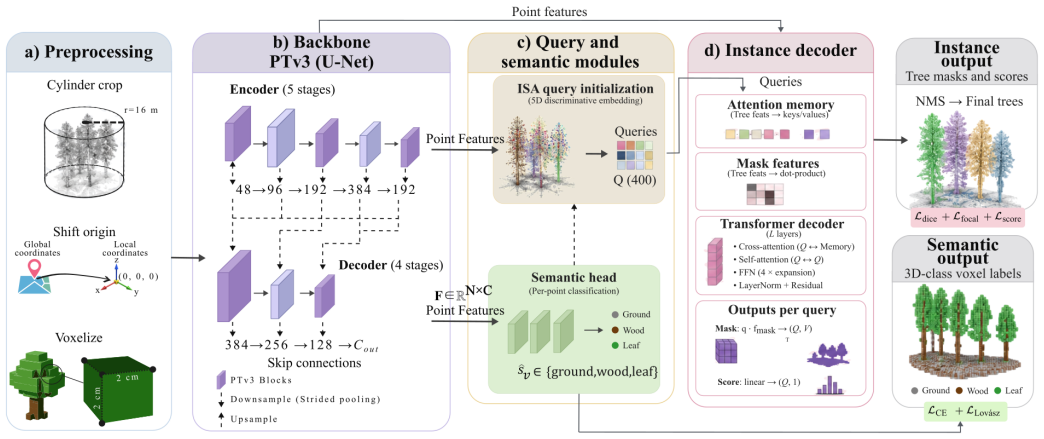
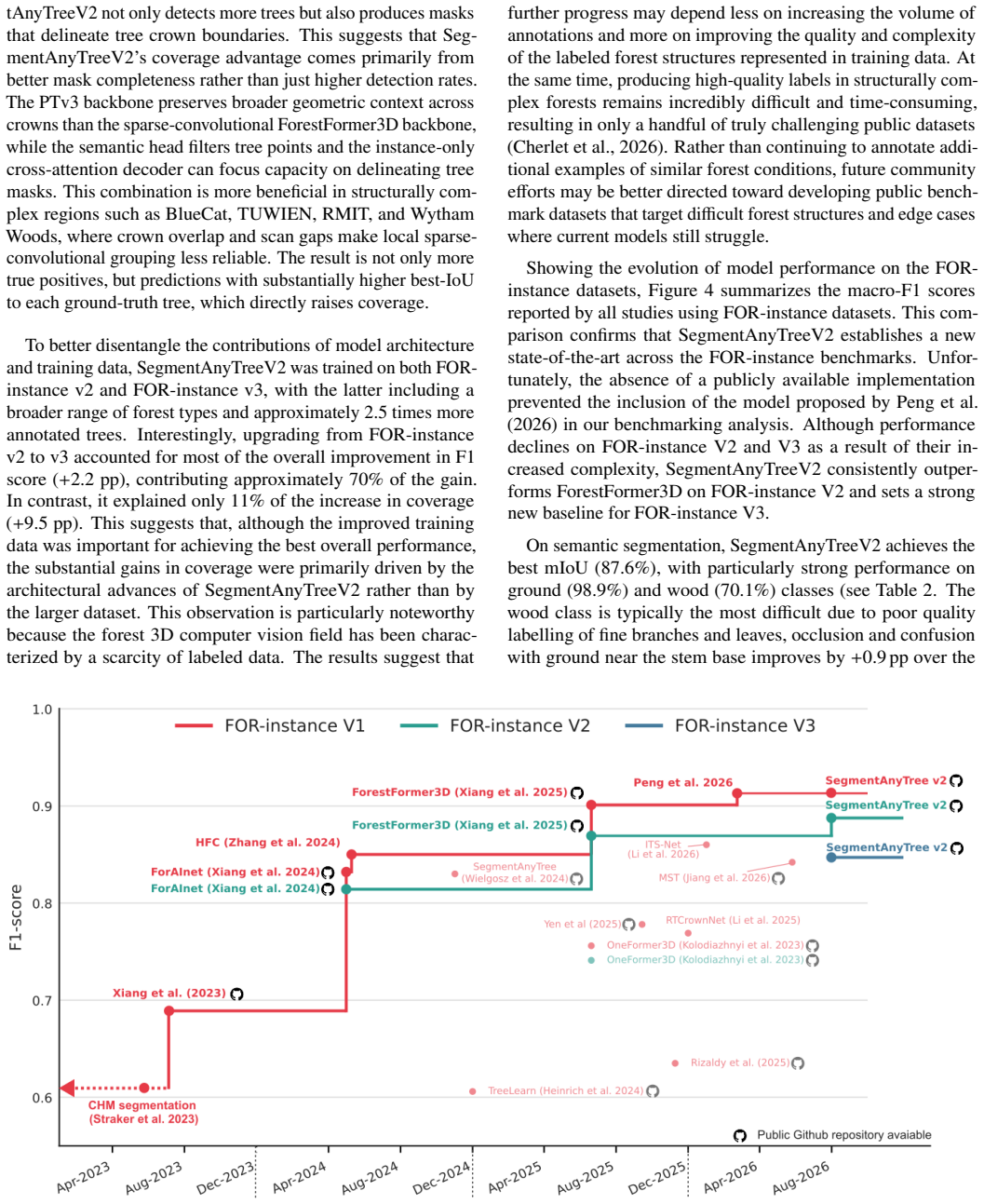
SegmentAnyTreeV2 is a sensor- and platform-agnostic framework for semantic and instance segmentation of forest point clouds that combines a serialization-based Point Transformer v3 backbone with a lightweight semantic head and a tree-focused cross-attention mask decoder; semantic predictions restrict instance decoding to tree-class voxels, while instance-aware query initialization, one-to-many seed supervision, and asymmetric mask scoring improve separation in dense stands, yielding 90.5 percent precision, 80.2 percent recall, 85.0 percent F1, 90.7 percent coverage, and 87.6 percent semantic mIoU on the FOR-instanceV2 test split with strong zero-shot cross-domain generalization.
What carries the argument
SegmentAnyTreeV2 framework, which restricts instance decoding to tree voxels via a semantic head and applies cross-attention mask decoding with instance-aware queries to separate trees in point clouds.
If this is right
- Automated tree detection and delineation become feasible at scale across mixed forest types and LiDAR sources.
- Inventory and carbon accounting pipelines can operate on point clouds collected from drones, helicopters, or ground platforms without retraining.
- Instance masks enable downstream tasks such as individual-tree biomass estimation from the same input data.
- Zero-shot transfer reduces the need for site-specific annotation when moving to new regions.
Where Pith is reading between the lines
- The approach could extend to multi-temporal LiDAR sequences for tracking individual tree growth or mortality.
- Integration with optical imagery might allow hybrid models that combine structural and spectral cues for species identification.
- The serialization and cross-attention design offers a template for instance segmentation of other natural objects such as rocks or crops in 3-D data.
Load-bearing premise
The FOR-instance v3 dataset captures a representative range of real forest conditions, sensor types, and platforms so that measured performance will hold on new data.
What would settle it
Running the released model on a fresh LiDAR collection from a biome absent from FOR-instance v3 and recording whether F1 falls below 70 percent would test the generalization claim.
Figures
read the original abstract
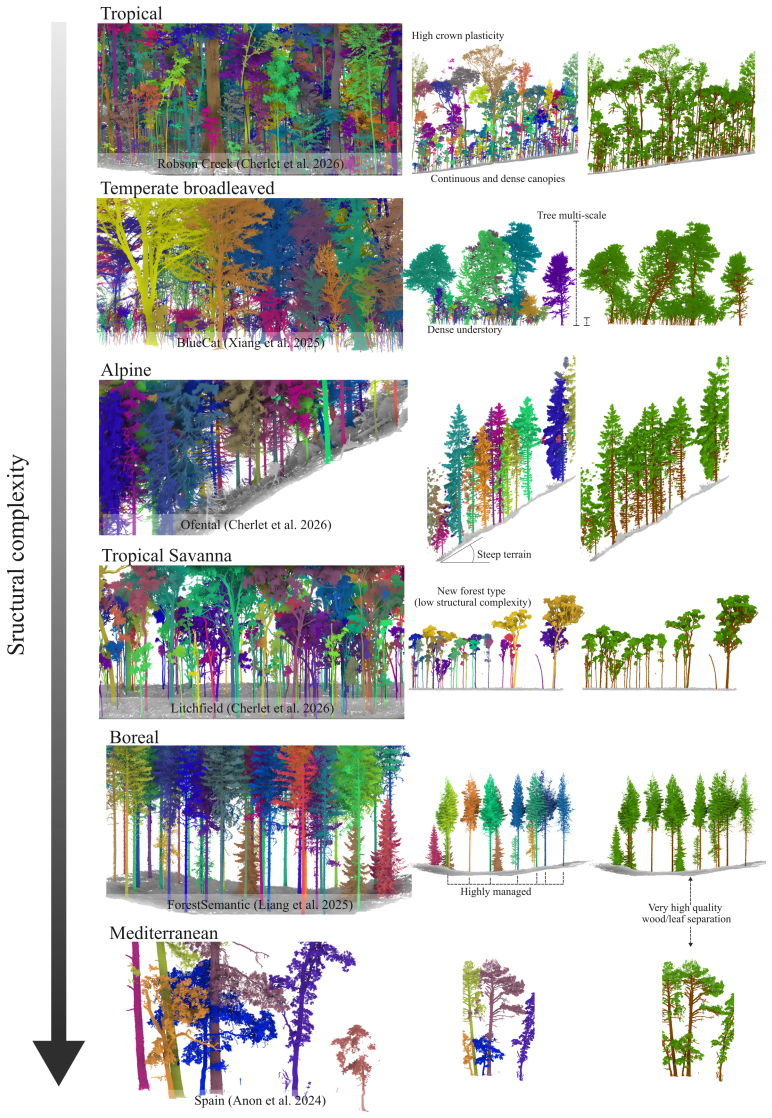
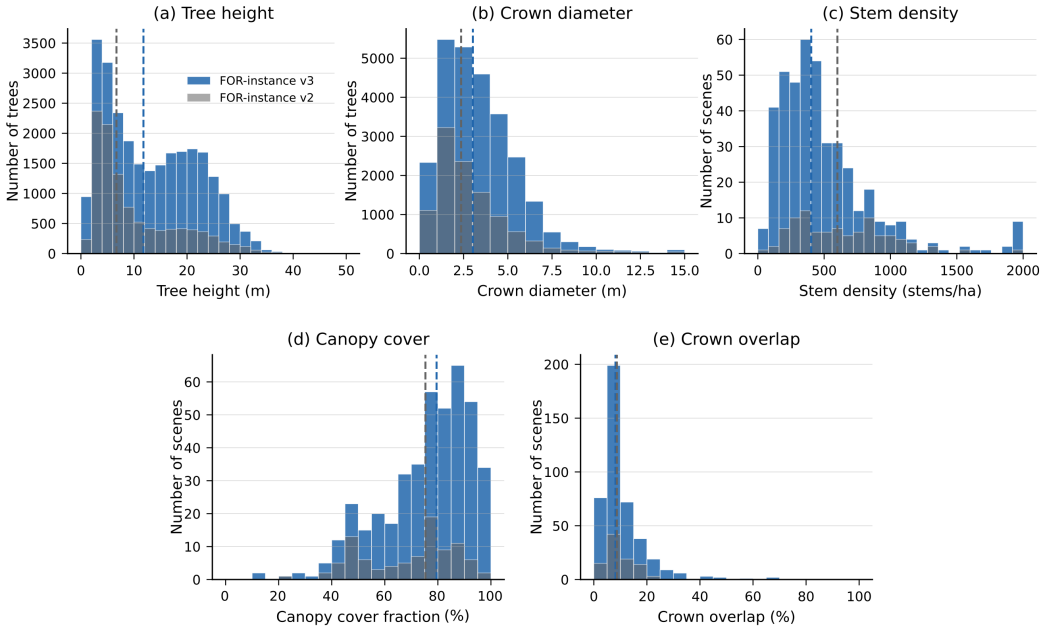
We present SegmentAnyTreeV2, a sensor- and platform-agnostic framework for semantic and instance segmentation of forest point clouds. The model combines a serialization-based Point Transformer v3 backbone with a lightweight semantic head and a tree-focused cross-attention mask decoder. Semantic predictions restrict instance decoding to tree-class voxels, while instance-aware query initialization, one-to-many seed supervision, and asymmetric mask scoring improve separation in dense and structurally complex stands. We further introduce FOR-instance v3, an expanded benchmark comprising 427 scenes and 26,496 annotated trees across diverse biomes, forest structures, and LiDAR platforms. On the FOR-instanceV2 test split, SegmentAnyTreeV2 achieves 90.5% precision, 80.2% recall, 85.0% F1, 90.7% coverage, and 87.6% semantic mIoU, outperforming previous learning-based methods in both instance detection and mask completeness. Zero-shot evaluation on independent sites further demonstrates strong cross-domain generalization.
Editorial analysis
A structured set of objections, weighed in public.
Referee Report
Summary. The manuscript presents SegmentAnyTreeV2, a sensor- and platform-agnostic framework for semantic and instance segmentation of forest point clouds. It uses a serialization-based Point Transformer v3 backbone with a lightweight semantic head and a tree-focused cross-attention mask decoder, incorporating semantic predictions to restrict instance decoding, instance-aware query initialization, one-to-many seed supervision, and asymmetric mask scoring. The authors introduce FOR-instance v3, an expanded benchmark with 427 scenes and 26,496 annotated trees across diverse biomes, structures, and LiDAR platforms. On the FOR-instanceV2 test split, the model achieves 90.5% precision, 80.2% recall, 85.0% F1, 90.7% coverage, and 87.6% semantic mIoU, outperforming prior learning-based methods, with additional zero-shot evaluation on independent sites demonstrating cross-domain generalization.
Significance. If the reported metrics are supported by a properly disjoint train/test split and full experimental details, the work would advance the field by scaling transformer-based tree segmentation to diverse real-world conditions and providing a substantially larger benchmark dataset. The combination of semantic restriction and specialized instance decoding addresses challenges in dense stands, and the zero-shot results would support claims of sensor/platform agnosticism.
major comments (2)
- [Abstract] Abstract and results paragraph: the headline metrics (90.5% precision, 80.2% recall, 85.0% F1 on FOR-instanceV2 test split) are presented as evidence of superiority and generalization, yet the manuscript does not state whether FOR-instanceV2 test scenes were excluded from the FOR-instance v3 training set. Overlap would mean the numbers reflect memorization rather than the claimed sensor- and platform-agnostic performance.
- [Abstract] Abstract: specific performance numbers are reported without any information on experimental setup, including training data composition, baselines, statistical significance, error bars, or potential data issues, preventing verification that the data supports the central claims.
minor comments (1)
- The terms 'one-to-many seed supervision' and 'asymmetric mask scoring' are mentioned in the abstract but require explicit definitions and algorithmic details in the methods section for reproducibility.
Simulated Author's Rebuttal
We thank the referee for the constructive feedback highlighting the need for clearer statements on data splits and experimental details. We address both major comments below and will incorporate clarifications in a revised manuscript.
read point-by-point responses
-
Referee: [Abstract] Abstract and results paragraph: the headline metrics (90.5% precision, 80.2% recall, 85.0% F1 on FOR-instanceV2 test split) are presented as evidence of superiority and generalization, yet the manuscript does not state whether FOR-instanceV2 test scenes were excluded from the FOR-instance v3 training set. Overlap would mean the numbers reflect memorization rather than the claimed sensor- and platform-agnostic performance.
Authors: The FOR-instanceV2 test scenes are fully excluded from the FOR-instance v3 training set. FOR-instance v3 augments the prior v2 data with new scenes across additional biomes and platforms while preserving the original v2 test split as a completely held-out evaluation set. This design directly supports the sensor- and platform-agnostic claims. We will add an explicit sentence in the abstract and expand the dataset description section to state the disjoint split. revision: yes
-
Referee: [Abstract] Abstract: specific performance numbers are reported without any information on experimental setup, including training data composition, baselines, statistical significance, error bars, or potential data issues, preventing verification that the data supports the central claims.
Authors: The abstract is intentionally concise, but the full manuscript details the training composition of FOR-instance v3, the full set of baselines, and reports error bars plus per-scene metrics in the experimental section and tables. We will revise the abstract to briefly note the disjoint test split, the comparison against prior learning-based methods, and direct readers to the methods and results sections for complete experimental protocols, including any data preprocessing steps. revision: yes
Circularity Check
No circularity: empirical results on held-out splits and zero-shot sites
full rationale
The paper introduces FOR-instance v3 as an expanded benchmark and reports metrics on the FOR-instanceV2 test split plus zero-shot evaluation on independent sites. These are standard held-out empirical evaluations with no self-definitional equations, fitted parameters renamed as predictions, or load-bearing self-citations that reduce the central claims to inputs by construction. The architecture description (Point Transformer v3 backbone, semantic head, mask decoder) is presented as design choices, not derived from the reported numbers. No patterns from the enumerated circularity kinds are present.
Axiom & Free-Parameter Ledger
free parameters (1)
- Various model hyperparameters
axioms (1)
- domain assumption Point Transformer v3 is an appropriate backbone for processing forest point clouds.
Forward citations
Cited by 1 Pith paper
-
SelectAnyTree: A Promptable Instance Segmentation Model for 3D Forest LiDAR Point Clouds
SelectAnyTree is a promptable instance segmentation model for 3D forest LiDAR point clouds that achieves 78.2 IoU from a single click via a click-to-query prompt encoder, CHM-guided first prompt, and state-space query...
Reference graph
Works this paper leans on
-
[1]
2019 , pages =
Choy, Christopher and Gwak, JunYoung and Savarese, Silvio , booktitle =. 2019 , pages =
2019
-
[2]
Zamir and Silvio Savarese , journal =
Iro Armeni and Sasha Sax and Amir R. Zamir and Silvio Savarese , journal =. Joint
-
[3]
Kuhn, Harold W , journal =. The. 1955 , number =
1955
-
[4]
2023 , pages =
Schult, Jonas and Engelmann, Francis and Hermans, Alexander and Litany, Or and Tang, Siyu and Leibe, Bastian , booktitle =. 2023 , pages =
2023
-
[5]
Andreas Tockner and Christoph Gollob and Tim Ritter and Arne Nothdurft , doi =
-
[6]
Remote Sensing , VOLUME =
Peng, Xiangji and Yi, Jizheng and Liu, Rong and Shen, Xiangyu and Li, Xiaoyao , TITLE =. Remote Sensing , VOLUME =. 2026 , NUMBER =
2026
-
[7]
NIPS , title =
Yuchen Bai and Jean. NIPS , title =. 2023 , pages =
2023
-
[8]
Stereńczak, Krzysztof and Kulicki, Maksymilian and Kraszewski, Bartłomiej and Gasica, Torana Arya and Mitelsztedt, Krzysztof and Mielcarek, Miłosz and Tangwa, Elvis and Erfanifard, Yousef and Brach, Michał and others , title =. Scientific Data , year =. doi:10.1038/s41597-026-07269-1 , url =
-
[9]
Query Refinement Transformer for
Lu, Jiahao and Deng, Jiacheng and Wang, Chuxin and He, Jianfeng and Zhang, Tianzhu , booktitle =. Query Refinement Transformer for. 2023 , pages =
2023
-
[10]
2024 , pages =
Kolodiazhnyi, Maxim and Vorontsova, Anna and Konushin, Anton and Rukhovich, Danila , booktitle =. 2024 , pages =
2024
-
[11]
2023 , pages =
He, Junjie and Li, Pengyu and Geng, Yifeng and Xie, Xuansong , booktitle =. 2023 , pages =
2023
-
[12]
Liu, Jiaheng and He, Tong and Yang, Honghui and Su, Rui and Tian, Jiayi and Wu, Junran and Guo, Hongcheng and Xu, Ke and Ouyang, Wanli , journal =
-
[13]
Semantic Instance Segmentation for Autonomous Driving , year =
De Brabandere, Bert and Neven, Davy and Van Gool, Luc , booktitle =. Semantic Instance Segmentation for Autonomous Driving , year =. doi:10.1109/CVPRW.2017.66 , keywords =
-
[14]
Secretariat of the Convention on Biological Diversity , title =
-
[15]
Intergovernamental Panel on Climate Change (IPCC) , title =
-
[16]
Towards accurate instance segmentation in large-scale
Binbin Xiang and Torben Peters and Theodora Kontogianni and Frawa Vetterli and Stefano Puliti and Rasmus Astrup and Konrad Schindler , journal =. Towards accurate instance segmentation in large-scale. 2023 , pages =
2023
-
[17]
Superpoint transformer for
Sun, Jiahao and Qing, Chunmei and Tan, Junpeng and Xu, Xiangmin , booktitle =. Superpoint transformer for
-
[18]
2023 , pages =
Zong, Zhuofan and Song, Guanglu and Liu, Yu , booktitle =. 2023 , pages =
2023
-
[19]
2018 , pages =
Wang, Weiyue and Yu, Ronald and Huang, Qiangui and Neumann, Ulrich , booktitle =. 2018 , pages =
2018
-
[20]
Improved Block Merging for
Denis, Leon and Royen, Remco and Munteanu, Adrian , booktitle =. Improved Block Merging for. 2023 , pages =
2023
-
[21]
Stefano Puliti and Grant Pearse and Peter Surový and Luke Wallace and Markus Hollaus and Maciej Wielgosz and Rasmus Astrup , journal =
-
[22]
2020 , pages =
Jiang, Li and Zhao, Hengshuang and Shi, Shaoshuai and Liu, Shu and Fu, Chi-Wing and Jia, Jiaya , booktitle =. 2020 , pages =
2020
-
[23]
2024 , pages =
Maciej Wielgosz and Stefano Puliti and Binbin Xiang and Konrad Schindler and Rasmus Astrup , journal =. 2024 , pages =
2024
-
[24]
Mark Danson and Miro Demol and Mathias Disney and Rachel Gaulton and Sruthi M
Kim Calders and Jennifer Adams and John Armston and Harm Bartholomeus and Sebastien Bauwens and Lisa Patrick Bentley and Jerome Chave and F. Mark Danson and Miro Demol and Mathias Disney and Rachel Gaulton and Sruthi M. Remote Sensing of Environment , title =. 2020 , pages =
2020
-
[25]
Bowen Li and Yong Pang and Daniel Kükenbrink and Luo Wang and Dan Kong and Mauro Marty , keywords =. ITS-Net: A platform and sensor agnostic 3D deep learning model for individual tree segmentation using aerial LiDAR data , journal =. 2026 , issn =. doi:10.1016/j.isprsjprs.2025.11.019 , url =
-
[26]
Geo-spatial Information Science , volume =
Xinlian Liang and Hanwen Qi and Xuejie Deng and Jianchang Chen and Shangshu Cai and Qingjun Zhang and Yunsheng Wang and Antero Kukko and Juha Hyyppä , title =. Geo-spatial Information Science , volume =. 2025 , publisher =
2025
-
[27]
Puletti, Nicola and Guasti, Matteo and Innocenti, Simone and Botticelli, Davide , title =. 2025 , month = jan, version =. doi:10.5281/zenodo.14687890 , url =
-
[28]
Anonymous , title =. 2024 , publisher =. doi:10.5281/zenodo.13268500 , url =
-
[29]
and Takhtkeshha, N
Bocaux, L. and Takhtkeshha, N. and Ma, Z. and Remondino, F. , TITLE =. The International Archives of the Photogrammetry, Remote Sensing and Spatial Information Sciences , VOLUME =. 2025 , PAGES =
2025
-
[30]
Xiang, Binbin and Wielgosz, Maciej and Puliti, Stefano and Král, Kamil and Krucek, Martin and Missarov, Azim and Astrup, Rasmus , title =. 2025 , publisher =. doi:10.5281/zenodo.16742708 , url =
-
[31]
Cross-platform forest understanding: A multi-platform synergistic training framework for generalized forest point cloud segmentation , journal =. 2026 , issn =. doi:10.1016/j.rse.2026.115467 , url =
-
[32]
2023 , eprint=
Towards accurate instance segmentation in large-scale LiDAR point clouds , author=. 2023 , eprint=
2023
-
[33]
and Jiang, Helen and Brilakis, Ioannis and Fischer, Martin and Savarese, Silvio , booktitle =
Armeni, Iro and Sener, Ozan and Zamir, Amir R. and Jiang, Helen and Brilakis, Ioannis and Fischer, Martin and Savarese, Silvio , booktitle =. 2016 , pages =
2016
-
[34]
and Savva, Manolis and Halber, Maciej and Funkhouser, Thomas and Nie
Dai, Angela and Chang, Angel X. and Savva, Manolis and Halber, Maciej and Funkhouser, Thomas and Nie. CVPR , title =. 2017 , pages =
2017
-
[35]
2019 , pages =
Behley, Jens and Garbade, Martin and Milioto, Andres and Quenzel, Jan and Behnke, Sven and Stachniss, Cyrill and Gall, J\"urgen , booktitle =. 2019 , pages =
2019
-
[36]
Lang and Sourabh Vora and Venice Erin Liong and Qiang Xu and Anush Krishnan and Yu Pan and Giancarlo Baldan and Oscar Beijbom , booktitle =
Holger Caesar and Varun Bankiti and Alex H. Lang and Sourabh Vora and Venice Erin Liong and Qiang Xu and Anush Krishnan and Yu Pan and Giancarlo Baldan and Oscar Beijbom , booktitle =. nuScenes:. 2020 , pages =
2020
-
[37]
Hierarchical Aggregation for
Chen, Shaoyu and Fang, Jiemin and Zhang, Qian and Liu, Wenyu and Wang, Xinggang , booktitle =. Hierarchical Aggregation for. 2021 , pages =
2021
-
[38]
and Nguyen, Thanh and Yoo, Chang D
Vu, Thang and Kim, Kookhoi and Luu, Tung M. and Nguyen, Thanh and Yoo, Chang D. , booktitle =. 2022 , pages =
2022
-
[39]
2022 , pages =
Zhong, Min and Chen, Xinghao and Chen, Xiaokang and Zeng, Gang and Wang, Yunhe , booktitle =. 2022 , pages =
2022
-
[40]
Associatively Segmenting Instances and Semantics in Point Clouds , year =
Xinlong Wang and Shu Liu and Xiaoyong Shen and Chunhua Shen and Jiaya Jia , booktitle =. Associatively Segmenting Instances and Semantics in Point Clouds , year =
-
[41]
CVPR , title =
Engelmann, Francis and Bokeloh, Martin and Fathi, Alireza and Leibe, Bastian and Nie. CVPR , title =. 2020 , pages =
2020
-
[42]
Learning Object Bounding Boxes for
Bo Yang and Jianan Wang and Ronald Clark and Qingyong Hu and Sen Wang and Andrew Markham and Niki Trigoni , booktitle =. Learning Object Bounding Boxes for. 2019 , pages =
2019
-
[43]
Top-Down Beats Bottom-Up in
Kolodiazhnyi, Maksim and Vorontsova, Anna and Konushin, Anton and Rukhovich, Danila , booktitle =. Top-Down Beats Bottom-Up in. 2024 , pages =
2024
-
[44]
and Prisacariu, Victor , booktitle =
Zhang, Feihu and Guan, Chenye and Fang, Jin and Bai, Song and Yang, Ruigang and Torr, Philip H.S. and Prisacariu, Victor , booktitle =. Instance Segmentation of. 2020 , pages =
2020
-
[45]
and Su, Hao and Mo, Kaichun and Guibas, Leonidas J
Qi, Charles R. and Su, Hao and Mo, Kaichun and Guibas, Leonidas J. , booktitle =. 2017 , pages =
2017
-
[46]
and Yi, Li and Su, Hao and Guibas, Leonidas J
Qi, Charles R. and Yi, Li and Su, Hao and Guibas, Leonidas J. , booktitle =. 2017 , pages =
2017
-
[47]
and Deschaud, Jean-Emmanuel and Marcotegui, Beatriz and Goulette, François and Guibas, Leonidas , booktitle =
Thomas, Hugues and Qi, Charles R. and Deschaud, Jean-Emmanuel and Marcotegui, Beatriz and Goulette, François and Guibas, Leonidas , booktitle =. 2019 , pages =
2019
-
[48]
Chen Liu and Yasutaka Furukawa , journal =
-
[49]
2019 , pages =
Pham, Quang-Hieu and Nguyen, Thanh and Hua, Binh-Son and Roig, Gemma and Yeung, Sai-Kit , booktitle =. 2019 , pages =
2019
-
[50]
arXiv , timestamp =
Cathrin Elich and Francis Engelmann and Theodora Kontogianni and Bastian Leibe , booktitle =. arXiv , timestamp =. 2019 , pages =
2019
-
[51]
Occuseg: Occupancy-aware
Han, Lei and Zheng, Tian and Xu, Lan and Fang, Lu , booktitle =. Occuseg: Occupancy-aware. 2020 , pages =
2020
-
[52]
Yi and Wang Zhao and He Wang and Minhyuk Sung and L
L. Yi and Wang Zhao and He Wang and Minhyuk Sung and L. Guibas , booktitle =. 2019 , pages =
2019
-
[53]
Lei Yao and Yi Wang and Moyun Liu and Lap-Pui Chau , journal =
-
[54]
Spherical Mask: Coarse-to-Fine
Sangyun Shin and Kaichen Zhou and Madhu Vankadari and Andrew Markham and Niki Trigoni , booktitle =. Spherical Mask: Coarse-to-Fine. 2024 , pages =
2024
-
[55]
Learnable Earth Parser: Discovering
Romain Loiseau and Elliot Vincent and Mathieu Aubry and Loic Landrieu , booktitle =. Learnable Earth Parser: Discovering. 2024 , pages =
2024
-
[56]
A Novel Approach for the Detection of Standing Tree Stems from Plot-Level Terrestrial Laser Scanning Data , year =
Zhang, Wuming and Wan, Peng and Wang, Tiejun and Cai, Shangshu and Chen, Yiming and Jin, Xiuliang and Yan, Guangjian , journal =. A Novel Approach for the Detection of Standing Tree Stems from Plot-Level Terrestrial Laser Scanning Data , year =
-
[57]
and Kelle, O
Hyyppa, J. and Kelle, O. and Lehikoinen, M. and Inkinen, M. , journal =. A segmentation-based method to retrieve stem volume estimates from. 2001 , number =
2001
-
[58]
Individual tree detection and estimation of stem attributes with mobile laser scanning along boreal forest roads , year =
Raul de Paula Pires and Kenneth Olofsson and Henrik Jan Persson and Eva Lindberg and Johan Holmgren , journal =. Individual tree detection and estimation of stem attributes with mobile laser scanning along boreal forest roads , year =
-
[59]
Methods in Ecology and Evolution , volume =
Burt, Andrew and Disney, Mathias and Calders, Kim , title =. Methods in Ecology and Evolution , volume =. doi:https://doi.org/10.1111/2041-210X.13121 , url =. https://besjournals.onlinelibrary.wiley.com/doi/pdf/10.1111/2041-210X.13121 , abstract =
-
[60]
Kershaw Jr
Elias Ayrey and Shawn Fraver and John A. Kershaw Jr. and Laura S. Kenefic and Daniel Hayes and Aaron R. Weiskittel and Brian E. Roth , journal =. Layer Stacking: A Novel Algorithm for Individual Forest Tree Segmentation from. 2017 , number =
2017
-
[61]
, title =
Dalponte, Michele and Coomes, David A. , title =. Methods in Ecology and Evolution , volume =. 2016 , doi =
2016
-
[62]
arXiv preprint arXiv:2503.04420 , year=
PointsToWood: A deep learning framework for complete canopy leaf-wood segmentation of TLS data across diverse European forests , author=. arXiv preprint arXiv:2503.04420 , year=
-
[63]
Calders, Kim and Verbeeck, Hans and Burt, Andrew and Origo, Niall and Nightingale, Joanne and Malhi, Yadvinder and Wilkes, Phil and Raumonen, Pasi and Bunce, Robert G. H. and Disney, Mathias , title =. Ecological Solutions and Evidence , volume =. 2022 , doi =
2022
-
[64]
Estimating plot-level tree heights with lidar: local filtering with a canopy-height based variable window size , year =
Sorin C Popescu and Randolph H Wynne and Ross F Nelson , journal =. Estimating plot-level tree heights with lidar: local filtering with a canopy-height based variable window size , year =
-
[65]
Remote Sensing of Environment , title =
Ant\'onio Ferraz and Fr\'ed\'eric Bretar and St\'ephane Jacquemoud and Gil Gon. Remote Sensing of Environment , title =. 2012 , pages =
2012
-
[66]
A tree detection method based on trunk point cloud section in dense plantation forest using drone
Yupan Zhang and Yiliu Tan and Yuichi Onda and Asahi Hashimoto and Takashi Gomi and Chenwei Chiu and Shodai Inokoshi , journal =. A tree detection method based on trunk point cloud section in dense plantation forest using drone. 2023 , pages =
2023
-
[67]
Individual tree identification using a new cluster-based approach with discrete-return airborne
Haijian Liu and Pinliang Dong and Changshan Wu and Pin Wang and Meihong Fang , journal =. Individual tree identification using a new cluster-based approach with discrete-return airborne. 2021 , pages =
2021
-
[68]
Remote Sensing , VOLUME =
Xi, Zhouxin and Hopkinson, Chris , TITLE =. Remote Sensing , VOLUME =. 2022 , NUMBER =
2022
-
[69]
and Scholes, Robert J
Sankaran, Mahesh and Hanan, Niall P. and Scholes, Robert J. and Ratnam, Jayashree and Augustine, David J. and Cade, Brian S. and Gignoux, Jacques and Higgins, Steven I. and Le Roux, Xavier and Ludwig, Fulco and Ard. Determinants of Woody Cover in African Savannas , journal =. 2005 , volume =
2005
-
[70]
Timothy Devereux and Thomas Lowe and Joshua Rivory and Rafael. RayExtract: A fast, scalable method for tree volume reconstruction from terrestrial laser scanning , journal =. 2026 , issn =. doi:10.1016/j.rse.2025.115162 , url =
-
[71]
and Disney, Mathias and Wilkes, Phil and Burt, Andrew and Calders, Kim and Woodgate, William , title =
Vicari, Matheus B. and Disney, Mathias and Wilkes, Phil and Burt, Andrew and Calders, Kim and Woodgate, William , title =. Methods in Ecology and Evolution , volume =. 2019 , doi =
2019
-
[72]
Victor F. Str. ISPRS Journal of Photogrammetry and Remote Sensing , title =. 2015 , pages =
2015
-
[73]
Eichhorn and Jiangchuan Fan and Fangzhou Liu and Bangqian Chen and Feng An and Lin Cao , journal =
Ting Yun and Kang Jiang and Guangchao Li and Markus P. Eichhorn and Jiangchuan Fan and Fangzhou Liu and Bangqian Chen and Feng An and Lin Cao , journal =. Individual tree crown segmentation from airborne. 2021 , pages =
2021
-
[74]
Towards low vegetation identification: A new method for tree crown segmentation from
Langning Huo and Eva Lindberg and Johan Holmgren , journal =. Towards low vegetation identification: A new method for tree crown segmentation from. 2022 , pages =
2022
-
[75]
2020 , number =
Wang, Di and Momo Takoudjou, Stéphane and Casella, Eric , journal =. 2020 , number =
2020
-
[76]
Separation of Wood and Foliage for Trees From Ground Point Clouds Using a Novel Least-Cost Path Model , year =
Xu, Sheng and Zhou, Kai and Sun, Yuan and Yun, Ting , journal =. Separation of Wood and Foliage for Trees From Ground Point Clouds Using a Novel Least-Cost Path Model , year =
-
[77]
A novel and efficient method for wood–leaf separation from terrestrial laser scanning point clouds at the forest plot level , year =
Peng Wan and Jie Shao and Shuangna Jin and Tiejun Wang and Shengmei Yang and Guangjian Yan and Wuming Zhang , journal =. A novel and efficient method for wood–leaf separation from terrestrial laser scanning point clouds at the forest plot level , year =
-
[78]
Filtering Stems and Branches from Terrestrial Laser Scanning Point Clouds Using Deep
Xi, Zhouxin and Hopkinson, Chris and Chasmer, Laura , journal =. Filtering Stems and Branches from Terrestrial Laser Scanning Point Clouds Using Deep. 2018 , number =
2018
-
[79]
Individual Tree Crown Segmentation Directly from
Chen, Xinxin and Jiang, Kang and Zhu, Yushi and Wang, Xiangjun and Yun, Ting , journal =. Individual Tree Crown Segmentation Directly from. 2021 , number =
2021
-
[80]
Sensor Agnostic Semantic Segmentation of Structurally Diverse and Complex Forest Point Clouds Using Deep Learning , year =
Krisanski, Sean and Taskhiri, Mohammad Sadegh and Gonzalez Aracil, Susana and Herries, David and Turner, Paul , journal =. Sensor Agnostic Semantic Segmentation of Structurally Diverse and Complex Forest Point Clouds Using Deep Learning , year =
discussion (0)
Sign in with ORCID, Apple, or X to comment. Anyone can read and Pith papers without signing in.