Operationalizing Linguistic Methods through Prompt-Engineering Skills: An Automatic Chinese Web Neologism Detection Pipeline
Pith reviewed 2026-06-27 18:40 UTC · model grok-4.3
The pith
A four-stage prompt pipeline operationalizes linguistic rules to detect Chinese web neologisms and decomposes recall to expose its bottlenecks.
A machine-rendered reading of the paper's core claim, the machinery that carries it, and where it could break.
Core claim
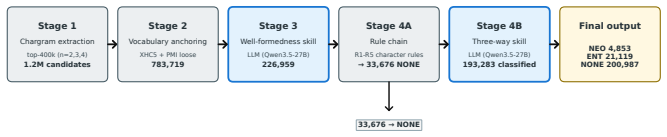
The central discovery is a method that operationalizes linguistic identification principles as prompt-engineering skills across four stages—tokenizer-independent character n-gram generation, dictionary anchoring with Pointwise Mutual Information pre-filter, well-formedness judgment based on Chinese word-formation principles, and combined rule plus three-way LLM classification for neologism versus entity versus none—and applies it to the BAAI CCI 3.0 corpus of 267 million documents to yield 226,959 classified candidates including 4,853 labeled neologisms. The accompanying per-stage conditional recall decomposition, when applied to the Hou (2023) reference set of 4,199 entries, factors the pip
What carries the argument
The per-stage conditional recall decomposition that expresses total recall as the product of conditional recalls at each linguistic skill stage.
If this is right
- Improving the initial n-gram candidate generation would multiply the overall yield since later stages are efficient.
- The semantic classification skill requires refinement for longer candidates to reduce length-dependent losses.
- Rule-based and structural linguistic skills can be reliably encoded as prompts with minimal recall loss.
- The released outputs provide a dataset of 4,853 neologisms for further linguistic study.
- The method offers a template for quantifying the operationalization of other linguistic tasks via prompts.
Where Pith is reading between the lines
- Extending the pipeline across successive time-stamped corpora could track rates of neologism emergence and obsolescence.
- Testing chain-of-thought or few-shot variants of the semantic prompt would directly test whether the observed length dependence can be mitigated.
- Applying the same skill-decomposition approach to neologism detection in other languages would reveal how language-specific the bottlenecks are.
- Pairing the LLM judgment stage with external knowledge bases might raise recall without changing the prompt structure.
Load-bearing premise
The three-way classification prompt accurately distinguishes semantic novelty from entities without systematic bias relative to human linguistic judgment.
What would settle it
Independent human re-labeling of the Hou (2023) reference set according to the same three-way criteria would show whether the reported 60 percent recall at Stage 4B reflects prompt shortcomings or differences in classification standards.
Figures
read the original abstract
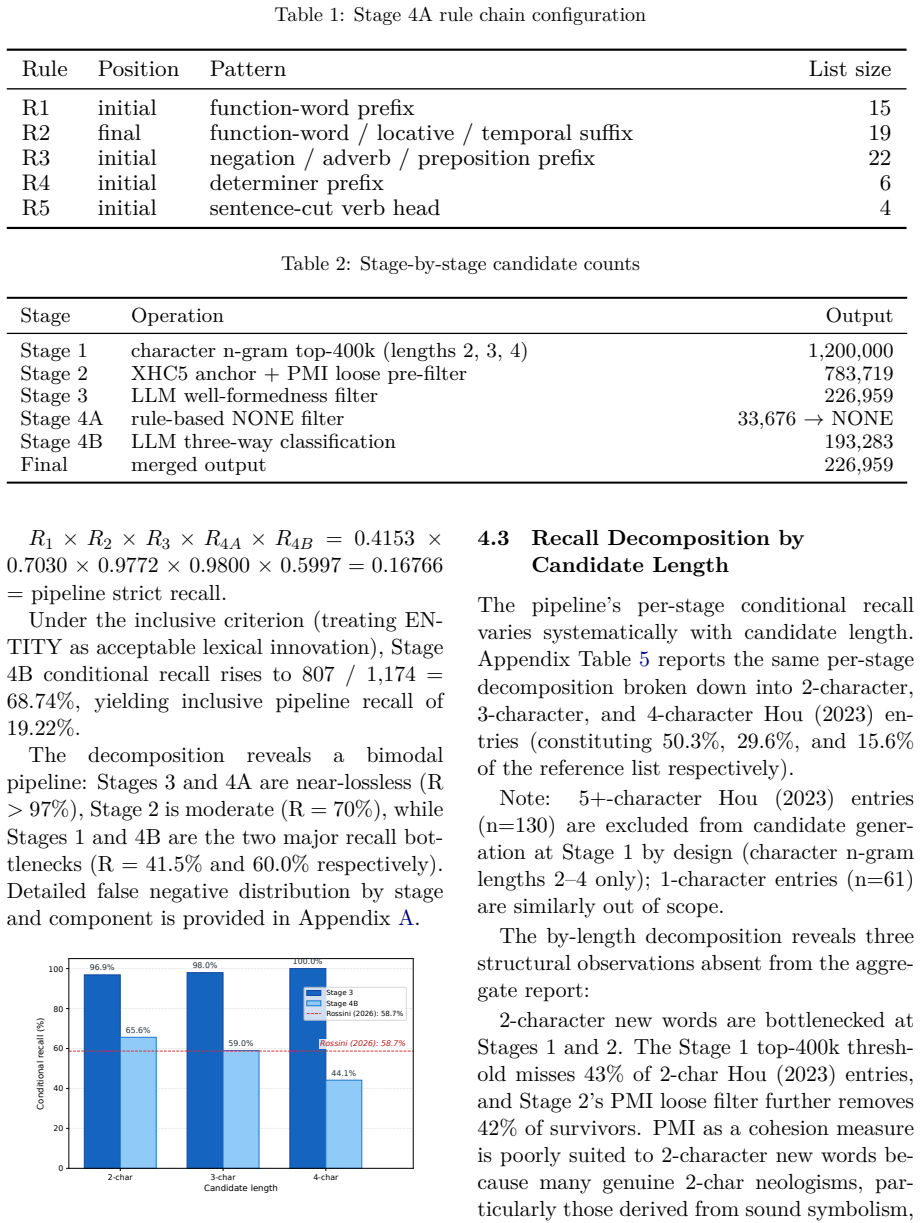
We present a method for automatic Chinese web neologism detection that operationalizes traditional linguistic identification principles as prompt-engineering skills. The method has four stages: tokenizer-independent character n-gram candidate generation; dictionary anchoring with a Pointwise Mutual Information pre-filter; a well-formedness skill based on Chinese word-formation principles; and a combined rule and three-way classification skill that distinguishes neologism, entity, and none. Applied to the BAAI CCI 3.0 corpus (267M documents), the method produces 226,959 classified candidates including 4,853 labeled neologisms. To evaluate the method, we develop a per-stage conditional recall decomposition in which the pipeline's strict recall factors mathematically into the product of stage conditional recalls. Applied to Hou (2023) (4,199 entries), the decomposition exposes Stage 1 candidate coverage and Stage 4B LLM semantic judgment as the two bottlenecks (R=41.5% and 60.0% respectively), while intermediate stages are near-lossless. A length-stratified analysis further reveals that the structural well-formedness skill is length-invariant (>= 96.9%) whereas the semantic novelty-classification skill is length-dependent (65.6%/59.0%/44.1% across 2/3/4-character candidates), mapping a current boundary of skill-based linguistic operationalization. We release the method, pipeline outputs, and evaluation protocol as public resources.
Editorial analysis
A structured set of objections, weighed in public.
Referee Report
Summary. The paper presents a four-stage pipeline for automatic Chinese web neologism detection that operationalizes linguistic principles (n-gram generation, dictionary anchoring with PMI, word-formation well-formedness, and rule+LLM three-way classification of neologism/entity/none) as prompt-engineering skills. Applied to the BAAI CCI 3.0 corpus (267M documents), it produces 226,959 classified candidates including 4,853 labeled neologisms. Evaluation develops a per-stage conditional recall decomposition applied to the Hou (2023) reference set (4,199 entries), exposing Stage 1 candidate coverage (R=41.5%) and Stage 4B LLM judgment (60.0%) as bottlenecks while intermediate stages are near-lossless; length-stratified analysis shows well-formedness is length-invariant (>=96.9%) but semantic classification is length-dependent (65.6%/59.0%/44.1% for 2/3/4-character items). The method, outputs, and protocol are released publicly.
Significance. If the classifications hold, the work provides a scalable, linguistically grounded approach to neologism detection via LLMs, with the mathematical recall decomposition offering a clear way to isolate stage contributions and the length-stratified results mapping current operationalization boundaries. Public release of pipeline, outputs, and evaluation protocol strengthens reproducibility and enables community verification or extension.
major comments (2)
- [Evaluation on Hou (2023)] Evaluation section (Hou 2023 reference set): the 60.0% recall for Stage 4B is treated as an engineering bottleneck, yet the manuscript provides no independent human adjudication, inter-annotator agreement, or sample verification on the BAAI CCI 3.0 outputs themselves; the reported length-dependent recalls (65.6%/59.0%/44.1%) therefore cannot be confirmed as reflecting semantic novelty rather than prompt-induced bias.
- [Stage 4B] Stage 4B description: the combined rule+LLM three-way classification assumes the prompt operationalizes 'semantic novelty' without systematic length or domain bias, but no ablation studies on prompt variants or direct comparison of LLM labels against human judgments on corpus-derived candidates are reported, leaving the headline count of 4,853 neologisms dependent on an unverified assumption.
minor comments (1)
- Ensure the released supplementary materials include the exact prompts for all stages (especially Stage 4B) and the precise definition of the per-stage conditional recall factors to support full reproducibility.
Simulated Author's Rebuttal
We thank the referee for the constructive and detailed report. We respond to the two major comments point by point below, acknowledging where the concerns are valid and indicating planned revisions.
read point-by-point responses
-
Referee: [Evaluation on Hou (2023)] Evaluation section (Hou 2023 reference set): the 60.0% recall for Stage 4B is treated as an engineering bottleneck, yet the manuscript provides no independent human adjudication, inter-annotator agreement, or sample verification on the BAAI CCI 3.0 outputs themselves; the reported length-dependent recalls (65.6%/59.0%/44.1%) therefore cannot be confirmed as reflecting semantic novelty rather than prompt-induced bias.
Authors: The referee is correct that our evaluation uses only the Hou (2023) reference set to compute the per-stage conditional recalls and does not include independent human adjudication or sample verification of the labels produced on BAAI CCI 3.0 candidates. The decomposition is intended to isolate stage contributions against a fixed reference; however, this leaves the length-stratified semantic-classification results open to the possibility of prompt-induced bias. We will revise the manuscript to explicitly state this limitation and to report a small-scale human verification on a random sample of corpus-derived candidates. revision: yes
-
Referee: [Stage 4B] Stage 4B description: the combined rule+LLM three-way classification assumes the prompt operationalizes 'semantic novelty' without systematic length or domain bias, but no ablation studies on prompt variants or direct comparison of LLM labels against human judgments on corpus-derived candidates are reported, leaving the headline count of 4,853 neologisms dependent on an unverified assumption.
Authors: We agree that the manuscript reports neither ablation studies on prompt variants nor direct human-LLM agreement on the corpus-derived candidates. The three-way classification prompt was constructed to operationalize the linguistic distinction between neologism, entity, and none, and the length-stratified results already document a length dependence in that stage. We will add a dedicated limitations paragraph acknowledging the absence of ablations and the reliance on the prompt's fidelity to linguistic criteria; full ablations remain outside the scope of the current study. revision: partial
Circularity Check
No significant circularity; evaluation uses external reference set and reports direct empirical counts
full rationale
The paper applies its four-stage pipeline to the external BAAI CCI 3.0 corpus and decomposes recall on the independent Hou (2023) reference set (4,199 entries) into per-stage conditional recalls. Reported figures (e.g., 4,853 neologisms, R=41.5% and 60.0% bottlenecks, length-stratified recalls) are direct measurements from data rather than quantities derived by construction from fitted parameters or self-citations. No equations reduce outputs to inputs, and no load-bearing premises rely on author-overlapping citations. The derivation chain is therefore self-contained against external benchmarks.
Axiom & Free-Parameter Ledger
Reference graph
Works this paper leans on
-
[1]
Claude Skills Documentation , year =
-
[2]
2023 , publisher =
Hou, Min , title =. 2023 , publisher =
2023
-
[3]
2026 , eprint =
Rossini, Diego and van der Plas, Lonneke , title =. 2026 , eprint =
2026
-
[4]
Proceedings of the Second Chinese Language Processing Workshop , pages =
Wu, Andi and Jiang, Zixin , title =. Proceedings of the Second Chinese Language Processing Workshop , pages =. 2000 , url =
2000
-
[5]
Computational Linguistics , volume =
Feng, Haodi and Chen, Kang and Deng, Xiaotie and Zheng, Weimin , title =. Computational Linguistics , volume =. 2004 , doi =
2004
-
[6]
Proceedings of the 20th Pacific Asia Conference on Language, Information and Computation , pages =
Ji, Luning and Lu, Qin and Li, Wenjie and Chen, Yirong , title =. Proceedings of the 20th Pacific Asia Conference on Language, Information and Computation , pages =. 2006 , address =
2006
-
[7]
Proceedings of COLING 2004 , year =
Peng, Fuchun and Feng, Fangfang and McCallum, Andrew , title =. Proceedings of COLING 2004 , year =
2004
-
[8]
Proceedings of ACL 2014 , pages =
Huang, Minlie and Ye, Bo and Wang, Yichen and Chen, Haiqiang and Cheng, Junjun and Zhu, Xiaoyan , title =. Proceedings of ACL 2014 , pages =. 2014 , url =
2014
-
[9]
Brown, Tom B. and Mann, Benjamin and Ryder, Nick and Subbiah, Melanie and Kaplan, Jared and Dhariwal, Prafulla and Neelakantan, Arvind and Shyam, Pranav and Sastry, Girish and Askell, Amanda and Agarwal, Sandhini and Herbert-Voss, Ariel and Krueger, Gretchen and Henighan, Tom and Child, Rewon and Ramesh, Aditya and Ziegler, Daniel M. and Wu, Jeffrey and W...
2020
-
[10]
Advances in Neural Information Processing Systems , volume =
Wei, Jason and Wang, Xuezhi and Schuurmans, Dale and Bosma, Maarten and Ichter, Brian and Xia, Fei and Chi, Ed and Le, Quoc and Zhou, Denny , title =. Advances in Neural Information Processing Systems , volume =. 2022 , url =
2022
-
[11]
Efficient Guided Generation for Large Language Models
Willard, Brandon T. and Louf, R. Efficient Guided Generation for Large Language Models , year =. 2307.09702 , archivePrefix =
work page internal anchor Pith review Pith/arXiv arXiv
-
[12]
Proceedings of LREC 2006 , pages =
Vilar, David and Xu, Jia and D'Haro, Luis Fernando and Ney, Hermann , title =. Proceedings of LREC 2006 , pages =. 2006 , url =
2006
-
[13]
and Eisner, Jason , title =
Smith, David A. and Eisner, Jason , title =. Proceedings of EMNLP 2008 , pages =. 2008 , url =
2008
-
[14]
Qwen3.5-27B , year =
-
[15]
Qwen3.5-Omni Technical Report , year =. 2604.15804 , archivePrefix =
work page internal anchor Pith review Pith/arXiv arXiv
-
[16]
Schulhoff, Sander and Ilie, Michael and Balepur, Nishant and Kahadze, Konstantine and Liu, Amanda and Si, Chenglei and Li, Yinheng and Gupta, Aayush and Han, HyoJung and Schulhoff, Sevien and Dulepet, Pranav Sandeep and Vidyadhara, Saurav and Ki, Dayeon and Agrawal, Sweta and Pham, Chau and Kroiz, Gerson and Li, Feileen and Tao, Hudson and Srivastava, Ash...
2024
-
[17]
2024 , eprint =
Sahoo, Pranab and Singh, Ayush Kumar and Saha, Sriparna and Jain, Vinija and Mondal, Samrat and Chadha, Aman , title =. 2024 , eprint =
2024
-
[18]
2025 , eprint =
Geng, Saibo and Cooper, Hudson and Moskal, Micha. 2025 , eprint =
2025
-
[19]
arXiv preprint arXiv:2505.04016 , volume=
Wang, Darren Yow-Bang and Shen, Zhengyuan and Mishra, Soumya Smruti and Xu, Zhichao and Teng, Yifei and Ding, Haibo , year =. 2505.04016 , archivePrefix =
-
[20]
2025 , eprint =
Ni, Shiwen and Chen, Guhong and Li, Shuaimin and Chen, Xuanang and Li, Siyi and Wang, Bingli and Wang, Qiyao and Wang, Xingjian and Zhang, Yifan and Fan, Liyang and Li, Chengming and Xu, Ruifeng and Sun, Le and Yang, Min , title =. 2025 , eprint =
2025
-
[21]
Proceedings of ACL-IJCNLP 2021 , pages =
Sun, Zijun and Li, Xiaoya and Sun, Xiaofei and Meng, Yuxian and Ao, Xiang and He, Qing and Wu, Fei and Li, Jiwei , title =. Proceedings of ACL-IJCNLP 2021 , pages =. 2021 , url =
2021
-
[22]
Proceedings of EMNLP 2020 , pages =
Huang, Kaiyu and Huang, Degen and Liu, Zhuang and Mo, Fengran , title =. Proceedings of EMNLP 2020 , pages =. 2020 , url =
2020
discussion (0)
Sign in with ORCID, Apple, or X to comment. Anyone can read and Pith papers without signing in.