Where Not to Look: A Parametric Avoidance Model for SETI Target Selection
Pith reviewed 2026-06-27 23:15 UTC · model grok-4.3
The pith
A rule-based filter using seven stellar parameters excludes roughly half of a 1.74 million-star Gaia DR3 sample for SETI target selection.
A machine-rendered reading of the paper's core claim, the machinery that carries it, and where it could break.
Core claim
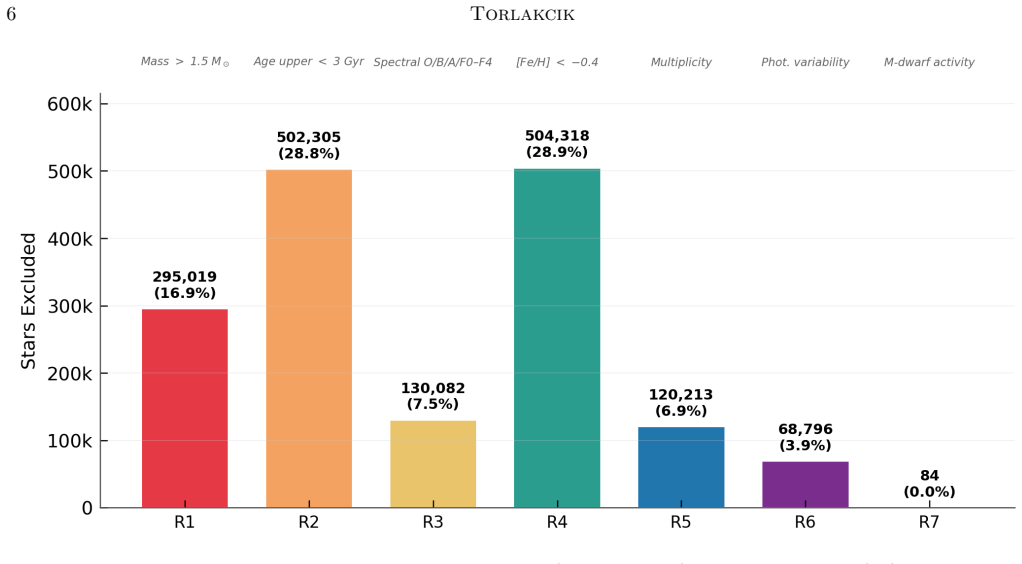
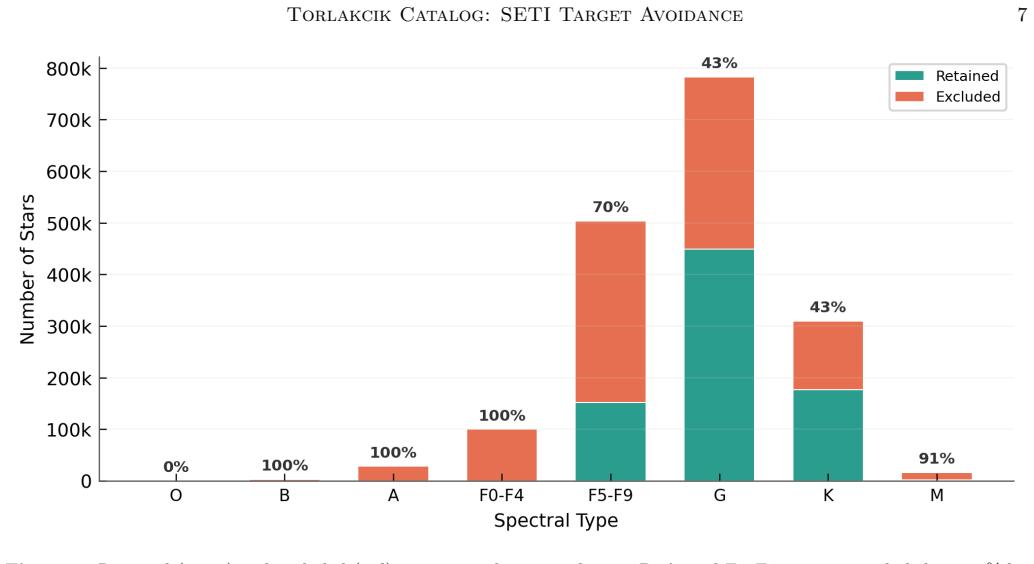
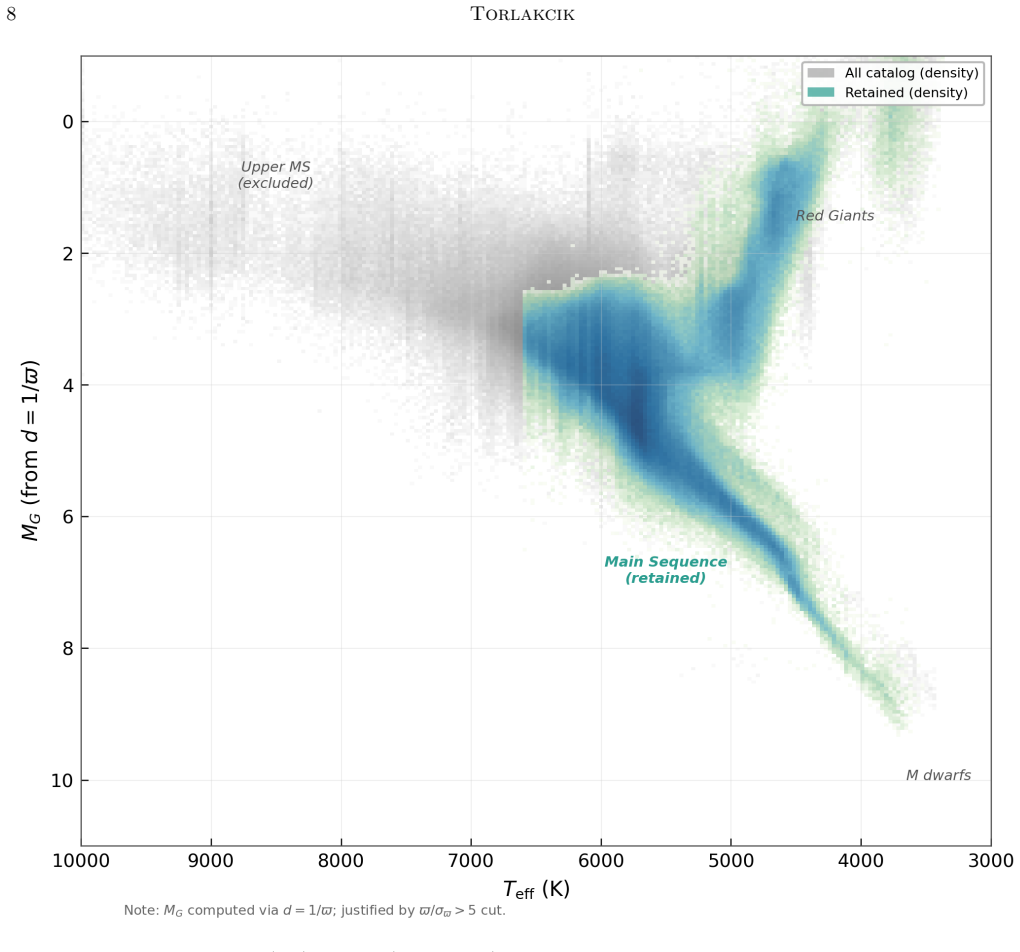
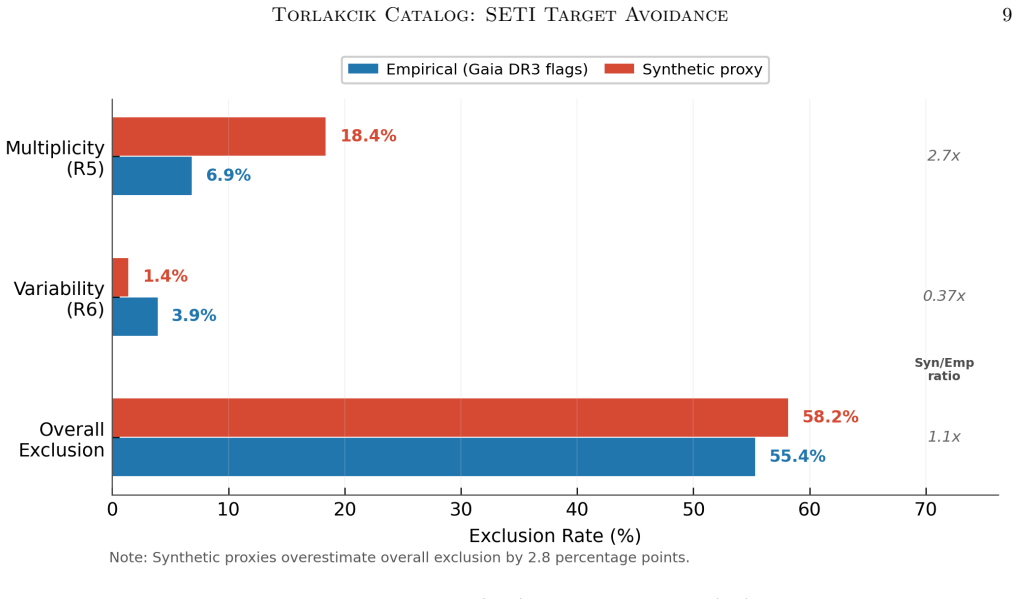
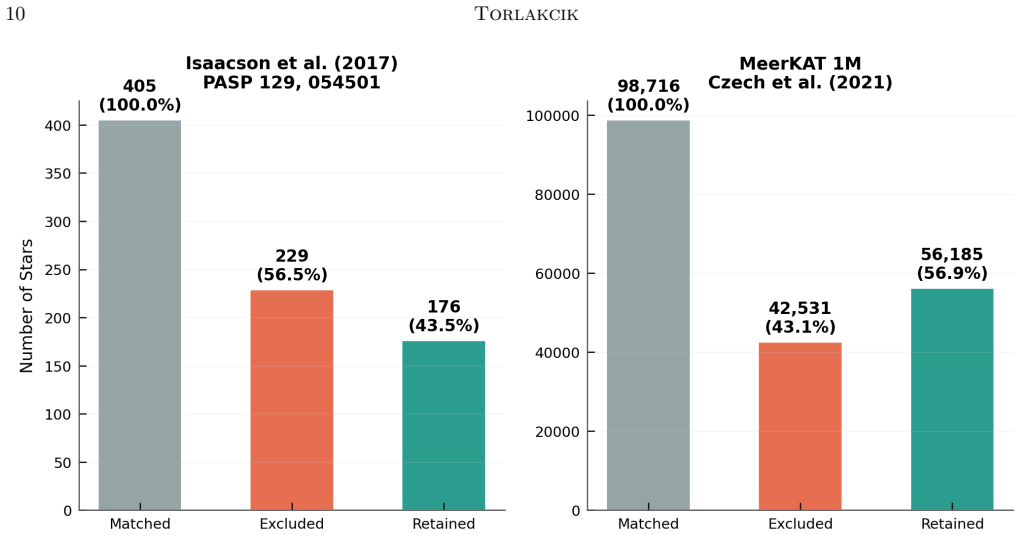
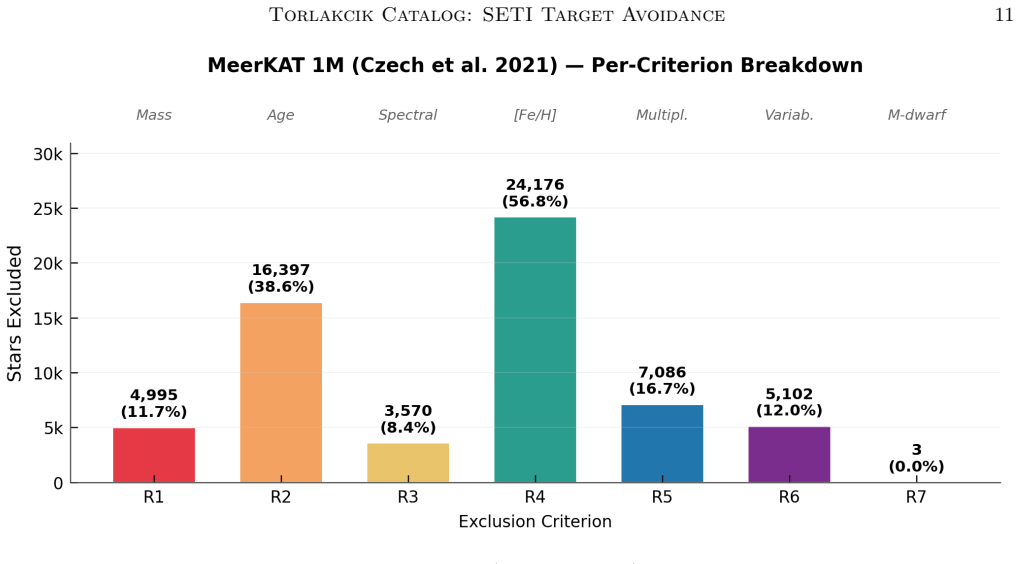
Using seven stellar parameters the model excludes roughly half of a 1.74 million-star Gaia DR3 sample, retaining 777835 high-priority targets, mainly G and K dwarfs. Age and metallicity dominate the rejections. Importantly, using Gaia's age upper bounds instead of point estimates saves 355086 stars from exclusion. A comparison of empirical and synthetic proxies shows that while the overall exclusion rate is robust, individual target assignments change significantly; for instance, the commonly used RUWE indicator flags 2.7x more binaries than Gaia's own non-single-star flag. Cross-matching with the Breakthrough Listen target list reveals a 56.5% exclusion rate.
What carries the argument
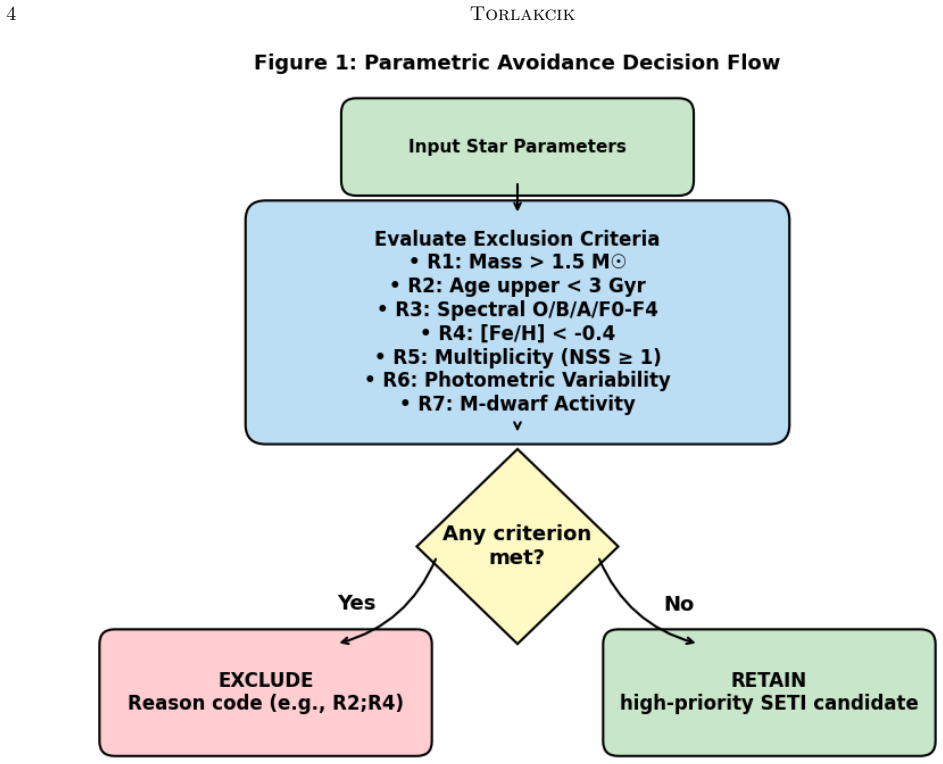
The parametric avoidance model, a simple rule-based filter that applies exclusion criteria on seven stellar parameters to identify stars unlikely to host complex life.
If this is right
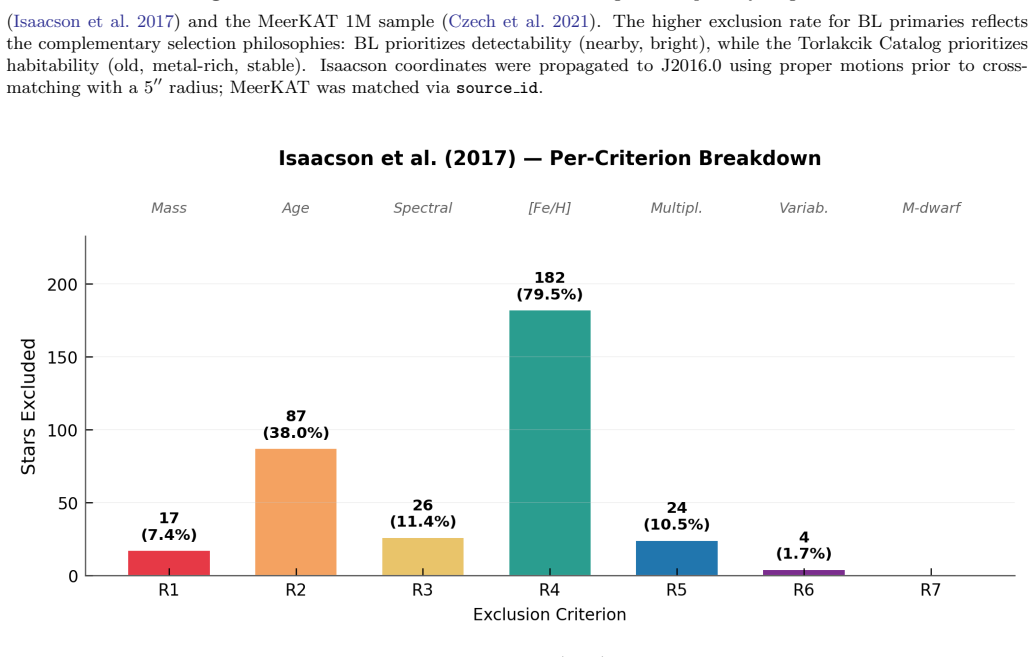
- Age and metallicity account for most exclusions in the 1.74 million-star sample.
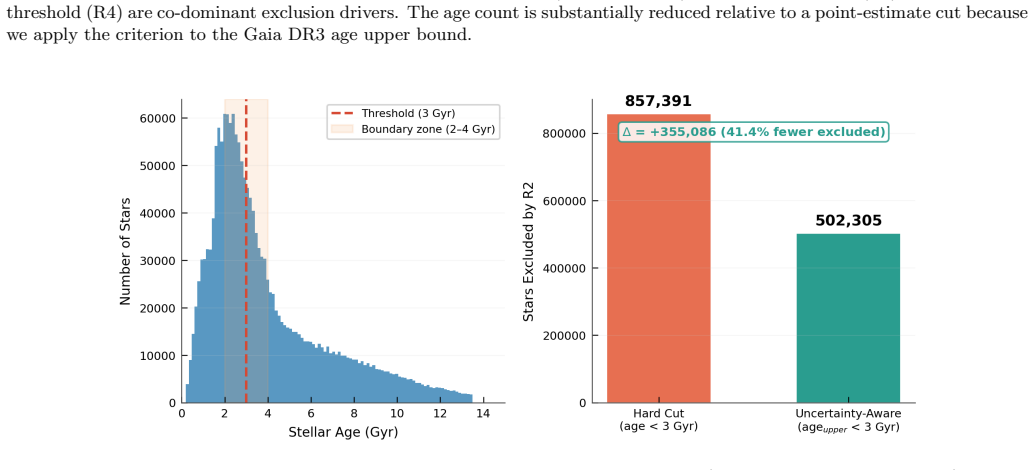
- Using age upper bounds instead of point estimates prevents the exclusion of 355086 stars.
- The model excludes 56.5 percent of the Breakthrough Listen target list.
- Different binary-star indicators produce substantially different numbers of flagged targets.
- The exclusion catalog, pipeline, and community tool are released for public use.
Where Pith is reading between the lines
- Habitability-driven filtering can be combined with proximity-driven surveys to produce more focused target lists.
- The finding that overall exclusion rates stay stable across proxy choices but individual assignments shift suggests future refinements could target the most uncertain parameters.
- Public availability of the pipeline allows direct testing on later data releases or expanded samples.
- The audit-ready exclusion list provides a documented basis for why certain stars are not observed in SETI programs.
Load-bearing premise
The seven chosen stellar parameters are reliable proxies for the presence or absence of complex life.
What would settle it
Detection of planets with biosignatures or conditions suitable for complex life around a star excluded by the model would falsify the exclusion rules.
Figures
read the original abstract
We present a simple, rule-based filter for SETI target selection that flags stars unlikely to host complex life and produces an audit-ready exclusion catalog. Using seven stellar parameters, including age, metallicity, and multiplicity, the model excludes roughly half of a 1.74 million-star Gaia DR3 sample, retaining 777,835 high-priority targets, mainly G and K dwarfs. Age and metallicity dominate the rejections. Importantly, using Gaia's age upper bounds instead of point estimates saves 355,086 stars from exclusion. A comparison of empirical and synthetic proxies shows that while the overall exclusion rate is robust, individual target assignments change significantly; for instance, the commonly used RUWE indicator flags 2.7x more binaries than Gaia's own non-single-star flag. Cross-matching with the Breakthrough Listen target list reveals a 56.5% exclusion rate, highlighting the complementary nature of habitability-driven and proximity-driven surveys. The catalog, pipeline, and a generalized community tool are publicly available.
Editorial analysis
A structured set of objections, weighed in public.
Referee Report
Summary. The manuscript presents a rule-based parametric avoidance model for SETI target selection. Using seven Gaia DR3 stellar parameters (age, metallicity, multiplicity and others), the model excludes roughly half of a 1.74 million-star sample and retains 777,835 high-priority targets, predominantly G and K dwarfs. Age and metallicity drive most exclusions; using Gaia age upper bounds instead of point estimates retains an additional 355,086 stars. The model shows a 56.5% exclusion rate on the Breakthrough Listen target list and releases the catalog, pipeline, and a generalized community tool.
Significance. If the habitability-proxy assumptions hold, the work supplies a transparent, audit-ready, and publicly reproducible filter that complements proximity-driven surveys such as Breakthrough Listen. The explicit release of the catalog and code is a clear strength for reproducibility.
major comments (3)
- [Methods (model parameter rules) and Results (exclusion statistics)] The exclusion thresholds applied to the seven parameters (especially the age and metallicity cuts that dominate rejections) are taken directly from external literature without derivation from the Gaia DR3 sample, sensitivity tests on the cutoff values, or validation against independent habitability indicators. Because the retained sample size of 777,835 and the 56.5% Breakthrough Listen overlap both depend directly on these specific thresholds, the central quantitative claims cannot be assessed for robustness without such analysis.
- [Abstract and §4 (robustness discussion)] The abstract states that 'the overall exclusion rate is robust' on the basis of empirical vs. synthetic proxy comparisons, yet no quantitative sensitivity table or figure varies the age or metallicity thresholds by even modest amounts (e.g., ±0.5 dex in [Fe/H] or ±1 Gyr in age). This omission leaves the load-bearing claim that 'roughly half' of the sample is excluded open to post-hoc adjustment.
- [Results (cross-match with Breakthrough Listen)] The 56.5% overlap statistic with the Breakthrough Listen list is presented as evidence of complementarity, but the manuscript does not specify the exact cross-match radius, the source of the seven parameters for the BL stars, or whether the same exclusion rules were applied uniformly; without these details the statistic cannot be independently reproduced.
minor comments (2)
- [Abstract and Methods] The abstract and main text would benefit from a single consolidated table listing the precise numerical thresholds and literature sources for each of the seven parameters.
- [Results (proxy comparison)] The statement that 'individual target assignments change significantly' between RUWE and the non-single-star flag would be clearer if accompanied by the exact counts or fractions rather than the factor of 2.7x alone.
Simulated Author's Rebuttal
We thank the referee for the constructive and detailed report. We address each major comment below and have incorporated revisions to improve clarity and robustness where the comments identify gaps in the original presentation.
read point-by-point responses
-
Referee: [Methods (model parameter rules) and Results (exclusion statistics)] The exclusion thresholds applied to the seven parameters (especially the age and metallicity cuts that dominate rejections) are taken directly from external literature without derivation from the Gaia DR3 sample, sensitivity tests on the cutoff values, or validation against independent habitability indicators. Because the retained sample size of 777,835 and the 56.5% Breakthrough Listen overlap both depend directly on these specific thresholds, the central quantitative claims cannot be assessed for robustness without such analysis.
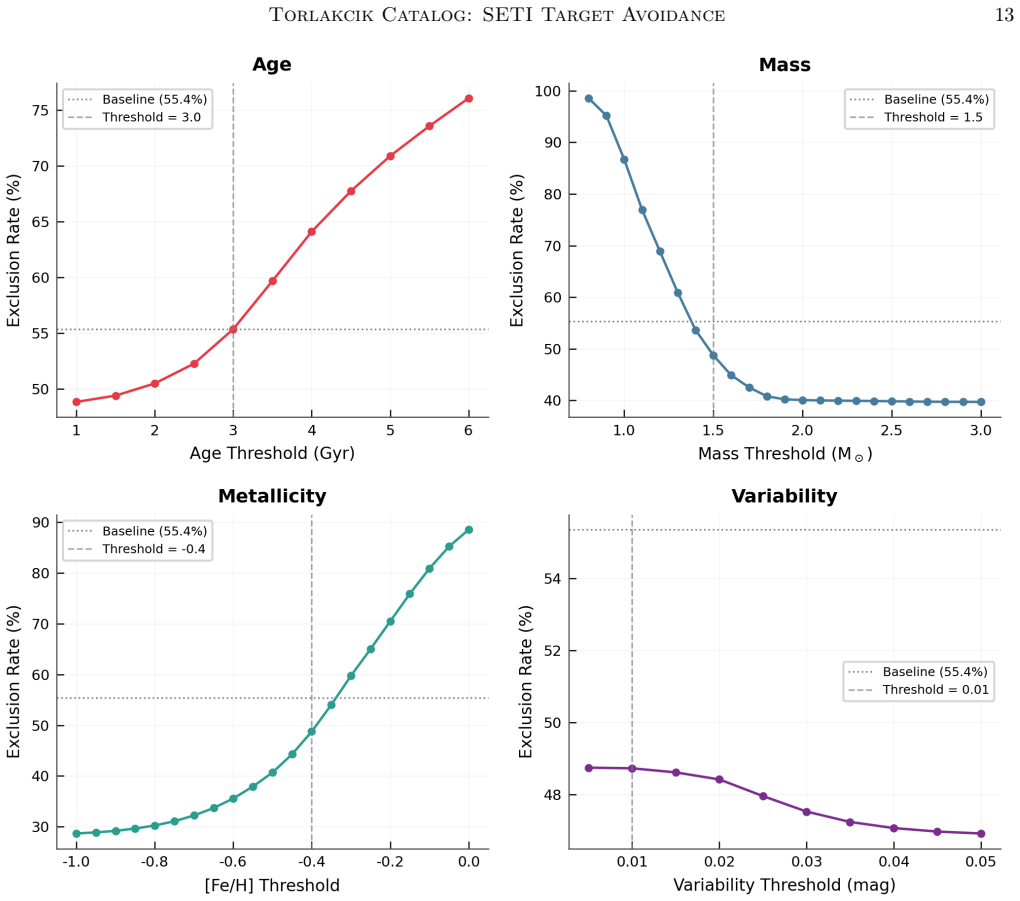
Authors: The thresholds are drawn from the peer-reviewed literature on stellar habitability as a deliberate design choice for a transparent, rule-based model rather than being fit to the Gaia DR3 sample. We agree that sensitivity tests would strengthen the manuscript. In revision we add a dedicated sensitivity subsection to §4 that varies the dominant age and metallicity cuts by ±1 Gyr and ±0.5 dex; the resulting exclusion fraction remains between 45 % and 55 %. We also note the current absence of comprehensive, independent habitability-indicator datasets covering the full 1.74 M-star sample and have added this limitation explicitly to the discussion. revision: yes
-
Referee: [Abstract and §4 (robustness discussion)] The abstract states that 'the overall exclusion rate is robust' on the basis of empirical vs. synthetic proxy comparisons, yet no quantitative sensitivity table or figure varies the age or metallicity thresholds by even modest amounts (e.g., ±0.5 dex in [Fe/H] or ±1 Gyr in age). This omission leaves the load-bearing claim that 'roughly half' of the sample is excluded open to post-hoc adjustment.
Authors: The robustness statement in the abstract refers to the agreement between empirical and synthetic proxy comparisons. We accept that an explicit threshold-sensitivity table is required to support the claim. We have added Table 3 in the revised §4 that reports exclusion rates under the suggested variations; the ~50 % figure is stable within the tested range. The abstract has been updated to reference this table. revision: yes
-
Referee: [Results (cross-match with Breakthrough Listen)] The 56.5% overlap statistic with the Breakthrough Listen list is presented as evidence of complementarity, but the manuscript does not specify the exact cross-match radius, the source of the seven parameters for the BL stars, or whether the same exclusion rules were applied uniformly; without these details the statistic cannot be independently reproduced.
Authors: We agree that these implementation details are necessary for reproducibility. In the revised manuscript we have expanded the relevant results section to state the cross-match radius, confirm that all seven parameters for the Breakthrough Listen targets were taken from Gaia DR3, and verify that the exclusion rules were applied identically. The exact matching procedure is now documented in the public code repository. revision: yes
Circularity Check
No significant circularity; derivation applies external rules to input catalog without internal reduction.
full rationale
The paper defines a rule-based filter using seven Gaia DR3 stellar parameters and habitability thresholds drawn from external literature. The output catalog (777835 retained targets) is produced by direct application of these stated rules to the 1.74 million-star input sample. No equations, fitted parameters, or self-citations reduce any claimed result to a quantity defined from the target list itself. The exclusions follow from the imported criteria without self-definitional loops or predictions that are statistically forced by construction. This is the normal case of a self-contained application of external inputs.
Axiom & Free-Parameter Ledger
free parameters (1)
- exclusion thresholds for age, metallicity, multiplicity
axioms (1)
- domain assumption Certain ranges of stellar age, metallicity and multiplicity make complex life unlikely
Reference graph
Works this paper leans on
-
[1]
2021, AJ, 161, 147, doi: 10.3847/1538-3881/abd806
Demleitner, M., & Andrae, R. 2021, AJ, 161, 147, doi: 10.3847/1538-3881/abd806
work page internal anchor Pith review doi:10.3847/1538-3881/abd806 2021
-
[2]
2026, Nature Astronomy, 10, 357, doi: 10.1038/s41550-026-02803-y
Basri, G. 2026, Nature Astronomy, 10, 357, doi: 10.1038/s41550-026-02803-y
-
[3]
2020, MNRAS, 496, 1922, doi: 10.1093/mnras/staa1522
Belokurov, V., Penoyre, Z., Oh, S., et al. 2020, MNRAS, 496, 1922, doi: 10.1093/mnras/staa1522
-
[4]
Czech, D., Isaacson, H., Pearce, L., et al. 2021, PASP, 133, 064502, doi: 10.1088/1538-3873/abf329
-
[5]
2023, , 674, A13, 10.1051/0004-6361/202244242
Eyer, L., Audard, M., Holl, B., et al. 2023, A&A, 674, A13, doi: 10.1051/0004-6361/202244242
-
[6]
Fischer, D. A., & Valenti, J. 2005, ApJ, 622, 1102, doi: 10.1086/428383
-
[7]
France, K., Loyd, R. O. P., Youngblood, A., et al. 2016, ApJ, 820, 89, doi: 10.3847/0004-637X/820/2/89 Gaia Collaboration, Smart, R. L., Sarro, L. M., et al. 2021, A&A, 649, A6, doi: 10.1051/0004-6361/202039498 Gaia Collaboration, Vallenari, A., Brown, A. G. A., et al. 2023, A&A, 674, A1, doi: 10.1051/0004-6361/202243940
-
[8]
Gajjar, V., Perez, K. I., Siemion, A. P. V., et al. 2021, AJ, 162, 33, doi: 10.3847/1538-3881/abfd36
-
[9]
O., & Corbally, C
Gray, R. O., & Corbally, C. J. 2009, Stellar Spectral Classification
2009
-
[10]
Hansen, C. J., & Kawaler, S. D. 1994, Stellar Interiors. Physical Principles, Structure, and Evolution., doi: 10.1007/978-1-4419-9110-2
-
[11]
Holman, M. J., & Wiegert, P. A. 1999, AJ, 117, 621, doi: 10.1086/300695
-
[12]
Howard, W. S., Tilley, M. A., Corbett, H., et al. 2018, ApJL, 860, L30, doi: 10.3847/2041-8213/aacaf3
-
[13]
Isaacson, H., Siemion, A. P. V., Marcy, G. W., et al. 2017, PASP, 129, 054501, doi: 10.1088/1538-3873/aa5800
-
[14]
Johnson, J. A., Aller, K. M., Howard, A. W., & Crepp, J. R. 2010, PASP, 122, 905, doi: 10.1086/655775
-
[15]
Kasting, J. F., Whitmire, D. P., & Reynolds, R. T. 1993, Icarus, 101, 108, doi: 10.1006/icar.1993.1010
-
[16]
1990, Stellar Structure and Evolution
Kippenhahn, R., & Weigert, A. 1990, Stellar Structure and Evolution
1990
-
[17]
Knoll, A. H. 2021, A Brief History of Earth: Four Billion Years in Eight Chapters (New York: Custom House)
2021
-
[18]
https://doi.org/10.1051/0004-6361/202039709
Lindegren, L., Klioner, S. A., Hern´ andez, J., et al. 2021, A&A, 649, A2, doi: 10.1051/0004-6361/202039709
-
[19]
Lutz, T. E., & Kelker, D. H. 1973, PASP, 85, 573, doi: 10.1086/129506
-
[20]
Marcy, G. W., & Tellis, N. K. 2024, MNRAS, 531, 2669, doi: 10.1093/mnras/stae1323 18Torlakcik
-
[21]
2020, The Astronomical Journal, 159, 80, doi: 10.3847/1538-3881/ab64fa
Quarles, B., Li, G., Kostov, V., & Haghighipour, N. 2020, AJ, 159, 80, doi: 10.3847/1538-3881/ab64fa
-
[22]
Photometric content and validation
Riello, M., De Angeli, F., Evans, D. W., et al. 2021, A&A, 649, A3, doi: 10.1051/0004-6361/202039587
-
[23]
2007, Astrobiology, 7, 85, doi: 10.1089/ast.2006.0125
Scalo, J., Kaltenegger, L., Segura, A., et al. 2007, Astrobiology, 7, 85, doi: 10.1089/ast.2006.0125
-
[24]
Shields, A. L., Ballard, S., & Johnson, J. A. 2016, PhR, 663, 1, doi: 10.1016/j.physrep.2016.10.003
-
[25]
Smith, H. 2003, MNRAS, 338, 891, doi: 10.1046/j.1365-8711.2003.06167.x
-
[26]
Turnbull, M. C., & Tarter, J. C. 2003, ApJS, 145, 181, doi: 10.1086/345779
discussion (0)
Sign in with ORCID, Apple, or X to comment. Anyone can read and Pith papers without signing in.