REVIEW 4 major objections 4 minor
Meissner Effect and Josephson Radiation in Driven Dissipative Superconductors
T0 review · 4 major / 4 minor · reviewed 2026-08-03 · deepseek-v4-flash
Pith's one-line read Photo-induced superconducting order may be a rotating condensate that still expels magnetic fields and radiates a zero-voltage Josephson signal.
desk verdict A clean phenomenological theory that derives the electromagnetic response of a driven-dissipative rotating superconductor and proposes a sharp zero-bias Josephson test, with the load-bearing microscopic assumption explicitly left open. read the letter →
The pith
A machine-rendered reading of the paper's core claim, the machinery that carries it, and where it could break.
The reading
What carries the argument
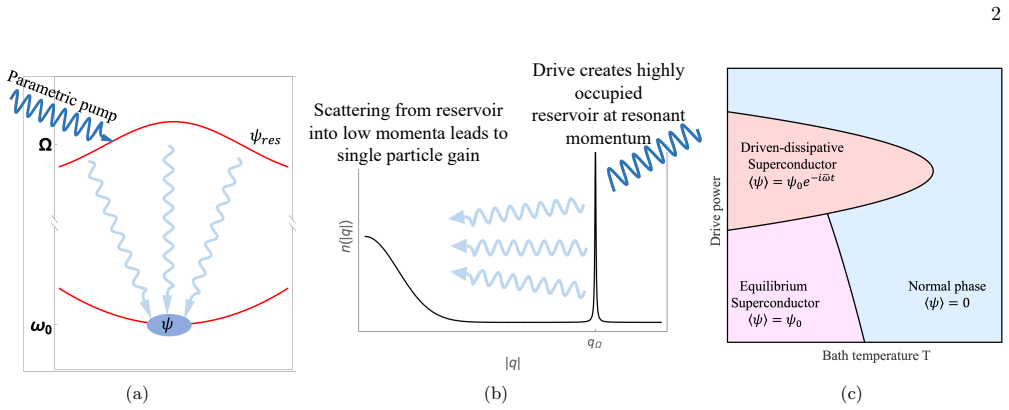
The central object is the complex pairing field ψ = √ρ e^{iθ} coupled to the conserved charge density and the electromagnetic gauge field through a non-equilibrium model-F dynamics with complex coefficients. The instability is driven by a sign change of the effective damping γ, supplied by an incoherent gain from resonantly pumped modes. The crucial structural feature is gauge invariance: since the time-dependence is a pure phase, the angular velocity can be absorbed into a shift of the longitudinal gauge field A0, so the bulk response is static. The combination of the phase dynamics, charge continuity, and Maxwell equations yields the Meissner kernel and plasmon spectra; the KPZ-type nonlin
What would settle it
Measure the current across a junction between a photo-excited superconductor and an equilibrium superconductor while the former shows flux expulsion: if no AC current appears at zero bias at a frequency incommensurate with the drive, the central prediction is contradicted. A second check is to measure the 2D plasmon dispersion and magnetic screening of a driven sheet; absence of the √q plasmon and Pearl-type screening would also rule the mechanism out.
Extended reading notes
Core claim
Despite the order parameter rotating at a finite intrinsic frequency, the state obeys the conventional long-wavelength electromagnetic laws of superconductivity. In three dimensions the static magnetic field is expelled with a London penetration depth and the plasmon is gapped; in two dimensions the screening is described by a Pearl length and the plasmon has the characteristic square-root dispersion. The paper further shows that the same rotation yields a direct experimental fingerprint: a Josephson junction to an equilibrium superconductor produces an oscillating current at zero bias, emitting radiation at the condensate's intrinsic rotation frequency, a signature that distinguishes driven
Load-bearing premise
The entire scenario depends on the optical pump actually producing an incoherent gain that overcomes the intrinsic damping of the pairing field in real materials; if this negative-damping regime is not reached, the rotating condensate and all its predicted responses never form.
Editorial extensions
If this is right
- A driven-dissipative condensate explains flux expulsion and microwave response above Tc without an equilibrium superconducting phase, offering a distinct theory for photo-induced superconductivity.
- Bulk samples should show static Meissner expulsion with a London penetration depth and a gapped plasmon, unaffected by the order parameter rotation.
- Two-dimensional sheets should show Pearl screening and a gapless square-root plasmon, with damping vanishing faster than the frequency at long wavelengths.
- A zero-bias AC Josephson current and the resulting radiation at the intrinsic rotation frequency provide a qualitative experimental discriminator against Floquet pairing, which would emit at harmonics of the drive.
- The coexistence of conventional electrodynamics and zero-bias radiation is robust to the precise values of the phenomenological coefficients.
Reading between the lines
- If the Josephson radiation is observed, its frequency should shift continuously with pump power and remain incommensurate with the drive, giving a direct handle on the condensate's rotation rate.
- The rotating condensate spontaneously breaks continuous time-translation symmetry, so the predicted radiation is effectively a time-crystal signature; the experiment would tie driven-dissipative superconductivity to the broader time-crystal landscape.
- This mechanism implies that superconducting electrodynamics does not require a static order parameter, which may generalize to other driven symmetry-broken states such as charge or spin density waves.
- A practical extension would be to measure the pump-intensity dependence of the Josephson frequency to extract the complex coefficients of the theory, connecting experiment to microscopic models.
Editorial analysis
A structured set of objections, weighed in public.
Referee Report
Summary. The paper proposes that photo-induced superconducting signatures observed far above equilibrium T_c arise from driven-dissipative condensation of the superconducting order parameter. The authors construct a phenomenological continuum theory coupling a complex pairing field, whose damping γ can be driven negative by optical pumping, to a conserved charge density and the electromagnetic gauge field. They show that the resulting phase-rotating condensate nonetheless exhibits a static Meissner response, a bulk gapped plasmon, a two-dimensional Pearl screening and square-root plasmon, and — because the phase rotates at an intrinsic frequency ω̄ — an AC Josephson current at zero bias that radiates at ω̄. The calculation is linearized around the rotating saddle and is presented as a Model F-type hydrodynamic theory with complex coefficients.
Significance. If the central mechanism holds, the paper provides a qualitatively new route to photo-induced superconductivity and, importantly, a falsifiable experimental fingerprint: zero-bias Josephson radiation at a low, pump-dependent frequency incommensurate with the drive. The manuscript is unusually transparent about its own limitations: Section V explicitly identifies the microscopic derivation of the dissipative instability as essential. The linearized phase-amplitude calculation is coherent in structure and yields concrete, testable dispersion relations and screening lengths. The proposed Josephson-junction experiment is a clean discriminator between driven-dissipative, Floquet-locked, and equilibrium superconducting states. However, as discussed below, the manuscript as printed contains internal discrepancies in some of the central response formulas, and the existence of a negative-damping regime for real superconductors is assumed rather than derived.
major comments (4)
- [§II and §V, Eq. (6)] The entire mechanism rests on γ being driven negative, since the rotating saddle has ρ0 = −γ/λ_d > 0 only for γ < 0. The paper cites O(N)-model and polariton analogs, but those systems do not include a conserved charge density or gauge coupling, and no microscopic derivation is offered for superconducting materials. The manuscript itself states in Section V that deriving this dissipative instability 'is essential.' This is a load-bearing assumption, not a cosmetic gap; without it the Meissner and Josephson predictions do not apply to the compounds that motivate the paper. Please either supply a microscopic argument for the sign change in the retarded pairing response or explicitly reframe the paper's central claims as conditional on this instability and discuss the materials-physics plausibility in more detail.
- [§III.A, Eqs. (15)–(16)] There is an apparent sign/structure inconsistency in the normal-carrier continuity equation. From Eq. (4), v_L should be proportional to (m∂t + γ_n)^{-1}(α∇θ − ∇A0 + ξ_L), but Eq. (15) writes σ̂ = (m∂t − γ)^{-1} and Eq. (16) does not follow from the printed v_L with the printed sign. Since the final spectra depend on the coefficient n_f σ̂, this is not a purely presentational issue. Please re-derive and correct the signs in Eqs. (15)–(16) and confirm that the subsequent expressions for ω̂_p^2, Eq. (25), and Eq. (31) are affected consistently.
- [§III.A, Eqs. (25) and (31)] The zero-momentum longitudinal and transverse gaps do not agree with each other as printed, despite the statement that they coincide by the Anderson–Higgs mechanism. With σ̂ ≃ −γ_n^{-1} from Eq. (24), the A-equation (30) gives a transverse mass squared Z_cρ0 + α n_f/γ_n, whereas Eq. (31) has the opposite sign for the α term. Similarly, Eq. (23) with Eq. (21d) yields a longitudinal ω²(0) = Z_cρ0 + α n_f/γ_n − n_f²/(4γ_n²), not the printed Z_cρ0 + α n_f/(2γ_n) − n_f²/(4γ_n²). These discrepancies affect the central claim of a conventional Meissner response and the asserted Anderson–Higgs coincidence. Please correct the sign/factor errors or explain the different conventions that make the printed formulas consistent.
- [Eq. (31) and stability] The Meissner kernel Z_cρ0 − α n_f/γ_n (or its corrected version) is assumed to be positive, but this stability condition is never stated or analyzed. If the normal-carrier drag α is large, the effective London stiffness can change sign, in which case the rotating condensate would not expel static fields in the conventional sense. Since the sign of the drag term is precisely what distinguishes the non-equilibrium response, the domain of validity of Eq. (31) should be given explicitly, and the consequences of a negative kernel should be discussed.
minor comments (4)
- [§III.A, Eq. (15)] Eq. (15) writes (m∂t − γ)^{-1}, but Eq. (4) has γ_n. The subscript is likely missing; please fix and make the notation consistent everywhere.
- [§III.A, Eq. (14)] The phase equation printed as Eq. (14) appears to lack the linear Z_c∇²ϕ term that would arise from the covariant derivative in Eq. (10). If this term is intentionally absorbed into the amplitude-elimination procedure, please say so explicitly; otherwise it should be retained.
- [Abstract/Fig. 2] There are several typographical artifacts: 'remain non-condensed charge carriers' should be 'remaining'; 'by by' in the acknowledgments; 'L3C60' should be 'K3C60'; and the labels in Fig. 2 are partially garbled. Please proofread.
- [§III.A, Eq. (25)] The expression 'Z_cρ2_0' should presumably be 'Z_cρ0' or 'Z_c ρ_0'; the superscript is confusing.
Circularity Check
No significant circularity: the electromagnetic response and Josephson radiation are conditional derivations from an explicitly assumed rotating condensate; the only flagged gap is the missing microscopic derivation of the negative damping, which the paper itself labels essential.
full rationale
I walked the derivation chain from the input Langevin model (Eq. 1) through the rotating saddle (Eq. 6) to the Meissner/Pearl kernels (Eqs. 31, 43) and the Josephson radiation (Eq. 45). No step reduces by construction to a fitted output. The saddle-point density ρ0 = -γ/λ_d is exactly the solution of the input equation when γ < 0; the London-like kernel Z_c ρ0 - α n_f/γ_n is computed from that assumed condensate and the phenomenological currents, not presupposed as the target result. The AC Josephson current I(t) = I_c sin(φ0 + ω̄ t) is the standard Josephson relation evaluated with the rotating phase, so it is a derived consequence of the model rather than a renamed empirical pattern. The cited anti-damping instability in O(N) models [10] is used motivationally, and independent support is cited ([17], plus polariton experiments); the paper does not invoke a self-authored uniqueness theorem or import a fitted ansatz through citation. The genuinely load-bearing unproved premise is that optical pumping makes γ negative. This is a missing microscopic derivation, not a circularity: the paper states in Section V, 'derive the dissipative instability from microscopic models... This step is essential for assessing which of the experimentally studied compounds are plausible candidates,' and in Section II, 'A microscopic theory for unconventional compounds such as the cuprates is beyond the scope of this article.' These passages are limitations on applicability, and I weigh them as correctness risk rather than circular reduction. Accordingly, the circularity score is 2: self-citations appear, but the central electromagnetic and Josephson claims have independent phenomenological content and are not equivalent to their inputs.
Assumptions & free parameters
free parameters (9)
- r_d = γ (effective damping/gain of pairing field)
- r_c = ω0 (bare gap)
- Z_c, Z_d (gradient coefficients)
- λ_c, λ_d (nonlinearities)
- g_c, g_d (coupling to charge density)
- n_f (normal carrier density)
- m, γ_n (normal-carrier mass and friction)
- α (drag coefficient)
- D (noise width)
assumptions (7)
- domain assumption Reservoir modes ψ_res feed irreversibly into the low-energy pairing sector, producing incoherent gain; inverse process is neglected.
- domain assumption The low-energy pairing mode has the longest lifetime in the system.
- domain assumption There exists a neutralizing background and a uniform normal-carrier density n_f.
- domain assumption Amplitude fluctuations are gapped and can be adiabatically eliminated at low frequencies and momenta.
- domain assumption Normal carriers are in the strong-damping regime, σ̂ ≃ -γ^{-1}.
- domain assumption The phase rotation can be absorbed into a shift of the longitudinal gauge field A0 for the static response.
- domain assumption The anti-damping instability is realizable in photo-excited superconducting materials.
invented entities (1)
-
Driven-dissipative superconducting condensate with rotating phase (ψ0 e^{-i ω̄ t})
independent evidence
Cite this review
Pith. "Pith review of Meissner Effect and Josephson Radiation in Driven Dissipative Superconductors." pith.science (2026). https://pith.science/paper/XK2S524Y
@misc{pith2026260728734,
  author       = {Pith},
  title        = {Pith review of: Meissner Effect and Josephson Radiation in Driven Dissipative Superconductors},
  year         = {2026},
  howpublished = {\url{https://pith.science/paper/XK2S524Y}},
  note         = {Machine review of arXiv:2607.28734}
}
read the original abstract
Photo-induced superconducting signatures have been observed in several materials at temperatures far above their equilibrium critical temperatures, including magnetic field expulsion as in the Meissner effect. We propose driven-dissipative condensation of the superconducting order parameter as a mechanism for this phenomenon. In such a theory, optical pumping generates an effective gain (possibly via a parametric resonance) that overcomes the intrinsic damping of the pairing field, and stabilizes a non-equilibrium condensate whose phase rotates at an intrinsic frequency that is generally lower than, and incommensurate with, the drive frequency. We develop a phenomenological continuum theory that couples this slowly rotating order parameter to the conserved charge density and the electromagnetic gauge field. Despite its finite-frequency dynamics, the resulting state exhibits the conventional long-wavelength electromagnetic signatures of superconductivity. In three dimensions, it displays a static Meissner effect and a gapped plasmon generated by the Anderson--Higgs mechanism. In a two-dimensional sheet, it exhibits Pearl screening and the characteristic square-root plasmon dispersion. We further propose a direct experimental test based on a Josephson junction between the driven-dissipative state and an equilibrium superconductor. The junction supports an AC Josephson current at zero applied voltage and emits radiation at the intrinsic rotation frequency of the condensate. Its low, pump-dependent, and generally incommensurate frequency provides a clear signature distinguishing driven-dissipative superconductivity from equilibrium and drive-locked pairing states.
Figures

Reviewed August 3, 2026 · model on record in the stance chip above.
Discussion (0). Continue with ORCID to comment.