REVIEW 4 major objections 4 minor 2 cited by
Anomalously fast transport in non-integrable lattice gauge theories
T0 review · 4 major / 4 minor · reviewed 2026-08-04 · deepseek-v4-flash
Pith's one-line read One-dimensional U(1) lattice gauge theories, after integrating out the gauge fields, become constrained XX spin chains in which energy transport is superdiffusive and spin transport is ballistic despite non-integrability.
desk verdict The duality is real and the spin ballistic claim is solid, but the superdiffusive energy result rests on one R=2 TEBD run that has not plateaued, and the R>2 claims generalize beyond what is simulated. read the letter →
The pith
A machine-rendered reading of the paper's core claim, the machinery that carries it, and where it could break.
The reading
What carries the argument
The key object is the non-local constraint variable R_j = Σ_{i<j}(σ^z_i/2 + (-1)^i/2), whose allowed values {-Δ,...,-Δ+R} are fixed by Gauss's law and the finite spin-S truncation of the gauge field; the projector Pbar onto this range defines the constrained Hilbert space. A Jordan-Wigner transformation turns the staggered fermions into Pauli operators, so the gauge theory becomes an XX chain—a spin-1/2 model with flip-flop hopping but no longitudinal interaction—with a global non-local constraint. The integer R=2S acts as a control parameter: R=L gives the free XX chain, R=1 gives the PXP-type model (a neighboring-configuration blockade), and intermediate R gives new constrained chains. The
What would settle it
Run the R=2 energy-autocorrelation simulation to longer times with larger bond dimension and check whether the logarithmic slope z^{-1} falls to 0.5 and stays there; if it does, the superdiffusion claim fails. Alternatively, compute the energy-current autocorrelation and test whether its time integral diverges as t^{1/z} with z<2 (superdiffusion) rather than t^{1/2} (diffusion).
Extended reading notes
Core claim
At zero mass and electric coupling, a one-dimensional U(1) spin-S quantum link model with fixed boundary electric fields is exactly dual to a constrained XX spin-1/2 chain: H = Pbar (-w Σ_j (σ^+_j σ^-_{j+1} + h.c.)) Pbar, where Pbar projects onto configurations in which the non-local variable R_j = Σ_{i<j}(σ^z_i/2 + (-1)^i/2) lies in the allowed window {-Δ, ..., -Δ+R}, with R=2S. The constraint radius R interpolates between the free XX chain (the infinite-spin/Schwinger limit) and the PXP-type model at R=1. The central claim is that these gauge-invariance constraints do not obstruct dynamics: the energy-energy autocorrelation decays with a dynamical exponent z between 1 and 2 over the access
Load-bearing premise
The load-bearing premise is that the superdiffusive energy scaling observed in the tensor-network simulations persists at asymptotically long times; the paper explicitly states that it cannot exclude eventual diffusion (z=2), and for R>2 the simulated constrained XX model is not exactly the quantum link model, which has non-uniform hoppings.
Editorial extensions
If this is right
- Energy transport in U(1) lattice gauge theories can be anomalously fast even though the constrained chains are non-integrable, so fast transport and quantum chaos are compatible in this setting.
- The exact duality provides a practical route for quantum simulators: implement the constrained XX chain and enforce the non-local window constraint, rather than simulating the full gauge-field Hilbert space.
- Energy and spin have different transport exponents in the same model: energy moves from ballistic to superdiffusive while spin remains ballistic up to the largest simulated times.
- Finite-size scaling of spin transport in gauge theories must account for the non-extensive conserved magnetization; the saturation of particle-number fluctuations at finite system sizes follows from Gauss's law.
- Higher-spin generalizations do not automatically produce the same effect: the non-gauge-theory spin-S PXP model shows diffusive energy transport, so the superdiffusion is tied to the gauge-theory constraint.
Reading between the lines
- Editorial inference: if the superdiffusive window survives at longer times, gauge-constrained XX chains could define a new universality class of non-integrable systems with anomalous hydrodynamics, distinct from both integrable ballistic transport and generic diffusion.
- Editorial inference: a direct test of the mechanism is to break the special conservation law by adding a small mass or electric-field term; if energy transport then becomes diffusive, the gauge-induced constraint, not the XX hopping, is the cause of the fast dynamics.
- Editorial inference: because the conserved spin is non-extensive, standard diagnostics such as domain-wall broadening or spin-current autocorrelations may be more informative than subsystem number fluctuations for detecting the ballistic front in gauge-theory simulators.
Editorial analysis
A structured set of objections, weighed in public.
Referee Report
Summary. The paper studies energy and spin transport in one-dimensional U(1) lattice gauge theories (quantum link models, QLMs) after integrating out the gauge fields. The authors derive a duality that maps a QLM with spin-S gauge links to a constrained spin-1/2 XX chain, with a non-local constraint characterized by a 'constraint radius' R=2S. For R=1 and R=2 the mapping is exact; for R>2 the matter-integrated QLM would contain non-uniform hopping matrix elements, so the uniform constrained XX model studied in the paper is a distinct model, as the authors acknowledge. Using exact diagonalization and tensor-network simulations, the paper reports GOE level statistics, energy transport that appears ballistic in ED but superdiffusive in TEBD at intermediate times, and ballistic spin transport. The central claim is that gauge-invariance constraints can produce faster-than-diffusive transport in a non-integrable system.
Significance. If the claims hold, the paper identifies a genuinely new mechanism for anomalous transport: local gauge constraints, usually associated with slowed or arrested dynamics, can instead accelerate transport. The exact mapping for R=1,2 is a valuable analytical tool, and the numerical procedures are standard and do not involve parameter fitting. The paper also includes a useful comparison to the spin-S PXP model, showing that the effect is not generic to all constrained models. However, the headline conclusions rest on two under-supported steps: the asymptotic nature of the superdiffusive energy transport is not established, and the extrapolation from the uniform constrained XX model to actual QLMs for R>2 is not justified. The conceptual observation that the conserved 'spin' in the QLM is non-extensive also needs careful framing.
major comments (4)
- [§3, Fig. 2(d)] The superdiffusive energy transport claim is not asymptotically established. The TEBD data for R=2 show z^{-1} monotonically decreasing from 1 towards values still above 0.5, but there is no plateau at the largest accessed times. The authors themselves state, 'we cannot exclude the possibility that the system may ultimately exhibit diffusion.' Since the abstract asserts 'superdiffusive over a broad parameter regime,' this is a load-bearing caveat. Please provide longer-time or finite-size scaling evidence (e.g., from a current autocorrelation or a scaling collapse) or explicitly revise the claim to 'intermediate-time superdiffusion.'
- [§2 and Abstract] For R>2, Eq. (4) with uniform hopping is not the matter-integrated QLM. The paper admits: 'the Hamiltonian contains non-uniform matrix elements due to higher-spin operators, whereas in the constrained XX models, these matrix elements remain uniform.' Nevertheless, the abstract generalizes to 'U(1) lattice gauge theories' and the R=4,6 results in Fig. 2(c) and Fig. 3(a) are for the uniform constrained model. To support the abstract's blanket statement, the authors must either simulate the full matter-integrated QLM for S≥3/2, provide a scaling argument that the non-uniformity is irrelevant in the hydrodynamic limit, or explicitly restrict the LGT claim to R=1,2 and present the rest as results for a new constrained XX class.
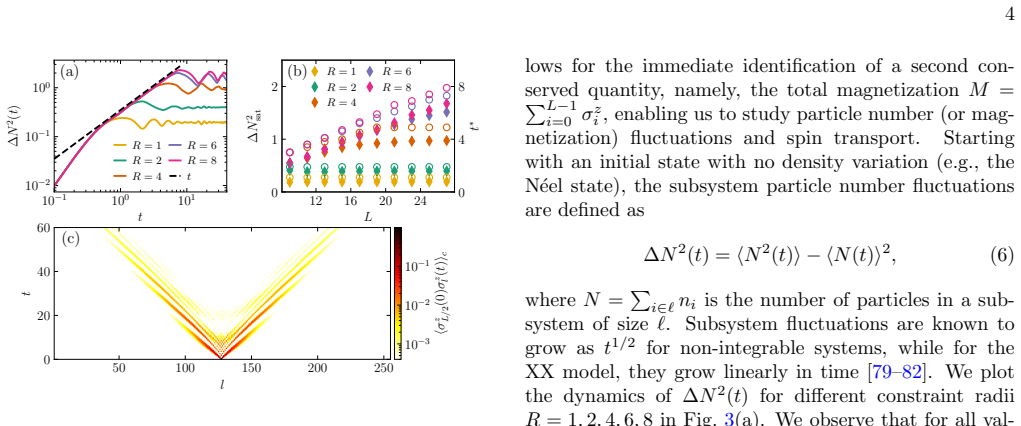
- [End Matter and Fig. 3] The conserved quantity whose transport is studied ('spin' or magnetization) is non-extensive in the QLM: the total magnetization depends only on the boundary electric fields. The paper notes this but the abstract's phrase 'spin transport exhibits ballistic behavior' could mislead, as this is not the usual transport of an extensive charge. The linear growth of subsystem fluctuations before saturation is an unconventional operational definition of ballistic transport; please clarify whether this qualifies as transport in the thermodynamic limit and adjust the presentation to avoid overclaiming.
- [§3, Fig. 2(c)] The ED data in Fig. 2(c) show apparent z=1 for all R, but this is likely a finite-size effect given that the TEBD data for R=2 clearly deviate from ballistic at longer times. The main text states 'we observe clear ballistic transport with z=1 for all constraint radii' without immediately noting the finite-size limitation. Please add a disclaimer in the main text that the ED timescales are too short to distinguish ballistic from superdiffusive behavior.
minor comments (4)
- [§3, text near Fig. 2] The sentence 'Figure 2(b) presents the decay of C_E(t) for L=256...' refers to the wrong panel; it should be Fig. 2(d).
- [Eq. (3)] The notation R for both the constraint radius and the cumulative variable R_j is confusing. Consider using a different symbol, e.g., Q_j or r_j, for the cumulative variable.
- [§2, after Eq. (3)] The phrase 'R=L' is strange since R is a fixed parameter and L is the system size; the limit S→∞ is what recovers the Schwinger model. Please rephrase to avoid a misleading dimensional dependence.
- [Fig. 3(a,b)] The saturation of crossover time and saturation value for R>2 is presented as anomalous. A brief explanation of why finite R imposes a finite maximum magnetization per subsystem would help the reader, as this is central to the spin-transport interpretation.
Circularity Check
No significant circularity: the mapping is a derivation and the transport results are measured from simulations without fitted inputs.
full rationale
The paper's central derivation maps U(1) QLMs to constrained XX models by applying Gauss's law and a Jordan-Wigner transformation (Eqs. (1)-(4)). The constraint variable R_j in Eq. (3) is defined directly from gauge invariance and the spin-S truncation; the constrained Hamiltonian in Eq. (4) follows from this transformation rather than being assumed. No transport exponent is obtained by fitting a parameter and then re-predicting the same quantity: the energy and spin dynamics are computed from exact diagonalization and TEBD correlation functions, which are independent numerical measurements. The paper explicitly flags the main asymptotic uncertainty ('we cannot exclude the possibility that the system may ultimately exhibit diffusion'), which is the opposite of a circular claim: the superdiffusive conclusion is presented as a time-dependent observation, not as an input of the model. The admitted distinction for R>2 between the uniform constrained XX model and the non-uniform matter-integrated QLM matrix elements is a stated limitation on how literally the constrained model represents the gauge theory; it is a validity/scope concern, not a self-referential reduction. Self-citations to prior work (e.g., Refs. [56-58,74,75,88]) are used for context, comparison, or known results such as the PXP duality, and they are not the load-bearing justification for the new transport claims. There is no fitted input renamed as a prediction, no uniqueness theorem imported from the authors, and no ansatz smuggled in via citation. The derivation chain is self-contained with respect to the numerical observables, so the circularity score is 0.
Assumptions & free parameters
assumptions (3)
- domain assumption The TEBD data at times up to ~100 and bond dimension 384 are converged and representative of the asymptotic transport behavior.
- ad hoc to paper For R>2, the transport properties of the full matter-integrated QLM (with non-uniform hopping) match the constrained XX model with uniform hopping.
- domain assumption The fixed edge electric field boundary conditions do not alter bulk transport.
Cite this review
Pith. "Pith review of Anomalously fast transport in non-integrable lattice gauge theories." pith.science (2026). https://pith.science/paper/XK63HJCM
@misc{pith2026250908889,
  author       = {Pith},
  title        = {Pith review of: Anomalously fast transport in non-integrable lattice gauge theories},
  year         = {2026},
  howpublished = {\url{https://pith.science/paper/XK63HJCM}},
  note         = {Machine review of arXiv:2509.08889}
}
read the original abstract
Kinetic constraints are generally expected to slow down dynamics in many-body systems, obstructing or even completely suppressing transport of conserved charges. Here, we show how gauge theories can defy this wisdom by yielding constrained models with faster-than-diffusive dynamics. We first show how, upon integrating out the gauge fields, one-dimensional U(1) lattice gauge theories are exactly mapped onto XX models with non-local constraints. This new class of kinetically constrained models interpolates between free theories and highly constrained local fermionic models. We find that energy transport is superdiffusive over a broad parameter regime. Even more drastically, spin transport exhibits ballistic behavior, albeit with anomalous finite-volume properties as a consequence of gauge invariance. Our findings are relevant to current efforts in quantum simulations of gauge-theory dynamics and anomalous hydrodynamics in closed quantum many-body systems.
Figures


Figures from the paper (1 more)

Forward citations
Cited by 2 Pith papers
-
Finite-temperature crossover from coherent magnons to energy superdiffusion in the PXP model
Finite-temperature energy autocorrelations in the PXP model cross over from single-magnon coherent dynamics at short times to superdiffusive hydrodynamics with z=3/2 at long times.
-
Finite-temperature crossover from coherent magnons to energy superdiffusion in the PXP model
Finite-temperature energy transport in the PXP model exhibits a crossover from single-magnon coherent dynamics to superdiffusive hydrodynamics with activated damping time separating the regimes.
Reference graph
Works this paper leans on
-
[1]
Bertini, M
B. Bertini, M. Collura, J. De Nardis, and M. Fagotti, Transport in out-of-equilibriumXXZchains: Exact profiles of charges and currents, Phys. Rev. Lett.117, 207201 (2016)
2016
-
[2]
Bertini, F
B. Bertini, F. Heidrich-Meisner, C. Karrasch, T. Prosen, R. Steinigeweg, and M. ˇZnidariˇ c, Finite-temperature transport in one-dimensional quantum lattice models, Rev. Mod. Phys.93, 025003 (2021)
2021
-
[3]
O. A. Castro-Alvaredo, B. Doyon, and T. Yoshimura, Emergent hydrodynamics in integrable quantum systems out of equilibrium, Phys. Rev. X6, 041065 (2016)
2016
-
[4]
De Nardis, M
J. De Nardis, M. Medenjak, C. Karrasch, and E. Ilievski, Universality classes of spin transport in one-dimensional isotropic magnets: The onset of logarithmic anomalies, Phys. Rev. Lett.124, 210605 (2020)
2020
-
[5]
De Nardis, S
J. De Nardis, S. Gopalakrishnan, R. Vasseur, and B. Ware, Stability of superdiffusion in nearly integrable spin chains, Phys. Rev. Lett.127, 057201 (2021)
2021
-
[6]
Doyon, J
B. Doyon, J. Dubail, R. Konik, and T. Yoshimura, Large-scale description of interacting one-dimensional bose gases: Generalized hydrodynamics supersedes con- ventional hydrodynamics, Phys. Rev. Lett.119, 195301 (2017)
2017
-
[7]
Doyon, S
B. Doyon, S. Gopalakrishnan, F. Møller, J. Schmied- mayer, and R. Vasseur, Generalized hydrodynamics: A perspective, Phys. Rev. X15, 010501 (2025)
2025
-
[8]
D. A. Abanin, E. Altman, I. Bloch, and M. Serbyn, Col- loquium: Many-body localization, thermalization, and entanglement, Rev. Mod. Phys.91, 021001 (2019)
2019
Show all 88 references
-
[9]
Nandkishore and D
R. Nandkishore and D. A. Huse, Many-body localization and thermalization in quantum statistical mechanics, An- nual Review of Condensed Matter Physics6, 15 (2015)
2015
-
[10]
Polkovnikov, K
A. Polkovnikov, K. Sengupta, A. Silva, and M. Vengalat- tore, Colloquium: Nonequilibrium dynamics of closed in- teracting quantum systems, Rev. Mod. Phys.83, 863 (2011)
2011
-
[11]
ˇZnidariˇ c, Spin transport in a one-dimensional anisotropic Heisenberg model, Phys
M. ˇZnidariˇ c, Spin transport in a one-dimensional anisotropic Heisenberg model, Phys. Rev. Lett.106, 220601 (2011)
2011
-
[12]
Sommer, M
A. Sommer, M. Ku, G. Roati, and M. W. Zwierlein, Uni- versal spin transport in a strongly interacting Fermi gas, Nature472, 201 (2011)
2011
-
[13]
Capizzi, J
L. Capizzi, J. Wang, X. Xu, L. Mazza, and D. Poletti, Hy- drodynamics and the eigenstate thermalization hypothe- sis, Phys. Rev. X15, 011059 (2025)
2025
-
[14]
J. Lux, J. M¨ uller, A. Mitra, and A. Rosch, Hydrodynamic long-time tails after a quantum quench, Phys. Rev. A89, 053608 (2014)
2014
-
[15]
Singh, B
H. Singh, B. A. Ware, R. Vasseur, and A. J. Friedman, Subdiffusion and many-body quantum chaos with kinetic constraints, Phys. Rev. Lett.127, 230602 (2021). 6
2021
-
[16]
Ljubotina, M
M. Ljubotina, M. ˇZnidariˇ c, and T. Prosen, Kardar-Parisi- Zhang physics in the quantum Heisenberg magnet, Phys. Rev. Lett.122, 210602 (2019)
2019
-
[17]
Bar Lev, G
Y. Bar Lev, G. Cohen, and D. R. Reichman, Absence of diffusion in an interacting system of spinless fermions on a one-dimensional disordered lattice, Phys. Rev. Lett. 114, 100601 (2015)
2015
-
[18]
Agarwal, S
K. Agarwal, S. Gopalakrishnan, M. Knap, M. M¨ uller, and E. Demler, Anomalous diffusion and Griffiths effects near the many-body localization transition, Phys. Rev. Lett.114, 160401 (2015)
2015
-
[19]
Bar Lev, D
Y. Bar Lev, D. M. Kennes, C. Kl¨ ockner, D. R. Reich- man, and C. Karrasch, Transport in quasiperiodic in- teracting systems: From superdiffusion to subdiffusion, Europhysics Letters119, 37003 (2017)
2017
-
[20]
Feldmeier, P
J. Feldmeier, P. Sala, G. De Tomasi, F. Pollmann, and M. Knap, Anomalous diffusion in dipole- and higher-moment-conserving systems, Phys. Rev. Lett. 125, 245303 (2020)
2020
-
[21]
Gopalakrishnan and R
S. Gopalakrishnan and R. Vasseur, Kinetic theory of spin diffusion and superdiffusion inXXZspin chains, Phys. Rev. Lett.122, 127202 (2019)
2019
-
[22]
McCarthy, H
C. McCarthy, H. Singh, S. Gopalakrishnan, and R. Vasseur, Subdiffusive transport in the Fredkin dynam- ical universality class, Phys. Rev. B111, 184317 (2025)
2025
-
[23]
Morningstar, V
A. Morningstar, V. Khemani, and D. A. Huse, Kinetically constrained freezing transition in a dipole-conserving sys- tem, Phys. Rev. B101, 214205 (2020)
2020
-
[24]
Moudgalya, A
S. Moudgalya, A. Prem, D. A. Huse, and A. Chan, Spec- tral statistics in constrained many-body quantum chaotic systems, Phys. Rev. Res.3, 023176 (2021)
2021
-
[25]
Gromov, A
A. Gromov, A. Lucas, and R. M. Nandkishore, Fracton hydrodynamics, Phys. Rev. Res.2, 033124 (2020)
2020
-
[26]
Richter and A
J. Richter and A. Pal, Anomalous hydrodynamics in a class of scarred frustration-free Hamiltonians, Phys. Rev. Res.4, L012003 (2022)
2022
-
[27]
Iaconis, A
J. Iaconis, A. Lucas, and R. Nandkishore, Multipole con- servation laws and subdiffusion in any dimension, Phys. Rev. E103, 022142 (2021)
2021
-
[28]
Roy and A
S. Roy and A. Lazarides, Strong ergodicity breaking due to local constraints in a quantum system, Phys. Rev. Res. 2, 023159 (2020)
2020
-
[29]
Y.-P. Wang, J. Ren, S. Gopalakrishnan, and R. Vasseur, Superdiffusive transport in chaotic quantum sys- tems with nodal interactions, arXiv e-prints (2025), arXiv:2501.08381 [cond-mat.stat-mech]
2025
-
[30]
ˇZnidariˇ c, Superdiffusive magnetization transport in the XX spin chain with nonlocal dephasing, Phys
M. ˇZnidariˇ c, Superdiffusive magnetization transport in the XX spin chain with nonlocal dephasing, Phys. Rev. B109, 075105 (2024)
2024
-
[31]
Kogut and L
J. Kogut and L. Susskind, Hamiltonian formulation of Wilson’s lattice gauge theories, Phys. Rev. D11, 395 (1975)
1975
-
[32]
Wiese, Ultracold quantum gases and lattice sys- tems: quantum simulation of lattice gauge theories, An- nalen der Physik525, 777 (2013)
U.-J. Wiese, Ultracold quantum gases and lattice sys- tems: quantum simulation of lattice gauge theories, An- nalen der Physik525, 777 (2013)
2013
-
[33]
Smith, J
A. Smith, J. Knolle, R. Moessner, and D. L. Kovrizhin, Absence of ergodicity without quenched disorder: From quantum disentangled liquids to many-body localization, Phys. Rev. Lett.119, 176601 (2017)
2017
-
[34]
Brenes, M
M. Brenes, M. Dalmonte, M. Heyl, and A. Scardicchio, Many-body localization dynamics from gauge invariance, Phys. Rev. Lett.120, 030601 (2018)
2018
-
[35]
Giudici, F
G. Giudici, F. M. Surace, J. E. Ebot, A. Scardicchio, and M. Dalmonte, Breakdown of ergodicity in disordered U(1) lattice gauge theories, Phys. Rev. Res.2, 032034 (2020)
2020
-
[36]
Karpov, R
P. Karpov, R. Verdel, Y.-P. Huang, M. Schmitt, and M. Heyl, Disorder-free localization in an interacting 2D lattice gauge theory, Phys. Rev. Lett.126, 130401 (2021)
2021
-
[37]
Jeyaretnam, T
J. Jeyaretnam, T. Bhore, J. J. Osborne, J. C. Halimeh, and Z. Papi´ c, Hilbert space fragmentation at the origin of disorder-free localization in the lattice Schwinger model, Communications Physics8, 172 (2025)
2025
-
[38]
E. A. Martinez, C. A. Muschik, P. Schindler, D. Nigg, A. Erhard, M. Heyl, P. Hauke, M. Dalmonte, T. Monz, P. Zoller, and R. Blatt, Real-time dynamics of lattice gauge theories with a few-qubit quantum computer, Na- ture534, 516 (2016)
2016
-
[39]
Bernien, S
H. Bernien, S. Schwartz, A. Keesling, H. Levine, A. Om- ran, H. Pichler, S. Choi, A. S. Zibrov, M. Endres, M. Greiner, V. Vuleti´ c, and M. D. Lukin, Probing many- body dynamics on a 51-atom quantum simulator, Nature 551, 579 (2017)
2017
-
[40]
Zhou, G.-X
Z.-Y. Zhou, G.-X. Su, J. C. Halimeh, R. Ott, H. Sun, P. Hauke, B. Yang, Z.-S. Yuan, J. Berges, and J.-W. Pan, Thermalization dynamics of a gauge theory on a quantum simulator, Science377, 311 (2022)
2022
-
[41]
R. C. Farrell, M. Illa, A. N. Ciavarella, and M. J. Sav- age, Quantum simulations of hadron dynamics in the Schwinger model using 112 qubits, Phys. Rev. D109, 114510 (2024)
2024
-
[42]
Gonz´ alez-Cuadra, M
D. Gonz´ alez-Cuadra, M. Hamdan, T. V. Zache, B. Braverman, M. Kornjaˇ ca, A. Lukin, S. H. Cant´ u, F. Liu, S.-T. Wang, A. Keesling, M. D. Lukin, P. Zoller, and A. Bylinskii, Observation of string breaking on a (2 + 1)D Rydberg quantum simulator, Nature642, 321 (2025)
2025
-
[43]
Z.-H. Zhu, Y. Liu, G. Lagnese, F. M. Surace, W.- Y. Zhang, M.-G. He, J. C. Halimeh, M. Dalmonte, S. C. Morampudi, F. Wilczek, Z.-S. Yuan, and J.- W. Pan, Probing false vacuum decay on a cold-atom gauge-theory quantum simulator, arXiv e-prints (2024), arXiv:2411.12565 [cond-mat...
2024 arXiv
-
[44]
Xiang, P
D.-S. Xiang, P. Zhou, C. Liu, H.-X. Liu, Y.-W. Zhang, D. Yuan, K. Zhang, B. Xu, M. Dalmonte, D.-L. Deng, and L. Li, Real-time scattering and freeze-out dynam- ics in Rydberg-atom lattice gauge theory, arXiv e-prints (2025), arXiv:2508.06639 [cond-mat.quant-gas]
2025 arXiv
-
[45]
Schuhmacher, G.-X
J. Schuhmacher, G.-X. Su, J. J. Osborne, A. Gandon, J. C. Halimeh, and I. Tavernelli, Observation of hadron scattering in a lattice gauge theory on a quantum com- puter, arXiv e-prints (2025), arXiv:2505.20387 [quant- ph]
2025 arXiv
-
[46]
R. C. Farrell, M. Illa, A. N. Ciavarella, and M. J. Savage, Scalable circuits for preparing ground states on digital quantum computers: The Schwinger model vacuum on 100 qubits, PRX Quantum5, 020315 (2024)
2024
-
[47]
Dalmonte and S
M. Dalmonte and S. Montangero, Lattice gauge theory simulations in the quantum information era, Contempo- rary Physics57, 388 (2016)
2016
-
[48]
Horn, Finite matrix models with continuous local gauge invariance, Physics Letters B100, 149 (1981)
D. Horn, Finite matrix models with continuous local gauge invariance, Physics Letters B100, 149 (1981)
1981
-
[49]
Orland and D
P. Orland and D. Rohrlich, Lattice gauge magnets: Local isospin from spin, Nuclear Physics B338, 647 (1990)
1990
-
[50]
Chandrasekharan and U.-J
S. Chandrasekharan and U.-J. Wiese, Quantum link models: A discrete approach to gauge theories, Nuclear Physics B492, 455 (1997)
1997
-
[51]
Banerjee, M
D. Banerjee, M. Dalmonte, M. M¨ uller, E. Rico, P. Ste- 7 bler, U.-J. Wiese, and P. Zoller, Atomic quantum simula- tion of dynamical gauge fields coupled to fermionic mat- ter: From string breaking to evolution after a quench, Phys. Rev. Lett.109, 175302 (2012)
2012
-
[52]
Di Meglio, K
A. Di Meglio, K. Jansen, I. Tavernelli, C. Alexandrou, S. Arunachalam, C. W. Bauer, K. Borras, S. Carrazza, A. Crippa, V. Croft, R. de Putter, A. Delgado, V. Dun- jko, D. J. Egger, E. Fern´ andez-Combarro, E. Fuchs, L. Funcke, D. Gonz´ alez-Cuadra, M. Grossi, J. C. Hal- imeh, ...
2024
-
[53]
Pichler, M
T. Pichler, M. Dalmonte, E. Rico, P. Zoller, and S. Mon- tangero, Real-time dynamics in U(1) lattice gauge theo- ries with tensor networks, Phys. Rev. X6, 011023 (2016)
2016
-
[54]
M. C. Ba˜ nuls, R. Blatt, J. Catani, A. Celi, J. I. Cirac, M. Dalmonte, L. Fallani, K. Jansen, M. Lewenstein, S. Montangero, C. A. Muschik, B. Reznik, E. Rico, L. Tagliacozzo, K. Van Acoleyen, F. Verstraete, U.-J. Wiese, M. Wingate, J. Zakrzewski, and P. Zoller, Sim- ulating l...
2020
-
[55]
C. W. Bauer, Z. Davoudi, A. B. Balantekin, T. Bhat- tacharya, M. Carena, W. A. de Jong, P. Draper, A. El-Khadra, N. Gemelke, M. Hanada, D. Kharzeev, H. Lamm, Y.-Y. Li, J. Liu, M. Lukin, Y. Meurice, C. Monroe, B. Nachman, G. Pagano, J. Preskill, E. Ri- naldi, A. Roggero, D. I. ...
2023
-
[56]
F. M. Surace, P. P. Mazza, G. Giudici, A. Lerose, A. Gambassi, and M. Dalmonte, Lattice gauge theories and string dynamics in Rydberg atom quantum simula- tors, Phys. Rev. X10, 021041 (2020)
2020
-
[57]
Desaules, A
J.-Y. Desaules, A. Hudomal, D. Banerjee, A. Sen, Z. Papi´ c, and J. C. Halimeh, Prominent quantum many- body scars in a truncated Schwinger model, Phys. Rev. B107, 205112 (2023)
2023
-
[58]
Desaules, D
J.-Y. Desaules, D. Banerjee, A. Hudomal, Z. Papi´ c, A. Sen, and J. C. Halimeh, Weak ergodicity breaking in the Schwinger model, Phys. Rev. B107, L201105 (2023)
2023
-
[59]
Jordan and E
P. Jordan and E. Wigner, ¨Uber das Paulische ¨Aquivalen- zverbot, Zeitschrift f¨ ur Physik47, 631 (1928)
1928
-
[60]
For a finite massm, the constrained XX model gets an additional staggered longitudinal field term
-
[61]
If the labeling of lattice sites starts from an odd number, then for oddLthe constrained XX model is defined in the sector with total magnetizationM= 1 due to the convention for staggered fermions used in this work
-
[62]
C. J. Hamer, Z. Weihong, and J. Oitmaa, Series expan- sions for the massive Schwinger model in Hamiltonian lattice theory, Phys. Rev. D56, 55 (1997)
1997
-
[63]
Muschik, M
C. Muschik, M. Heyl, E. Martinez, T. Monz, P. Schindler, B. Vogell, M. Dalmonte, P. Hauke, R. Blatt, and P. Zoller, U(1) Wilson lattice gauge theories in digital quantum simulators, New Journal of Physics19, 103020 (2017)
2017
-
[64]
Fendley, K
P. Fendley, K. Sengupta, and S. Sachdev, Competing density-wave orders in a one-dimensional hard-boson model, Phys. Rev. B69, 075106 (2004)
2004
-
[65]
C. J. Turner, A. A. Michailidis, D. A. Abanin, M. Serbyn, and Z. Papi´ c, Weak ergodicity breaking from quantum many-body scars, Nature Physics14, 745 (2018)
2018
-
[66]
Lesanovsky and H
I. Lesanovsky and H. Katsura, Interacting Fibonacci anyons in a Rydberg gas, Phys. Rev. A86, 041601(R) (2012)
2012
-
[67]
Y. Y. Atas, E. Bogomolny, O. Giraud, and G. Roux, Distribution of the ratio of consecutive level spacings in random matrix ensembles, Phys. Rev. Lett.110, 084101 (2013)
2013
-
[68]
Haake,Quantum signatures of chaos, 3rd ed., Springer Series in Synergetics, Vol
F. Haake,Quantum signatures of chaos, 3rd ed., Springer Series in Synergetics, Vol. 54 (Springer Berlin, Heidel- berg, Germany, 2010)
2010
-
[69]
M. L. Mehta,Random matrices, 3rd ed., Pure and Ap- plied Mathematics, Vol. 142 (Elsevier B.V., Amsterdam, Netherlands, 2004)
2004
-
[70]
D. N. Page, Average entropy of a subsystem, Phys. Rev. Lett.71, 1291 (1993)
1993
-
[71]
T. A. Elsayed and B. V. Fine, Regression relation for pure quantum states and its implications for efficient comput- ing, Phys. Rev. Lett.110, 070404 (2013)
2013
-
[72]
Bartsch and J
C. Bartsch and J. Gemmer, Dynamical typicality of quantum expectation values, Phys. Rev. Lett.102, 110403 (2009)
2009
-
[73]
Steinigeweg, J
R. Steinigeweg, J. Gemmer, and W. Brenig, Spin- current autocorrelations from single pure-state propaga- tion, Phys. Rev. Lett.112, 120601 (2014)
2014
-
[74]
Ljubotina, J.-Y
M. Ljubotina, J.-Y. Desaules, M. Serbyn, and Z. Papi´ c, Superdiffusive energy transport in kinetically constrained models, Phys. Rev. X13, 011033 (2023)
2023
-
[75]
Y.-P. Wang, C. Fang, and J. Ren, Superdiffusive trans- port in quasi-particle dephasing models, SciPost Phys. 17, 150 (2024)
2024
-
[76]
Schollw¨ ock, The density-matrix renormalization group in the age of matrix product states, Annals of Physics 326, 96 (2011), January 2011 Special Issue
U. Schollw¨ ock, The density-matrix renormalization group in the age of matrix product states, Annals of Physics 326, 96 (2011), January 2011 Special Issue
2011
-
[77]
Xiang,Density Matrix and Tensor Network Renormal- ization(Cambridge University Press, Cambridge, United Kingdom, 2023)
T. Xiang,Density Matrix and Tensor Network Renormal- ization(Cambridge University Press, Cambridge, United Kingdom, 2023)
2023
-
[78]
Collura, G
M. Collura, G. Lami, N. Ranabhat, and A. Santini, Tensor Network Techniques for Quantum Computation (SISSA Medialab Srl, 2024)
2024
-
[79]
J. F. Wienand, S. Karch, A. Impertro, C. Schweizer, E. McCulloch, R. Vasseur, S. Gopalakrishnan, M. Aidels- burger, and I. Bloch, Emergence of fluctuating hydrody- namics in chaotic quantum systems, Nature Physics20, 1732 (2024)
2024
-
[80]
Fujimoto, R
K. Fujimoto, R. Hamazaki, and Y. Kawaguchi, Dynam- ical scaling of surface roughness and entanglement en- tropy in disordered fermion models, Phys. Rev. Lett.127, 090601 (2021)
2021
-
[81]
D. S. Bhakuni and Y. B. Lev, Dynamic scaling relation in quantum many-body systems, Phys. Rev. B110, 014203 (2024)
2024
-
[82]
Fujimoto and T
K. Fujimoto and T. Sasamoto, Exact solution of bipar- tite fluctuations in one-dimensional fermions, Phys. Rev. Lett.134, 067101 (2025)
2025
-
[83]
Brenes, E
M. Brenes, E. Mascarenhas, M. Rigol, and J. Goold, High-temperature coherent transport in the XXZ chain in the presence of an impurity, Phys. Rev. B98, 235128 8 (2018)
2018
-
[84]
Brenes, T
M. Brenes, T. LeBlond, J. Goold, and M. Rigol, Eigen- state thermalization in a locally perturbed integrable sys- tem, Phys. Rev. Lett.125, 070605 (2020)
2020
-
[85]
ˇZnidariˇ c, Weak integrability breaking: Chaos with integrability signature in coherent diffusion, Phys
M. ˇZnidariˇ c, Weak integrability breaking: Chaos with integrability signature in coherent diffusion, Phys. Rev. Lett.125, 180605 (2020)
2020
-
[86]
Osborne, B
J. Osborne, B. Yang, I. P. McCulloch, P. Hauke, and J. C. Halimeh, Spin-SU(1) quantum link models with dynamical matter on a quantum simulator, arXiv e-prints (2023), arXiv:2305.06368 [cond-mat.quant-gas]
2023 arXiv
-
[87]
Fishman, S
M. Fishman, S. R. White, and E. M. Stoudenmire, The ITensor Software Library for Tensor Network Calcula- tions, SciPost Phys. Codebases , 4 (2022)
2022
-
[88]
W. W. Ho, S. Choi, H. Pichler, and M. D. Lukin, Pe- riodic orbits, entanglement, and quantum many-body scars in constrained models: Matrix product state ap- proach, Phys. Rev. Lett.122, 040603 (2019). 9 END MA TTER Tensor network simulations—For the tensor network simulations,...
2019
Reviewed August 4, 2026 · model on record in the stance chip above.
Discussion (0). Sign in to comment.