REVIEW 4 major objections 6 minor 44 references
Info-Coevolution: An Efficient Framework for Data Model Coevolution
T0 review · 4 major / 6 minor · reviewed 2026-08-07 · deepseek-v4-flash
Pith's one-line read A selective-annotation framework that fuses model and neighbor predictions cuts ImageNet labeling cost by 32% with no accuracy loss and sets its own stopping ratio.
desk verdict The selective annotation method is a real step forward, but the automatic stopping claim is unverifiable as written and needs a specified rule and seeded runs before I'd trust the 68% figure. read the letter →
The pith
A machine-rendered reading of the paper's core claim, the machinery that carries it, and where it could break.
The reading
What carries the argument
The load-bearing object is a Bayesian Prediction Fusion of two views of a sample: the model's softmax prediction and a data-based prediction computed by confidence-weighted interpolation over the sample's nearest neighbors in feature space (Eq.4). The two views are merged via Bayesian formulas (Eqs.5-6) that update a confidence value α, and the annotation gain of a candidate is the difference between the annotator's confidence and the fused confidence. This gain drives batch selection, a dynamic-rechecking step that updates gains of neighbors after each annotation, and the automatic stopping criterion. The framework is built on a locality theorem (Theorem 3.1) asserting that nearby features yield nearby predictions, which the paper uses to justify interpolation.
What would settle it
On a small benchmark such as CIFAR-10, train a model on a 1% subset, use Eq.(4) to estimate the annotation gain of every remaining sample, and measure the rank correlation between the estimated gain and the actual accuracy improvement of adding each sample individually to the training set; if the correlation is not significantly positive, the locality/interpolation assumption that carries the method is falsified.
Extended reading notes
Core claim
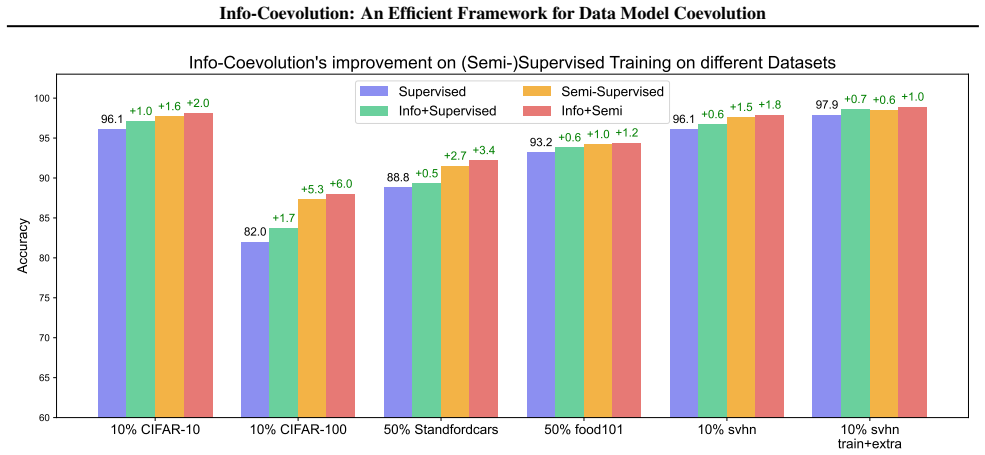
The paper proposes Info-Coevolution, an online selective-annotation framework that fuses a model's prediction with a 'data view' derived from nearby already-annotated samples to estimate each candidate sample's information gain, then annotates the batch with the highest gain and dynamically rechecks neighbors. Its central empirical claim is that on ImageNet-1K this selection reaches full-data accuracy with 68% of the labels under continual supervised training, and that the same gain estimation provides an automatic stopping rule (the algorithm stops when marginal gains plateau, yielding the 68% ratio itself). It also claims compatibility with semi-supervised learning (50% labels, near-lossless) and that retrieved unlabeled web data selected by the method matches the benefit of using all such data at half the volume.
Load-bearing premise
The method assumes that within a small feature-space distance, prediction vectors of neighboring samples can be interpolated and combined to give a valid estimate of a new sample's information gain, and the paper's proof establishes only that nearby features produce nearby predictions, not that such interpolation correctly estimates entropy reduction.
Editorial extensions
If this is right
- If the ImageNet claim holds, large-scale supervised dataset construction can cut labeling cost by roughly one third with no accuracy loss, and the saving ratio is discovered automatically rather than tuned.
- The automatic stopping rule removes the need to annotate a holdout set to verify saturation, so data-collection pipelines can stop exactly when marginal information is exhausted.
- Compatibility with semi-supervised training means the framework can double as a labeled-data selection front-end for SSL methods, reducing the labeled budget to 50% with near-lossless performance.
- As an online method with ANN-based retrieval, it can be applied to continuously growing data streams, unlike batch active-learning pipelines that retrain and re-infer between rounds.
- Retrieval-based dataset enhancement with unlabeled open-source data means the method can also curate web data for downstream tasks, not just decide which in-domain samples to label.
Reading between the lines
- Editorial inference: the locality assumption suggests the method will be most effective on feature spaces that are smooth and well-behaved; tasks where decision boundaries are locally non-linear (e.g., fine-grained recognition with subtle distinctions) may see estimated gains diverge from true annotation value.
- Editorial inference: the Bayesian fusion formulas assume independent predictors, but the model and KNN predictions are correlated since the model generates the features; if so, fused confidence may be overconfident and the reported saving ratios could partly reflect confidence calibration rather than pure information gain.
- Editorial inference: the automatic stop rule is a direct consequence of the gain estimate; if the estimate is biased low late in training, stopping could occur before full-data performance is reached on other datasets, so users should validate the rule on a small held-out set unless the correlation between estimated and true gain is established.
- Editorial inference: the framework's value could be tested as a drop-in module for language or multimodal data streams, where the same feature-space locality argument is plausible but unverified.
Editorial analysis
A structured set of objections, weighed in public.
Referee Report
Summary. This paper proposes Info-Coevolution, an online selective-annotation framework. It estimates a sample's information gain by combining a model's prediction with a KNN data-view prediction via Bayesian fusion (Eqs. 4-6), rechecks neighbors dynamically after annotation, and uses the estimated gain both for prioritized selection and for automatic stopping. On ImageNet-1K the authors report lossless accuracy (85.6%) with 68% of labels under continual supervised training and 85.5% with 50% labels under Semi-ViT; on CIFAR-10 with FixMatch they report 95.85% with 1000 labels. They also explore retrieval-based enhancement with unlabeled web data and report a 1M-sample selected subset matching the performance of a 2M-sample random subset.
Significance. If the claims hold, the framework would be a practically valuable contribution: it offers annotation savings at scale, low selection overhead via approximate nearest-neighbor search, compatibility with semi-supervised learning, and a selection signal that is not purely model-uncertainty based. The public code release and the use of large-scale benchmarks are strengths. However, the strongest claim---automatic stopping without tuning---is currently under-specified, and the theoretical grounding for the fusion and interpolation steps is thinner than the paper suggests. The experimental core (ImageNet at 68%, CIFAR-10 at 1000 labels) supports the potential of the selection heuristic but does not yet verify the auto-stopping mechanism.
major comments (4)
- [§3.5, §4.2] The central claim of an automatic, tuning-free saving ratio is not verifiable as written. Section 3.5 defines annotation gain as cann - cmerged but neither the value of cann nor the stopping condition is specified; Section 4.2 states only that an 'automatic stop criterion' triggers when the 'marginal gain of annotating more samples is negligible' and that the 68% ratio is 'given by the algorithm itself.' Without the stopping rule (e.g., gain ≤ 0 versus gain ≤ ε for some ε), the reported 68% cannot be distinguished from a post hoc threshold choice. Please specify the stopping criterion, the cann value used, and an analysis showing that the reported ratio is insensitive to any remaining free parameter.
- [§3.3, Eq. (5)] Equation (5) assumes two independent predictors with confidences α1 and α2. The model view and the KNN data view are not independent: the model is trained on samples that overlap or correlate with the KNN neighbors, and both views are computed from the same feature representation. This likely makes cmerged overconfident, which would make cann - cmerged non-positive earlier than it should and could produce an artificially low stopping ratio. Please justify the independence assumption or provide an empirical calibration check (e.g., compare fused confidence with actual accuracy on a hold-out set).
- [§3.1, Theorem 3.1] Theorem 3.1 establishes only Lipschitz continuity of the classifier, i.e., that nearby features yield nearby predictions. The paper then states that 'this theorem implies a kind of linearity' and uses Eq. (4) to interpolate and combine logits/predictions inside an epsilon-neighborhood. Continuity does not imply that interpolation of prediction vectors or the confidence-weighted KNN fusion estimates the entropy reduction H(x) - H(x|z). This is an additional assumption that underpins both the selection scores and the stopping signal. Please either prove a stronger statement, validate the interpolation empirically, or explicitly mark Eq. (4) as a heuristic with a sensitivity study.
- [§4.2, Tables 1 and 3] The lossless-performance claim rests on single runs without error bars or multiple seeds. The ImageNet result (85.6% at 68% labels versus 85.6% full) and the CIFAR10 FixMatch result (95.85% with 1000 labels versus 95.85% full) are consistent with the claim, but a single run cannot establish 'lossless' on noisy deep-learning training. Additionally, the paper motivates the framework by the limitations of active learning but reports no comparison against standard active-learning baselines (e.g., uncertainty sampling, BADGE, core-set). Please add variance estimates and at least one active-learning comparison on CIFAR-10 or ImageNet to substantiate the efficiency claim.
minor comments (6)
- [Table 3] The method name appears as 'Info-Evolution' in the first row of Table 3; this should be 'Info-Coevolution'.
- [§3.2, Eq. (4)] The notation yx is described as 'the probability prediction vector of x's annotation' and Sim(x,z) is not defined; please define both and state whether Sim is cosine similarity after feature normalization.
- [§3.5] The batch sampling procedure is described only as 'sample with probability proportional to the gain and drop redundant samples'; the redundancy-dropping rule is not specified and is needed for reproducibility.
- [§3.6] The cosine retrieval threshold of 0.2 is stated without justification or sensitivity analysis; please report how this threshold was chosen and whether the results are sensitive to it.
- [§4.1, Appendix B] The implementation details defer to the appendix, but the appendix gives only training hyperparameters; HNSW parameters, the number of neighbors k, the distance threshold epsilon, and the model-update schedule used in Fig. 8 are missing.
- [§3.4, Eq. (7)] The notation H(αann) in Eq. (7) is inconsistent with the later use of cann; please clarify the relationship between confidence and entropy in this formula.
Circularity Check
No significant circularity: the selection-gain estimator is an explicit proxy validated against external ImageNet accuracy, and the self-citations are non-load-bearing implementation details.
full rationale
We walked the derivation chain and found no step that reduces to its own inputs by construction. The core sample-selection score is an explicit proxy: Eq. (2)-(4) estimate information gain from locality and confidence-weighted nearest-neighbor interpolation, Eq. (5)-(6) are Bayesian fusion formulas derived from an explicit independence assumption, and Eq. (7) defines annotation gain via a difference of confidences. None of these identities uses the target result (e.g., ImageNet accuracy at 68% annotation) as an input; the lossless claim is established by external benchmarking in Tab. 1 and Fig. 5, not read off from the gain estimator. The self-citations in the paper (Qin et al., 2024 for ANN de-redundancy in the superset construction; Zhou et al., 2023 as a coreset baseline) are implementation details or comparison baselines, not load-bearing premises that force the central claim. The 'automatic saving ratio without tuning' statement is under-specified: the paper does not state the stopping threshold (epsilon for 'negligible' gain) or the exact value of cann in Section 3.5, which is a reproducibility/correctness concern rather than a circular reduction. The independence assumption behind Eq. (5) is an explicit modeling assumption, and the appendix's Lipschitz proof supports only a similarity guarantee, not the full logit-interpolation claim; both are potential validity weaknesses, not circularity. No fitted parameter is renamed as a prediction, and no cited uniqueness theorem is imported from the authors' prior work. Therefore the appropriate finding is no significant circularity.
Assumptions & free parameters
free parameters (5)
- distance threshold epsilon =
not specified
- number of neighbors k =
not specified
- annotator confidence cann =
not specified (assumed known)
- cosine retrieval threshold =
0.2
- stopping threshold =
not specified
assumptions (5)
- standard math The classifier g is Lg-Lipschitz on the feature space and softmax is 1-Lipschitz.
- ad hoc to paper Within an epsilon-neighborhood in feature space, linearity holds enough that prediction vectors can be interpolated and combined via Eq.(4).
- domain assumption The model-view and data-view predictors are independent in the Bayesian fusion of Section 3.3.
- domain assumption The target distribution rho is uniform or IID to training data in Eq.(2)-(3).
- domain assumption The matching distribution over wrong labels is uniform over c-1 classes when deriving lower bounds in Section 3.3.
Cite this review
Pith. "Pith review of Info-Coevolution: An Efficient Framework for Data Model Coevolution." pith.science (2026). https://pith.science/paper/XKB4YQTE
@misc{pith2026250608070,
  author       = {Pith},
  title        = {Pith review of: Info-Coevolution: An Efficient Framework for Data Model Coevolution},
  year         = {2026},
  howpublished = {\url{https://pith.science/paper/XKB4YQTE}},
  note         = {Machine review of arXiv:2506.08070}
}
read the original abstract
Machine learning relies heavily on data, yet the continuous growth of real-world data poses challenges for efficient dataset construction and training. A fundamental yet unsolved question is: given our current model and data, does a new data (sample/batch) need annotation/learning? Conventional approaches retain all available data, leading to non-optimal data and training efficiency. Active learning aims to reduce data redundancy by selecting a subset of samples to annotate, while it increases pipeline complexity and introduces bias. In this work, we propose Info-Coevolution, a novel framework that efficiently enables models and data to coevolve through online selective annotation with no bias. Leveraging task-specific models (and open-source models), it selectively annotates and integrates online and web data to improve datasets efficiently. For real-world datasets like ImageNet-1K, Info-Coevolution reduces annotation and training costs by 32\% without performance loss. It is able to automatically give the saving ratio without tuning the ratio. It can further reduce the annotation ratio to 50\% with semi-supervised learning. We also explore retrieval-based dataset enhancement using unlabeled open-source data. Code is available at https://github.com/NUS-HPC-AI-Lab/Info-Coevolution/.
Figures


Figures from the paper (4 more)



Reference graph
Works this paper leans on
-
[1]
write newline
" write newline "" before.all 'output.state := FUNCTION n.dashify 't := "" t empty not t #1 #1 substring "-" = t #1 #2 substring "--" = not "--" * t #2 global.max substring 't := t #1 #1 substring "-" = "-" * t #2 global.max substring 't := while if t #1 #1 substring * t #2 global.max substring 't := if while FUNCTION format.date year duplicate empty "emp...
-
[2]
Food-101 -- mining discriminative components with random forests
Bossard, L., Guillaumin, M., and Van Gool, L. Food-101 -- mining discriminative components with random forests. In Fleet, D., Pajdla, T., Schiele, B., and Tuytelaars, T. (eds.), Computer Vision -- ECCV 2014, pp.\ 446--461, Cham, 2014. Springer International Publishing. ISBN 978-3-319-10599-4
work page 2014
-
[3]
Brown, T. B., Mann, B., Ryder, N., Subbiah, M., Kaplan, J., Dhariwal, P., Neelakantan, A., Shyam, P., Sastry, G., Askell, A., Agarwal, S., Herbert-Voss, A., Krueger, G., Henighan, T., Child, R., Ramesh, A., Ziegler, D. M., Wu, J., Winter, C., Hesse, C., Chen, M., Sigler, E., Litwin, M., Gray, S., Chess, B., Clark, J., Berner, C., McCandlish, S., Radford, ...
arXiv 2020
-
[4]
Semi-supervised vision transformers at scale, 2022
Cai, Z., Ravichandran, A., Favaro, P., Wang, M., Modolo, D., Bhotika, R., Tu, Z., and Soatto, S. Semi-supervised vision transformers at scale, 2022. URL https://arxiv.org/abs/2208.05688
arXiv 2022
-
[5]
Changpinyo, S., Sharma, P., Ding, N., and Soricut, R. Conceptual 12m: Pushing web-scale image-text pre-training to recognize long-tail visual concepts, 2021. URL https://arxiv.org/abs/2102.08981
arXiv 2021
-
[6]
Chen, X., Fang, H., Lin, T.-Y., Vedantam, R., Gupta, S., Dollar, P., and Zitnick, C. L. Microsoft coco captions: Data collection and evaluation server, 2015. URL https://arxiv.org/abs/1504.00325
arXiv 2015
-
[7]
Selection via proxy: Efficient data selection for deep learning
Coleman, C., Yeh, C., Mussmann, S., Mirzasoleiman, B., Bailis, P., Liang, P., Leskovec, J., and Zaharia, M. Selection via proxy: Efficient data selection for deep learning. arXiv preprint arXiv:1906.11829, 2019
arXiv 1906
-
[8]
Imagenet: A large-scale hierarchical image database
Deng, J., Dong, W., Socher, R., Li, L.-J., Li, K., and Fei-Fei, L. Imagenet: A large-scale hierarchical image database. In 2009 IEEE Conference on Computer Vision and Pattern Recognition, pp.\ 248--255, 2009. doi:10.1109/CVPR.2009.5206848
arXiv 2009
Show all 44 references
-
[9]
The mnist database of handwritten digit images for machine learning research [best of the web]
Deng, L. The mnist database of handwritten digit images for machine learning research [best of the web]. IEEE Signal Processing Magazine, 29 0 (6): 0 141--142, 2012. doi:10.1109/MSP.2012.2211477
2012
-
[10]
Bert: Pre-training of deep bidirectional transformers for language understanding, 2019
Devlin, J., Chang, M.-W., Lee, K., and Toutanova, K. Bert: Pre-training of deep bidirectional transformers for language understanding, 2019. URL https://arxiv.org/abs/1810.04805
2019 arXiv
-
[11]
An image is worth 16x16 words: Transformers for image recognition at scale, 2021
Dosovitskiy, A., Beyer, L., Kolesnikov, A., Weissenborn, D., Zhai, X., Unterthiner, T., Dehghani, M., Minderer, M., Heigold, G., Gelly, S., Uszkoreit, J., and Houlsby, N. An image is worth 16x16 words: Transformers for image recognition at scale, 2021. URL https://arxiv.org/ab...
2021 arXiv
-
[12]
and Precioso, F
Ducoffe, M. and Precioso, F. Adversarial active learning for deep networks: a margin based approach. arXiv preprint arXiv:1802.09841, 2018
2018 arXiv
-
[13]
Deepcore: A comprehensive library for coreset selection in deep learning, 2022
Guo, C., Zhao, B., and Bai, Y. Deepcore: A comprehensive library for coreset selection in deep learning, 2022. URL https://arxiv.org/abs/2204.08499
2022 arXiv
-
[14]
Masked autoencoders are scalable vision learners, 2021
He, K., Chen, X., Xie, S., Li, Y., Dollár, P., and Girshick, R. Masked autoencoders are scalable vision learners, 2021. URL https://arxiv.org/abs/2111.06377
2021 arXiv
-
[15]
Active learning: Problem settings and recent developments
Hino, H. Active learning: Problem settings and recent developments. CoRR, abs/2012.04225, 2020. URL https://arxiv.org/abs/2012.04225
2012 arXiv
-
[16]
Submodular combinatorial information measures with applications in machine learning
Iyer, R., Khargoankar, N., Bilmes, J., and Asanani, H. Submodular combinatorial information measures with applications in machine learning. In Algorithmic Learning Theory, pp.\ 722--754. PMLR, 2021
2021
-
[17]
Grad-match: Gradient matching based data subset selection for efficient deep model training
Killamsetty, K., Durga, S., Ramakrishnan, G., De, A., and Iyer, R. Grad-match: Gradient matching based data subset selection for efficient deep model training. In International Conference on Machine Learning, pp.\ 5464--5474. PMLR, 2021 a
2021
-
[18]
Glister: Generalization based data subset selection for efficient and robust learning
Killamsetty, K., Sivasubramanian, D., Ramakrishnan, G., and Iyer, R. Glister: Generalization based data subset selection for efficient and robust learning. In Proceedings of the AAAI Conference on Artificial Intelligence, volume 35-9, pp.\ 8110--8118, 2021 b
2021
-
[19]
C., Lo, W.-Y., Dollár, P., and Girshick, R
Kirillov, A., Mintun, E., Ravi, N., Mao, H., Rolland, C., Gustafson, L., Xiao, T., Whitehead, S., Berg, A. C., Lo, W.-Y., Dollár, P., and Girshick, R. Segment anything, 2023. URL https://arxiv.org/abs/2304.02643
2023 arXiv
-
[20]
A., Bernstein, M
Krishna, R., Zhu, Y., Groth, O., Johnson, J., Hata, K., Kravitz, J., Chen, S., Kalantidis, Y., Li, L.-J., Shamma, D. A., Bernstein, M. S., and Li, F.-F. Visual genome: Connecting language and vision using crowdsourced dense image annotations, 2016. URL https://arxiv.org/abs/1602.07332
2016 arXiv
-
[21]
Cifar-10 (canadian institute for advanced research)
Krizhevsky, A., Nair, V., and Hinton, G. Cifar-10 (canadian institute for advanced research). a . URL http://www.cs.toronto.edu/ kriz/cifar.html
-
[22]
Cifar-100 (canadian institute for advanced research)
Krizhevsky, A., Nair, V., and Hinton, G. Cifar-100 (canadian institute for advanced research). b . URL http://www.cs.toronto.edu/ kriz/cifar.html
-
[23]
A survey on deep active learning: Recent advances and new frontiers, 2024
Li, D., Wang, Z., Chen, Y., Jiang, R., Ding, W., and Okumura, M. A survey on deep active learning: Recent advances and new frontiers, 2024. URL https://arxiv.org/abs/2405.00334
2024 arXiv
-
[24]
BLIP : Bootstrapping language-image pre-training for unified vision-language understanding and generation
Li, J., Li, D., Xiong, C., and Hoi, S. BLIP : Bootstrapping language-image pre-training for unified vision-language understanding and generation. In Chaudhuri, K., Jegelka, S., Song, L., Szepesvari, C., Niu, G., and Sabato, S. (eds.), Proceedings of the 39th International Conf...
2022
-
[25]
Malkov, Y. A. and Yashunin, D. A. Efficient and robust approximate nearest neighbor search using hierarchical navigable small world graphs, 2018. URL https://arxiv.org/abs/1603.09320
2018 arXiv
-
[26]
Active learning by acquiring contrastive examples
Margatina, K., Vernikos, G., Barrault, L., and Aletras, N. Active learning by acquiring contrastive examples. arXiv preprint arXiv:2109.03764, 2021
2021 arXiv
-
[27]
Coresets for data-efficient training of machine learning models
Mirzasoleiman, B., Bilmes, J., and Leskovec, J. Coresets for data-efficient training of machine learning models. In International Conference on Machine Learning, pp.\ 6950--6960. PMLR, 2020
2020
-
[28]
Netzer, Y., Wang, T., Coates, A., Bissacco, A., Wu, B., and Ng, A. Y. Reading digits in natural images with unsupervised feature learning. In NIPS Workshop on Deep Learning and Unsupervised Feature Learning 2011, 2011. URL http://ufldl.stanford.edu/housenumbers/nips2011_housen...
2011
-
[29]
Im2text: Describing images using 1 million captioned photographs
Ordonez, V., Kulkarni, G., and Berg, T. Im2text: Describing images using 1 million captioned photographs. In Shawe-Taylor, J., Zemel, R., Bartlett, P., Pereira, F., and Weinberger, K. (eds.), Advances in Neural Information Processing Systems, volume 24. Curran Associates, Inc....
2011
-
[30]
Paul, M., Ganguli, S., and Dziugaite, G. K. Deep learning on a data diet: Finding important examples early in training. Advances in neural information processing systems, 34: 0 20596--20607, 2021
2021
-
[31]
Dataset growth
Qin, Z., Xu, Z., Zhou, Y., Zheng, Z., Cheng, Z., Tang, H., Shang, L., Sun, B., Peng, X., Timofte, R., Yao, H., Wang, K., and You, Y. Dataset growth. In Computer Vision – ECCV 2024: 18th European Conference, Milan, Italy, September 29–October 4, 2024, Proceedings, Part IX, pp.\...
2024 doi
-
[32]
W., Hallacy, C., Ramesh, A., Goh, G., Agarwal, S., Sastry, G., Askell, A., Mishkin, P., Clark, J., Krueger, G., and Sutskever, I
Radford, A., Kim, J. W., Hallacy, C., Ramesh, A., Goh, G., Agarwal, S., Sastry, G., Askell, A., Mishkin, P., Clark, J., Krueger, G., and Sutskever, I. Learning transferable visual models from natural language supervision, 2021. URL https://arxiv.org/abs/2103.00020
2021 arXiv
-
[33]
Raffel, C., Shazeer, N., Roberts, A., Lee, K., Narang, S., Matena, M., Zhou, Y., Li, W., and Liu, P. J. Exploring the limits of transfer learning with a unified text-to-text transformer. Journal of machine learning research, 21 0 (140): 0 1--67, 2020
2020
-
[34]
Laion-400m: Open dataset of clip-filtered 400 million image-text pairs, 2021
Schuhmann, C., Vencu, R., Beaumont, R., Kaczmarczyk, R., Mullis, C., Katta, A., Coombes, T., Jitsev, J., and Komatsuzaki, A. Laion-400m: Open dataset of clip-filtered 400 million image-text pairs, 2021. URL https://arxiv.org/abs/2111.02114
2021 arXiv
-
[36]
and Savarese, S
Sener, O. and Savarese, S. Active learning for convolutional neural networks: A core-set approach, 2018. URL https://arxiv.org/abs/1708.00489
2018 arXiv
-
[37]
Conceptual captions: A cleaned, hypernymed, image alt-text dataset for automatic image captioning
Sharma, P., Ding, N., Goodman, S., and Soricut, R. Conceptual captions: A cleaned, hypernymed, image alt-text dataset for automatic image captioning. In Proceedings of ACL, 2018
2018
-
[38]
Small-gan: Speeding up gan training using core-sets
Sinha, S., Zhang, H., Goyal, A., Bengio, Y., Larochelle, H., and Odena, A. Small-gan: Speeding up gan training using core-sets. In International Conference on Machine Learning, pp.\ 9005--9015. PMLR, 2020
2020
-
[39]
B., Kirsch, A., Farquhar, S., Gal, Y., Foster, A., and Rainforth, T
Smith, F. B., Kirsch, A., Farquhar, S., Gal, Y., Foster, A., and Rainforth, T. Prediction-oriented bayesian active learning, 2023. URL https://arxiv.org/abs/2304.08151
2023 arXiv
-
[40]
D., Kurakin, A., Zhang, H., and Raffel, C
Sohn, K., Berthelot, D., Li, C.-L., Zhang, Z., Carlini, N., Cubuk, E. D., Kurakin, A., Zhang, H., and Raffel, C. Fixmatch: Simplifying semi-supervised learning with consistency and confidence, 2020. URL https://arxiv.org/abs/2001.07685
2020 arXiv
-
[41]
Toneva, M., Sordoni, A., Combes, R. T. d., Trischler, A., Bengio, Y., and Gordon, G. J. An empirical study of example forgetting during deep neural network learning. arXiv preprint arXiv:1812.05159, 2018
2018 arXiv
-
[42]
Freematch: Self-adaptive thresholding for semi-supervised learning, 2023
Wang, Y., Chen, H., Heng, Q., Hou, W., Fan, Y., Wu, Z., Wang, J., Savvides, M., Shinozaki, T., Raj, B., Schiele, B., and Xie, X. Freematch: Self-adaptive thresholding for semi-supervised learning, 2023. URL https://arxiv.org/abs/2205.07246
2023 arXiv
-
[43]
Flexmatch: Boosting semi-supervised learning with curriculum pseudo labeling, 2022
Zhang, B., Wang, Y., Hou, W., Wu, H., Wang, J., Okumura, M., and Shinozaki, T. Flexmatch: Boosting semi-supervised learning with curriculum pseudo labeling, 2022. URL https://arxiv.org/abs/2110.08263
2022 arXiv
-
[44]
Dataset quantization, 2023
Zhou, D., Wang, K., Gu, J., Peng, X., Lian, D., Zhang, Y., You, Y., and Feng, J. Dataset quantization, 2023. URL https://arxiv.org/abs/2308.10524
2023 arXiv
-
[45]
Aligning books and movies: Towards story-like visual explanations by watching movies and reading books
Zhu, Y. Aligning books and movies: Towards story-like visual explanations by watching movies and reading books. arXiv preprint arXiv:1506.06724, 2015
2015 arXiv
Reviewed August 7, 2026 · model on record in the stance chip above.
Discussion (0). Sign in to comment.