REVIEW 3 major objections 8 minor 52 references
TMLC-Net: Transferable Meta Label Correction for Noisy Label Learning
T0 review · 3 major / 8 minor · reviewed 2026-08-08 · deepseek-v4-flash
Pith's one-line read A meta-learner claims to correct noisy labels and transfer across datasets without retraining.
desk verdict TMLC-Net's meta-learner is trained to reproduce a smoothed version of the noisy label, so its correction claim is unsupported by its own equations. read the letter →
The pith
A machine-rendered reading of the paper's core claim, the machinery that carries it, and where it could break.
The reading
What carries the argument
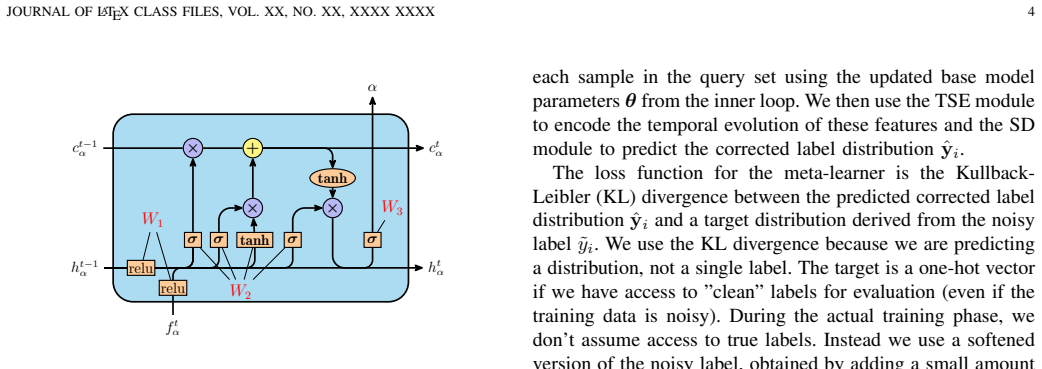
The machinery is the three-module pipeline. Normalized Noise Perception (NNP) computes per-sample, per-epoch statistics normalized against the current mini-batch, so their scale does not depend on the dataset or noise level. Time-Series Encoding (TSE) feeds the sequence of these feature vectors through a single-layer LSTM, and Subclass Decoding (SD) maps the final hidden state to a $\hat{y}_i$ distribution via a fully connected layer plus softmax. The training loop is nested: the inner loop trains the base model using $\hat{y}_i$ as the soft target, and the outer loop updates the meta-learner by minimizing the KL divergence between $\hat{y}_i$ and a smoothed version of the noisy label. That KL objective is what carries the learning signal for the whole correction mechanism.
What would settle it
Train TMLC-Net on CIFAR-10 with 20% symmetric noise, then evaluate the corrected distributions $\hat{y}_i$ on a held-out set whose labels are corrupted by an unrelated, high-rate random flip. If the corrected labels just reproduce the smoothed noisy labels, with the KL in Eq. 11 staying near zero on the query set, and clean-label accuracy does not improve over directly training with the noisy labels, then the module is not recovering clean labels and the transfer claim lacks a mechanism.
Extended reading notes
Core claim
The paper claims that a corrected label distribution $\hat{y}_i$ can be predicted from three normalized features of a sample's learning trajectory: category-normalized loss, global-normalized loss, and prediction entropy, together with the noisy one-hot label. An LSTM encodes the sequence of these features across epochs, and a small decoding head maps the final hidden state to a distribution over classes. This distribution replaces the noisy label as the target for training the base model. The reported experiments compare TMLC-Net against loss-correction, sample-selection, and meta-learning baselines, and the transferability tables show the same trained module applied to target settings it never saw. The paper's own stated contribution is transferability: the same learned correction function, rather than a new meta-training run, is what moves to a new task.
Load-bearing premise
The load-bearing premise is that patterns in a sample's normalized loss and prediction entropy over time reveal its true label, even though the meta-learner's objective never exposes it to a clean label and only ever asks it to reproduce a softened version of the given noisy label.
Editorial extensions
If this is right
- After a single meta-training run, TMLC-Net can be applied to a new dataset or noise condition without retraining or fine-tuning, amortizing the training cost.
- The corrected soft distribution, not a hard relabeling, is used as the target for the base model, so the classifier can keep some uncertainty about ambiguous samples.
- Because NNP normalizes losses within each mini-batch, the correction is insensitive to the absolute scale of the loss, which is the main distribution shift between datasets and noise levels.
- The paper's transfer tables show the same module moving between different noise rates and between CIFAR-10, CIFAR-100, Clothing1M, and WebVision, including real-world noise.
- If the transfer claim holds, the expensive bi-level optimization of meta-label correction only has to be run once on a source task, and downstream tasks inherit the correction module for free.
Reading between the lines
- The paper does not compare the corrected labels $\hat{y}_i$ against any clean-label oracle during meta-training; a consequence the authors leave implicit is that the method's gains may be attributable to learned label smoothing rather than to recovery of true labels, and the two explanations are distinguishable by ablating the meta-learner and using a fixed smoothing target.
- The normalized features are computed relative to the current mini-batch, so at deployment the correction for a sample depends on which other samples happen to be in the batch; this is an unexamined implementation detail that could affect transfer and could be tested by shuffling batch composition.
- A natural extension is cross-architecture transfer: the abstract promises generality across model architectures, but the reported experiments use ResNet backbones, so applying the same trained meta-learner to a transformer or a smaller CNN would test whether the dynamics features are backbone-independent.
- The paper's own failure cases suggest a boundary condition: when noise is systematic, with an entire class relabeled as another, normalized loss and entropy dynamics cannot identify the true class, so transferability should degrade exactly in that regime.
Editorial analysis
A structured set of objections, weighed in public.
Referee Report
Summary. The paper proposes TMLC-Net, a meta-learning framework for correcting noisy labels. It consists of Normalized Noise Perception (NNP), which computes normalized per-sample training statistics; Time-Series Encoding (TSE), which processes the history of these statistics with an LSTM; and Subclass Decoding (SD), which outputs a corrected label distribution. The base model is trained with cross-entropy against the corrected distribution, and the meta-learner is trained with a KL divergence against a target distribution. The central claim is that the meta-learner learns a general-purpose, transferable label-correction strategy. The paper reports experiments on CIFAR-10, CIFAR-100, Clothing1M, and WebVision, including an ablation study and a transferability analysis. The core training objective, however, targets only a smoothed version of the noisy label, which makes the claimed correction impossible by construction.
Significance. If TMLC-Net worked as claimed, it would fill a real gap: most meta-label-correction methods require retraining on each task, and a transferable corrector would reduce computational cost. The architectural breakdown into NNP, TSE, and SD is clearly presented, and the paper is explicit about not assuming access to true labels during training. Those are strengths in framing. However, the central derivation shows that the meta-learner is optimized to reproduce a softened noisy label rather than to estimate the clean label; the temporal encoding is not actually implemented in the training algorithm; and the reported gains over baselines (Tables I-III) could be explained by label smoothing or regularization. No code or reproducible implementation details are provided. The claimed significance therefore rests on a mechanism that the equations contradict.
major comments (3)
- [Section III-C, Eqs. (10)-(11)] The outer-loop objective trains TMLC-Net to match y_target_i = (1 - epsilon) * onehot(tilde y_i) + epsilon/C. Since KL(y_target || y_hat) over y_hat is uniquely minimized at y_hat = y_target, and y_hat is an unconstrained C-dimensional softmax output, the global optimum of Eq. (11) is exactly the smoothed noisy label. No term in the outer loop uses clean labels, a validation set, or the effect of y_hat on base-model accuracy; the inner-loop loss in Eq. (8) updates only theta and never backpropagates into phi. The sentence in Section III-C, 'During the actual training phase, we don't assume access to true labels. Instead we use a softened version of the noisy label,' confirms that the target contains no clean-label information. Consequently, TMLC-Net cannot learn to correct any mislabeled sample; at best it learns an instance-dependent smoothing of the noisy label. This is a load-bearing inconsistency with the abstract's claim of a 'label correction strategy.'
- [Section III-B2 and Algorithm 1] The TSE module is defined to consume the sequence {f_i^1, ..., f_i^T} of per-sample features and to update a hidden state via h_i^t = LSTM(f_i^t, h_i^{t-1}). Algorithm 1 samples a fresh mini-batch at each epoch and provides no buffer or storage for the per-sample feature history, and it never carries the LSTM hidden state from one epoch to the next. The instruction at line 7 to 'Compute hidden state h_i^t using TSE module' is therefore not realizable as written, because h_i^{t-1} is unavailable and the sequence {f_i^1, ..., f_i^T} is never accumulated. The temporal modeling that is central to the method is thus absent from the proposed training procedure.
- [Section IV, Algorithm 2] The meta-test algorithm does not specify how the trained TMLC-Net is applied. It states that TMLC-Net predicts a soft label for the current iteration, but the update in Eq. (13) uses the original loss ell_train_i(u) and does not involve the predicted soft label. The notation is also inconsistent (e.g., 'TMLC-Net cell theta_0 = (h_0, c_0)^T' and 'choose the subset of meta-learned TMLC-Net Phi_s'). As written, the transfer procedure in Algorithm 2 cannot be reproduced from the paper.
minor comments (8)
- [Section IV-D and Tables I-III] The text states that averages and standard deviations are reported, but no standard deviations appear in any table, and the number of random seeds is not specified.
- [Section IV-F5] The subsection 'Attributes and Fixed Conditions Comparison' is empty; either fill it with the promised comparison or remove the subsection.
- [Section IV-E and Eq. (10)] The label-smoothing parameter epsilon is used in Eq. (10), but the paper never reports its value for the TMLC-Net experiments or for the Label Smoothing baseline, making the comparison with Label Smoothing difficult to interpret.
- [Section IV-B] Instance-dependent noise is listed as one of the noise models, but no generation procedure for it is described and no experiments with it are reported.
- [Section V-A and Figure 3] The t-SNE visualization colors points by true labels even though the model is trained with noisy labels; this post-hoc coloring does not by itself establish that the model learned true-class structure, and no quantitative clustering metric is given.
- [Section III-B2 and Algorithm 1] The symbol T is used both for the total number of training epochs in Algorithm 1 and for the length of the feature sequence in Section III-B2; these should be denoted by different symbols.
- [Section II-C and references] The citation for label smoothing appears as '[ ?]', and several references contain formatting inconsistencies.
- [Section III-B3] The name 'Subclass Decoding' is misleading: no subclass structure is defined anywhere, and Eq. (7) is simply a two-layer MLP followed by softmax.
Circularity Check
TMLC-Net's 'corrected' labels are trained to match a smoothed version of the noisy label, so the claimed label correction reduces to the input by construction.
-
fitted input called prediction
[Section III-C (Outer Loop), Eqs. (10)-(11); Algorithm 1]
"During the actual training phase, we don't assume access to true labels. Instead we use a softened version of the noisy label, obtained by adding a small amount of uniform noise: ytarget_i = (1 − ϵ) · onehot(˜yi) + ϵ/C · 1 (10) ... The meta-learner loss is then: Lmeta = Σ (xi,˜yi)∈Dq KL(ytarget_i || ˆyi) (11)"
The meta-learner g(·;φ) is trained exclusively to minimize the KL divergence in Eq. (11) to the target ytarget_i defined in Eq. (10). That target is a convex combination of the noisy label's one-hot vector and the uniform distribution; it contains no information about clean labels or about which samples are mislabeled. KL(p||q) is minimized (uniquely) at q=p, so for a sufficiently expressive SD module the optimal corrected distribution yhat_i is exactly the smoothed noisy label. The inner-loop loss (Eq. 8) uses yhat_i to train the base model but supplies no clean-label supervision to φ; any influence of φ on θ through unrolling is still scored only by Eq. (11).
full rationale
The central claim of the paper is that TMLC-Net learns a general-purpose label correction strategy that transfers to new datasets and noise conditions. The only outer-loop supervision for the meta-learner is Eq. (11), whose target Eq. (10) is a softened one-hot encoding of the noisy label. Consequently, the predicted 'corrected' distribution is fitted, by construction, to the noisy label itself. No clean-label signal, noise-detection signal, or held-out clean validation enters the meta-learner objective, so the method cannot learn to distinguish mislabeled from correctly labeled samples. The reported accuracy gains can be explained as label smoothing or regularization rather than genuine label correction. This is a load-bearing internal reduction, not a peripheral citation issue: the method's output is statistically forced to be approximately the smoothed input label, and the transferability claim inherits that limitation. The paper is self-contained and does not rely on self-citations; the circularity is in the training objective itself.
Assumptions & free parameters
free parameters (4)
- Label smoothing coefficient epsilon =
0.1
- LSTM hidden units =
64
- Meta-learner update period Tval =
not specified
- Inner and outer learning rates alpha and beta =
not specified
assumptions (3)
- standard math Gradient-based bi-level optimization converges to a useful solution
- domain assumption Normalized loss and entropy trajectories are informative about true label correctness
- ad hoc to paper Optimizing against the softened noisy label target teaches correction rather than copying
Cite this review
Pith. "Pith review of TMLC-Net: Transferable Meta Label Correction for Noisy Label Learning." pith.science (2026). https://pith.science/paper/XKYWHW2X
@misc{pith2026250207721,
  author       = {Pith},
  title        = {Pith review of: TMLC-Net: Transferable Meta Label Correction for Noisy Label Learning},
  year         = {2026},
  howpublished = {\url{https://pith.science/paper/XKYWHW2X}},
  note         = {Machine review of arXiv:2502.07721}
}
read the original abstract
The prevalence of noisy labels in real-world datasets poses a significant impediment to the effective deployment of deep learning models. While meta-learning strategies have emerged as a promising approach for addressing this challenge, existing methods often suffer from limited transferability and task-specific designs. This paper introduces TMLC-Net, a novel Transferable Meta-Learner for Correcting Noisy Labels, designed to overcome these limitations. TMLC-Net learns a general-purpose label correction strategy that can be readily applied across diverse datasets and model architectures without requiring extensive retraining or fine-tuning. Our approach integrates three core components: (1) Normalized Noise Perception, which captures and normalizes training dynamics to handle distribution shifts; (2) Time-Series Encoding, which models the temporal evolution of sample statistics using a recurrent neural network; and (3) Subclass Decoding, which predicts a corrected label distribution based on the learned representations. We conduct extensive experiments on benchmark datasets with various noise types and levels, demonstrating that TMLC-Net consistently outperforms state-of-the-art methods in terms of both accuracy and robustness to label noise. Furthermore, we analyze the transferability of TMLC-Net, showcasing its adaptability to new datasets and noise conditions, and establishing its potential as a broadly applicable solution for robust deep learning in noisy environments.
Figures


Figures from the paper (2 more)


Reference graph
Works this paper leans on
-
[21]
Learning to learn from noisy labeled data,
Y . Li, Y . Yang, T. M. Hospedales, T. Xiang, and Y .-Z. Wang, “Learning to learn from noisy labeled data,” in Proceedings of the IEEE/CVF International Conference on Computer Vision , 2019, pp. 5536–5544
work page 2019
-
[1]
Imagenet classification with deep convolutional neural networks,
A. Krizhevsky, I. Sutskever, and G. E. Hinton, “Imagenet classification with deep convolutional neural networks,” Advances in neural informa- tion processing systems , vol. 25, 2012
2012
-
[2]
Deep residual learning for image recognition,
K. He, X. Zhang, S. Ren, and J. Sun, “Deep residual learning for image recognition,” Proceedings of the IEEE conference on computer vision and pattern recognition , pp. 770–778, 2016
2016
-
[3]
Bert: Pre-training of deep bidirectional transformers for language understanding,
J. Devlin, M.-W. Chang, K. Lee, and K. Toutanova, “Bert: Pre-training of deep bidirectional transformers for language understanding,” arXiv preprint arXiv:1810.04805, 2018
arXiv 2018
-
[4]
G. Hinton, L. Deng, D. Yu, G. E. Dahl, A.-r. Mohamed, N. Jaitly, A. Senior, V . Vanhoucke, P. Nguyen, T. N. Sainath et al., “Deep neural networks for acoustic modeling in speech recognition: The shared views of four research groups,” IEEE Signal Processing Magazine , vol. 29, no. 6, pp. 82–97, 2012
work page 2012
-
[5]
Classification in the presence of label noise: a survey,
B. Frenay and M. Verleysen, “Classification in the presence of label noise: a survey,” IEEE transactions on neural networks and learning systems, vol. 25, no. 5, pp. 845–869, 2013
work page 2013
-
[6]
Pervasive label errors in test sets destabilize machine learning benchmarks,
C. G. Northcutt, A. Athalye, and J. Mueller, “Pervasive label errors in test sets destabilize machine learning benchmarks,” arXiv preprint arXiv:2103.14749, 2021
arXiv 2021
-
[7]
Un- derstanding deep learning (still) requires rethinking generalization,
C. Zhang, S. Bengio, M. Hardt, B. Recht, and O. Vinyals, “Un- derstanding deep learning (still) requires rethinking generalization,” Communications of the ACM , vol. 64, no. 3, pp. 107–115, 2021
work page 2021
Show all 52 references
-
[8]
Image classification with noisy labels: a comprehensive survey,
G. Algan and I. Ulusoy, “Image classification with noisy labels: a comprehensive survey,” Artificial Intelligence Review , pp. 1–56, 2023
2023
-
[9]
A closer look at memorization in deep networks,
D. Arpit, S. Jastrzebski, N. Ballas, D. Krueger, Y . Bengio, M. S. Kanwal, T. Maharaj, A. Fischer, A. Courville, Y . Bengio et al., “A closer look at memorization in deep networks,” International Conference on Machine Learning, pp. 233–242, 2017
2017
-
[10]
Gender shades: Intersectional accuracy disparities in commercial gender classification,
J. Buolamwini and T. Gebru, “Gender shades: Intersectional accuracy disparities in commercial gender classification,” in Conference on fair- ness, accountability and transparency . PMLR, 2018, pp. 77–91
2018
-
[11]
Explaining and harnessing adversarial examples,
I. J. Goodfellow, J. Shlens, and C. Szegedy, “Explaining and harnessing adversarial examples,” in International Conference on Learning Repre- sentations (ICLR), 2015
2015
-
[12]
Intriguing properties of neural networks,
C. Szegedy, W. Zaremba, I. Sutskever, J. Bruna, D. Erhan, I. Good- fellow, and R. Fergus, “Intriguing properties of neural networks,” in International Conference on Learning Representations (ICLR) , 2014
2014
-
[13]
Robust loss functions under label noise for deep neural networks,
A. Ghosh, H. Kumar, and P. Sastry, “Robust loss functions under label noise for deep neural networks,” Proceedings of the AAAI Conference on Artificial Intelligence , vol. 31, no. 1, 2017
2017
-
[14]
Using pre- training can improve model robustness and uncertainty,
D. Hendrycks, M. Mazeika, S. Kadavath, and D. Jurafsky, “Using pre- training can improve model robustness and uncertainty,” in International Conference on Machine Learning . PMLR, 2019, pp. 2712–2721
2019
-
[15]
Making deep neural networks robust to label noise: A loss correction approach,
G. Patrini, A. Rozza, A. K. Menon, R. Nock, and L. Qu, “Making deep neural networks robust to label noise: A loss correction approach,” in Proceedings of the IEEE conference on computer vision and pattern recognition, 2017, pp. 1944–1952
2017
-
[16]
Mentornet: Learning data-driven curriculum for very deep neural networks on corrupted labels,
L. Jiang, Z. Zhou, T. Leung, L.-J. Li, and L. Fei-Fei, “Mentornet: Learning data-driven curriculum for very deep neural networks on corrupted labels,” in International conference on machine learning . PMLR, 2018, pp. 2304–2313
2018
-
[17]
Co-teaching: Robust training of deep neural networks with extremely noisy labels,
B. Han, Q. Yao, X. Yu, G. Niu, M. Xu, W. Hu, I. Tsang, and M. Sugiyama, “Co-teaching: Robust training of deep neural networks with extremely noisy labels,” in Advances in neural information pro- cessing systems, vol. 31, 2018
2018
-
[18]
Training deep neural networks on noisy labels with bootstrap- ping,
S. E. Reed, H. Lee, D. Anguelov, C. Szegedy, D. Erhan, and A. Rabi- novich, “Training deep neural networks on noisy labels with bootstrap- ping,” in International Conference on Learning Representations (ICLR), 2015
2015
-
[19]
Joint optimization framework for learning with noisy labels,
D. Tanaka, D. Ikami, T. Yamasaki, and K. Aizawa, “Joint optimization framework for learning with noisy labels,” in Proceedings of the IEEE conference on computer vision and pattern recognition, 2018, pp. 5552– 5560
2018
-
[20]
Learning to reweight ex- amples for robust deep learning,
M. Ren, W. Zeng, B. Yang, and R. Urtasun, “Learning to reweight ex- amples for robust deep learning,” International Conference on Machine Learning, pp. 4334–4343, 2018
2018
-
[22]
How does disagreement help generalization against label corruption?
X. Yu, B. Han, J. Yao, G. Niu, I. Tsang, and M. Sugiyama, “How does disagreement help generalization against label corruption?” International Conference on Machine Learning , pp. 7164–7173, 2019
2019
-
[23]
Robust estimation of a location parameter,
P. J. Huber, “Robust estimation of a location parameter,” in The Annals of Mathematical Statistics , vol. 35, no. 1, 1964, pp. 73–101
1964
-
[24]
Generalized cross entropy loss for training deep neural networks with noisy labels,
Z. Zhang and M. Sabuncu, “Generalized cross entropy loss for training deep neural networks with noisy labels,” in NeurIPS, 2018
2018
-
[25]
Northcutt, T
C. Northcutt, T. Wu, and I. L. Chuang, Learning with Confident Examples: Rank Pruning for Robust Classification with Noisy Labels . JMLR, 2017
2017
-
[26]
Early-learning regularization prevents memorization of noisy labels,
S. Liu, Z. Guo, T. Yu, J. Taylor, and A. B. Whinston, “Early-learning regularization prevents memorization of noisy labels,” NeurIPS, 2020
2020
-
[27]
Unsupervised label noise modeling and loss correction,
E. Arazo, D. Ortego, P. Albert, N. E. O’Connor, and K. McGuinness, “Unsupervised label noise modeling and loss correction,” in Interna- tional Conference on Machine Learning . PMLR, 2019, pp. 312–321
2019
-
[28]
Temporal ensembling for semi-supervised learn- ing,
S. Laine and T. Aila, “Temporal ensembling for semi-supervised learn- ing,” arXiv preprint arXiv:1610.02242 , 2016
2016 arXiv
-
[29]
Virtual adversarial training: a regularization method for supervised and semi-supervised learning,
T. Miyato, S.-i. Maeda, M. Koyama, and S. Ishii, “Virtual adversarial training: a regularization method for supervised and semi-supervised learning,” in IEEE transactions on pattern analysis and machine intel- ligence, vol. 41, no. 8, 2018, pp. 1979–1993
2018
-
[30]
Iterative learning with open-set noisy labels,
Y . Wang, W. Wang, J. Zhou, Y . Gao, and H. Zha, “Iterative learning with open-set noisy labels,” Proceedings of the IEEE conference on computer vision and pattern recognition , pp. 8688–8696, 2018
2018
-
[31]
Settles, Active learning literature survey
B. Settles, Active learning literature survey . University of Wisconsin- Madison Department of Computer Sciences, 2009
2009
-
[32]
Dividemix: Learning with noisy labels as semi-supervised learning,
J. Li, R. Socher, and S. C. Hoi, “Dividemix: Learning with noisy labels as semi-supervised learning,” in International Conference on Learning Representations, 2020
2020
-
[33]
Probabilistic end-to-end noise correction for learn- ing with noisy labels,
K. Yi and J. Wu, “Probabilistic end-to-end noise correction for learn- ing with noisy labels,” Proceedings of the IEEE/CVF Conference on Computer Vision and Pattern Recognition , pp. 7021–7029, 2019
2019
-
[34]
Error-bounded correction of noisy labels,
S. Zheng, P. Wan, C. Zhang, and H. Yu, “Error-bounded correction of noisy labels,” in ICML. PMLR, 2021
2021
-
[35]
Topological structural relation learning for zero-shot and few-shot image classification under label noise,
Y . Wu, X. Chen, Y . Shen, and G. Liu, “Topological structural relation learning for zero-shot and few-shot image classification under label noise,” IEEE Access, vol. 8, pp. 23 336–23 347, 2020
2020
-
[36]
Noise detection and label correction via likelihood estimation for medical image classification,
X. Wang, J. Zhang, S. Wan, Z. Liu, Q. Li, S. Sun, and K. Sun, “Noise detection and label correction via likelihood estimation for medical image classification,” Computer Methods and Programs in Biomedicine, vol. 208, p. 106234, 2021
2021
-
[37]
Classification with noisy labels by importance reweighting,
T. Liu and D. Tao, “Classification with noisy labels by importance reweighting,” IEEE transactions on pattern analysis and machine in- telligence, vol. 38, no. 3, pp. 447–461, 2015
2015
-
[38]
Model-agnostic meta-learning for fast adaptation of deep networks,
C. Finn, P. Abbeel, and S. Levine, “Model-agnostic meta-learning for fast adaptation of deep networks,” in International conference on machine learning. PMLR, 2017, pp. 1126–1135
2017
-
[39]
Prototypical networks for few- shot learning,
J. Snell, K. Swersky, and R. Zemel, “Prototypical networks for few- shot learning,” in Advances in neural information processing systems , vol. 30, 2017
2017
-
[40]
Learning to learn by gradient descent by gradient descent,
M. Andrychowicz, M. Denil, S. Gomez, M. W. Hoffman, D. Pfau, T. Schaul, B. Shilling, and N. De Freitas, “Learning to learn by gradient descent by gradient descent,” Advances in neural information processing systems, vol. 29, 2016
2016
-
[41]
Meta networks,
T. Munkhdalai and H. Yu, “Meta networks,” International Conference on Machine Learning , pp. 2554–2563, 2017
2017
-
[42]
A survey on transfer learning,
S. J. Pan and Q. Yang, “A survey on transfer learning,” IEEE Trans- actions on knowledge and data engineering , vol. 22, no. 10, pp. 1345– 1359, 2009
2009
-
[43]
Transfer learning for reinforcement learning domains: A survey,
M. E. Taylor and P. Stone, “Transfer learning for reinforcement learning domains: A survey,” Journal of Machine Learning Research , vol. 10, no. 7, 2009
2009
-
[44]
Domain-adversarial training of neural networks,
Y . Ganin and V . Lempitsky, “Domain-adversarial training of neural networks,” vol. 16, no. 1, 2015, pp. 2096–2030
2015
-
[45]
Long short-term memory,
S. Hochreiter and J. Schmidhuber, “Long short-term memory,” Neural computation, vol. 9, no. 8, pp. 1735–1780, 1997
1997
-
[46]
Learning multiple layers of features from tiny images,
A. Krizhevsky and G. Hinton, “Learning multiple layers of features from tiny images,” 2009
2009
-
[47]
Learning from massive noisy labeled data for image classification,
T. Xiao, T. Xia, Y . Yang, C. Huang, and X. Wang, “Learning from massive noisy labeled data for image classification,” in Proceedings of the IEEE conference on computer vision and pattern recognition , 2015, pp. 2691–2699. JOURNAL OF LATEX CLASS FILES, VOL. XX, NO. XX, XXXX XXXX 10
2015
-
[48]
Webvision database: Visual learning and understanding from web data,
W. Li, L. Wang, W. Li, E. Agustsson, and L. V . Gool, “Webvision database: Visual learning and understanding from web data,” in arXiv preprint arXiv:1708.02862, 2017
2017 arXiv
-
[49]
Decoupling
E. Malach and S. Shalev-Shwartz, “Decoupling ”when to update” from ”how to update”,” Advances in Neural Information Processing Systems , vol. 30, 2017
2017
-
[50]
Imagenet: A large-scale hierarchical image database,
J. Deng, W. Dong, R. Socher, L.-J. Li, K. Li, and L. Fei-Fei, “Imagenet: A large-scale hierarchical image database,” CVPR, pp. 248–255, 2009
2009
-
[51]
Adam: A method for stochastic optimization,
D. P. Kingma and J. Ba, “Adam: A method for stochastic optimization,” in International Conference on Learning Representations (ICLR) , 2015
2015
-
[52]
Visualizing data using t-sne,
L. Van der Maaten and G. Hinton, “Visualizing data using t-sne,” in J. Mach. Learn. Res. , 2008
2008
Reviewed August 8, 2026 · model on record in the stance chip above.
Discussion (0). Continue with ORCID to comment.