REVIEW 3 major objections 4 minor 1 cited by
Elastic3D claims flat video becomes controllable stereo with no depth or warping: one-step latent diffusion generates the right-eye view, steered by a disparity knob and a left-view-guided decoder, setting state-of-the-art numbers on three
Reviewed by Pith at T0; open to challenge. T0 means a machine referee read the full paper against a public rubric. the ladder, T0–T4 →
T0 review · deepseek-v4-flash
2026-08-03 16:12 UTC pith:XMJE6KRC
load-bearing objection Solid engineering with an honest limitations section, but the 'new state of the art' claim only holds under an oracle-conditioning evaluation; cite the guided decoder and disparity-control mechanism, not the SOTA tables as-is. the 3 major comments →
Elastic3D: Controllable Stereo Video Conversion with Guided Latent Decoding
The pith
A machine-rendered reading of the paper's core claim, the machinery that carries it, and where it could break.
Core claim
The paper's central claim is that the right-eye view of a stereo video can be synthesized directly from the left-eye video, without explicit depth estimation or geometric warping. Elastic3D does this with a one-step latent diffusion model built on a pretrained video-diffusion backbone: it takes the compressed left-view latent and a scalar 'median disparity' token, and generates the right-view latent in a single forward pass. Two components carry the argument: the scalar token gives continuous, intuitive control over the output disparity range (so one model covers different camera baselines), and a guided VAE decoder re-injects high-frequency detail from the left video through epipolar-constr
What carries the argument
The load-bearing mechanism is the guided latent-decoding loop. A frozen VAE encoder compresses the left video into latents; a 1-step denoising U-Net — trained as a feed-forward generator with zero noise at the maximum timestep — outputs the right-view latent; and a guided decoder, initialized from the standard VAE decoder, reconstructs the right view while a guidance network (initialized from the VAE encoder) supplies multi-scale features of the left video. Inside each decoder upsampling block, a zero-initialized epipolar cross-attention layer lets each decoder feature attend only to the corresponding horizontal scanline (the epipolar line in the rectified case) of the left-view feature map,
Load-bearing premise
At evaluation time the model is told the correct median disparity of the target pair — the paper states that 'the GT disparity is used to compute the conditioning factor δ' — so the headline results assume the desired 3D strength is known rather than discovered from the monocular input; if the user or an automatic estimator sets δ wrongly, the alignment and quality gains may shrink.
What would settle it
Take the same left-eye videos and feed them through Elastic3D with the conditioning knob set by an automatic estimate (for example, the median of a monocular depth map rescaled into pixels) instead of the ground-truth median disparity, then recompute the disparity error using an independent stereo matcher different from the one that generated the pseudo-ground-truth. If PSNR drops by several dB or disparity errors grow markedly under that honest, fully monocular protocol, then the reported state of the art comes from oracle conditioning and evaluator self-consistency, not from strength of the
If this is right
- Monocular video libraries could be converted to stereo with a user-adjustable 3D intensity, allowing comfortable viewing on headsets with different interocular settings.
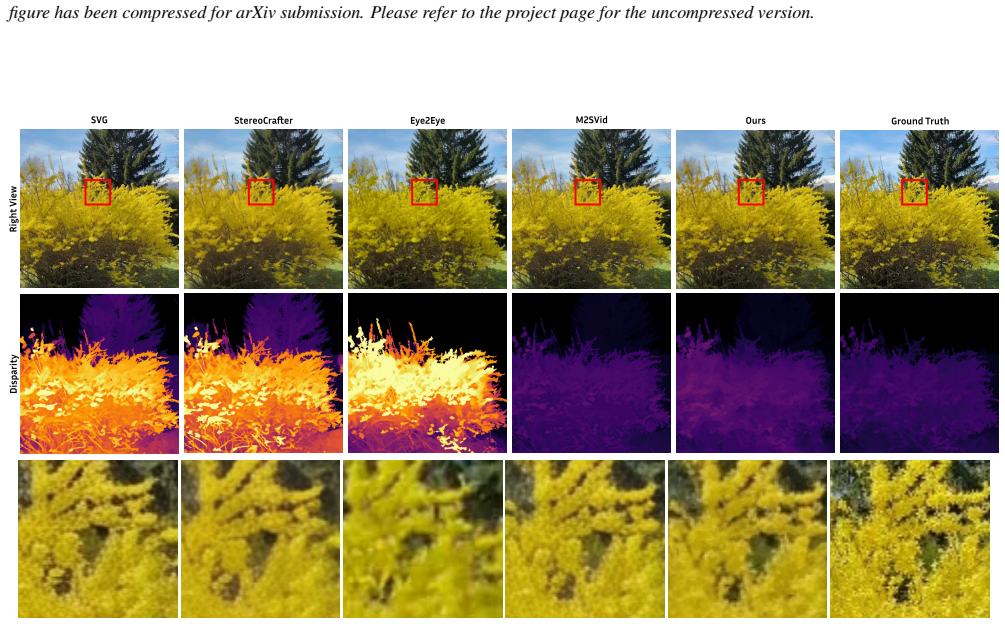
- Removing the explicit depth-and-warp stage eliminates disocclusion holes and depth-estimator failure modes, so thin structures, text, and non-Lambertian surfaces survive in the generated view.
- Sharp texture is transferred from the source eye to the target eye, cutting the mismatch that causes binocular rivalry and making long stereo viewing more comfortable.
- One-step feed-forward inference (about 1.7 seconds for 16 512x512 frames on an H100 GPU) makes near-interactive conversion practical, whereas multi-stage depth-plus-diffusion pipelines take roughly 5 seconds or more.
- The four-part evaluation protocol gives future stereo-conversion systems a common yardstick covering quality, fidelity, geometry, and temporal stability.
Where Pith is reading between the lines
- Fully automatic conversion will require estimating δ from the left view or from user intent; the paper does not evaluate that setting, so the 'monocular' framing should be read as 'monocular plus a target-disparity hint.'
- The global scalar is a coarse control: the paper's own limitation section observes that a background-dominated scene can have median disparity near zero while foreground objects demand nonzero disparity. A per-frame or spatially varying conditioning signal is a natural testable extension for zoom and dolly shots.
- Because the guided decoder is trained separately and plugs into other latent diffusion pipelines, its benefit may transfer beyond stereo conversion, e.g., to any two-view synthesis task where one view must borrow detail from another along known epipolar geometry.
- The 1-D epipolar attention presumes rectified stereo; applying the approach to unrectified, rotating, or rolling cameras would require generalizing the attention search to full epipolar lines in arbitrary directions.
Editorial analysis
A structured set of objections, weighed in public.
Referee Report
Summary. The paper presents Elastic3D, a warping-free latent diffusion model for monocular-to-stereo video conversion. The method synthesizes the right-eye video directly from the left video using a one-step denoising process, conditioned on a scalar median-disparity token that provides user-controllable 3D strength. A guided VAE decoder with epipolar attention re-injects high-frequency detail from the left view to reduce binocular rivalry. The authors evaluate on Stereo4D, Ego4D, and the Spatial Video dataset (AVP and iPhone), reporting favorable metrics against warp-based and warping-free baselines, plus a small headset user study. The central claim is that Elastic3D sets a new state of the art for controllable stereo video conversion.
Significance. If the results hold, the paper makes a solid contribution: a feed-forward, single-step warping-free stereo video generator with intuitive scalar disparity control, a plug-and-play guided decoder that improves detail preservation, and a more complete evaluation protocol covering geometry, stereoscopic fidelity, and temporal consistency. The ablation study is thorough, the user study is a genuinely useful qualitative check, and the supplementary material is unusually transparent about limitations, including the ambiguity of median conditioning and occasional geometric hallucinations. The main caveat is that the quantitative SOTA claim is evaluated under an oracle condition: Elastic3D receives the ground-truth median disparity at inference, and the geometric metric relies on the same stereo estimator family used to produce training labels. This does not make the method internally inconsistent, but it narrows what Tables 5–7 certify. The claim of a 'new standard' should be re-scoped to 'given a target median disparity' unless automatic disparity estimation is also evaluated.
major comments (3)
- [Sec. 6.1 / Tables 5–7] The main SOTA comparison gives Elastic3D the ground-truth median disparity δ at inference ('For our method, the GT disparity is used to compute the conditioning factor δ'), while the abstract and conclusion present the method as automated monocular-to-stereo conversion. Since PSNR/SSIM/LPIPS strongly penalize global disparity misalignment, providing the exact target δ directly controls the dominant error term. Baselines receive scale/shift-aligned monocular depth, which is also target-derived, but the asymmetry remains important. Please either (a) evaluate with an estimated or user-chosen δ and report sensitivity to δ errors, or (b) re-scope the headline claim as 'given a user-specified median disparity.' The paper's own Sec. H acknowledges ambiguity in median conditioning; that limitation should be reflected in the abstract/conclusion.
- [Sec. 5.1 / Sec. 6.1] The Disp.err metric estimates dense disparity on generated views with FoundationStereo and compares against pseudo-GT disparities also produced by FoundationStereo. The same estimator family supplies the training labels for δ and the synthetic warping augmentation. This self-consistency can reward outputs that mimic FoundationStereo's error distribution rather than true geometric accuracy. The paper should validate the geometric claim with an independent stereo matcher (e.g., RAFT-Stereo or a learned matcher not involved in training) on at least a subset, or explicitly discuss this limitation. The current text calls the reference 'pseudo' but does not analyze the circularity.
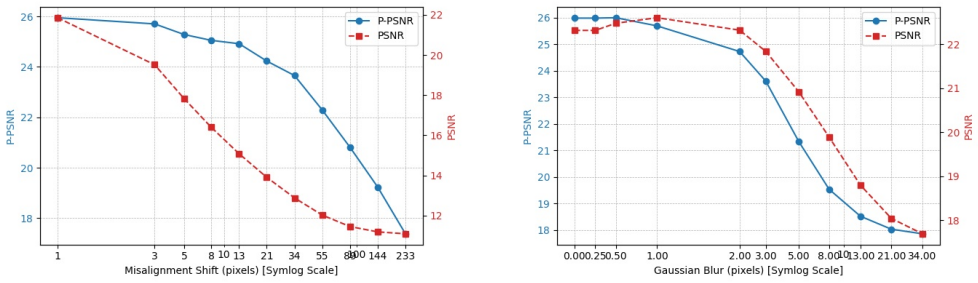
- [Tab. 1 (iPhone row) / Tab. 13] The text states that the proposed conditioning 'does not impact the geometric accuracy (Disp. err)', but the iPhone row of Table 1 shows Disp.err worsening from 0.64 without conditioning to 0.77 with conditioning — a roughly 20% relative degradation. The supplementary Table 13 repeats the same numbers. If this is noise, variance, or a side effect of the different training distribution, the claim should be qualified; as written, the table contradicts the stated conclusion.
minor comments (4)
- [Tab. 4] In the guided-decoder ablation, M2SVid + D′ achieves a lower Matchability Error (24.8) than Elastic3D (27.8). The text emphasizes a 'drastic reduction' for Elastic3D but does not mention that the plug-and-play decoder on a warp-based baseline outperforms the full warping-free model on this particular metric. This should be acknowledged for fairness.
- [Sec. 5 / evaluation protocol] The protocol is called 'black-box' but provides target-derived global 3D information to every method. This is a reasonable controlled-strength design, but the terminology is misleading and should be replaced with something like 'controlled-strength pipeline evaluation'.
- [Sec. E.1 / Table 9] The user study uses 9 participants and 120 pairwise judgments per comparison. The 50.0% vs 12.5% preference over Eye2Eye is plausible, but no significance testing or inter-participant variability is reported. Adding a confidence interval or a simple sign test would strengthen the claim.
- [References] Reference [22] is marked 'Submitted' and the Spatial Video Dataset is central to the evaluation. Please update the reference or indicate the arXiv/version status. Also, there are minor typos such as 'simplidied' (Supp. Sec. C) and 'Cputer Vision' in reference [66].
Circularity Check
No construction-level circularity; SOTA claim is scope-limited by oracle median-disparity conditioning and same-estimator pseudo-GT geometry evaluation.
full rationale
Elastic3D's construction-level derivation is self-contained and non-circular. The synthesis core is a 1-step latent diffusion map f_theta(0, z_L, tau(delta)) trained with latent and pixel-space losses (Eqs. 1, 2, 11, 12); the generated right view is not an algebraic consequence of the conditioning scalar delta or the left video alone. The guided decoder is trained as a reconstruction module, ablated both in isolation (Tab. 3) and on the full task (Tab. 4), and is initialized to preserve the pretrained SVD decoder mapping via zero-initialized output projections, so its gains are empirical rather than assumed. The M2SVid [50] citation is used for data splits, data handling, and as a baseline; it shares three authors with the present paper, but it is not invoked as a uniqueness theorem or as the justification for the conditioning or decoder design, so the self-citation is not load-bearing. Two evaluation-scope issues prevent the headline SOTA claim from being fully certified from monocular input alone, but neither reduces by construction. Sec. 5 states that all methods 'operate solely on the monocular input I_L at inference time', yet Sec. 6.1 says 'For our method, the GT disparity is used to compute the conditioning factor delta with eq. (3)': the target median disparity is supplied as an oracle or user-set knob rather than predicted. Second, the Disp.err metric estimates disparity on generated views with FoundationStereo and compares against pseudo-GT disparity also produced by FoundationStereo (Sec. 5.1 vs 6.1), while the same estimator family supplied the training labels for delta; this self-consistency can reward outputs that mimic FoundationStereo's error distribution. Sec. H openly lists the ambiguity of median conditioning and geometric hallucinations, confirming the authors' awareness of these scope limits. These are correctness/scope concerns, not construction-level circularity.
Axiom & Free-Parameter Ledger
free parameters (5)
- test-time median disparity δ (oracle conditioning) =
GT/FoundationStereo median disparity of target pair in all quantitative comparisons
- disparity scaling factor for conditioning =
≈10^-2
- synthetic augmentation disparity scale set =
{0.05,0.1,0.2,0.4,0.6,0.8,1.25,1.5,2.0,3.0}
- zero-disparity augmentation probability =
1%
- loss weights =
equal weights (L2 latent; L1, SSIM, LPIPS pixel; decoder L1+LPIPS)
axioms (5)
- domain assumption Rectified stereo geometry: epipolar lines are horizontal, so stereo correspondence is a 1D search along rows.
- domain assumption FoundationStereo's disparity estimates are a valid pseudo-ground truth for training labels, conditioning, synthetic warping, and the Disp.err metric.
- standard math 1-step zero-noise diffusion (z_T≈0, v≈−z) is a valid feed-forward approximation of the pretrained SVD denoiser.
- ad hoc to paper A single scalar median disparity is a sufficient conditioning signal to control global 3D strength.
- ad hoc to paper Synthetic forward-warped pairs (left warped by scaled pseudo-GT disparity) are a valid proxy for real stereo pairs of different baselines.
read the original abstract
The growing demand for immersive 3D content calls for automated monocular-to-stereo video conversion. We present Elastic3D, a controllable, direct end-to-end method for upgrading a conventional video to a binocular one. Our approach, based on (conditional) latent diffusion, avoids artifacts due to explicit depth estimation and warping. The key to its high-quality stereo video output is a novel, guided VAE decoder that ensures sharp and epipolar-consistent stereo video output. Moreover, our method gives the user control over the strength of the stereo effect (more precisely, the disparity range) at inference time, via an intuitive, scalar tuning knob. Experiments on three different datasets of real-world stereo videos show that our method outperforms both traditional warping-based and recent warping-free baselines and sets a new standard for reliable, controllable stereo video conversion. Please check the project page for the video samples https://elastic3d.github.io.
Figures






Forward citations
Cited by 1 Pith paper
-
UniFixer: A Universal Reference-Guided Fixer for Diffusion-Based View Synthesis
UniFixer is a universal reference-guided framework that fixes spatial, temporal, and backbone-related degradations in diffusion-based view synthesis via coarse-to-fine modules and achieves zero-shot SOTA results on no...
Reference graph
Works this paper leans on
-
[1]
Lumiere: A space-time diffu- sion model for video generation
Omer Bar-Tal, Hila Chefer, Omer Tov, Charles Her- rmann, Roni Paiss, Shiran Zada, Ariel Ephrat, Junhwa Hur, Guanghui Liu, Amit Raj, et al. Lumiere: A space-time diffu- sion model for video generation. InACM SIGGRAPH Asia,
-
[2]
Visual competi- tion.Nature Reviews Neuroscience, 3(1):13–21, 2002
Randolph Blake and Nikos K Logothetis. Visual competi- tion.Nature Reviews Neuroscience, 3(1):13–21, 2002. 3
2002
-
[3]
Andreas Blattmann, Tim Dockhorn, Sumith Kulal, Daniel Mendelevitch, Maciej Kilian, Dominik Lorenz, Yam Levi, Zion English, Vikram V oleti, Adam Letts, et al. Stable video diffusion: Scaling latent video diffusion models to large datasets.preprint arXiv:2311.15127, 2023. 2, 4
Pith/arXiv arXiv 2023
-
[4]
Depth Pro: Sharp monocular metric depth in less than a second.preprint arXiv:2410.02073, 2024
Aleksei Bochkovskii, Ama ¨el Delaunoy, Hugo Germain, Marcel Santos, Yichao Zhou, Stephan R Richter, and Vladlen Koltun. Depth Pro: Sharp monocular metric depth in less than a second.preprint arXiv:2410.02073, 2024. 2
Pith/arXiv arXiv 2024
-
[5]
B Breese
B. B Breese. Binocular rivalry.Psychological Review, 16(6): 410–415, 1909. 2, 3
1909
-
[6]
Com- parison of three different methods to merge multiresolution and multispectral data- landsat TM and SPOT panchromatic
Pats Chavez, Stuart C Sides, Jeffrey A Anderson, et al. Com- parison of three different methods to merge multiresolution and multispectral data- landsat TM and SPOT panchromatic. Photogrammetric Engineering and Remote Sensing, 57(3): 295–303, 1991. 2
1991
-
[7]
SVG: 3d stereoscopic video generation via denoising frame matrix
Peng Dai, Feitong Tan, Qiangeng Xu, David Futschik, Ruofei Du, Sean Fanello, Xiaojuan Qi, and Yinda Zhang. SVG: 3d stereoscopic video generation via denoising frame matrix. InInternational Conference on Learning Represen- tations (ICLR), 2025. 1, 2, 3, 5, 6, 7
2025
-
[8]
Guided super-resolution as pixel-to-pixel transformation
Riccardo de Lutio, Stefano D’Aronco, Jan Dirk Wegner, and Konrad Schindler. Guided super-resolution as pixel-to-pixel transformation. InIEEE/CVF International Conference on Computer Vision (ICCV), 2019. 2
2019
-
[9]
DeDoDe v2: Analyzing and improving the DeDoDe keypoint detec- tor
Johan Edstedt, Georg B ¨okman, and Zhenjun Zhao. DeDoDe v2: Analyzing and improving the DeDoDe keypoint detec- tor. InIEEE/CVF Computer Society Conference on Com- puter Vision and Pattern Recognition Workshops (CVPRW),
-
[10]
Depth-image-based rendering (DIBR), compression, and transmission for a new approach on 3D- TV
Christoph Fehn. Depth-image-based rendering (DIBR), compression, and transmission for a new approach on 3D- TV. InStereoscopic Displays and Virtual Reality Systems XI, pages 93–104. SPIE, 2004. 2
2004
-
[11]
Rinon Gal, Yuval Alaluf, Yuval Atzmon, Or Patashnik, Amit H Bermano, Gal Chechik, and Daniel Cohen-Or. An image is worth one word: Personalizing text-to-image gen- eration using textual inversion.preprint arXiv:2208.01618,
-
[12]
Fine-tuning image-conditional diffusion models is easier than you think
Gonzalo Martin Garcia, Karim Abou Zeid, Christian Schmidt, Daan De Geus, Alexander Hermans, and Bastian Leibe. Fine-tuning image-conditional diffusion models is easier than you think. InIEEE/CVF Winter Conference on Applications of Computer Vision (WACV), 2025. 4, 3
2025
-
[13]
Eye2Eye: A simple approach for monocular-to-stereo video synthesis.preprint arXiv:2505.00135, 2025
Michal Geyer, Omer Tov, Linyi Jin, Richard Tucker, Inbar Mosseri, Tali Dekel, and Noah Snavely. Eye2Eye: A simple approach for monocular-to-stereo video synthesis.preprint arXiv:2505.00135, 2025. 1, 2, 3, 5, 7, 8
Pith/arXiv arXiv 2025
-
[14]
Ego4D: Around the world in 3,000 hours of egocentric video
Kristen Grauman, Andrew Westbury, Eugene Byrne, Zachary Chavis, Antonino Furnari, Rohit Girdhar, Jack- son Hamburger, Hao Jiang, Miao Liu, Xingyu Liu, et al. Ego4D: Around the world in 3,000 hours of egocentric video. InIEEE/CVF Conference on Computer Vision and Pattern Recognition (CVPR), 2022. 6, 7
2022
-
[15]
Epipolar transformers
Yihui He, Rui Yan, Katerina Fragkiadaki, and Shoou-I Yu. Epipolar transformers. InIEEE/CVF Conference on Com- puter Vision and Pattern Recognition (CVPR), 2020. 2, 4
2020
-
[16]
Denoising diffu- sion probabilistic models.Advances in Neural Information Processing Systems (NeurIPS), 2020
Jonathan Ho, Ajay Jain, and Pieter Abbeel. Denoising diffu- sion probabilistic models.Advances in Neural Information Processing Systems (NeurIPS), 2020. 2
2020
-
[17]
Video dif- fusion models.Advances in Neural Information Processing Systems (NeurIPS), 2022
Jonathan Ho, Tim Salimans, Alexey Gritsenko, William Chan, Mohammad Norouzi, and David J Fleet. Video dif- fusion models.Advances in Neural Information Processing Systems (NeurIPS), 2022. 2
2022
-
[18]
DepthCrafter: Generating consistent long depth sequences for open-world videos
Wenbo Hu, Xiangjun Gao, Xiaoyu Li, Sijie Zhao, Xi- aodong Cun, Yong Zhang, Long Quan, and Ying Shan. DepthCrafter: Generating consistent long depth sequences for open-world videos. InIEEE/CVF Conference on Com- puter Vision and Pattern Recognition (CVPR), pages 2005– 2015, 2025. 2, 6, 7
2005
-
[19]
Restereo: Diffusion stereo video generation and restoration.preprint arXiv:2506.06023, 2025
Xingchang Huang, Ashish Kumar Singh, Florian Dubost, Cristina Nader Vasconcelos, Sakar Khattar, Liang Shi, Chris- tian Theobalt, Cengiz Oztireli, and Gurprit Singh. Restereo: Diffusion stereo video generation and restoration.preprint arXiv:2506.06023, 2025. 1, 2, 7
Pith/arXiv arXiv 2025
-
[20]
EpiDiff: Enhancing multi-view synthesis via localized epipolar-constrained diffusion
Zehuan Huang, Hao Wen, Junting Dong, Yaohui Wang, Yangguang Li, Xinyuan Chen, Yan-Pei Cao, Ding Liang, Yu Qiao, Bo Dai, et al. EpiDiff: Enhancing multi-view synthesis via localized epipolar-constrained diffusion. InIEEE/CVF Conference on Computer Vision and Pattern Recognition (CVPR), 2024. 4
2024
-
[21]
Depth map super-resolution by deep multi-scale guidance
Tak-Wai Hui, Chen Change Loy, and Xiaoou Tang. Depth map super-resolution by deep multi-scale guidance. InEu- ropean Conference on Computer Vision (ECCV), 2016. 2
2016
-
[22]
Izadimehr, Milad Ghanbari, Guodong Chen, Wei Zhou, Xiaoshuai Hao, Mallesham Dasari, Christian Tim- merer, and Hadi Amirpour
M.H. Izadimehr, Milad Ghanbari, Guodong Chen, Wei Zhou, Xiaoshuai Hao, Mallesham Dasari, Christian Tim- merer, and Hadi Amirpour. SVD: Spatial video dataset. In ACM International Conference on Multimedia (ACM MM),
-
[23]
Stereo4D: Learning how things move in 3d from internet stereo videos
Linyi Jin, Richard Tucker, Zhengqi Li, David Fouhey, Noah Snavely, and Aleksander Holynski. Stereo4D: Learning how things move in 3d from internet stereo videos. InIEEE/CVF Conference on Computer Vision and Pattern Recognition (CVPR), 2025. 6, 7, 8
2025
-
[24]
Repurpos- ing diffusion-based image generators for monocular depth estimation
Bingxin Ke, Anton Obukhov, Shengyu Huang, Nando Met- zger, Rodrigo Caye Daudt, and Konrad Schindler. Repurpos- ing diffusion-based image generators for monocular depth estimation. InProceedings of the IEEE/CVF Conference on Computer Vision and Pattern Recognition (CVPR), 2024. 2
2024
-
[25]
Marigold: Affordable adaptation of diffusion- based image generators for image analysis.IEEE Transac- tions on Pattern Analysis and Machine Intelligence (TPAMI),
Bingxin Ke, Kevin Qu, Tianfu Wang, Nando Metzger, Shengyu Huang, Bo Li, Anton Obukhov, and Konrad Schindler. Marigold: Affordable adaptation of diffusion- based image generators for image analysis.IEEE Transac- tions on Pattern Analysis and Machine Intelligence (TPAMI),
-
[26]
Auto-encoding varia- tional bayes
Diederik P Kingma and Max Welling. Auto-encoding varia- tional bayes. InInternational Conference on Learning Rep- resentations (ICLR), 2013. 2
2013
-
[27]
2d-to- 3d image conversion by learning depth from examples
Janusz Konrad, Meng Wang, and Prakash Ishwar. 2d-to- 3d image conversion by learning depth from examples. In IEEE Conference on Computer Vision and Pattern Recogni- tion Workshops (CVPRW), 2012. 2
2012
-
[28]
Visual discomfort of 3D TV: Assessment methods and modeling.Displays, 32(4):209–218, 2011
Marc Lambooij, Wijnand A IJsselsteijn, and Ingrid Heynd- erickx. Visual discomfort of 3D TV: Assessment methods and modeling.Displays, 32(4):209–218, 2011. 3
2011
-
[29]
Stereo conversion with disparity-aware warping, compositing and inpainting
Lukas Mehl, Andr ´es Bruhn, Markus Gross, and Christopher Schroers. Stereo conversion with disparity-aware warping, compositing and inpainting. InIEEE/CVF Winter Confer- ence on Applications of Computer Vision (WACV), 2024. 3
2024
-
[30]
Guided depth super-resolution by deep anisotropic diffusion
Nando Metzger, Rodrigo Caye Daudt, and Konrad Schindler. Guided depth super-resolution by deep anisotropic diffusion. InIEEE/CVF Conference on Computer Vision and Pattern Recognition (CVPR), 2023. 2
2023
-
[31]
T2I-Adapter: Learn- ing adapters to dig out more controllable ability for text-to- image diffusion models
Chong Mou, Xintao Wang, Liangbin Xie, Yanze Wu, Jian Zhang, Zhongang Qi, and Ying Shan. T2I-Adapter: Learn- ing adapters to dig out more controllable ability for text-to- image diffusion models. InAAAI Conference on Artificial Intelligence, 2024. 3
2024
-
[32]
One-step image translation with text-to-image models.preprint arXiv:2403.12036, 2024
Gaurav Parmar, Taesung Park, Srinivasa Narasimhan, and Jun-Yan Zhu. One-step image translation with text-to-image models.preprint arXiv:2403.12036, 2024. 2
Pith/arXiv arXiv 2024
-
[33]
UniDepth: Universal monocular metric depth estimation
Luigi Piccinelli, Yung-Hsu Yang, Christos Sakaridis, Mattia Segu, Siyuan Li, Luc Van Gool, and Fisher Yu. UniDepth: Universal monocular metric depth estimation. InIEEE/CVF Conference on Computer Vision and Pattern Recognition (CVPR), 2024. 2
2024
-
[34]
UniDepthV2: Universal monocular metric depth estimation made simpler.IEEE Transactions on Pattern Analysis and Machine Intelligence (TPAMI), 2025
Luigi Piccinelli, Christos Sakaridis, Yung-Hsu Yang, Mat- tia Segu, Siyuan Li, Wim Abbeloos, and Luc Van Gool. UniDepthV2: Universal monocular metric depth estimation made simpler.IEEE Transactions on Pattern Analysis and Machine Intelligence (TPAMI), 2025. 2
2025
-
[35]
SDXL: Improving latent diffusion models for high-resolution image synthesis
Dustin Podell, Zion English, Kyle Lacey, Andreas Blattmann, Tim Dockhorn, Jonas M ¨uller, Joe Penna, and Robin Rombach. SDXL: Improving latent diffusion models for high-resolution image synthesis. InInternational Con- ference on Learning Representations (ICLR), 2024. 2
2024
-
[36]
Towards open-world generation of stereo images and unsu- pervised matching
Feng Qiao, Zhexiao Xiong, Eric Xing, and Nathan Jacobs. Towards open-world generation of stereo images and unsu- pervised matching. InIEEE/CVF International Conference on Computer Vision (ICCV), 2025. 2, 5
2025
-
[37]
Ren ´e Ranftl, Katrin Lasinger, David Hafner, Konrad Schindler, and Vladlen Koltun. Towards robust monocular depth estimation: Mixing datasets for zero-shot cross-dataset transfer.IEEE Transactions on Pattern Analysis and Ma- chine Intelligence (TPAMI), 44(3):1623–1637, 2020. 2
2020
-
[38]
Vi- sion transformers for dense prediction
Ren ´e Ranftl, Alexey Bochkovskiy, and Vladlen Koltun. Vi- sion transformers for dense prediction. InIEEE/CVF In- ternational Conference on Computer Vision (ICCV), pages 12179–12188, 2021. 2
2021
-
[39]
Deepspeed: System optimizations enable train- ing deep learning models with over 100 billion parameters
Jeff Rasley, Samyam Rajbhandari, Olatunji Ruwase, and Yuxiong He. Deepspeed: System optimizations enable train- ing deep learning models with over 100 billion parameters. InProceedings of the 26th ACM SIGKDD international con- ference on knowledge discovery & data mining, pages 3505– 3506, 2020. 1
2020
-
[40]
High-resolution image syn- thesis with latent diffusion models
Robin Rombach, Andreas Blattmann, Dominik Lorenz, Patrick Esser, and Bj¨orn Ommer. High-resolution image syn- thesis with latent diffusion models. InIEEE/CVF Conference on Computer Vision and Pattern Recognition (CVPR), 2022. 2
2022
-
[41]
U- net: Convolutional networks for biomedical image segmen- tation
Olaf Ronneberger, Philipp Fischer, and Thomas Brox. U- net: Convolutional networks for biomedical image segmen- tation. InMedical image computing and computer-assisted intervention–MICCAI 2015: 18th international conference, Munich, Germany, October 5-9, 2015, proceedings, part III 18, pages 234–241. Springer, 2015. 3
2015
-
[42]
DreamBooth: Fine tuning text-to-image diffusion models for subject-driven generation
Nataniel Ruiz, Yuanzhen Li, Varun Jampani, Yael Pritch, Michael Rubinstein, and Kfir Aberman. DreamBooth: Fine tuning text-to-image diffusion models for subject-driven generation. InIEEE/CVF Conference on Computer Vision and Pattern Recognition (CVPR), 2023. 3
2023
-
[43]
Photorealistic text-to-image diffusion models with deep language understanding.Advances in Neural Information Processing Systems (NeurIPS), 2022
Chitwan Saharia, William Chan, Saurabh Saxena, Lala Li, Jay Whang, Emily L Denton, Kamyar Ghasemipour, Raphael Gontijo Lopes, Burcu Karagol Ayan, Tim Salimans, et al. Photorealistic text-to-image diffusion models with deep language understanding.Advances in Neural Information Processing Systems (NeurIPS), 2022. 2
2022
-
[44]
Progressive distillation for fast sampling of diffusion models.arXiv preprint arXiv:2202.00512, 2022
Tim Salimans and Jonathan Ho. Progressive distillation for fast sampling of diffusion models.arXiv preprint arXiv:2202.00512, 2022. 3
Pith/arXiv arXiv 2022
-
[45]
Feng Shao, Weisi Lin, Shanbo Gu, Gangyi Jiang, and Tham- bipillai Srikanthan. Perceptual full-reference quality assess- ment of stereoscopic images by considering binocular vi- sual characteristics.IEEE Transactions on Image Processing (TIP), 22(5):1940–1953, 2013. 3
1940
-
[46]
ImmersePro: End- to-end stereo video synthesis via implicit disparity learning
Jian Shi, Zhenyu Li, and Peter Wonka. ImmersePro: End- to-end stereo video synthesis via implicit disparity learning. preprint arXiv:2410.00262, 2024. 3
Pith/arXiv arXiv 2024
-
[47]
The zone of comfort: Predicting visual discom- fort with stereo displays.Journal of Vision, 11(8):11–11,
Takashi Shibata, Joohwan Kim, David M Hoffman, and Mar- tin S Banks. The zone of comfort: Predicting visual discom- fort with stereo displays.Journal of Vision, 11(8):11–11,
-
[48]
3d photography using context-aware layered depth inpainting
Meng-Li Shih, Shih-Yang Su, Johannes Kopf, and Jia-Bin Huang. 3d photography using context-aware layered depth inpainting. InIEEE/CVF Conference on Computer Vision and Pattern Recognition (CVPR), 2020. 3
2020
-
[49]
3d scene reconstruction with multi-layer depth and epipolar transformers
Daeyun Shin, Zhile Ren, Erik B Sudderth, and Charless C Fowlkes. 3d scene reconstruction with multi-layer depth and epipolar transformers. InIEEE/CVF International Confer- ence on Computer Vision (ICCV), 2019. 2
2019
-
[50]
M2SVid: End-to-end inpainting and refinement for monocular-to-stereo video conversion
Nina Shvetsova, Goutam Bhat, Prune Truong, Hilde Kuehne, and Federico Tombari. M2SVid: End-to-end inpainting and refinement for monocular-to-stereo video conversion. InIn- ternational Conference on 3D Vision (3DV), 2026. 1, 2, 3, 4, 5, 6, 7, 10
2026
-
[51]
Denois- ing diffusion implicit models
Jiaming Song, Chenlin Meng, and Stefano Ermon. Denois- ing diffusion implicit models. InInternational Conference on Learning Representations (ICLR), 2021. 2
2021
-
[52]
What makes for a good stereoscopic image? InIEEE/CVF Conference on Computer Vision and Pattern Recognition (CVPR), 2025
Netanel Tamir, Shir Amir, Ranel Itzhaky, Noam Atia, Shob- hita Sundaram, Stephanie Fu, Ron Sokolovsky, Phillip Isola, 10 Tali Dekel, Richard Zhang, et al. What makes for a good stereoscopic image? InIEEE/CVF Conference on Computer Vision and Pattern Recognition (CVPR), 2025. 7
2025
-
[53]
RAFT: Recurrent all-pairs field transforms for optical flow
Zachary Teed and Jia Deng. RAFT: Recurrent all-pairs field transforms for optical flow. InEuropean Conference on Computer Vision (ECCV), 2020. 6
2020
-
[54]
Methods for reducing vi- sual discomfort in stereoscopic 3d: A review.Signal Pro- cessing: Image Communication, 47:402–416, 2016
Kasim Terzi ´c and Miles Hansard. Methods for reducing vi- sual discomfort in stereoscopic 3d: A review.Signal Pro- cessing: Image Communication, 47:402–416, 2016. 3
2016
-
[55]
Attention is all you need.Advances in neural information processing systems, 30, 2017
Ashish Vaswani, Noam Shazeer, Niki Parmar, Jakob Uszko- reit, Llion Jones, Aidan N Gomez, Łukasz Kaiser, and Illia Polosukhin. Attention is all you need.Advances in neural information processing systems, 30, 2017. 2
2017
-
[56]
A critical comparison of pansharpening algorithms
Gemine Vivone, Luciano Alparone, Jocelyn Chanussot, Mauro Dalla Mura, Andrea Garzelli, Giorgio Licciardi, Rocco Restaino, and Lucien Wald. A critical comparison of pansharpening algorithms. InIEEE Geoscience and Remote Sensing Symposium (IGARSS), 2014. 2
2014
-
[57]
StereoDiffusion: Training- free stereo image generation using latent diffusion models
Lezhong Wang, Jeppe Revall Frisvad, Mark Bo Jensen, and Siavash Arjomand Bigdeli. StereoDiffusion: Training- free stereo image generation using latent diffusion models. InIEEE/CVF Conference on Computer Vision and Pattern Recognition (CVPR), 2024. 2
2024
-
[58]
Image quality assessment: from error visibility to structural similarity.IEEE Transactions on Image Process- ing (TIP), 13(4):600–612, 2004
Zhou Wang, Alan C Bovik, Hamid R Sheikh, and Eero P Si- moncelli. Image quality assessment: from error visibility to structural similarity.IEEE Transactions on Image Process- ing (TIP), 13(4):600–612, 2004. 5
2004
-
[59]
Learning stereo from single images
Jamie Watson, Oisin Mac Aodha, Daniyar Turmukhambe- tov, Gabriel J Brostow, and Michael Firman. Learning stereo from single images. InEuropean Conference on Computer Vision (ECCV), 2020. 3
2020
-
[60]
FoundationStereo: Zero- shot stereo matching.IEEE/CVF Conference on Computer Vision and Pattern Recognition (CVPR), 2025
Bowen Wen, Matthew Trepte, Joseph Aribido, Jan Kautz, Orazio Gallo, and Stan Birchfield. FoundationStereo: Zero- shot stereo matching.IEEE/CVF Conference on Computer Vision and Pattern Recognition (CVPR), 2025. 6
2025
-
[61]
Direct and explicit 3d generation from a single image
Haoyu Wu, Meher Gitika Karumuri, Chuhang Zou, Seung- bae Bang, Yuelong Li, Dimitris Samaras, and Sunil Hadap. Direct and explicit 3d generation from a single image. In International Conference on 3D Vision (3DV), 2025. 3
2025
-
[62]
Deep3d: Fully automatic 2d-to-3d video conversion with deep convo- lutional neural networks
Junyuan Xie, Ross Girshick, and Ali Farhadi. Deep3d: Fully automatic 2d-to-3d video conversion with deep convo- lutional neural networks. InEuropean Conference on Com- puter Vision (ECCV), 2016. 2
2016
-
[63]
Depth Anything: Unleash- ing the power of large-scale unlabeled data
Lihe Yang, Bingyi Kang, Zilong Huang, Xiaogang Xu, Jiashi Feng, and Hengshuang Zhao. Depth Anything: Unleash- ing the power of large-scale unlabeled data. InIEEE/CVF Conference on Computer Vision and Pattern Recognition (CVPR), 2024. 2
2024
-
[64]
Yang Yang, Siming Zheng, Jinwei Chen, Boxi Wu, Xiaofei He, Deng Cai, Bo Li, and Peng-Tao Jiang. Any-to-Bokeh: One-step video bokeh via multi-plane image guided diffu- sion.preprint arXiv:2505.21593, 2025. 2
arXiv 2025
-
[65]
Hu Ye, Jun Zhang, Sibo Liu, Xiao Han, and Wei Yang. IP- Adapter: Text compatible image prompt adapter for text-to- image diffusion models.preprint arXiv:2308.06721, 2023. 3
Pith/arXiv arXiv 2023
-
[66]
Tra- jectoryCrafter: Redirecting camera trajectory for monocu- lar videos via diffusion models
Mark YU, Wenbo Hu, Jinbo Xing, and Ying Shan. Tra- jectoryCrafter: Redirecting camera trajectory for monocu- lar videos via diffusion models. InIEEE/CVF International Conference on Cputer Vision (ICCV), 2025. 3
2025
-
[67]
3D- TV content creation: automatic 2D-to-3D video conversion
Liang Zhang, Carlos Vazquez, and Sebastian Knorr. 3D- TV content creation: automatic 2D-to-3D video conversion. IEEE Transactions on Broadcasting, 57(2):372–383, 2011. 2
2011
-
[68]
Adding conditional control to text-to-image diffusion models
Lvmin Zhang, Anyi Rao, and Maneesh Agrawala. Adding conditional control to text-to-image diffusion models. In IEEE/CVF International Conference on Computer Vision (ICCV), 2023. 3, 2
2023
-
[69]
The unreasonable effectiveness of deep features as a perceptual metric
Richard Zhang, Phillip Isola, Alexei A Efros, Eli Shecht- man, and Oliver Wang. The unreasonable effectiveness of deep features as a perceptual metric. InIEEE Conference on Computer Vision and Pattern Recognition (CVPR), 2018. 5
2018
-
[70]
High-fidelity novel view synthesis via splatting-guided diffusion
Xiang Zhang, Yang Zhang, Lukas Mehl, Markus Gross, and Christopher Schroers. High-fidelity novel view synthesis via splatting-guided diffusion. InACM SIGGRAPH, 2025. 2, 5
2025
-
[71]
Sijie Zhao, Wenbo Hu, Xiaodong Cun, Yong Zhang, Xiaoyu Li, Zhe Kong, Xiangjun Gao, Muyao Niu, and Ying Shan. StereoCrafter: Diffusion-based generation of long and high- fidelity stereoscopic 3d from monocular videos.preprint arXiv:2409.07447, 2024. 1, 2, 3, 4, 6, 7, 10
Pith/arXiv arXiv 2024
-
[72]
Wei Zhou, Hadi Amirpour, Christian Timmerer, Guangtao Zhai, Patrick Le Callet, and Alan C Bovik. Perceptual visual quality assessment: Principles, methods, and future direc- tions.preprint arXiv:2503.00625, 2025. 3 11 Elastic3D: Controllable Stereo Video Conversion with Guided Latent Decoding Supplementary Material In Sec. A, we provide implementation det...
Pith/arXiv arXiv 2025
discussion (0)
Sign in with ORCID, Apple, or X to comment. Anyone can read and Pith papers without signing in.