REVIEW 3 major objections 4 minor 49 references
A topology-adaptive tetrahedral mesh from multi-view images can be optimized end-to-end into one connected solid ready for physics simulation.
Reviewed by Pith at T0; open to challenge. T0 means a machine referee read the full paper against a public rubric. the ladder, T0–T4 →
T0 review · grok-4.5
2026-07-10 08:04 UTC pith:XMONNX6V
load-bearing objection Solid graphics methods paper: Gaussian-coupled continuous opacity pruning on a single hull-bounded tet mesh actually delivers single-component, FEM-usable volumes that beat TetSphere and surface+TetGen baselines on the reported metrics. the 3 major comments →
HoloTetSphere: Unified TetSphere Mesh Reconstruction for Physical Simulations
The pith
A machine-rendered reading of the paper's core claim, the machinery that carries it, and where it could break.
Core claim
End-to-end topological and geometric optimization of a Gaussian-coupled tetrahedral representation produces a unified, topologically coherent single-connected tetrahedral mesh that is suitable for downstream physical simulation and that outperforms surface and volumetric baselines on geometric accuracy while bypassing conventional surface-extraction-and-tetrahedralization.
What carries the argument
Continuous opacity field: each tetrahedron’s existence is decided by a sigmoid of the barycentric average of a learnable scalar field defined on its four vertices; edge-wise smoothness regularizers keep the pruning spatially coherent, enabling differentiable topology change inside a single connected volume.
Load-bearing premise
That a coarse convex-hull tetrahedralization, followed only by opacity-based element removal and a light post-hoc cleanup of inverted tetrahedra, leaves a domain whose remaining connectivity is both topologically correct for the target solid and numerically stable under finite-element simulation.
What would settle it
Take an object whose recovered mesh reports a single component and low inverted ratio; run a gravity-driven drop in a standard FEM simulator and check whether the surface Chamfer distance to a reference trajectory stays below 0.02 throughout the motion, or whether the mesh fractures into multiple pieces or becomes inverted under stress.
Editorial analysis
A structured set of objections, weighed in public.
Referee Report
Summary. The paper introduces HoloTetSphere, a Lagrangian framework that reconstructs a single connected tetrahedral mesh from multi-view images by coupling Gaussian spheres to tetrahedral elements. Starting from a convex-hull Delaunay initialization of a rapid 2DGS point cloud, it optimizes a continuous vertex opacity field (barycentric average + sigmoid) for differentiable element pruning, then alternates geometric refinement of the mesh (weighted bi-harmonic + two-stage HC-Laplacian) with Gaussian rendering losses and normal supervision. The result is claimed to be a topologically coherent, watertight volumetric mesh that outperforms NeuS2, 2DGS, DMesh and TetSphere on surface metrics (Chamfer, Hausdorff, Vol. IoU) while achieving high single-component rates and supporting stable FEM drop simulations, thereby bypassing conventional surface-extraction-plus-TetGen pipelines.
Significance. If the claims hold, the work usefully advances physics-ready reconstruction by producing simulation-compatible tetrahedral meshes end-to-end rather than as a fragile post-process. The Gaussian–tet coupling, continuous opacity pruning, and alternating two-stage smoothing are concrete technical contributions that improve both geometric fidelity and connectivity over TetSphere’s homeomorphic disjoint primitives. Strong quantitative tables (geometry, mesh quality, rendering, single-component rates), ablations, and Isaac Sim validation give the community a practical baseline; the limitations on thin structures and pruning-only adaptation are acknowledged and do not erase the incremental value for solid-object simulation pipelines.
major comments (3)
- [Sec. 4.3, Limitations] Sec. 4.3 (and Limitations) states that the optimization yields an inverted ratio of 0.017 which, after vertex reordering and a volume-threshold filter that discards 0.14 % “genuinely degenerate” surface-adjacent elements, becomes inversion-free and FEM-stable. The Abstract and Sec. 4.2–4.3 claim that the method thereby produces meshes “suitable for physical simulation” and “bypasses the error-prone conventional tetrahedralization step.” Because the cleanup is post-hoc and outside the differentiable loop, residual inverted or near-degenerate tets that survive the threshold still require “in-simulator handling.” The paper should quantify geometric error and FEM residual (e.g., energy drift or contact forces under the same PhysX settings used for Tab. 3 / Fig. 5) both before and after the filter, and clarify whether the end-to-end claim includes this non-differentiable step.
- [Sec. 3.3, Eqs. 4–6, Limitations] Sec. 3.3 (Robust Initialization + Continuous Opacity Field, Eqs. 4–6) and Limitations explicitly note that topology adaptation is pruning-only: material is never added and the domain begins as a single convex-hull tetrahedralization. Consequently any cavity, thin feature, or topological detail thinner than the initial hull resolution must be carved by the continuous opacity field alone. While Tab. 2 reports a 96.7 % single-component rate and the ablation (Tab. 5) shows that removing the continuous field fragments the mesh, the paper does not demonstrate that residual connectivity after pruning is topologically correct for objects with genus > 0 or internal voids. A quantitative stress test on such shapes (or an explicit statement that the method targets only simply-connected solids) is needed to support the “holistic / topologically coherent” claim.
- [Table 2, Tab. 3, Sec. 4.3] Table 2 (bottom) and Sec. 4.3 compare single-component rates against TetGen pipelines and TetSphere, yet the only quantitative simulation metric is a single gravity-drop Chamfer trajectory (Tab. 3). Qualitative fracture of TetSphere (Fig. 6) is persuasive, but the superiority claim for “stable and realistic deformations” would be stronger with additional FEM diagnostics (minimum Jacobian over time, energy conservation, or multi-object contact) on the same cleaned meshes used for the drop experiments. Without them the simulation-readiness argument rests heavily on the post-hoc cleanup whose residual is only partially quantified.
minor comments (4)
- [Abstract, Sec. 1] Several run-on words appear in the abstract and introduction (“therebyeffectivelybypassing”, “andstreamlining”, “topologicallycoherent”). These are almost certainly PDF extraction artifacts but should be cleaned for the camera-ready version.
- [Sec. 3.1, Eq. 2] The conceptual objective (Eq. 2) is useful for exposition, yet the text never states the precise mapping from D_topo to the continuous opacity losses (Eqs. 5–6). A short clarifying sentence would help readers who skip the later sections.
- [Fig. 2, Sec. 4.1] Figure 2 caption and the main-text description of the alternating schedule are slightly inconsistent about when pruning occurs (15 k / 20 k / 25 k). Aligning the figure legend with the supplementary schedule would improve reproducibility.
- [Limitations, Supp. Tab. 9] In the supplementary thickness stress test (Tab. 9) the relative-error column is informative; a corresponding sentence in the main Limitations paragraph would make the thin-structure bound more visible to readers who do not consult the appendix.
Circularity Check
No circularity: empirical multi-view optimization of a hybrid tet-Gaussian representation evaluated on external geometric and simulation metrics.
full rationale
The paper is a standard empirical graphics/reconstruction methods paper. Its central claims (unified single-component tet mesh via continuous opacity pruning + alternating geometry optimization, superior Chamfer/Hausdorff/IoU and FEM suitability vs. NeuS2/2DGS/DMesh/TetSphere) are obtained by minimizing ordinary rendering + regularizer losses (L_render, L_eik, L_smooth, L_mask, L_norm, L_HC, L_w) whose parameters are free variables optimized against multi-view images, then measured against independent GT meshes and Isaac-Sim FEM trajectories. No equation reduces a claimed prediction to a fitted constant by construction; the continuous opacity field (barycentric mean of vertex scalars + sigmoid) and the two-stage HC-Laplacian / weighted bi-harmonic are design choices, not self-definitions of the reported metrics. Self-citations (e.g., prior Gao et al. works) are peripheral and non-load-bearing; the key baseline TetSphere is external. Hyper-parameters are hand-chosen but do not force the geometric or connectivity numbers. The residual inverted-element cleanup and pruning-only limitation are correctness/assumption issues, not circularity. Score 0 is therefore the correct outcome.
Axiom & Free-Parameter Ledger
free parameters (7)
- opacity prune threshold τ_α =
0.1
- opacity sharpness κ (learnable, clamped) =
init 10.0, clamp [1,50]
- loss weights λ_eik, λ_smooth, λ_rgb, λ_mask, λ_normal, λ_prior, λ_m, λ_n =
various fixed values in supp.
- surface weight γ in weighted bi-harmonic =
5e-4
- Gaussian scale recompute factor 0.65 =
0.65
- convex-hull scale factor 1.1 and TetWild ε=0.001 =
1.1 / 0.001
- two-stage HC switch and decaying λ_HC/λ_w schedule =
t=5000; quadratic decay
axioms (5)
- domain assumption Multi-view photometric and silhouette consistency is a sufficient supervisory signal for both geometry and topology of solid objects.
- ad hoc to paper A continuous vertex scalar field averaged barycentrically and passed through a sigmoid is a valid differentiable surrogate for discrete element existence (conceptual D_topo).
- domain assumption Orientation-preserving / positive-volume constraints plus light post-hoc cleanup suffice for FEM stability.
- domain assumption Target objects are solid volumes with a meaningful interior that can be covered by a convex-hull tet mesh and refined by removal only.
- standard math Standard discrete bi-harmonic / HC-Laplacian mesh energies regularize deformation without destroying the topology obtained by pruning.
invented entities (2)
-
HoloTetSphere / Gaussian-coupled continuous opacity field on a single hull-bounded tet mesh
no independent evidence
-
Two-stage HC-Laplacian + weighted bi-harmonic alternating schedule after topology updates
no independent evidence
read the original abstract
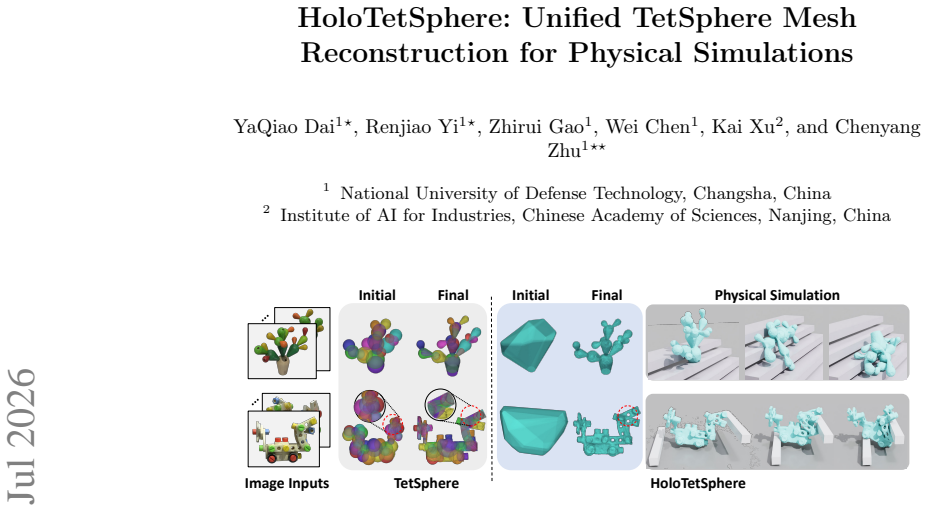
Standard pipelines for physics-ready 3D reconstruction rely on a decoupled two-stage paradigm: extracting surface geometry followed by an error-prone tetrahedralization process. While recent Lagrangian methods like TetSphere Splatting attempt to bypass this by directly optimizing volumetric primitives, their homeomorphic constraints prevent topology-adaptive optimization. Consequently, they produce disjoint tetrahedra rather than a single connected mesh, rendering the structures unsuitable for further physical simulations. To address this, we propose a topology-adaptive framework for holistic tetrahedral mesh reconstruction through end-to-end topological and geometric optimization. First, by coupling Gaussian spheres to tetrahedral elements and leveraging edge connections, we estimate a continuous opacity field for differentiable element pruning. Next, jointly minimizing mesh smoothing energy and multi-view Gaussian rendering error drives alternating geometric refinement while preserving topological adaptivity. Consequently, our approach effectively constructs a unified and topologically coherent tetrahedral mesh. Extensive experiments demonstrate that our method outperforms state-of-the-art techniques by achieving superior geometric accuracy and producing coherent, single-connected tetrahedral meshes, thereby effectively bypassing the error-prone conventional tetrahedralization step for reconstructed surface meshes and streamlining downstream physical simulation.
Figures


Reference graph
Works this paper leans on
-
[1]
Springer Science & Business Media (2013)
Bendsoe, M.P., Sigmund, O.: Topology optimization: theory, methods, and appli- cations. Springer Science & Business Media (2013)
work page 2013
-
[2]
IEEE transactions on visualization and computer graphics14(1), 213–230 (2008)
Botsch, M., Sorkine, O.: On linear variational surface deformation methods. IEEE transactions on visualization and computer graphics14(1), 213–230 (2008)
work page 2008
-
[3]
NeuSG: Neural Implicit Surface Reconstruction with 3D Gaussian Splatting Guidance
Chen,H.,Li,C.,Wang,Y.,Lee,G.H.:Neusg:Neuralimplicitsurfacereconstruction with 3d gaussian splatting guidance. arXiv preprint arXiv:2312.00846 (2023)
work page internal anchor Pith review Pith/arXiv arXiv 2023
-
[4]
In: Proceedings of the International Conference on Learning Representations (ICLR) (2025)
Chen, Y., He, T., Huang, D., Ye, W., Chen, S., Tang, J., Chen, X., Cai, Z., Yang, L., Yu, G., et al.: Meshanything: Artist-created mesh generation with autoregres- sive transformers. In: Proceedings of the International Conference on Learning Representations (ICLR) (2025)
work page 2025
-
[5]
Cambridge university press (2002)
Chung, T.J.: Computational fluid dynamics. Cambridge university press (2002)
work page 2002
-
[6]
In: Proceedings of the IEEE/CVF Conference on Computer Vision and Pattern Recognition
Deitke, M., Schwenk, D., Salvador, J., Weihs, L., Michel, O., VanderBilt, E., Schmidt, L., Ehsani, K., Kembhavi, A., Farhadi, A.: Objaverse: A universe of annotated 3d objects. In: Proceedings of the IEEE/CVF Conference on Computer Vision and Pattern Recognition. pp. 13142–13153 (2023)
work page 2023
-
[7]
In: Proceedings of the 26th annual conference on Computer graphics and interactive techniques
Desbrun, M., Meyer, M., Schröder, P., Barr, A.H.: Implicit fairing of irregular meshes using diffusion and curvature flow. In: Proceedings of the 26th annual conference on Computer graphics and interactive techniques. pp. 317–324 (1999)
work page 1999
-
[8]
Dou, Z., Lin, C., Xu, R., Yang, L., Xin, S., Komura, T., Wang, W.: Coverage axis: Inner point selection for 3d shape skeletonization. In: Computer Graphics Forum. vol. 41, pp. 419–432. Wiley Online Library (2022) 16 Y. Dai et al
work page 2022
-
[9]
In: Proceedings of the IEEE International Conference on Robotics and Automation (ICRA)
Downs, L., Francis, A., Koenig, N., Kinman, B., Hickman, R., Reymann, K., McHugh, T.B., Vanhoucke, V.: Google scanned objects: A High-Quality dataset of 3D scanned household items. In: Proceedings of the IEEE International Conference on Robotics and Automation (ICRA). pp. 2553–2560 (2022)
work page 2022
-
[10]
Advances in neural information processing systems33, 9936–9947 (2020)
Gao, J., Chen, W., Xiang, T., Jacobson, A., McGuire, M., Fidler, S.: Learning de- formable tetrahedral meshes for 3d reconstruction. Advances in neural information processing systems33, 9936–9947 (2020)
work page 2020
-
[11]
In: Proceedings of the IEEE/CVF International Conference on Computer Vision
Gao, Z., Yi, R., Dai, Y., Zhu, X., Chen, W., Zhu, C., Xu, K.: Curve-aware gaussian splatting for 3d parametric curve reconstruction. In: Proceedings of the IEEE/CVF International Conference on Computer Vision. pp. 27531–27541 (2025)
work page 2025
-
[12]
In: Proceedings of the IEEE/CVF International Conference on Computer Vision
Gao, Z., Yi, R., Huang, Y., Chen, W., Zhu, C., Xu, K.: Self-supervised learning of hybrid part-aware 3d representations of 2d gaussians and superquadrics. In: Proceedings of the IEEE/CVF International Conference on Computer Vision. pp. 9649–9659 (2025)
work page 2025
-
[13]
Gao, Z., Yi, R., Zhu, C., Zhuang, K., Chen, W., Xu, K.: Generic objects as pose probes for few-shot view synthesis. IEEE Transactions on Circuits and Systems for Video Technology35(9), 9046–9059 (2025), 10.1109/TCSVT.2025.3551303
-
[14]
In: Proceedings of the IEEE/CVF Conference on Computer Vision and Pattern Recognition
Guédon, A., Lepetit, V.: Sugar: Surface-aligned gaussian splatting for efficient 3d mesh reconstruction and high-quality mesh rendering. In: Proceedings of the IEEE/CVF Conference on Computer Vision and Pattern Recognition. pp. 5354– 5363 (2024)
work page 2024
-
[15]
In: Proceedings of the Inter- national Conference on Learning Representations (ICLR) (2025)
Guo, M., Wang, B., He, K., Matusik, W.: Tetsphere splatting: Representing high- quality geometry with lagrangian volumetric meshes. In: Proceedings of the Inter- national Conference on Learning Representations (ICLR) (2025)
work page 2025
- [16]
-
[17]
In: Computer Vision – ECCV 2020
Heming, Z., Yu, C., Hang, J., Weikai, C., Dong, D., Zhangye, W., Shuguang, C., Xiaoguang, H.: Deep fashion3d: A dataset and benchmark for 3d garment recon- struction from single images. In: Computer Vision – ECCV 2020. pp. 512–530. Springer International Publishing (2020)
work page 2020
-
[18]
In: ACM SIGGRAPH 2024 Conference Papers
Huang, B., Yu, Z., Chen, A., Geiger, A., Gao, S.: 2d gaussian splatting for geo- metrically accurate radiance fields. In: ACM SIGGRAPH 2024 Conference Papers. pp. 1–11 (2024)
work page 2024
-
[19]
In: Pro- ceedings of the AAAI Conference on Artificial Intelligence
Huang, T., Zhang, H., Zeng, Y., Zhang, Z., Li, H., Zuo, W., Lau, R.W.: Dream- physics: Learning physics-based 3d dynamics with video diffusion priors. In: Pro- ceedings of the AAAI Conference on Artificial Intelligence. vol. 39, pp. 3733–3741 (2025)
work page 2025
- [20]
-
[21]
ACM Transactions on Graphics42(4) (2023)
Kerbl, B., Kopanas, G., Leimkühler, T., Drettakis, G.: 3d gaussian splatting for real-time radiance field rendering. ACM Transactions on Graphics42(4) (2023)
work page 2023
-
[22]
In: Proceedings of the IEEE/CVF international conference on com- puter vision
Kulhanek, J., Sattler, T.: Tetra-nerf: Representing neural radiance fields using tetrahedra. In: Proceedings of the IEEE/CVF international conference on com- puter vision. pp. 18458–18469 (2023)
work page 2023
-
[23]
In: Proceedings of the International Conference on Learning Representations (ICLR) (2023)
Li, X., Qiao, Y.L., Chen, P.Y., Jatavallabhula, K.M., Lin, M., Jiang, C., Gan, C.: Pac-nerf: Physics augmented continuum neural radiance fields for geometry- agnostic system identification. In: Proceedings of the International Conference on Learning Representations (ICLR) (2023)
work page 2023
-
[24]
Li, Z., Müller, T., Evans, A., Taylor, R.H., Unberath, M., Liu, M.Y., Lin, C.H.: Neuralangelo: High-fidelity neural surface reconstruction. In: Proceedings of the HoloTetSphere 17 IEEE/CVF conference on computer vision and pattern recognition. pp. 8456–8465 (2023)
work page 2023
-
[25]
Commu- nications of the ACM65(1), 99–106 (2021)
Mildenhall, B., Srinivasan, P.P., Tancik, M., Barron, J.T., Ramamoorthi, R., Ng, R.: Nerf: Representing scenes as neural radiance fields for view synthesis. Commu- nications of the ACM65(1), 99–106 (2021)
work page 2021
-
[26]
ACM transactions on graphics (TOG)41(4), 1–15 (2022)
Müller,T.,Evans,A.,Schied,C.,Keller,A.:Instantneuralgraphicsprimitiveswith a multiresolution hash encoding. ACM transactions on graphics (TOG)41(4), 1–15 (2022)
work page 2022
-
[27]
In: Proceedings of the IEEE/CVF conference on computer vision and pattern recognition
Park,J.J.,Florence,P.,Straub,J.,Newcombe,R.,Lovegrove,S.:Deepsdf:Learning continuous signed distance functions for shape representation. In: Proceedings of the IEEE/CVF conference on computer vision and pattern recognition. pp. 165– 174 (2019)
work page 2019
-
[28]
In: Conference on Computer Vision and Pattern Recognition (CVPR) (2016)
Schönberger, J.L., Frahm, J.M.: Structure-from-motion revisited. In: Conference on Computer Vision and Pattern Recognition (CVPR) (2016)
work page 2016
-
[29]
Schüller, C., Kavan, L., Panozzo, D., Sorkine-Hornung, O.: Locally injective map- pings. In: Computer Graphics Forum. vol. 32, pp. 125–135. Wiley Online Library (2013)
work page 2013
-
[30]
Shen, T., Gao, J., Yin, K., Liu, M.Y., Fidler, S.: Deep marching tetrahedra: a hybrid representation for high-resolution 3d shape synthesis. In: NeurIPS (2021)
work page 2021
- [31]
-
[32]
In: Acm siggraph 2012 courses, pp
Sifakis,E.,Barbic,J.:Femsimulationof3ddeformablesolids:apractitioner’sguide to theory, discretization and model reduction. In: Acm siggraph 2012 courses, pp. 1–50. Association for Computing Machinery (2012)
work page 2012
-
[33]
In: Advances in Neural Information Processing Systems (NeurIPS) (2024)
Son, S., Gadelha, M., Zhou, Y., Xu, Z., Lin, M.C., Zhou, Y.: Dmesh: A differ- entiable representation for general meshes. In: Advances in Neural Information Processing Systems (NeurIPS) (2024)
work page 2024
-
[34]
In: Proceedings of the 22nd annual conference on Computer graphics and interactive techniques
Taubin, G.: A signal processing approach to fair surface design. In: Proceedings of the 22nd annual conference on Computer graphics and interactive techniques. pp. 351–358 (1995)
work page 1995
-
[35]
Computer Graphics Forum18(1999)
Vollmer, J., Mencl, R., Müller, H.: Improved laplacian smoothing of noisy surface meshes. Computer Graphics Forum18(1999)
work page 1999
-
[36]
In: Proceedings of the Computer Vision and Pattern Recognition Conference
Wang, J., Chen, M., Karaev, N., Vedaldi, A., Rupprecht, C., Novotny, D.: Vggt: Visual geometry grounded transformer. In: Proceedings of the Computer Vision and Pattern Recognition Conference. pp. 5294–5306 (2025)
work page 2025
-
[37]
In: Advances in Neural Information Processing Systems (NeurIPS)
Wang, P., Liu, L., Liu, Y., Theobalt, C., Komura, T., Wang, W.: Neus: Learning neural implicit surfaces by volume rendering for multi-view reconstruction. In: Advances in Neural Information Processing Systems (NeurIPS). vol. 34, pp. 27171– 27183 (2021)
work page 2021
-
[38]
In: Proceedings of the IEEE/CVF Conference on Computer Vision and Pattern Recognition
Wang, S., Leroy, V., Cabon, Y., Chidlovskii, B., Revaud, J.: Dust3r: Geometric 3d vision made easy. In: Proceedings of the IEEE/CVF Conference on Computer Vision and Pattern Recognition. pp. 20697–20709 (2024)
work page 2024
-
[39]
In: Pro- ceedings of the IEEE/CVF International Conference on Computer Vision (ICCV) (2023)
Wang, Y., Han, Q., Habermann, M., Daniilidis, K., Theobalt, C., Liu, L.: Neus2: Fast learning of neural implicit surfaces for multi-view reconstruction. In: Pro- ceedings of the IEEE/CVF International Conference on Computer Vision (ICCV) (2023)
work page 2023
-
[40]
In: Proceedings of the International Conference on Learning Representations (ICLR) (2023) 18 Y
Wu, T., Wang, J., Pan, X., Xu, X., Theobalt, C., Liu, Z., Lin, D.: Voxurf: Voxel- based efficient and accurate neural surface reconstruction. In: Proceedings of the International Conference on Learning Representations (ICLR) (2023) 18 Y. Dai et al
work page 2023
-
[41]
In: Proceedings of the IEEE/CVF Conference on Computer Vision and Pattern Recognition
Xie, T., Zong, Z., Qiu, Y., Li, X., Feng, Y., Yang, Y., Jiang, C.: Physgaussian: Physics-integrated 3d gaussians for generative dynamics. In: Proceedings of the IEEE/CVF Conference on Computer Vision and Pattern Recognition. pp. 4389– 4398 (2024)
work page 2024
-
[42]
In: Proceedings of the Computer Vision and Pattern Recognition Conference
Yang, J., Sax, A., Liang, K.J., Henaff, M., Tang, H., Cao, A., Chai, J., Meier, F., Feiszli, M.: Fast3r: Towards 3d reconstruction of 1000+ images in one forward pass. In: Proceedings of the Computer Vision and Pattern Recognition Conference. pp. 21924–21935 (2025)
work page 2025
-
[43]
In: Proceedings of the AAAI Conference on Artificial Intelli- gence
Yang, S., Liu, J., Wang, W., Guo, Z.: Tet-gan: Text effects transfer via stylization and destylization. In: Proceedings of the AAAI Conference on Artificial Intelli- gence. vol. 33, pp. 1238–1245 (2019)
work page 2019
-
[44]
In: Thirty-Fifth Conference on Neural Information Processing Systems (2021)
Yariv, L., Gu, J., Kasten, Y., Lipman, Y.: Volume rendering of neural implicit surfaces. In: Thirty-Fifth Conference on Neural Information Processing Systems (2021)
work page 2021
-
[45]
In: Proceedings of the IEEE/CVF Conference on Computer Vision and Pattern Recognition
Yariv, L., Puny, O., Gafni, O., Lipman, Y.: Mosaic-sdf for 3d generative models. In: Proceedings of the IEEE/CVF Conference on Computer Vision and Pattern Recognition. pp. 4630–4639 (2024)
work page 2024
-
[46]
Advances in Neural Information Processing Systems34, 10368–10381 (2021)
Zehnder, J., Li, Y., Coros, S., Thomaszewski, B.: Ntopo: Mesh-free topology op- timization using implicit neural representations. Advances in Neural Information Processing Systems34, 10368–10381 (2021)
work page 2021
-
[47]
In: European Conference on Computer Vision
Zhang, T., Yu, H.X., Wu, R., Feng, B.Y., Zheng, C., Snavely, N., Wu, J., Freeman, W.T.: Physdreamer: Physics-based interaction with 3d objects via video genera- tion. In: European Conference on Computer Vision. pp. 388–406. Springer (2024)
work page 2024
-
[48]
ACM Transactions on Graphics (TOG)41(6), 1–17 (2022)
Zhao, F., Jiang, Y., Yao, K., Zhang, J., Wang, L., Dai, H., Zhong, Y., Zhang, Y., Wu, M., Xu, L., et al.: Human performance modeling and rendering via neural animated mesh. ACM Transactions on Graphics (TOG)41(6), 1–17 (2022)
work page 2022
-
[49]
Thingi10K: A Dataset of 10,000 3D-Printing Models
Zhou, Q., Jacobson, A.: Thingi10k: A dataset of 10,000 3d-printing models. arXiv preprint arXiv:1605.04797 (2016) HoloTetSphere 19 A Overview This supplementary material provides additional implementation details, ex- tended experiments, and physical simulation configurations that complement the main paper. The content is organized as follows: Section B g...
work page internal anchor Pith review Pith/arXiv arXiv 2016
discussion (0)
Sign in with ORCID, Apple, or X to comment. Anyone can read and Pith papers without signing in.