REVIEW 3 major objections 6 minor 2 cited by
It's All in the Name: Mitigating Gender Bias with Name-Based Counterfactual Data Substitution
T0 review · 3 major / 6 minor · reviewed 2026-08-14 · deepseek-v4-flash
Pith's one-line read Name-paired rewriting cuts hidden gender bias in word embeddings by 49%.
desk verdict A solid empirical contribution on name-based counterfactual augmentation for gender debiasing, but the headline 49% indirect-bias figure rests on an under-specified cluster-purity evaluation and no released code. read the letter →
The pith
A machine-rendered reading of the paper's core claim, the machinery that carries it, and where it could break.
The reading
What carries the argument
The central mechanism is the Names Intervention: a bipartite matching of the 2,500 most frequent male and female first names in the US Social Security Administration gazetteer, solved as an assignment problem with the Hungarian method. Names are paired so that matched names are close in a two-dimensional space of log-frequency and gender-specificity, meaning a common, highly gender-specific name is swapped with a comparably common, comparably gender-specific name of the opposite gender. Combined with Counterfactual Data Substitution (CDS)—a per-document coin flip that swaps gendered words and paired names with probability 0.5 instead of duplicating the corpus—this mechanism expands the set of treated gender signals from a few dozen hand-made pairs to thousands of name tokens, and it is what the paper credits for the drop in indirect bias.
What would settle it
Rerun the indirect-bias experiment with several t-SNE perplexities, cluster counts, and random seeds; if the 49% reduction in cluster purity and the ordering of nCDS above all other methods does not persist across these settings, the paper's central claim is not supported by its own evaluation.
Extended reading notes
Core claim
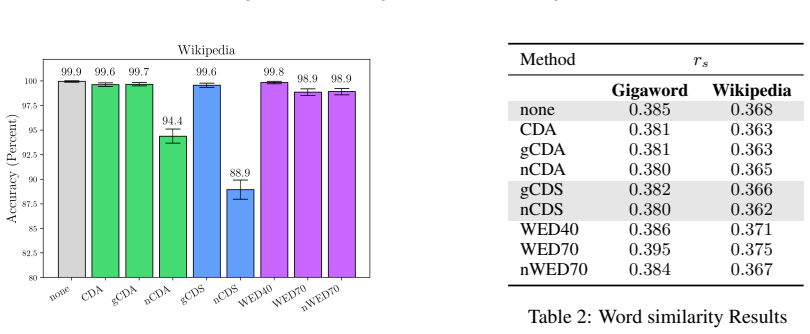
The paper's central empirical claim is that only counterfactual training with a name-pairing intervention—where occurrences of first names are swapped with matched names of the opposite gender before retraining embeddings—reduces indirect gender bias, meaning the tendency of previously biased words to remain separated by gender in the embedding space. In the authors' evaluation, this shows up as a 49% average reduction in the V-measure purity of clusters formed by the 1,000 most biased words across the two corpora, and as a significant drop in an SVM's accuracy at reclassifying the gender of biased words. The paper further claims that its CDA/CDS variants outperform projection-based Word Embedding Debiasing (WED) by an average of 19% on a new test of non-biased gender analogies, and that WED actually performs worse than the unmitigated embedding on that test, indicating it removes legitimate gender information along with bias. The authors frame these results against the gender subspace hypothesis—the assumption that bias lives in a low-dimensional linear subspace—which they argue is inadequate for capturing indirect bias.
Load-bearing premise
The central claim depends on the assumption that clustering the 1,000 most biased words after a low-dimensional projection is a stable and meaningful measure of indirect gender bias; if that measurement wobbles under different settings, the reported 49% reduction has no firm basis.
Editorial extensions
If this is right
- If the central claim holds, training embeddings on counterfactually substituted text with paired names is the only demonstrated way to reduce indirect gender bias, not just direct stereotypical associations.
- Projection-based debiasing should be expected to damage legitimate gender analogies, so downstream uses that need gender information—such as translation or coreference—would be better served by corpus-level counterfactual training.
- Counterfactual data substitution is faster than augmentation because it does not double the corpus, and it can in principle support multiple interventions without exponential growth.
- The benefit is tied to treating names: the paper's own comparison shows that adding the same names as equalise pairs to projection-based debiasing does not achieve the clustering reduction.
Reading between the lines
- One natural extension the paper leaves implicit is to measure downstream gender skew—for example in occupation classification or coreference resolution—after the Names Intervention, to see whether lower cluster purity translates into fairer behavior in applications.
- The reproducibility of the 49% figure is worth checking: because t-SNE and k-means are stochastic and the paper reports no perplexity or seed sensitivity, a stability analysis across random runs would tell whether the reduction is a property of the embeddings or of one embedding configuration.
- The same pairing-and-substitution recipe could be tested on other binary or multi-category name sets, such as nationality- or race-coded names, with the caveat the paper itself raises that valid pairings are harder to define there.
Signed reviews
Editorial analysis
A structured set of objections, weighed in public.
Referee Report
Summary. This paper compares two families of gender-debiasing methods for word embeddings—linear-subspace projection (WED) and counterfactual data augmentation (CDA)—on English Gigaword and Wikipedia. The authors propose two modifications to CDA: Counterfactual Data Substitution (CDS), which probabilistically substitutes gender-marked text instead of duplicating the corpus, and the Names Intervention, which pairs US SSA first names by frequency and gender-specificity using bipartite matching. Across WEAT direct-bias tests, an indirect-bias cluster-purity evaluation, SimLex-999, sentiment classification, and a new non-biased gender analogy task, the paper reports that CDA/S with the Names Intervention reduces direct bias comparably to WED, preserves embedding quality, outperforms WED on non-biased gender analogies by an average of 19%, and is the only method to mitigate indirect bias, with cluster purity reduced by an average of 49%.
Significance. If substantiated, the paper offers a practical path toward mitigating indirect gender bias—a known failure mode of linear-subspace debiasing—and provides evidence that counterfactual corpus modification can outperform projection-based methods. The strengths of the paper include the breadth of the empirical comparison across two large corpora, the use of multiple external benchmarks (WEAT, SimLex-999, sentiment classification), the construction of a second WED subspace to address variance thresholds, and a novel name-pairing algorithm with a clear rationale. The central limitations are reproducibility and validation: the headline indirect-bias result rests on a stochastic t-SNE/k-means pipeline whose hyperparameters, seeds, and variance are not reported, and the new non-biased analogy test is introduced without independent validation. These issues are load-bearing because the paper's main claims depend on them.
major comments (3)
- [§4 (Indirect bias), §5 (Indirect bias), Figs. 5–6] The headline claim that nCDA/nCDS is the only approach able to mitigate indirect bias rests on a t-SNE/k-means/V-measure pipeline for which no cluster count, t-SNE perplexity, random seeds, or run-to-run variance are reported. t-SNE is stochastic and is known to produce apparent clusters even on unstructured data, so the reported 49% average reduction (58% on Gigaword, 39% on Wikipedia; §5) is not interpretable without a null baseline (e.g., clustering the same words in unmodified embeddings with random labels or in random subspaces) and without variance estimates. The absence of released code or data makes independent verification impossible. The authors should report the missing hyperparameters, run the clustering multiple times with different seeds, and provide a null comparison before the central claim can be assessed.
- [§5 (Indirect bias), Fig. 7] The statement that nCDA and nCDS have 'significantly lower' cluster purity than all other methods is not supported by a statistical test applied to the V-measure. The permutation test described in §4 is applied to the classifier reclassification accuracy, and Fig. 7 reports confidence intervals only for that classifier, not for the cluster-purity values in Fig. 5. In addition, the t-SNE examples in Fig. 6 are described as 'chosen as they represent the best results' for each method, which is a selection criterion that can bias qualitative comparison. The authors should either provide a significance test and error bars for cluster purity or avoid claiming significance for those differences.
- [§4 (Non-biased gender analogies), §5 (Non-biased gender analogies), Fig. 9] The non-biased gender analogy test is a novel evaluation instrument, but its validity is not established. The conclusion that 'WED seems to remove too much gender information' depends on interpreting high error rates on this test as over-debiasing, yet the test could instead reflect sensitivity to word frequency, analogy difficulty, or embedding degeneracy. Because the abstract's comparison claim ('CDA variants outperform projection-based methods by an average of 19%') relies on this measure, the authors should validate the test, for example by showing agreement with human judgments of appropriate analogies or by demonstrating stable results across analogy subsets, multiple embedding seeds, and alternative analogy formulations.
minor comments (6)
- [§2.1 (after Eq. 1)] There is a typo: 'operalisation' should be 'operationalisation'. Also, in the same paragraph, 'the compliment of which' should be 'the complement of which'.
- [Table 1] The formatting of p-values is ambiguous in several entries (e.g., '1 .05 .02 1' and '1 .24 < 10−2'); the table should use clear column separators or explicit notation such as '1.05' and '0.02' so that each p-value is attributable to its test.
- [§3.2 (Names Intervention)] There are small language issues: 'occurances' should be 'occurrences', and the phrase 'We fixedly associate pairs of names' is awkward; consider rewording to 'We fix pairs of names ...'.
- [§4 (Non-biased gender analogies)] The text contains a double-colon typo: 'man::grandfather' should be 'man:grandfather'.
- [§4 (Experimental Setup)] The choice of substitution probability (0.5), the number of names per gender (2500), and the WED subspace threshold (70%) are fixed without a sensitivity analysis; a short discussion of how robust the reported results are to these choices would strengthen the paper.
- [§5 (Indirect bias)] The paper repeatedly states 'Gigaword patterns similarly' and defers to the appendix, but the appendix does not provide numerical V-measure values for Gigaword; adding a table with the exact values and cluster settings would aid reproducibility.
Circularity Check
No circularity found: the debiasing interventions and evaluations are grounded in external data and benchmarks, and the 49% cluster-purity reduction is a measured result, not a fitted prediction.
full rationale
The paper's central claims are empirical comparisons of debiasing methods. The Names Intervention pairs names using external SSA data and Hungarian matching on frequency and gender-specificity, with no parameter fitted to the reported evaluation metrics. The indirect-bias evaluation (t-SNE/k-means cluster purity and SVM reclassification) is taken from Gonen and Goldberg (2019), an externally published operationalization, and is not equivalent by construction to the intervention; the 49% reduction is a measured outcome, not a fitted prediction. The non-biased gender analogy test and quality benchmarks (WEAT, SimLex-999, sentiment classification) are external. The only self-citation is the use of Gonen and Goldberg's indirect-bias measure, co-authored by one of the present authors, but that measure is an external benchmark rather than a theorem invoked to force the paper's conclusions, so it does not constitute circularity. Reproducibility concerns about t-SNE hyperparameters and unreported seeds are correctness risks, not circularity, and do not affect the circularity score.
Assumptions & free parameters
free parameters (3)
- substitution_probability =
0.5
- num_names_per_gender =
2500
- WED_subspace_dimension =
1 (WED40), 2 (WED70)
assumptions (4)
- domain assumption Gender bias in word embeddings is partially captured by a linear subspace
- domain assumption Swapping gendered words and paired names in a corpus counterfactually removes gender bias without destroying semantics
- domain assumption SSA birth-record gender labels provide a reliable binary gender signal for first names
- domain assumption t-SNE followed by k-means yields a valid cluster-purity measure of indirect bias
Cite this review
Pith. "Pith review of It's All in the Name: Mitigating Gender Bias with Name-Based Counterfactual Data Substitution." pith.science (2026). https://pith.science/paper/XMR3PBCF
@misc{pith2026190900871,
  author       = {Pith},
  title        = {Pith review of: It's All in the Name: Mitigating Gender Bias with Name-Based Counterfactual Data Substitution},
  year         = {2026},
  howpublished = {\url{https://pith.science/paper/XMR3PBCF}},
  note         = {Machine review of arXiv:1909.00871}
}
read the original abstract
This paper treats gender bias latent in word embeddings. Previous mitigation attempts rely on the operationalisation of gender bias as a projection over a linear subspace. An alternative approach is Counterfactual Data Augmentation (CDA), in which a corpus is duplicated and augmented to remove bias, e.g. by swapping all inherently-gendered words in the copy. We perform an empirical comparison of these approaches on the English Gigaword and Wikipedia, and find that whilst both successfully reduce direct bias and perform well in tasks which quantify embedding quality, CDA variants outperform projection-based methods at the task of drawing non-biased gender analogies by an average of 19% across both corpora. We propose two improvements to CDA: Counterfactual Data Substitution (CDS), a variant of CDA in which potentially biased text is randomly substituted to avoid duplication, and the Names Intervention, a novel name-pairing technique that vastly increases the number of words being treated. CDA/S with the Names Intervention is the only approach which is able to mitigate indirect gender bias: following debiasing, previously biased words are significantly less clustered according to gender (cluster purity is reduced by 49%), thus improving on the state-of-the-art for bias mitigation.
Figures


Figures from the paper (10 more)




Forward citations
Cited by 2 Pith papers
-
FairSteer: Inference Time Debiasing for LLMs with Dynamic Activation Steering
FairSteer uses a linear probe to detect biased activations and adds a contrastively computed steering vector to shift generation toward unbiased answers, cutting bias across six LLMs without retraining.
-
A Survey on Data Security in Large Language Models
A survey of data security risks in LLMs that organizes threats, defenses, and evaluation datasets, with notable factual errors in its tables.
Reference graph
Works this paper leans on
-
[1]
URL: " 'urlintro :=
ENTRY address author booktitle chapter edition editor howpublished institution journal key month note number organization pages publisher school series title type volume year eprint doi pubmed url lastchecked label extra.label sort.label short.list INTEGERS output.state before.all mid.sentence after.sentence after.block STRINGS urlintro eprinturl eprintpr...
-
[2]
write newline
" write newline "" before.all 'output.state := FUNCTION n.dashify 't := "" t empty not t #1 #1 substring "-" = t #1 #2 substring "--" = not "--" * t #2 global.max substring 't := t #1 #1 substring "-" = "-" * t #2 global.max substring 't := while if t #1 #1 substring * t #2 global.max substring 't := if while FUNCTION word.in bbl.in capitalize " " * FUNCT...
-
[3]
David Bamman and Noah A. Smith. 2014. https://www.aclweb.org/anthology/Q14-1029 Unsupervised discovery of biographical structure from text . Transactions of the Association for Computational Linguistics, 2:363--376
work page 2014
-
[4]
Zou, Venkatesh Saligrama, and Adam Tauman Kalai
Tolga Bolukbasi, Kai - Wei Chang, James Y. Zou, Venkatesh Saligrama, and Adam Tauman Kalai. 2016. http://papers.nips.cc/paper/6228-man-is-to-computer-programmer-as-woman-is-to-homemaker-debiasing-word-embeddings Man is to computer programmer as woman is to homemaker? D ebiasing word embeddings . In Advances in Neural Information Processing Systems 29: Ann...
work page 2016
-
[5]
Aylin Caliskan, Joanna J. Bryson, and Arvind Narayanan. 2017. http://arxiv.org/abs/https://science.sciencemag.org/content/356/6334/183.full.pdf Semantics derived automatically from language corpora contain human-like biases . Science, 356(6334):183--186
work page 2017
-
[6]
Hila Gonen and Yoav Goldberg. 2019. Lipstick on a pig: D ebiasing methods cover up systematic gender biases in word embeddings but do not remove them. In Proceedings of the 2019 Conference of the North American Chapter of the Association for Computational Linguistics: Human Language Technologies, Volume 1 (Long Papers), Minneapolis, Minnesota. Association...
work page 2019
-
[7]
Eduardo Graells-Garrido, Mounia Lalmas, and Filippo Menczer. 2015. http://doi.acm.org/10.1145/2700171.2791036 First women, second sex: Gender bias in W ikipedia . In Proceedings of the 26th ACM Conference on Hypertext &\#38; Social Media, HT '15, pages 165--174, New York, NY, USA. ACM
arXiv 2015
-
[8]
Anthony G. Greenwald, Debbie E. McGhee, and Jordan L. K. Schwartz. 1998. Measuring individual differences in implicit cognition: T he I mplicit A ssociation T est. Journal of Personality and Social Psychology, 74(6):1464--1480
work page 1998
Show all 21 references
-
[9]
Felix Hill, Roi Reichart, and Anna Korhonen. 2015. https://www.aclweb.org/anthology/J15-4004 S im L ex-999: Evaluating semantic models with (genuine) similarity estimation . American Journal of Computational Linguistics, 41(4):665--695
2015
-
[10]
Harold W Kuhn. 1955. The hungarian method for the assignment problem. Naval research logistics quarterly, 2(1-2):83--97
1955
-
[11]
Jey Han Lau and Timothy Baldwin. 2016. https://www.aclweb.org/anthology/W16-1609 An empirical evaluation of doc2vec with practical insights into document embedding generation . In Proceedings of the 1st Workshop on Representation Learning for NLP , pages 78--86, Berlin, German...
2016
-
[12]
Quoc Le and Tomas Mikolov. 2014. http://proceedings.mlr.press/v32/le14.html Distributed representations of sentences and documents . In Proceedings of the 31st International Conference on Machine Learning, volume 32 of Proceedings of Machine Learning Research, pages 1188--1196...
2014
-
[13]
Kaiji Lu, Piotr Mardziel, Fangjing Wu, Preetam Amancharla, and Anupam Datta. 2018. http://arxiv.org/abs/1807.11714 Gender bias in neural natural language processing . CoRR, abs/1807.11714
2018 arXiv
-
[14]
Laurens van der Maaten and Geoffrey Hinton. 2008. http://www.jmlr.org/papers/v9/vandermaaten08a.html Visualizing data using t-SNE . Journal of Machine Learning Research, 9:2579--2605
2008
-
[15]
Corrado, and Jeff Dean
Tomas Mikolov, Ilya Sutskever, Kai Chen, Greg S. Corrado, and Jeff Dean. 2013. http://papers.nips.cc/paper/5021-distributed-representations-of-words-and-phrases-and-their-compositionality.pdf Distributed representations of words and phrases and their compositionality . In C. J...
2013
-
[16]
Courtney Napoles, Matthew Gormley, and Benjamin Van Durme . 2012. Annotated gigaword. In AKBC-WEKEX Workshop at NAACL 2012
2012
-
[17]
Nosek, Mahzarin R
Brian A. Nosek, Mahzarin R. Banaji, and Anthony G Greenwald. 2002. Harvesting implicit group attitudes and beliefs from a demonstration web site. Group Dynamics: Theory, Research, and Practice, 6 1:101--115
2002
-
[18]
Joseph Reagle and Lauren Rhue. 2011. https://ijoc.org/index.php/ijoc/article/view/777 Gender bias in W ikipedia and B ritannica . International Journal of Communication, 5(0)
2011
-
[19]
Andrew Rosenberg and Julia Hirschberg. 2007. https://www.aclweb.org/anthology/D07-1043 V -measure: A conditional entropy-based external cluster evaluation measure . In Proceedings of the 2007 Joint Conference on Empirical Methods in Natural Language Processing and Computationa...
2007
-
[20]
Rachel Rudinger, Jason Naradowsky, Brian Leonard, and Benjamin Van Durme. 2018. https://www.aclweb.org/anthology/N18-2002 Gender bias in coreference resolution . In Proceedings of the 2018 Conference of the North A merican Chapter of the Association for Computational Linguisti...
2018
-
[21]
Jieyu Zhao, Tianlu Wang, Mark Yatskar, Vicente Ordonez, and Kai-Wei Chang. 2018. https://www.aclweb.org/anthology/N18-2003 Gender bias in coreference resolution: Evaluation and debiasing methods . In Proceedings of the 2018 Conference of the North A merican Chapter of the Asso...
2018
Reviewed August 14, 2026 · model on record in the stance chip above.
Discussion (0). Continue with ORCID to comment.