REVIEW 2 major objections 5 minor 57 references
A Bayesian shared-control system for full SE(3) grasping lets low-bandwidth joystick users succeed more often with less effort.
Reviewed by Pith at T0; open to challenge. T0 means a machine referee read the full paper against a public rubric. the ladder, T0–T4 →
T0 review · grok-4.5
2026-07-13 03:55 UTC pith:XN2UA6MT
load-bearing objection Solid SE(3) extension of RT-V2 with a clean 21-subject study; the grasp-set assumption is the real limit, and the authors already own it. the 2 major comments →
Robot Trajectron V3: A Probabilistic Shared Control Framework for SE(3) Manipulation
The pith
A machine-rendered reading of the paper's core claim, the machinery that carries it, and where it could break.
Core claim
Shared control for multi-object, multi-affordance SE(3) grasping can be realized as continuous Bayesian posterior estimation over future trajectories: a transformer-conditioned generative prior that reasons over point clouds and grasp candidates is fused at every step with a likelihood derived from the observed user twist, producing assistance that is both intent-aware and collision-aware.
What carries the argument
The factorized CVAE-GMM prior: a transformer encodes scene point clouds and grasp-pose clouds, an LSTM tracks robot dynamics, a discrete latent variable captures multi-modal maneuver classes, and the six-dimensional action is split into a translational Gaussian whose sample then conditions a rotational Gaussian, yielding a tractable density that remains stable in closed-loop execution.
Load-bearing premise
The off-the-shelf grasp planner must already contain the exact grasp pose the user intends; if that pose is missing, the learned prior cannot recover it and the assistance actively fights the user.
What would settle it
Replace the grasp planner with one that systematically omits the instructed side or orientation of each object and measure whether success rate and user-reported control drop below pure teleoperation.
Editorial analysis
A structured set of objections, weighed in public.
Referee Report
Summary. The paper presents Robot Trajectron V3 (RT-V3), a Bayesian shared-control framework for SE(3) grasping under low-bandwidth interfaces. User intent is modeled as a distribution over future end-effector trajectories conditioned on past dynamics, point clouds, and candidate grasp poses from an off-the-shelf planner. A transformer-based CVAE-GMM prior with factorized translation-then-rotation decoding is trained via ELBO on planner trajectories; at runtime a Gaussian interface-noise likelihood yields a closed-form posterior that is used for continuous assistance, including an asynchronous mode that executes the prior when the user is silent. Evaluation comprises trajectory-prediction ablations, closed-loop planning against CuRobo and NeoSS, large-scale simulated-user shared-control trials, and a 21-participant real-world Xbox-joystick study reporting higher success rate, fewer inputs, and lower NASA-TLX scores than pure teleoperation and Hindsight Optimization.
Significance. If the reported gains hold, RT-V3 supplies a practical, modular recipe for lifting probabilistic shared autonomy from SE(2)/R^3 navigation to full SE(3) multi-object multi-affordance grasping. The combination of a transformer context encoder, translation-conditioned rotation factorization, and asynchronous assistance is a concrete engineering advance that demonstrably reduces cognitive and physical load for novice users on low-bandwidth devices. Code release, extensive ablations, and a properly powered user study with non-parametric statistics strengthen the claim and make the work immediately usable by the assistive-robotics community. The explicit surface of the grasp-planner completeness assumption further aids reproducibility and future improvement.
major comments (2)
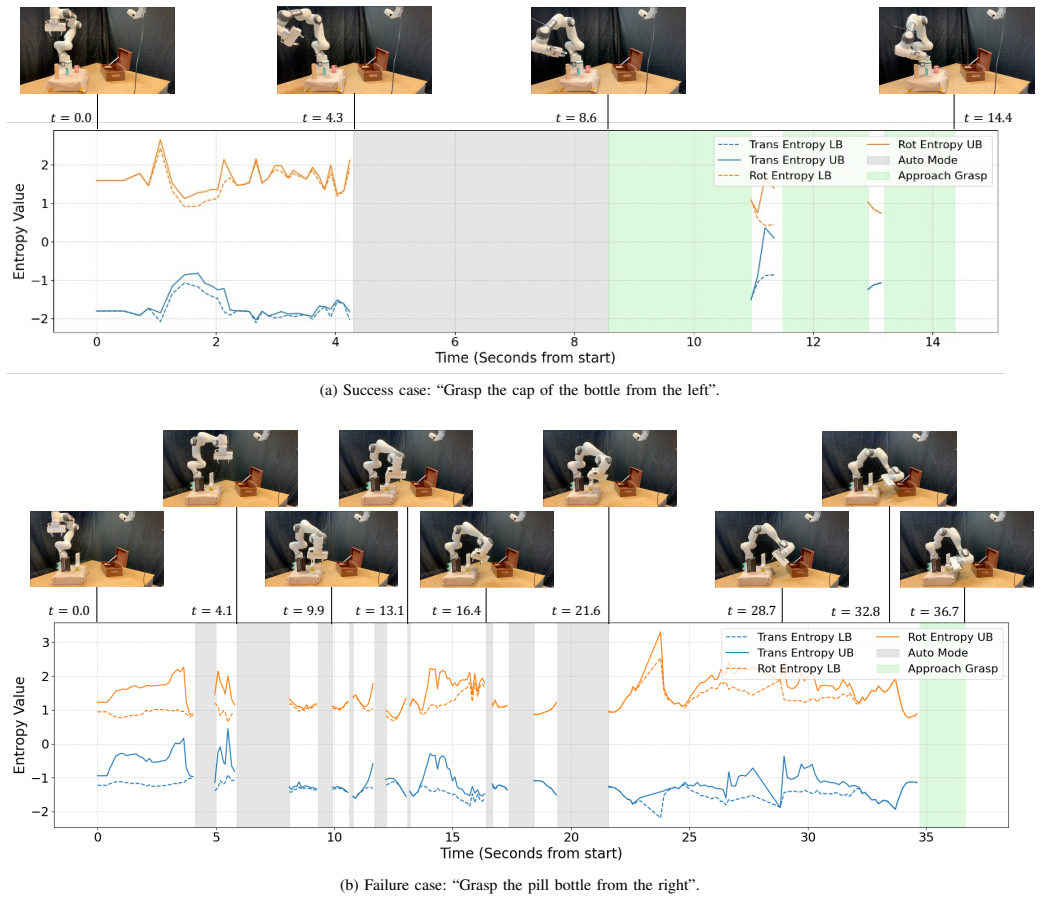
- Methodology Overview and Sec. V-B state the load-bearing assumption that the dense candidate set G produced by the off-the-shelf grasp planner contains the user’s intended grasp. When this fails (explicitly illustrated by the failure case in Fig. 8b and quantified by unmatched/time-out rates), the prior cannot recover the correct intent and posterior assistance becomes actively harmful. While the paper already acknowledges the limitation and shows RT-V3 is less brittle than HO under the same incomplete G, the real-world claim (86.9 % SR) is conditioned on the planner’s coverage of the 12 tested scenes. A short quantitative sensitivity analysis—e.g., randomly dropping a fraction of ground-truth grasps from G and re-running the simulated-user suite—would make the robustness boundary explicit and strengthen the central claim.
- Sec. VII-A / Table I: the “6D pred” ablation achieves the best open-loop ADE/FDE yet collapses to 3.4 % planning success. The authors attribute this to compounding error and claim the translation-conditioned factorization acts as a regularizer. The explanation is plausible but remains post-hoc; a short diagnostic (e.g., closed-loop state-distribution divergence or per-step rotation error conditioned on translation error) would confirm that the factorization, rather than other hyper-parameters, is the decisive factor for closed-loop stability.
minor comments (5)
- Eq. (5) and surrounding text: the maneuver-class posterior q(z|h_H) is used only at training time; a one-sentence clarification that inference always samples from the prior p(z|h_0) would prevent reader confusion.
- Fig. 6 caption and text: “adjusted” trajectory lengths exclude autonomous segments; the exact distance threshold used to disable asynchronous mode should be stated numerically for reproducibility.
- Appendix B: the manifold distance scales Euler angles by 0.3/π; a brief justification relative to the 0.3 m workspace size is already present, but units of the resulting ADE/FDE numbers (cm? rad?) should be made explicit in Table I.
- Typographical: “forSE(3)” missing space in title and abstract; “CV AE” inconsistently spaced; “maneuver class” sometimes hyphenated, sometimes not.
- Sec. VII-D protocol: 19 male / 2 female participants; a short note on whether gender imbalance was considered in the statistical analysis would be good practice.
Circularity Check
No significant circularity: standard CVAE prior + Bayesian update trained and evaluated empirically; self-cites supply lineage only.
full rationale
RT-V3 learns a trajectory prior p(i|c) via CVAE/ELBO (Eqs. 2–5) on planner-generated SE(3) trajectories, then forms the posterior by a standard Gaussian-interface likelihood (Eqs. 22–34). All headline claims—ADE/FDE, planning SR, and the 21-user study gains in success rate, joystick inputs, and NASA-TLX—are measured on held-out or real data against Direct/HO baselines, not obtained by algebraic rearrangement of fitted constants. Self-citations to RT-V1/RT-V2 supply the 2-D navigation architecture that is extended, but the SE(3) factorization, transformer encoders, asynchronous mechanism, and new experimental numbers stand independently. The grasp-set assumption is an explicit modeling premise with acknowledged failure modes (Fig. 8b, Limitations), not a definitional loop. No equation reduces a claimed prediction to its own input by construction.
Axiom & Free-Parameter Ledger
free parameters (4)
- β (ELBO weight)
- Σ_sys, Γ_sys (interface noise covariances)
- asynchronous disable distance
- number of maneuver classes |Z|
axioms (6)
- domain assumption The dense set of candidate grasp poses generated by an off-the-shelf planner contains the grasp the user intends to execute.
- domain assumption Environment is static during a trial (point cloud and grasp set do not change).
- domain assumption Latent dynamics are Markovian: h_t depends only on h_{t-1} and a_{t-1}.
- domain assumption User-command noise is independent Gaussian with known covariance (p(u|i)=N(u|i,Σ_sys)).
- domain assumption All poses, velocities and point clouds are expressed in the current end-effector frame, which is assumed to confer SE(3) equivariance.
- standard math Standard CVAE ELBO with discrete latent is a valid training objective for multi-modal trajectory densities.
invented entities (1)
-
maneuver-class latent z
no independent evidence
read the original abstract
We aim to address the challenge of teleoperating robotic arms for high-degree-of-freedom (high-DoF) manipulation tasks, which is cognitively demanding and error-prone, particularly when relying on low-bandwidth interfaces. We propose Robot Trajectron V3 (RT-V3), a probabilistic shared control framework designed for $SE(3)$ grasping tasks. RT-V3 formulates shared control as Bayesian inference by learning a prior over user intent and combining it with real-time user commands to estimate the posterior intent distribution. The prior models user intent as a distribution over future trajectories conditioned on past robot dynamics and visual scene context. The intent prior is parameterized by a transformer-based conditional generative model that reasons over point clouds and candidate grasp poses, together with a factorized translation-rotation representation that improves learning efficiency in high-dimensional action spaces. During execution, RT-V3 continuously estimates the posterior distribution over future trajectories by combining the learned intent prior with a user-command likelihood derived from the observed control input, enabling continuous intent refinement and shared assistance. Comprehensive experiments demonstrate that RT-V3 achieves high accuracy in trajectory prediction and competitive performance in reactive planning. Furthermore, real-world user studies indicate that RT-V3 significantly outperforms baseline methods in terms of success rate and efficiency, while substantially reducing the user's physical and mental workload.
Figures






Reference graph
Works this paper leans on
-
[1]
Mobile aloha: Learning bimanual mobile manipulation with low-cost whole-body teleoperation,
Z. Fu, T. Z. Zhao, and C. Finn, “Mobile aloha: Learning bimanual mobile manipulation with low-cost whole-body teleoperation,”arXiv preprint arXiv:2401.02117, 2024
Pith/arXiv arXiv 2024
-
[2]
Open-television: Teleoperation with immersive active visual feedback,
X. Cheng, J. Li, S. Yang, G. Yang, and X. Wang, “Open-television: Teleoperation with immersive active visual feedback,”arXiv preprint arXiv:2407.01512, 2024
Pith/arXiv arXiv 2024
-
[3]
Telemotion: A realtime humanoid teleoperation system with motion capture,
J. Gan, S. Guo, Z. Li, and X. Shi, “Telemotion: A realtime humanoid teleoperation system with motion capture,” inInternational Conference on Extended Reality. Springer, 2024, pp. 31–45
2024
-
[4]
Rulik, M
I. Rulik, M. S. H. Sunny, J. D. Sanjuan De Caro, M. I. I. Zarif, B. Brahmi, S. I. Ahamed, K. Schultz, I. Wang, T. Leheng, J. P. Longxiang,et al., “Control of a wheelchair-mounted 6dof assistive robot 𝑡=0.0 𝑡=1.9𝑡=3.3 𝑡=9.3𝑡=6.3 𝑡=19.4𝑡=13.4 𝑡=5.7 𝑡=10.2 (a) 𝑡=0.0 𝑡=4.3 𝑡=9.8𝑡=11.9𝑡=14.9 𝑡=19.0𝑡=17.8 (b) 𝑡=0.0 𝑡=2.6 𝑡=14.9𝑡=8.0 𝑡=9.9 𝑡=13.6 (c) Fig. 10: Vi...
2022
-
[5]
Controlling an automated wheelchair via joystick/head-joystick supported by smart driving assistance,
T. Rofer, C. Mandel, and T. Laue, “Controlling an automated wheelchair via joystick/head-joystick supported by smart driving assistance,” in 2009 IEEE international conference on rehabilitation robotics. IEEE, 2009, pp. 743–748
2009
-
[6]
Reach and grasp by people with tetraplegia using a neurally controlled robotic arm,
L. R. Hochberg, D. Bacher, B. Jarosiewicz, N. Y . Masse, J. D. Simeral, J. V ogel, S. Haddadin, J. Liu, S. S. Cash, P. Van Der Smagt,et al., “Reach and grasp by people with tetraplegia using a neurally controlled robotic arm,”Nature, vol. 485, no. 7398, pp. 372–375, 2012
2012
-
[7]
Stabilization–responsiveness trade-offs in continuous shared-control for invasive brain–computer interfaces,
O. Saussus, P. Song, S. De Schrijver, I. Caprara, T. Decramer, R. Detry, and P. Janssen, “Stabilization–responsiveness trade-offs in continuous shared-control for invasive brain–computer interfaces,”bioRxiv, pp. 2026–03, 2026
2026
-
[8]
Assistive planning in complex, dynamic environments: a probabilistic approach,
P. Trautman, “Assistive planning in complex, dynamic environments: a probabilistic approach,” in2015 IEEE International Conference on Systems, Man, and Cybernetics. IEEE, 2015, pp. 3072–3078
2015
-
[9]
An intention prediction based shared control system for point-to-point navigation of a robotic wheelchair,
Z. Lei, B. Y . Tan, N. P. Garg, L. Li, A. Sidarta, and W. T. Ang, “An intention prediction based shared control system for point-to-point navigation of a robotic wheelchair,”IEEE Robotics and Automation Letters, vol. 7, no. 4, pp. 8893–8900, 2022
2022
-
[10]
Shared control in robot teleoperation with improved potential fields,
A. Gottardi, S. Tortora, E. Tosello, and E. Menegatti, “Shared control in robot teleoperation with improved potential fields,”IEEE Transactions on Human-Machine Systems, vol. 52, no. 3, pp. 410–422, 2022
2022
-
[11]
A policy-blending formalism for shared control,
A. D. Dragan and S. S. Srinivasa, “A policy-blending formalism for shared control,”The International Journal of Robotics Research, vol. 32, no. 7, pp. 790–805, 2013
2013
-
[12]
Contin- uous shared control for robotic arm reaching driven by a hybrid gaze- brain machine interface,
Y . Wang, G. Xu, A. Song, B. Xu, H. Li, C. Hu, and H. Zeng, “Contin- uous shared control for robotic arm reaching driven by a hybrid gaze- brain machine interface,” in2018 IEEE/RSJ International Conference on Intelligent Robots and Systems (IROS). IEEE, 2018, pp. 4462–4467
2018
-
[13]
Natural gradient shared control,
Y . Oh, S.-W. Wu, M. Toussaint, and J. Mainprice, “Natural gradient shared control,” in2020 29th IEEE International Conference on Robot and Human Interactive Communication (RO-MAN). IEEE, 2020, pp. 1223–1229
2020
-
[14]
Brain–computer interface control with artificial intelligence copilots,
J. Y . Lee, S. Lee, A. Mishra, X. Yan, B. McMahan, B. Gaisford, C. Kobashigawa, M. Qu, C. Xie, and J. C. Kao, “Brain–computer interface control with artificial intelligence copilots,”Nature machine intelligence, vol. 7, no. 9, pp. 1510–1523, 2025
2025
-
[15]
A shared control strategy for reach and grasp of multiple objects using robot vision and noninvasive brain–computer interface,
Y . Xu, H. Zhang, L. Cao, X. Shu, and D. Zhang, “A shared control strategy for reach and grasp of multiple objects using robot vision and noninvasive brain–computer interface,”IEEE Transactions on Automa- tion Science and Engineering, vol. 19, no. 1, pp. 360–372, 2020
2020
-
[16]
Robot trajectron: Trajectory prediction-based shared control for robot manipulation,
P. Song, P. Li, E. Aertbeli ¨en, and R. Detry, “Robot trajectron: Trajectory prediction-based shared control for robot manipulation,” inProceedings Of IEEE International Conference on Robotics and Automation, 2024
2024
-
[17]
Robot trajectron v2: A probabilistic shared control framework for navigation,
P. Song, Y . Du, O. Saussus, S. De Schrijver, I. Caprara, P. Janssen, and R. Detry, “Robot trajectron v2: A probabilistic shared control framework for navigation,”arXiv preprint arXiv:2509.19954, 2025
arXiv 2025
-
[18]
Model predictive-based shared control for brain- controlled driving,
Y . Lu, L. Bi, and H. Li, “Model predictive-based shared control for brain- controlled driving,”IEEE Transactions on Intelligent Transportation Systems, vol. 21, no. 2, pp. 630–640, 2019
2019
-
[19]
Shared control for intelligent wheelchairs: an implicit estimation of the user intention,
D. Vanhooydonck, E. Demeester, M. Nuttin, and H. Van Brussel, “Shared control for intelligent wheelchairs: an implicit estimation of the user intention,” inProceedings of the 1st international workshop on advances in service robotics (ASER’03), 2003, pp. 176–182
2003
-
[20]
Assistron: Bayesian shared auton- omy with off-the-shelf vision-language-action models,
P. Song, Z. Fu, Y . Hu, and R. Detry, “Assistron: Bayesian shared auton- omy with off-the-shelf vision-language-action models,”arXiv preprint arXiv:2606.23147, 2026
Pith/arXiv arXiv 2026
-
[21]
Shared autonomy via hindsight optimization for teleoperation and teaming,
S. Javdani, H. Admoni, S. Pellegrinelli, S. S. Srinivasa, and J. A. Bagnell, “Shared autonomy via hindsight optimization for teleoperation and teaming,”The International Journal of Robotics Research, vol. 37, no. 7, pp. 717–742, 2018
2018
-
[22]
Autonomy infused teleoperation with application to brain computer interface controlled manipulation,
K. Muelling, A. Venkatraman, J.-S. Valois, J. E. Downey, J. Weiss, S. Javdani, M. Hebert, A. B. Schwartz, J. L. Collinger, and J. A. Bagnell, “Autonomy infused teleoperation with application to brain computer interface controlled manipulation,”Autonomous Robots, vol. 41, pp. 1401–1422, 2017
2017
-
[23]
Shared autonomy of a robotic manipulator for grasping under human intent uncertainty using pomdps,
J.-A. Yow, N. P. Garg, and W. T. Ang, “Shared autonomy of a robotic manipulator for grasping under human intent uncertainty using pomdps,” IEEE Transactions on Robotics, vol. 40, pp. 332–350, 2023
2023
-
[24]
Tasc: Task-aware shared control for teleoperated manipulation,
Z. Fu, P. Song, Y . Hu, and R. Detry, “Tasc: Task-aware shared control for teleoperated manipulation,” 2025. [Online]. Available: https://arxiv.org/abs/2509.10416
Pith/arXiv arXiv 2025
-
[25]
Survey of imitation learning for robotic manipulation,
B. Fang, S. Jia, D. Guo, M. Xu, S. Wen, and F. Sun, “Survey of imitation learning for robotic manipulation,”International Journal of Intelligent Robotics and Applications, vol. 3, pp. 362–369, 2019
2019
-
[26]
A survey on imitation learning techniques for end-to-end autonomous vehicles,
L. Le Mero, D. Yi, M. Dianati, and A. Mouzakitis, “A survey on imitation learning techniques for end-to-end autonomous vehicles,” IEEE Transactions on Intelligent Transportation Systems, vol. 23, no. 9, pp. 14 128–14 147, 2022
2022
-
[27]
Open x- embodiment: Robotic learning datasets and rt-x models,
A. Padalkar, A. Pooley, A. Jain, A. Bewley, A. Herzog, A. Ir- pan, A. Khazatsky, A. Rai, A. Singh, A. Brohan,et al., “Open x- embodiment: Robotic learning datasets and rt-x models,”arXiv preprint arXiv:2310.08864, 2023
Pith/arXiv arXiv 2023
-
[28]
Learning fine- grained bimanual manipulation with low-cost hardware,
T. Z. Zhao, V . Kumar, S. Levine, and C. Finn, “Learning fine- grained bimanual manipulation with low-cost hardware,”arXiv preprint arXiv:2304.13705, 2023
Pith/arXiv arXiv 2023
-
[29]
Implicit behavioral cloning,
P. Florence, C. Lynch, A. Zeng, O. A. Ramirez, A. Wahid, L. Downs, A. Wong, J. Lee, I. Mordatch, and J. Tompson, “Implicit behavioral cloning,” inConference on robot learning. PMLR, 2022, pp. 158–168
2022
-
[30]
Diffusion policy: Visuomotor policy learning via ac- tion diffusion,
C. Chi, Z. Xu, S. Feng, E. Cousineau, Y . Du, B. Burchfiel, R. Tedrake, and S. Song, “Diffusion policy: Visuomotor policy learning via ac- tion diffusion,”The International Journal of Robotics Research, p. 02783649241273668, 2023
2023
-
[31]
Rlbench: The robot learning benchmark & learning environment,
S. James, Z. Ma, D. R. Arrojo, and A. J. Davison, “Rlbench: The robot learning benchmark & learning environment,”IEEE Robotics and Automation Letters, vol. 5, no. 2, pp. 3019–3026, 2020
2020
-
[32]
Libero: Benchmarking knowledge transfer for lifelong robot learning,
B. Liu, Y . Zhu, C. Gao, Y . Feng, Q. Liu, Y . Zhu, and P. Stone, “Libero: Benchmarking knowledge transfer for lifelong robot learning,”Advances in Neural Information Processing Systems, vol. 36, pp. 44 776–44 791, 2023
2023
-
[33]
Calvin: A benchmark for language-conditioned policy learning for long-horizon robot manipulation tasks,
O. Mees, L. Hermann, E. Rosete-Beas, and W. Burgard, “Calvin: A benchmark for language-conditioned policy learning for long-horizon robot manipulation tasks,”IEEE Robotics and Automation Letters, vol. 7, no. 3, pp. 7327–7334, 2022
2022
-
[34]
Dinov2: Learning robust visual features without supervision,
M. Oquab, T. Darcet, T. Moutakanni, H. V o, M. Szafraniec, V . Khalidov, P. Fernandez, D. Haziza, F. Massa, A. El-Nouby,et al., “Dinov2: Learning robust visual features without supervision,”arXiv preprint arXiv:2304.07193, 2023
Pith/arXiv arXiv 2023
-
[35]
Openvla: An open- source vision-language-action model,
M. J. Kim, K. Pertsch, S. Karamcheti, T. Xiao, A. Balakrishna, S. Nair, R. Rafailov, E. Foster, G. Lam, P. Sanketi,et al., “Openvla: An open- source vision-language-action model,”arXiv preprint arXiv:2406.09246, 2024
Pith/arXiv arXiv 2024
-
[36]
Pointnet: Deep learning on point sets for 3d classification and segmentation,
C. R. Qi, H. Su, K. Mo, and L. J. Guibas, “Pointnet: Deep learning on point sets for 3d classification and segmentation,” inProceedings of the IEEE conference on computer vision and pattern recognition, 2017, pp. 652–660
2017
-
[37]
Point transformer,
H. Zhao, L. Jiang, J. Jia, P. H. Torr, and V . Koltun, “Point transformer,” inProceedings of the IEEE/CVF international conference on computer vision, 2021, pp. 16 259–16 268
2021
-
[38]
Point transformer v2: Grouped vector attention and partition-based pooling,
X. Wu, Y . Lao, L. Jiang, X. Liu, and H. Zhao, “Point transformer v2: Grouped vector attention and partition-based pooling,”Advances in Neural Information Processing Systems, vol. 35, pp. 33 330–33 342, 2022
2022
-
[39]
Point transformer v3: Simpler faster stronger,
X. Wu, L. Jiang, P.-S. Wang, Z. Liu, X. Liu, Y . Qiao, W. Ouyang, T. He, and H. Zhao, “Point transformer v3: Simpler faster stronger,” inProceedings of the IEEE/CVF conference on computer vision and pattern recognition, 2024, pp. 4840–4851
2024
-
[40]
Equivariant diffusion policy,
D. Wang, S. Hart, D. Surovik, T. Kelestemur, H. Huang, H. Zhao, M. Yeatman, J. Wang, R. Walters, and R. Platt, “Equivariant diffusion policy,” in8th Annual Conference on Robot Learning, 2024
2024
-
[41]
Bilateral control-based imitation learning for velocity- controlled robot,
S. Sakaino, “Bilateral control-based imitation learning for velocity- controlled robot,” in2021 IEEE 30th International Symposium on Industrial Electronics (ISIE). IEEE, 2021, pp. 1–6
2021
-
[42]
3d diffuser ac- tor: Policy diffusion with 3d scene representations,
T.-W. Ke, N. Gkanatsios, and K. Fragkiadaki, “3d diffuser ac- tor: Policy diffusion with 3d scene representations,”arXiv preprint arXiv:2402.10885, 2024
Pith/arXiv arXiv 2024
-
[43]
Mini diffuser: Fast multi-task diffusion policy training using two-level mini-batches,
Y . Hu, P. Song, K. Wen, and R. Detry, “Mini diffuser: Fast multi-task diffusion policy training using two-level mini-batches,”arXiv preprint arXiv:2505.09430, 2025
Pith/arXiv arXiv 2025
-
[44]
Perceiver-actor: A multi- task transformer for robotic manipulation,
M. Shridhar, L. Manuelli, and D. Fox, “Perceiver-actor: A multi- task transformer for robotic manipulation,” inProceedings of The 6th Conference on Robot Learning, ser. Proceedings of Machine Learning Research, K. Liu, D. Kulic, and J. Ichnowski, Eds., vol
-
[45]
PMLR, 14–18 Dec 2023, pp. 785–799. [Online]. Available: https://proceedings.mlr.press/v205/shridhar23a.html
2023
-
[46]
Transformer-based deep im- itation learning for dual-arm robot manipulation,
H. Kim, Y . Ohmura, and Y . Kuniyoshi, “Transformer-based deep im- itation learning for dual-arm robot manipulation,” in2021 IEEE/RSJ International Conference on Intelligent Robots and Systems (IROS). IEEE, 2021, pp. 8965–8972
2021
-
[47]
Implicit grasp diffusion: Bridging the gap between dense prediction and sampling-based grasping,
P. Song, P. Li, and R. Detry, “Implicit grasp diffusion: Bridging the gap between dense prediction and sampling-based grasping,” in8th Annual Conference on Robot Learning, 2024
2024
-
[48]
Equivariant volumetric grasping,
P. Song, Y . Hu, P. Li, and R. Detry, “Equivariant volumetric grasping,” arXiv preprint arXiv:2507.18847, 2025
Pith/arXiv arXiv 2025
-
[49]
A review of intent detection, arbitration, and communication aspects of shared control for physical human–robot interaction,
D. P. Losey, C. G. McDonald, E. Battaglia, and M. K. O’Malley, “A review of intent detection, arbitration, and communication aspects of shared control for physical human–robot interaction,”Applied Mechanics Reviews, vol. 70, no. 1, p. 010804, 2018
2018
-
[50]
Learning structured output represen- tation using deep conditional generative models,
K. Sohn, H. Lee, and X. Yan, “Learning structured output represen- tation using deep conditional generative models,”Advances in neural information processing systems, vol. 28, 2015
2015
-
[51]
beta-vae: Learning basic visual concepts with a constrained variational framework,
I. Higgins, L. Matthey, A. Pal, C. Burgess, X. Glorot, M. Botvinick, S. Mohamed, and A. Lerchner, “beta-vae: Learning basic visual concepts with a constrained variational framework,” inInternational conference on learning representations, 2016
2016
-
[52]
Stochastic tra- jectory prediction via motion indeterminacy diffusion,
T. Gu, G. Chen, J. Li, C. Lin, Y . Rao, J. Zhou, and J. Lu, “Stochastic tra- jectory prediction via motion indeterminacy diffusion,” inProceedings of the IEEE/CVF Conference on Computer Vision and Pattern Recognition, 2022, pp. 17 113–17 122
2022
-
[53]
The trajectron: Probabilistic multi-agent trajectory modeling with dynamic spatiotemporal graphs,
B. Ivanovic and M. Pavone, “The trajectron: Probabilistic multi-agent trajectory modeling with dynamic spatiotemporal graphs,” inProceed- ings of the IEEE/CVF International Conference on Computer Vision, 2019, pp. 2375–2384
2019
-
[54]
Curobo: Parallelized collision-free robot motion generation,
B. Sundaralingam, S. K. S. Hari, A. Fishman, C. Garrett, K. Van Wyk, V . Blukis, A. Millane, H. Oleynikova, A. Handa, F. Ramos,et al., “Curobo: Parallelized collision-free robot motion generation,” in2023 IEEE International Conference on Robotics and Automation (ICRA). IEEE, 2023, pp. 8112–8119
2023
-
[55]
Efficient collision detection framework for enhancing collision-free robot motion,
X. Zhu, Y . Xin, S. Li, H. Liu, C. Xia, and B. Liang, “Efficient collision detection framework for enhancing collision-free robot motion,” in2025 IEEE International Conference on Robotics and Automation (ICRA). IEEE, 2025, pp. 16 162–16 168
2025
-
[56]
Shared autonomy via deep reinforcement learning,
S. Reddy, A. D. Dragan, and S. Levine, “Shared autonomy via deep reinforcement learning,”arXiv preprint arXiv:1802.01744, 2018
Pith/arXiv arXiv 2018
-
[57]
Development of nasa-tlx (task load index): Results of empirical and theoretical research,
S. Hart, “Development of nasa-tlx (task load index): Results of empirical and theoretical research,”Human mental workload/Elsevier, 1988
1988
discussion (0)
Sign in with ORCID, Apple, or X to comment. Anyone can read and Pith papers without signing in.