Exploring the neutron momentum distribution in nuclei through γ n to π^- p at an electron-positron collider
Pith reviewed 2026-07-02 10:10 UTC · model grok-4.3
The pith
Electron-positron colliders like BESIII can measure the neutron momentum distribution in nuclei via the γn → π⁻p process.
A machine-rendered reading of the paper's core claim, the machinery that carries it, and where it could break.
Core claim
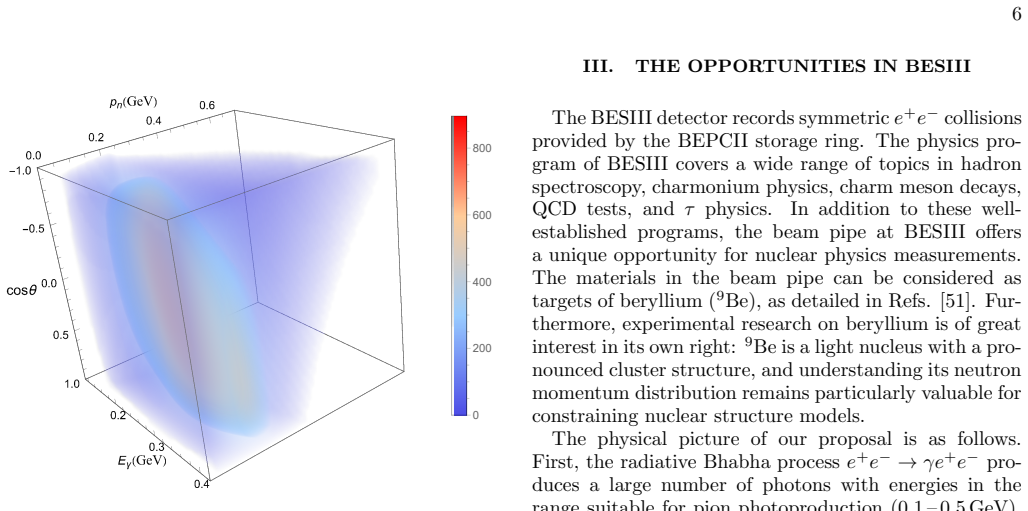
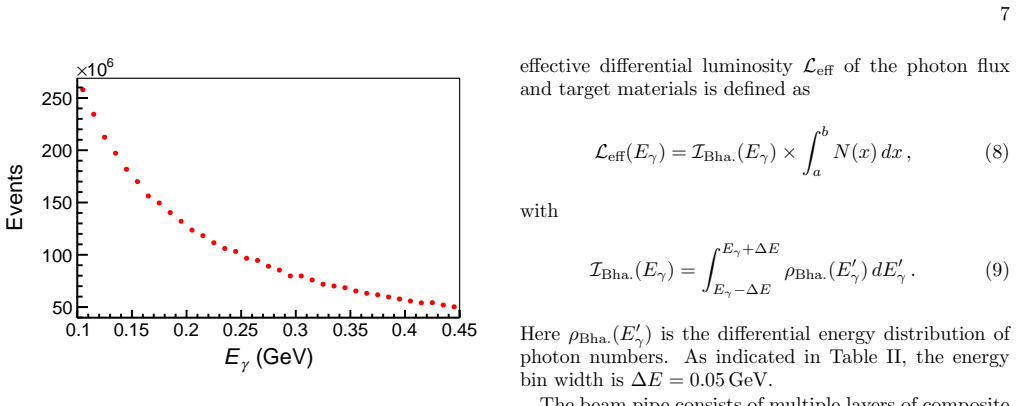
The paper claims that the γn → π⁻p process at BESIII, using the beryllium beam pipe as target material, can generate tens of thousands of events within the impulse approximation, providing the statistics needed for precise measurements of the neutron momentum distribution in nuclei.
What carries the argument
The impulse approximation framework for cross-section calculations on deuteron and beryllium targets, combined with the photon flux from radiative Bhabha scattering.
If this is right
- Precise measurements of the neutron momentum distribution become feasible at BESIII.
- Improved extraction of free neutron observables from nuclear targets.
- Direct access to the high-momentum neutron fraction that tests the tensor force and short-range correlations.
- Electron-positron colliders gain a demonstrated role in nuclear structure research.
Where Pith is reading between the lines
- Similar beam-pipe targets at other e+e- colliders could enable comparable measurements without dedicated nuclear facilities.
- The method could be cross-checked against electron-scattering data on the same nuclei to test consistency of momentum distributions.
- Higher-luminosity runs or detector upgrades would scale the event yield for finer binning in momentum.
Load-bearing premise
The impulse approximation accurately describes the γn → π⁻p process on deuteron and beryllium targets without significant final-state interaction or off-shell corrections that would alter the extracted momentum distribution.
What would settle it
An actual count of events at BESIII that falls well below or above the predicted tens of thousands, or an extracted momentum distribution that deviates markedly from impulse-approximation expectations after data taking.
Figures

read the original abstract
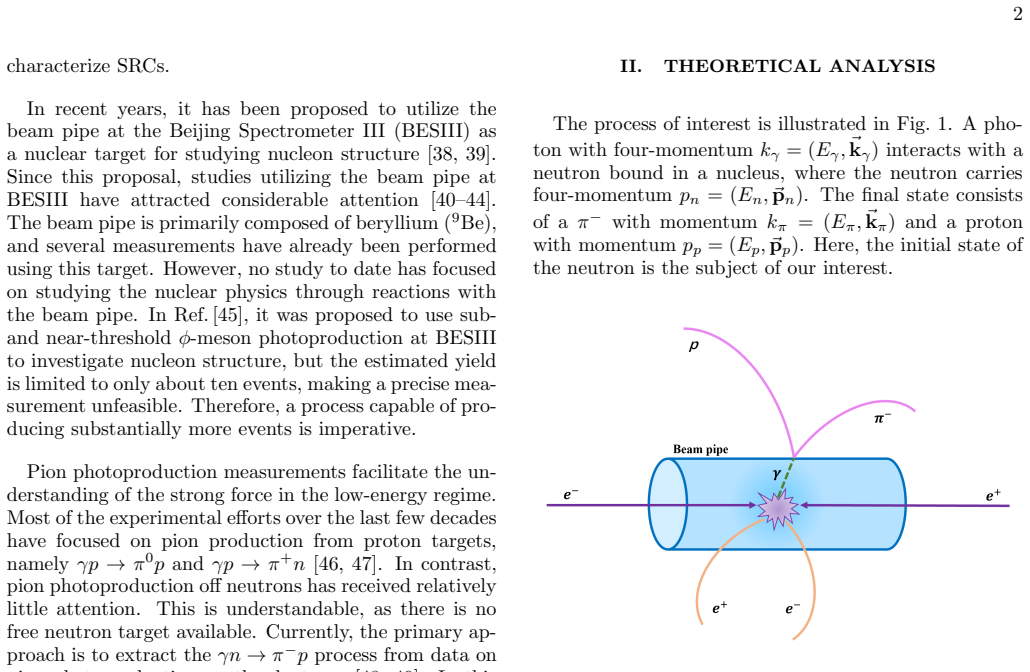
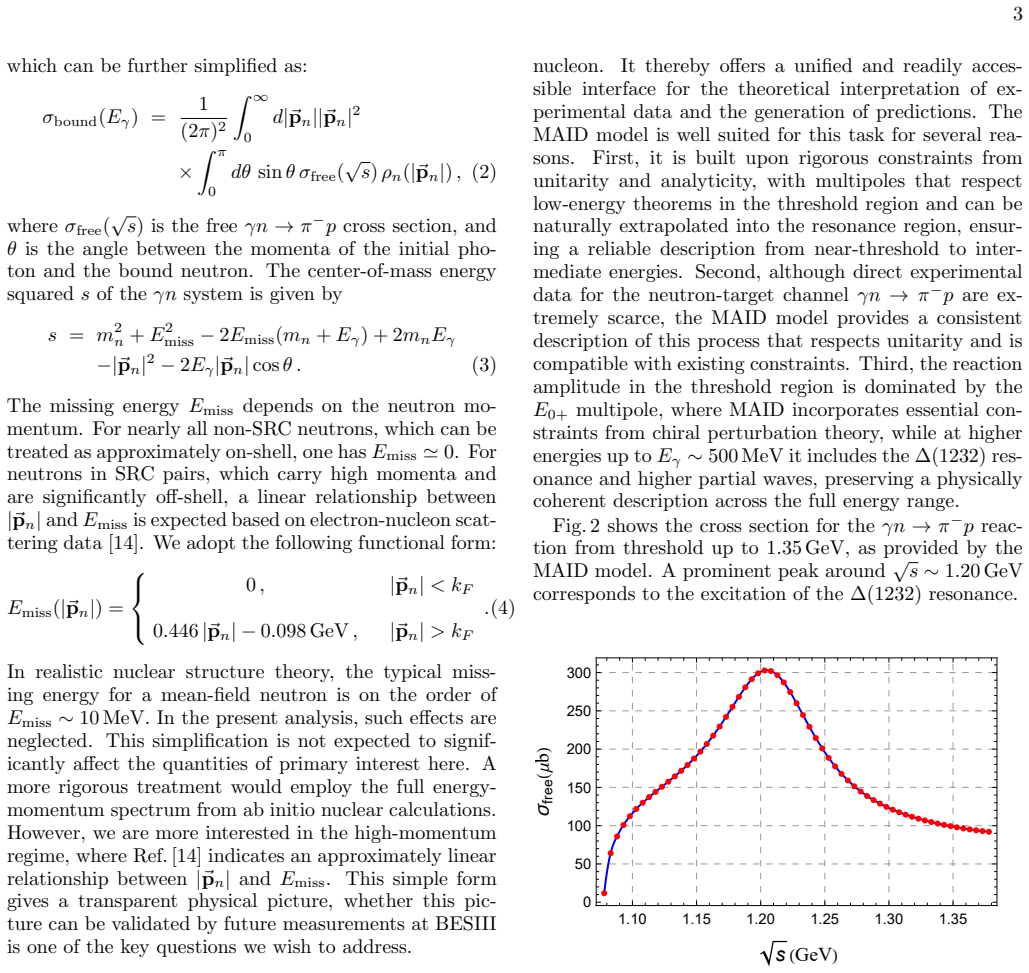
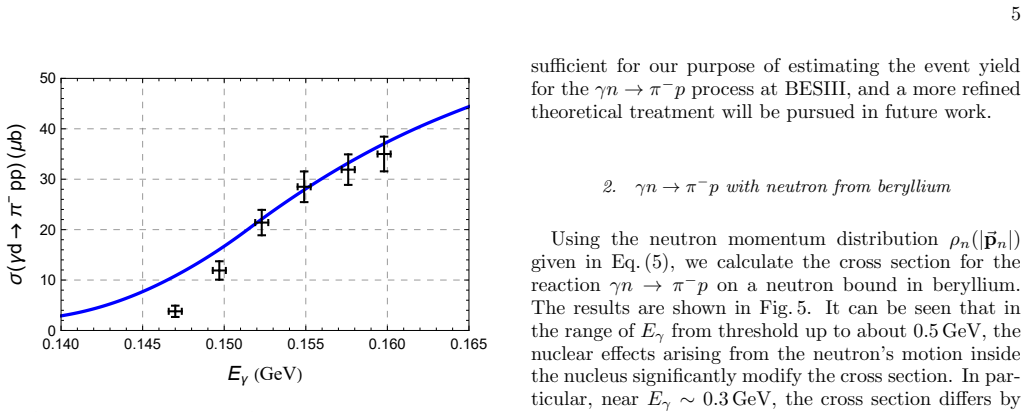
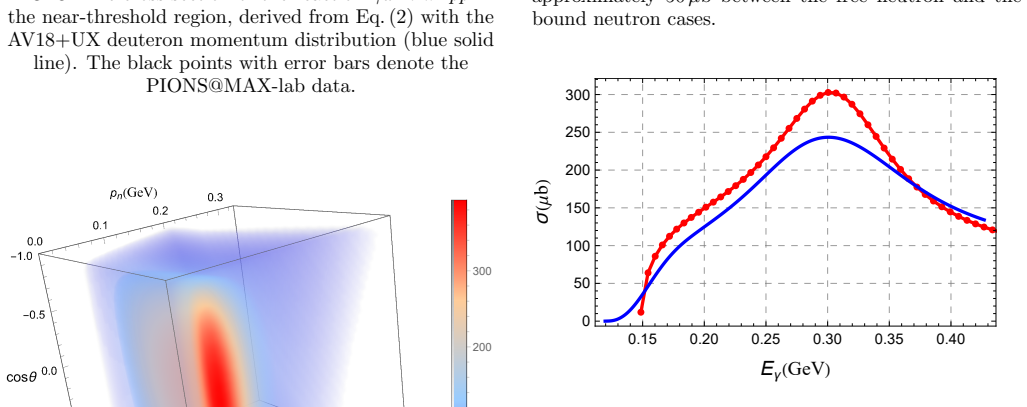
The neutron momentum distribution is essential both for reliably extracting fundamental free neutron observables from nuclear measurements and for probing the tensor force via the high-momentum neutron fraction, which is crucial to the theoretical understanding of short-range correlations (SRCs). In this work, we investigate this distribution by studying the $\gamma n \to \pi^- p$ process at an electron-positron collider, proposing to utilize the beryllium beam pipe at the Beijing Spectrometer III (BESIII). The cross sections for this process on both deuteron and beryllium targets are calculated within the impulse approximation framework. We also evaluate the effective luminosity of the photon flux from radiative Bhabha scattering, taking into account the distribution of target materials within the BESIII experimental setup. Our results show that tens of thousands of events can be generated at BESIII, offering the potential for precise measurements of the neutron momentum distribution. These findings suggest that electron-positron colliders could play a valuable role in elucidating nuclear structure and advancing our understanding of nonperturbative QCD, offering promising new avenues for both particle and nuclear physics.
Editorial analysis
A structured set of objections, weighed in public.
Referee Report
Summary. The manuscript proposes measuring the neutron momentum distribution in nuclei via the γn → π⁻p process on deuteron and beryllium targets at BESIII, using photons from radiative Bhabha scattering. Cross sections are computed in the impulse approximation, the effective luminosity is evaluated accounting for the experimental setup, and the resulting event yield is estimated at tens of thousands, which the authors argue would enable precise extraction of the neutron momentum distribution.
Significance. If the impulse-approximation cross sections and luminosity estimates are accurate and the mapping to the free-neutron distribution holds, the work would demonstrate a novel use of e⁺e⁻ collider infrastructure for nuclear-structure studies and short-range correlations. The absence of any quantitative validation of the modeling assumptions or comparison to existing data limits the assessed significance.
major comments (2)
- [theoretical framework and results sections] The cross-section calculations (theoretical framework and results sections) are performed strictly within the impulse approximation for both deuteron and beryllium targets, with no quantitative estimate or bound provided for final-state interaction or off-shell corrections. These effects are known to modify the observed momentum distribution in photoproduction, particularly in the high-momentum tail; without an assessment of their size (e.g., via comparison to models that include them), the claim that measured yields directly yield the neutron momentum distribution is not supported.
- [abstract and results section] The abstract and results section state that cross sections and luminosities were calculated and that tens of thousands of events are expected, yet no numerical values, error estimates, or validation against existing photoproduction data are supplied. This leaves the central event-yield claim dependent on unexamined modeling choices.
minor comments (2)
- [abstract] The abstract would benefit from a brief statement of the numerical cross-section and luminosity values obtained.
- [luminosity evaluation section] Notation for the effective luminosity and target-material distribution should be defined explicitly when first introduced.
Simulated Author's Rebuttal
We thank the referee for the careful review and constructive comments on our manuscript. We address the major comments point by point below, indicating where revisions will be made.
read point-by-point responses
-
Referee: [theoretical framework and results sections] The cross-section calculations (theoretical framework and results sections) are performed strictly within the impulse approximation for both deuteron and beryllium targets, with no quantitative estimate or bound provided for final-state interaction or off-shell corrections. These effects are known to modify the observed momentum distribution in photoproduction, particularly in the high-momentum tail; without an assessment of their size (e.g., via comparison to models that include them), the claim that measured yields directly yield the neutron momentum distribution is not supported.
Authors: We agree that final-state interactions and off-shell corrections are important and can affect the high-momentum tail. The present work restricts itself to the impulse approximation to obtain a first estimate of event yields from the collider luminosity. In a revised manuscript we will add an explicit discussion of these effects, citing literature estimates of their typical size for deuteron photoproduction, and will rephrase the abstract and conclusions to state that any extraction of the neutron momentum distribution would require comparison with models that incorporate FSI rather than claiming a direct mapping from yields. revision: partial
-
Referee: [abstract and results section] The abstract and results section state that cross sections and luminosities were calculated and that tens of thousands of events are expected, yet no numerical values, error estimates, or validation against existing photoproduction data are supplied. This leaves the central event-yield claim dependent on unexamined modeling choices.
Authors: The results section contains the impulse-approximation cross sections and the effective-luminosity calculation that together produce the stated yield. To address the concern we will insert a table with the explicit numerical cross-section and luminosity values together with the resulting event estimates. We will also add a short paragraph noting that the deuteron impulse-approximation framework has been employed in earlier photoproduction studies; a direct comparison to existing data will be included where space permits. revision: yes
Circularity Check
No circularity; forward calculations from external models
full rationale
The derivation computes cross sections for γn → π⁻p on deuteron and Be targets strictly within the impulse approximation, evaluates photon flux from radiative Bhabha scattering using the BESIII setup, and multiplies to obtain event yields. These steps are forward predictions from stated external inputs with no parameter fitting to the target observables, no self-definitional loops, and no load-bearing self-citations that reduce the central claim to its own inputs. The event count is therefore not forced by construction.
Axiom & Free-Parameter Ledger
axioms (1)
- domain assumption The impulse approximation is valid for calculating the γn → π⁻p cross section on deuteron and beryllium targets.
Reference graph
Works this paper leans on
-
[1]
L. L. Frankfurt and M. I. Strikman, Phys. Rept.160 (1988), 235-427 doi:10.1016/0370-1573(88)90179-2
-
[2]
O. Hen, G. A. Miller, E. Piasetzky and L. B. We- instein, Rev. Mod. Phys.89, no.4, 045002 (2017) doi:10.1103/RevModPhys.89.045002 [arXiv:1611.09748 [nucl-ex]]
work page internal anchor Pith review Pith/arXiv arXiv doi:10.1103/revmodphys.89.045002 2017
-
[3]
J. Arrington, N. Fomin and A. Schmidt, Ann. Rev. Nucl. Part. Sci.72, 307-337 (2022) doi:10.1146/annurev-nucl- 102020-022253 [arXiv:2203.02608 [nucl-ex]]
-
[4]
C. Ciofi degli Atti and S. Simula, Phys. Rev. C53 (1996), 1689 doi:10.1103/PhysRevC.53.1689 [arXiv:nucl- th/9507024 [nucl-th]]
-
[5]
Y. Fujii, O. Hashimoto, T. Nakagawa, Y. Sato, T. Taka- hashi, J. T. Brack, C. J. Gelderloos, M. V. Keilman, R. J. Peterson and M. Itoh,et al.Phys. Rev. C64(2001), 034608 doi:10.1103/PhysRevC.64.034608
-
[6]
On the dependence of the wave function of a bound nucleon on its momentum and the EMC effect
C. Ciofi degli Atti, L. L. Frankfurt, L. P. Kaptari and M. I. Strikman, Phys. Rev. C76(2007), 055206 doi:10.1103/PhysRevC.76.055206 [arXiv:0706.2937 [nucl-th]]
work page internal anchor Pith review Pith/arXiv arXiv doi:10.1103/physrevc.76.055206 2007
-
[7]
S. Das, Phys. Rev. C107(2023) no.3, 035201 doi:10.1103/PhysRevC.107.035201 [arXiv:2303.13214 [nucl-th]]
-
[8]
R. B. Wiringa, R. Schiavilla, S. C. Pieper and J. Carlson, Phys. Rev. C89, no.2, 024305 (2014) doi:10.1103/PhysRevC.89.024305 [arXiv:1309.3794 [nucl-th]]
work page internal anchor Pith review Pith/arXiv arXiv doi:10.1103/physrevc.89.024305 2014
-
[9]
M. Piarulli, S. Pastore, R. B. Wiringa, S. Brusilow and R. Lim, Phys. Rev. C107(2023) no.1, 014314 doi:10.1103/PhysRevC.107.014314 [arXiv:2210.02421 [nucl-th]]
-
[10]
V. M. Datar, D. R. Chakrabarty, S. Kumar, V. Nanal, S. Pastore, R. B. Wiringa, S. P. Be- hera, A. Chatterjee, D. Jenkins and C. J. Lister, et al.Phys. Rev. Lett.111(2013) no.6, 062502 doi:10.1103/PhysRevLett.111.062502 [arXiv:1305.1094 [nucl-ex]]
work page internal anchor Pith review Pith/arXiv arXiv doi:10.1103/physrevlett.111.062502 2013
-
[11]
Quantum Monte Carlo methods for nuclear physics
J. Carlson, S. Gandolfi, F. Pederiva, S. C. Pieper, R. Schi- avilla, K. E. Schmidt and R. B. Wiringa, Rev. Mod. Phys.87(2015), 1067 doi:10.1103/RevModPhys.87.1067 [arXiv:1412.3081 [nucl-th]]
work page internal anchor Pith review Pith/arXiv arXiv doi:10.1103/revmodphys.87.1067 2015
-
[12]
Light-nuclei spectra from chiral dynamics
M. Piarulli, A. Baroni, L. Girlanda, A. Kievsky, A. Lo- vato, E. Lusk, L. E. Marcucci, S. C. Pieper, R. Schiavilla and M. Viviani,et al.Phys. Rev. Lett.120(2018) no.5, 052503 doi:10.1103/PhysRevLett.120.052503 [arXiv:1707.02883 [nucl-th]]
work page internal anchor Pith review Pith/arXiv arXiv doi:10.1103/physrevlett.120.052503 2018
-
[14]
A. Schmidtet al.[CLAS], Nature578(2020) no.7796, 540-544 doi:10.1038/s41586-020-2021-6 [arXiv:2004.11221 [nucl-ex]]
-
[15]
B. Schmookleret al.[CLAS], Nature566, no.7744, 354-358 (2019) doi:10.1038/s41586-019-0925-9 [arXiv:2004.12065 [nucl-ex]]. 9
-
[16]
Probing Cold Dense Nuclear Matter
R. Subedi, R. Shneor, P. Monaghan, B. D. Ander- son, K. Aniol, J. Annand, J. Arrington, H. Be- naoum, W. Bertozzi and F. Benmokhtar,et al.Sci- ence320(2008), 1476-1478 doi:10.1126/science.1156675 [arXiv:0908.1514 [nucl-ex]]
work page internal anchor Pith review Pith/arXiv arXiv doi:10.1126/science.1156675 2008
-
[17]
Study of Non-Strange Baryon Resonances with Meson Photoproduction
B. Krusche and S. Schadmand, Prog. Part. Nucl. Phys. 51(2003), 399-485 doi:10.1016/S0146-6410(03)90005-6 [arXiv:nucl-ex/0306023 [nucl-ex]]
work page internal anchor Pith review Pith/arXiv arXiv doi:10.1016/s0146-6410(03)90005-6 2003
-
[18]
Isospin decomposition of $\gamma N \to N^*$ transitions within a dynamical coupled-channels model
H. Kamano, S. X. Nakamura, T. S. H. Lee and T. Sato, Phys. Rev. C94(2016) no.1, 015201 doi:10.1103/PhysRevC.94.015201 [arXiv:1605.00363 [nucl-th]]
work page internal anchor Pith review Pith/arXiv arXiv doi:10.1103/physrevc.94.015201 2016
-
[19]
L. L. Frankfurt, M. I. Strikman, D. B. Day and M. Sargsian, Phys. Rev. C48, 2451-2461 (1993) doi:10.1103/PhysRevC.48.2451
-
[20]
Hard probes of short-range nucleon-nucleon correlations
J. Arrington, D. W. Higinbotham, G. Rosner and M. Sargsian, Prog. Part. Nucl. Phys.67, 898-938 (2012) doi:10.1016/j.ppnp.2012.04.002 [arXiv:1104.1196 [nucl- ex]]
work page internal anchor Pith review Pith/arXiv arXiv doi:10.1016/j.ppnp.2012.04.002 2012
-
[21]
G. A. Miller, Phys. Rev. C102(2020) no.5, 055206 doi:10.1103/PhysRevC.102.055206 [arXiv:2008.06524 [nucl-th]]
-
[22]
Y. P. Zhang, Z. H. Ye, D. Nguyen, P. Aguilera, Z. Ahmed, H. Albataineh, K. Allada, B. Ander- son, D. Anez and K. Aniol,et al.Phys. Lett. B 872(2026), 140087 doi:10.1016/j.physletb.2025.140087 [arXiv:2504.17462 [nucl-ex]]
-
[23]
J. J. Aubertet al.[European Muon], Phys. Lett. B123 (1983), 275-278 doi:10.1016/0370-2693(83)90437-9
-
[24]
L. B. Weinstein, E. Piasetzky, D. W. Higinbotham, J. Gomez, O. Hen and R. Shneor, Phys. Rev. Lett. 106, 052301 (2011) doi:10.1103/PhysRevLett.106.052301 [arXiv:1009.5666 [hep-ph]]
work page internal anchor Pith review Pith/arXiv arXiv doi:10.1103/physrevlett.106.052301 2011
-
[25]
O. Hen, E. Piasetzky and L. B. Weinstein, Phys. Rev. C85, 047301 (2012) doi:10.1103/PhysRevC.85.047301 [arXiv:1202.3452 [nucl-ex]]
work page internal anchor Pith review Pith/arXiv arXiv doi:10.1103/physrevc.85.047301 2012
-
[26]
A. W. Dennistonet al.[nCTEQ], Phys. Rev. Lett.133(2024) no.15, 152502 doi:10.1103/PhysRevLett.133.152502 [arXiv:2312.16293 [hep-ph]]
- [27]
-
[28]
W. Wang, J. Xu, X. H. Yang and S. Zhao, PoS QCHSC24(2025), 065 doi:10.22323/1.483.0065
-
[29]
A. Courtoy and A. Ibsen, Eur. Phys. J. C86 (2026) no.1, 86 doi:10.1140/epjc/s10052-026-15324-9 [arXiv:2511.07518 [hep-ph]]
- [30]
-
[31]
W. Yang and C. Li, Nucl. Phys. A1060(2025), 123111 doi:10.1016/j.nuclphysa.2025.123111 [arXiv:2407.17107 [nucl-th]]
-
[32]
F. Huang, S. M. Hu, D. M. Li and J. Xu, Eur. Phys. J. C85(2025) no.10, 1225 doi:10.1140/epjc/s10052-025- 14960-x [arXiv:2501.07059 [hep-ph]]
-
[33]
W. Wang, J. Xu, X. H. Yang and S. Zhao, Eur. Phys. J. A61(2025) no.5, 112 doi:10.1140/epja/s10050-025- 01588-4 [arXiv:2401.16662 [hep-ph]]
-
[34]
A. Mirjalili, M. A. Ahmadmahmoudi, H. Abdolmaleki and M. M. Yazdanpanah, Phys. Rev. D112(2025) no.11, 114011 doi:10.1103/shvj-txd6 [arXiv:2511.06099 [nucl-th]]
-
[35]
B. J. Cai, B. A. Li and Y. G. Ma, doi:10.1140/epjs/s11734-026-02227-9 [arXiv:2512.04206 [nucl-th]]
-
[36]
X. H. Yang, F. Huang and J. Xu, Phys. Rev. D108 (2023) no.5, 053005 doi:10.1103/PhysRevD.108.053005 [arXiv:2305.11538 [hep-ph]]
-
[37]
F. Huang, J. Xu and X. H. Yang, Phys. Rev. D104 (2021) no.3, 033002 doi:10.1103/PhysRevD.104.033002 [arXiv:2103.07873 [hep-ph]]
-
[38]
C. Z. Yuan and M. Karliner, Phys. Rev. Lett.127, no.1, 012003 (2021) doi:10.1103/PhysRevLett.127.012003 [arXiv:2103.06658 [hep-ex]]
-
[39]
J. Dai, H. B. Li, H. Miao and J. Zhang, Chin. Phys. C 48, no.7, 073003 (2024) doi:10.1088/1674-1137/ad3dde [arXiv:2209.12601 [hep-ex]]
- [40]
-
[41]
M. Ablikimet al.[BESIII], Phys. Rev. Lett.130, no.25, 251902 (2023) doi:10.1103/PhysRevLett.130.251902 [arXiv:2304.13921 [hep-ex]]
-
[42]
M. Ablikimet al.[BESIII], Phys. Rev. Lett.132, no.23, 231902 (2024) doi:10.1103/PhysRevLett.132.231902 [arXiv:2401.09012 [hep-ex]]
-
[43]
M. Ablikimet al.[BESIII], Phys. Rev. C113(2026) no.3, L032201 doi:10.1103/nzzh-4f6y
-
[44]
Ablikimet al.[BESIII], [arXiv:2511.21462 [hep-ex]]
M. Ablikimet al.[BESIII], [arXiv:2511.21462 [hep-ex]]
-
[45]
W. Wang, J. Xu, X. H. Yang, Y. T. Zhang and S. Zhao, Phys. Lett. B875, 140329 (2026) doi:10.1016/j.physletb.2026.140329 [arXiv:2409.14367 [hep-ph]]
-
[46]
D. G. Ireland, E. Pasyuk and I. Strakovsky, Prog. Part. Nucl. Phys.111, 103752 (2020) doi:10.1016/j.ppnp.2019.103752 [arXiv:1906.04228 [nucl-ex]]
-
[47]
W. J. Briscoeet al.[A2], Phys. Rev. C100 (2019) no.6, 065205 doi:10.1103/PhysRevC.100.065205 [arXiv:1908.02730 [nucl-ex]]
-
[48]
W. J. Briscoe, A. E. Kudryavtsev, I. I. Strakovsky, V. E. Tarasov and R. L. Workman, Eur. Phys. J. A 58(2022) no.2, 23 doi:10.1140/epja/s10050-022-00671-4 [arXiv:2112.08150 [nucl-th]]
-
[49]
B. Strandberget al., Phys. Rev. C101, no.3, 035207 (2020) doi:10.1103/PhysRevC.101.035207 [arXiv:1812.03023 [nucl-ex]]
-
[50]
W. J. Briscoe, A. E. Kudryavtsev, I. I. Strakovsky, V. E. Tarasov and R. L. Workman, Eur. Phys. J. A 56(2020) no.8, 218 doi:10.1140/epja/s10050-020-00221- w [arXiv:2004.01742 [nucl-th]]
-
[51]
Design and Construction of the BESIII Detector
M. Ablikimet al.[BESIII], Nucl. Instrum. Meth. A614, 345-399 (2010) doi:10.1016/j.nima.2009.12.050 [arXiv:0911.4960 [physics.ins-det]]
work page internal anchor Pith review Pith/arXiv arXiv doi:10.1016/j.nima.2009.12.050 2010
-
[52]
M. Ablikimet al.[BESIII], Chin. Phys. C44, no.4, 040001 (2020) doi:10.1088/1674-1137/44/4/040001 [arXiv:1912.05983 [hep-ex]]
-
[53]
Y. Hatta, M. Strikman, J. Xu and F. Yuan, Phys. Lett. B803(2020), 135321 doi:10.1016/j.physletb.2020.135321 [arXiv:1911.11706 [hep-ph]]
-
[54]
J. Xu and F. Yuan, Phys. Lett. B801(2020), 135187 doi:10.1016/j.physletb.2019.135187 [arXiv:1908.10413 [hep-ph]]
-
[55]
R. S. White, M. J. Jacobson and A. G. Schulz, Phys. Rev.88(1952), 836-850 doi:10.1103/PhysRev.88.836
-
[56]
Unitary Isobar Model - MAID2007
D. Drechsel, S. S. Kamalov and L. Tiator, Eur. Phys. J. A34, 69-97 (2007) doi:10.1140/epja/i2007-10490-6 [arXiv:0710.0306 [nucl-th]]
work page internal anchor Pith review Pith/arXiv arXiv doi:10.1140/epja/i2007-10490-6 2007
-
[57]
M. Hilt, B. C. Lehnhart, S. Scherer and L. Tiator, Phys. Rev. C88, 055207 (2013) 10 doi:10.1103/PhysRevC.88.055207 [arXiv:1309.3385 [nucl-th]]
work page internal anchor Pith review Pith/arXiv arXiv doi:10.1103/physrevc.88.055207 2013
-
[58]
E. J. Moniz, I. Sick, R. R. Whitney, J. R. Ficenec, R. D. Kephart and W. P. Trower, Phys. Rev. Lett.26, 445-448 (1971) doi:10.1103/PhysRevLett.26.445
-
[59]
Quantifying short-range correlations in nuclei
M. Vanhalst, J. Ryckebusch and W. Cosyn, Phys. Rev. C86, 044619 (2012) doi:10.1103/PhysRevC.86.044619 [arXiv:1206.5151 [nucl-th]]
work page internal anchor Pith review Pith/arXiv arXiv doi:10.1103/physrevc.86.044619 2012
-
[60]
Henet al., Supplementary Materials for Science346, 614-617 (2014) doi:10.1126/science.1256785
O. Henet al., Supplementary Materials for Science346, 614-617 (2014) doi:10.1126/science.1256785
-
[61]
M. M. Sargsian, Phys. Rev. C89, no.3, 034305 (2014) doi:10.1103/PhysRevC.89.034305 [arXiv:1210.3280 [nucl-th]]
work page internal anchor Pith review Pith/arXiv arXiv doi:10.1103/physrevc.89.034305 2014
-
[62]
Lattice simulations for few- and many-body systems
D. Lee, Prog. Part. Nucl. Phys.63(2009), 117-154 doi:10.1016/j.ppnp.2008.12.001 [arXiv:0804.3501 [nucl- th]]
work page internal anchor Pith review Pith/arXiv arXiv doi:10.1016/j.ppnp.2008.12.001 2009
-
[63]
S. Shen, S. Elhatisari, D. Lee, U. G. Meißner and Z. Ren, Phys. Rev. Lett.134(2025) no.16, 162503 doi:10.1103/PhysRevLett.134.162503 [arXiv:2411.14935 [nucl-th]]
-
[64]
L. Wu, S. Elhatisari, U. G. Meißner, S. Shen, L. S. Geng and Y. Kim, Phys. Rev. Lett.136(2026) no.14, 142502 doi:10.1103/89w9-p443 [arXiv:2601.01801 [nucl-th]]
work page internal anchor Pith review Pith/arXiv arXiv doi:10.1103/89w9-p443 2026
-
[65]
C. M. Carloni Calame, G. Montagna, O. Nicrosini and F. Piccinini, Nucl. Phys. B Proc. Suppl. 131, 48-55 (2004) doi:10.1016/j.nuclphysbps.2004.02.008 [arXiv:hep-ph/0312014 [hep-ph]]
work page internal anchor Pith review Pith/arXiv arXiv doi:10.1016/j.nuclphysbps.2004.02.008 2004
-
[66]
M. Achasovet al., Front. Phys. (Beijing)19, no.1, 14701 (2024) doi:10.1007/s11467-023-1333-z [arXiv:2303.15790 [hep-ex]]
discussion (0)
Sign in with ORCID, Apple, or X to comment. Anyone can read and Pith papers without signing in.