REVIEW 3 major objections 4 minor 54 references
Quadrupedal Spine Control Strategies: Exploring Correlations Between System Dynamic Responses and Human Perspectives
T0 review · 3 major / 4 minor · reviewed 2026-08-16 · deepseek-v4-flash
Pith's one-line read Giving a quadruped robot an actively controlled spine can make its gait look more natural to human viewers, but none of the tested spine strategies improved energy efficiency over a fixed spine.
desk verdict First head-to-head perception comparison of quadruped spine strategies, but the naturalness ranking rests on mean scores with no inferential statistics and a tuning-effort confound. read the letter →
The pith
A machine-rendered reading of the paper's core claim, the machinery that carries it, and where it could break.
The reading
What carries the argument
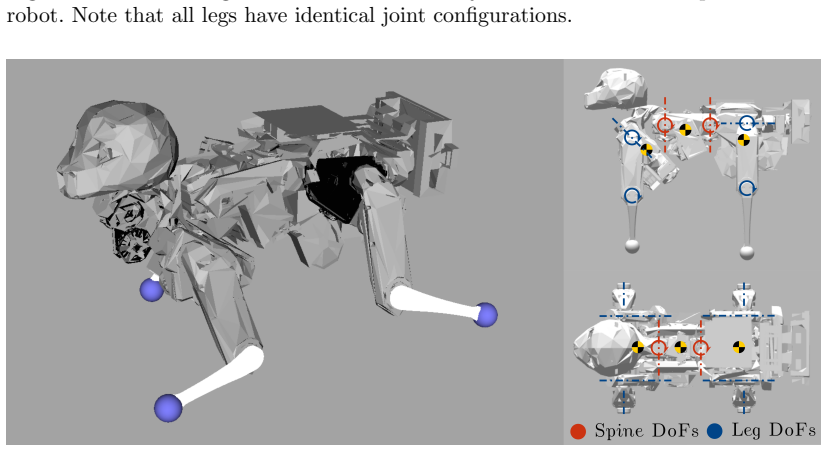
The load-bearing components are the four spine trajectory strategies and the model predictive control (MPC) system they plug into. The spine is a four-degree-of-freedom active joint set (two pitch, two yaw) on a simulated poodle-sized robot; a central pattern generator (CPG) produces a phase variable $\phi$ that synchronises leg swing and stance cycles with spine commands. The strategies are: a stiffness strategy that sinusoidally varies the PD gain $K_p$ while holding a fixed setpoint; a foot-tracking strategy that derives spine pitch from the average fore-aft foot displacement from neutral and spine yaw from the angle between paired feet; a real-dog time-varying strategy using a bi-periodic sine in pitch and a mono-periodic sine in yaw with coefficients taken from canine motion data; and an optimised time strategy using the same sinusoidal law with coefficients found by grid search over a weighted cost function of energy, tracking error, foot-force variance, and spine range of motion. Ground-reaction forces are computed by a representation-free MPC that treats the robot as a single rigid body, so spine motion enters as a disturbance the controller must accommodate. This pairing of an actively moved spine with an MPC that ignores spine inertia is what makes the comparison possible, and it shapes the energy results.
What would settle it
Run a new human study that fixes tuning effort: give the real-dog law the same number of optimisation evaluations as the optimised-time law, then check whether the naturalness ranking inverts. Alternatively, measure the spine kinematics of toy-poodle-sized dogs directly; if the real-dog coefficients actually match small-dog motion and viewers still rate it least natural, the premise that real canine data looks natural on a small robot is falsified.
Extended reading notes
Core claim
The paper claims that spine motion in a quadruped robot is judged more natural when it is subtle and coordinated with the legs, and that copying real canine motion does not automatically look natural on a small robot. Concretely, in a randomised comparison with 49 participants, the optimised time-varying strategy and the foot-tracking strategy scored higher than the fixed-spine baseline, while the real-dog time-varying strategy and the stiffness strategy scored lower. The same participants chose the same gait as most natural and most appealing to interact with in 97.7% of votes. Dynamic measurements show the fixed spine has the lowest cost of transport at all tested velocities, and spine strategies increase the work done by the legs; the two strategies judged most natural also showed the most consistent trotting footfalls, suggesting a possible link between perceived naturalness and gait regularity rather than energy cost.
Load-bearing premise
The strategies are compared under equally well-tuned parameters: the optimised-time strategy received a grid search plus manual review by the researchers, while the real-dog strategy used manually chosen, unoptimised coefficients, so the naturalness ranking could reflect tuning effort rather than the control law itself.
Editorial extensions
If this is right
- For human-robot interaction applications such as elder-care companions, a spine that moves subtly and tracks the feet can make a quadruped seem more natural and more worth interacting with, even if it does not save energy.
- Gait naturalness and energy efficiency are not coupled: the most efficient gait (fixed spine) was not the most natural, and no spine strategy improved cost of transport over the baseline.
- Robot designers should select the spine strategy per gait: the stiffness strategy jumped to most natural in trotting, while the optimised-time strategy was best in walking and turning, implying that HRI-focused robots should be able to switch strategy.
- The 97.7% match between 'most natural' and 'most likely to interact with' suggests that perceived naturalness is a reliable proxy for user acceptance in this context.
- Because the fixed spine was most efficient even with spine motor power excluded, active spine motion increases leg work, so an energy-neutral natural spine would likely need passive or hybrid components.
Reading between the lines
- The paper's explanation for the real-dog strategy's low naturalness (viewers compared the small simulated robot to larger dogs) is testable: re-render the same gaits with a familiar size reference object in view, and the naturalness ranking may shift.
- The observed correlation between naturalness and footfall consistency in trotting could be isolated experimentally: if the spine is hidden and only footfall timing is varied, one could test whether regularity alone drives perceived naturalness.
- The MPC treats spine inertia as negligible, so the energy verdict may be specific to this controller; modelling spine dynamics inside the MPC, as the paper suggests, could change both cost of transport and perceived naturalness.
- The naturalness-versus-efficiency trade-off may not hold on larger robots; on a platform closer in scale to the dogs in the motion-capture data, the real-dog coefficients might score higher and the conclusions could invert.
Signed reviews
Editorial analysis
A structured set of objections, weighed in public.
Referee Report
Summary. This paper investigates spine control strategies for a simulated quadruped robot with a four-degree-of-freedom active spine. Four trajectory-generation strategies are compared with a fixed-spine baseline: a varying-stiffness strategy, a foot-tracking strategy, a real-dog time-varying strategy, and an optimised time-varying strategy. The authors evaluate cost of transport (CoT) for walking, trotting, and turning gaits, and they run a forced-choice online video study (49 participants) in which viewers rank naturalness and inclination to interact. The paper reports that no spine strategy improves CoT over the fixed-spine baseline, and that the optimised-time and foot-tracking strategies are perceived as more natural than the baseline. The authors conclude that spine-enabled robots may be promising for HRI applications where naturalness outweighs energy efficiency.
Significance. The paper addresses a genuine gap in the quadruped-spine literature, which has largely focused on efficiency and stability, by making human perception the outcome of interest. Its strengths include a transparent description of the four control strategies, a within-simulation comparison on multiple gaits, and especially the public release of code, videos, and raw data on GitHub, which allows the main analysis to be reproduced and extended. The honest reporting of a null CoT result is also valuable: it sets a boundary condition for claims that active spines improve efficiency. However, the central naturalness finding is not currently established. The reported mean scores are not accompanied by inferential statistics, and the parameter-selection procedure appears to incorporate the researchers' own judgment of naturalness, so the comparison risks confounding strategy with tuning effort. Because these two issues bear directly on the paper's main contribution, they must be addressed before the perceptual claim can be accepted.
major comments (3)
- [Section 5.2, Figure 13] The paper's central positive claim, that the optimised-time and foot-tracking spine strategies are perceived as more natural than the fixed-spine baseline, is supported only by point estimates. Section 5.2 reports mean naturalness scores in Figure 13, with no confidence intervals, standard errors, significance tests, or effect sizes. The experiment has a repeated-measures structure (49 participants, pairwise forced choices among five strategies), so the ranking could plausibly lie within sampling noise, especially because multiple pairwise comparisons are implicitly being made. Please provide inferential statistics for the baseline comparisons, for example a mixed-effects logistic regression on the forced-choice responses or paired nonparametric tests with multiplicity correction, and report effect sizes. The raw data are public, so these analyses should be straightforward.
- [Section 4.5] The naturalness ranking is confounded by unequal tuning effort across conditions. The grid search for the optimised strategies minimises the cost function in Equation (15), which does not contain a naturalness term, but the authors then state that candidates with good scores were reviewed manually and chosen based on how natural they appeared to the researchers. Thus the optimised-time strategy, and by the same procedure the foot-tracking and stiffness strategies, were selected partly for natural appearance, whereas the real-dog strategy was not optimised and the fixed-spine baseline received no naturalness-based selection. Any observed advantage for the optimised strategies could therefore reflect the manual selection and increased tuning effort rather than the control law itself. To make the claim strategy-level, the authors should either use a pre-registered, naturalness-blind selection criterion, or show that the ranking is stable across the set of near-optimal parameter candidates, or explicitly restrict their conclusion to the particular tuned instances studied.
- [Section 6.1] Hypothesis #1 is evaluated by counting how often a participant's most natural and most likely to interact with choices agree (862 of 882 votes, 97.7%), but this is not strong evidence of a correlation between the two constructs. The two questions are answered on the same videos within the same forced-choice task, so agreement is inflated by shared response tendencies and task framing, and no chance baseline or appropriate statistical model is reported. Please analyse the two responses jointly, for example with a contingency-table or multilevel model that accounts for the forced-choice design, and temper the greater likeability wording in the abstract accordingly.
minor comments (4)
- [Abstract and Section 5.2] The abstract states that the randomised trial used 50 participants, while Section 5.2 reports 50 recruited with one dropped, leaving 49 total results; please make the participant count consistent throughout.
- [Table 6] The entry 4rd appears in the time-real row of the table; it should be 4th.
- [Section 4.9, Figure 8] The naturalness scoring algorithm is described only in the caption of Figure 8. Please move the full algorithm into the main text so that the normalisation and the baseline-halving rule are reproducible without reading the figure.
- [Section 4.6 and Section 7] The perception study uses videos of the simulation, and Section 4.6 explains that the MPC approximates the robot as a single rigid body with small spine movements. Please state explicitly in the limitations that the naturalness results have not been validated on hardware with true spine dynamics, since this could affect the HRI conclusions.
Circularity Check
Naturalness ranking is partly circular because the optimised spine strategies were manually selected for natural appearance before being tested for perceived naturalness.
-
fitted input called prediction
[Section 4.5 (Spine Control Strategies) and Section 5.2 (Subjective Results)]
"Finally, candidates with good scores were reviewed manually and chosen based on how natural they appeared to the researchers. ... Note that the real-dog time-varying strategy is not optimised, the values are chosen manually."
The central perception result (Section 5.2) reports that the optimised-time and foot-tracking strategies are perceived as more natural than the fixed-spine baseline. But those strategies' parameters were not selected solely by the published energy/error cost function: after grid search, candidates were manually filtered on how natural they appeared to the researchers. Thus the target quantity of the later experiment (perceived naturalness) was already used as a selection criterion during strategy construction.
full rationale
The paper is mostly a self-contained empirical study: the CoT comparison is direct simulation output, and the perception data come from an external MTurk experiment. The main circularity is the parameter-selection step in Section 4.5, where candidates from the grid search were reviewed manually and chosen based on how natural they appeared to the researchers. Because the same naturalness construct is then measured in the subjective experiment, the claim that the optimised-time and foot-tracking strategies are more natural is partly by construction rather than a fully independent test. This does not make the whole derivation circular: the strategies are still defined by concrete equations, the CoT results are independent of human judgment, and the perception experiment itself is a real measurement. However, the asymmetry between naturalness-tuned and non-tuned strategies means the central naturalness ranking is only partially supported as a property of the control laws. No self-citation chain or imported uniqueness theorem is load-bearing; the sinusoidal forms are cited to external dog-motion data.
Assumptions & free parameters
free parameters (4)
- Spine trajectory parameters C1..C4 for each strategy and gait =
not stated in paper; available online (GitHub)
- Cost function weights W1..W11 =
W1=50, W2=50, W3=50, W4=10, W5=4, W6=4, W7=0.1, W8=1800, W9=10, W10=0, W11=0.002 (per Table 3, with one entry…
- Gait parameters tstance, tswing, and phase offsets psi =
Walk/Turn: 0.3/0.1, Trot: 0.2/0.1; phases as in Table 2
- Command velocities for video recording =
Walking 0.3 m/s, Turning 0.3 m/s and -0.5 rad/s, Trotting 0.6 m/s (Table 4)
assumptions (5)
- domain assumption The MPC can treat the robot as a single rigid body, ignoring the internal dynamics, inertia changes, and COM shifts of the moving spine.
- domain assumption The simulated robot in DART with default friction and restitution coefficients is a valid proxy for a physical toy-poodle-sized quadruped.
- domain assumption Human naturalness ratings of simulated videos with no physical size reference transfer to how people would perceive a real robot.
- domain assumption The real-dog spine motion from Beagle data in [9] is applicable to a robot approximating a toy poodle.
- standard math Standard robotics math: SO(3) composition, Jacobian transpose inverse dynamics, and PD control are sufficient for the simulated platform.
Cite this review
Pith. "Pith review of Quadrupedal Spine Control Strategies: Exploring Correlations Between System Dynamic Responses and Human Perspectives." pith.science (2026). https://pith.science/paper/XNL3RUXT
@misc{pith2026250502414,
  author       = {Pith},
  title        = {Pith review of: Quadrupedal Spine Control Strategies: Exploring Correlations Between System Dynamic Responses and Human Perspectives},
  year         = {2026},
  howpublished = {\url{https://pith.science/paper/XNL3RUXT}},
  note         = {Machine review of arXiv:2505.02414}
}
read the original abstract
Unlike their biological cousins, the majority of existing quadrupedal robots are constructed with rigid chassis. This results in motion that is either beetle-like or distinctly robotic, lacking the natural fluidity characteristic of mammalian movements. Existing literature on quadrupedal robots with spinal configurations primarily focuses on energy efficiency and does not consider the effects in human-robot interaction scenarios. Our contributions include an initial investigation into various trajectory generation strategies for a quadrupedal robot with a four degree of freedom spine, and an analysis on the effect that such methods have on human perception of gait naturalness compared to a fixed spine baseline. The strategies were evaluated using videos of walking, trotting and turning simulations. Among the four different strategies developed, the optimised time varying and the foot-tracking strategies were perceived to be more natural than the baseline in a randomised trial with 50 participants. Although none of the strategies demonstrated any energy efficiency improvements over the no-spine baseline, some showed greater footfall consistency at higher speeds. Given the greater likeability drawn from the more natural locomotion patterns, this type of robot displays potential for applications in social robot scenarios such as elderly care, where energy efficiency is not a primary concern.
Figures


Figures from the paper (11 more)


Reference graph
Works this paper leans on
-
[1]
Available from: https://www.unitree.com/en/a1/
Unitree a1 ; Accessed: 2023-10-19. Available from: https://www.unitree.com/en/a1/
work page 2023
-
[2]
Available from: https: //bostondynamics.com/products/spot/
Boston dynamics’ spot ; Accessed: 2023-10-19. Available from: https: //bostondynamics.com/products/spot/
work page 2023
-
[3]
Anymal - a highly mobile and dynamic quadrupedal robot
Hutter M, Gehring C, Jud D, et al. Anymal - a highly mobile and dynamic quadrupedal robot. 2016 IEEE/RSJ International Conference on Intelligent Robots and Systems (IROS). 2016
work page 2016
-
[4]
Further studies on locomotion of the cheetah
Hildebrand M. Further studies on locomotion of the cheetah. Journal of Mammalogy. 1961;42(1):84–91. Available from: http://www.jstor.org/stable/1377246
-
[5]
Gait and the energetics of locomotion in horses
Hoyt DF, Taylor CR. Gait and the energetics of locomotion in horses. Nature. 1981; 292(5820):239–240
work page 1981
-
[6]
Bertram JE, Gutmann A. Motions of the running horse and cheetah revisited: Fundamen- tal mechanics of the transverse and rotary gallop. Journal of The Royal Society Interface. 2008;6(35):549–559
work page 2008
-
[7]
Benninger MI, Seiler GS, Robinson LE, et al. Three-dimensional motion pattern of the caudal lumbar and lumbosacral portions of the vertebral column of dogs. American Jour- nal of Veterinary Research. 2004;65(5):544–551
work page 2004
-
[8]
Physically-based simulation of the spine in dog walking
Aleotti J, Caselli S, Bracchi P, et al. Physically-based simulation of the spine in dog walking. 09; 2008. p. 2283–2288
work page 2008
Show all 54 references
-
[9]
Three-dimensional movements of the pelvis and the lumbar intervertebral joints in walking and trotting dogs
Wachs K, Fischer M, Schilling N. Three-dimensional movements of the pelvis and the lumbar intervertebral joints in walking and trotting dogs. The Veterinary Journal. 2016; 210:46–55. Available from: https://www.sciencedirect.com/science/article/pii/ S1090023315005407
2016
-
[10]
Comparing the effect of different spine and leg designs for a small bounding quadruped robot
Eckert P, Spr¨ owitz A, Witte H, et al. Comparing the effect of different spine and leg designs for a small bounding quadruped robot. In: 2015 IEEE International Conference on Robotics and Automation (ICRA); 2015. p. 3128–3133
2015
-
[11]
Study on quadruped bounding with a passive compliant spine
Phan LT, Lee YH, Lee YH, et al. Study on quadruped bounding with a passive compliant spine. In: 2017 IEEE/RSJ International Conference on Intelligent Robots and Systems (IROS); 2017. p. 2409–2414
2017
-
[12]
Passive quadrupedal bounding with a segmented flexible torso
Cao Q, Poulakakis I. Passive quadrupedal bounding with a segmented flexible torso. In: 2012 IEEE/RSJ International Conference on Intelligent Robots and Systems; 2012. p. 2484–2489
2012
-
[13]
A bio-inspired quadruped robot with a global compliant spine
Zhang X, Yu H, Liu B, et al. A bio-inspired quadruped robot with a global compliant spine. 12; 2013. p. 1312–1316
2013
-
[14]
Demonstration and analysis of quadrupedal passive dynamic walking
Nakatani K, Sugimoto Y, Osuka K. Demonstration and analysis of quadrupedal passive dynamic walking. Advanced Robotics. 2009 04;23(5):483–501
2009
-
[15]
On passive quadrupedal bounding with translational spinal joint
Koutsoukis K, Papadopoulos E. On passive quadrupedal bounding with translational spinal joint. In: 2016 IEEE/RSJ International Conference on Intelligent Robots and Sys- tems (IROS); 2016. p. 3406–3411
2016
-
[16]
Realization of stable quadruped gait transition by chang- ing body stiffness (japanese)
Sakai Y, Sato T, Owaki D, et al. Realization of stable quadruped gait transition by chang- ing body stiffness (japanese). The Proceedings of JSME annual Conference on Robotics and Mechatronics (Robomec). 2007;2007(0)
2007
-
[17]
A study on trunk stiffness and gait stability in quadrupedal locomotion using musculoskeletal robot
Tsujita K, Miki K. A study on trunk stiffness and gait stability in quadrupedal locomotion using musculoskeletal robot. In: 2011 15th International Conference on Advanced Robotics (ICAR); 2011. p. 316–321. 25
2011
-
[18]
Design of quadruped bionic robot with variable stiffness spine
Lu G. Design of quadruped bionic robot with variable stiffness spine. In: Proceedings of the 2022 4th International Conference on Robotics, Intelligent Control and Artificial In- telligence; New York, NY, USA. Association for Computing Machinery; 2023. p. 255–259; RICAI ’22. A...
2022
-
[19]
High speed trot-running: Implementation of a hierarchical controller using proprioceptive impedance control on the mit cheetah
Hyun DJ, Seok S, Lee J, et al. High speed trot-running: Implementation of a hierarchical controller using proprioceptive impedance control on the mit cheetah. The International Journal of Robotics Research. 2014;33(11):1417–1445
2014
-
[20]
Design and development of biomimetic quadruped robot for behavior studies of rats and mice
Ishii H, Masuda Y, Miyagishima S, et al. Design and development of biomimetic quadruped robot for behavior studies of rats and mice. 2009 Annual International Con- ference of the IEEE Engineering in Medicine and Biology Society. 2009
2009
-
[21]
Development of a biped walking robot compensating for three-axis moment by trunk motion
Yamaguchi J, Takanishi A, Kato I. Development of a biped walking robot compensating for three-axis moment by trunk motion. Proceedings of 1993 IEEE/RSJ International Conference on Intelligent Robots and Systems (IROS ’93). 1993;1:561–566 vol.1. Available from: https://api.sema...
1993
-
[22]
Zero-moment point - thirty five years of its life
Vukobratovic M, Borovac B. Zero-moment point - thirty five years of its life. I J Humanoid Robotics. 2004 03;1:157–173
2004
-
[23]
Analysis of using an active artificial spine in a quadruped robot
Kuehn D, Dettmann A, Kirchner F, et al. Analysis of using an active artificial spine in a quadruped robot. 2018 4th International Conference on Control, Automation and Robotics (ICCAR). 2018 Apr
2018
-
[24]
A platform with six degrees of freedom
Stewart D. A platform with six degrees of freedom. Aircraft Engineering and Aerospace Technology. 1966 Apr;38(4):30–35
1966
-
[25]
Bionic design of multi-toe quadruped robot for planetary surface exploration
Chen G, Qiao L, Wang B, et al. Bionic design of multi-toe quadruped robot for planetary surface exploration. Machines. 2022 09;10:827
2022
-
[26]
Spine controller for a sprawling posture robot
Horvat T, Melo K, Ijspeert AJ. Spine controller for a sprawling posture robot. IEEE Robotics and Automation Letters. 2017;2(2):1195–1202
2017
-
[27]
Representation-free model predictive control for dynamic motions in quadrupeds
Ding Y, Pandala A, Li C, et al. Representation-free model predictive control for dynamic motions in quadrupeds. IEEE Transactions on Robotics. 2021;37(4):1154–1171
2021
-
[28]
Dynamic locomotion of a quadruped robot with active spine via model predictive control
Li W, Zhou Z, Cheng H. Dynamic locomotion of a quadruped robot with active spine via model predictive control. In: 2023 IEEE International Conference on Robotics and Automation (ICRA); 2023. p. 1185–1191
2023
-
[29]
High-speed running quadruped robot with a multi-joint spine adopting a 1dof closed-loop linkage
Matsumoto O, Tanaka H, Kawasetsu T, et al. High-speed running quadruped robot with a multi-joint spine adopting a 1dof closed-loop linkage. Frontiers in Robotics and AI. 2023;10. Available from: https://www.frontiersin.org/journals/robotics-and-ai/ articles/10.3389/frobt.2023.1148816
2023
-
[30]
Analysis and generation of laughter motions, and evalu- ation in an android robot
Ishi CT, Minato T, Ishiguro H. Analysis and generation of laughter motions, and evalu- ation in an android robot. APSIPA Transactions on Signal and Information Processing. 2019;8:e6
2019
-
[31]
A speech-driven hand gesture generation method and evaluation in android robots
Ishi CT, Machiyashiki D, Mikata R, et al. A speech-driven hand gesture generation method and evaluation in android robots. IEEE Robotics and Automation Letters. 2018; 3(4):3757–3764
2018
-
[32]
Impression analysis of various humanlike gait patterns
Miura K, Ohtaki Y, Inooka H. Impression analysis of various humanlike gait patterns. In: Proceedings 10th IEEE International Workshop on Robot and Human Interactive Communication. ROMAN 2001 (Cat. No.01TH8591); 2001. p. 568–573
2001
-
[33]
The uncanny valley [from the field]
Mori M, MacDorman KF, Kageki N. The uncanny valley [from the field]. IEEE Robotics & Automation Magazine. 2012;19(2):98–100
2012
-
[34]
DART: Dynamic animation and robotics toolkit
Lee J, Grey MX, Ha S, et al. DART: Dynamic animation and robotics toolkit. The Journal of Open Source Software. 2018 Feb;3(22):500. Available from: https://doi. org/10.21105/joss.00500
2018 doi
-
[35]
An open torque-controlled modular robot architecture for legged locomotion research
Grimminger F, Meduri A, Khadiv M, et al. An open torque-controlled modular robot architecture for legged locomotion research. IEEE Robotics and Automation Letters. 2020; 5(2):3650–3657
2020
-
[36]
Implementation of a reactive walking con- troller for the new open-hardware quadruped solo-12
Leziart PA, Flayols T, Grimminger F, et al. Implementation of a reactive walking con- troller for the new open-hardware quadruped solo-12. 2021 IEEE International Conference on Robotics and Automation (ICRA). 2021;. 26
2021
-
[37]
Resolved motion rate control of manipulators and human prostheses
Whitney D. Resolved motion rate control of manipulators and human prostheses. IEEE Transactions on Man Machine Systems. 1969;10(2):47–53
1969
-
[38]
Robust control of robotic manipulators
Balestrino A, De Maria G, Sciavicco L. Robust control of robotic manipulators. IFAC Proceedings Volumes. 1984;17(2):2435–2440. 9th IFAC World Congress: A Bridge Be- tween Control Science and Technology, Budapest, Hungary, 2-6 July 1984; Available from: https://www.sciencedirec...
1984
-
[39]
A computational technique for inverse kinematics
Wolovich WA, Elliott H. A computational technique for inverse kinematics. In: The 23rd IEEE Conference on Decision and Control; 1984. p. 1359–1363
1984
-
[40]
Selectively damped least squares for inverse kinematics
Buss S, Kim JS. Selectively damped least squares for inverse kinematics. J Graphics Tools. 2005 01;10:37–49
2005
-
[41]
A combined optimization method for solving the inverse kinematics problems of mechanical manipulators
Wang LC, Chen C. A combined optimization method for solving the inverse kinematics problems of mechanical manipulators. IEEE Transactions on Robotics and Automation. 1991;7(4):489–499
1991
-
[42]
Fabrik: A fast, iterative solver for the inverse kinematics problem
Aristidou A, Lasenby J. Fabrik: A fast, iterative solver for the inverse kinematics problem. Graphical Models. 2011 09;73:243–260
2011
-
[43]
Available from: http:// openrave.org/docs/0.8.2/openravepy/ikfast/
ikfast module — openrave documentation ; 2024-05-27. Available from: http:// openrave.org/docs/0.8.2/openravepy/ikfast/
2024
-
[44]
Mechanism design and performance analysis of bionic quadruped robot with spine
Chen G, Ma M, Guo S, et al. Mechanism design and performance analysis of bionic quadruped robot with spine. In: 2021 40th Chinese Control Conference (CCC); 2021. p. 6685–6690
2021
-
[45]
Control of dynamic gaits for a quadrupedal robot
Gehring C, Coros S, Hutter M, et al. Control of dynamic gaits for a quadrupedal robot. 2013 IEEE International Conference on Robotics and Automation. 2013
2013
-
[46]
A whole-body controller based on a sim- plified template for rendering impedances in quadruped manipulators
Risiglione M, Barasuol V, Caldwell DG, et al. A whole-body controller based on a sim- plified template for rendering impedances in quadruped manipulators. 2022 IEEE/RSJ International Conference on Intelligent Robots and Systems (IROS). 2022
2022
-
[47]
Adaptive force-based control for legged robots
Sombolestan M, Chen Y, Nguyen Q. Adaptive force-based control for legged robots. 2021 IEEE/RSJ International Conference on Intelligent Robots and Systems (IROS). 2021
2021
-
[48]
Model predictive control
Camacho EF, Bordons C. Model predictive control. Springer; 2007
2007
-
[49]
Controlling the solo12 quadruped robot with deep reinforcement learning
Aractingi M, L´ eziart PA, Flayols T, et al. Controlling the solo12 quadruped robot with deep reinforcement learning. Scientific Reports. 2023;13(1)
2023
-
[50]
Whole-body nonlinear model predictive con- trol through contacts for quadrupeds
Neunert M, Stauble M, Giftthaler M, et al. Whole-body nonlinear model predictive con- trol through contacts for quadrupeds. IEEE Robotics and Automation Letters. 2018; 3(3):1458–1465
2018
-
[51]
Mit cheetah 3: Design and control of a robust, dynamic quadruped robot
Bledt G, Powell MJ, Katz B, et al. Mit cheetah 3: Design and control of a robust, dynamic quadruped robot. 2018 IEEE/RSJ International Conference on Intelligent Robots and Systems (IROS). 2018
2018
-
[52]
Fast contact-implicit model-predictive con- trol
Le Cleac’h S, Howell TA, Schwager M, et al. Fast contact-implicit model-predictive con- trol. arXiv preprint arXiv:210705616. 2021
2021
-
[53]
Nonlinear model predictive control for quadrupedal loco- motion using second-order sensitivity analysis ; 2022
Kang D, Vincenti FD, Coros S. Nonlinear model predictive control for quadrupedal loco- motion using second-order sensitivity analysis ; 2022
2022
-
[54]
Symmetrical gaits of dogs in relation to body build
Hildebrand M. Symmetrical gaits of dogs in relation to body build. Journal of Morphol- ogy. 1968;124(3):353–359. Available from: https://onlinelibrary.wiley.com/doi/ abs/10.1002/jmor.1051240308. Appendix A. Accompanying Data Code, videos, and raw data generated within this pro...
1968 doi
Reviewed August 16, 2026 · model on record in the stance chip above.
Discussion (0). Continue with ORCID to comment.