Non-Hermitian Crystalline Braid Topology from Hermitian Projection: A Zero-Mode Resonance Mechanism
Pith reviewed 2026-06-27 23:38 UTC · model grok-4.3
The pith
Non-Hermitian crystalline braid topology emerges from Hermitian projection via zero-mode resonance
A machine-rendered reading of the paper's core claim, the machinery that carries it, and where it could break.
Core claim
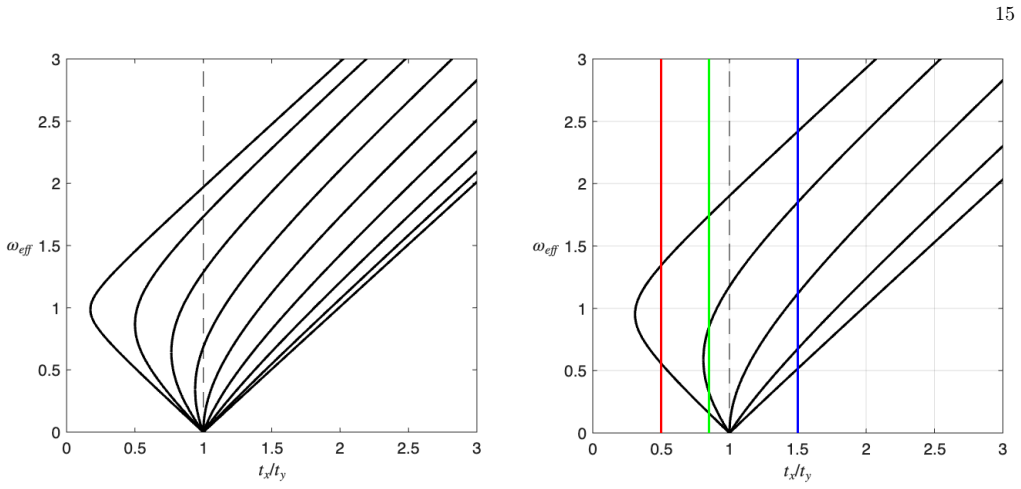
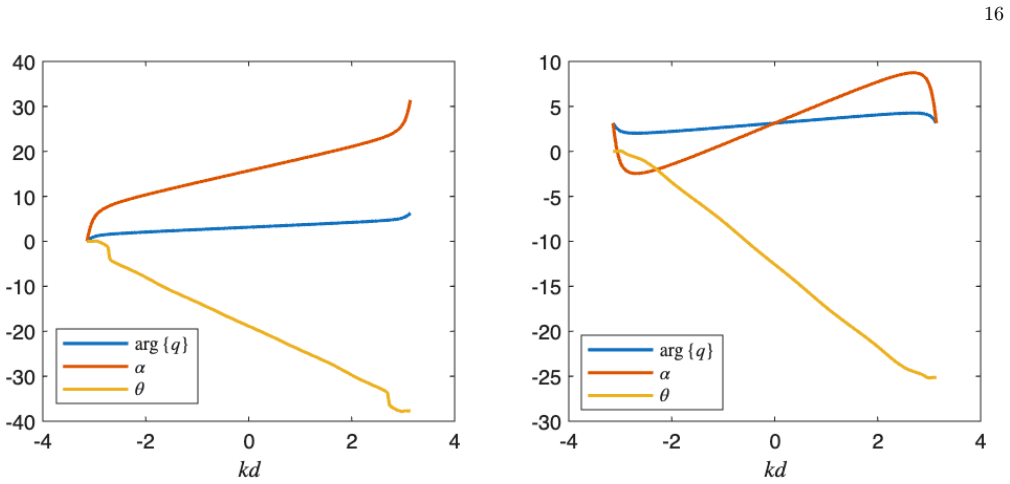
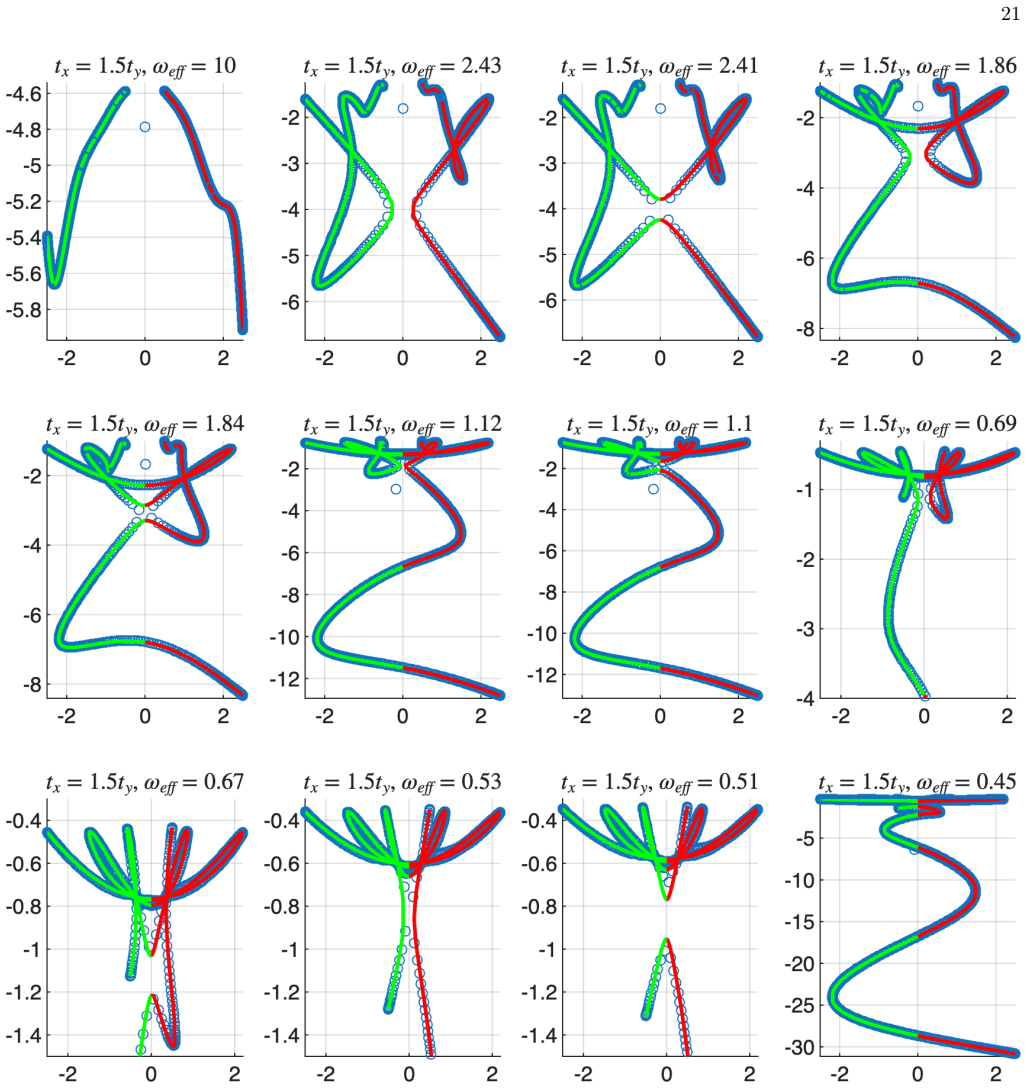
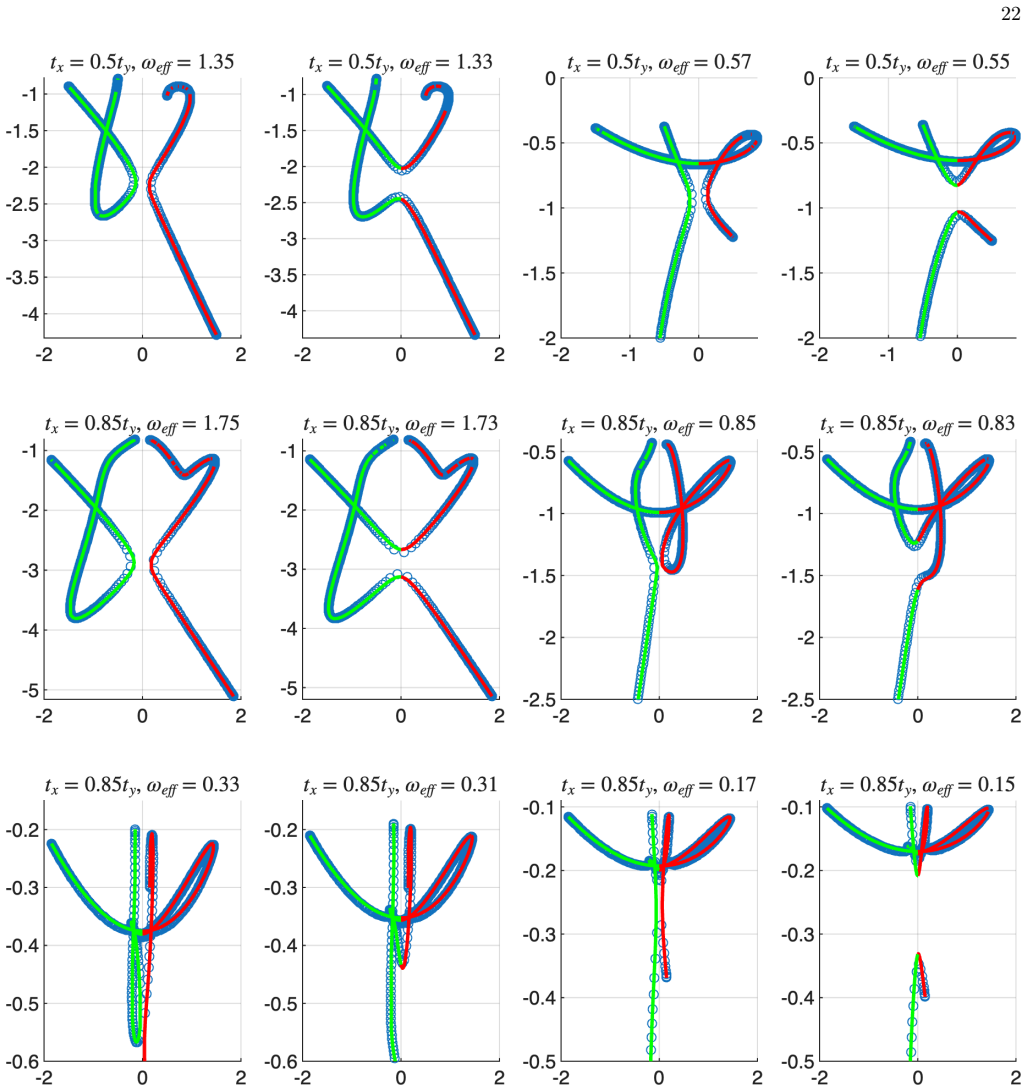
The central discovery is that zero-mode-resonant projection of a trivial Hermitian square lattice with an embedded zig-zag brane yields a non-Hermitian effective model whose spectrum forms an abelian two-band braid. Transitions occur only at isolated finite frequencies. Embedding parity induces conjugated pseudo-Hermiticity that quantizes the complex Berry phase and equates it to the braid count, even though the internal class AI† is trivial. The absence of the non-Hermitian skin effect ensures the invariant is a genuine Bloch bulk quantity.
What carries the argument
The zero-mode resonance mechanism, in which a sublattice-imbalance zero mode generates a singular self-energy pole that carries topology in the finite-frequency projected Green's function
If this is right
- Braid transitions appear as transmission zeros at predicted drive frequencies in topolectrical realizations.
- The complex Berry phase is quantized and equals the braid count due to conjugated pseudo-Hermiticity.
- The projected system exhibits non-Hermitian topology without gain, loss or asymmetric couplings.
- The topological invariant remains a Bloch bulk quantity free of skin effect localization.
Where Pith is reading between the lines
- This zero-mode resonance could be used to induce braid topology in other projected Hermitian systems by engineering appropriate defects.
- Frequency as a tunable parameter opens the possibility of switching between different braid topologies by changing the drive frequency.
- The mechanism may generalize to higher-dimensional or other symmetry classes where projection creates effective non-Hermiticity.
Load-bearing premise
The embedding parity induces conjugated pseudo-Hermiticity that quantizes the complex Berry phase and identifies it with the braid count, and that the model has no non-Hermitian skin effect.
What would settle it
If the complex Berry phase measured in the model is not an integer multiple matching the braid transitions, or if boundary skin modes appear, the central claim would be falsified.
Figures
read the original abstract
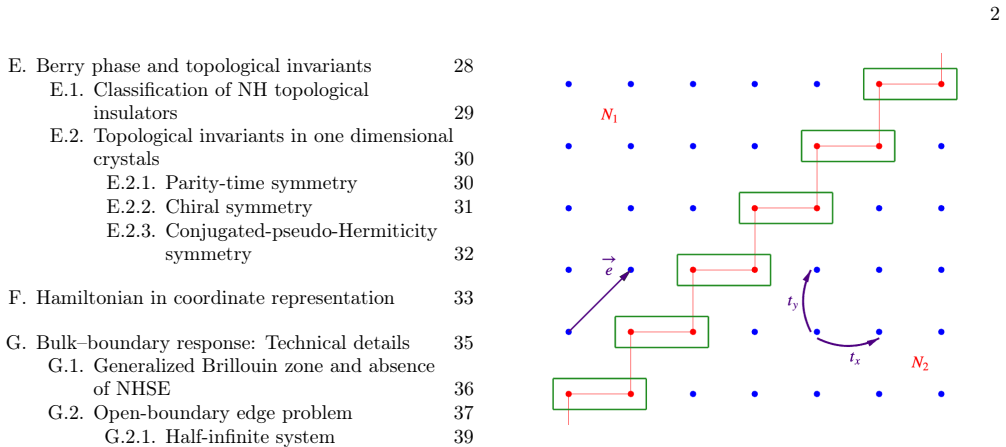
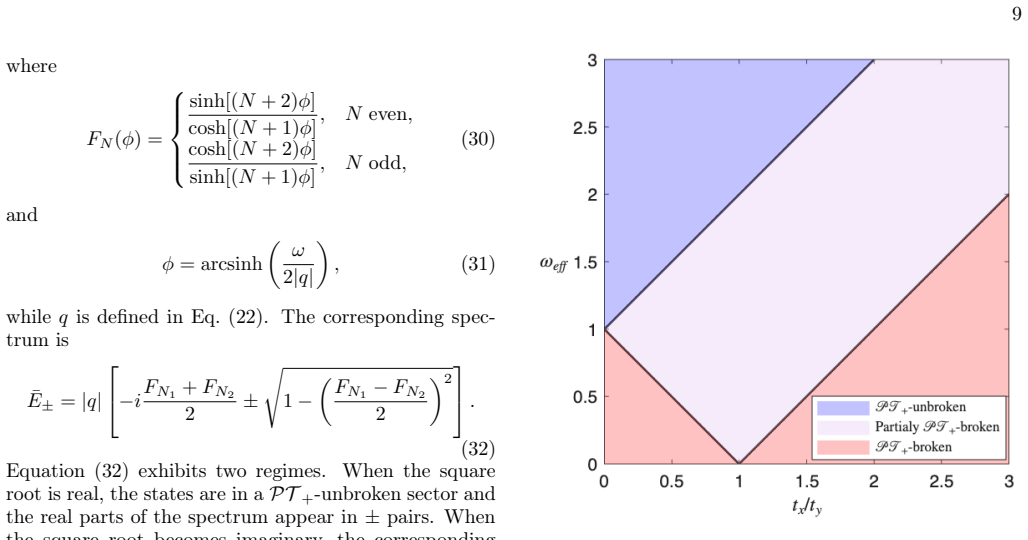
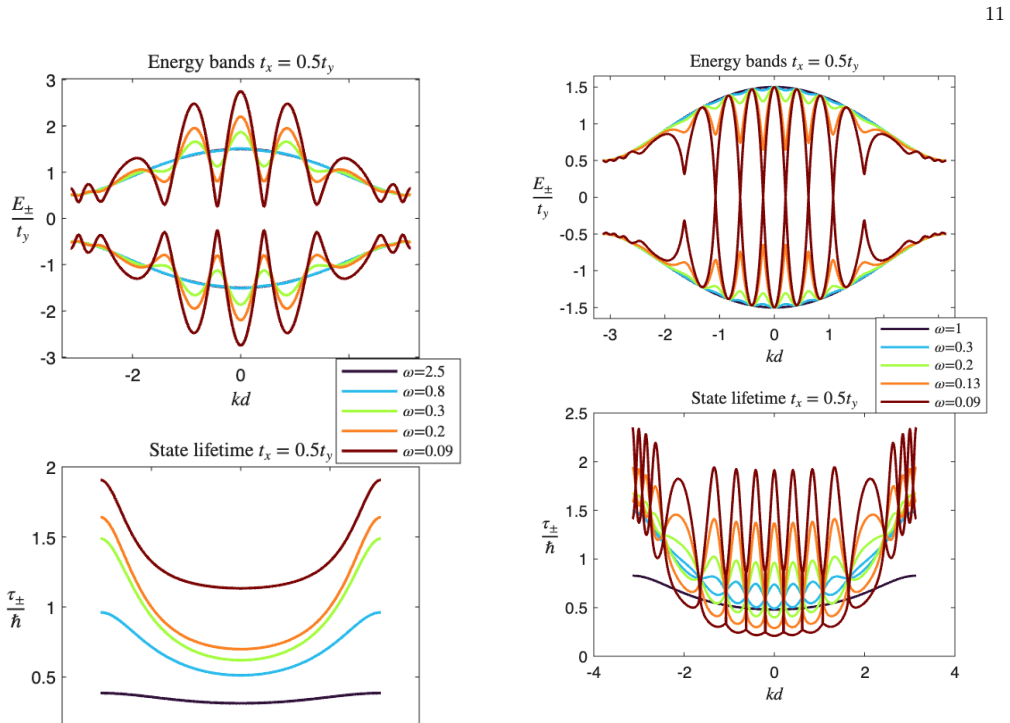
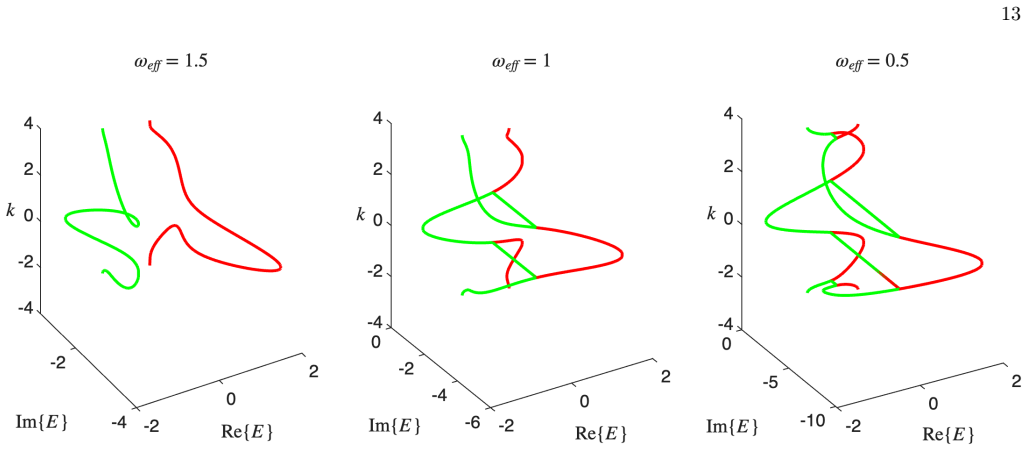
Non-Hermitian topological phases are usually engineered through gain, loss, asymmetric couplings, or explicit environmental channels. Here we show that non-Hermitian crystalline braid topology can instead emerge from projection alone, starting from a fully Hermitian and topologically trivial parent lattice. The mechanism is zero-mode-resonant projection. When the eliminated complement is zero-mode free, projection has a smooth low-frequency limit and reduces to a static Schur complement, yielding conventional SSH-type descendants. When a complement zero mode couples to the retained subsystem, the embedding self-energy develops a pole, the zero-frequency limit becomes singular, and topology is carried by the finite-frequency projected Green's function-where frequency is a tunable parameter, the drive frequency in a circuit realization, for instance. We demonstrate this mechanism in an exactly solvable model, a trivial nearest-neighbor square lattice with an embedded one-dimensional zig-zag brane. Odd-parity periodic sectors are resonant: a sublattice-imbalance zero mode generates the singular self-energy, and the complex spectrum forms an abelian two-band braid whose transitions occur only at isolated finite frequencies. Although the internal class is $\text{AI}^{\dag}$ featuring only trivial phases, embedding parity induces conjugated pseudo-Hermiticity (CPH), quantizes the complex Berry phase, and identifies it with the braid count. The model is free of the non-Hermitian skin effect, making the invariant a genuine Bloch bulk quantity. In topolectrical realizations, the same finite-frequency braid transitions appear as transmission zeros and admittance features at the predicted drive frequencies.
Editorial analysis
A structured set of objections, weighed in public.
Referee Report
Summary. The paper claims that non-Hermitian crystalline braid topology can emerge purely from Hermitian projection via a zero-mode resonance mechanism, without gain/loss or asymmetric couplings. Starting from a trivial Hermitian square lattice, projection onto an embedded zig-zag brane with a sublattice-imbalance zero mode produces a singular self-energy; the finite-frequency projected Green's function then yields an abelian two-band braid in the complex spectrum, with transitions only at isolated frequencies. Embedding parity induces conjugated pseudo-Hermiticity (CPH) that quantizes the complex Berry phase and equates it to the braid count, while the internal AI† class is trivial. The model is asserted to lack the non-Hermitian skin effect, rendering the invariant a valid Bloch quantity, with implications for topolectrical circuit realizations.
Significance. If the central claims hold, the work supplies a new, parameter-free route to non-Hermitian topology from Hermitian parents, grounded in an exactly solvable model and a concrete projection construction. The identification of braid count with a quantized complex Berry phase under CPH, together with the absence of skin effect, would distinguish this from conventional NH engineering and enable frequency-tunable transitions observable as transmission zeros. The reproducible, exactly solvable character and potential circuit mapping are clear strengths.
major comments (2)
- [zig-zag brane construction and CPH discussion] The assertion that embedding parity induces conjugated pseudo-Hermiticity (CPH) which quantizes the complex Berry phase and identifies it with the braid count (abstract and zig-zag brane construction) is load-bearing for the topology claim. An explicit computation of the complex Berry phase on the projected Green's function, demonstrating that it is real and integer-valued, is required; the parity argument alone does not yet establish the quantization step independently of the braid count.
- [model and NHSE statement] The claim that the model is free of the non-Hermitian skin effect, so that the invariant remains a genuine Bloch bulk quantity (abstract), rests on the frequency-dependent effective operator with a self-energy pole. Standard NHSE diagnostics (point-gap topology, biorthogonal localization lengths, or open-boundary spectra) must be applied explicitly to the projected non-Hermitian Hamiltonian at the relevant finite frequencies; without this verification the Bloch invariant status is not yet secured.
minor comments (1)
- [projection mechanism] Clarify the precise definition of the frequency-dependent projected Green's function and its relation to the effective non-Hermitian Hamiltonian in the main text.
Simulated Author's Rebuttal
We thank the referee for the careful reading of our manuscript and the constructive comments. We address each major comment below and will incorporate the requested explicit verifications in the revised version.
read point-by-point responses
-
Referee: The assertion that embedding parity induces conjugated pseudo-Hermiticity (CPH) which quantizes the complex Berry phase and identifies it with the braid count (abstract and zig-zag brane construction) is load-bearing for the topology claim. An explicit computation of the complex Berry phase on the projected Green's function, demonstrating that it is real and integer-valued, is required; the parity argument alone does not yet establish the quantization step independently of the braid count.
Authors: We agree that an explicit computation provides independent confirmation. In the revised manuscript we will add a direct evaluation of the complex Berry phase on the projected Green's function at representative finite frequencies within the zig-zag brane construction section. This calculation will demonstrate that the phase is real and integer-valued, matching the braid count and thereby establishing the quantization under CPH separately from the topological classification of the braid itself. revision: yes
-
Referee: The claim that the model is free of the non-Hermitian skin effect, so that the invariant remains a genuine Bloch bulk quantity (abstract), rests on the frequency-dependent effective operator with a self-energy pole. Standard NHSE diagnostics (point-gap topology, biorthogonal localization lengths, or open-boundary spectra) must be applied explicitly to the projected non-Hermitian Hamiltonian at the relevant finite frequencies; without this verification the Bloch invariant status is not yet secured.
Authors: We acknowledge the need for explicit verification. In the revision we will apply the suggested diagnostics to the projected non-Hermitian operator at the finite frequencies where the braid spectrum is defined. Specifically, we will present open-boundary spectra and biorthogonal localization lengths, confirming the absence of skin effect and thereby securing the Bloch character of the complex Berry phase invariant. revision: yes
Circularity Check
No significant circularity; derivation proceeds from external Hermitian parent via explicit projection
full rationale
The paper constructs the non-Hermitian effective model by projecting a trivial Hermitian square lattice onto a zig-zag brane subsystem, with the singular self-energy arising from an explicit zero mode in the complement. The abelian braid in the complex spectrum of the finite-frequency Green's function is exhibited directly from the poles and residues of that self-energy. Embedding parity is an external lattice symmetry that induces CPH; the quantization of the complex Berry phase and its identification with braid count follow from the resulting symmetry constraints on the projected operator, not from any redefinition or fit of the braid count itself. No load-bearing self-citation, parameter fitting, or ansatz smuggling is present in the derivation chain. The assertion of absent NHSE is a separate claim about the model's spectrum and does not collapse the topological identification to an input by construction.
Axiom & Free-Parameter Ledger
axioms (2)
- domain assumption The parent square lattice is Hermitian and topologically trivial.
- domain assumption Embedding parity induces conjugated pseudo-Hermiticity that quantizes the complex Berry phase.
Reference graph
Works this paper leans on
-
[1]
The remaining condition is therefore|λ 0|<1
By construction, this is automatically satisfied forλr, since there are always two solutions, one greater than 1 and the other less than 1, and we simply select the one with magnitude below 1. The remaining condition is therefore|λ 0|<1. This holds whenδ t >0and|η|<1 orδ t <0and|η|>1. Because the topological invariant predicts edge states only forδt >0, v...
-
[2]
El-Ganainy, K
R. El-Ganainy, K. G. Makris, M. Khajavikhan, Z. H. Musslimani, S. Rotter, and D. N. Christodoulides, Non- hermitian physics andPTsymmetry, Nature Physics14, 11 (2018)
2018
-
[3]
E. J. Bergholtz, J. C. Budich, and F. K. Kunst, Ex- ceptional topology of non-hermitian systems, Rev. Mod. Phys.93, 015005 (2021)
2021
-
[5]
Rotter, A non-hermitian hamilton operator and the physics of open quantum systems, J
I. Rotter, A non-hermitian hamilton operator and the physics of open quantum systems, J. Phys. A: Math. Theor.42, 153001 (2009)
2009
-
[6]
Z. Gong, Y. Ashida, K. Kawabata, K. Takasan, S. Hi- gashikawa, and M. Ueda, Topological phases of non- hermitian systems, Phys. Rev. X8, 031079 (2018)
2018
-
[8]
Kawabata, K
K. Kawabata, K. Shiozaki, M. Ueda, and M. Sato, Sym- metry and topology in non-hermitian physics, Phys. Rev. X9, 041015 (2019)
2019
-
[10]
F. K. Kunst, E. Edvardsson, J. C. Budich, and E. J. Bergholtz, Biorthogonal bulk-boundary correspondence in non-hermitian systems, Phys. Rev. Lett.121, 026808 (2018)
2018
-
[12]
Y. Wang, Classifying order-two spatial symmetries in non-hermitian hamiltonians: Point-gapped az and az † classes (2024), arXiv:2411.03410 [cond-mat.mes-hall]
-
[13]
Fu, Topological crystalline insulators, Phys
L. Fu, Topological crystalline insulators, Phys. Rev. Lett. 106, 106802 (2011)
2011
-
[14]
Slager, A
R.-J. Slager, A. Mesaros, V. Juričić, and J. Zaanen, The space group classification of topological band-insulators, Nature Physics9, 98 (2013)
2013
-
[16]
Shiozaki, M
K. Shiozaki, M. Sato, and K. Gomi, Topology of non- symmorphic crystalline insulators and superconductors, Phys. Rev. B93, 195413 (2016)
2016
-
[17]
Kruthoff, J
J. Kruthoff, J. de Boer, J. van Wezel, C. L. Kane, and R.-J. Slager, Topological classification of crystalline in- sulators through band structure combinatorics, Physical Review X7, 041069 (2017)
2017
-
[18]
Bradlyn, L
B. Bradlyn, L. Elcoro, J. Cano, M. G. Vergniory, Z. Wang, C. Felser, M. I. Aroyo, and B. A. Bernevig, Topological quantum chemistry, Nature547, 298 (2017)
2017
-
[19]
Carlström and E
J. Carlström and E. J. Bergholtz, Exceptional links and twisted fermi ribbons in non-hermitian systems, Physical Review A98, 042114 (2018)
2018
-
[20]
Yang and J
Z. Yang and J. Hu, Non-hermitian hopf-link exceptional line semimetals, Physical Review B99, 081102 (2019)
2019
-
[21]
C. C. Wojcik, K. Wang, A. Dutt, J. Zhong, and S. Fan, Eigenvalue topology of non-hermitian band structures in two and three dimensions, Physical Review B106, L161401 (2022)
2022
-
[22]
Li and R
Z. Li and R. S. K. Mong, Homotopical characterization of non-hermitian band structures, Phys. Rev. B103, 155129 (2021)
2021
-
[23]
M. P. López Sancho, J. M. López Sancho, J. M. L. López Sancho, and J. Rubio, Highly convergent schemes for the calculation of bulk and surface green functions, J. Phys. F: Met. Phys.15, 851 (1985)
1985
-
[24]
E. N. Economou,Green’s Functions in Quantum Physics, 3rd ed. (Springer, Berlin, 2006)
2006
-
[25]
Löwdin, A note on the quantum-mechanical per- turbation theory, J
P.-O. Löwdin, A note on the quantum-mechanical per- turbation theory, J. Chem. Phys.19, 1396 (1951)
1951
-
[26]
Feshbach, Unified theory of nuclear reactions, Annals of Physics5, 357 (1958)
H. Feshbach, Unified theory of nuclear reactions, Annals of Physics5, 357 (1958)
1958
-
[27]
Feshbach, A unified theory of nuclear reactions
H. Feshbach, A unified theory of nuclear reactions. ii, Annals of Physics19, 287 (1962)
1962
-
[28]
T.I.Tuegel, V.Chua,andT.L.Hughes,Embeddedtopo- logical insulators, Physical Review B100, 115126 (2019)
2019
-
[29]
Velury and T
S. Velury and T. L. Hughes, Embedded topological semimetals, Physical Review B105, 184105 (2022)
2022
-
[30]
An Ising machine based on networks of subharmonic electrical resonators
A. Panigrahi, V. Juričić, and B. Roy, Projected topolog- ical branes, Communications Physics5, 10.1038/s42005- 022-01006-x (2022)
-
[31]
A. Panigrahi and B. Roy, Projected branes as plat- forms for crystalline, superconducting, and higher-order topological phases, Physical Review B 10.1103/vlk8-59x3 (2026)
-
[32]
A. C. Tyner and V. Juričić, Three-dimensional topologi- cal insulators without reflection symmetry, Scientific Re- ports14, 10.1038/s41598-024-54821-3 (2024)
- [33]
-
[34]
Gurarie, Single-particle green’s functions and inter- acting topological insulators, Phys
V. Gurarie, Single-particle green’s functions and inter- acting topological insulators, Phys. Rev. B83, 085426 (2011)
2011
-
[35]
Wang, X.-L
Z. Wang, X.-L. Qi, and S.-C. Zhang, Topological order parameters for interacting topological insulators, Phys. Rev. Lett.105, 256803 (2010)
2010
-
[36]
W. P. Su, J. R. Schrieffer, and A. J. Heeger, Solitons in polyacetylene, Phys. Rev. Lett.42, 1698 (1979)
1979
-
[37]
S. Lieu, Topological phases in the non-hermitian su-schrieffer-heeger model, Physical Review B97, 10.1103/physrevb.97.045106 (2018)
-
[38]
Sutherland, Localization of electronic wave functions due to local topology, Phys
B. Sutherland, Localization of electronic wave functions due to local topology, Phys. Rev. B34, 5208 (1986)
1986
-
[39]
M.Inui, S.A.Trugman,andE.Abrahams,Unusualprop- erties of midband states in systems with off-diagonal dis- order, Phys. Rev. B49, 3190 (1994)
1994
-
[40]
Dörfler and F
F. Dörfler and F. Bullo, Kron reduction of graphs with applications to electrical networks, IEEE Transactions on Circuits and Systems I: Regular Papers60, 150 (2013)
2013
-
[41]
C.-K. Chiu, H. Yao, and S. Ryu, Classification of topo- logical insulators and superconductors in the presence of reflection symmetry, Phys. Rev. B88, 075142 (2013)
2013
-
[42]
H. T. Teo, Y. Long, H.-y. Zou, K. Song, H. Xue, Y. Ge, S.-q. Yuan, H.-x. Sun, and B. Zhang, Observation of em- bedded topology in a trivial bulk via projective crystal symmetry, Physical Review Letters135, 136602 (2025). 49
2025
-
[43]
C.-K. Chiu, J. C. Y. Teo, A. P. Schnyder, and S. Ryu, Classification of topological quantum matter with sym- metries, Rev. Mod. Phys.88, 035005 (2016)
2016
-
[44]
J. K. Asbóth, L. Oroszlány, and A. Pályi,A Short Course on Topological Insulators: Band-Structure Topology and Edge States in One and Two Dimensions, Lecture Notes in Physics, Vol. 919 (Springer, Cham, 2016)
2016
-
[45]
Shiozaki and M
K. Shiozaki and M. Sato, Topology of crystalline insu- lators and superconductors, Phys. Rev. B90, 165114 (2014)
2014
-
[46]
V. M. Martinez Alvarez, J. E. Barrios Vargas, and L. E. F. Foa Torres, Non-hermitian robust edge states in one dimension: Anomalous localization and eigenspace condensation at exceptional points, Phys. Rev. B97, 121401(R) (2018)
2018
-
[49]
Yokomizo and S
K. Yokomizo and S. Murakami, Non-bloch band theory of non-hermitian systems, Phys. Rev. Lett.123, 066404 (2019)
2019
-
[50]
S. Li, M. Liu, Y. Zhang, R. Tian, M. Arzamasovs, and B. Liu, Anomalous symmetry-protected blockade of the skin effect in one-dimensional non-hermitian lattice sys- tems, Phys. Rev. A110, 042208 (2024)
2024
-
[51]
V. V. Albert, L. I. Glazman, and L. Jiang, Topological properties of linear circuit lattices, Phys. Rev. Lett.114, 173902 (2015)
2015
-
[52]
C. H. Lee, S. Imhof, C. Berger, F. Bayer, J. Brehm, L. W. Molenkamp, T. Kiessling, and R. Thomale, Topolectrical circuits, Communications Physics1, 39 (2018)
2018
-
[53]
Imhof, C
S. Imhof, C. Berger, F. Bayer, J. Brehm, L. W. Molenkamp, T. Kiessling, F. Schindler, C. H. Lee, M. Greiter, T. Neupert, and R. Thomale, Topolectrical- circuit realization of topological corner modes, Nature Physics14, 925 (2018)
2018
-
[54]
L. O. Chua, C. A. Desoer, and E. S. Kuh,Linear and Nonlinear Circuits(McGraw-Hill, New York, 1987)
1987
-
[55]
S. Y. Caliskan and P. Tabuada, Towards kron reduction of generalized electrical networks, Automatica50, 2586 (2014)
2014
-
[56]
H. T. Teo, Y. Long, H.-y. Zou, K. Song, H. Xue, Y. Ge, S.-q. Yuan, H.-x. Sun, and B. Zhang, Observation of em- bedded topology in a trivial bulk via projective crystal symmetry, Phys. Rev. Lett.135, 136602 (2025)
2025
-
[57]
M. Xiao, Z. Q. Zhang, and C. T. Chan, Surface impedance and bulk band geometric phases in one- dimensional systems, Physical Review X4, 021017 (2014)
2014
-
[58]
Q. Wang, M. Xiao, H. Liu, S. Zhu, and C. T. Chan, Mea- surement of the zak phase of photonic bands through the interface states of metasurface/photonic crystal, Physical Review B93, 041415(R) (2016)
2016
-
[59]
S.-D. Liang and G.-Y. Huang, Topological invariance and global berry phase in non-hermitian systems, Physical Review A87, 10.1103/physreva.87.012118 (2013)
-
[60]
Singhal, E
Y. Singhal, E. Martello, S. Agrawal, T. Ozawa, H. Price, and B. Gadway, Measuring the adiabatic non-hermitian berry phase in feedback-coupled oscillators, Phys. Rev. Res.5, L032026 (2023)
2023
-
[61]
Yao and Z
S. Yao and Z. Wang, Edge states and topological in- variants of non-hermitian systems, Phys. Rev. Lett.121, 086803 (2018)
2018
-
[62]
S. Yao, F. Song, and Z. Wang, Non-hermitian chern bands, Phys. Rev. Lett.121, 136802 (2018)
2018
-
[63]
H. Shen, B. Zhen, and L. Fu, Topological band theory for non-hermitian hamiltonians, Phys. Rev. Lett.120, 146402 (2018)
2018
-
[64]
Resta, Macroscopic polarization in crystalline di- electrics: the geometric phase approach, Rev
R. Resta, Macroscopic polarization in crystalline di- electrics: the geometric phase approach, Rev. Mod. Phys. 66, 899 (1994)
1994
-
[65]
R. D. King-Smith and D. Vanderbilt, Theory of polariza- tion of crystalline solids, Phys. Rev. B47, 1651 (1993)
1993
-
[66]
R. Resta, Theory of the electric polariza- tion in crystals, Ferroelectrics136, 51 (1992), https://doi.org/10.1080/00150199208016065
-
[67]
J. Hu, C. A. Perroni, G. De Filippis, S. Zhuang, L. Mar- rucci, and F. Cardano, Electric polarization and its quan- tization in one-dimensional non-hermitian chains, Physi- cal Review B107, 10.1103/physrevb.107.l121101 (2023)
-
[68]
C. M. Bender and S. Boettcher, Real spectra in non- hermitianhamiltonianshavingPTsymmetry,Phys.Rev. Lett.80, 5243 (1998)
1998
-
[69]
C. M. Bender, D. C. Brody, and H. F. Jones, Complex extension of quantum mechanics, Phys. Rev. Lett.89, 270401 (2002)
2002
-
[70]
Non-Hermitian Crystalline Topology from Hermitian Projection: A Zero-Mode Resonance Mechanism
C. H.Lee, S. Imhof, C.Berber, F.Bayer, J.Brehm, L. W. Molenkamp, T. Kiessling, and R. Thomale, Topolectrical circuits, Communications Physics1, 39 (2018). 50 Supplemental Material for “Non-Hermitian Crystalline Topology from Hermitian Projection: A Zero-Mode Resonance Mechanism” Stefan Ðorđević Faculty of Physics, University of Belgrade, Studentski Trg 12...
2018
-
[71]
(S.44) Notice that there are four solutions
+ γ0 γ2 # . (S.44) Notice that there are four solutions. We should choose the sign± ′ such that bothλ± have a positive real part. This leaves only one set ofλ± as expected. The eigen- 55 values are now given by: ℏ τ ≡ −ε=F 0|tx −t y| 1−α γ0 γ2 .(S.45) SinceG 0 is imaginary whenNis odd, this case must be treated separately. We begin by considering the situ...
discussion (0)
Sign in with ORCID, Apple, or X to comment. Anyone can read and Pith papers without signing in.