REVIEW 4 major objections 4 minor 129 references
Criticality of Spin Systems with Weak Long-Range Interactions
T0 review · 4 major / 4 minor · reviewed 2026-08-14 · deepseek-v4-flash
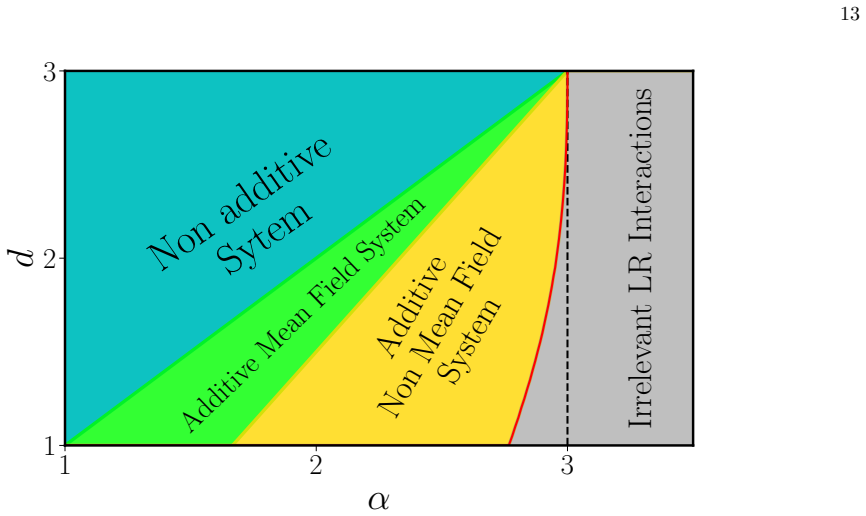
Pith's one-line read For weakly long-range O(N) spin models, the paper argues that the anomalous dimension is exactly η=2−σ for d/2<σ<σ*, with no perturbative correction, and that the long-range and short-range fixed points merge at σ*=2−η_SR.
desk verdict A solid, self-described FRG review that restates the authors' earlier Sak-scenario results; the new error estimates and quantum exponents are useful, but the core derivation hinges on an unexamined regulator/truncation assumption. read the letter →
The pith
A machine-rendered reading of the paper's core claim, the machinery that carries it, and where it could break.
The reading
What carries the argument
The load-bearing machinery is the scale-dependent effective action $\Gamma_k$ truncated to the two leading momentum terms of the inverse propagator, $Z_{\sigma,k} q^\sigma$ and $Z_{2,k} q^2$, together with a regulator that acts on both terms symmetrically, $R_k(q)=Z_{\sigma,k}(k^\sigma-q^\sigma)\theta(k^\sigma-q^\sigma)+Z_{2,k}(k^2-q^2)\theta(k^2-q^2)$. This choice avoids biasing the competition between long-range and short-range physics. The fixed-point analysis then reduces to two mutually exclusive possibilities: either the long-range kinetic coefficient vanishes (short-range fixed point) or the anomalous dimension is forced to $\eta=2-\sigma$ (long-range fixed point). The two solutions coalesce exactly when $2-\sigma$ equals $\eta_{SR}$, which is the mechanism producing the threshold $\sigma^*=2-\eta_{SR}$. The same structure, with an additional frequency term $K_k \partial_\tau^2$, carries the quantum calculation.
What would settle it
Measure the anomalous dimension of the two-dimensional Ising model with long-range couplings directly at $\sigma=7/4$: the scenario predicts $\eta=1/4$ exactly and a transition that is still long-range at $\sigma=7/4$ but short-range for any $\sigma>7/4$; a measured $\eta$ clearly different from $1/4$, or clear long-range scaling above $\sigma=7/4$, would refute the central claim. A direct check of the mechanism itself is to add a $q^4$ term to the ansatz and see whether the fixed-point condition $\partial_t Z_\sigma=(2-\sigma-\eta)Z_\sigma$ remains the only way to stop the long-range kinetic flow.
Extended reading notes
Core claim
On the paper's own terms, the central discovery is that the long-range fixed point of the classical $O(N)$ model satisfies $\eta=2-\sigma$ exactly, because the flow of the $q^\sigma$ kinetic coefficient vanishes only when this identity holds, while the $q^2$ coefficient adjusts its scaling dimension to match. The two kinetic terms therefore exchange dominance precisely at the value of $\sigma$ where the long-range anomalous dimension equals the short-range one, yielding $\sigma^*=2-\eta_{SR}$. At $\sigma>\sigma^*$ only the short-range fixed point exists; at $\sigma<\sigma^*$ the long-range fixed point controls the transition and has one relevant direction, and at $\sigma=d/2$ it merges with the Gaussian (mean-field) fixed point. In the quantum case the same fixed-point condition on the kinetic term gives $\sigma^*=2-\eta_{SR}$ with $\eta_{SR}$ the anomalous dimension of the corresponding short-range model in $d+1$ dimensions, and the dynamical exponent is $z=\sigma/(2-\eta_\tau)$, where $\eta_\tau$ is the frequency anomalous dimension.
Load-bearing premise
The whole derivation rests on truncating the flowing action to the single $q^\sigma$ and $q^2$ momentum terms and on the symmetric regulator chosen to compare them; if higher-order momentum dependence or a different regulator moves the fixed-point condition, the threshold $\sigma^*=2-\eta_{SR}$ and the exponents would shift.
Editorial extensions
If this is right
- For $d/2<\sigma<\sigma^*$, the critical exponents of classical long-range $O(N)$ models can be read from short-range exponents in the effective dimension $D_{\rm eff}=2d/\sigma$, with $\nu_{LR}=(2-\eta_{SR}(D'_{\rm eff}))\,\nu_{SR}(D'_{\rm eff})/\sigma$.
- At $\sigma=\sigma^*$ the long-range and short-range fixed points coincide, so the anomalous dimension $\eta$ is continuous across the boundary, with no jump to a different value at $\sigma^*$.
- For quantum rotors and the transverse-field Ising model, $\sigma^*=2-\eta_{SR}$ (with $\eta_{SR}$ taken from the $d+1$-dimensional short-range theory) and the dynamical exponent is $z=\sigma/(2-\eta_\tau)$, reducing to the mean-field value $z=\sigma/2$ when frequency renormalization vanishes.
- The upper critical dimension of the long-range quantum model is $d_{\rm uc}=3\sigma/2$, and for continuous symmetries the lower critical dimension is $d_{\rm lc}=\sigma/2$.
- Within this truncation, the computed $\nu$ and $z\nu$ agree with available Monte Carlo results to within about five percent for the Ising case, with the known exception of the $d=1,N=2$ case where a topological transition is expected at $\sigma=2$.
Reading between the lines
- If the two-term truncation is faithful, the same merging criterion $\sigma^*=2-\eta_{SR}$ should apply to other models with two competing kinetic operators, such as long-range percolation or long-range $O(N)$ field theories in fractional dimension; the paper does not test those cases.
- A natural cross-check not performed in the paper would compare high-precision long-range Monte Carlo exponents in $(d,\sigma)$ with short-range conformal-bootstrap data at fractional dimension $D_{\rm eff}=2d/\sigma$.
- Trapped-ion spin chains with tunable decay exponent could test the predicted dynamical exponent $z=\sigma/(2-\eta_\tau)$ by measuring correlation-spread dynamics, a quantitative target the paper does not address.
- Because $\eta_{SR}$ must be supplied from outside the present truncation, a fully scheme-independent test of $\sigma^*=2-\eta_{SR}$ would require computing both sides at the same approximation level; that consistency check is not carried out here.
Signed reviews
Editorial analysis
A structured set of objections, weighed in public.
Referee Report
Summary. The paper presents a functional renormalization group (FRG) study of classical and quantum O(N) spin models with weak long-range (LR) interactions, i.e. couplings decaying as r^{-(d+σ)} with 0<σ<2. The main classical part (Sections II-III) constructs scale-dependent effective actions containing both the non-analytic kinetic term q^σ and the standard q^2 term, together with a symmetric infrared regulator. The central claim is that no correction to the mean-field value of the anomalous dimension exists (δη=0, hence η_LR=2−σ) and that the long-range fixed point merges with the short-range one at σ*=2−η_SR, in agreement with Sak's scenario. The quantum part (Section IV) extends the same construction to quantum rotor and transverse-field Ising models, deriving the quantum-to-classical effective dimension, the dynamical exponent z, and the threshold σ*=2−η_SR, together with numerical estimates for 1/ν and 1/(zν) in d=1. The paper also reviews effective-dimension relations and compares its results with Monte Carlo, conformal bootstrap, and previous FRG work.
Significance. If the central derivation were fully robust, the paper would provide a single FRG framework that unifies classical and quantum LR criticality and settles the long-standing controversy between σ*=2 and σ*=2−η_SR in favor of Sak's scenario. The paper is genuinely useful as a review and as a source of concrete predictions: it contains parameter-free flow equations, explicit numerical curves for exponents as functions of σ, and a consistent discussion of the fixed-point structure. The agreement with existing Monte Carlo and conformal-bootstrap evidence is a real strength, as is the explicit treatment of the competition between q^σ and q^2 terms near σ*. However, the derivation of the key result δη=0 and σ*=2−η_SR rests on a specific truncation of the effective action and a specific regulator choice, and the paper does not establish regulator independence; this limits the conclusiveness of the central claim.
major comments (4)
- [§IIB, Eq. (14a)] The result ∂_t Z_σ = 0 is the hinge of the Sak-scenario derivation: it directly yields the fixed-point condition η_2 = 2−σ in Eq. (16a) and the branching at σ* = 2−η_SR. However, this equation is obtained within the two-term parametrization (10) and the symmetric sharp regulator (11). The text's justification, that the flow of the inverse propagator remains analytic at p→0, is an assumption: at an LR fixed point the exact propagator behaves as q^σ, which is non-analytic for non-integer σ. Moreover, the ansatz (10) contains only the momentum structures q^σ and q^2, so any correction of the form q^{σ+δη} is excluded by construction and projecting onto p^σ cannot detect it. As written, the derivation exhibits Sak's result inside a truncation/regulator in which it is effectively assumed rather than deriving it from the exact flow. The authors should either prove regulator independence or carefully state this limitation in the main text.
- [§IIB, Eq. (11) and §III] The symmetric regulator (11) uses the same scale k for the q^σ and q^2 terms, making the low-momentum propagator (Z_σ k^σ + Z_2 k^2 + ...) constant for q<k. This removes the non-analytic q^σ momentum dependence from the loop integrand and is likely responsible for the exact vanishing of ∂_t Z_σ. A different regulator, for instance two independent cutoff scales for the two kinetic terms or a smooth regulator, would generically produce a non-zero p^σ projection of ∂_t Γ_k^(2). The paper does not test this sensitivity. Consequently, the conclusion σ* = 2−η_SR, which follows from Eqs. (16a) and (18a), is not shown to be scheme-independent. I would not regard this as a refutation of Sak's scenario—independent Monte Carlo and bootstrap evidence supports it—but the FRG derivation as presented does not establish it beyond the chosen truncation.
- [§IVB, Eq. (40)] Equation (40), ∂_t Z_k = (2−σ−η)Z_k, is used to conclude that either η = 2−σ or Z_k→0. This is again an ansatz-level statement: the scaling dimension of the LR kinetic coefficient is computed relative to the SR kinetic term, and the 'anomalous dimension' η is defined with respect to the SR term (Eq. (41)). If there were a non-mean-field correction to the LR term, the flow would read ∂_t Z_k = (2−σ−η−δη)Z_k with δη≠0. The equation therefore presupposes the absence of such a correction. The subsequent derivation of σ*=2−η_SR in Eq. (44) consequently inherits this assumption. The authors should acknowledge that Eq. (40) is a truncation assumption rather than a derived exact relation.
- [§IVC, paragraph following Eq. (44)] The statement that 'setting Z_2,k = 0 ... does not introduce any further correction to the determination of the critical exponents, since the analytic momentum term only becomes relevant for σ≃σ* and, even there, it has been shown in Ref. [27,28] not to substantially influence the numerical values' is presented as a justification for dropping the q^2 term in the computation of η_τ and ν. This is an external approximation claim, not a demonstration within the present framework. Given that the central Sak-scenario result depends precisely on the competition between the LR and SR terms near σ*, this omission should be flagged explicitly as an additional truncation and its numerical impact should be quantified in the present paper rather than only cited from earlier work.
minor comments (4)
- [Introduction, first paragraph] There is a spelling error: 'diffucult' should be 'difficult'.
- [§IVC, Eqs. (46)-(48)] The function f(ρ̄0, Ū(2)(ρ̄0)) is used in Eq. (47) for η_τ before it is defined in Eq. (48). Reorder the definitions or add a forward reference.
- [§V, Conclusions] The phrase 'the d→d+z correspondence seems an artefact of our approximation procedure rather than an exact result' is somewhat in tension with the earlier use of the same correspondence to derive upper and lower critical dimensions in Section IVA. It would help to state clearly which results are affected by this artefact and which are not.
- [References] Reference [117] contains a typo: 'Phis. Rev.B' should be 'Phys. Rev. B'. Also, Ref. [30] is a PhD thesis; if it is not accessible to the reader, more details of the spike-plot technique should be provided in the text.
Circularity Check
No significant circularity: the FRG derivation is self-contained and the Sak-scenario claim is independently benchmarked.
full rationale
The paper's central claim (Sak scenario: eta_LR = 2 - sigma and sigma* = 2 - eta_SR) is supported by explicit Wetterich-flow computations built on the stated ansatz (10) and regulator (11). No fitted parameter enters the beta functions: the relation dt Z_sigma = 0 in Eq. (14a) is presented as the result of projecting the flow of the inverse propagator, and the fixed-point condition eta_2 = 2 - sigma in Eq. (16a) is a consistency condition for a nonzero LR coupling J_sigma, not a value imposed from data. The input eta_SR in fractional dimensions is taken from the authors' earlier FRG work (Ref. [106]) and the quantum exponents from Ref. [29], but these are published results that the paper benchmarks against Monte Carlo and conformal bootstrap, so they count as independent evidence rather than a self-citation loop. The reviewer's concern that the vanishing of dt Z_sigma may be an artifact of the two-term truncation and the symmetric sharp regulator is a legitimate correctness and robustness question, but it is not a circularity: the paper does not define the anomalous dimension in terms of the conclusion, and the Sak scenario is not presented as a consequence of a fitted input. The derivation is transparent about its approximations, and the central physical claim has support outside the present paper's own equations.
Assumptions & free parameters
assumptions (4)
- domain assumption The effective action for LR O(N) models is accurately parametrized by the LPA' form containing only the q^σ and q^2 kinetic terms (Eq. (10) classical, Eq. (24) quantum).
- ad hoc to paper The regulator R_k(q) = Zσ(k^σ−q^σ)θ(k^σ−q^σ)+Z2(k^2−q^2)θ(k^2−q^2) does not bias the competition between LR and SR kinetic terms near σ* (Eq. (11)).
- ad hoc to paper When computing quantum critical exponents, setting Z2,k=0 leaves the exponents unchanged except at σ≃σ* (Section IV C).
- domain assumption Effective dimension relations D_e=2d/σ and d'_SR=2d/σ+1 are accurate enough to derive upper and lower critical dimensions and exponent relations in the LR regime.
Cite this review
Pith. "Pith review of Criticality of Spin Systems with Weak Long-Range Interactions." pith.science (2026). https://pith.science/paper/XP2TADGQ
@misc{pith2026190805158,
  author       = {Pith},
  title        = {Pith review of: Criticality of Spin Systems with Weak Long-Range Interactions},
  year         = {2026},
  howpublished = {\url{https://pith.science/paper/XP2TADGQ}},
  note         = {Machine review of arXiv:1908.05158}
}
abstract
The study of critical properties of systems with long-range interactions has attracted in the last decades a continuing interest and motivated the development of several analytical and numerical techniques, in particular in connection with spin models. From the point of view of the investigation of their criticality, a special role is played by systems in which the interactions are long-range enough that their universality class is different from the short-range case and, nevertheless, they maintain the extensivity of thermodynamical quantities. Such interactions are often called weak long-range. In this paper we focus on the study of the critical behaviour of spin systems with weak-long range couplings using renormalization group, and we review their remarkable properties. For the sake of clarity and self-consistency, we start from the classical $O(N)$ spin models and we then move to quantum spin systems.
Figures


Figures from the paper (3 more)


Reference graph
Works this paper leans on
-
[118]
A. Dutta, in Phys. A Stat. Mech. its Appl. (2003), vol. 318, pp. 63–71
work page 2003
-
[1]
Campa, T
A. Campa, T. Dauxois, and S. Ruffo, Phys. Rep. 480, 57 (2009)
2009
-
[2]
(34) A careful inspection of Eq. (28) reveals that the flow for the effective potential in the quantum case at LPA level can be mapped to the one of the classical case [106, 113] in the effective fractional dimension dSR = 2(d +z) σ . (35) 11 The latter results has been obtained in LPA and does not account for the renormalization of the kinetic sector. There...
-
[3]
what are the phenomena introduced by LR interactions in classical systems which also survive in the quantum case?
(39) While the validity of the result in Eq. (37) is independent on N, the lower critical dimension expression in Eq. (39) is a consequence of the MWT and it applies only to continuous symmetries N≥ 2. The most fascinating feature of the LPA picture is its simplicity. The solution of Eq. (28) reveals the existence of two fixed points for the effective poten...
-
[4]
Campa, T
A. Campa, T. Dauxois, D. Fanelli, and S. Ruffo, Physics of long-range interacting systems (Oxford University Press, Oxford, 2011)
2011
-
[5]
M. E. Fisher, S.-k. Ma, and B. G. Nickel, Phys. Rev. Lett. 29, 917 (1972)
1972
-
[6]
Sak, Phys
J. Sak, Phys. Rev. B 8, 281 (1973)
1973
-
[7]
F. J. Dyson, Commun. Math. Phys. 12, 91 (1969)
1969
Show all 129 references
-
[8]
D. J. Thouless, Phys. Rev. 187, 732 (1969)
1969
-
[9]
P. W. Anderson, G. Yuval, and D. R. Hamann, Phys. Rev. B 1, 4464 (1970)
1970
-
[10]
J. L. Cardy, J. Phys. A. Math. Gen. 14, 1407 (1981)
1981
-
[11]
Fr¨ ohlich and T
J. Fr¨ ohlich and T. Spencer, Commun. Math. Phys.84, 87 (1982)
1982
-
[12]
Luijten and H
E. Luijten and H. Meßingfeld, Phys. Rev. Lett. 86, 5305 (2001)
2001
-
[13]
Luijten and H
E. Luijten and H. W. J. Bl¨ ote, Phys. Rev. B 56, 8945 (1997)
1997
-
[14]
Balog, G
I. Balog, G. Tarjus, and M. Tissier, J. Stat. Mech. P10017 (2014)
2014
-
[15]
Luijten and H
E. Luijten and H. W. Bl¨ ote, Int. J. Mod. Phys. C 06, 359 (1995)
1995
-
[16]
Fukui and S
K. Fukui and S. Todo, J. Computat. Phys. 228, 2629 (2009)
2009
-
[17]
G. Gori, M. Michelangeli, N. Defenu, and A. Trombettoni, Phys. Rev. E 96, 012108 (2017)
2017
-
[18]
Luijten and H
E. Luijten and H. W. J. Bl¨ ote, Phys. Rev. Lett. 89, 025703 (2002)
2002
-
[19]
M. C. Angelini, G. Parisi, and F. Ricci-Tersenghi, Phys. Rev. E 89, 062120 (2014)
2014
-
[20]
Horita, H
T. Horita, H. Suwa, and S. Todo, Phys. Rev. E 95, 012143 (2016)
2016
-
[21]
Suzuki, Progr
M. Suzuki, Progr. Theor. Phys. 49, 1106 (1973)
1973
-
[22]
Yamazaki, Phys
Y. Yamazaki, Phys. Lett. A 61, 207 (1977)
1977
- [23]
-
[24]
Blanchard, M
T. Blanchard, M. Picco, and M. A. Rajabpour, Europhysics Lett. 101, 56003 (2013)
2013
-
[25]
Grassberger, J
P. Grassberger, J. Stat. Phys. 153, 289 (2013)
2013
-
[26]
M. F. Paulos, S. Rychkov, B. C. van Rees, and B. Zan, Nucl. Phys. B 902, 246 (2016)
2016
-
[27]
Behan, L
C. Behan, L. Rastelli, S. Rychkov, and B. Zan, Phys. Rev. Lett. 118, 241601 (2017); J. Phys. A 50, 354002 (2017)
2017
-
[28]
Behan, J
C. Behan, J. Phys. A 52, 075401 (2019)
2019
-
[29]
Defenu, A
N. Defenu, A. Trombettoni, and A. Codello, Phys. Rev. E 92, 052113 (2015)
2015
-
[30]
Defenu, A
N. Defenu, A. Trombettoni, and S. Ruffo, Phys. Rev. B 94, 224411 (2016)
2016
-
[31]
Defenu, A
N. Defenu, A. Trombettoni, and S. Ruffo, Phys. Rev. B 96, 104432 (2017)
2017
-
[32]
Defenu, Ph
N. Defenu, Ph. D. Thesis, avaialable at https://cm.sissa.it/phdsection/alumni
-
[33]
Bloch, J
I. Bloch, J. Dalibard, and W. Zwerger, Rev. Mod. Phys. 80, 885 (2008)
2008
-
[34]
J. W. Britton, B. C. Sawyer, A. C. Keith, C.-C. J. Wang, J. K. Freericks, H. Uys, M. J. Biercuk, and J. J. Bollinger, Nature 484, 489 (2012)
2012
-
[35]
Schauß, M
P. Schauß, M. Cheneau, M. Endres, T. Fukuhara, S. Hild, A. Omran, T. Pohl, C. Gross, S. Kuhr, and I. Bloch, Nature 491, 87 (2012)
2012
-
[36]
Aikawa, A
K. Aikawa, A. Frisch, M. Mark, S. Baier, A. Rietzler, R. Grimm, and F. Ferlaino, Phys. Rev. Lett. 108, 210401 (2012)
2012
-
[37]
M. Lu, N. Q. Burdick, and B. L. Lev, Phys. Rev. Lett. 108, 215301 (2012)
2012
-
[38]
B. Yan, S. A. Moses, B. Gadway, J. P. Covey, K. R. A. Hazzard, A. M. Rey, D. S. Jin, and J. Ye, Nature 501, 521 (2013)
2013
-
[39]
Firstenberg, T
O. Firstenberg, T. Peyronel, Q.-Y. Liang, A. V. Gorshkov, M. D. Lukin, and V. Vuleti´ c, Nature 502, 71 (2013)
2013
-
[40]
Islam, C
R. Islam, C. Senko, W. C. Campbell, S. Korenblit, J. Smith, A. Lee, E. E. Edwards, C.-C. J. Wang, J. K. Freericks, and C. Monroe, Science (80-. ). 340, 583 (2013)
2013
-
[41]
Richerme, Z.-X
P. Richerme, Z.-X. Gong, A. Lee, C. Senko, J. Smith, M. Foss-Feig, S. Michalakis, A. V. Gorshkov, and C. Monroe, Nature 511, 198 (2014)
2014
-
[42]
Jurcevic, B
P. Jurcevic, B. P. Lanyon, P. Hauke, C. Hempel, P. Zoller, R. Blatt, and C. F. Roos, Nature 511, 202 (2014)
2014
-
[43]
J. S. Douglas, H. Habibian, C.-L. Hung, A. V. Gorshkov, H. J. Kimble, and D. E. Chang, Nat. Photonics 9, 326 (2015)
2015
-
[44]
Schempp, G
H. Schempp, G. G¨ unter, S. W¨ uster, M. Weidem¨ uller, and S. Whitlock, Phys. Rev. Lett.115, 093002 (2015). 18
2015
-
[45]
Landig, F
R. Landig, F. Brennecke, R. Mottl, T. Donner, and T. Esslinger, Nat. Commun. 6, 7046 (2015)
2015
-
[46]
Landig, L
R. Landig, L. Hruby, N. Dogra, M. Landini, R. Mottl, T. Donner, and T. Esslinger, Nature 532, 476 (2016)
2016
-
[47]
P. W. Hess, P. Becker, H. B. Kaplan, A. Kyprianidis, A. C. Lee, B. Neyenhuis, G. Pagano, P. Richerme, C. Senko, J. Smith, W. L. Tan, J. Zhang, and C. Monroe, Phil. Trans. R. Soc. A 375, 0107 (2017)
2017
-
[48]
Jurcevic, H
P. Jurcevic, H. Shen, P. Hauke, C. Maier, T. Brydges, C. Hempel, B. P. Lanyon, M. Heyl, R. Blatt, and C. F. Roos, Phys. Rev. Lett. 119, 080501 (2017)
2017
-
[49]
Pagano, P
G. Pagano, P. W. Hess, H. B. Kaplan, W. L. Tan, P. Richerme, P. Becker, A. Kyprianidis, J. Zhang, E. Birckelbaw, M. R. Hernandez, Y. Wu, and C. Monroe, Quantum Sci. Technol. 4, 014004 (2019)
2019
-
[50]
Hempel, C
C. Hempel, C. Maier, J. Romero, J. McClean, T.Monz, H. Shen, P. Jurcevic, B. Lanyon, P. Love, R. Babbush, A. Aspuru-Guzik, R. Blatt, and C. F. Roos, Phys. Rev. X 8, 031022 (2018)
2018
-
[51]
Keesling, A
A. Keesling, A. Omran, H. Levine, H. Bernien, H. Pichler, S. Choi, R. Samajdar, S. Schwartz, P. Silvi, S. Sachdev, P. Zoller, M. Endres, M. Greiner, V. Vuleti´ c, and M. D. Lukin, Nature568, 207 (2019)
2019
-
[52]
E. A. Martinez, C. A. Muschik, P. Schindler, D. Nigg, A. Erhard, M. Heyl, P. Hauke, M. Dalmonte, T. Monz, P. Zoller, and R. Blatt, Nature 534, 516 (2016)
2016
-
[53]
Koffel, M
T. Koffel, M. Lewenstein, and L. Tagliacozzo, Phys. Rev. Lett. 109, 267203 (2012)
2012
-
[54]
Schachenmayer, B
J. Schachenmayer, B. P. Lanyon, C. F. Roos, and A. J. Daley, Phys. Rev. X 3, 031015 (2013)
2013
-
[55]
M. Knap, A. Kantian, T. Giamarchi, I. Bloch, M. D. Lukin, and E. Demler, Phys. Rev. Lett. 111, 147205 (2013)
2013
-
[56]
Hauke and L
P. Hauke and L. Tagliacozzo, Phys. Rev. Lett. 111, 207202 (2013)
2013
-
[57]
Eisert, M
J. Eisert, M. van den Worm, S. R. Manmana, and M. Kastner, Phys. Rev. Lett. 111, 260401 (2013)
2013
-
[58]
Z. X. Gong, M. Foss-Feig, S. Michalakis, and A. V. Gorshkov, Phys. Rev. Lett. 113 (2014)
2014
-
[59]
Damanik, M
D. Damanik, M. Lemm, M. Lukic, and W. Yessen, Phys. Rev. Lett. 113, 127202 (2014)
2014
-
[60]
Foss-Feig, Z.-X
M. Foss-Feig, Z.-X. Gong, C. W. Clark, and A. V. Gorshkov, Phys. Rev. Lett. 114, 157201 (2015)
2015
-
[61]
M. A. Rajabpour and S. Sotiriadis, Phys. Rev. B 91, 045131 (2015)
2015
-
[62]
G. Gori, S. Paganelli, A. Sharma, P. Sodano, and A. Trombettoni, Phys. Rev. B 91, 245138 (2015)
2015
-
[63]
Cevolani, G
L. Cevolani, G. Carleo, and L. Sanchez-Palencia, Phys. Rev. A 92, 041603 (2015)
2015
-
[64]
M. J. Hwang, R. Puebla, and M. B. Plenio, Phys. Rev. Lett. 115, 180404 (2015)
2015
-
[65]
Bertini, F
B. Bertini, F. H. L. Essler, S. Groha, and N. J. Robinson, Phys. Rev. Lett. 115, 180601 (2015)
2015
-
[66]
L. F. Santos, F. Borgonovi, and G. L. Celardo, Phys. Rev. Lett. 116, 250402 (2016)
2016
-
[67]
Z.-X. Gong, M. F. Maghrebi, A. Hu, M. L. Wall, M. Foss-Feig, and A. V. Gorshkov, Phys. Rev. B 93, 041102 (2016)
2016
-
[68]
Humeniuk, Phys
S. Humeniuk, Phys. Rev. B 93, 104412 (2016)
2016
-
[69]
M. F. Maghrebi, Z.-X. Gong, M. Foss-Feig, and A. V. Gorshkov, Phys. Rev. B 93, 125128 (2016)
2016
-
[70]
I. A. Kov´ acs, R. Juh´ asz, and F. Igl´ oi, Phys. Rev. B93, 184203 (2016)
2016
-
[71]
Z. X. Gong, M. F. Maghrebi, A. Hu, M. Foss-Feig, P. Richerme, C. Monroe, and A. V. Gorshkov, Phys. Rev. B 93, 205115 (2016)
2016
-
[72]
Kuwahara, J
T. Kuwahara, J. Stat. Mech. Theory Exp. 2016, 053103 (2016)
2016
-
[73]
A. S. Buyskikh, M. Fagotti, J. Schachenmayer, F. Essler, and A. J. Daley, Phys. Rev. A 93, 053620 (2016)
2016
-
[74]
Fey and K
S. Fey and K. P. Schmidt, Phys. Rev. A 94, 075156 (2016)
2016
-
[75]
G. L. Celardo, R. Kaiser, and F. Borgonovi, Phys. Rev. B 94, 144206 (2016)
2016
-
[76]
Viyuela, D
O. Viyuela, D. Vodola, G. Pupillo, and M. A. Martin-Delgado, Phys. Rev. B 94, 125121 (2016)
2016
-
[77]
Bermudez, L
A. Bermudez, L. Tagliacozzo, G. Sierra, and P. Richerme, Phys. Rev. B 95, 024431 (2016)
2016
-
[78]
Cevolani, G
L. Cevolani, G. Carleo, and L. Sanchez-Palencia, New J. Phys. 18, 093002 (2016)
2016
-
[79]
Jaschke, K
D. Jaschke, K. Maeda, J. D Whalen, M. L. Wall, and L. D. Carr, New J. Phys. 19, 033032 (2017)
2017
-
[80]
Lepori and L
L. Lepori and L. Dell’Anna, New J. Phys. 19, 103030 (2017)
2017
-
[81]
Cevolani, J
L. Cevolani, J. Despres, G. Carleo, L. Tagliacozzo, and L. Sanchez-Palencia, Phys. Rev. B 98, 024302 (2018)
2018
-
[82]
Igl´ oi, B
F. Igl´ oi, B. Blaβ, G. Ro´ osz, and H. Rieger, Phys. Rev. B98, 184415 (2018)
2018
-
[83]
Lerose, J
A. Lerose, J. Marino, B. Zunkovic, A. Gambassi, and A. Silva, Phys. Rev. Lett. 120, 130603 (2018)
2018
-
[84]
B. Blaβ, H. Rieger, G. Ro´ osz, and F. Igl´ oi, Phys. Rev. Lett.121, 095301 (2018)
2018
-
[85]
Defenu, T
N. Defenu, T. Enss, M. Kastner, and G. Morigi, Phys. Rev. Lett. 121, 240403 (2018)
2018
- [86]
-
[87]
Lerose, B
A. Lerose, B. Zunkovic, A. Silva, and A. Gambassi, Phys. Rev. B 99, 121112 (2019)
2019
-
[88]
Gabbrielli, L
M. Gabbrielli, L. Lepori, and L. Pezz` e, New J. Phys. 21, 033039 (2019)
2019
-
[89]
S. Fey, S. C. Kapfer, and K. P. Schmidt, Phys. Rev. Lett. 122, 017203 (2019)
2019
-
[90]
Vodola, L
D. Vodola, L. Lepori, E. Ercolessi, A. V. Gorshkov, and G. Pupillo, Phys. Rev. Lett. 113, 156402 (2014)
2014
-
[91]
F. Ares, J. G. Esteve, F. Falceto, and A. R. De Queiroz, Phys. Rev. A 92, 042334 (2015)
2015
-
[92]
Lepori, D
L. Lepori, D. Vodola, G. Pupillo, G. Gori, and A. Trombettoni, Ann. Physics 374, 35 (2016)
2016
-
[93]
Van Regemortel, D
M. Van Regemortel, D. Sels, and M. Wouters, Phys. Rev. A 93, 032311 (2016)
2016
-
[94]
Vodola, L
D. Vodola, L. Lepori, E. Ercolessi, and G. Pupillo, New J. Phys. 18, 015001 (2016)
2016
-
[95]
Lepori, A
L. Lepori, A. Trombettoni, and D. Vodola, J. Stat. Mech. 033102 (2017)
2017
-
[96]
Dutta and A
A. Dutta and A. Dutta, Phys. Rev. B 96, 125113 (2017)
2017
-
[97]
Alecce and L
A. Alecce and L. Dell’Anna, Phys. Rev. B 95, 195160 (2017)
2017
-
[98]
Defenu, T
N. Defenu, T. Enss, and J. C. Halimeh, Phys. Rev. B 100, 014434 (2019)
2019
-
[99]
Dutta and J
A. Dutta and J. K. Bhattacharjee, Phys. Rev. B 64, 184106 (2001)
2001
-
[100]
Sachdev, Quantum Phase Transitions (Cambridge University Press, Cambridge, 2011)
S. Sachdev, Quantum Phase Transitions (Cambridge University Press, Cambridge, 2011)
2011
-
[101]
Berges, N
J. Berges, N. Tetradis, and C. Wetterich, Phys. Rep. 363, 223 (2002). 19
2002
- [102]
-
[103]
Wetterich, Phys
C. Wetterich, Phys. Lett. B 301, 90 (1993)
1993
-
[104]
Codello, J
A. Codello, J. Phys. A 45, 465006 (2012)
2012
-
[105]
T. R. Morris, Int. J. Mod. Phys. A 09, 2411 (1994)
1994
-
[106]
G. S. Joyce, Phys. Rev. 146, 349 (1966)
1966
-
[107]
R. A. Ba˜ nos, L. A. Fernandez, V. Martin-Mayor, and A. P. Young, Phys. Rev. B 86, 134416 (2012)
2012
-
[108]
Codello and G
A. Codello and G. D’Odorico, Phys. Rev. Lett. 110, 141601 (2013)
2013
-
[109]
S. L. Katz, M. Droz, and J. D. Gunton, Phys. Rev. B 15, 1597 (1977)
1977
-
[110]
HOLOVATCH, Int
Y. HOLOVATCH, Int. J. Mod. Phys. A 08, 5329 (1993)
1993
-
[111]
El-Showk, M
S. El-Showk, M. F. Paulos, D. Poland, S. Rychkov, D. Simmons-Duffin, and A. Vichi, J. Stat. Phys. 157, 869 (2014)
2014
-
[112]
Cappelli, L
A. Cappelli, L. Maffi, and S. Okuda, J. High Energy Phys. 2019, 161 (2019)
2019
-
[113]
Mussardo, Statistical field theory: an introduction to exactly solved models in statistical physics (Oxford University Press, 2010)
G. Mussardo, Statistical field theory: an introduction to exactly solved models in statistical physics (Oxford University Press, 2010)
2010
-
[114]
Brezin, G
E. Brezin, G. Parisi, and F. Ricci-Tersenghi, J. Stat. Phys. 157, 855 (2014)
2014
-
[115]
Codello, N
A. Codello, N. Defenu, and G. D’Odorico, Phys. Rev. D 91, 105003 (2015)
2015
-
[116]
Mendoza-Coto, D
A. Mendoza-Coto, D. G. Barci, D. A. Stariolo Phys. Rev. B 95, 144209 (2017)
2017
-
[117]
Vojta, Phys
T. Vojta, Phys. Rev. B 53, 710 (1996)
1996
-
[119]
Defenu, A
N. Defenu, A. Trombettoni, I. N´ andori, T. Enss, Phis. Rev.B 96 174505 (2017)
2017
-
[120]
I. B. Sperstad, E. B. Stiansen, and A. Sudbø, Phys. Rev. B 85, 214302 (2012)
2012
-
[121]
Cescatti, M
F. Cescatti, M. Ib´ a˜ nez-Berganza, A. Vezzani, and R. Burioni,arXiv:1905.06688
1905 arXiv
-
[122]
Brezin and J
E. Brezin and J. Zinn-Justin, Phys. Rev. Lett. 36, 691 (1976)
1976
-
[123]
T. R. Morris and M. D. Turner, Nucl. Phys. B 509, 637 (1998)
1998
-
[124]
Laflorencie, I
N. Laflorencie, I. Affleck, and M. Berciu, J. Stat. Mech. Theory Exp. 2005, P12001 (2005)
2005
-
[125]
M. B. Hastings and T. Koma, Commun. Math. Phys. 265, 781 (2006)
2006
-
[126]
Yuval and P
G. Yuval and P. W. Anderson, Phys. Rev. B 1, 1522 (1970)
1970
-
[127]
G. E. Uhlenbeck, P. C. Hemmer, and M. Kac, J. Math. Phys. 4, 216 (1963)
1963
-
[128]
Tetradis and C
N. Tetradis and C. Wetterich, Nucl. Phys. B 383, 197 (1992)
1992
-
[129]
Mori, Phys
T. Mori, Phys. Rev. E 82, 060103 (2010)
2010
Reviewed August 14, 2026 · model on record in the stance chip above.
Discussion (0). Continue with ORCID to comment.