REVIEW 3 major objections 5 minor 73 references
Girsanov reweighting turns one rare-event simulation into a full posterior over kinetic observables, propagating machine-learned potential uncertainty without resampling.
Reviewed by Pith at T0; open to challenge. T0 means a machine referee read the full paper against a public rubric. the ladder, T0–T4 →
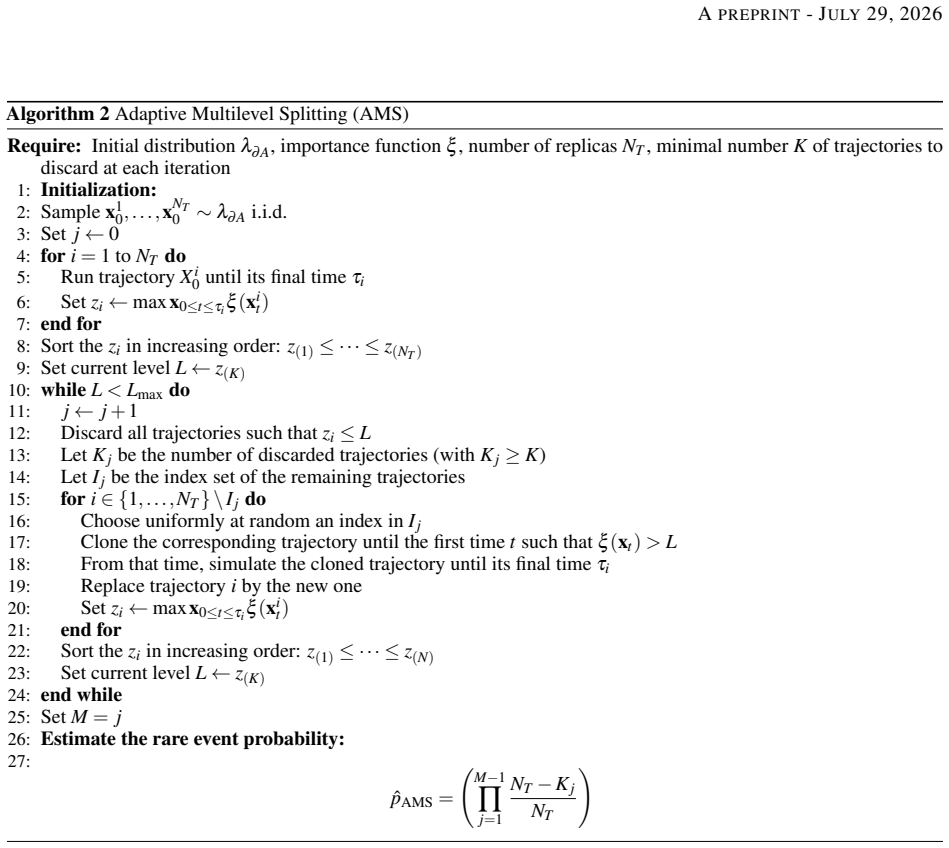
Girsanov reweighting of AMS-sampled reactive trajectories propagates machine-learned interatomic potential parameter uncertainty to committor probabilities and, under extra assumptions, to reaction rates.
T0 review reviewed 2026-08-02 challenge →
load-bearing objection The estimator is correctly derived and convincingly validated on toy models, but the butane application does not test the variance-control assumption the practical pipeline depends on. the 3 major comments →
Girsanov Reweighting for Uncertainty Propagation in Rare-Event Kinetics
The pith
A machine-rendered reading of the paper's core claim, the machinery that carries it, and where it could break.
The reading
Core claim
On its own terms, the paper establishes that for potentials linear in their parameters, the path-space likelihood ratio between two potentials is an exponential linear-quadratic form in the parameter displacement, built from a trajectory score s(X) and Fisher information matrix I(X). This makes the Girsanov estimator p_G(θ) in Eq. (28) an unbiased estimator of the committor probability p(θ) using only trajectories sampled at the reference parameter θL, and the first-order cumulant estimator p_C(θ) in Eq. (31) a cheap approximation sharing its Taylor expansion. From these, one constructs the uncertainty-aware distribution P(p|π) over any parameter posterior π, and—under the assumption that th
What carries the argument
The central object is the Girsanov likelihood ratio for linear potentials V(x,θ)=θᵀD(x): M(X,θ_L,θ) = exp[(θ−θ_L)ᵀs(X) − ½(θ−θ_L)ᵀI(X)(θ−θ_L)] / Z(θ_L,θ). Here s(X) is a path score accumulating vector-Jacobian products of the descriptor field along the trajectory, I(X) is the path Fisher information matrix, and Z normalizes the exit-distribution ratio. This factorization converts path reweighting into a cheap parameter-space tilt: one AMS run at θL yields predictions for every θ. The cumulant estimator p_C keeps only the score term, avoiding the costly I(X) computation that would need roughly 256 automatic-differentiation passes for a MACE-style network. The unbiasedness of p_G derives from
Load-bearing premise
The load-bearing premise is that Girsanov path-reweighting variance remains bounded over the reactive ensemble—short reactive trajectories and small potential perturbations under MLIP parameter uncertainty—along with the assumption that the exit-frequency φA is essentially independent of θ; the butane validation, whose POPS posterior is built from basin configurations, does not directly test the variance bound near the transition barrier.
What would settle it
For butane or a similar MLIP system, draw θ samples from a POPS posterior estimated from configurations sampled on the transition path (the barrier region) rather than only the metastable basins, then compare p_G(θ) and p_C(θ) against direct AMS reruns at the same θ. If the distribution of per-trajectory weights M(X,θ_L,θ) develops heavy tails or the reweighted confidence intervals systematically miss the direct estimates, the bounded-variance premise fails.
If this is right
- A single AMS run at the MLE parameter plus one score pass replaces a per-parameter resampling loop; the paper reports a speedup of about 10^3x for butane.
- The cumulant estimator p_C reproduces the full estimator's accuracy in all tested systems while costing only scores, making the method tractable for high-dimensional MLIP parameter spaces.
- The framework cleanly separates algorithmic sampling noise from model-misspecification uncertainty, producing narrow, covering intervals for accurate surrogates and wide, covering intervals for biased ones.
- Under the stated basin-accuracy assumption, uncertainty bounds on the reaction rate k_AB follow from Hill's relation with exit frequencies estimated once at θL.
- Because it relies only on an unbiased reactive path distribution, the method is agnostic to the splitting sampler (FFS, SMC, AMS) and to the parameter posterior model.
Where Pith is reading between the lines
- The variance-boundedness premise is the Achilles heel; a stress test with a POPS posterior built from transition-path configurations (rather than basin configurations) would reveal whether the weights M(X,θ_L,θ) remain well-behaved where the reaction actually occurs.
- The log-normal ansatz for p|θ is an extra modeling assumption; a nonparametric conditional distribution or a beta fit could change the tails of P(p|π) even with identical first two moments.
- The same reweighting machinery could, in principle, correct for estimator bias by reweighting from a cheap surrogate to a high-fidelity reference potential, not just among posterior samples, as long as the potential difference stays small along reactive paths.
- For long reactive trajectories (protein folding, large conformational changes), Girsanov variance will grow exponentially with duration; extensions using control variates or learned ratio estimation would be needed to keep the method practical.
Editorial analysis
A structured set of objections, weighed in public.
Referee Report
Summary. The manuscript presents a rare-event kinetic uncertainty-propagation framework for machine-learned interatomic potentials (MLIPs). The authors combine Adaptive Multilevel Splitting (AMS) at a reference parameter θ_L with Girsanov path reweighting to estimate the averaged committor probability p(θ) for nearby potentials without rerunning AMS for each θ. For linear-in-parameter potentials, they derive an unbiased full estimator p̂_G (Eqs. 19–28) and a cheaper first-order cumulant estimator p̂_C (Eq. 31), then reconstruct a log-normal conditional law p|θ and mix over a parameter posterior π(θ). Validation is performed on a dimer in a WCA solvent, a rugged Müller–Brown potential, a 1D model, and butane conformational transitions using MACE foundation models with POPS posteriors. Under an explicit assumption on the exit flux φ_A, the framework is extended to reaction rates via Hill's relation.
Significance. The theoretical contribution is valuable: the unbiasedness argument for p̂_G via the path-measure estimator γ̂ is clean, and the linear-parametrization trick makes score/FIM computations tractable for architectures like MACE. The toy tests are well designed and show good agreement with direct AMS over a range of parameter perturbations. The paper also ships code and data, which is a strength. The main open risk is whether the approximations and variance-control assumptions survive in the real butane application, where only p̂_C is used and no direct validation at sampled θ is provided. If the suggested diagnostics are added, the framework could be a solid methodological contribution to MLIP uncertainty propagation for rare-event kinetics.
major comments (3)
- [§4.2.2, Eq. (31)] The butane pipeline uses p̂_C, the first-order-in-(θ−θ_L) cumulant estimator, but there is no evidence that this truncation is accurate for the POPS posterior actually sampled. The toy models validate p̂_C for single-parameter perturbations of about ±10% around θ0; the butane posterior lives in a high-dimensional parameter space and the effective width in the score direction is not reported. Because p̂_C discards all second-order and higher terms in (θ−θ_L), the reported 'coverage' of the reference MPA value could simply reflect a wide posterior. Please add a calibration check: compare p̂_C to p̂_G on a subset of the 2000 drawn θ, or report the distribution of (θ−θ_L)ᵀs̄ and the magnitude of the neglected quadratic term, ideally with direct AMS at a few θ points. This is load-bearing for the central claim that the framework 'successfully recovers reference rare event probabilities' in a
- [§2.4, §4.2.2 step 1] The variance-control premise for the full Girsanov estimator is not tested in the butane application. Section 2.4 asserts that reactive trajectories are short and potential differences are 'sufficiently bounded across the configurational space explored by the reactive ensemble,' but the POPS posterior in §4.2.2 step 1 is calibrated on configurations from metastable basins A and B, not from the transition-state region traversed by the AMS reactive paths. For p̂_G in Eq. (28), the weights are exponential in path integrals of s and I; if the surrogate potential or force is misspecified near the barrier, the effective sample size of those weights can collapse. Please report an effective-sample-size or variance diagnostic for the p̂_G weights on the butane reactive trajectories, or explicitly restrict the central variance-controlled claim to p̂_C and state that p̂_G is validated only on the t
- [§3.2, Eqs. (23), (28), (29)] The unbiasedness proof in Eq. (20) uses the exact normalization Z(θ_L,θ). In practice, Eq. (29) estimates Z with K samples, and plugging 1/Ẑ into Eq. (28) introduces a finite-sample bias; E[1/Ẑ] ≠ 1/E[Ẑ]. The text in §3.2 describes p̂_G as 'although unbiased,' which is not exactly true for the implemented estimator with estimated Z. Please clarify this distinction, and either use an unbiased estimator of the ratio or quantify the bias (e.g., by reporting K and the variance of Ẑ). This is a correctness caveat for the central estimator.
minor comments (5)
- [Eqs. (30)–(31)] The phrase 'first-order cumulant' is potentially misleading. The first cumulant κ₁(L) contains a term proportional to E[I](θ−θ_L)², so Eq. (31) is a first-order-in-(θ−θ_L) truncation, not a first-cumulant truncation. Please state explicitly which small parameter is being used for the truncation.
- [Eq. (33)] The notation s̄ʲ and the aggregation over n_real realizations are unclear. It appears the score is averaged over all trajectories of all realizations, while the AMS probability estimates are averaged separately. Please define each term and provide the explicit delta-method variance formula used to produce confidence intervals.
- [Figs. 7, 9, 10] The confidence intervals and violin plots are not fully specified. State how the log-normal fit is performed (moment matching on which scale), how the reported intervals are derived from the delta-method variance, and how many θ samples N_θ are used in each figure.
- [Table 1, §4.3] The assumption that φ_A is essentially θ-independent is supported only by three point estimates of mean exit times. Please add statistical uncertainties on φ_A⁻¹ to quantify the support for this assumption, and note explicitly that Table 1 compares discrete models rather than the POPS posterior around θ_L.
- [§4.2.2] The statement that FIM computation requires 'P=256 automatic differentiation passes' should clarify whether P is the number of final-layer parameters of MACE-OMAT-0 small and MACE-MP-0a small, and whether this number is architecture-specific.
Circularity Check
No constructional circularity: the Girsanov estimator is derived from external theorems and validated against independent AMS/reference computations; the only self-citation overlap (POPS) supplies an input posterior, not the predicted rare-event distribution.
full rationale
The derivation chain is self-contained. Equations (28)-(31) construct the target committor probability p(θ) from paths sampled at θL via Girsanov weights M(X,θL,θ), with unbiasedness justified by Eq. (20) using standard AMS empirical-measure unbiasedness (refs [11,44,43]) and Girsanov's theorem (refs [32,33,34]); neither theorem is supplied by this paper. Reference values in the validations are not fitted constants used inside the estimator: the toy models use direct AMS at perturbed potentials, the 1D example uses AMS on the original reference potential, and butane uses the separate MACE-MPA-0 medium model as controlled ground truth, with reduced-size surrogates finetuned on reference configurations. The POPS posterior πPOPS is an input from prior work by coauthors (refs [18,19]), and the paper explicitly states that the framework is applicable to any parameter distribution π; thus the self-citation supplies the UQ prior, not the predicted rare-event distribution. The cumulant estimator p_C is presented as an approximation, not as an exact identity, and is tested against direct AMS. The weakest premise, that Girsanov weight variance remains controlled on reactive paths, is indeed not directly tested because POPS is calibrated on basin configurations (Section 4.2.2, step 1), and the paper itself acknowledges for φA that basin accuracy is an assumption to be investigated in future work. This is a validation gap or correctness risk, not circularity: nothing in the estimator is defined in terms of the quantity it predicts, and no fitted parameter is renamed as a prediction. Overall score 1 reflects no constructional circularity, with only a minor non-load-bearing self-citation overlap.
Axiom & Free-Parameter Ledger
free parameters (2)
- POPS posterior πPOPS over final-layer linear parameters =
2000 samples around θL for MACE surrogates
- Log-normal shape assumption for p|θ =
moments from delta method / empirical variance
axioms (5)
- standard math Discretized Girsanov likelihood ratio (Eqs. 15, 53) is exact for Euler-Maruyama and OBABO schemes.
- domain assumption AMS/SMC path empirical distribution γ̂ is unbiased (Eqs. 7-8).
- ad hoc to paper Parameter uncertainty is captured by a linear subset V=θᵀD(x) and a POPS posterior over those θ.
- ad hoc to paper Girsanov weight variance is bounded on reactive trajectories for UQ-scale perturbations.
- ad hoc to paper For rates, φA is essentially θ-independent and MLIPs are accurate inside metastable basins.
Cite this review
Pith. "Pith review of Girsanov Reweighting for Uncertainty Propagation in Rare-Event Kinetics." pith.science (2026). https://pith.science/paper/XP4QY3VJ
@misc{pith2026260713757,
  author       = {Pith},
  title        = {Pith review of: Girsanov Reweighting for Uncertainty Propagation in Rare-Event Kinetics},
  year         = {2026},
  howpublished = {\url{https://pith.science/paper/XP4QY3VJ}},
  note         = {Machine review of arXiv:2607.13757}
}
read the original abstract
Machine-learning interatomic potentials (MLIPs) have become a powerful tool for rare event sampling in molecular dynamics, offering near ab initio accuracy at a fraction of the computational cost. However, the uncertainty associated with these models remains a major challenge. Existing uncertainty quantification approaches have largely focused on point-wise quantities, such as energies and forces, or on equilibrium thermodynamic observables. In this work, we introduce a framework for propagating MLIP uncertainty to the averaged committor probability, a kinetic observable that enables reaction-rate calculations. Our approach combines rare event sampling methods such as Adaptive Multilevel Splitting with Girsanov reweighting to estimate the sensitivity of committor probabilities to variations in MLIP parameters, without requiring the costly resampling of reactive trajectories for each parameter realization. We derive exact and approximate Girsanov-based estimators for uncertainty propagation and validate them on several benchmark systems, including a rugged Muller-Brown potential, a dimer in a solvent, and the conformational transition of butane. The proposed framework enables the construction of uncertainty-aware probability distributions for rare event observables and successfully recovers reference rare event probabilities from uncertain surrogate models. Under mild assumptions on the accuracy of the MLIP within metastable basins, the framework can also provide uncertainty bounds on reaction rates through Hill's relation. These results demonstrate that path-space reweighting provides an efficient route for propagating MLIP uncertainty to rare event kinetics.
Figures




Reference graph
Works this paper leans on
-
[1]
Cossio P, Hummer G and Szabo A 2018 The Journal of Chemical Physics 148ISSN 0021-9606 URL https://pubs.aip.org/aip/jcp/article/148/12/123309/1023758/ Transition-paths-in-single-molecule-force
2018
-
[2]
Vanden-Eijnden E and Tal F A 2005 The Journal of Chemical Physics
2005
-
[3]
Hänggi P, Talkner P and Borkovec M 1990 Reviews of modern physics62251
1990
-
[4]
Gešvandtnerová M, Raybaud P, Chizallet C and Buˇcko T 2024 ACS Catalysis 147478–7491 ISSN 2155-5435, 2155-5435 URLhttps://pubs.acs.org/doi/10.1021/acscatal.4c00736
-
[5]
E W and Vanden-Eijnden E 2006Journal of Statistical Physics 123503–523 ISSN 0022-4715, 1572-9613 URL http://link.springer.com/10.1007/s10955-005-9003-9
-
[6]
E W and Vanden-Eijnden E 2010 Annual Review of Physical Chemistry 61391–420 ISSN 0066-426X, 1545-1593 URL https://www.annualreviews.org/content/journals/10.1146/annurev.physchem. 040808.090412
arXiv 2010
-
[7]
Hill T L 2012 Free Energy Transduction in Biology: The Steady-State Kinetic and Thermodynamic Formalism (Elsevier Science and Technology Books) ISBN 9780123482501
2012
-
[8]
Dellago C, Bolhuis P G, Csajka F S and Chandler D 1998 The Journal of Chemical Physics
1998
-
[9]
Van Erp T S, Moroni D and Bolhuis P G 2003 The Journal of chemical physics1187762–7774
2003
-
[10]
Allen R J, Valeriani C and Rein Ten Wolde P 2009Journal of Physics: Condensed Matter 21463102 ISSN 0953- 8984, 1361-648X URLhttps://iopscience.iop.org/article/10.1088/0953-8984/21/46/463102
-
[11]
Del Moral P 2004 Feynman-kac formulaeFeynman-Kac Formulae: Genealogical and Interacting Particle Systems with Applications (Springer) pp 47–93
2004
-
[12]
Cérou F and Guyader A 2007 Stochastic Analysis and Applications 25417–443 ISSN 0736-2994, 1532-9356 URLhttp://www.tandfonline.com/doi/abs/10.1080/07362990601139628
-
[13]
Pigeon T, Valero M C and Raybaud P 2026 Journal of Catalysis 116826
2026
-
[14]
Borrero E E and Escobedo F A 2006 The Journal of Chemical Physics 125164904 ISSN 0021-9606 URL https://doi.org/10.1063/1.2357944
-
[15]
Teo I, Mayne C G, Schulten K and Lelièvre T 2016 Journal of chemical theory and computation122983–2989
2016
-
[16]
Kulichenko M, Barros K, Lubbers N, Li Y W, Messerly R, Tretiak S, Smith J S and Nebgen B 2023 Nature Computational Science 3230–239 ISSN 2662-8457 URL https://www.nature.com/articles/ s43588-023-00406-5
2023
-
[17]
Carrete J, Montes-Campos H, Wanzenböck R, Heid E and Madsen G K H 2023 The Journal of Chemical Physics 158204801 ISSN 0021-9606 URLhttps://doi.org/10.1063/5.0146905
-
[18]
Swinburne T D and Perez D 2025 Machine Learning: Science and Technology 6015008 ISSN 2632-2153 URL https://iopscience.iop.org/article/10.1088/2632-2153/ad9fce
-
[19]
Perez D, Subramanyam A P, Maliyov I and Swinburne T D 2025 npj Computational Materials 11263 URL https://doi.org/10.1038/s41524-025-01758-4
-
[20]
Fu X, Wu Z, Wang W, Xie T, Keten S, Gomez-Bombarelli R and Jaakkola T 2023 Forces are not Enough: Bench- mark and Critical Evaluation for Machine Learning Force Fields with Molecular Simulations arXiv:2210.07237 [physics.comp-ph] URLhttp://arxiv.org/abs/2210.07237
Pith/arXiv arXiv 2023
-
[21]
Montes De Oca Zapiain D, Wood M A, Lubbers N, Pereyra C Z, Thompson A P and Perez D 2022 npj Computational Materials 8189 ISSN 2057-3960 URL https://www.nature.com/articles/ s41524-022-00872-x
2022
-
[22]
Mazitov A, Bigi F, Kellner M, Pegolo P, Tisi D, Fraux G, Pozdnyakov S, Loche P and Ceriotti M 2025 Nature Communications 1610653 ISSN 2041-1723 URL https://www.nature.com/articles/ s41467-025-65662-7
2025
-
[23]
Grasselli F, Chong S, Kapil V , Bonfanti S and Rossi K 2025 Digital Discovery 42654–2675 URL https: //pubs.rsc.org/en/content/articlelanding/2025/dd/d5dd00102a
2025
-
[24]
Ho C H, Ortner C and Wang Y 2026 npj Computational Materials
2026
-
[25]
Zeni C, Anelli A, Glielmo A, De Gironcoli S and Rossi K 2024 Digital Discovery 3113–121 ISSN 2635-098X URLhttps://xlink.rsc.org/?DOI=D3DD00155E 26 APREPRINT- JULY29, 2026
2024
-
[26]
2026 Advances in Neural Information Processing Systems38129391–129427
Wood B, Dzamba M, Fu X, Gao M, Shuaibi M, Barroso-Luque L, Abdelmaqsoud K, Gharakhanyan V , Kitchin J, Levine D et al. 2026 Advances in Neural Information Processing Systems38129391–129427
2026
-
[27]
Kellner M and Ceriotti M 2024 Machine Learning: Science and Technology 5035006 ISSN 2632-2153 URL https://doi.org/10.1088/2632-2153/ad594a
-
[28]
Hegde A, Weiss E, Windl W, Najm H N and Safta C 2024 International Journal for Uncertainty Quantification 1437–70 ISSN 2152-5080 URL https://www.dl.begellhouse.com/journals/52034eb04b657aea, 3de4227a72ef3945,231acd2072a0acb7.html
2024
-
[29]
Bigi F, Chong S, Ceriotti M and Grasselli F 2024 Machine Learning: Science and Technology 5045018 URL https://doi.org/10.1088/2632-2153/ad805f
-
[30]
1038/s41467-025-66938-8
Swinburne T D, Lapointe C and Marinica M C 2025 Nature Communications URL https://doi.org/10. 1038/s41467-025-66938-8
2025
-
[31]
Keller B G and Bolhuis P G 2024 Annual Review of Physical Chemistry 75137–162 ISSN 0066-426X, 1545-1593 URL https://www.annualreviews.org/content/journals/10.1146/ annurev-physchem-083122-124538
2024
-
[32]
Donati L, Hartmann C and Keller B G 2017 The Journal of Chemical Physics 146244112 ISSN 0021-9606, 1089-7690 URL https://pubs.aip.org/jcp/article/146/24/244112/991531/ Girsanov-reweighting-for-path-ensembles-and-Markov
2017
-
[33]
Theory arXiv:2303.14696 [cond-mat] URLhttp://arxiv.org/abs/2303.14696
Kieninger S, Ghysbrecht S and Keller B G 2023 Girsanov reweighting for simulations of underdamped Langevin dynamics. Theory arXiv:2303.14696 [cond-mat] URLhttp://arxiv.org/abs/2303.14696
Pith/arXiv arXiv 2023
-
[34]
Kieninger S and Keller B G 2021 The Journal of Chemical Physics154
2021
-
[35]
Imbalzano G, Zhuang Y , Kapil V , Rossi K, Engel E A, Grasselli F and Ceriotti M 2021The Journal of Chemical Physics154074102 ISSN 0021-9606 URLhttps://doi.org/10.1063/5.0036522
-
[36]
Weeks J D, Chandler D and Andersen H C 1971 The Journal of chemical physics545237–5247
1971
-
[37]
Müller K and Brown L D 1979 Theoretica chimica acta5375–93
1979
-
[38]
2025 The Journal of chemical physics163
Batatia I, Benner P, Chiang Y , Elena A M, Kovács D P, Riebesell J, Advincula X R, Asta M, Avaylon M, Baldwin W J et al. 2025 The Journal of chemical physics163
2025
-
[39]
Jung H, Covino R and Hummer G 2019 arXiv preprint arXiv:1901.04595
Pith/arXiv arXiv 2019
-
[40]
Chen H, Roux B and Chipot C 2023 Journal of chemical theory and computation194414–4426
2023
-
[41]
Fröhlking T, Aureli S and Gervasio F L 2025 Nature Computational Science5520–521
2025
-
[42]
Lelièvre T, Ramil M and Reygner J 2024 Annales de l’Institut Henri Poincaré, Probabilités et Statistiques 60 1645 – 1683 URLhttps://doi.org/10.1214/23-AIHP1370
-
[43]
Cérou F, Guyader A and Rousset M 2019 Chaos: An Interdisciplinary Journal of Nonlinear Science29
2019
-
[44]
Bréhier C E, Gazeau M, Goudenège L, Lelièvre T and Rousset M 2016 The Annals of Applied Probability
2016
-
[45]
Vieira P C, Ribeiro P and Borovitskiy V 2026 Do Deep Ensembles Actually Capture Uncertainty in Graph Neural Networks? arXiv:2605.22593 [cs.LG] URLhttp://arxiv.org/abs/2605.22593
Pith/arXiv arXiv 2026
-
[46]
Bartók A P, Kondor R and Csányi G 2013 Physical Review B—Condensed Matter and Materials Physics 87 184115
2013
-
[47]
Thompson A P, Swiler L P, Trott C R, Foiles S M and Tucker G J 2015 Journal of Computational Physics 285 316–330
2015
-
[48]
2021 npj computational materials797
Lysogorskiy Y , Oord C v d, Bochkarev A, Menon S, Rinaldi M, Hammerschmidt T, Mrovec M, Thompson A, Csányi G, Ortner C et al. 2021 npj computational materials797
2021
-
[49]
Goryaeva A M, Dérès J, Lapointe C, Grigorev P, Swinburne T D, Kermode J R, Ventelon L, Baima J and Marinica M C 2021 Physical Review Materials5103803
2021
-
[50]
2023 Journal of Open Source Software85118
Rohskopf A, Sievers C, Lubbers N, Cusentino M, Goff J, Janssen J, McCarthy M, de Zapiain D M O, Nikolov S, Sargsyan K et al. 2023 Journal of Open Source Software85118
2023
-
[51]
Bartók A P and Csányi G 2015 International Journal of Quantum Chemistry1151051–1057
2015
-
[52]
Novelli P, Meanti G, Buigues P J, Rosasco L, Parrinello M, Pontil M and Bonati L 2025 npj Computational Materials11293
2025
-
[53]
Kurniawan Y , Petrie C L, Williams K J, Transtrum M K, Tadmor E B, Elliott R S, Karls D S and Wen M 2022The Journal of Chemical Physics156 27 APREPRINT- JULY29, 2026
2026
-
[54]
Dai J, Adhikari S and Wen M 2025 Reviews in Chemical Engineering 41333–357 ISSN 2191-0235 URL https://www.degruyterbrill.com/document/doi/10.1515/revce-2024-0028/html
-
[55]
com/articles/s41524-020-00390-8
Wen M and Tadmor E B 2020npj Computational Materials 6124 ISSN 2057-3960 URL https://www.nature. com/articles/s41524-020-00390-8
2057
-
[56]
Onsager L and Machlup S 1953 Physical Review911505–1512
1953
-
[57]
Girsanov I V 1960 Theory of Probability & Its Applications5285–301
1960
-
[58]
Shmilovich K and Ferguson A L 2023 The Journal of Physical Chemistry A 1273497–3517 ISSN 1089-5639 URLhttps://doi.org/10.1021/acs.jpca.3c00505
-
[59]
Pantazis Y and Katsoulakis M A 2013 The Journal of chemical physics138
2013
-
[60]
Tsourtis A, Pantazis Y , Katsoulakis M A and Harmandaris V 2015 The Journal of Chemical Physics 143 014116 ISSN 0021-9606, 1089-7690 URL https://pubs.aip.org/jcp/article/143/1/014116/566974/ Parametric-sensitivity-analysis-for-stochastic
2015
-
[61]
Wang Y , Wu H and Olsson S 2025 Marginal Girsanov Reweighting: Stable Variance Reduction via Neural Ratio Estimation URLhttps://arxiv.org/abs/2509.25872
Pith/arXiv arXiv 2025
-
[62]
V ols.II and III
Kendall M G and Alan S 1961 The advanced theory of statistics. V ols.II and III. (Hafner)
1961
-
[63]
Miao Y , Sinko W, Pierce L, Bucher D, Walker R C and McCammon J A 2014Journal of chemical theory and computation102677–2689
-
[64]
Singh A N and Limmer D T 2023 The Journal of Chemical Physics159
2023
-
[65]
Ceriotti M, Brain G A, Riordan O and Manolopoulos D E 2012Proceedings of the Royal Society A: Mathematical, Physical and Engineering Sciences4682–17
-
[66]
Asselah A, Ferrari P A and Groisman P 2011 Journal of Applied Probability48322–332
2011
-
[67]
2013 APL materials1
Jain A, Ong S P, Hautier G, Chen W, Richards W D, Dacek S, Cholia S, Gunter D, Skinner D, Ceder Get al. 2013 APL materials1
2013
-
[68]
Barros-Luque L, Shuaibi M, Fu X, Wood B M, Dzamba M, Gao M, Rizvi A, Uyttendaele M, Zitnick C L and Ulissi Z W 2026 Nature Computational Science 1–11
2026
-
[69]
Lopes L J and Lelièvre T 2019 Journal of computational chemistry401198–1208
2019
-
[70]
Achar S K, Shukla P B, Mhatre C V , Bernasconi L, Vinger C Y and Johnson J K 2025Journal of Chemical Theory and Computation218889–8906
-
[71]
Bachelor K, Murdeshwar S, Sabo D and Marinescu R 2025 arXiv preprint arXiv:2509.17208
Pith/arXiv arXiv 2025
-
[72]
Qi J, Ko T W, Wood B C, Pham T A and Ong S P 2024 npj Computational Materials1043
2024
-
[73]
Kang K, Purcell T A, Carbogno C and Scheffler M 2025 Physical Review Materials9063801 28
2025
This paper was first reviewed by deepseek-v4-flash on August 2, 2026.
discussion (0)
Sign in with ORCID, Apple, or X to comment. Anyone can read and Pith papers without signing in.