REVIEW 3 major objections 4 minor 26 references
Preventing the Generation of Inconsistent Sets of Classification Rules
T0 review · 3 major / 4 minor · reviewed 2026-08-14 · deepseek-v4-flash
Pith's one-line read This paper proposes two algorithms, CFSGS and CFSBE, that find feature-space regions in which any newly created rule is guaranteed consistent with existing rules, replacing conflict resolution with conflict avoidance.
desk verdict Conflict-avoidance algorithms for rule consistency are clearly described and logically sound, but CFSBE's unproven seed requirement narrows the contribution's scope. read the letter →
The pith
A machine-rendered reading of the paper's core claim, the machinery that carries it, and where it could break.
The reading
What carries the argument
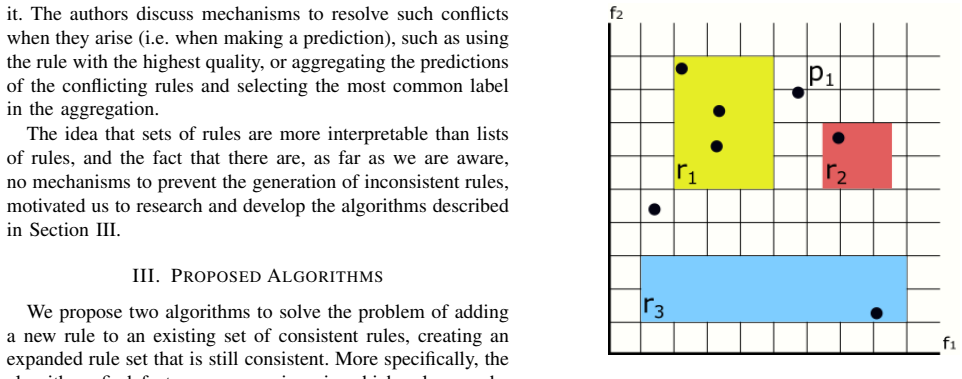
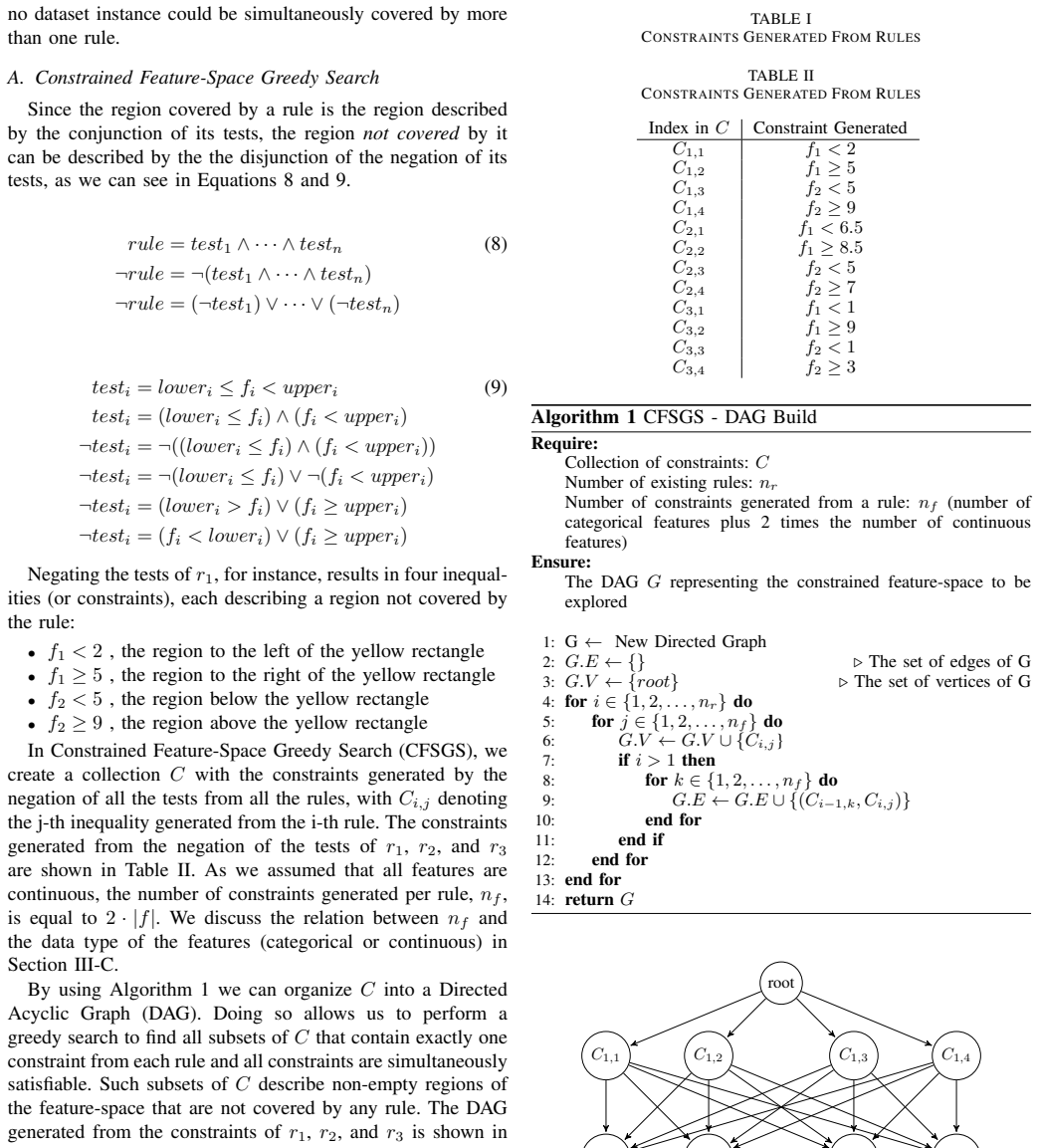
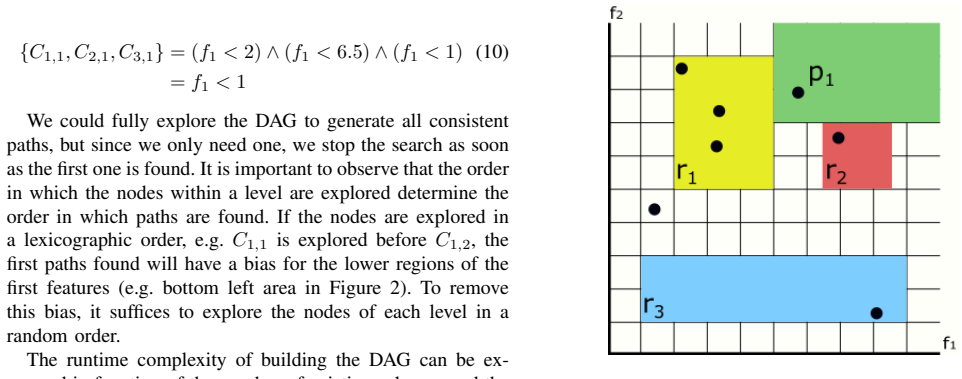
The central object is the antecedent-as-hyperrectangle: every rule covers an axis-aligned box in feature space, and consistency of a rule set is non-overlap of boxes whose consequents differ. CFSGS's machinery is the negation of rule tests into constraints of the form $f_i < \text{lower}$ or $f_i \ge \text{upper}$, organized as a DAG; a consistent path picks one constraint from each rule and corresponds to a region covered by no rule. CFSBE's machinery is the seed point and the Intersects function: starting from a known uncovered instance, it expands the box one dimension at a time and, for each existing rule that intersects the box on the other dimensions, pushes the box boundary just up to the rule's edge. The half-open test interval (lower bound inclusive, upper bound exclusive) is what lets two rules that touch at a boundary remain consistent.
What would settle it
Build a small two-feature dataset with two existing rules and one uncovered seed, run CFSBE, and test whether the returned box overlaps either rule by brute force; any overlap falsifies the guarantee. For CFSGS, apply the same check to every region it returns. The boundary convention can be probed with rules $[0,10)$ and $[10,99)$: if a rule created with the boundary value $f=10$ is treated as conflicting with both rules, the half-open-interval convention was not respected, which would break the algorithms' correctness.
Extended reading notes
Core claim
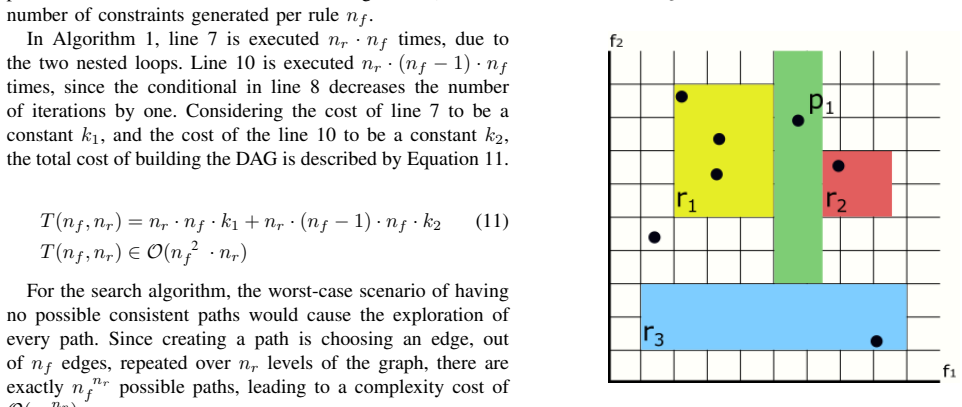
Stated on the paper's own terms: conflict avoidance is feasible for rule sets. Viewing each rule antecedent as an axis-aligned hyperrectangle in the $|f|$-dimensional feature space, a new rule is consistent with an existing set exactly when its antecedent does not overlap any existing antecedent that predicts a different class. CFSGS builds a directed acyclic graph from constraints produced by negating each rule's tests and searches it for simultaneously satisfiable paths; each such path is an uncovered region. CFSBE starts from a dataset instance not covered by any rule, called a seed, and enlarges a degenerate box outward in a chosen dimension order, using an intersection test to stop before the box touches any rule. The paper's guarantee is that a rule created inside a returned region is consistent with all existing rules, making conflict resolution unnecessary.
Load-bearing premise
CFSBE's usefulness depends on at least one training instance remaining uncovered by all existing rules, because it needs such an instance as its seed; if every training instance is covered, CFSBE finds nothing even though safe empty regions may exist.
Editorial extensions
If this is right
- Any rule-generating algorithm, whether genetic, ant-colony, or other, can query CFSGS or CFSBE during rule initialization or mutation and restrict new rules to the returned regions, guaranteeing a consistent rule set by construction.
- Learners that use the returned regions no longer need a conflict-resolution strategy at prediction time, since no instance can be covered by two rules with different predictions.
- CFSBE runs in $O(d^2 r + n)$ (with $d$ features, $r$ rules, $n$ instances), so it is practical enough to supplement existing learners; CFSGS is exponential but returns all possible regions.
- Both algorithms work for categorical as well as continuous features, and for any rule format whose consequents can be tested for equality, including hierarchical and multi-label rules.
- If the consequent of the rule to be created is known in advance, the algorithms can permit overlaps with existing rules that share that consequent, since same-consequent overlaps are consistent.
Reading between the lines
- A direct experimental extension would plug CFSBE into a Learning Classifier System's initialization and mutation steps and compare consistency, model size, and accuracy against the same system using conflict resolution; the paper does not run this test.
- Because CFSBE's output depends on the chosen dimension order, an evolutionary learner could treat each dimension ordering as a source of diversity, producing different safe boxes that cover different training instances while all remaining conflict-free.
- The consistency guarantee is tied to rules whose antecedents are exactly axis-aligned intervals; if a learner produces more complex antecedents, such as disjunctions or oblique splits, the returned region cannot be used directly without re-checking.
- The paper's argument that uncovered instances are always available assumes the rule set does not yet partition the whole instance population; a dataset with dense rule coverage could starve CFSBE of seeds, and whether that matters in practice is an empirical question.
Signed reviews
Editorial analysis
A structured set of objections, weighed in public.
Referee Report
Summary. The paper addresses the problem of maintaining consistency in unordered rule-based classification models. It proposes two algorithms. CFSGS negates each test of every existing rule, builds a layered DAG whose paths select one negated constraint per rule, and searches for satisfiable paths; each such path describes a feature-space region disjoint from all existing rule antecedents. CFSBE starts from a dataset instance not covered by any rule (a seed) and greedily enlarges a box around it, clipping the box in each dimension against any rule that intersects the box on all other dimensions. The authors provide pseudocode, complexity analyses, and brief extensions to categorical features and to rules with identical consequents. No empirical evaluation is included; the contribution is theoretical and intended to be plugged into rule-generating algorithms such as Learning Classifier Systems.
Significance. If the algorithms are correct, the conflict-avoidance idea is a useful complement to existing conflict-resolution strategies and could improve the interpretability of unordered rule sets. The paper's core reasoning is largely sound: Boolean negation of rule tests correctly characterizes uncovered regions, and the geometric clipping in CFSBE preserves disjointness from a fixed rule set. The pseudocode is concrete, and the paper is free of fitted parameters or circular derivations. However, the current version contains an erroneous complexity derivation and an unsupported claim about the non-covered-seed requirement, and its guarantees are stated more broadly than the assumptions support.
major comments (3)
- [Section III-A, Equation (11)] The complexity derivation in Equation (11) misstates the number of executions of the edge-insertion loop in Algorithm 1. The paper says line 10 is executed nr*(nf-1)*nf times because the conditional in line 8 decreases the number of iterations by one, but the loop actually runs for i=2,...,nr and for all nf choices of j, giving (nr-1)*nf^2 executions. The final O(nf^2*nr) bound is unaffected, but the displayed equation does not follow from the pseudocode and should be corrected.
- [Section IV and Section III-B] Section IV states that 'the non-covered dataset instance requirement of CFSBE is not a hindering issue', but no argument or evidence is supplied. If a rule-learning system reaches a state in which every training instance is covered by at least one existing rule, CFSBE has no seed and returns no region, whereas CFSGS can still return regions. Because the abstract claims the algorithms prevent inconsistencies from arising without qualification, the paper overstates CFSBE's scope. The authors should either prove that their intended host systems always maintain uncovered training instances or explicitly qualify the guarantee as conditional on the availability of a seed.
- [Section III-A, Equation (1)] The algorithms are presented under the convention that every rule has exactly one test for every predictive feature. This is a substantive restriction for Learning Classifier Systems and other rule learners, where rules commonly omit features or use 'don't care' conditions. The paper should state whether and how CFSGS and CFSBE extend to such rules, since the abstract's claim of preventing inconsistent rule generation is otherwise broader than the settings covered by the presented algorithms.
minor comments (4)
- [Section III-A, Tables I and II] Tables I and II have identical captions, 'Constraints Generated from Rules', and appear to be duplicate artifacts; the paper should keep only one table or label them distinctly.
- [Section III-A] The statement that randomizing the order of node exploration 'removes' the lower-region bias is imprecise: randomization removes the systematic ordering bias in expectation, not for every run.
- [Section III-B] The discussion refers to Figures 4 and 5, but these figures are not present in the posted manuscript; the corresponding enlarged regions should be displayed or described precisely in the text.
- [Section III, first paragraph] There is a typo in 'There is a important distinction'; it should be 'an important distinction'.
Circularity Check
No significant circularity: the algorithms' guarantees are direct consequences of their geometric construction, with no fitted parameters or load-bearing self-citation.
full rationale
The paper's central claim is that CFSGS and CFSBE return feature-space regions inside which any newly created rule is consistent with an existing rule set. This follows directly from the paper's own construction: CFSGS defines a region as a satisfiable conjunction of negated rule tests, i.e., a subset of the complement of all rule antecedents, and CFSBE grows a box only while checking non-intersection with every existing rule. Consistency is thus a direct consequence of the algorithm's state invariant, not an independently predicted result. There are no fitted parameters, no empirical benchmarks from which a quantity is later 'predicted', and no uniqueness theorem or prior-work result that is doing load-bearing work. The one self-citation, to Cerri et al. [20], merely supports the practical remark that Learning Classifier Systems may already track instance-rule coverage; it does not justify the correctness of either algorithm. The acknowledged limitation that CFSBE requires a non-covered seed instance is an applicability condition, not a circular dependency. Overall, the derivation chain is self-contained and non-circular.
Assumptions & free parameters
assumptions (5)
- domain assumption Rule antecedents are axis-aligned hyperrectangles with half-open intervals: lower bound inclusive, upper bound exclusive (Equation 2).
- domain assumption A new rule is consistent with an existing set if its antecedent does not overlap any existing antecedent with a different consequent (Section I).
- domain assumption Any rule whose antecedent hyperrectangle is fully contained in a region returned by CFSGS or CFSBE will not overlap any existing rule's antecedent (implicit in Section III).
- domain assumption CFSBE requires a seed dataset instance not covered by any existing rule (Section III-B).
- domain assumption Regions that contain no training instances are 'arguably' irrelevant for rule creation (Section III-B).
Cite this review
Pith. "Pith review of Preventing the Generation of Inconsistent Sets of Classification Rules." pith.science (2026). https://pith.science/paper/XPFYERKE
@misc{pith2026190809652,
  author       = {Pith},
  title        = {Pith review of: Preventing the Generation of Inconsistent Sets of Classification Rules},
  year         = {2026},
  howpublished = {\url{https://pith.science/paper/XPFYERKE}},
  note         = {Machine review of arXiv:1908.09652}
}
read the original abstract
In recent years, the interest in interpretable classification models has grown. One of the proposed ways to improve the interpretability of a rule-based classification model is to use sets (unordered collections) of rules, instead of lists (ordered collections) of rules. One of the problems associated with sets is that multiple rules may cover a single instance, but predict different classes for it, thus requiring a conflict resolution strategy. In this work, we propose two algorithms capable of finding feature-space regions inside which any created rule would be consistent with the already existing rules, preventing inconsistencies from arising. Our algorithms do not generate classification models, but are instead meant to enhance algorithms that do so, such as Learning Classifier Systems. Both algorithms are described and analyzed exclusively from a theoretical perspective, since we have not modified a model-generating algorithm to incorporate our proposed solutions yet. This work presents the novelty of using conflict avoidance strategies instead of conflict resolution strategies.
Figures

Figures from the paper (2 more)
Reference graph
Works this paper leans on
-
[1]
Improving the interpretability of classi- fication rules discovered by an ant colony algorithm,
F. E. Otero and A. A. Freitas, “Improving the interpretability of classi- fication rules discovered by an ant colony algorithm,” in Proceedings of the 15th annual conference on Genetic and evolutionary computation . ACM, 2013, pp. 73–80
work page 2013
-
[2]
European union regulations on algo- rithmic decision-making and a
B. Goodman and S. Flaxman, “European union regulations on algo- rithmic decision-making and a "right to explanation",” arXiv preprint arXiv:1606.08813, 2016
arXiv 2016
-
[3]
The mythos of model interpretability,
Z. C. Lipton, “The mythos of model interpretability,” arXiv preprint arXiv:1606.03490, 2016
arXiv 2016
-
[4]
Induction of decision trees,
J. R. Quinlan, “Induction of decision trees,” Machine learning, vol. 1, no. 1, pp. 81–106, 1986
1986
-
[5]
Deep learning,
Y . LeCun, Y . Bengio, and G. Hinton, “Deep learning,” nature, vol. 521, no. 7553, p. 436, 2015
2015
-
[6]
Comprehensible classification models: a position paper,
A. A. Freitas, “Comprehensible classification models: a position paper,” ACM SIGKDD explorations newsletter , vol. 15, no. 1, pp. 1–10, 2014
work page 2014
-
[7]
Case- based explanation of non-case-based learning methods
R. Caruana, H. Kangarloo, J. Dionisio, U. Sinha, and D. Johnson, “Case- based explanation of non-case-based learning methods.” in Proceedings of the AMIA Symposium . American Medical Informatics Association, 1999, p. 212
work page 1999
-
[8]
What is a learning classifier system?
J. H. Holland, L. B. Booker, M. Colombetti, M. Dorigo, D. E. Goldberg, S. Forrest, R. L. Riolo, R. E. Smith, P. L. Lanzi, W. Stolzmann et al., “What is a learning classifier system?” in International Workshop on Learning Classifier Systems . Springer, 1999, pp. 3–32
work page 1999
Show all 26 references
-
[9]
Why interpretability in machine learning? an answer using distributed detection and data fusion theory,
K. R. Varshney, P. Khanduri, P. Sharma, S. Zhang, and P. K. Varshney, “Why interpretability in machine learning? an answer using distributed detection and data fusion theory,” arXiv preprint arXiv:1806.09710 , 2018
2018 arXiv
-
[10]
Cognitive systems: Toward human-level functionality
S. Nirenburg, “Cognitive systems: Toward human-level functionality.” AI Magazine, vol. 38, no. 4, 2017
2017
-
[11]
A hierarchical multi- label classification ant colony algorithm for protein function prediction,
F. E. Otero, A. A. Freitas, and C. G. Johnson, “A hierarchical multi- label classification ant colony algorithm for protein function prediction,” Memetic Computing, vol. 2, no. 3, pp. 165–181, 2010
2010
-
[12]
J. R. Quinlan, C4. 5: programs for machine learning . Elsevier, 2014
2014
-
[13]
Knowledge discovery in multi-label pheno- type data,
A. Clare and R. D. King, “Knowledge discovery in multi-label pheno- type data,” in European Conference on Principles of Data Mining and Knowledge Discovery. Springer, 2001, pp. 42–53
2001
-
[14]
Hierarchical multi-classification,
H. Blockeel, M. Bruynooghe, S. Džeroski, J. Ramon, and J. Struyf, “Hierarchical multi-classification,” in Workshop Notes of the KDD’02 Workshop on Multi-Relational Data Mining , 2002, pp. 21–35
2002
-
[15]
Top-down induction of clus- tering trees,
H. Blockeel, L. D. Raedt, and J. Ramon, “Top-down induction of clus- tering trees,” in Proceedings of the Fifteenth International Conference on Machine Learning . Morgan Kaufmann Publishers Inc., 1998, pp. 55–63
1998
-
[16]
Deci- sion trees for hierarchical multi-label classification,
C. Vens, J. Struyf, L. Schietgat, S. Džeroski, and H. Blockeel, “Deci- sion trees for hierarchical multi-label classification,” Machine learning, vol. 73, no. 2, p. 185, 2008
2008
-
[17]
Predicting gene function using hierarchical multi-label decision tree ensembles,
L. Schietgat, C. Vens, J. Struyf, H. Blockeel, D. Kocev, and S. Džeroski, “Predicting gene function using hierarchical multi-label decision tree ensembles,” BMC bioinformatics, vol. 11, no. 1, p. 2, 2010
2010
-
[18]
Agent-based evolutionary approach for interpretable rule-based knowledge extrac- tion,
H. Wang, S. Kwong, Y . Jin, W. Wei, and K.-F. Man, “Agent-based evolutionary approach for interpretable rule-based knowledge extrac- tion,” IEEE Transactions on Systems, Man, and Cybernetics, Part C (Applications and Reviews) , vol. 35, no. 2, pp. 143–155, 2005
2005
-
[19]
A fast and elitist multiobjective genetic algorithm: Nsga-ii,
K. Deb, A. Pratap, S. Agarwal, and T. Meyarivan, “A fast and elitist multiobjective genetic algorithm: Nsga-ii,” IEEE transactions on evolu- tionary computation, vol. 6, no. 2, pp. 182–197, 2002
2002
-
[20]
A genetic algorithm for hierarchical multi-label classification,
R. Cerri, R. C. Barros, and A. C. de Carvalho, “A genetic algorithm for hierarchical multi-label classification,” in Proceedings of the 27th annual ACM symposium on applied computing . ACM, 2012, pp. 250–255
2012
-
[21]
A survey of genetic algorithms for multi-label classification,
E. C. Gonçalves, A. A. Freitas, and A. Plastino, “A survey of genetic algorithms for multi-label classification,” in 2018 IEEE Congress on Evolutionary Computation (CEC) . IEEE, 2018, pp. 1–8
2018
-
[22]
Data mining with an ant colony optimization algorithm,
R. S. Parpinelli, H. S. Lopes, and A. A. Freitas, “Data mining with an ant colony optimization algorithm,” IEEE transactions on evolutionary computation, vol. 6, no. 4, pp. 321–332, 2002
2002
-
[23]
A new ant colony algorithm for multi-label classification with applications in bioinfomatics,
A. Chan and A. A. Freitas, “A new ant colony algorithm for multi-label classification with applications in bioinfomatics,” in Proceedings of the 8th annual conference on Genetic and evolutionary computation. ACM, 2006, pp. 27–34
2006
-
[24]
cant-miner: an ant colony classification algorithm to cope with continuous attributes,
F. E. Otero, A. A. Freitas, and C. G. Johnson, “cant-miner: an ant colony classification algorithm to cope with continuous attributes,” in International Conference on Ant Colony Optimization and Swarm Intelligence. Springer, 2008, pp. 48–59
2008
-
[25]
A hierarchical classification ant colony algorithm for predicting gene ontology terms,
——, “A hierarchical classification ant colony algorithm for predicting gene ontology terms,” in European Conference on Evolutionary Compu- tation, Machine Learning and Data Mining in Bioinformatics. Springer, 2009, pp. 68–79
2009
-
[26]
A new sequential covering strategy for inducing classification rules with ant colony algorithms
——, “A new sequential covering strategy for inducing classification rules with ant colony algorithms.” IEEE Trans. Evolutionary Computa- tion, vol. 17, no. 1, pp. 64–76, 2013
2013
Reviewed August 14, 2026 · model on record in the stance chip above.
Discussion (0). Continue with ORCID to comment.