REVIEW 3 major objections 4 minor 29 references
Quantum Implicit Neural Compression
T0 review · 3 major / 4 minor · reviewed 2026-08-11 · deepseek-v4-flash
Pith's one-line read quINR, a hybrid quantum-classical INR codec, outperforms JPEG2000 and COIN by up to 1.2 dB in rate-distortion performance on tested images.
desk verdict Plausible quantum-INR compression idea, but the rate-distortion claim is unverifiable because bpp is never defined. read the letter →
The pith
A machine-rendered reading of the paper's core claim, the machinery that carries it, and where it could break.
The reading
What carries the argument
The load-bearing object is the quINR architecture, a hybrid quantum-classical network whose QNN layers carry most of the representational load. Its folded-angle embedding packs an M-dimensional embedding vector into alternating RX and RZ rotations on a small number of qubits, avoiding the qubit-count limit of standard angle embedding; its entangling layers use single-qubit rotations plus two-qubit controlled-Z rotations, shuffled with a data re-uploading trick; and its output layer measures quantum-state probabilities and applies a quantum ReLU. The argument is that the exponentially large Hilbert space of the circuit lets a small set of classical parameters encode high-frequency pixel variation that a classical MLP of the same size cannot.
What would settle it
Re-run the rate-distortion comparison with a fixed quantization scheme applied identically to COIN and quINR parameters, and include the bit cost of the circuit description and measurement settings; if quINR no longer reaches the reported PSNR at the same bits per pixel, the claimed gain is an accounting artifact rather than a coding gain.
Extended reading notes
Core claim
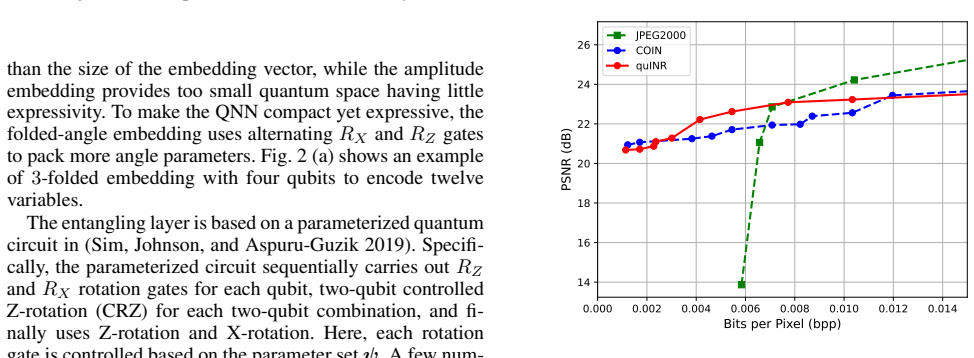
The paper's central claim is that replacing a layer of a classical implicit neural network with a parameterized quantum circuit produces a coordinate-to-value mapping that reconstructs images more accurately at the same bit rate. The proposed quINR architecture folds the coordinate embedding into alternating RX/RZ rotations on a small register of qubits, iterates entangling layers with data re-uploading, and reads out probabilities through a quantum ReLU; the classical parameters are trained by mean squared error minimization and then transmitted as the compressed representation. In the reported experiments, quINR's PSNR-versus-bits-per-pixel frontier lies above COIN and JPEG2000 on a LiDAR range image, and on the Kodak color image it beats both baselines in the low-to-medium rate regime with up to 1.2 dB gain. The authors present this as evidence that quantum expressivity can be converted into compression efficiency, while acknowledging that color-image performance is limited and needs further work.
Load-bearing premise
The comparison counts bits per pixel for quINR and COIN in the same way, including how trained parameters are quantized and whether the circuit description costs extra bits.
Editorial extensions
If this is right
- quINR shifts some of the representational burden from classical weights to the quantum circuit, so compression of LiDAR-like range data could need fewer stored parameters at equal quality.
- The reported gains appear in the low-to-medium bit-rate range, which is exactly where INR codecs are expected to compete with classical codecs.
- Because the same training loop maps arbitrary coordinates to values, the scheme could be applied to other signal types, including video frames and 3D point clouds.
- The method's main promise is not replacing JPEG2000 at high quality but enabling extremely small model sizes for sensor data.
Reading between the lines
- The reported gain depends on an unstated bit-accounting rule; a fair comparison would need the bit cost of quantized classical parameters plus any circuit-description overhead.
- Because the QNN is simulated classically in the experiments, the compression results do not yet show that real quantum hardware can deliver the same gain under noise.
- Folded-angle embedding is a general method for packing many classical features into few qubits and could be reused in other hybrid quantum models outside compression.
- A natural next experiment would test quINR on all 24 Kodak images and against COIN++ to see whether the single-image result represents a systematic advantage.
Editorial analysis
A structured set of objections, weighed in public.
Referee Report
Summary. The manuscript introduces quINR, a hybrid quantum-classical implicit neural representation for signal compression. Coordinates are passed through a linear sinusoidal layer, then a folded-angle quantum embedding and a parameterized entangling circuit, and finally read out via probability measurements and a QReLU output stage. The authors train quINR and COIN on one KITTI LiDAR range image and one Kodak color image, plot PSNR versus bpp against JPEG2000 and COIN, and claim up to 1.2 dB gain in rate-distortion performance.
Significance. The idea of using a quantum neural network as the backbone of an INR is creative and, if the claimed gains were substantiated, would point toward a parameter-efficiency advantage for quantum circuits in compression. The manuscript also has the virtue of explicitly acknowledging the limited color-image performance. However, the central quantitative claim is not verifiable from the text because the bit-rate accounting is unspecified, the JPEG2000 comparison on the range image is unfair, and the evaluation rests on just two images with no statistical support. As written, the paper does not establish its advertised improvement.
major comments (3)
- [Performance Comparison (Figs. 3 and 4)] The x-axis is 'Bits per Pixel (bpp)', but the manuscript nowhere defines bpp, nor does it state how the optimized parameter set ψ (which includes W and b from Eq. (2), the QNN rotation angles, and any output-stage parameters) is quantized, entropy-coded, or otherwise counted. Because the rate-distortion claim (up to 1.2 dB gain) rests entirely on this axis, any asymmetry in the parameter accounting between quINR and COIN—such as charging COIN for all weights at 32 bits while charging quINR for only a subset of rotation angles at lower precision—could shift the reported curves and eliminate the advantage. The bpp accounting must be specified and applied identically to all methods before the central claim can be assessed.
- [Experiments, Baseline] The RI comparison of Fig. 3 is biased against JPEG2000 because the manuscript states that JPEG2000 requires conversion to 8-bit precision in advance, whereas the LiDAR range image stores distance values ρ with floating-point precision. Since the two methods are not operating on the same target precision, the reported PSNR curve for JPEG2000 is not directly comparable, and the conclusion that quINR 'achieves better image quality than other baselines' on RI is not supported.
- [Experiments, Settings and Performance Comparison] The evaluation uses exactly one range image and one color image, with no error bars or statistical significance measures, and no code or trained models are released. The training details (optimizer, learning rate, number of iterations, the hyperparameter sweep used for the Pareto frontier) are also omitted. Given that the claimed improvement is up to 1.2 dB, which is within the typical variation across images and random seeds, these results cannot be considered a reliable demonstration of a rate-distortion advantage.
minor comments (4)
- [Related Work] The word 'expressibity' should be 'expressibility'.
- [References] The reference to Parigi et al. has a missing year (listed as '????') and an incomplete bibliographic entry.
- [Baseline] The paper cites COIN++ (Dupont et al., 2022) but does not include it as a baseline; because COIN++ is a stronger INR codec than COIN, the claim of outperforming 'classic INR-based coding methods' is conditional at best.
- [Conclusion] The wording of the conclusion ('demonstrated good PSNR performance') overstates the results; the color-image performance in Fig. 4 is below JPEG2000 over much of the plotted range, and the abstract more cautiously says 'could improve'.
Circularity Check
No significant circularity: the quINR rate-distortion gain is measured against external baselines, not derived from a fitted parameter or self-citation chain.
full rationale
The central claim is an empirical rate-distortion comparison. quINR is optimized by the MSE objective in Eq. (1) for a given signal, the optimized parameter set is stored, and Figs. 3-4 plot measured PSNR versus bpp against JPEG2000 and COIN. The QNN expressivity and universality citations (Sim et al. 2019; Perez-Salinas et al. 2020) are background motivation for parameter efficiency, not inputs that fix the measured outcome. The only self-citation by a present author, Koike-Akino et al. 2024, appears in a related-work sentence about QNN fine-tuning and is not load-bearing for the R-D claim. No equation defines the reported gain in terms of a quantity fitted from the same comparison, and no uniqueness or expressivity theorem is invoked to forbid alternative architectures. The main weakness is that bpp is never defined and parameter quantization/bit-width accounting is unspecified, so the magnitude of the claimed 1.2 dB gain may not be reproducible; that is a falsifiability and correctness risk, not circularity under the stated rules. The omission of code and data, and the use of only two test images, likewise weaken evidence strength but do not make the measured comparison circular.
Assumptions & free parameters
free parameters (5)
- freq multiplier omega_0 in input layer =
30.0
- embedding size M =
varied (values not given)
- number of qubits N_q =
unknown
- number of entangling layers and re-uploading iterations =
unknown
- parameter bit-width for bpp =
unknown
assumptions (4)
- domain assumption QNNs have exponentially rich expressivity (Sim et al. 2019)
- domain assumption Data re-uploading gives universal approximation (Perez-Salinas et al. 2020)
- domain assumption PennyLane classical simulation faithfully models the quantum circuit
- domain assumption INR overfitting compression works for quantum networks as it does for classical ones (COIN)
Cite this review
Pith. "Pith review of Quantum Implicit Neural Compression." pith.science (2026). https://pith.science/paper/XPUFYZY2
@misc{pith2026241219828,
  author       = {Pith},
  title        = {Pith review of: Quantum Implicit Neural Compression},
  year         = {2026},
  howpublished = {\url{https://pith.science/paper/XPUFYZY2}},
  note         = {Machine review of arXiv:2412.19828}
}
read the original abstract
Signal compression based on implicit neural representation (INR) is an emerging technique to represent multimedia signals with a small number of bits. While INR-based signal compression achieves high-quality reconstruction for relatively low-resolution signals, the accuracy of high-frequency details is significantly degraded with a small model. To improve the compression efficiency of INR, we introduce quantum INR (quINR), which leverages the exponentially rich expressivity of quantum neural networks for data compression. Evaluations using some benchmark datasets show that the proposed quINR-based compression could improve rate-distortion performance in image compression compared with traditional codecs and classic INR-based coding methods, up to 1.2dB gain.
Figures


Reference graph
Works this paper leans on
-
[1]
, " * write output.state after.block = add.period write newline
ENTRY address archivePrefix author booktitle chapter edition editor eid eprint howpublished institution isbn journal key month note number organization pages publisher school series title type volume year label extra.label sort.label short.list INTEGERS output.state before.all mid.sentence after.sentence after.block FUNCTION init.state.consts #0 'before.a...
-
[2]
write newline
" write newline "" before.all 'output.state := FUNCTION n.dashify 't := "" t empty not t #1 #1 substring "-" = t #1 #2 substring "--" = not "--" * t #2 global.max substring 't := t #1 #1 substring "-" = "-" * t #2 global.max substring 't := while if t #1 #1 substring * t #2 global.max substring 't := if while FUNCTION word.in bbl.in capitalize " " * FUNCT...
-
[3]
Biamonte, J.; Wittek, P.; Pancotti, N.; Rebentrost, P.; Wiebe, N.; and Lloyd, S. 2017. Quantum machine learning. Nature, 549(7671): 195--202
2017
-
[4]
Chen, C.-S.; Tsai, A. H.-W.; and Huang, S.-C. 2024. Quantum Multimodal Contrastive Learning Framework. arXiv preprint arXiv:2408.13919
arXiv 2024
-
[5]
Chen, H.; He, B.; Wang, H.; Ren, Y.; Lim, S.-N.; and Shrivastava, A. 2021. Ne RV : Neural Representations for Videos. In NeurIPS
work page 2021
-
[6]
Chen, Z.; Dangovski, R.; Loh, C.; Dugan, O. M.; Luo, D.; and Soljacic, M. 2024. Quan TA : Efficient High-Rank Fine-Tuning of LLM s with Quantum-Informed Tensor Adaptation. In The Thirty-eighth Annual Conference on Neural Information Processing Systems
work page 2024
-
[7]
Dallaire-Demers, P.-L.; and Killoran, N. 2018. Quantum generative adversarial networks. Physical Review A, 98(1): 012324
work page 2018
-
[8]
Dupont, E.; Golinski, A.; Alizadeh, M.; Teh, Y. W.; and an an, A. D. 2021. COIN : CO mpression with Implicit Neural representations. In ICLR Workshop Neural Compression
work page 2021
Show all 29 references
-
[9]
W.; and Doucet, A
Dupont, E.; Loya, H.; Alizadeh, M.; Goliński, A.; Teh, Y. W.; and Doucet, A. 2022. COIN++: Neural compression across modalities. TMLR, 2022(11): 1--26
2022
-
[10]
Eastman Kodak Company . 1999. Kodak lossless true color image suite
1999
-
[11]
Farhi, E.; and Neven, H. 2018. Classification with quantum neural networks on near term processors. arXiv preprint arXiv:1802.06002
2018 arXiv
-
[12]
Geiger, A.; Lenz, P.; Stiller, C.; and Urtasun, R. 2013. Vision meets robotics: The KITTI dataset. Int. J. Robot. Res., 32(11): 1231--1237
2013
-
[13]
N.; and Cevher, V
Koike-Akino, T.; Tonin, F.; Wu, Y.; Candogan, L. N.; and Cevher, V. 2024. Quantum-PEFT : Ultra parameter-efficient fine-tuning. In Workshop on Efficient Systems for Foundation Models II@ ICML2024
2024
-
[14]
Lloyd, S.; and Weedbrook, C. 2018. Quantum generative adversarial learning. Physical review letters, 121(4): 040502
2018
-
[15]
P.; Tancik, M.; Barron, J
Mildenhall, B.; Srinivasan, P. P.; Tancik, M.; Barron, J. T.; Ramamoorthi, R.; and Ng, R. 2021. NeRF: Representing scenes as neural radiance fields for view synthesis. Communications of the ACM, 65(1): 99--106
2021
-
[16]
???? Quantum-Noise-Driven Generative Diffusion Models
Parigi, M.; Martina, S.; and Caruso, F. ???? Quantum-Noise-Driven Generative Diffusion Models. Advanced Quantum Technologies, 2300401
-
[17]
Parisi, L.; Neagu, D.; Ma, R.; and Campean, F. 2022. Quantum ReLU activation for Convolutional Neural Networks to improve diagnosis of Parkinson’s disease and COVID-19 . Expert Systems with Applications, 187: 1--17
2022
-
[18]
P \'e rez-Salinas, A.; Cervera-Lierta, A.; Gil-Fuster, E.; and Latorre, J. I. 2020. Data re-uploading for a universal quantum classifier. Quantum, 4: 226
2020
-
[19]
P.; and Aspuru-Guzik, A
Romero, J.; Olson, J. P.; and Aspuru-Guzik, A. 2017. Quantum autoencoders for efficient compression of quantum data. Quantum Science and Technology, 2(4): 045001
2017
-
[20]
Schuld, M.; Bergholm, V.; Gogolin, C.; Izaac, J.; and Killoran, N. 2019. Evaluating analytic gradients on quantum hardware. Physical Review A, 99(3): 032331
2019
-
[21]
Schuld, M.; Sinayskiy, I.; and Petruccione, F. 2015. An introduction to quantum machine learning. Contemporary Physics, 56(2): 172--185
2015
-
[22]
D.; and Aspuru-Guzik, A
Sim, S.; Johnson, P. D.; and Aspuru-Guzik, A. 2019. Expressibility and entangling capability of parameterized quantum circuits for hybrid quantum-classical algorithms. Advanced Quantum Technologies, 2(12): 1--18
2019
-
[23]
Sitzmann, V.; Martel, J. N. P.; Bergman, A. W.; Lindell, D. B.; and Wetzstein, G. 2020. Implicit Neural Representations with Periodic Activation Functions. In NeurIPS, 1--12
2020
-
[24]
Yang, Y.; and Sun, M. 2022. A Quantum-Powered Photorealistic Rendering. arXiv preprint arXiv:2211.03418
2022 arXiv
-
[25]
Zhang, B.; Xu, P.; Chen, X.; and Zhuang, Q. 2024 a . Generative quantum machine learning via denoising diffusion probabilistic models. Physical Review Letters, 132(10): 100602
2024
-
[26]
Zhang, X.; Yang, R.; He, D.; Ge, X.; Xu, T.; Wang, Y.; Qin, H.; and Zhang, J. 2024 b . Boosting Neural Representations for Videos with a Conditional Decoder. In CVPR
2024
-
[27]
Zhao, J.; Qiao, W.; Zhang, P.; and Gao, H. 2024. Quantum Implicit Neural Representations. arXiv preprint arXiv:2406.03873
2024 arXiv
-
[28]
Zhao, L.; Ma, K.-K.; Liu, Z.; Yin, Q.; and Chen, J. 2022. Real-Time Scene-Aware LiDAR Point Cloud Compression Using Semantic Prior Representation. IEEE Trans. Circuits Syst. Video Technol., 32(8): 5623--5637
2022
-
[29]
Zheng, J.; Gao, Q.; and L \"u , Y. 2021. Quantum graph convolutional neural networks. In 2021 40th Chinese Control Conference (CCC), 6335--6340. IEEE
2021
Reviewed August 11, 2026 · model on record in the stance chip above.
Discussion (0). Continue with ORCID to comment.