REVIEW 3 major objections 4 minor 2 cited by
Jet charge modification in dense QCD matter
T0 review · 3 major / 4 minor · reviewed 2026-08-14 · deepseek-v4-flash
Pith's one-line read The paper derives a factorization of the medium-modified average jet charge whose Pb+Pb-to-p+p ratio is flavor-independent and controlled by the (κ+1)th Mellin moment of the medium-induced splitting function.
desk verdict A genuine first SCET calculation of medium-modified jet charge with a clever ratio observable, but the resummation in Eq. (17) needs a rescoped error claim before I'd trust the low-pT predictions. read the letter →
The pith
A machine-rendered reading of the paper's core claim, the machinery that carries it, and where it could break.
The reading
What carries the argument
The machinery is the SCET factorization of jet production, in which the average jet charge of a quark jet is a product of the jet matching coefficient $\tilde J_{qq}(E,R,\kappa,\mu)$, the inverse of the total jet function $J_q(E,R,\mu)$, and the charge-weighted fragmentation function moment $\tilde D^Q_q(\kappa,\mu)$. The engine of the paper is the replacement of vacuum splitting kernels by medium-induced splitting functions $P^{\rm med}_{q\to qg}(x,k_\perp)$ computed to first order in opacity: this replacement generates the medium corrections to the jet functions and, through the medium-modified DGLAP equation, the exponential factor in Eq. (17). The (κ+1)th Mellin moment $\tilde P^{\rm med}_{qq}(\kappa,\mu)$ is the specific combination that carries the medium information into the observable, and the jet radius $R$ enters through the upper limit of the $k_\perp$ integration, $2E x(1-x)\tan(R/2)$, which sets how much of the medium-induced shower is reconstructed in the jet.
What would settle it
Measure the Pb+Pb-to-p+p ratio of the average up- and down-quark jet charges over $p_T \simeq 60$–$500$ GeV for $\kappa = 0.3, 0.5, 1, 2$; if the two ratios differ beyond combined uncertainties, Eq. (22) is false, and if the (κ+1)th Mellin moment extracted from the $p_T$ slope via Eq. (20) depends on κ, the medium-modified DGLAP ansatz fails.
Extended reading notes
Core claim
On the paper's own terms, the discovery is a factorization formula: for a quark-initiated jet of flavor $q$, $\langle Q^{AA}_{q,\kappa}\rangle = \langle Q^{pp}_{q,\kappa}\rangle \left(1 + \tilde J^{\rm med}_{qq} - J^{\rm med}_q\right) \exp\left[\int \frac{d\mu}{\mu} \frac{\alpha_s}{\pi} \tilde P^{\rm med}_{qq}\right]$ up to corrections of order $\alpha_s^2$ and $\chi^2$, where $\chi$ is the opacity expansion parameter. The factor $\left(1+\cdots\right)$ comes from medium corrections to the jet matching coefficient and the total jet function, and the exponential is the solution of a medium-modified DGLAP equation for the charge-weighted fragmentation function. The structure is the direct generalization of the vacuum SCET factorization to dense matter, with vacuum splitting kernels replaced by medium-induced splitting kernels $P^{\rm med}_{q\to qg}(x,k_\perp)$ at first order in opacity. Since the exponential and the jet-function correction do not depend on the quark's electric charge, the ratio $\langle Q^{Pb+Pb}_{\kappa,u}\rangle/\langle Q^{p+p}_{\kappa,u}\rangle$ equals $\langle Q^{Pb+Pb}_{\kappa,d}\rangle/\langle Q^{p+p}_{\kappa,d}\rangle$, so the observable isolates final-state in-medium branching from initial-state isospin effects. The paper also shows that the $p_T$ slope of the logarithm of the jet charge is controlled by the (κ+1)th Mellin moment of the medium-induced splitting function.
Load-bearing premise
The calculation assumes that the way quark jets break into charged hadrons inside the hot medium is described by the vacuum evolution equation with an extra in-medium splitting term, and that the starting conditions for that evolution are the same as in proton collisions; if that is wrong, the predicted modification of the jet charge collapses.
Editorial extensions
If this is right
- The average charges of up- and down-quark jets remain well separated in 0–10% central Pb+Pb collisions at $\sqrt{s_{NN}}=5.02$ TeV, so flavor tagging of quark jets should survive in the quark-gluon plasma.
- The medium-to-vacuum jet charge ratio is identical for up- and down-quark jets, meaning a measurement of either ratio directly exposes final-state in-medium branching with the initial-state isospin effect divided out.
- The transverse-momentum slope of the jet charge, Eq. (20), is set by the (κ+1)th Mellin moment of the medium-induced splitting function, so a measured slope gives a direct extraction of that moment.
- Because larger κ weights softer fragments more strongly, the modification ratio grows with κ, giving experiments a dial to trade the magnitude of the jet charge against its sensitivity to soft medium-induced gluon radiation.
- At jet transverse momenta below roughly 200 GeV the medium-induced shower contribution dominates the modification, while at high $p_T$ the modification is mostly the initial-state isospin effect, so a wide $p_T$ scan separates the two.
Reading between the lines
- The authors leave implicit that the same factorization should hold for any hard process that produces quark jets, since the jet charge is independent of the hard scattering; vector-boson-plus-jet and heavy-flavor jet samples would give independent handles on the same medium-induced splitting moment.
- A testable extension would be to compare the κ-dependence of the extracted moment with the κ-dependence predicted by higher-order opacity calculations; if the extracted $\tilde P^{\rm med}_{qq}(\kappa,\mu)$ drifts with κ, the first-order-in-opacity truncation is being probed.
- Because the flavor-independent ratio removes both isospin and, at leading order, the nonperturbative fragmentation boundary conditions, it could serve as a cleaner test of the medium-modified evolution than inclusive hadron suppression ratios, which mix many channels.
- If future flavor-tagged data show up/down ratios that differ at fixed $p_T$ and κ, the most natural explanations would be flavor-dependent hadronization in the medium or a medium response beyond the first-order opacity expansion, both of which are outside the current framework.
Signed reviews
Editorial analysis
A structured set of objections, weighed in public.
Referee Report
Summary. The paper presents an analytic SCET-based calculation of the average jet charge in heavy-ion collisions. In vacuum, the average charge factorizes into a perturbative jet matching coefficient and a nonperturbative charge-weighted fragmentation function; the authors extend this by replacing vacuum splitting functions with medium-induced splitting kernels computed to first order in opacity. The central result, Eq. (17), expresses the medium jet charge as the pp value times a prefactor involving the medium jet-function correction and an exponential of the (κ+1)th Mellin moment of the medium splitting function. The paper derives a flavor-independent ratio, Eq. (22), and presents numerical predictions for 5.02 TeV Pb+Pb collisions, including flavor-separated jet charges and forward/central dijet averages, with the nonperturbative boundary conditions fit to PYTHIA and the pp results compared with ATLAS data.
Significance. If the framework is correct, this is the first direct analytic calculation of jet charge modification in dense QCD matter and provides an observable sensitive to Mellin moments of medium-induced splitting functions. The derivation of the medium jet-function corrections (Eqs. 12-14 and 18) is explicit and coherent, and the pp comparison with ATLAS data is a useful validation. The two main load-bearing issues are the uncontrolled exponentiation of the first-order opacity kernel in Eq. (17) and the posited, rather than derived, medium-modified DGLAP evolution in Eq. (15); both need to be addressed before the numerical predictions can be considered reliable.
major comments (3)
- [Section III.B, Eq. (17)] The label '+O(α_s², χ²)' is not justified as written. The prefactor (1+J~med_qq−Jmed_q) and the exponent argument ∫ dμ/μ α_s/π P~med_qq are each first order in the opacity parameter χ, so expanding the exponential generates terms of order χ², χ³, ... from iterating the first-order kernel. These iterated terms are not the genuine two-scattering, single-emission kernels computed in Refs. [56,57], so they do not constitute the full second-order opacity correction. If Eq. (17) is intended as a first-order-in-opacity result, it must be expanded to 1+(J~med_qq−Jmed_q)+∫ dμ/μ α_s/π P~med_qq; if it is intended as a leading-log resummation of an independent-emission picture, that assumption must be stated and the error estimate must be reformulated. This is numerically relevant: in the pT<200 GeV region of Fig. 4 the exponent is O(0.5), so the difference between exponentiated and expanded forms is not negligible.
- [Section III.B, Eq. (15)] The medium-modified DGLAP evolution of the charge-weighted fragmentation function is posited, not derived, and the scale choice μ=k⊥ in Eq. (16) is stated as following Refs. [50,51,55,76]. Since the exponential factor in Eq. (17) is the direct solution of Eq. (15), the accuracy of the central prediction depends on this assumption at the same level as the explicit jet-function corrections. Please either derive Eq. (15) from the opacity expansion to the quoted accuracy, or state explicitly that this is a model assumption and quantify its uncertainty. The previous validation of the formalism against inclusive hadron suppression is not a direct test of the charge-weighted Mellin-moment evolution.
- [Section III.B, Eq. (20)] The relation between Eq. (19) and Eq. (20) is not explained. Differentiating Eq. (17) with respect to pT should produce the d ln μ/d ln pT term plus an explicit derivative of the prefactor, and the second integral in Eq. (20) appears to account for the latter. Please show the derivation so the reader can verify that the extraction of the Mellin moment is not contaminated by boundary terms. In addition, the notation P_med_qq(κ,k⊥) appearing in Eq. (20) has not been defined, since Eq. (16) defines the integrated moment P~med_qq(κ,μ).
minor comments (4)
- [Section III.A] The sentence 'the coefficient function function A(k⊥)' contains a duplicated word; it should read 'the coefficient function A(k⊥)'.
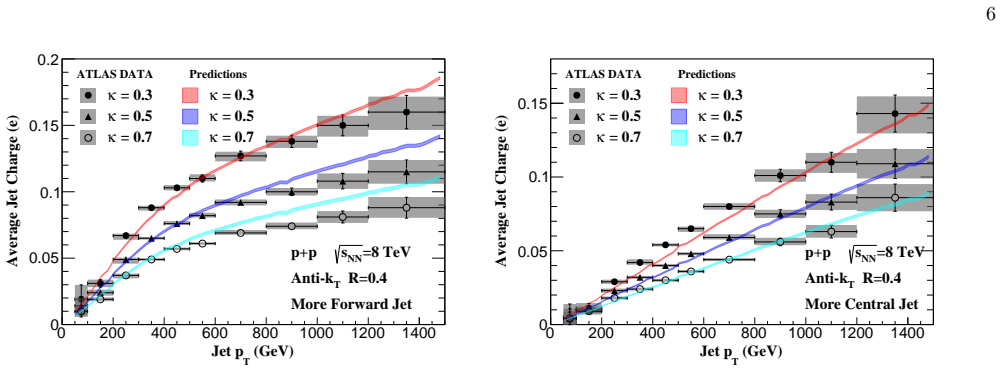
- [Figure 5 caption] The parenthetical labels '(right)' and '(left)' appear to be swapped relative to the two-panel layout of the figure; please check that the caption matches the panels.
- [Section I and throughout] The notation for the heavy-ion average jet charge is inconsistent: the text uses ⟨Q_AA⟩, ⟨Q_PbPb⟩, and ⟨Q^Pb+Pb⟩. Please define one symbol and use it consistently.
- [Section III.A] The phrase 'The Relation of this technique to other approaches' has an unnecessary capital 'R' and should be lower-case.
Circularity Check
No significant circularity: the medium-modified jet charge is a genuine calculation built on previously validated medium-induced splitting functions, and the fitted nonperturbative boundary condition cancels in the central heavy-ion/pp ratio.
full rationale
The derivation chain is self-contained with respect to the jet charge observable. The vacuum factorization (Eq. (4)) and the heavy-ion generalization (Eq. (17)) are constructed by inserting medium-modified splitting kernels into the jet-function and fragmentation-evolution expressions; the paper does not define any input in terms of the target observable. The single nonperturbative parameter per flavor and κ is fitted to PYTHIA for pp and then reused unchanged for Pb+Pb ('we will use the same nonperturbative parameters as in pp collisions'), but this parameter cancels in the key prediction, the flavor-independent modification ratio of Eq. (22), which the paper explicitly derives from the fact that 'the only difference between the up- and down-quark jet charges is the nonperturbative parameters or boundary conditions.' Thus the central claim is not a fitted input renamed as a prediction. The medium-induced splitting functions and medium-modified DGLAP evolution are imported from prior work by the same group (Refs. [50,51,53–59]), which is a self-citation chain, but the paper cites external experimental validation: 'the accuracy of theoretical predictions to this order has been confirmed by experimental measurements' (Ref. [77] CMS inclusive hadron suppression), so the imported kernels are not unverified assertions and do not make the argument circular. The skeptical concern that Eq. (17) exponentiates a first-order-in-opacity kernel while quoting O(α_s^2, χ^2) is a legitimate accuracy/resummation-consistency issue, but it is not a circularity: the exponentiated form is not equivalent to its input by construction, nor does it reintroduce the fitted parameter. Overall, the heavy-ion jet charge modification is a derived prediction with independent external anchors, and no circular step can be exhibited.
Assumptions & free parameters
free parameters (2)
- D~Q_q(kappa, mu0=1 GeV), nonperturbative charge-weighted fragmentation function boundary condition =
not tabulated; fitted to PYTHIA8 for each kappa and flavor
- g, jet-medium coupling =
1.9 +/- 0.1
assumptions (5)
- domain assumption The SCET factorization of the jet charge in vacuum, Eq. (4), extends to heavy-ion collisions with medium-modified jet functions, matching coefficients, and fragmentation functions.
- domain assumption Gluon jets have zero average jet charge because soft correlations are negligible and quark/antiquark contributions cancel.
- domain assumption The first order in opacity is a sufficient approximation for the medium-induced splitting functions at LHC energies; higher orders in opacity are neglected.
- ad hoc to paper The in-medium evolution of the fragmentation function follows the medium-modified DGLAP equation, Eq. (15), with the factorization scale set to k_perp in the medium part.
- ad hoc to paper The nonperturbative fragmentation boundary condition is the same in vacuum and in the medium.
Cite this review
Pith. "Pith review of Jet charge modification in dense QCD matter." pith.science (2026). https://pith.science/paper/XPV47NAV
@misc{pith2026190806979,
  author       = {Pith},
  title        = {Pith review of: Jet charge modification in dense QCD matter},
  year         = {2026},
  howpublished = {\url{https://pith.science/paper/XPV47NAV}},
  note         = {Machine review of arXiv:1908.06979}
}
read the original abstract
Jet production and jet substructure modification in heavy-ion collisions have played an essential role in revealing the in-medium evolution of parton showers and the determination of the properties of strongly-interacting matter under extreme conditions. It is imperative to extend these studies to include flavor tagging and to devise observables that are sensitive to the partonic origin of jets. The average jet charge, defined as the momentum-weighted sum of the electric charges of particles inside the jet, is a proxy of the electric charge of the quark or gluon that initiates the jet. We demonstrate how the factorization framework of soft-collinear effective theory can be generalized to evaluate the jet charge in a dense strongly-interacting matter environment, such as the one produced in nuclear reactions at collider energies. Observables that can separate the contribution of in-medium branching from the trivial isospin effects are identified and their connection to established jet quenching effects is elucidated. We present predictions for the transverse momentum dependence of the jet charge distribution in nucleus-nucleus collisions and its modification relative to the proton case.
Figures


Figures from the paper (1 more)

Forward citations
Cited by 2 Pith papers
-
Secondary Lund jet plane as a gluon enriched sample
Selecting close, asymmetric dijets at the LHC gives a ~90% gluon-enriched subleading jet sample, supported by fixed-order QCD and Monte Carlo.
-
Anisotropic jet broadening and jet shape
The paper introduces azimuthal-dependent jet broadening and jet shape observables, calculates their jet functions in SCET for standard and Winner-Take-All axes, and shows the broadening can directly probe the collinea...
Reference graph
Works this paper leans on
-
[1]
G. F. Sterman and S. Weinberg, Phys. Rev. Lett. 39, 1436 (1977)
1977
-
[2]
C. W. Bauer, S. Fleming, and M. E. Luke, Phys. Rev. D63, 014006 (2000), arXiv:hep-ph/0005275 [hep-ph]
arXiv 2000
-
[3]
C. W. Bauer, S. Fleming, D. Pirjol, and I. W. Stewart, Phys. Rev. D63, 114020 (2001), arXiv:hep-ph/0011336 [hep-ph]
arXiv 2001
-
[4]
C. W. Bauer and I. W. Stewart, Phys. Lett. B516, 134 (2001), arXiv:hep-ph/0107001 [hep-ph]
arXiv 2001
-
[5]
C. W. Bauer, D. Pirjol, and I. W. Stewart, Phys. Rev. D65, 054022 (2002), arXiv:hep-ph/0109045 [hep-ph]
arXiv 2002
- [6]
- [7]
-
[8]
R. B. Neufeld and I. Vitev, Phys. Rev. Lett. 108, 242001 (2012), arXiv:1202.5556 [hep-ph]
work page Pith review arXiv 2012
Show all 83 references
-
[9]
W. Dai, I. Vitev, and B.-W. Zhang, Phys. Rev. Lett. 110, 142001 (2013), arXiv:1207.5177 [hep-ph]
2013 arXiv
- [10]
-
[11]
Wang and Y
X.-N. Wang and Y. Zhu, Phys. Rev. Lett. 111, 062301 (2013), arXiv:1302.5874 [hep-ph]
2013 arXiv
-
[12]
Chatrchyan et al
S. Chatrchyan et al. (CMS), Phys. Lett. B718, 773 (2013), arXiv:1205.0206 [nucl-ex]
2013 arXiv
-
[13]
A. M. Sirunyan et al. (CMS), Phys. Lett. B785, 14 (2018), arXiv:1711.09738 [nucl-ex]. 10 60 70 80 90 100 200 300 400 500 [GeV] T Jet p0 0.2 0.4 0.6 0.8 1 Fraction Gluon Up Down Gluon Up Down = 5.02 TeV NNs R=0.4 T Anti-k More Forward Jet Pb+Pb p+p 0.1 ± g=1.9 60 70 80 90 100 2...
2018 arXiv
-
[14]
A. M. Sirunyan et al. (CMS), Phys. Rev. Lett. 119, 082301 (2017), arXiv:1702.01060 [nucl-ex]
2017 arXiv
-
[15]
Aaboud et al
M. Aaboud et al. (ATLAS), Phys. Lett. B789, 167 (2019), arXiv:1809.07280 [nucl-ex]
2019 arXiv
- [16]
-
[17]
A. M. Sirunyan et al. (CMS), Phys. Rev. Lett. 122, 152001 (2019), arXiv:1809.08602 [hep-ex]
2019 arXiv
-
[18]
Aaboud et al
M. Aaboud et al. (ATLAS), Phys. Rev. Lett.123, 042001 (2019), arXiv:1902.10007 [nucl-ex]
2019 arXiv
-
[19]
R. D. Field and R. P. Feynman, Nucl. Phys. B136, 1 (1978), [763(1977)]
1978
-
[20]
J. P. Berge et al. , Nucl. Phys. B184, 13 (1981)
1981
-
[21]
J. P. Albanese et al. (European Muon), Phys. Lett. 144B, 302 (1984)
1984
-
[22]
Erickson et al
R. Erickson et al. , Phys. Rev. Lett. 42, 822 (1979), [Er- ratum: Phys. Rev. Lett.42,1246(1979)]
1979
-
[23]
Braunschweig et al
W. Braunschweig et al. (TASSO), Z. Phys. C48, 433 (1990)
1990
-
[24]
Abreu et al
P. Abreu et al. (DELPHI), Phys. Lett. B277, 371 (1992)
1992
-
[25]
Decamp et al
D. Decamp et al. (ALEPH), Phys. Lett. B259, 377 (1991)
1991
-
[26]
P. D. Acton et al. (OPAL), Phys. Lett.B294, 436 (1992)
1992
-
[27]
Abreu et al
P. Abreu et al. (DELPHI), Z. Phys. C72, 17 (1996)
1996
-
[28]
Abe et al
K. Abe et al. (SLD), Phys. Rev. Lett. 74, 2890 (1995)
1995
-
[29]
Abe et al
F. Abe et al. (CDF), Phys. Rev. D60, 072003 (1999), arXiv:hep-ex/9903011 [hep-ex]
1999 arXiv
-
[30]
Barate et al
R. Barate et al. (ALEPH), Phys. Lett. B422, 369 (1998)
1998
-
[31]
Abreu et al
P. Abreu et al. (DELPHI), Phys. Lett. B502, 9 (2001), arXiv:hep-ex/0102041 [hep-ex]
2001 arXiv
-
[32]
Acciarri et al
M. Acciarri et al. (L3), Phys. Lett. B467, 171 (1999), arXiv:hep-ex/9910008 [hep-ex]
1999 arXiv
-
[33]
Abbiendi et al
G. Abbiendi et al. (OPAL), Eur. Phys. J. C19, 1 (2001), arXiv:hep-ex/0009022 [hep-ex]
2001 arXiv
-
[34]
ATLAS (ATLAS), ATLAS-CONF-2015-025 (2015)
2015
-
[35]
Aad et al
G. Aad et al. (ATLAS), Phys. Rev. D93, 052003 (2016), arXiv:1509.05190 [hep-ex]
2016 arXiv
-
[36]
CMS (CMS), CMS-PAS-SMP-15-003 (2016)
2016
-
[37]
A. M. Sirunyan et al. (CMS), JHEP 10, 131 (2017), arXiv:1706.05868 [hep-ex]
2017 arXiv
-
[38]
Krohn, M
D. Krohn, M. D. Schwartz, T. Lin, and W. J. Waalewijn, Phys. Rev. Lett. 110, 212001 (2013), arXiv:1209.2421 [hep-ph]
2013 arXiv
-
[39]
W. J. Waalewijn, Phys. Rev. D86, 094030 (2012), arXiv:1209.3019 [hep-ph]
2012 arXiv
-
[40]
S. D. Ellis, C. K. Vermilion, J. R. Walsh, A. Hornig, and C. Lee, JHEP 11, 101 (2010), arXiv:1001.0014 [hep-ph]
2010 arXiv
-
[41]
Fraser and M
K. Fraser and M. D. Schwartz, JHEP 10, 093 (2018), arXiv:1803.08066 [hep-ph]
2018 arXiv
-
[42]
Kovarik et al
K. Kovarik et al. , Phys. Rev. D93, 085037 (2016), arXiv:1509.00792 [hep-ph]
2016 arXiv
-
[43]
Vitev and B.-W
I. Vitev and B.-W. Zhang, Phys. Lett. B669, 337 (2008), arXiv:0804.3805 [hep-ph]
2008 arXiv
-
[44]
Adare et al
A. Adare et al. (PHENIX), Phys. Rev. C87, 054907 (2013), arXiv:1208.1234 [nucl-ex]
2013 arXiv
-
[45]
Aaboud et al
M. Aaboud et al. (ATLAS), Phys. Lett. B796, 230 (2019), arXiv:1903.02209 [nucl-ex]
2019 arXiv
- [46]
-
[47]
J. L. Albacete et al. , Nucl. Phys. A972, 18 (2018), arXiv:1707.09973 [hep-ph]
2018 arXiv
-
[48]
Gyulassy, P
M. Gyulassy, P. Levai, I. Vitev, and T. S. Biro, Phys. Rev. D90, 054025 (2014), arXiv:1405.7825 [hep-ph]
2014 arXiv
-
[49]
Majumder and C
A. Majumder and C. Shen, Phys. Rev. Lett. 109, 202301 (2012), arXiv:1103.0809 [hep-ph]
2012 arXiv
-
[50]
Z.-B. Kang, R. Lashof-Regas, G. Ovanesyan, P. Saad, and I. Vitev, Phys. Rev. Lett. 114, 092002 (2015), arXiv:1405.2612 [hep-ph]
2015 arXiv
-
[51]
Chien, A
Y.-T. Chien, A. Emerman, Z.-B. Kang, G. Ovanesyan, and I. Vitev, Phys. Rev. D93, 074030 (2016), arXiv:1509.02936 [hep-ph]
2016 arXiv
- [52]
- [53]
-
[54]
Ovanesyan and I
G. Ovanesyan and I. Vitev, Phys. Lett.B706, 371 (2012), arXiv:1109.5619 [hep-ph]
2012 arXiv
-
[55]
Z.-B. Kang, F. Ringer, and I. Vitev, JHEP 03, 146 (2017), arXiv:1610.02043 [hep-ph]
2017 arXiv
-
[56]
M. D. Sievert and I. Vitev, Phys. Rev. D98, 094010 (2018), arXiv:1807.03799 [hep-ph]. 11
2018 arXiv
-
[57]
M. D. Sievert, I. Vitev, and B. Yoon, Phys. Lett. B795, 502 (2019), arXiv:1903.06170 [hep-ph]
2019 arXiv
-
[58]
Z.-B. Kang, F. Ringer, and I. Vitev, Phys. Lett. B769, 242 (2017), arXiv:1701.05839 [hep-ph]
2017 arXiv
-
[59]
H. T. Li and I. Vitev, JHEP 07, 148 (2019), arXiv:1811.07905 [hep-ph]
2019 arXiv
-
[60]
Procura and I
M. Procura and I. W. Stewart, Phys. Rev. D81, 074009 (2010), [Erratum: Phys. Rev.D83,039902(2011)], arXiv:0911.4980 [hep-ph]
2010 arXiv
- [61]
-
[62]
S. D. Ellis, A. Hornig, C. Lee, C. K. Vermilion, and J. R. Walsh, Phys. Lett. B689, 82 (2010), arXiv:0912.0262 [hep-ph]
2010 arXiv
-
[63]
A. Jain, M. Procura, and W. J. Waalewijn, JHEP 05, 035 (2011), arXiv:1101.4953 [hep-ph]
2011 arXiv
-
[64]
Chien, Z.-B
Y.-T. Chien, Z.-B. Kang, F. Ringer, I. Vitev, and H. Xing, JHEP 05, 125 (2016), arXiv:1512.06851 [hep- ph]
2016 arXiv
-
[65]
L. Dai, C. Kim, and A. K. Leibovich, Phys. Rev. D94, 114023 (2016), arXiv:1606.07411 [hep-ph]
2016 arXiv
-
[66]
Gyulassy, P
M. Gyulassy, P. Levai, and I. Vitev, Phys. Rev. Lett. 85, 5535 (2000), arXiv:nucl-th/0005032 [nucl-th]
2000 arXiv
-
[67]
Gyulassy, P
M. Gyulassy, P. Levai, and I. Vitev, Nucl. Phys. B594, 371 (2001), arXiv:nucl-th/0006010 [nucl-th]
2001 arXiv
-
[68]
X. Feal, C. A. Salgado, and R. A. Vazquez, (2019), arXiv:1911.01309 [hep-ph]
2019 arXiv
- [69]
-
[70]
Vitev and B.-W
I. Vitev and B.-W. Zhang, Phys. Rev. Lett. 104, 132001 (2010), arXiv:0910.1090 [hep-ph]
2010 arXiv
-
[71]
Collaboration (CMS), (2019), CMS-PAS-HIN-18-014
C. Collaboration (CMS), (2019), CMS-PAS-HIN-18-014
2019
-
[72]
Wang and X.-f
X.-N. Wang and X.-f. Guo, Nucl. Phys. A696, 788 (2001), arXiv:hep-ph/0102230 [hep-ph]
2001 arXiv
-
[73]
Deng and X.-N
W.-t. Deng and X.-N. Wang, Phys. Rev. C81, 024902 (2010), arXiv:0910.3403 [hep-ph]
2010 arXiv
- [74]
-
[75]
Chang, W.-T
N.-B. Chang, W.-T. Deng, and X.-N. Wang, Phys. Rev. C89, 034911 (2014), arXiv:1401.5109 [nucl-th]
2014 arXiv
-
[76]
H. T. Li and I. Vitev, Phys. Lett. B793, 259 (2019), arXiv:1801.00008 [hep-ph]
2019 arXiv
-
[77]
Khachatryan et al
V. Khachatryan et al. (CMS), JHEP 04, 039 (2017), arXiv:1611.01664 [nucl-ex]
2017 arXiv
-
[78]
L. D. Landau and I. Pomeranchuk, Dokl. Akad. Nauk Ser. Fiz. 92, 535 (1953)
1953
-
[79]
A. B. Migdal, Phys. Rev. 103, 1811 (1956)
1956
-
[80]
Dulat, T.-J
S. Dulat, T.-J. Hou, J. Gao, M. Guzzi, J. Hus- ton, P. Nadolsky, J. Pumplin, C. Schmidt, D. Stump, and C. P. Yuan, Phys. Rev. D93, 033006 (2016), arXiv:1506.07443 [hep-ph]
2016 arXiv
-
[81]
Sjostrand, S
T. Sjostrand, S. Mrenna, and P. Z. Skands, Comput. Phys. Commun. 178, 852 (2008), arXiv:0710.3820 [hep- ph]
2008 arXiv
-
[82]
Sjstrand, S
T. Sjstrand, S. Ask, J. R. Christiansen, R. Corke, N. De- sai, P. Ilten, S. Mrenna, S. Prestel, C. O. Rasmussen, and P. Z. Skands, Comput. Phys. Commun. 191, 159 (2015), arXiv:1410.3012 [hep-ph]
2015 arXiv
-
[83]
A. M. Sirunyan et al. (CMS), (2020), arXiv:2004.00602 [hep-ex]
2020 arXiv
Reviewed August 14, 2026 · model on record in the stance chip above.
Discussion (0). Continue with ORCID to comment.