Decoherence of spatial superpositions along stationary worldlines
Pith reviewed 2026-05-14 17:43 UTC · model grok-4.3
The pith
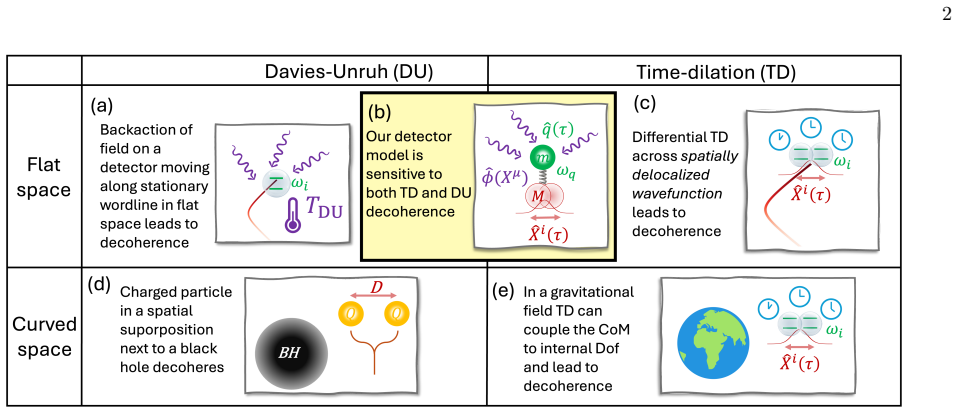
A particle's spatial superposition along a stationary worldline decoheres from a modified vacuum field spectrum and differential time dilation across its wavefunction.
A machine-rendered reading of the paper's core claim, the machinery that carries it, and where it could break.
Core claim
The central claim is that for a particle modeled with an internal degree of freedom coupled to a scalar field and quantized center-of-mass motion around a stationary worldline, the decoherence of the spatial superposition has two components that both take an effectively thermal form: one arising from a modified field spectrum observed by the particle and the other due to differential time-dilation over the extended spatial wavefunction. This is derived by obtaining an effective red-shifted polarizability from the separation of time scales and then a quantum Brownian motion master equation under the Born-Markov approximation.
What carries the argument
The effective red-shifted polarizability characterizing the trajectory-dependent linear response of the internal oscillator to the field, which enables derivation of the quantum Brownian motion master equation describing center-of-mass decoherence in the position basis.
If this is right
- Decoherence rates can be evaluated explicitly for hyperbolic motion.
- Decoherence rates can be evaluated explicitly for uniform circular motion.
- The master equation includes Hamiltonian modifications corresponding to a dispersive potential.
- Both contributions to decoherence take an effectively thermal form for stationary trajectories.
Where Pith is reading between the lines
- The approach could be generalized to non-stationary worldlines to determine if the thermal character of the decoherence persists.
- Similar two-component decoherence might arise in electromagnetic fields or other quantum fields beyond the scalar case.
- The differential time-dilation effect points to a geometric contribution to decoherence that could be tested in analog systems simulating acceleration.
- This links relativistic motion to effective thermal baths, with possible implications for quantum information processing in curved spacetime.
Load-bearing premise
The assumption of a separation of time scales between the particle's internal and external dynamics to obtain the effective red-shifted polarizability, combined with the Born-Markov approximation for the master equation.
What would settle it
An observation or calculation of the decoherence rate for a spatial superposition in hyperbolic motion that does not match the sum of the two predicted thermal-like contributions.
Figures


read the original abstract
We analyze the decoherence of a particle's spatial superposition moving along a stationary worldline through the Minkowski vacuum. The particle is modeled via an internal degree of freedom that couples to a scalar field, and an external degree of freedom, i.e., its quantized center-of-mass motion around the stationary worldline. Assuming a separation of time scales between the particle's internal and external dynamics, we first obtain an effective red-shifted polarizability of the particle, characterizing the trajectory-dependent linear response of the internal oscillator to the field. We then derive a quantum Brownian motion master equation for the particle's center of mass, under the Born-Markov approximation, which describes its decoherence in the position basis, as well as, Hamiltonian modifications corresponding to a dispersive potential. The resulting decoherence has two components: (1) arising from a modified field spectrum observed by the particle; and (2) due to a differential time-dilation over the particle's extended spatial wavefunction. For stationary trajectories, both contributions take an effectively thermal form. We evaluate the decoherence rates for two specific cases of hyperbolic and uniform circular motion.
Editorial analysis
A structured set of objections, weighed in public.
Referee Report
Summary. The manuscript analyzes decoherence of a particle's spatial superposition along stationary worldlines in Minkowski vacuum. The particle is modeled with an internal oscillator coupled to a scalar field and a quantized center-of-mass degree of freedom. Assuming separation of internal/external time scales, an effective red-shifted polarizability is obtained; a quantum Brownian motion master equation is then derived under the Born-Markov approximation. This yields decoherence with two components (modified field spectrum observed by the particle and differential time-dilation across the wavefunction), both taking effectively thermal form for stationary trajectories, with explicit rates evaluated for hyperbolic and uniform circular motion.
Significance. If the central approximations hold in the regimes studied, the result supplies a concrete, trajectory-dependent calculation distinguishing spectrum-modification and time-dilation contributions to decoherence, both reducible to thermal rates. This is a useful addition to the literature on relativistic quantum Brownian motion and Unruh-type effects for extended systems, with direct applicability to the two explicit cases treated.
major comments (2)
- [Derivation of effective polarizability (preceding the master equation)] The separation of time scales between the internal oscillator frequency and the external/CM plus field-correlation timescales along the worldline is invoked to reduce to an effective red-shifted polarizability. For hyperbolic motion this separation is not quantified against the acceleration scale a; when a becomes comparable to the internal frequency the linear-response reduction fails and the two decoherence components may mix or acquire non-Markovian corrections, undermining the claimed thermal structure.
- [Quantum Brownian motion master equation] The Born-Markov approximation is used to close the master equation for the quantized center-of-mass. No explicit check is provided that the resulting rates remain Markovian for the evaluated trajectories; for circular motion the orbital frequency can introduce additional timescales that violate the approximation and spoil the effectively thermal form asserted for both contributions.
minor comments (1)
- [Abstract] The abstract states that both contributions 'take an effectively thermal form' but does not define the effective temperature in terms of the trajectory parameters (acceleration or angular velocity); a short explicit expression would improve readability.
Simulated Author's Rebuttal
We thank the referee for their thorough review and valuable comments on our manuscript. We address each of the major comments below, providing clarifications and indicating the revisions we plan to make to strengthen the presentation of our assumptions and approximations.
read point-by-point responses
-
Referee: [Derivation of effective polarizability (preceding the master equation)] The separation of time scales between the internal oscillator frequency and the external/CM plus field-correlation timescales along the worldline is invoked to reduce to an effective red-shifted polarizability. For hyperbolic motion this separation is not quantified against the acceleration scale a; when a becomes comparable to the internal frequency the linear-response reduction fails and the two decoherence components may mix or acquire non-Markovian corrections, undermining the claimed thermal structure.
Authors: We appreciate the referee highlighting the need to quantify the timescale separation. Our derivation relies on the assumption that the internal oscillator frequency is sufficiently high compared to the external dynamics and field correlation times along the worldline. For hyperbolic motion, this corresponds to the internal frequency ω being much larger than the acceleration a. In the revised manuscript, we will explicitly state this condition (ω ≫ a) and discuss its implications for the validity of the effective polarizability and the thermal form of the decoherence rates. We will also note that when a approaches ω, non-Markovian effects may indeed arise, but our focus is on the regime where the separation holds. revision: yes
-
Referee: [Quantum Brownian motion master equation] The Born-Markov approximation is used to close the master equation for the quantized center-of-mass. No explicit check is provided that the resulting rates remain Markovian for the evaluated trajectories; for circular motion the orbital frequency can introduce additional timescales that violate the approximation and spoil the effectively thermal form asserted for both contributions.
Authors: We agree that verifying the Markovian nature of the approximation is important, especially for circular motion. The orbital frequency introduces a new timescale, and the Born-Markov approximation requires that the system-bath coupling is weak and the bath correlations decay faster than the system's evolution. In the revised manuscript, we will add a discussion providing order-of-magnitude estimates for the trajectories considered, showing that for typical parameters where the internal frequency dominates, the approximation holds and the thermal structure is preserved. We will also mention the conditions under which it might break down. revision: yes
Circularity Check
Standard QFT derivation with explicit approximations; no reduction to self-inputs or fitted predictions
full rationale
The paper begins from a standard scalar-field coupling to an internal oscillator plus quantized center-of-mass motion, invokes an explicit separation-of-timescales assumption to obtain a trajectory-dependent effective polarizability, and then applies the Born-Markov approximation to close the quantum Brownian motion master equation. Both the modified-spectrum and differential-time-dilation contributions to decoherence are obtained by direct calculation from these steps; the thermal form for stationary worldlines is a derived consequence rather than an input or a self-citation. No equations reduce to each other by construction, no parameters are fitted and relabeled as predictions, and no load-bearing uniqueness theorem or ansatz is imported from the authors' prior work. The derivation therefore remains self-contained against external QFT and open-systems benchmarks.
Axiom & Free-Parameter Ledger
axioms (2)
- domain assumption Separation of time scales between internal and external dynamics
- domain assumption Born-Markov approximation
Lean theorems connected to this paper
-
IndisputableMonolith/Cost/FunctionalEquation.leanwashburn_uniqueness_aczel unclear?
unclearRelation between the paper passage and the cited Recognition theorem.
Assuming a separation of time scales between the particle’s internal and external dynamics, we first obtain an effective red-shifted polarizability... under the Born-Markov approximation... both contributions take an effectively thermal form.
-
IndisputableMonolith/Foundation/RealityFromDistinction.leanreality_from_one_distinction unclear?
unclearRelation between the paper passage and the cited Recognition theorem.
The resulting decoherence has two components: (1) arising from a modified field spectrum... (2) due to a differential time-dilation... For stationary trajectories, both contributions take an effectively thermal form.
What do these tags mean?
- matches
- The paper's claim is directly supported by a theorem in the formal canon.
- supports
- The theorem supports part of the paper's argument, but the paper may add assumptions or extra steps.
- extends
- The paper goes beyond the formal theorem; the theorem is a base layer rather than the whole result.
- uses
- The paper appears to rely on the theorem as machinery.
- contradicts
- The paper's claim conflicts with a theorem or certificate in the canon.
- unclear
- Pith found a possible connection, but the passage is too broad, indirect, or ambiguous to say the theorem truly supports the claim.
discussion (0)
Sign in with ORCID, Apple, or X to comment. Anyone can read and Pith papers without signing in.