REVIEW 5 major objections 5 minor 38 references
Structured Attention Matters to Multimodal LLMs in Document Understanding
T0 review · 5 major / 5 minor · reviewed 2026-08-06 · deepseek-v4-flash
Pith's one-line read LaTeX-formatted OCR text lifts document QA accuracy
desk verdict A cheap and plausible input-formatting trick that shows consistent gains, but the paper never proves that structure, not extra text, is doing the work. read the letter →
The pith
A machine-rendered reading of the paper's core claim, the machinery that carries it, and where it could break.
The reading
What carries the argument
The central object is the LaTeX-paradigm structured text: OCR text and the document image are fed to an MLLM prompted to capture the layout as fully as possible, producing LaTeX code with sections, tables, figures, and virtual paths for unparseable images. This encoding carries the argument because it converts two-dimensional layout into a token sequence the model can attend to, and it is what redirects attention away from image borders and blank areas toward informative regions.
What would settle it
Run the same four benchmarks with the LaTeX conversion replaced by a shuffled version whose tokens are identical but whose section/table/figure structure is randomized; if accuracy stays as high as the structured condition, the improvements are not caused by structure. Alternatively, compare against perfect ground-truth LaTeX generated from the original document source: if there is no further gain over noisy conversion, the conversion step is already faithful.
Extended reading notes
Core claim
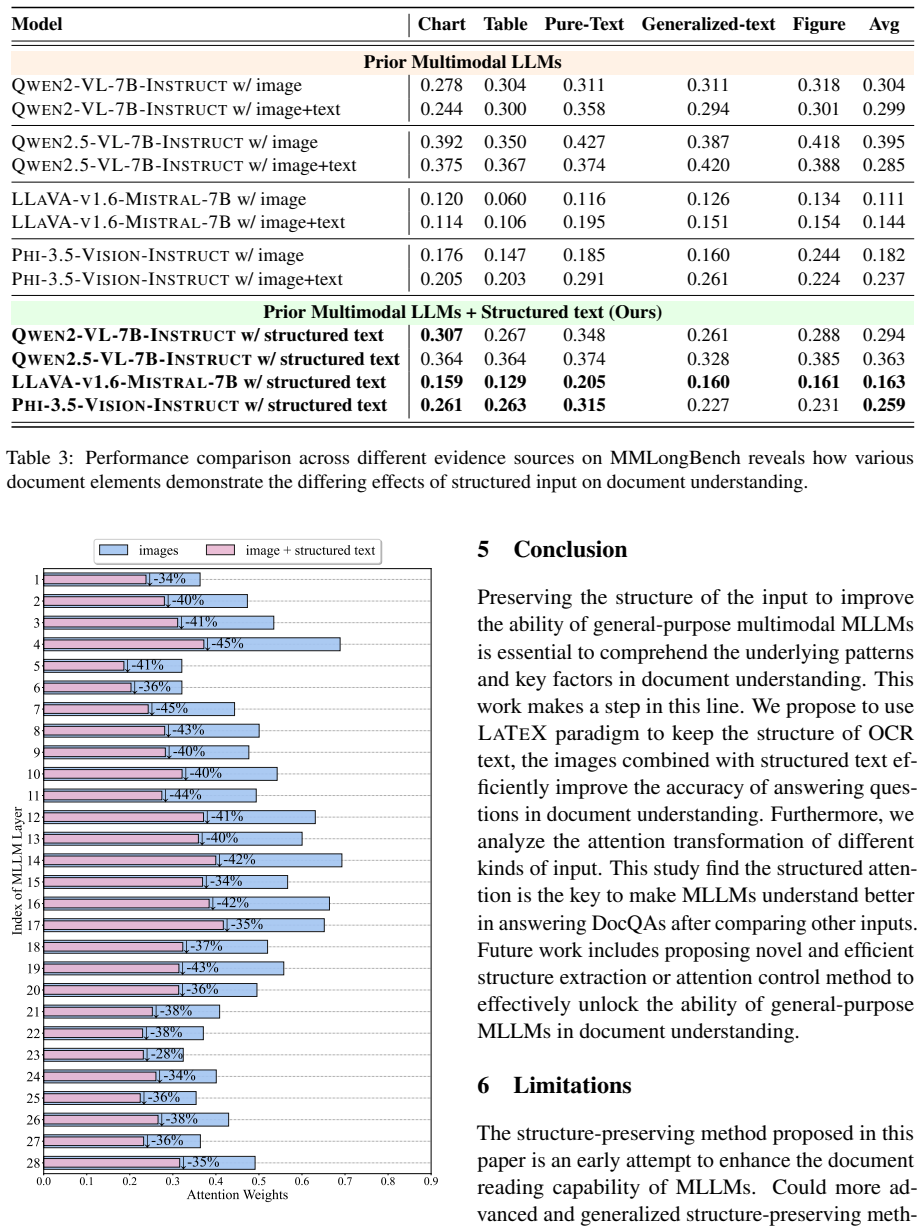
The paper establishes three observations. Observation 1: providing unstructured OCR text alongside document images often degrades MLLM performance despite adding information. Observation 2: structured LaTeX text combined with images improves MLLM performance on DocQAs, for example raising Qwen2.5-VL-7B on MMLongBench from 0.389 to 0.435 and Phi-3.5-Vision on PaperTab from 0.077 to 0.224. Observation 3: structured text induces structured attention over both textual and visual content, directing models toward semantically meaningful regions and reducing attention waste. The authors argue that preserving hierarchical organization and spatial relationships through the LaTeX paradigm is what lets general-purpose MLLMs answer document questions better, without architectural changes or additional training.
Load-bearing premise
The method depends on the MLLM faithfully converting OCR text and document images into LaTeX; if that conversion invents layout, drops content, or leaks answer cues, the measured gains could come from the added material rather than from preserved structure.
Editorial extensions
If this is right
- Retrieval-augmented document QA pipelines should treat layout preservation as a design goal, not just evidence retrieval.
- Chart- and table-related questions gain the most from structured input, so structure-aware formatting matters most for those document types.
- Input-format changes can improve general-purpose MLLMs on document QA without architectural modifications or training.
- Attention distributions can serve as a diagnostic for whether an input representation is helping a model understand a document.
Reading between the lines
- If the mechanism is genuinely structural attention, then any faithful layout markup—HTML, Markdown, XML—should produce similar gains, which is testable without retraining.
- The reported gains could partly reflect the LaTeX conversion step adding answer-relevant content or normalizing noisy OCR; the paper does not isolate that, so a null-conversion control would sharpen the claim.
- A practical extension is to make structured generation a first-class retrieval target: retrieve evidence already in structured form rather than converting it after retrieval.
Editorial analysis
A structured set of objections, weighed in public.
Referee Report
Summary. The paper studies how the input format of evidence pages affects multimodal large language model (MLLM) performance on document question answering (DocQA). It claims that raw OCR text often degrades performance compared with images alone, and proposes to preserve document structure by converting OCR text and images into LaTeX-style structured text. Across four MLLMs (Qwen2-VL, Qwen2.5-VL, LLaVA-v1.6-Mistral, Phi-3.5-Vision) and four benchmarks (MMLongBench, LongDocUrl, PaperTab, FetaTab), the authors report that combining images with structured text improves accuracy over image-only and image+OCR-text baselines. They also analyze attention distributions and argue that structured text induces 'structured attention,' which they identify as the mechanism behind the improvements. The proposal requires no architectural changes or training and is evaluated using Llama-3.1-8B as an answer-judging model.
Significance. If the central attribution claim were fully supported, this would be a practically valuable result: a training-free, API-level input-format change that consistently improves DocQA across models and benchmarks would be of broad interest to the multimodal retrieval-augmented generation community. The paper also ships a clear, reproducible comparison table, explicit observations, and attention visualizations, and it does not rely on circular evaluation because accuracy is measured on external benchmarks. The main significance is however conditional on the structure-versus-content attribution, which the current evidence does not yet establish. The manuscript's own promised placeholder control is absent from the results, LaTeX conversion fidelity is not measured, and the attention analysis is correlational rather than causal. These gaps directly affect the paper's central claim that preserved structure, rather than duplicated or re-emphasized answer content, is what drives the gains.
major comments (5)
- [§4.5, Table 2] The manuscript promises a placeholder control but never reports it. The text states: 'We further conduct experiments on the following cases: structured text as input, OCR text as input, and the LATEX format acting as a placeholder without specific text information.' Table 2, however, reports only the 'w/ text' and 'w/ structured text' conditions. The placeholder condition is exactly the control needed to separate the effect of preserved layout from the effect of the structured text containing the answer content. Without this condition, the observed improvement of image+structured-text over image+OCR-text could be caused by the LaTeX conversion duplicating or emphasizing answer-relevant strings rather than by structure itself. Please add the placeholder results, describe how the placeholder was generated, and use them to support or qualify Observation 2.
- [§3.2, §4.1] LaTeX conversion fidelity and answer leakage are not quantified. The method prompts the same MLLM family that later answers the questions to convert the image and OCR text into LaTeX 'as much as possible.' There is no fidelity metric, no human or automatic evaluation of how well the LaTeX preserves tables, headers, and spatial relations, and no check of whether the gold answer appears verbatim in the generated structured text more often than in the original OCR text. If the conversion step hallucinates or selectively includes answer strings, the accuracy gains in Table 1 would come from content, not from preserved structure. Please report conversion quality statistics and answer-overlap rates, and consider an external conversion baseline (e.g., a deterministic layout/PDF parser) to decouple the conversion model from the answering model.
- [§4.1, Table 1] The baseline comparison is not fully controlled. The 'w/ image' numbers are cited from the original model papers and the 'w/ image+text' numbers from Han et al. (2025), rather than being re-run with the same preprocessing, retrieval, OCR pipeline, and prompts used for the proposed method. Differences in evidence selection, OCR quality, and prompting can easily explain several percentage points on these benchmarks. Moreover, no error bars or significance tests are reported for any condition. Please re-run all conditions in the same pipeline and report variance across runs or seeds; this is needed before the statement that structured text leads to consistent 'significant' improvements can be accepted.
- [§4.4, Observation 3] The attention analysis supports a correlation, not the causal claim in Observation 3 that structured text 'directly improves' MLLM abilities and that 'structured attention is the key.' The paper shows that attention distributions differ when structured text is present and that accuracy also differs, but it does not intervene on attention, so the link between the two is not established. A concrete test would be to reweight or mask the attention heads/tokens that the analysis identifies as 'focused' and check whether accuracy changes accordingly, or to feed structured text whose layout is shuffled while keeping content constant. Without such a test, the mechanism narrative should be stated as a hypothesis rather than as a demonstrated cause.
- [§4.2, Observation 1] Observation 1 is worded more strongly than the data warrant. Table 1 shows OCR text impairs only one of the four model-benchmark combinations clearly (Qwen2.5-VL on MMLongBench, 0.389 to 0.375), while for several rows it improves accuracy. The observation's claim that OCR text 'often degrades' and 'across benchmark datasets' would benefit from an explicit count of degrading vs. improving cases and a statistical test; otherwise the first observation is not uniformly supported by the reported numbers.
minor comments (5)
- [Table 1] The table header 'A vg' appears to be a typo for 'Avg'; please correct it.
- [§4.5] The sentence 'In the cases needed images to answer questions' and the phrase 'with structured text ans images' contain grammatical errors; these should be corrected (e.g., 'In cases where images are needed to answer questions' and 'with structured text and images').
- [Throughout] The notation for Qwen models is inconsistent (QWEN2, Qwen2, QWEN2.5) and the benchmark name appears as both MMLongBench and MMlongBench; please unify the capitalization conventions.
- [§4.5] The sentence 'We almost obtain the best results on almost every dataset and model' is redundant; consider rewording to 'We obtain the best results on nearly every dataset and model.'
- [§3.2] The use of the uppercase string 'LATEX' is inconsistent with the standard typography of LaTeX; using the proper notation would improve readability.
Circularity Check
No significant circularity: benchmark-based empirical claims with external baselines; flagged confounds are validity issues, not circular reductions.
full rationale
The paper's central claims are empirical and benchmark-anchored rather than definitionally circular. Observation 2 (structured text plus images improves DocQA accuracy) is supported by Table 1 comparisons against image-only and image+OCR results on four external benchmarks; the structured text is generated from image and OCR inputs without access to answer labels, and no parameter is fitted to the test sets. Observation 3 (structured text induces structured attention) is a post-hoc attention analysis, and the same model family is used both to generate the LaTeX and to compute attention, but this creates a possible confound rather than a reduction by construction. The paper's Section 4.5 mentions a placeholder control ('the LATEX format acting as a placeholder without specific text information') but never reports its results, and the paper does not quantify LaTeX conversion fidelity or check for answer leakage; these are substantive experimental gaps that weaken the structure-vs-content attribution, but they are not instances of a prediction being equivalent to its input by definition. There are no load-bearing self-citations or imported uniqueness theorems; prior-work citations (e.g., Han et al. 2025 for OCR preprocessing and image+text baselines, Zhang et al. 2024b for the attention-analysis method) are external and do not justify the paper's central claim. Hence, no circular step can be exhibited, and the appropriate score is 0.
Assumptions & free parameters
free parameters (1)
- LaTeX conversion prompt =
not disclosed
assumptions (4)
- domain assumption LaTeX markup is easy for MLLMs to understand and preserves document structure.
- domain assumption The OCR text and PDF parsing pipeline from Han et al. (2025) provides accurate textual content.
- domain assumption LLAMA-3.1-8B-INSTRUCT reliably judges whether model answers match reference answers.
- domain assumption Attention maps extracted following Zhang et al. (2024b) reflect the model's information usage.
invented entities (1)
-
structured attention
Cite this review
Pith. "Pith review of Structured Attention Matters to Multimodal LLMs in Document Understanding." pith.science (2026). https://pith.science/paper/XQMNBUGI
@misc{pith2026250621600,
  author       = {Pith},
  title        = {Pith review of: Structured Attention Matters to Multimodal LLMs in Document Understanding},
  year         = {2026},
  howpublished = {\url{https://pith.science/paper/XQMNBUGI}},
  note         = {Machine review of arXiv:2506.21600}
}
read the original abstract
Document understanding remains a significant challenge for multimodal large language models (MLLMs). While previous research has primarily focused on locating evidence pages through precise multimodal queries, our work investigates a fundamental yet overlooked aspect: how input format influences document comprehension performance. Through systematic analysis, we discover that raw OCR text often impairs rather than improves MLLMs' performance, which is a counterintuitive finding we attribute to attention dispersion and structure loss. To further substantiate our hypothesis, we propose a novel structure-preserving approach that encodes document elements using the LaTex paradigm, maintaining the hierarchical organization and spatial relationships critical for comprehension. Our attention analysis reveals that structured text induces structured attention patterns on both textual and visual content, directing models to focus on semantically meaningful regions while reducing attention waste. This approach significantly enhances MLLMs' document question answering performance across diverse document types without requiring architectural modifications or additional training.
Figures


Figures from the paper (3 more)


Reference graph
Works this paper leans on
-
[1]
Marah Abdin, Jyoti Aneja, Hany Awadalla, Ahmed Awadallah, Ammar Ahmad Awan, Nguyen Bach, Amit Bahree, Arash Bakhtiari, Jianmin Bao, Harkirat Behl, et al. 2024. Phi-3 technical report: A highly capable language model locally on your phone. arXiv preprint arXiv:2404.14219
arXiv 2024
-
[2]
Anthropic. 2023. https://www.anthropic.com/index/introducing-claude Introducing claude
work page 2023
-
[3]
Jinze Bai, Shuai Bai, Shusheng Yang, Shijie Wang, Sinan Tan, Peng Wang, Junyang Lin, Chang Zhou, and Jingren Zhou. 2023. Qwen-vl: A versatile vision-language model for understanding, localization, text reading, and beyond. arXiv preprint arXiv:2308.12966
arXiv 2023
-
[4]
Yukang Chen, Shengju Qian, Haotian Tang, Xin Lai, Zhijian Liu, Song Han, and Jiaya Jia. 2023. Longlora: Efficient fine-tuning of long-context large language models. arXiv preprint arXiv:2309.12307
arXiv 2023
-
[5]
Zhanpeng Chen, Chengjin Xu, Yiyan Qi, and Jian Guo. 2024 a . Mllm is a strong reranker: Advancing multimodal retrieval-augmented generation via knowledge-enhanced reranking and noise-injected training. arXiv preprint arXiv:2407.21439
arXiv 2024
-
[6]
Zhe Chen, Weiyun Wang, Hao Tian, Shenglong Ye, Zhangwei Gao, Erfei Cui, Wenwen Tong, Kongzhi Hu, Jiapeng Luo, Zheng Ma, et al. 2024 b . How far are we to gpt-4v? closing the gap to commercial multimodal models with open-source suites. Science China Information Sciences, 67(12):220101
2024
-
[7]
Jaemin Cho, Debanjan Mahata, Ozan Irsoy, Yujie He, and Mohit Bansal. 2024. M3docrag: Multi-modal retrieval is what you need for multi-page multi-document understanding. arXiv preprint arXiv:2411.04952
arXiv 2024
-
[8]
Chao Deng, Jiale Yuan, Pi Bu, Peijie Wang, Zhong-Zhi Li, Jian Xu, Xiao-Hui Li, Yuan Gao, Jun Song, Bo Zheng, et al. 2024. Longdocurl: a comprehensive multimodal long document benchmark integrating understanding, reasoning, and locating. arXiv preprint arXiv:2412.18424
arXiv 2024
Show all 38 references
-
[9]
Yihao Ding, Zhe Huang, Runlin Wang, YanHang Zhang, Xianru Chen, Yuzhong Ma, Hyunsuk Chung, and Soyeon Caren Han. 2022. V-doc: Visual questions answers with documents. In Proceedings of the IEEE/CVF conference on computer vision and pattern recognition, pages 21492--21498
2022
-
[10]
Xiaoyi Dong, Pan Zhang, Yuhang Zang, Yuhang Cao, Bin Wang, Linke Ouyang, Songyang Zhang, Haodong Duan, Wenwei Zhang, Yining Li, et al. 2024. Internlm-xcomposer2-4khd: A pioneering large vision-language model handling resolutions from 336 pixels to 4k hd. Advances in Neural Inf...
2024
-
[11]
Manuel Faysse, Hugues Sibille, Tony Wu, Bilel Omrani, Gautier Viaud, C \'e line Hudelot, and Pierre Colombo. 2024. Colpali: Efficient document retrieval with vision language models. In The Thirteenth International Conference on Learning Representations
2024
-
[12]
Yunfan Gao, Yun Xiong, Xinyu Gao, Kangxiang Jia, Jinliu Pan, Yuxi Bi, Yixin Dai, Jiawei Sun, Haofen Wang, and Haofen Wang. 2023. Retrieval-augmented generation for large language models: A survey. arXiv preprint arXiv:2312.10997, 2:1
2023 arXiv
-
[13]
Siwei Han, Peng Xia, Ruiyi Zhang, Tong Sun, Yun Li, Hongtu Zhu, and Huaxiu Yao. 2025. Mdocagent: A multi-modal multi-agent framework for document understanding. arXiv preprint arXiv:2503.13964
2025 arXiv
-
[14]
Anwen Hu, Haiyang Xu, Jiabo Ye, Ming Yan, Liang Zhang, Bo Zhang, Chen Li, Ji Zhang, Qin Jin, Fei Huang, et al. 2024. mplug-docowl 1.5: Unified structure learning for ocr-free document understanding. arXiv preprint arXiv:2403.12895
2024 arXiv
-
[15]
Yulong Hui, Yao Lu, and Huanchen Zhang. 2024. Uda: A benchmark suite for retrieval augmented generation in real-world document analysis. arXiv preprint arXiv:2406.15187
2024 arXiv
-
[16]
Omar Khattab and Matei Zaharia. 2020. Colbert: Efficient and effective passage search via contextualized late interaction over bert. In Proceedings of the 43rd International ACM SIGIR conference on research and development in Information Retrieval, pages 39--48
2020
-
[17]
u ttler, Mike Lewis, Wen-tau Yih, Tim Rockt \
Patrick Lewis, Ethan Perez, Aleksandra Piktus, Fabio Petroni, Vladimir Karpukhin, Naman Goyal, Heinrich K \"u ttler, Mike Lewis, Wen-tau Yih, Tim Rockt \"a schel, et al. 2020. Retrieval-augmented generation for knowledge-intensive nlp tasks. Advances in neural information proc...
2020
-
[18]
Bo Li, Yuanhan Zhang, Liangyu Chen, Jinghao Wang, Fanyi Pu, Jingkang Yang, Chunyuan Li, and Ziwei Liu. 2023. Mimic-it: Multi-modal in-context instruction tuning. arXiv preprint arXiv:2306.05425
2023 arXiv
-
[19]
Haotian Liu, Chunyuan Li, Yuheng Li, and Yong Jae Lee. 2024 a . Improved baselines with visual instruction tuning. In Proceedings of the IEEE/CVF Conference on Computer Vision and Pattern Recognition, pages 26296--26306
2024
-
[20]
Haotian Liu, Chunyuan Li, Qingyang Wu, and Yong Jae Lee. 2023. Visual instruction tuning. Advances in neural information processing systems, 36:34892--34916
2023
-
[21]
Yuliang Liu, Biao Yang, Qiang Liu, Zhang Li, Zhiyin Ma, Shuo Zhang, and Xiang Bai. 2024 b . Textmonkey: An ocr-free large multimodal model for understanding document. arXiv preprint arXiv:2403.04473
2024 arXiv
-
[22]
Yujie Lu, Xiujun Li, Tsu-Jui Fu, Miguel Eckstein, and William Yang Wang. 2024. From text to pixel: Advancing long-context understanding in mllms. arXiv preprint arXiv:2405.14213
2024 arXiv
-
[23]
Yubo Ma, Yuhang Zang, Liangyu Chen, Meiqi Chen, Yizhu Jiao, Xinze Li, Xinyuan Lu, Ziyu Liu, Yan Ma, Xiaoyi Dong, et al. 2024. Mmlongbench-doc: Benchmarking long-context document understanding with visualizations. arXiv preprint arXiv:2407.01523
2024 arXiv
-
[24]
Anand Mishra, Shashank Shekhar, Ajeet Kumar Singh, and Anirban Chakraborty. 2019. Ocr-vqa: Visual question answering by reading text in images. In 2019 international conference on document analysis and recognition (ICDAR), pages 947--952. IEEE
2019
-
[25]
Jaeyoo Park, Jin Young Choi, Jeonghyung Park, and Bohyung Han. 2024. Hierarchical visual feature aggregation for ocr-free document understanding. Advances in Neural Information Processing Systems, 37:105972--105996
2024
-
[26]
Manan Suri, Puneet Mathur, Franck Dernoncourt, Kanika Goswami, Ryan A Rossi, and Dinesh Manocha. 2024. Visdom: Multi-document qa with visually rich elements using multimodal retrieval-augmented generation. arXiv preprint arXiv:2412.10704
2024 arXiv
-
[27]
Gemini Team, Petko Georgiev, Ving Ian Lei, Ryan Burnell, Libin Bai, Anmol Gulati, Garrett Tanzer, Damien Vincent, Zhufeng Pan, Shibo Wang, et al. 2024. Gemini 1.5: Unlocking multimodal understanding across millions of tokens of context. arXiv preprint arXiv:2403.05530
2024 arXiv
-
[28]
Qwen Team. 2025. https://qwenlm.github.io/blog/qwen2.5-vl/ Qwen2.5-vl
2025
-
[29]
Rub \`e n Tito, Dimosthenis Karatzas, and Ernest Valveny. 2023. Hierarchical multimodal transformers for multipage docvqa. Pattern Recognition, 144:109834
2023
-
[30]
Szymon Tworkowski, Konrad Staniszewski, Miko aj Pacek, Yuhuai Wu, Henryk Michalewski, and Piotr Mi o \'s . 2023. Focused transformer: Contrastive training for context scaling. Advances in neural information processing systems, 36:42661--42688
2023
-
[31]
Peng Wang, Shuai Bai, Sinan Tan, Shijie Wang, Zhihao Fan, Jinze Bai, Keqin Chen, Xuejing Liu, Jialin Wang, Wenbin Ge, et al. 2024 a . Qwen2-vl: Enhancing vision-language model's perception of the world at any resolution. arXiv preprint arXiv:2409.12191
2024 arXiv
-
[32]
Weihan Wang, Qingsong Lv, Wenmeng Yu, Wenyi Hong, Ji Qi, Yan Wang, Junhui Ji, Zhuoyi Yang, Lei Zhao, Song XiXuan, et al. 2024 b . Cogvlm: Visual expert for pretrained language models. Advances in Neural Information Processing Systems, 37:121475--121499
2024
-
[33]
Jiabo Ye, Anwen Hu, Haiyang Xu, Qinghao Ye, Ming Yan, Yuhao Dan, Chenlin Zhao, Guohai Xu, Chenliang Li, Junfeng Tian, et al. 2023. mplug-docowl: Modularized multimodal large language model for document understanding. arXiv preprint arXiv:2307.02499
2023 arXiv
-
[34]
Junyuan Zhang, Qintong Zhang, Bin Wang, Linke Ouyang, Zichen Wen, Ying Li, Ka-Ho Chow, Conghui He, and Wentao Zhang. 2024 a . Ocr hinders rag: Evaluating the cascading impact of ocr on retrieval-augmented generation. arXiv preprint arXiv:2412.02592
2024 arXiv
-
[35]
Qizhe Zhang, Aosong Cheng, Ming Lu, Zhiyong Zhuo, Minqi Wang, Jiajun Cao, Shaobo Guo, Qi She, and Shanghang Zhang. 2024 b . [cls] attention is all you need for training-free visual token pruning: Make vlm inference faster. arXiv preprint arXiv:2412.01818
2024 arXiv
-
[36]
Deyao Zhu, Jun Chen, Xiaoqian Shen, Xiang Li, and Mohamed Elhoseiny. 2023. Minigpt-4: Enhancing vision-language understanding with advanced large language models. arXiv preprint arXiv:2304.10592
2023 arXiv
-
[37]
URL: " 'urlintro :=
ENTRY address author booktitle chapter edition editor howpublished institution journal key month note number organization pages publisher school series title type volume year eprint doi pubmed url lastchecked label extra.label sort.label short.list INTEGERS output.state before...
-
[38]
write newline
" write newline "" before.all 'output.state := FUNCTION n.dashify 't := "" t empty not t #1 #1 substring "-" = t #1 #2 substring "--" = not "--" * t #2 global.max substring 't := t #1 #1 substring "-" = "-" * t #2 global.max substring 't := while if t #1 #1 substring * t #2 gl...
Reviewed August 6, 2026 · model on record in the stance chip above.
Discussion (0). Sign in to comment.