REVIEW 3 major objections 5 minor 84 references
Symmetry-enforced band crossings in trigonal materials: Accordion states and Weyl nodal lines
T0 review · 3 major / 5 minor · reviewed 2026-08-14 · deepseek-v4-flash
Pith's one-line read In nonmagnetic trigonal crystals with strong spin-orbit coupling, six space groups force accordion Weyl points and three force Weyl nodal lines, independent of chemistry.
desk verdict A clean symmetry-forced crossing inventory for trigonal space groups, with DFT backing for candidate materials; the classification is the contribution, not the Fermi-level claims. read the letter →
The pith
A machine-rendered reading of the paper's core claim, the machinery that carries it, and where it could break.
The reading
What carries the argument
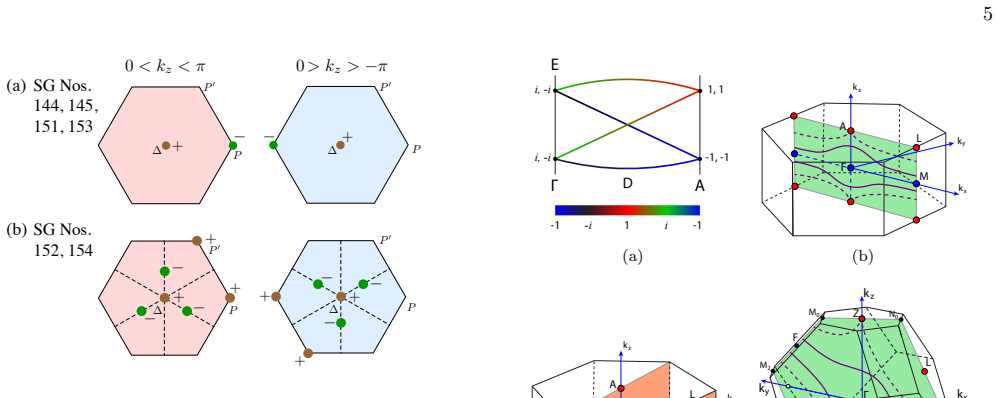
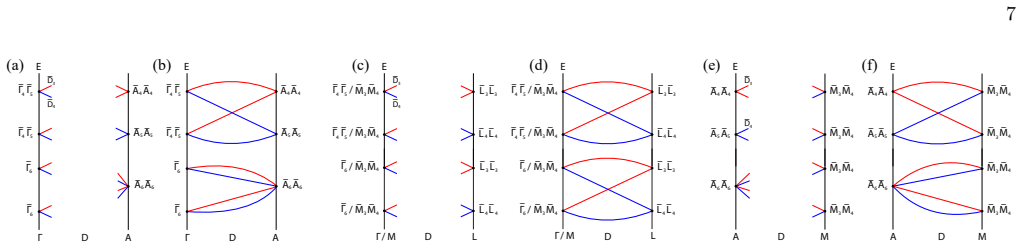
The central machinery is the momentum dependence of nonsymmorphic symmetry eigenvalues. For the screw rotation $C_{3,p}:(x,y,z)\to(-y,x-y,z+p/3)$, the eigenvalue is $e^{i\pi(2m+1)/3}e^{-ipk_z/3}$ with $m=0,1,2$; because the Kramers pairing changes between $\Gamma$ and $A$, the six-band group along $\Gamma$--$\Delta$--$A$ cannot avoid crossings. For the glide mirrors $M$ with $M^2=-\hat{z}$, eigenvalues $\pm i e^{-ik_z/2}$ give $\pm1$ at some time-reversal-invariant momenta and $\pm i$ at others, and the forced switching of Kramers partners generates nodal lines in the mirror plane. Compatibility relations between double-valued irreducible representations (the symmetry labels appropriate for spinful electrons) at high-symmetry points and lines prove the same connectivity and show why the effect disappears when inversion or symmorphic rotations are present, which is why only the six and three space groups in Table I qualify.
What would settle it
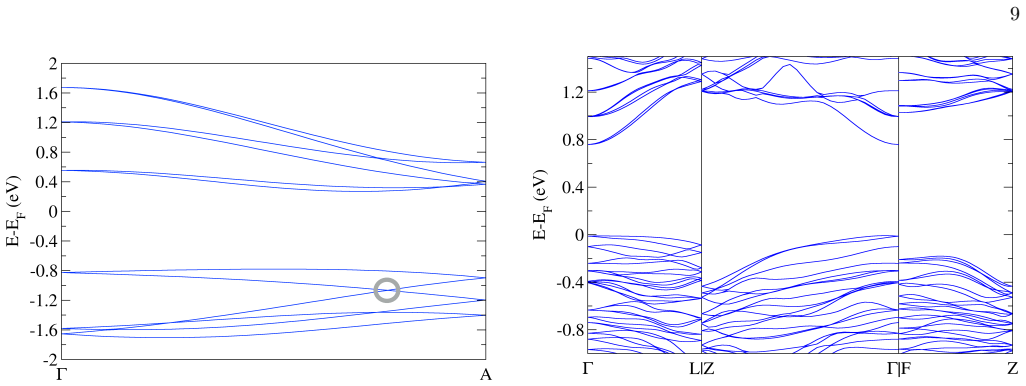
Compute the band structure of any nonmagnetic, strong-spin-orbit material in space group 144 along $\Gamma$--$\Delta$--$A$: if the bands do not form connected groups of six with at least two crossings, the enforcement claim fails; for SG 158, a mirror plane with no nodal line separating the two types of time-reversal-invariant momenta would be an equally decisive counterexample.
Extended reading notes
Core claim
On the paper's own terms, the central discovery is a systematic classification of nonsymmorphic band degeneracies in trigonal space groups under time-reversal symmetry and strong spin-orbit coupling. Along the $\Gamma$--$\Delta$--$A$ line, the eigenvalue of the threefold screw rotation $C_{3,p}$ winds with $k_z$; the Kramers pairs at $\Gamma$ and $A$ pair different eigenvalue labels (for $p=1$: $(0,0)$ with $(1,2)$; for $p=2$: $(0,1)$ with $(2,2)$), so the six bands in the connected group cannot be disentangled and must cross at least twice, producing Weyl points with accordion dispersion. In the glide-mirror planes of SGs 158, 159, and 161, the mirror eigenvalue is $\pm i e^{-ik_z/2}$; at some time-reversal-invariant momenta the Kramers partners share the same eigenvalue while at others they have opposite eigenvalues, so any path connecting the two types forces a crossing, and the crossings form Weyl nodal lines. The paper further derives filling constraints ($6\mathbb{N}$ for the screw-rotation groups, $4\mathbb{N}$ for the glide-mirror groups) and identifies tellurium, selenium, Cu$_2$SrSnS$_4$, Cu$_2$SrGeS$_4$, Ag$_2$HPO$_4$, and Te$_{16}$Si$_{38}$ as materials realizing these crossings, with surface arcs and drumhead states following from Chern numbers and $\pi$-Berry phases.
Load-bearing premise
The protection argument assumes the crystal truly has the listed nonsymmorphic space group with time-reversal symmetry and strong spin-orbit coupling; the near-Fermi claim assumes the density-functional band energies are accurate, which the paper does not check with higher-level corrections.
Editorial extensions
If this is right
- Any nonmagnetic material with strong spin-orbit coupling in space groups 144, 145, 151, 152, 153, or 154 must contain accordion Weyl points along $\Gamma$--$\Delta$--$A$; no symmetry-preserving perturbation can remove them.
- Any material in space groups 158, 159, or 161 must contain Weyl nodal lines in the glide-mirror planes, separating time-reversal-invariant momenta of opposite glide-mirror eigenvalue type.
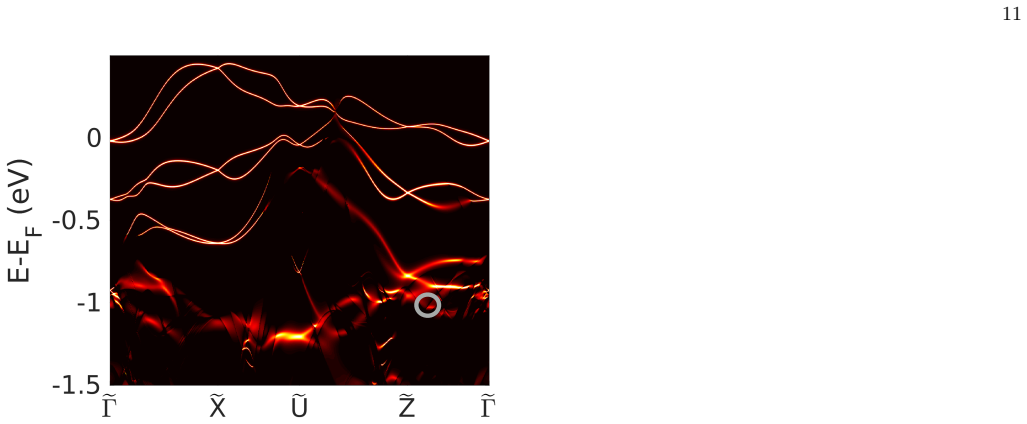
- The crossings imply observable topological surface states: arc states for the Weyl points and drumhead states for the nodal lines, tied to nonzero Chern numbers and a $\pi$-Berry phase.
- Band insulators in these space groups are allowed only at specific electron fillings — $6\mathbb{N}$ for the accordion Weyl groups and $4\mathbb{N}$ for the nodal-line groups — so other fillings force metallic behavior.
- Density-functional calculations for tellurium, selenium, Cu$_2$SrSnS$_4$, Cu$_2$SrGeS$_4$, Ag$_2$HPO$_4$, and Te$_{16}$Si$_{38}$ show the predicted crossings in their calculated band structures.
Reading between the lines
- The classification can be used as a screening rule: any compound found in one of these nine space groups automatically qualifies as a candidate for symmetry-enforced Weyl physics, and the only material-specific question is where the Fermi energy sits.
- Because the near-Fermi claim is not protected by symmetry, the wide-gap candidates (Cu$_2$SrSnS$_4$, Cu$_2$SrGeS$_4$, Ag$_2$HPO$_4$) should be re-examined with quasiparticle or hybrid-functional calculations; if those shift band energies by a few hundred meV, these compounds remain topological but are no longer near-Fermi examples.
- The same eigenvalue-pairing logic may predict enforced crossings in other crystal families, and the contrast with hexagonal systems suggests a general criterion based on how nonsymmorphic operations act on time-reversal-invariant momenta.
- A direct experimental check of the 'in all bands' statement would be angle-resolved photoemission on a cleaved tellurium surface: the predicted arc states from both the H-point Weyl points and the accordion Weyl points should cross the entire surface Brillouin zone between valence and conduction bands.
Signed reviews
Editorial analysis
A structured set of objections, weighed in public.
Referee Report
Summary. The paper classifies nonsymmorphic band crossings in trigonal space groups with strong spin-orbit coupling. Using the kz-dependence of screw-rotation and glide eigenvalues together with compatibility relations of double-valued irreps, it argues that nonmagnetic materials in SGs 144, 145, 151, 152, 153, and 154 must exhibit Weyl points with accordion-like dispersion along the Γ–Δ–A line, while SGs 158, 159, and 161 must exhibit Weyl nodal lines in glide-mirror-invariant planes. It additionally derives filling constraints and reports DFT band structures for Cu2SrSnS4, Cu2SrGeS4, Ag2HPO4, Te, Se, and Te16Si38 that reproduce the predicted connectivity, including surface-state calculations for Ag2HPO4 and Te.
Significance. If correct, the central theorem is a strong and falsifiable result: the crossings are mandatory for any nonmagnetic material in the listed space groups, and their location in the Brillouin zone is fixed by symmetry independent of chemistry. The derivation is parameter-free and uses standard external irrep tables, and the DFT band structures independently reproduce the predicted connectivity in every candidate material, including surface arc states for Ag2HPO4 and Te. This is a clean extension of the hexagonal classification of Ref. [38] to trigonal systems and provides concrete targets for experimental searches. The material-realization claim that these crossings are 'near the Fermi energy' is, however, overstated for the large-gap compounds and depends on DFT accuracy.
major comments (3)
- [Abstract; Sec. V A (Cu2SrSnS4, Cu2SrGeS4)] The abstract and conclusions state that the identified materials realize the crossings 'near the Fermi energy', but for the gapped compounds this is not supported by the numbers in the text. In Sec. V A a the mBJ gap of Cu2SrSnS4 is quoted as about 1.1 eV, Appendix A says about 1.5 eV, and the experimental gap is 1.78 eV, so the symmetry-enforced Weyl points along Γ–Δ–A are at least about 1 eV away from E_F. The paper itself notes that probing these crossings is 'very challenging'. Please either qualify the abstract to say that the crossings are symmetry-enforced and material-independent while their proximity to E_F is a per-material quantitative question, or provide a consistent energy scale showing that the crossings lie within a few tens of meV of E_F.
- [Sec. V A, first paragraph] The database search is reported in a single sentence ('We look for suitable compounds in the ICSD database, the AFLOW database, and the Materials Project database, which yields four materials with accordion Weyl points and one material with Weyl nodal lines'), with no search criteria, no list of candidate compounds in the relevant space groups, no count of false positives, and no explanation for why SGs 153, 154, 158, and 159 have no examples. This makes the materials-realization part of the abstract non-reproducible. Please add a table or appendix describing the search workflow, the number of candidates per SG, and the screening conditions used to select the five reported compounds.
- [Sec. II C (Fig. 2)] The claimed minimal Weyl-point multiplicities (four for SGs 144, 145, 151, and 153; twelve for SGs 152 and 154) are supported only by an explicit construction of a symmetry-allowed configuration; no lower-bound proof is given that rules out smaller configurations, for example a four-point configuration in SG 152. Since the abstract and Table I do not state multiplicities, the central existence claim does not depend on this, but the text should either label these values as constructive counts that are consistent with symmetry and the fermion-doubling theorem, or provide a rigorous minimality argument.
minor comments (5)
- [Sec. II A, paragraph 4] The statement that 'out of the eighteen trigonal space groups with hexagonal lattice system (P-trigonal) there are only six space groups without inversion symmetry' is incorrect, because SGs 149, 150, 156, and 157 are also non-centrosymmetric. The intended statement is that only six of these have a nonsymmorphic threefold screw and lack inversion; please rephrase.
- [Sec. V A c vs Appendix B] Tellurium is called metallic in Sec. V A c ('Since tellurium is metallic...'), while Appendix B describes surface states that 'lie within the bulk band gap'. Please clarify whether Te is a small-gap semiconductor or a metal in the PBE calculation and reconcile the wording.
- [Sec. V A a; Appendix A] The reported gap of Cu2SrSnS4 is inconsistent: 1.1 eV in Sec. V A a, 1.5 eV in Appendix A, and 1.78 eV as the experimental value. State clearly which functional gives which value and how the experimental comparison is made.
- [Sec. V A (computational methods)] The VASP calculations are not described with sufficient detail (pseudopotentials, energy cutoff, k-point sampling, convergence criteria); providing these parameters, perhaps in an appendix, would improve reproducibility.
- [Throughout] There are several typos that should be corrected in proof: 'Nonsymmoprhic' in the abstract, 'derivation form' in Sec. II B, 'exibits' in the caption of Fig. 10, and 'crystalizes' in Sec. V A c.
Circularity Check
No significant circularity: the symmetry-enforced crossing proof is self-contained and parameter-free.
full rationale
The paper's central claims are derived from first-principles symmetry algebra, not from fitted inputs or self-referential assumptions. The Weyl-point argument starts from the explicit screw-rotation operator C3,p, whose cube is -R (Eq. 2.1 and surrounding text), giving the momentum-dependent eigenvalue equation (2.2). Kramers pairings at the TRIMs Γ and A are then computed directly from time-reversal symmetry and the C3,p eigenvalues, leading to the nontrivial connectivity diagrams and enforced crossings along Γ–Δ–A. The same structure is repeated for glide mirrors: Eq. (3.1) follows from M^2 = -z (with the spin sign), and the eigenvalue sign pattern at blue vs. red TRIMs forces nodal lines in the mirror planes. These derivations are carried out within the paper (Tables II–IV, Figs. 1, 3, 4), using standard external irreps tables and the Bilbao Crystallographic Server, which are independent inputs and do not assume the target results. The compatibility-relation check (Sec. II B) is presented as an independent confirmation of the eigenvalue argument, not as the sole source. The cited prior work by the same group (Ref. [38]) supplies only the methodological strategy and is explicitly described as a previous application, not as the source of the trigonal classification; the trigonal eigenvalue and irrep tables are new in this paper. The DFT calculations for candidate materials are downstream illustrations: they are compared with the predicted connectivity diagrams rather than used to fit any parameter that enters the proof. The paper itself flags the main caveat, that some candidate gaps are large (e.g., ~1.1 eV mBJ vs. 1.78 eV experiment for Cu2SrSnS4, ~2.8 eV for Ag2HPO4), which weakens only the 'near the Fermi energy' material-realization claim and is a functional-accuracy issue, not a circularity. No equation is defined in terms of its own conclusion, no fitted parameter is renamed as a prediction, and no load-bearing uniqueness theorem is imported from the authors' own prior work. The claimed crossings are enforced by the stated space-group symmetries alone, so the derivation chain is self-contained.
Assumptions & free parameters
assumptions (6)
- domain assumption Noninteracting Bloch band theory and adiabatic stability of band crossings under symmetry-preserving deformations.
- domain assumption The material is nonmagnetic with time-reversal symmetry and strong spin-orbit coupling, so Kramers theorem applies.
- standard math Double-valued irreps and compatibility relations of trigonal space groups as tabulated on the Bilbao Crystallographic Server and Refs. [48-50] are correct and complete.
- standard math Fermion doubling theorem (Nielsen-Ninomiya) applies and the net chirality of Weyl points must vanish.
- domain assumption DFT with PBE and mBJ exchange-correlation functionals approximates true band energies well enough to identify Fermi-level proximity of crossings.
- domain assumption The experimental crystal structures taken from Refs. [66-70] are correctly assigned to the listed space groups.
Cite this review
Pith. "Pith review of Symmetry-enforced band crossings in trigonal materials: Accordion states and Weyl nodal lines." pith.science (2026). https://pith.science/paper/XRD4MXVU
@misc{pith2026190800901,
  author       = {Pith},
  title        = {Pith review of: Symmetry-enforced band crossings in trigonal materials: Accordion states and Weyl nodal lines},
  year         = {2026},
  howpublished = {\url{https://pith.science/paper/XRD4MXVU}},
  note         = {Machine review of arXiv:1908.00901}
}
read the original abstract
Nonsymmoprhic symmetries, such as screw rotations or glide reflections, can enforce band crossings within high-symmetry lines or planes of the Brillouin zone. When these band degeneracies are close to the Fermi energy, they can give rise to a number of unusual phenomena: e.g., anomalous magnetoelectric responses, transverse Hall currents, and exotic surface states. In this paper, we present a comprehensive classification of such nonsymmorphic band crossings in trigonal materials with strong spin-orbit coupling. We find that in trigonal systems there are two different types of nonsymmorphic band degeneracies: (i) Weyl points protected by screw rotations with an accordion-like dispersion, and (ii) Weyl nodal lines protected by glide reflections. We report a number of existing materials, where these band crossings are realized near the Fermi energy. This includes Cu2SrSnS4 and elemental tellurium (Te), which exhibit accordion Weyl points; and the tellurium-silicon clathrate Te16Si38, which shows Weyl nodal lines. The ab-initio band structures and surface states of these materials are studied in detail, and implications for experiments are briefly discussed.
Figures

Figures from the paper (6 more)




Reference graph
Works this paper leans on
-
[38]
J. Zhang, Y.-H. Chan, C.-K. Chiu, M. G. Vergniory, L. M. Schoop, and A. P. Schnyder, Phys. Rev. Mate- rials 2, 074201 (2018)
work page 2018
-
[1]
von Neumann and E
J. von Neumann and E. Wigner, Z. Physik 30, 467 (1929)
1929
-
[2]
C.-K. Chiu, J. C. Y. Teo, A. P. Schnyder, and S. Ryu, Rev. Mod. Phys. 88, 035005 (2016)
2016
-
[3]
G. E. Volovik, Topology of quantum vacuum , Lecture Notes in Physics, Vol. 870 (Springer Berlin, 2013) pp. 343–383
2013
-
[4]
N. P. Armitage, E. J. Mele, and A. Vishwanath, ArXiv e-prints (2017), arXiv:1705.01111 [cond-mat.str-el]
arXiv 2017
-
[5]
A. Burkov, Annual Review of Condensed Matter Physics 9, 359 (2018), https://doi.org/10.1146/annurev- conmatphys-033117-054129
doi:10.1146/annurev- 2018
-
[6]
S.-Y. Yang, H. Yang, E. Derunova, S. S. P. Parkin, B. Yan, and M. N. Ali, ArXiv e-prints (2017), arXiv:1707.04523 [cond-mat.mtrl-sci]
work page Pith review arXiv 2017
-
[7]
X. Wan, A. M. Turner, A. Vishwanath, and S. Y. Savrasov, Phys. Rev. B 83, 205101 (2011)
2011
Show all 84 references
-
[8]
A. A. Burkov, M. D. Hook, and L. Balents, Phys. Rev. B 84, 235126 (2011)
2011
-
[9]
S.-Y. Xu, C. Liu, S. K. Kushwaha, R. Sankar, J. W. Krizan, I. Belopolski, M. Neupane, G. Bian, N. Ali- doust, T.-R. Chang, H.-T. Jeng, C.-Y. Huang, W.-F. Tsai, H. Lin, P. P. Shibayev, F.-C. Chou, R. J. Cava, and M. Z. Hasan, Science 347, 294 (2015), http://science.sciencemag.o...
2015
-
[10]
Huang, S.-Y
S.-M. Huang, S.-Y. Xu, I. Belopolski, C.-C. Lee, G. Chang, B. Wang, N. Alidoust, G. Bian, M. Neupane, C. Zhang, S. Jia, A. Bansil, H. Lin, and M. Z. Hasan, Nature Communications 6 (2015)
2015
-
[11]
Chan, C.-K
Y.-H. Chan, C.-K. Chiu, M. Y. Chou, and A. P. Schny- der, Phys. Rev. B 93, 205132 (2016)
2016
-
[12]
Bian, T.-R
G. Bian, T.-R. Chang, R. Sankar, S.-Y. Xu, H. Zheng, T. Neupert, C.-K. Chiu, S.-M. Huang, G. Chang, I. Be- lopolski, D. S. Sanchez, M. Neupane, N. Alidoust, C. Liu, B. Wang, C.-C. Lee, H.-T. Jeng, C. Zhang, Z. Yuan, S. Jia, A. Bansil, F. Chou, H. Lin, and M. Z. Hasan, Nature C...
2016
-
[13]
Bian, T.-R
G. Bian, T.-R. Chang, H. Zheng, S. Velury, S.-Y. Xu, T. Neupert, C.-K. Chiu, S.-M. Huang, D. S. Sanchez, I. Belopolski, N. Alidoust, P.-J. Chen, G. Chang, A. Ban- sil, H.-T. Jeng, H. Lin, and M. Z. Hasan, Phys. Rev. B 93, 121113 (2016)
2016
-
[14]
W. B. Rui, Y. X. Zhao, and A. P. Schnyder, Phys. Rev. B 97, 161113 (2018)
2018
-
[15]
Bzdusek, Q
T. Bzdusek, Q. Wu, A. R¨ uegg, M. Sigrist, and A. A. Soluyanov, Nature 538, 75 (2016)
2016
-
[16]
Z. Shi, M. Wang, and J. Wu, Applied Physics Letters 107, 102403 (2015), https://doi.org/10.1063/1.4930875
2015 doi
-
[17]
J. R. Schaibley, H. Yu, G. Clark, P. Rivera, J. S. Ross, K. L. Seyler, W. Yao, and X. Xu, Nature Reviews Ma- terials 1 (2016)
2016
-
[18]
Chiu and A
C.-K. Chiu and A. P. Schnyder, Phys. Rev. B 90, 205136 (2014)
2014
-
[19]
Shiozaki and M
K. Shiozaki and M. Sato, Phys. Rev. B90, 165114 (2014)
2014
-
[20]
Y. X. Zhao, A. P. Schnyder, and Z. D. Wang, Phys. Rev. Lett. 116, 156402 (2016)
2016
-
[21]
A. H. Castro Neto, F. Guinea, N. M. R. Peres, K. S. Novoselov, and A. K. Geim, Rev. Mod. Phys. 81, 109 (2009)
2009
-
[22]
Z. Wang, Y. Sun, X.-Q. Chen, C. Franchini, G. Xu, H. Weng, X. Dai, and Z. Fang, Phys. Rev. B 85, 195320 (2012)
2012
-
[23]
Chiu and A
C.-K. Chiu and A. P. Schnyder, Journal of Physics: Con- ference Series 603, 012002 (2015)
2015
-
[24]
Z. Wang, H. Weng, Q. Wu, X. Dai, and Z. Fang, Phys. Rev. B 88, 125427 (2013). 12
2013
-
[25]
L. S. Xie, L. M. Schoop, E. M. Seibel, Q. D. Gibson, W. Xie, and R. J. Cava, APL Mater. 3, 083602 (2015), http://dx.doi.org/10.1063/1.4926545
2015 doi
-
[26]
Yamakage, Y
A. Yamakage, Y. Yamakawa, Y. Tanaka, and Y. Okamoto, Journal of the Physi- cal Society of Japan 85, 013708 (2016), http://dx.doi.org/10.7566/JPSJ.85.013708
2016 doi
-
[27]
S. M. Young, S. Zaheer, J. C. Y. Teo, C. L. Kane, E. J. Mele, and A. M. Rappe, Phys. Rev. Lett. 108, 140405 (2012)
2012
-
[28]
L. M. Schoop, M. N. Ali, C. Straßer, A. Topp, A. Varykhalov, D. Marchenko, V. Duppel, S. S. P. Parkin, B. V. Lotsch, and C. R. Ast, Nature Communi- cations 7 (2016)
2016
-
[29]
Y. X. Zhao and A. P. Schnyder, Phys. Rev. B 94, 195109 (2016)
2016
-
[30]
Michel and J
L. Michel and J. Zak, Phys. Rev. B 59, 5998 (1999)
1999
-
[31]
S. M. Young and C. L. Kane, Phys. Rev. Lett. 115, 126803 (2015)
2015
-
[32]
Alexandradinata, Z
A. Alexandradinata, Z. Wang, and B. A. Bernevig, Phys. Rev. X 6, 021008 (2016)
2016
-
[33]
Furusaki, Science Bulletin 62, 788 (2017)
A. Furusaki, Science Bulletin 62, 788 (2017)
2017
-
[34]
Takahashi, M
R. Takahashi, M. Hirayama, and S. Murakami, Phys. Rev. B 96, 155206 (2017)
2017
-
[35]
B.-J. Yang, T. A. Bojesen, T. Morimoto, and A. Fu- rusaki, Phys. Rev. B 95, 075135 (2017)
2017
-
[36]
C. Fang, Y. Chen, H.-Y. Kee, and L. Fu, Phys. Rev. B 92, 081201 (2015)
2015
-
[37]
Malard, P
M. Malard, P. E. de Brito, S. Ostlund, and H. Johan- nesson, ArXiv e-prints (2018), arXiv:1804.09736 [cond- mat.str-el]
2018 arXiv
-
[39]
R. Chen, H. C. Po, J. B. Neaton, and A. Vishwanath, Nature Physics 14 (2017)
2017
-
[40]
Bradlyn, L
B. Bradlyn, L. Elcoro, J. Cano, M. G. Vergniory, Z. Wang, C. Felser, M. I. Aroyo, and B. A. Bernevig, Nature 547, 298 (2017)
2017
-
[41]
L. M. Schoop, A. Topp, J. Lippmann, F. Orlandi, L. M¨ uchler, M. G. Vergniory, Y. Sun, A. W. Rost, V. Duppel, M. Krivenkov, S. Sheoran, P. Manuel, A. Varykhalov, B. Yan, R. K. Kremer, C. R. Ast, and B. V. Lotsch, 4 (2018), 10.1126/sciadv.aar2317
2018 doi
-
[42]
A. Topp, J. M. Lippmann, A. Varykhalov, V. Duppel, B. V. Lotsch, C. R. Ast, and L. M. Schoop, New Journal of Physics 18, 125014 (2016)
2016
-
[43]
S. A. Parameswaran, A. M. Turner, D. P. Arovas, and A. Vishwanath, Nature Physics 9 (2013)
2013
-
[44]
Watanabe, H
H. Watanabe, H. C. Po, M. P. Zaletel, and A. Vish- wanath, Phys. Rev. Lett. 117, 096404 (2016)
2016
-
[45]
Zhang, Y
T. Zhang, Y. Jiang, Z. Song, H. Huang, Y. He, Z. Fang, H. Weng, and C. Fang, Nature 566, 475 (2019)
2019
-
[46]
M. G. Vergniory, L. Elcoro, C. Felser, N. Regnault, B. A. Bernevig, and Z. Wang, Nature 566, 480 (2019)
2019
-
[47]
F. Tang, H. C. Po, A. Vishwanath, and X. Wan, Nature 566, 486 (2019)
2019
-
[48]
Michel and J
L. Michel and J. Zak, Physics Reports 341, 377 (2001), symmetry, invariants, topology
2001
-
[49]
Kruthoff, J
J. Kruthoff, J. de Boer, J. van Wezel, C. L. Kane, and R.-J. Slager, Phys. Rev. X 7, 041069 (2017)
2017
-
[50]
Elcoro, B
L. Elcoro, B. Bradlyn, Z. Wang, M. G. Vergniory, J. Cano, C. Felser, B. A. Bernevig, D. Orobengoa, G. de la Flor, and M. I. Aroyo, Journal of Applied Crys- tallography 50, 1457 (2017)
2017
-
[51]
Bradley and A
C. Bradley and A. P. Cracknell, The Mathematical The- ory of Symmetry in Solids: Representation theory for point groups and space groups (Clarendon Press, Oxford, 1972)
1972
-
[52]
S. C. Miller and W. F. Love, Tables of Irreducible Rep- resentations of Space Groups and Co-representations of Magnetic Groups (Boulder: Pruett, 1967)
1967
-
[53]
Nielsen and M
H. Nielsen and M. Ninomiya, Nuclear Physics B 185, 20 (1981)
1981
-
[54]
Hence, nodal lines are also possible in the kx = 0 plane, but they are not guaranteed to exist by symmetry alone
We note that at the A point there exist both two- dimensional and four-dimensional irreps. Hence, nodal lines are also possible in the kx = 0 plane, but they are not guaranteed to exist by symmetry alone
-
[55]
Https://icsd.fiz-karlsruhe.de/
-
[56]
Curtarolo, W
S. Curtarolo, W. Setyawan, S. Wang, J. Xue, K. Yang, R. H. Taylor, L. J. Nelson, G. L. Hart, S. Sanvito, M. Buongiorno-Nardelli, N. Mingo, and O. Levy, Com- putational Materials Science 58, 227 (2012)
2012
-
[57]
A. Jain, S. P. Ong, G. Hautier, W. Chen, W. D. Richards, S. Dacek, S. Cholia, D. Gunter, D. Skinner, G. Ceder, and K. a. Persson, APL Materials 1, 011002 (2013)
2013
-
[58]
Materials Project,
“Materials Project,”
-
[59]
Kresse and J
G. Kresse and J. Furthm¨ uller, Phys. Rev. B 54, 11169 (1996)
1996
-
[60]
Kresse and J
G. Kresse and J. Furthm¨ uller, Computational Materials Science 6, 15 (1996)
1996
-
[61]
P. E. Bl¨ ochl, Phys. Rev. B50, 17953 (1994)
1994
-
[62]
Kresse and D
G. Kresse and D. Joubert, Phys. Rev. B 59, 1758 (1999)
1999
-
[63]
J. P. Perdew, K. Burke, and M. Ernzerhof, Phys. Rev. Lett. 77, 3865 (1996)
1996
-
[64]
A. D. Becke and E. R. Johnson, The Jour- nal of Chemical Physics 124, 221101 (2006), https://doi.org/10.1063/1.2213970
2006 doi
-
[65]
Tran and P
F. Tran and P. Blaha, Phys. Rev. Lett. 102, 226401 (2009)
2009
-
[66]
C. L. Teske, Zeitschrift f¨ ur anorganische und allgemeine Chemie 419, 67 (1976), https://onlinelibrary.wiley.com/doi/pdf/10.1002/zaac.19764190112
1976 doi
-
[67]
C. L. Teske, Zeitschrift fr Naturforschung B 34, 386 (1979)
1979
-
[68]
Tordjman, A
I. Tordjman, A. Boudjada, J.-C. Guitel, and R. Masse, Acta Crystallographica Section B 34, 3723 (1978), https://onlinelibrary.wiley.com/doi/pdf/10.1107/S0567740878011966
1978 doi
-
[69]
Adenis, V
C. Adenis, V. Langer, and O. Lindqvist, Acta Crystal- lographica Section C 45, 941 (1989)
1989
-
[70]
Jaussaud, P
N. Jaussaud, P. Toulemonde, M. Pouchard, A. San- Miguel, P. Gravereau, S. Pechev, G. Goglio, and C. Cros, Solid State Sciences 6, 401 (2004)
2004
-
[71]
A. A. Mostofi, J. R. Yates, Y.-S. Lee, I. Souza, D. Van- derbilt, and N. Marzari, Computer Physics Communi- cations 178, 685 (2008)
2008
-
[72]
Z. Tong, J. Yuan, J. Chen, A. Wu, W. Huang, C. Han, Q. Cai, C. Ma, Y. Liu, L. Fang, and Z. Liu, Materials Letters 237, 130 (2019)
2019
-
[73]
Cherin and P
P. Cherin and P. Unger, Acta Crystallographica 23, 670 (1967)
1967
-
[74]
153 ( P 3212)
Note that depending on the chirality of these chains Te can also be in SG No. 153 ( P 3212)
-
[75]
Hirayama, R
M. Hirayama, R. Okugawa, S. Ishibashi, S. Murakami, and T. Miyake, Phys. Rev. Lett. 114, 206401 (2015)
2015
-
[76]
Nakayama, M
K. Nakayama, M. Kuno, K. Yamauchi, S. Souma, K. Sug- awara, T. Oguchi, T. Sato, and T. Takahashi, Phys. Rev. B 95, 125204 (2017). 13
2017
-
[77]
L. A. Agapito, N. Kioussis, W. A. Goddard, and N. P. Ong, Phys. Rev. Lett. 110, 176401 (2013)
2013
-
[78]
Cherin and P
P. Cherin and P. Unger, Inorganic Chemistry 6, 1589 (1967), https://doi.org/10.1021/ic50054a037
1967 doi
-
[79]
Jaussaud, M
N. Jaussaud, M. Pouchard, P. Gravereau, S. Pechev, G. Goglio, C. Cros, A. San Miguel, and P. Toulemonde, Inorganic Chemistry 44, 2210 (2005)
2005
-
[80]
C. K. Chiu, Y. H. Chan, and A. P. Schnyder, arXiv e-prints , arXiv:1810.04094 (2018), arXiv:1810.04094 [cond-mat.mes-hall]
2018 arXiv
-
[81]
Note that there is only one type of termination
-
[82]
von Klitzing and G
K. von Klitzing and G. Landwehr, Solid State Commu- nications 9, 2201 (1971)
1971
-
[83]
L. D. Laude, R. F. Willis, and B. Fitton, Phys. Rev. Lett. 29, 472 (1972)
1972
-
[84]
Englert, K
T. Englert, K. von Klitzing, R. Silbermann, and G. Landwehr, physica status solidi (b) 81, 119 (1977), https://onlinelibrary.wiley.com/doi/pdf/10.1002/pssb.2220810110
1977 doi
Reviewed August 14, 2026 · model on record in the stance chip above.
Discussion (0). Continue with ORCID to comment.