REVIEW 4 major objections 4 minor 31 references
High-Pressure Synthesis of Magnetic Neodymium Polyhydrides
T0 review · 4 major / 4 minor · reviewed 2026-08-14 · deepseek-v4-flash
Pith's one-line read Resistance measurements detect a reproducible drop at 4.5 ± 0.5 K in a sample containing hexagonal NdH9, which the authors interpret as a possible superconducting transition; first-principles calculations predict antiferromagnetic order…
desk verdict Synthesis of three new Nd hydrides and the AFM prediction are solid; the 4.5 K superconductivity claim does not hold up as stated. read the letter →
The pith
A machine-rendered reading of the paper's core claim, the machinery that carries it, and where it could break.
The reading
What carries the argument
The central object is the effective spin-splitting h(k), defined as half the energy difference between the spin-up and spin-down bands at the Fermi level. In the paper's calculations h is about 450 meV without a Hubbard correction and about 890 meV with U-J = 5 eV, and inserting this h into the Eliashberg equations for phonon-mediated superconductivity drives the computed critical temperature to zero even for zero Coulomb pseudopotential. The argument then shows that a much smaller spin-splitting, about 20 meV for µ* = 0.1, would be needed to obtain a 4.5 K transition, framing the possible coexistence of antiferromagnetism and superconductivity at low temperature.
What would settle it
The decisive check is a resistance measurement on a phase-pure P63/mmc-NdH9 sample with an intact four-electrode contact set: if the 4.5 K drop does not reproduce, or appears together with a separately identifiable impurity transition, the superconductivity attribution fails. A corroborating observation would be zero resistance and suppression of the drop by a modest magnetic field.
Extended reading notes
Core claim
The paper claims to have discovered three novel neodymium polyhydrides at 85–135 GPa, including hexagonal P63/mmc-NdH9 as the next member of the P63/mmc nonahydride family. Electrical resistance measurements on a sample containing distorted P63/mmc-NdH9 and I4/mmm-NdH4 show a sharp, reproducible drop at 4.5 ± 0.5 K at about 110 GPa, with no reproducible transitions above 5 K; this drop is attributed to possible superconductivity in NdH9. At the same time, ab initio calculations predict that all the synthesized neodymium hydrides have collinear antiferromagnetic order, with exchange spin-splitting at the Fermi level of about 450 meV (or 890 meV with a Hubbard correction), which is large enough to suppress conventional s-wave superconductivity. The authors conclude that the intensity of superconducting properties declines along the La-Ce-Pr-Nd series of superhydrides while magnetic properties become more pronounced.
Load-bearing premise
The 4.5 K resistance drop is attributed to superconductivity in P63/mmc-NdH9 even though the measured sample is a mixture of distorted hexagonal NdH9-x and tetragonal I4/mmm-NdH4, its X-ray pattern could not be quantitatively interpreted, and the electrodes were partially damaged with possible (Mo,Nd)CxHy impurities.
Editorial extensions
If this is right
- If the 4.5 K transition is real superconductivity in P63/mmc-NdH9, it would be the first case in the superhydride family in which a magnetic order with large spin-splitting coexists with a low-temperature superconducting state.
- The three new phases become candidates for doping or alloying studies aimed at tuning the balance between f-electron magnetism and phonon-mediated superconductivity.
- The predicted antiferromagnetic order with estimated Néel temperatures of about 4 K (NdH4), 251 K (NdH7), and 136 K (NdH9) means magnetic measurements should show ordering well above the superconducting transition.
- The La-Ce-Pr-Nd comparison implies that hydrides of lighter lanthanides are the better targets for high-temperature conventional superconductivity, since their f-electron magnetism is weaker.
- The new structures expand the known compositional range of lanthanide superhydrides, providing stable hydrogen-rich hosts that can be studied under pressure beyond the specific Nd compositions.
Reading between the lines
- The paper does not pursue it, but the same ammonia-borane synthesis route could be applied to mixed lanthanide targets; a continuous series of La-Nd alloys would directly test the predicted trade-off between 4f magnetism and superconducting temperature.
- If the large spin-splitting is the real suppressor, then diluting the magnetic f-electron moments by alloying with a nonmagnetic metal should raise the superconducting critical temperature continuously, a testable consequence the paper leaves implicit.
- The high predicted Néel temperatures suggest that neutron or muon experiments on these phases could verify whether the magnetic order is collinear and whether its onset coincides with the pressure range where the resistance drop appears.
- The uncertainty about the measured sample's phase composition means the cleanest test of the superconductivity claim is a resistance measurement on phase-pure P63/mmc-NdH9, which would separate an intrinsic transition from impurity or contact artifacts.
Editorial analysis
A structured set of objections, weighed in public.
Referee Report
Summary. The paper reports the high-pressure synthesis of three new neodymium polyhydrides, I4/mmm-NdH4, C2/c-NdH7, and P63/mmc-NdH9, formed by laser heating Nd in NH3BH3 at pressures between 85 and 135 GPa, plus Fm-3m-NdH3 at lower pressures. The authors assign crystal structures using X-ray diffraction with Le Bail refinements, report equations of state, and perform DFT/DFT+U calculations predicting strong magnetism and antiferromagnetic ordering. Electrical resistance measurements on a sample containing NdH9 and NdH4 show a reproducible drop at ~4.5 K, interpreted as a possible superconducting transition in NdH9. Eliashberg calculations with a reduced spin-splitting parameter h=20 meV yield Tc~5 K, which the authors present as agreement with experiment, while ab initio h values give Tc=0 K.
Significance. If the synthesis and structural assignments hold, the paper adds three new members to the family of lanthanide superhydrides and provides the first evidence that strong f-electron magnetism can coexist with—or suppress—conventional superconductivity in these systems. The reported AFM ground states with exchange splittings above 450 meV would be a notable prediction. However, the significance of the central superconductivity claim is currently limited because the 4.5 K resistance drop is not securely attributed to a single phase, and the theoretical 'agreement' is obtained by adjusting the spin-splitting parameter. The structural and magnetic results are valuable independently of the superconductivity claim.
major comments (4)
- [Measurements of the electrical resistance of P63/mmc-NdH9 (main text, Figs. 4-5)] The 4.5 K resistance drop cannot be unambiguously attributed to NdH9. The authors state that the XRD pattern from the electrical cell 'cannot be quantitatively interpreted' and 'qualitatively corresponds to a distorted hexagonal P63/mmc-NdH9-x mixed with tetragonal I4/mmm-NdH4'. The electrode system was partially damaged, forcing 3- and 2-electrode geometries, and the paper mentions (Mo,Nd)CxHy as possible superconducting impurities. Without field-dependent resistance, magnetic susceptibility, or a clear single-phase attribution, the claim that this drop demonstrates a superconducting transition in NdH9 is not established. The abstract's statement that the measurements 'demonstrate a possible superconducting transition' is therefore too strong and should be revised to reflect that the transition cannot be assigned to NdH9 on the present evidence.
- [Eliashberg calculations with UppSC code (main text, 'Eliashberg calculations with UppSC code')] The claimed agreement between theory and experiment is circular. With the ab initio spin-splitting h=450 meV (or 890 meV with U-J=5 eV), the UppSC calculation yields Tc=0 K. The authors then reduce h to 20 meV, obtaining Tc~5 K, which they report as agreement with the measured 4.5 K. This is a parameter fit, not independent confirmation, and the phrase 'in agreement with experiment' in the text is misleading. The manuscript should either present this as a speculative scenario or provide a physical justification for why the ab initio h is overestimated by a factor of more than 20.
- [Supplementary: Details of calculation of Eliashberg function for NdH9: VASP & QE] The QE electron-phonon calculation for NdH9 is not converged: phonon frequencies and λq are negative for many q-points, and λ is not converged over a broad range of Gaussian broadening. The authors remedy this by combining converged λq values from QE with phonon frequencies from VASP to construct a single α2F(ω). This ad hoc combination is not justified as a first-principles result, and the resulting λ=2.82 and Tc=63 K are presented without quantifying the uncertainty introduced by this mixing. The negative-frequency instability in QE should be acknowledged as an unresolved discrepancy rather than bypassed by a hybrid construction.
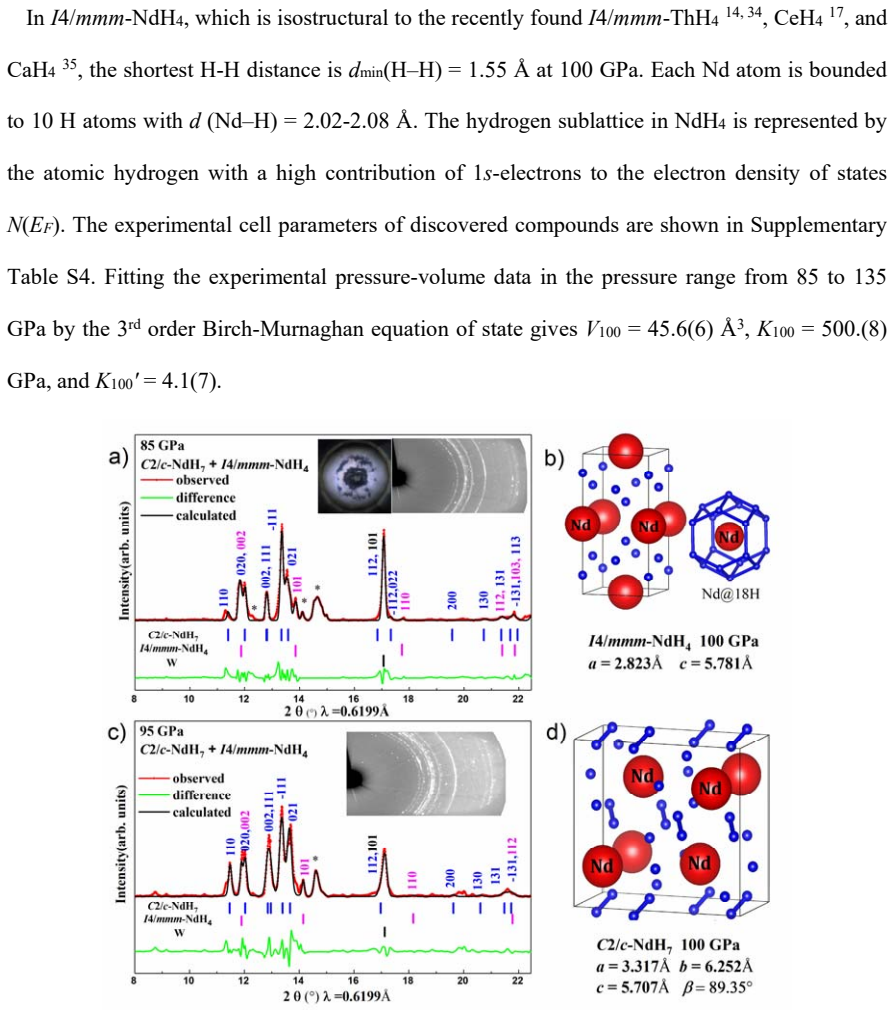
- [Experimental synthesis of atomic I4/mmm-NdH4 and molecular C2/c-NdH7 (Fig. 2, Fig. S1)] The Le Bail refinements for NdH4 and NdH7 show unexplained diffraction peaks marked by asterisks (e.g., Fig. 2a and 2c). This indicates that the samples contain additional unidentified phases, so the derived lattice parameters and equations of state may be affected by the impurity phases. While this does not necessarily invalidate the assignment of the main phases, the paper should state the fraction of unexplained intensity and discuss how it could affect the reported EoS parameters and the stability ranges of NdH4 and NdH7.
minor comments (4)
- [Title/Abstract] The abstract uses 'demonstrate a possible superconducting transition', which is internally contradictory; 'demonstrate' implies a claim, while 'possible' hedges. Rephrase to 'show a resistance drop that may indicate superconductivity' or similar.
- [Author affiliations] The corresponding author email for T. Cui contains a typo: 'cui@jlu.edu.c n' should be 'cui@jlu.edu.cn'.
- [Supplementary, Eq. (S2)-(S5)] The Matsubara equations in the supplementary contain several typos and garbled characters (e.g., 'TKT' in Eq. S6 and 'dxkT' in Eq. S8), which hinder reproducibility. These equations should be typeset cleanly.
- [General notation] The space group P63/mmc is written as 'P6_3/mmc' in some places and 'P63/mmc' in others; unify the notation.
Circularity Check
The UppSC reconciliation fits h = 20 meV to reproduce TC ≈ 5 K, so the claimed AFM–superconductivity coexistence agreement is by construction; the synthesis and the >450 meV AFM prediction remain independent.
-
fitted input called prediction
[Main text, 'Eliashberg calculations with UppSC code' section (p. 15-16)]
"Given that experiments find TC ~ 4.5 K it is worthwhile to discuss possible scenarios. Aside from the potential presence of superconducting impurities (Mo,Nd)CxHy, it is possible that, within our current calculations we overestimated the spin-splitting (h) around the Fermi level. To investigate this scenario, we solved the Eliashberg equations for several values of h, T and µ*. We found that for µ* = 0.1 and h = 20 meV, TС ~ 5 K in agreement with experiment."
The ab initio spin-splitting is h ≈ 450 meV (890 meV with U-J = 5 eV), and with that h the Eliashberg solution gives TC = 0 K. The authors then scan h and select h = 20 meV precisely because it yields TC ≈ 5 K, matching the measured 4.5 K drop. Since TC increases as h is reduced, the statement 'TC ~ 5 K in agreement with experiment' is true by construction: the input was chosen to produce that output. The conclusion that NdH9 could be the first hydride where AFM and superconductivity coexist therefore rests on a fitted parameter, not on an independent prediction. The paper is transparent about having overestimated h, but the agreement is still a fit, and the separately predicted h > 450 meV actually excludes the s-wave pairing channel that the fitted h = 20 meV scenario restores.
full rationale
The synthesis of I4/mmm-NdH4, C2/c-NdH7 and P63/mmc-NdH9, the structural refinements, and the ab initio prediction of antiferromagnetic order with exchange spin-splitting larger than 450 meV are self-contained results with external benchmarks (USPEX, VASP, QE, phonon stability checks, EoS agreement), and I find no circularity in those parts. The one genuine circular step is in the UppSC section: the authors reduce the spin-splitting h from the computed 450/890 meV to 20 meV so that the Eliashberg equation returns TC ≈ 5 K, and then present that agreement as support for a possible AFM–superconductivity coexistence. That is fitting the input to the experimental output, so the 'TC ~ 5 K in agreement with experiment' statement is not an independent confirmation. No load-bearing self-citation chain or imported uniqueness theorem occurs; self-citations (e.g., ref. 18 for σ-sensitivity, USPEX refs, UppSC framework) are methodological, not foundational. Separately, the experimental attribution of the 4.5 K resistance drop to P63/mmc-NdH9 is fragile: the authors state the XRD pattern 'cannot be quantitatively interpreted' and corresponds to a distorted hexagonal NdH9-x mixed with tetragonal I4/mmm-NdH4, electrodes were partially damaged, and (Mo,Nd)CxHy impurities are mentioned; however, this is an evidentiary weakness, not a circularity. Overall, the core synthesis and magnetic predictions stand independently, but the theoretical reconciliation with the measured transition is partially circular, giving a score of 5.
Assumptions & free parameters
free parameters (4)
- Hubbard U-J for Nd f-electrons =
4.98 eV (NdH9), 4.18 eV (NdH7), 5.04 eV (NdH4)
- Effective spin-splitting h in Eliashberg calculations =
20 meV
- Gaussian broadening sigma in Quantum ESPRESSO =
0.025 Ry
- K' in Birch-Murnaghan fit for NdH9 =
4 (fixed)
assumptions (5)
- domain assumption DFT within GGA-PBE and PAW pseudopotentials provides a reliable description of Nd-H phases; where correlation is strong, DFT+U with linear-response U is sufficient.
- ad hoc to paper The quantum ESPRESSO electron-phonon calculation and the VASP phonon calculation can be combined into a single Eliashberg function for NdH9.
- standard math Neel temperatures estimated with the mean-field approximation T_N approximately |E_AFM - E_FM|/(3 k_B) provide physically meaningful values.
- domain assumption The observed resistance drop at 4.5 K is intrinsic to P63/mmc-NdH9 rather than to impurity phases or contact effects.
- domain assumption Hydrogen is generated in situ from NH3BH3 and absorbed by Nd to form the stoichiometric phases assigned by XRD.
Cite this review
Pith. "Pith review of High-Pressure Synthesis of Magnetic Neodymium Polyhydrides." pith.science (2026). https://pith.science/paper/XRE5XJVP
@misc{pith2026190808304,
  author       = {Pith},
  title        = {Pith review of: High-Pressure Synthesis of Magnetic Neodymium Polyhydrides},
  year         = {2026},
  howpublished = {\url{https://pith.science/paper/XRE5XJVP}},
  note         = {Machine review of arXiv:1908.08304}
}
abstract
The current search for room-temperature superconductivity is inspired by the unique properties of the electron-phonon interaction in metal superhydrides. Encouraged by the recently found highest-$T_C$ superconductor fcc-$LaH_{10}$, here we discover several superhydrides of another lanthanide - neodymium. We identify three novel metallic Nd-H phases at pressure range from 85 to 135 GPa: $I4/mmm$-$NdH_4$, $C2/c$-$NdH_7$, $P6_3/mmc$-$NdH_9$, synthesized by laser-heating metal samples in NH3BH3 media for in situ generation of hydrogen. A lower trihydride $Fm\bar{3}m$-$NdH_3$ is found at pressures from 2 to 52 GPa. $I4/mmm$-$NdH_4$ and $C2/c$-$NdH_7$ are stable from 135 down to 85 GPa, and $P6_3/mmc$-$NdH_9$ from 110 to 130 GPa. Measurements of the electrical resistance of NdH9 demonstrate a possible superconducting transition at ~4.5 K in $P6_3/mmc$-$NdH_9$. Our theoretical calculations predict that all the neodymium hydrides have antiferromagnetic order at pressures below 150 GPa and represent one of the first discovered examples of strongly correlated superhydrides with large exchange spin-splitting in the electron band structure (> 450 meV). The critical N$\'e$el temperatures for new neodymium hydrides are estimated using the mean-field approximation as about 4 K ($NdH_4$), 251 K ($NdH_7$) and 136 K ($NdH_9$).
Figures


Figures from the paper (3 more)


Reference graph
Works this paper leans on
-
[1]
I., Megabar high- pressure cells for Raman measurements
Eremets, M. I., Megabar high- pressure cells for Raman measurements. Journal of Raman Spectroscopy 2003, 34 (7-8), 515-518
work page 2003
-
[2]
L.; Yan, S.; Jiang, S.; Yang, K.; Wang, H.; He, S
Zhang, L. L.; Yan, S.; Jiang, S.; Yang, K.; Wang, H.; He, S. ; Liang, D.; Zhang, L.; He, Y.; Lan, X.; Mao, C.; Wang, J.; Jiang, H.; Zheng, Y.; Dong, Z.; Zeng, L.; Li, A., Hard X-ray micro-focusing beamline at SSRF. Nuclear Science And Techniques 2015, 26, 060101
work page 2015
-
[3]
B., DIOPTAS: a program for redu ction of two-dimensional X-ray diffraction data and data exploration
Prescher, C.; Prakapenka, V. B., DIOPTAS: a program for redu ction of two-dimensional X-ray diffraction data and data exploration. High Pressure Research 2015, 35 (3), 223-230
work page 2015
-
[4]
Young, R. A., The Rietveld Method. International union of crystallography 1993, 5, 1-38
work page 1993
-
[5]
Petříček, V.; Dušek, M.; Pal atinus, L., Crystallographic Computing System JANA2006: General features. Z. Kristallogr. 2014, 229 (5), 345-352
work page 2014
-
[6]
Bail, A. L.; Duroy, H.; Forquet, J. L., Ab-initio structure determination of LiSbWO6 by X-ray powder diffraction. Mater. Res. Bull. 1988, 23, 447-452
work page 1988
-
[7]
Hohenberg, P.; Kohn, W., Inhomogeneous Electron Gas. Phys. Rev. 1964, 136 (3B), B864-B871
work page 1964
-
[8]
J., Self-Consistent Equations Including E xchange and Correlation Effects
Kohn, W.; Sham, L. J., Self-Consistent Equations Including E xchange and Correlation Effects. Phys. Rev. 1965, 140 (4A), A1133-A1138
work page 1965
Show all 31 references
-
[9]
P.; Burke, K.; Ernzerhof, M., Generalized Gradien t Approximation Made Simple
Perdew, J. P.; Burke, K.; Ernzerhof, M., Generalized Gradien t Approximation Made Simple. Phys. Rev. Lett. 1996, 77, 3865-3868
1996
-
[10]
E., Projector augmented-wave method
Blöchl, P. E., Projector augmented-wave method. Phys. Rev. B 1994, 50 (24), 17953-17979
1994
-
[11]
Kresse, G.; Joubert, D., From ultrasoft pseudopotentials to the projector augmented-wave method. Phys. Rev. B 1999, 59, 1758
1999
-
[12]
Kresse, G.; Hafner, J., Ab initiomolecular dynamics for ope n-shell transition metals. Phys. Rev. B 1993, 48 (17), 13115-13118
1993
-
[13]
Kresse, G.; Hafner, J., Ab initiomolecular-dynamics simulat ion of the liquid-metal–amorphous- semiconductor transition in germanium. Phys. Rev. B 1994, 49 (20), 14251-14269
1994
-
[14]
Kresse, G.; Hafner, J., Efficient iterative schemes for ab initio total-energy calculations using a plane-wave basis set. Phys. Rev. B 1996, 54, 11169
1996
-
[15]
Hobbs, D.; Kresse, G.; Hafner, J., Fully unconstrained nonc ollinear magnetism within the projector augmented-wave method. Phys. Rev. B 2000, 62, 11558
2000
-
[16]
Francis, B., Finite Elastic Strain of Cubic Crystals. Phys. Rev. 1947, 71 (11), 809-824
1947
-
[17]
Gonzalez-Platas, J.; Alvaro, M.; Nestola, F.; Angel, R., Eo sFit7-GUI: a new graphical user interface for equation of state calculations, analyses and teaching. J. Applied Crystallography 2016, 49 (4), 1377-1382
2016
-
[18]
Togo, A.; Oba, F.; Tanaka, I., First-principles calculation s of the ferroelastic transition between rutile-type andCaCl2-typeSiO2at high pressures. Phys. Rev. B 2008, 78 (13), 134106
2008
-
[19]
Scripta Materialia 2015, 108, 1-5
Togo, A.; Tanaka, I., First p rinciples phonon calculations in materials science. Scripta Materialia 2015, 108, 1-5
2015
-
[20]
L.; Cococcioni, M.; Dabo, I.; Corso, A
Giannozzi, P.; Baroni, S.; Bon ini, N.; Calandra, M.; Car, R.; Cavazzoni, C.; Ceresoli, D.; Chiarotti, G. L.; Cococcioni, M.; Dabo, I.; Corso, A. D.; Gironcoli, S. d.; Fabris, S.; Fratesi, G.; Gebauer, R.; Gerstmann, U.; Gougoussis, C.; Kokalj, A.; Lazzeri, M.; Martin-Samos, L...
2009
-
[21]
d.; Corso, A
Baroni, S.; Gironcoli, S. d.; Corso, A. D.; Giannozzi, P., Phonons and related crystal properties from density-functional perturbation theory. Rev. Mod. Phys 2001, 73, 515-562
2001
-
[22]
B.; Dynes, R
Allen, P. B.; Dynes, R. C., Transition temperature of stron g-coupled superconductors reanalyzed. Phys. Rev. B 1975, 12 (3), 905-922
1975
-
[23]
N.; Vohra, Y
Chesnut, G. N.; Vohra, Y. K., a-uranium phase in compressed neodymium metal Phys. Rev. B. 2000, 61, R3768-R3771
2000
-
[24]
M.; Geneste, G.; Dewaele, A.; Mezouar, M.; Loubey re, P., Synthesis of FeH5: A layered structure with atomic hydrogen slabs
Pépin, C. M.; Geneste, G.; Dewaele, A.; Mezouar, M.; Loubey re, P., Synthesis of FeH5: A layered structure with atomic hydrogen slabs. Science 2017, 357, 382
2017
-
[25]
C.; D alladay-Simpson, P.; Gregoryanz, E.; Howie, R
Peña-Alvarez, M.; Binns, J.; Hermann, A.; Kelsall, L. C.; D alladay-Simpson, P.; Gregoryanz, E.; Howie, R. T., Praseodymium polyhydrides synthesized at high temperatures and pressures. Phys. Rev. B 2019, 100 , 184109. S20
2019
-
[26]
Hart, G. L. W.; Nelson, L. J.; Forcade, R. W., Generating d erivative structures at a fixed concentration. Comp. Mat. Sci. 2012, 59, 101-107
2012
-
[27]
G.; Carbotte, J
Lie, S. G.; Carbotte, J. P., Dep endence of Tc on electronic density of states. Sol. State. Comm. 1978, 26 (8), 511-514
1978
-
[28]
M., Interactions between Electrons and Latti ce Vibrations in a Superconductor
Eliashberg, G. M., Interactions between Electrons and Latti ce Vibrations in a Superconductor. JETP 1959, 11 (3), 696-702
1959
-
[29]
Bergmann, G.; Rainer, D., The sensitivity of the transition temperature to changes in α2F(ω) | SpringerLink. Z. Für Phys. 1973, 263 (1), 59-68
1973
-
[30]
B.; Dynes, R
Allen, P. B.; Dynes, R. C. A computer program for numerical solution of the Eliashberg equation to find Tc; 1974; p TCM/4/1974
1974
-
[31]
M., Ab initio theor y of magnetic-field-induced odd- frequency two-band superconductivity in MgB2
Aperis, A.; Maldonado, P.; Oppeneer, P. M., Ab initio theor y of magnetic-field-induced odd- frequency two-band superconductivity in MgB2. Phys. Rev. B 2015, 92, 054516
2015
Reviewed August 14, 2026 · model on record in the stance chip above.
Discussion (0). Continue with ORCID to comment.