REVIEW 5 major objections 6 minor 3 cited by
Ask and Remember: A Questions-Only Replay Strategy for Continual Visual Question Answering
T0 review · 5 major / 6 minor · reviewed 2026-08-08 · deepseek-v4-flash
Pith's one-line read In continual visual question answering, storing only past question text—no images—and distilling attention from the previous model beats every tested method that stores full image-question pairs, reaching 39.25% average performance on…
desk verdict A solid, well-ablated paper on question-only replay for continual VQA that deserves review, but its central 'sufficiency' claim should be softened and it needs error bars. read the letter →
The pith
A machine-rendered reading of the paper's core claim, the machinery that carries it, and where it could break.
The reading
What carries the argument
The load-bearing machinery is the stability loss $L_{\mathrm{Stability}} = L_{\mathrm{QR}} + L_{\mathrm{ACD}}$, evaluated on pairs $(x_t, q_m)$ of a current-task image and a stored past question. $L_{\mathrm{QR}}$ is a cross-entropy between the current model's output and the previous model's soft output on that pair---soft pseudo-labels, deliberately not argmaxed, so the full output distribution is preserved. $L_{\mathrm{ACD}}$ is a cross-entropy between the previous and current models' softmax-normalized self-attention maps, summed over all layers and heads, which weights corrections toward highly attended regions and leaves low-attended regions flexible. A third, selection-side mechanism carries the argument: questions are drawn from memory only if their object category matches the current subtask's object group, which keeps replayed pairs semantically coherent (a counting question is not paired with an image of cows when the current task counts cars). The named problem the mechanism targets is the out-of-answer-set problem, the multimodal analogue of class recency bias, where fine-tuning overfits the answer vocabulary of the newest task.
What would settle it
The decisive experiment is to break the object-category match between stored questions and current images: permute the five object groups per subtask so the images a question is paired with never contain the objects the question asks about, keeping the model, losses, and memory buffer otherwise identical. If QUAD's average performance on VQAv2 falls back toward the memory-free baseline rather than staying near 39%, the shared-category pairing is the load-bearing assumption; if it stays high, question replay generalizes beyond object overlap.
Extended reading notes
Core claim
On its own terms, the paper's discovery is that question-only replay plus attention consistency distillation makes past images dispensable in the VQACL setting. The question-only replay term $L_{\mathrm{QR}}$ builds new image-question pairs from current images and stored past questions—matched so the question's object category and the image's content overlap—and trains the current model to imitate the previous model's soft output distribution on these pairs, without the argmax. The attention-consistency term $L_{\mathrm{ACD}}$ distills the previous model's normalized self-attention maps into the current model, preserving both intra-modal (text-text, image-image) and inter-modal (text-image) focus patterns. Together the two terms counteract the out-of-answer-set problem, the paper's name for the tendency of sequential fine-tuning to collapse all responses into the latest task's answer vocabulary. The empirical claim is that this recipe outperforms every tested method that does store images, on standard and on novel-composition tests, which the paper reads as evidence that questions alone can carry the visual-linguistic associations needed to mitigate forgetting.
Load-bearing premise
The method works only if pairing a stored past question with a current-task image that shares the same object category recreates enough of the original image-question association for the previous model's answers to be a trustworthy teaching signal.
Editorial extensions
If this is right
- On the VQACL benchmark, a model that never stores images forgets less than every tested image-storing method: 4.91% average forgetting on VQAv2 versus 5.99% for the best prior method, and 2.91% versus 4.12% on NExT-QA.
- Storage cost drops from image-plus-question to question-text alone, reducing the memory footprint from $O(N \cdot (I + L_q + L_a))$ to $O(N \cdot L_q)$ with less than 5% GPU-memory impact, since the number of processed pairs is unchanged.
- Performance on novel compositions—unseen object-skill pairings—lands within 0.75 percentage points of standard performance on VQAv2, so the question-only signal transfers to combinations the model never trained on.
- Larger memory buffers help monotonically, and object-matched question selection beats random pairing at every buffer size, so the selection criterion, not the buffer alone, is doing the work.
Reading between the lines
- The same trick may transfer to other multimodal continual settings—video question answering, image captioning, visual dialogue—where the text side is the cheaper and less sensitive modality to retain; the paper does not test these settings.
- The visible weakness on 'type' tasks suggests a hybrid that the paper only gestures at: keep a small buffer of images exclusively for visually intensive question types and rely on question replay everywhere else; per-task AP curves could be measured against how many images per type are retained.
- Because question text can still correlate with sensitive visual content (a question about a person's identity is not anonymous), QUAD reduces storage-related privacy risk but does not eliminate information leakage; an adversarial re-identification test on stored questions would quantify what remains.
- The 'judge' task jump (62.6% with the full method versus 35.0% with replay alone, per Fig. 4) is attributed to attention distillation; a targeted ablation that freezes $L_{\mathrm{ACD}}$ only for spatially demanding tasks would test whether attention alignment is the carrier or whether soft pseudo-labels alone suffice.
Editorial analysis
A structured set of objections, weighed in public.
Referee Report
Summary. The paper addresses continual visual question answering under a new question-only rehearsal setting, VQACL-QR, in which past images are not stored. The proposed method, QUAD, combines question-only replay (Eq. 4), which pairs stored past questions with current-task images using pseudo-labels from the previous model, with attention consistency distillation (Eq. 5), which aligns self-attention distributions across tasks. Experiments on VQAv2 and NExT-QA, plus experiments with BLIP-2 and LLaVA, report state-of-the-art average performance and lower forgetting compared with image-storing baselines such as VQACL. Ablations isolate the contributions of the two loss terms, and a memory-size sensitivity study is provided.
Significance. If the claims hold, the central result is significant: it would show that storing only questions can mitigate forgetting in continual VQA even when image-rehearsal methods store thousands of image-question pairs, with clear benefits for memory and privacy. The paper's strengths include a clearly specified problem setting, public code, component ablations in Table 3, comparison of attention-distillation variants in Table 4, and extensions to large pretrained vision-language models. However, the paper currently overstates the sufficiency claim relative to its own evidence: the novel-composition results on NExT-QA do not actually beat the best image-storing baseline, and the main comparisons lack error bars or statistical tests.
major comments (5)
- [§4.2, Table 1] The text in §4.2 states that QUAD achieves "top AP scores of 40.00% on VQAv2 and 33.85% on NExT-QA" for novel composition testing, but Table 1 reports QUAD at 33.21% for NExT-QA novel composition while VQACL reports 33.85%. Because the paper's headline claim is that question-only storage surpasses image-storing methods, this contradiction is load-bearing: on NExT-QA novel compositions, QUAD does not outperform VQACL. The text must be corrected and the claim tempered accordingly.
- [Tables 1–2, §4.2] All main results are reported as single runs without standard deviations or statistical tests. For example, QUAD versus VQACL on the standard test is 39.25% vs 37.46% on VQAv2 and 31.70% vs 30.86% on NExT-QA; the latter margin is 0.84 percentage points, which could easily be within run-to-run variation. The paper should report mean±std over at least three random seeds (or confidence intervals) for the main tables before claiming state-of-the-art superiority.
- [Abstract, §4.2, §8, Eq. (4)] The claim that "storing only questions is sufficient to mitigate forgetting" is broader than the evidence. Eq. (4) only provides meaningful replay when current-task images share object categories with stored questions, and the paper's own limitation section (§8) concedes that tasks requiring detailed visual or spatial reasoning, such as 'type' in Fig. 4, still degrade and that storing representative images "may be necessary" for high-fidelity visual reasoning. The paper should either restrict the sufficiency claim to object-recurrent, conceptually driven tasks or provide a quantitative task-level analysis showing how much forgetting is actually prevented.
- [Eq. (4), §3.3] The replay loss relies on soft pseudo-labels generated by the previous model θ_{t-1} for image-question pairs (x_t, q_m) that the teacher has never seen. The paper does not measure the reliability of these pseudo-labels, nor does it compare against an oracle-label variant. Since the entire question-only replay mechanism depends on these cross-pairs being semantically coherent and the pseudo-labels being trustworthy, the authors should report pseudo-label accuracy on the replayed pairs or ablate with ground-truth answers to establish that the replay signal is not systematically misleading.
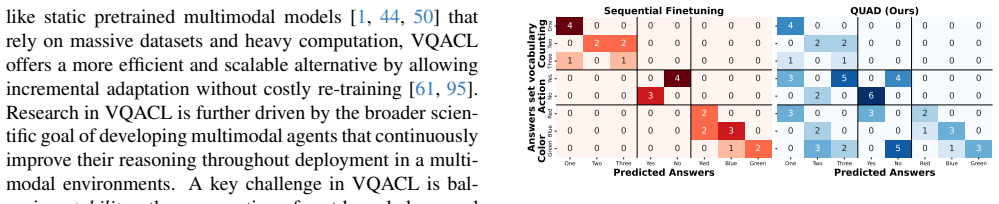
- [§14, Fig. 2] The controlled out-of-answer-set experiment uses only 10 questions per task and no error bars, so the confusion matrices in Fig. 2 cannot quantitatively support the claimed severity of the phenomenon. The paper should report the full evaluation set with confidence intervals, or explicitly present Fig. 2 as an illustrative example rather than as an empirical evaluation.
minor comments (6)
- [Fig. 1] The caption mentions "Without replay: Blue" but does not explain what answer this refers to or which image-question pair produced it; please clarify.
- [§3.3] The example pairs counting cars with the stored question "What's the color of the car?", which is not a counting question; this obscures the intended object-matched selection. Clarify that selection matches object categories, not question types or reasoning skills.
- [Supp. §7 and Introduction] There are several typos, e.g., "distilaltion" in Supp. §7 and "lean new skills" in the Introduction; please proofread the text.
- [Table 1] The legend for the memory-type column is garbled ("? and /ctre"); the symbols used for question-only versus image-plus-question memory should be defined cleanly and consistently.
- [Eq. (5)] Cross-entropy is applied to two-dimensional self-attention maps; please specify how the maps are flattened or normalized so that LCE is well-defined as a distributional loss.
- [Supp. §12] The sensitivity analysis for λ is reported only on VQAv2; since λ is a central hyperparameter, the same analysis should be shown on NExT-QA or justified as unnecessary.
Circularity Check
No significant circularity: QUAD's losses are defined independently of the target metrics and the central 'questions-only is sufficient' claim is an empirical comparison against external benchmarks.
full rationale
The paper's central claim (storing only past questions is sufficient to mitigate forgetting) is supported by AP and Forgetting scores on VQAv2 and NExT-QA computed against ground-truth answers and external baselines, not by construction from the loss definitions. LQR (Eq. 4) is a standard self-distillation replay term that pairs current images with stored questions and uses the previous model's soft outputs as targets; it is a training regularizer, not the evaluation metric. LACD (Eq. 5) aligns attention distributions and is ablated in Tables 3-4, with AP as the external criterion. The hyperparameter λ is fixed at 0.5 and its sensitivity is reported in Fig. 9, so the headline numbers are not fitted outcomes. The object-matched question selection in Sec. 3.3 is benchmarked against random pairing in Fig. 6 rather than assumed. Baseline comparisons use independently defined methods (ER, DER, VS, VQACL). The paper's own Sec. 8 concedes that visually detailed tasks such as 'type' may still require images, which is a limitation and a conditional framing of the sufficiency claim, not a circular reduction. Self-citations (e.g., [56], [63]) appear in related-work and baseline contexts and are not load-bearing for the central result. No step in the derivation reduces to its own input by definition.
Assumptions & free parameters
free parameters (2)
- lambda (stability weight) =
0.5
- memory size =
5000 for VQAv2, 500 for NExT-QA
assumptions (4)
- domain assumption Questions paired with current images provide enough information to recover past visual-linguistic associations.
- domain assumption Self-attention maps encode task-relevant knowledge and are the right representation to distill across tasks.
- domain assumption Soft pseudo-labels from the previous model are reliable supervision for the current model.
- domain assumption The VQACL task split (linguistic macro-tasks into visual subtasks) is a representative evaluation of continual VQA.
invented entities (2)
-
VQACL-QR setting
-
Attention Consistency Distillation (ACD) loss
Cite this review
Pith. "Pith review of Ask and Remember: A Questions-Only Replay Strategy for Continual Visual Question Answering." pith.science (2026). https://pith.science/paper/XS6TBDEX
@misc{pith2026250204469,
  author       = {Pith},
  title        = {Pith review of: Ask and Remember: A Questions-Only Replay Strategy for Continual Visual Question Answering},
  year         = {2026},
  howpublished = {\url{https://pith.science/paper/XS6TBDEX}},
  note         = {Machine review of arXiv:2502.04469}
}
read the original abstract
Continual Learning in Visual Question Answering (VQACL) requires models to acquire new visual-linguistic skills (plasticity) while preserving previously learned knowledge (stability). The inherent multimodality of VQACL exacerbates this challenge, as models must balance stability across visual and textual domains while adapting to novel objects and reasoning tasks. Existing methods, primarily designed for unimodal settings, often fall short in addressing this dual requirement. In this work, we present QUestion-only replay with Attention Distillation (QUAD), a novel approach for VQACL that leverages only past task questions for regularization. By eliminating the need to store visual data, QUAD not only reduces memory overhead, but also alleviates privacy concerns. Our method introduces a Question-only Replay mechanism that selectively reuses prior task questions to counteract overfitting to the answer space of the current task, addressing the problem out of answer set. Complementing this, we propose Attention Consistency Distillation to enforce both intra-modal and inter-modal attention consistency across tasks, preserving essential visual-linguistic associations. Extensive experiments on VQAv2 and NExT-QA demonstrate that QUAD significantly outperforms state-of-the-art methods, achieving robust performance in continual VQA. Code is available at: https://github.com/IemProg/QUAD.
Figures


Figures from the paper (6 more)


Forward citations
Cited by 3 Pith papers
-
Continual Learning for VLMs: A Survey and Taxonomy Beyond Forgetting
The paper offers a comprehensive survey and proposes a new taxonomy for continual learning strategies in VLMs and MLLMs to combat catastrophic forgetting beyond traditional methods.
-
Text as Partial Constraint: Core-Residual Alignment for Robust Vision-Language Learning
Aligning images to multi-view caption cores while suppressing orthogonal residual text and disagreement-aware temperature improves robust zero-shot recognition and LVLM transfer.
-
Continual Learning for Generative AI: From LLMs to MLLMs and Beyond
A survey that categorizes continual learning methods for generative models into architecture-based, regularization-based, and replay-based paradigms across four model families.
Reference graph
Works this paper leans on
-
[1]
Pravesh Agrawal, Szymon Antoniak, Emma Bou Hanna, Baptiste Bout, Devendra Chaplot, Jessica Chudnovsky, Diogo Costa, Baudouin De Monicault, Saurabh Garg, Theophile Gervet, Soham Ghosh, Am ´elie H ´eliou, Paul Jacob, Albert Q. Jiang, Kartik Khandelwal, Timoth ´ee Lacroix, Guillaume Lample, Diego Las Casas, Thibaut Lavril, Teven Le Scao, Andy Lo, William Mar...
2024
-
[2]
Memory aware synapses: Learning what (not) to forget
Rahaf Aljundi, Francesca Babiloni, Mohamed Elhoseiny, Marcus Rohrbach, and Tinne Tuytelaars. Memory aware synapses: Learning what (not) to forget. In ECCV, 2018. 2, 6, 7
2018
-
[3]
Looking at words and points with attention: a benchmark for text-to-shape coherence
Andrea Amaduzzi, Giuseppe Lisanti, Samuele Salti, and Luigi Di Stefano. Looking at words and points with at- tention: a benchmark for text-to-shape coherence. arXiv preprint arXiv:2309.07917, 2023. 3
work page Pith review arXiv 2023
-
[4]
Lawrence Zitnick, and Devi Parikh
Stanislaw Antol, Aishwarya Agrawal, Jiasen Lu, Margaret Mitchell, Dhruv Batra, C. Lawrence Zitnick, and Devi Parikh. Vqa: Visual question answering. In ICCV, 2015. 3
2015
-
[5]
Vqa: Visual question answering
Stanislaw Antol, Aishwarya Agrawal, Jiasen Lu, Margaret Mitchell, Dhruv Batra, C Lawrence Zitnick, and Devi Parikh. Vqa: Visual question answering. In ICCV, 2015. 2
2015
-
[6]
Riemannian walk for incremen- tal learning: Understanding forgetting and intransigence
Arslan Chaudhry, Puneet K Dokania, Thalaiyasingam Ajan- than, and Philip HS Torr. Riemannian walk for incremen- tal learning: Understanding forgetting and intransigence. In ECCV, 2018. 6
2018
-
[7]
Efficient lifelong learning with a- gem
Arslan Chaudhry, Marc’Aurelio Ranzato, Marcus Rohrbach, and Mohamed Elhoseiny. Efficient lifelong learning with a- gem. arXiv preprint arXiv:1812.00420, 2018. 3
arXiv 2018
-
[8]
Arslan Chaudhry, Marcus Rohrbach, Mohamed Elhoseiny, Thalaiyasingam Ajanthan, Puneet Kumar Dokania, Philip H. S. Torr, and Marc’Aurelio Ranzato. Continual learning with tiny episodic memories. CoRR, abs/1902.10486, 2019. 2, 3, 6, 7
arXiv 1902
Show all 109 references
-
[9]
Dokania, Philip H
Arslan Chaudhry, Marcus Rohrbach, Mohamed Elhoseiny, Thalaiyasingam Ajanthan, Puneet K. Dokania, Philip H. S. Torr, and Marc’Aurelio Ranzato. On tiny episodic memories in continual learning, 2019. 2, 3, 6, 7
2019
-
[10]
Vindlu: A recipe for effective video-and-language pretraining
Feng Cheng, Xizi Wang, Jie Lei, David Crandall, Mohit Bansal, and Gedas Bertasius. Vindlu: A recipe for effective video-and-language pretraining. In CVPR, 2023. 1, 2
2023
-
[11]
Unifying vision-and-language tasks via text generation
Jaemin Cho, Jie Lei, Hao Tan, and Mohit Bansal. Unifying vision-and-language tasks via text generation. 2021. 2
2021
-
[12]
One vlm to keep it learning: Gen- eration and balancing for data-free continual visual question answering
Deepayan Das, Davide Talon, Massimiliano Mancini, Yim- ing Wang, and Elisa Ricci. One vlm to keep it learning: Gen- eration and balancing for data-free continual visual question answering. IEEE, 2025. 4
2025
-
[13]
Ratt: Recurrent attention to transient tasks for continual image captioning
Riccardo Del Chiaro, Bartł omiej Twardowski, Andrew Bag- danov, and Joost van de Weijer. Ratt: Recurrent attention to transient tasks for continual image captioning. In NeurIPS,
-
[14]
Learning without mem- orizing
Prithviraj Dhar, Rajat Vikram Singh, Kuan-Chuan Peng, Ziyan Wu, and Rama Chellappa. Learning without mem- orizing. In CVPR, 2019. 3, 4, 5, 1, 2
2019
-
[15]
Sok: Model inversion attack land- scape: Taxonomy, challenges, and future roadmap
Sayanton V Dibbo. Sok: Model inversion attack land- scape: Taxonomy, challenges, and future roadmap. In 2023 IEEE 36th Computer Security Foundations Symposium (CSF). IEEE, 2023. 1
2023
-
[16]
Podnet: Pooled outputs distil- lation for small-tasks incremental learning
Arthur Douillard, Matthieu Cord, Charles Ollion, Thomas Robert, and Eduardo Valle. Podnet: Pooled outputs distil- lation for small-tasks incremental learning. In ECCV, 2020. 3
2020
-
[17]
Dytox: Transformers for continual learn- ing with dynamic token expansion
Arthur Douillard, Alexandre Ram ´e, Guillaume Couairon, and Matthieu Cord. Dytox: Transformers for continual learn- ing with dynamic token expansion. In CVPR, 2022. 3
2022
-
[18]
Memory efficient contin- ual learning with transformers
Beyza Ermis, Giovanni Zappella, Martin Wistuba, Aditya Rawal, and Cedric Archambeau. Memory efficient contin- ual learning with transformers. NeurIPS, 2022. 3
2022
-
[19]
Vision language transformers: A survey
Clayton Fields and Casey Kennington. Vision language transformers: A survey. arXiv preprint arXiv:2307.03254 ,
-
[20]
Sharpness-aware minimization for efficiently improving generalization
Pierre Foret, Ariel Kleiner, Hossein Mobahi, and Behnam Neyshabur. Sharpness-aware minimization for efficiently improving generalization. arXiv preprint arXiv:2010.01412,
2010 arXiv
-
[21]
A unified continual learn- ing framework with general parameter-efficient tuning.arXiv preprint arXiv:2303.10070, 2023
Qiankun Gao, Chen Zhao, Yifan Sun, Teng Xi, Gang Zhang, Bernard Ghanem, and Jian Zhang. A unified continual learn- ing framework with general parameter-efficient tuning.arXiv preprint arXiv:2303.10070, 2023. 3
2023 arXiv
-
[22]
General data protection regulation
General Data Protection Regulation GDPR. General data protection regulation. Regulation (EU) 2016/679 of the Eu- ropean Parliament and of the Council of 27 April 2016 on the protection of natural persons with regard to the process- ing of personal data and on the free movement...
2016
-
[23]
Exploring the frontier of vision- language models: A survey of current methodologies and future directions, 2024
Akash Ghosh, Arkadeep Acharya, Sriparna Saha, Vinija Jain, and Aman Chadha. Exploring the frontier of vision- language models: A survey of current methodologies and future directions, 2024. 3
2024
-
[24]
Anisotropy is inherent to self-attention in transformers
Nathan Godey, ´Eric de la Clergerie, and Beno ˆıt Sagot. Anisotropy is inherent to self-attention in transformers. arXiv preprint arXiv:2401.12143, 2024. 5
2024 arXiv
-
[25]
Deep Learning
Ian Goodfellow, Yoshua Bengio, and Aaron Courville. Deep Learning . MIT Press, 2016. http : / / www . deeplearningbook.org. 2
2016
-
[26]
Fecam: Exploiting the heterogeneity of class distributions in exemplar-free continual learning
Dipam Goswami, Yuyang Liu, Bartł omiej Twardowski, and Joost van de Weijer. Fecam: Exploiting the heterogeneity of class distributions in exemplar-free continual learning. In NeurIPS, 2023. 1
2023
-
[27]
Psycholinguistics meets continual learning: Measuring catastrophic forgetting in visual question answer- ing
Claudio Greco, Barbara Plank, Raquel Fern ´andez, and Raf- faella Bernardi. Psycholinguistics meets continual learning: Measuring catastrophic forgetting in visual question answer- ing. In Proceedings of the 57th Annual Meeting of the Asso- ciation for Computational Linguistic...
2019
-
[28]
Psycholinguistics meets continual learning: Measuring catastrophic forgetting in visual question answer- ing
Claudio Greco, Barbara Plank, Raquel Fern ´andez, and Raf- faella Bernardi. Psycholinguistics meets continual learning: Measuring catastrophic forgetting in visual question answer- ing. In Proceedings of the 57th Annual Meeting of the Asso- ciation for Computational Linguistic...
2019
-
[29]
Can spatiotemporal 3d cnns retrace the history of 2d cnns and imagenet? In CVPR, 2018
Kensho Hara, Hirokatsu Kataoka, and Yutaka Satoh. Can spatiotemporal 3d cnns retrace the history of 2d cnns and imagenet? In CVPR, 2018. 5
2018
-
[30]
Distill- ing the knowledge in a neural network
Geoffrey Hinton, Oriol Vinyals, and Jeff Dean. Distill- ing the knowledge in a neural network. arXiv preprint arXiv:1503.02531, 2015. 4
2015 arXiv
-
[31]
Learning a unified classifier incrementally via rebalancing
Saihui Hou, Xinyu Pan, Chen Change Loy, Zilei Wang, and Dahua Lin. Learning a unified classifier incrementally via rebalancing. In CVPR, 2019. 3
2019
-
[32]
Cl-moe: Enhancing multi- modal large language model with dual momentum mixture- of-experts for continual visual question answering
Tianyu Huai, Jie Zhou, Xingjiao Wu, Qin Chen, Qingchun Bai, Ze Zhou, and Liang He. Cl-moe: Enhancing multi- modal large language model with dual momentum mixture- of-experts for continual visual question answering. InCVPR,
-
[33]
Clevr: A diagnostic dataset for compositional language and elementary visual reasoning
Justin Johnson, Bharath Hariharan, Laurens Van Der Maaten, Li Fei-Fei, C Lawrence Zitnick, and Ross Girshick. Clevr: A diagnostic dataset for compositional language and elementary visual reasoning. In CVPR, 2017. 2
2017
-
[34]
Class- Incremental Learning by Knowledge Distillation with Adap- tive Feature Consolidation
Minsoo Kang, Jaeyoo Park, and Bohyung Han. Class- Incremental Learning by Knowledge Distillation with Adap- tive Feature Consolidation. In CVPR, 2022. 3, 5
2022
-
[35]
Measuring compositional generalization: A comprehensive method on realistic data
Daniel Keysers, Nathanael Sch ¨arli, Nathan Scales, Hylke Buisman, Daniel Furrer, Sergii Kashubin, Nikola Momchev, Danila Sinopalnikov, Lukasz Stafiniak, Tibor Tihon, et al. Measuring compositional generalization: A comprehensive method on realistic data. arXiv preprint arXiv:...
1912 arXiv
-
[36]
Adam: A method for stochastic optimization
Diederik Kingma and Jimmy Ba. Adam: A method for stochastic optimization. In ICLR, 2015. 5
2015
-
[37]
Overcoming catastrophic forgetting in neu- ral networks
James Kirkpatrick, Razvan Pascanu, Neil Rabinowitz, Joel Veness, Guillaume Desjardins, Andrei A Rusu, Kieran Milan, John Quan, Tiago Ramalho, Agnieszka Grabska- Barwinska, et al. Overcoming catastrophic forgetting in neu- ral networks. Proceedings of the national academy of sc...
2017
-
[38]
Overcoming catastrophic forgetting in neu- ral networks
James Kirkpatrick, Razvan Pascanu, Neil Rabinowitz, Joel Veness, Guillaume Desjardins, Andrei A Rusu, Kieran Milan, John Quan, Tiago Ramalho, Agnieszka Grabska- Barwinska, et al. Overcoming catastrophic forgetting in neu- ral networks. Proceedings of the national academy of sc...
2017
-
[39]
Deep weight factorization: Sparse learning through the lens of artificial symmetries
Chris Kolb, Tobias Weber, Bernd Bischl, and David R¨ugamer. Deep weight factorization: Sparse learning through the lens of artificial symmetries. ICLR, 2025. 2
2025
-
[40]
Shamma, Michael S
Ranjay Krishna, Yuke Zhu, Oliver Groth, Justin Johnson, Kenji Hata, Joshua Kravitz, Stephanie Chen, Yannis Kalan- tidis, Li-Jia Li, David A. Shamma, Michael S. Bernstein, and Li Fei-Fei. Visual genome: Connecting language and vision using crowdsourced dense image annotations. ...
2017
-
[41]
Mitigating the diminishing effect of elastic weight consolidation
Canasai Kruengkrai and Junichi Yamagishi. Mitigating the diminishing effect of elastic weight consolidation. In Pro- ceedings of the 29th International Conference on Compu- tational Linguistics, pages 4568–4574, Gyeongju, Republic of Korea, 2022. International Committee on Com...
2022
-
[42]
Building machines that learn and think like people
Brenden M Lake, Tomer D Ullman, Joshua B Tenenbaum, and Samuel J Gershman. Building machines that learn and think like people. Behavioral and brain sciences , 40:e253,
-
[43]
Less is more: Clipbert for video-and-language learning via sparse sampling
Jie Lei, Linjie Li, Luowei Zhou, Zhe Gan, Tamara L Berg, Mohit Bansal, and Jingjing Liu. Less is more: Clipbert for video-and-language learning via sparse sampling. In CVPR,
-
[44]
BLIP-2: bootstrapping language-image pre-training with frozen image encoders and large language models
Junnan Li, Dongxu Li, Silvio Savarese, and Steven Hoi. BLIP-2: bootstrapping language-image pre-training with frozen image encoders and large language models. In ICML,
-
[45]
How to configure good in-context sequence for visual question answering
Li Li, Jiawei Peng, Huiyi Chen, Chongyang Gao, and Xu Yang. How to configure good in-context sequence for visual question answering. In CVPR, 2024. 2
2024
-
[46]
Learning without forgetting
Zhizhong Li and Derek Hoiem. Learning without forgetting. IEEE transactions on pattern analysis and machine intelli- gence, 40(12):2935–2947, 2017. 3
2017
-
[47]
Learning without forgetting
Zhizhong Li and Derek Hoiem. Learning without forgetting. IEEE Transactions on Pattern Analysis and Machine Intelli- gence, 40(12):2935–2947, 2018. 3, 4
2018
-
[48]
Belongie, Lubomir D
Tsung-Yi Lin, Michael Maire, Serge J. Belongie, Lubomir D. Bourdev, Ross B. Girshick, James Hays, Pietro Perona, Deva Ramanan, Piotr Doll’a r, and C. Lawrence Zitnick. Microsoft COCO: common objects in context. CoRR, abs/1405.0312,
-
[49]
Pri- vacy intelligence: A survey on image privacy in online social networks
Chi Liu, Tianqing Zhu, Jun Zhang, and Wanlei Zhou. Pri- vacy intelligence: A survey on image privacy in online social networks. ACM Computing Surveys, 2022. 2
2022
-
[50]
Visual instruction tuning, 2023
Haotian Liu, Chunyuan Li, Qingyang Wu, and Yong Jae Lee. Visual instruction tuning, 2023. 2
2023
-
[51]
Pre-train, prompt, and predict: A systematic survey of prompting methods in nat- ural language processing
Pengfei Liu, Weizhe Yuan, Jinlan Fu, Zhengbao Jiang, Hi- roaki Hayashi, and Graham Neubig. Pre-train, prompt, and predict: A systematic survey of prompting methods in nat- ural language processing. ACM Computing Surveys, 55(9): 1–35, 2023. 3
2023
-
[52]
Gradient episodic memory for continual learning
David Lopez-Paz and Marc’Aurelio Ranzato. Gradient episodic memory for continual learning. NeurIPS, 2017. 3
2017
-
[53]
Gradient episodic memory for continual learning, 2022
David Lopez-Paz and Marc’Aurelio Ranzato. Gradient episodic memory for continual learning, 2022. 6
2022
-
[54]
Augmented ge- ometric distillation for data-free incremental person reid
Yichen Lu, Mei Wang, and Weihong Deng. Augmented ge- ometric distillation for data-free incremental person reid. In CVPR, 2022. 3
2022
-
[55]
Supervised contrastive replay: Revisiting the nearest class mean classifier in online class-incremental continual learn- ing
Zheda Mai, Ruiwen Li, Hyunwoo Kim, and Scott Sanner. Supervised contrastive replay: Revisiting the nearest class mean classifier in online class-incremental continual learn- ing. In CVPR, 2021. 4, 5
2021
-
[56]
Weighted ensemble models are strong continual learners
Imad Eddine Marouf, Subhankar Roy, Enzo Tartaglione, and St´ephane Lathuili`ere. Weighted ensemble models are strong continual learners. In ECCV, 2024. 1
2024
-
[57]
Why there are complementary learning systems in the hippocampus and neocortex: insights from the successes and failures of connectionist models of learning and memory
James L McClelland, Bruce L McNaughton, and Randall C O’Reilly. Why there are complementary learning systems in the hippocampus and neocortex: insights from the successes and failures of connectionist models of learning and memory. Psychological review, 102(3):419, 1995. 1, 3
1995
-
[58]
Catastrophic inter- ference in connectionist networks: The sequential learning problem
Michael McCloskey and Neal J Cohen. Catastrophic inter- ference in connectionist networks: The sequential learning problem. In Psychology of learning and motivation. 1989. 1
1989
-
[59]
An empirical investigation of the role of pre-training in lifelong learning
Sanket Vaibhav Mehta, Darshan Patil, Sarath Chandar, and Emma Strubell. An empirical investigation of the role of pre-training in lifelong learning. arXiv preprint arXiv:2112.09153, 2021. 3
2021 arXiv
-
[60]
Context- vqa: Towards context-aware and purposeful visual question answering
Nandita Naik, Christopher Potts, and Elisa Kreiss. Context- vqa: Towards context-aware and purposeful visual question answering. In ICCV, 2023. 2
2023
-
[61]
Task formulation matters when learning continually: A case study in visual question answer- ing
Mavina Nikandrou, Lu Yu, Alessandro Suglia, Ioannis Kon- stas, and Verena Rieser. Task formulation matters when learning continually: A case study in visual question answer- ing. arXiv preprint arXiv:2210.00044, 2022. 2, 3, 5
2022 arXiv
-
[62]
Pytorch: An imperative style, high-performance deep learning library
Adam Paszke, Sam Gross, Francisco Massa, Adam Lerer, James Bradbury, Gregory Chanan, Trevor Killeen, Zeming Lin, Natalia Gimelshein, Luca Antiga, Alban Desmaison, Andreas Kopf, Edward Yang, Zachary DeVito, Martin Rai- son, Alykhan Tejani, Sasank Chilamkurthy, Benoit Steiner, L...
2019
-
[63]
Towards exemplar-free continual learning in vision transformers: an account of at- tention, functional and weight regularization
Francesco Pelosin, Saurav Jha, Andrea Torsello, Bogdan Ra- ducanu, and Joost van de Weijer. Towards exemplar-free continual learning in vision transformers: an account of at- tention, functional and weight regularization. In CVPR,
-
[64]
Colin Raffel, Noam Shazeer, Adam Roberts, Katherine Lee, Sharan Narang, Michael Matena, Yanqi Zhou, Wei Li, and Peter J. Liu. Exploring the limits of transfer learning with a unified text-to-text transformer. 2020. 5
2020
-
[65]
Vlc-bert: Visual question answering with contextualized commonsense knowledge
Sahithya Ravi, Aditya Chinchure, Leonid Sigal, Renjie Liao, and Vered Shwartz. Vlc-bert: Visual question answering with contextualized commonsense knowledge. 2023. 3
2023
-
[66]
Sylvestre-Alvise Rebuffi, Alexander Kolesnikov, Georg Sperl, and Christoph H. Lampert. icarl: Incremental clas- sifier and representation learning. In CVPR, 2017. 3
2017
-
[67]
Faster r-cnn: Towards real-time object detection with region proposal networks
Shaoqing Ren, Kaiming He, Ross Girshick, and Jian Sun. Faster r-cnn: Towards real-time object detection with region proposal networks. NeurIPS, 2015. 5
2015
-
[68]
Task-recency bias strikes back: Adapting covariances in exemplar-free class incremental learning
Grzegorz Rype ´s´c, Sebastian Cygert, Tomasz Trzcinski, and Bartłomiej Twardowski. Task-recency bias strikes back: Adapting covariances in exemplar-free class incremental learning. NeurIPS, 2025. 4, 5
2025
-
[69]
Gradient pro- jection memory for continual learning
Gobinda Saha, Isha Garg, and Kaushik Roy. Gradient pro- jection memory for continual learning. In ICLR, 2021. 3
2021
-
[70]
A-okvqa: A benchmark for visual question answering using world knowl- edge
Dustin Schwenk, Apoorv Khandelwal, Christopher Clark, Kenneth Marino, and Roozbeh Mottaghi. A-okvqa: A benchmark for visual question answering using world knowl- edge. In ECCV, 2022. 1
2022
-
[71]
Non-autoregressive sequence-to-sequence vision-language models
Kunyu Shi, Qi Dong, Luis Goncalves, Zhuowen Tu, and Stefano Soatto. Non-autoregressive sequence-to-sequence vision-language models. In CVPR, 2024. 2
2024
-
[72]
Coda-prompt: Contin- ual decomposed attention-based prompting for rehearsal-free continual learning
James Seale Smith, Leonid Karlinsky, Vyshnavi Gutta, Paola Cascante-Bonilla, Donghyun Kim, Assaf Arbelle, Rameswar Panda, Rogerio Feris, and Zsolt Kira. Coda-prompt: Contin- ual decomposed attention-based prompting for rehearsal-free continual learning. In CVPR, 2023. 3
2023
-
[73]
Climb: A continual learning benchmark for vision-and- language tasks
Tejas Srinivasan, Ting-Yun Chang, Leticia Pinto Alva, Geor- gios Chochlakis, Mohammad Rostami, and Jesse Thoma- son. Climb: A continual learning benchmark for vision-and- language tasks. NeurIPS, 2022. 3
2022
-
[74]
A privacy-preserving image retrieval scheme with access control based on searchable encryption in media cloud
Miao Tian, Yushu Zhang, Yongming Zhang, Xiangli Xiao, and Wenying Wen. A privacy-preserving image retrieval scheme with access control based on searchable encryption in media cloud. Cybersecurity, 2024. 2
2024
-
[75]
Analyzing multi-head self-attention: Spe- cialized heads do the heavy lifting, the rest can be pruned
Elena V oita, David Talbot, Fedor Moiseev, Rico Sennrich, and Ivan Titov. Analyzing multi-head self-attention: Spe- cialized heads do the heavy lifting, the rest can be pruned. arXiv preprint arXiv:1905.09418, 2019. 5
1905 arXiv
-
[76]
Learning soft labels via meta learning, 2021
Nidhi Vyas, Shreyas Saxena, and Thomas V oice. Learning soft labels via meta learning, 2021. 4
2021
-
[77]
Timmy S. T. Wan, Jun-Cheng Chen, Tzer-Yi Wu, and Chu- Song Chen. Continual learning for visual search with back- ward consistent feature embedding. In CVPR, 2022. 2, 3, 6, 7, 8
2022
-
[78]
S-prompts learning with pre-trained transformers: An occam’s razor for domain incremental learning
Yabin Wang, Zhiwu Huang, and Xiaopeng Hong. S-prompts learning with pre-trained transformers: An occam’s razor for domain incremental learning. NeurIPS, 2022. 3
2022
-
[79]
Learning adaptive axis attentions in fine-tuning: Be- yond fixed sparse attention patterns
Zihan Wang, Jiuxiang Gu, Jason Kuen, Handong Zhao, Vlad Morariu, Ruiyi Zhang, Ani Nenkova, Tong Sun, and Jingbo Shang. Learning adaptive axis attentions in fine-tuning: Be- yond fixed sparse attention patterns. In Findings of the As- sociation for Computational Linguistics: AC...
2022
-
[80]
Continual learning with lifelong vision trans- former
Zhen Wang, Liu Liu, Yiqun Duan, Yajing Kong, and Dacheng Tao. Continual learning with lifelong vision trans- former. In CVPR, 2022. 1
2022
-
[81]
Dualprompt: Complementary prompting for rehearsal-free continual learning
Zifeng Wang, Zizhao Zhang, Sayna Ebrahimi, Ruoxi Sun, Han Zhang, Chen-Yu Lee, Xiaoqi Ren, Guolong Su, Vin- cent Perot, Jennifer Dy, et al. Dualprompt: Complementary prompting for rehearsal-free continual learning. In ECCV,
-
[82]
Learning to prompt for continual learning
Zifeng Wang, Zizhao Zhang, Chen-Yu Lee, Han Zhang, Ruoxi Sun, Xiaoqi Ren, Guolong Su, Vincent Perot, Jen- nifer Dy, and Tomas Pfister. Learning to prompt for continual learning. In CVPR, 2022. 3
2022
-
[83]
Unified coarse-to-fine alignment for video-text retrieval
Ziyang Wang, Yi-Lin Sung, Feng Cheng, Gedas Bertasius, and Mohit Bansal. Unified coarse-to-fine alignment for video-text retrieval. In ICCV, 2023. 1
2023
-
[84]
Separating skills and concepts for novel visual question answering
Spencer Whitehead, Hui Wu, Heng Ji, Rogerio Feris, and Kate Saenko. Separating skills and concepts for novel visual question answering. In CVPR, 2021. 3
2021
-
[85]
Next-qa: Next phase of question-answering to explaining temporal actions
Junbin Xiao, Xindi Shang, Angela Yao, and Tat-Seng Chua. Next-qa: Next phase of question-answering to explaining temporal actions. In CVPR, pages 9777–9786, 2021. 6
2021
-
[86]
Video graph transformer for video question answering
Junbin Xiao, Pan Zhou, Tat-Seng Chua, and Shuicheng Yan. Video graph transformer for video question answering. In ECCV, 2022. 2
2022
-
[87]
Multi-task learning with knowledge distillation for dense prediction
Yangyang Xu, Yibo Yang, and Lefei Zhang. Multi-task learning with knowledge distillation for dense prediction. In ICCV, 2023. 5
2023
-
[88]
Zero-shot video question answering via frozen bidirectional language models
Antoine Yang, Antoine Miech, Josef Sivic, Ivan Laptev, and Cordelia Schmid. Zero-shot video question answering via frozen bidirectional language models. NeurIPS, 2022. 1, 2
2022
-
[89]
Data augmented flatness-aware gradient projection for continual learning
Enneng Yang, Li Shen, Zhenyi Wang, Shiwei Liu, Guibing Guo, and Xingwei Wang. Data augmented flatness-aware gradient projection for continual learning. In ICCV, 2023. 3
2023
-
[90]
Self-chained image-language model for video localization and question answering
Shoubin Yu, Jaemin Cho, Prateek Yadav, and Mohit Bansal. Self-chained image-language model for video localization and question answering. arXiv preprint arXiv:2305.06988,
-
[91]
Suzanne Barber
Razieh Nokhbeh Zaeem and K. Suzanne Barber. The effect of the gdpr on privacy policies: Recent progress and future promise. ACM Trans. Manage. Inf. Syst., 2020. 2
2020
-
[92]
Privacy threats and protection in machine learning
Jiliang Zhang, Chen Li, Jing Ye, and Gang Qu. Privacy threats and protection in machine learning. In Proceedings of the 2020 on Great Lakes Symposium on VLSI, 2020. 1
2020
-
[93]
Overcoming generic knowledge loss with selec- tive parameter update
Wenxuan Zhang, Paul Janson, Rahaf Aljundi, and Mohamed Elhoseiny. Overcoming generic knowledge loss with selec- tive parameter update. In CVPR, 2024. 2
2024
-
[94]
Refin- ing pseudo labels with clustering consensus over generations for unsupervised object re-identification
Xiao Zhang, Yixiao Ge, Yu Qiao, and Hongsheng Li. Refin- ing pseudo labels with clustering consensus over generations for unsupervised object re-identification. In CVPR, 2021. 4
2021
-
[95]
Vqacl: A novel visual question answering continual learning setting
Xi Zhang, Feifei Zhang, and Changsheng Xu. Vqacl: A novel visual question answering continual learning setting. In CVPR, 2023. 1, 2, 3, 5, 6, 7, 8
2023
-
[96]
Continual sequence generation with adaptive compositional modules
Yanzhe Zhang, Xuezhi Wang, and Diyi Yang. Continual sequence generation with adaptive compositional modules. In Proceedings of the 60th Annual Meeting of the Associ- ation for Computational Linguistics (Volume 1: Long Pa- pers), pages 3653–3667, Dublin, Ireland, 2022. Associat...
2022
-
[97]
Expandable subspace ensemble for pre-trained model- based class-incremental learning
Da-Wei Zhou, Hai-Long Sun, Han-Jia Ye, and De-Chuan Zhan. Expandable subspace ensemble for pre-trained model- based class-incremental learning. In CVPR, 2024. 1 Ask and Remember: A Questions-Only Replay Strategy for Continual Visual Question Answering Supplementary Material In...
2024
-
[98]
We do not foresee any negative soci- etal impact from this work, as it does not involve the gen- eration of harmful or biased data
Ethics Statement Our method, QUAD, is designed to improve continual learning in Visual Question Answering (VQACL) while maintaining generalization and privacy through distilaltion using questions-only. We do not foresee any negative soci- etal impact from this work, as it does...
-
[99]
Limitations of QUAD While QUAD effectively reduces storage requirements and enhances privacy by eliminating the need to store images, it may be suboptimal for tasks that heavily rely on detailed vi- sual or spatial reasoning. Certain VQA tasks, such as object classification, f...
-
[100]
Discussion about Attention Consistency Dis- tillation Problem setup. Consider a self-attention mechanism where the attention matrix at layer l, head k, for an input sequence x at task t is given by: At l,k(x) = QlK T l√ d , (6) where Ql, Kl ∈ RN ×d are the query and key matric...
-
[101]
Analysis of Attention Drift To assess the effectiveness of QUAD in mitigating at- tention drift in continual VQA, we compare it to L1- Attention Regularization (L1-Attn) [14] and Asymmetric ReLU-Attention Regularization (Asym-ReLU Attn) [63] using two metrics: Cross-Attention ...
-
[102]
This section analyzes storage requirements, computational com- plexity, and GPU memory usage of our text-only replay ap- proach compared to image-based methods
Computational Analysis Efficient memory and storage management is crucial for continual VQA, where scalability is a key challenge. This section analyzes storage requirements, computational com- plexity, and GPU memory usage of our text-only replay ap- proach compared to image-...
-
[103]
9, which governs the trade-off between adaptation to new tasks (plasticity) and retention of prior knowledge (stability) in our Q UAD framework
Effect of λ We investigate the sensitivity of our model to the balancing coefficient λ in Fig. 9, which governs the trade-off between adaptation to new tasks (plasticity) and retention of prior knowledge (stability) in our Q UAD framework. The results demonstrate that performa...
-
[104]
Pre-trained models/VQA architectures We extend our evaluation to recent continual learn- ing approaches—CL-MoE [32] and GaB [12]—using pretrained vision-language models BLIP-2 and LLaV A (Tabs. 5, 6). On BLIP-2, QUAD achieves the highest av- erage precision (AP = 50.27) and lo...
-
[105]
Red” instead of “Two
Out-of-Answer-Set Problem Evaluation To empirically analyze the out-of-answer-set problem, we designed a controlled continual learning experiment within the VQACL setting. Our objective was to demonstrate how sequential fine-tuning without appropriate regulariza- tion leads to...
-
[106]
Detailed Description of the VQACL Setting This section provides a detailed overview of the Visual Question Answering Continual Learning (VQACL) setting, as introduced by [95]. The VQACL setting is designed to test a model’s ability to generalise and retain knowledge across a s...
-
[107]
Each dataset has been carefully structured into different tasks, which are used to evaluate the performance of our continual learning models
Details of Evaluation Datasets In this section, we provide a detailed overview of the two datasets used in our evaluation: VQA v2 and NExT-QA. Each dataset has been carefully structured into different tasks, which are used to evaluate the performance of our continual learning ...
-
[108]
The sequential finetuning baseline (left) demon- strates severe forgetting, with consistently low off-diagonal values
Extended Analysis of Plasticity/Stability Trade-Off Fig.10 compares the impact of three continual learning strategies on performance across tasks in the NExT-QA dataset. The sequential finetuning baseline (left) demon- strates severe forgetting, with consistently low off-diago...
-
[109]
To ensure a consistent evaluation, all methods are implemented using their official codebases and integrated into the same trans- former backbone as described in Section 5.1
Continual Learning Methods We assess and benchmark five prominent continual learn- ing methods, encompassing two regularization techniques (EWC [38], MAS [2]) and three rehearsal-based methods (ER [9], DER [8], VS [77], and VQACL[95]). To ensure a consistent evaluation, all me...
Reviewed August 8, 2026 · model on record in the stance chip above.
Discussion (0). Continue with ORCID to comment.